
AI and BLE for Home Improvement Retail
AI-Driven Home Improvement Retail for Inventory, Fulfillment, and Store Operations
AI and BLE can help home improvement retailers improve inventory accuracy, product availability, merchandising, order fulfillment, asset visibility, and store operations across large-format stores, garden centers, contractor sales areas, distribution centers, and stockrooms. AI analyzes sales transactions, inventory records, order activity, product movement, customer demand, equipment status, and other operational data to support forecasting and decision-making. BLE gateways, beacons, and sensors can provide additional location, proximity, and condition data for selected assets and store equipment.
The combination is particularly useful for retailers managing thousands of SKUs across lumber, building materials, plumbing, electrical supplies, hardware, tools, paint, flooring, appliances, outdoor products, and seasonal merchandise. AI can identify demand patterns, inventory exceptions, fulfillment risks, and operational inefficiencies, while connected BLE devices provide physical-world signals that can improve the quality and timeliness of those decisions.
How AI Improves Home Improvement Retail Operations
Home improvement retail has operational characteristics that make AI-driven decision support particularly valuable. Stores may contain extensive indoor and outdoor selling areas, high-bay storage, contractor pickup zones, receiving docks, lumber yards, garden centers, tool areas, appliance displays, special-order merchandise, and large volumes of bulky inventory.
AI can combine information from point-of-sale systems, inventory databases, order management systems, warehouse management software, product information systems, customer relationship software, workforce systems, security systems, and connected devices. The resulting analysis can support decisions that would be difficult to make from individual systems independently.
Key applications include:
- AI inventory management for improving stock accuracy and identifying inventory discrepancies
- AI demand forecasting for seasonal, project-driven, and location-specific products
- AI merchandise allocation for balancing inventory between stores and distribution facilities
- AI order fulfillment for selecting suitable fulfillment locations
- AI replenishment for identifying products approaching reorder thresholds
- AI loss prevention for detecting unusual inventory and asset movement
- AI equipment management for prioritizing maintenance of store and material-handling equipment
- AI workforce planning for matching staffing levels with customer traffic and operational workload
- AI customer service for supporting project-based product recommendations
- AI omnichannel inventory optimization for improving online product availability and fulfillment decisions
For home improvement retailers, the value of AI depends heavily on data quality. A forecast is only useful when inventory records, sales history, product attributes, lead times, receiving events, returns, transfers, and fulfillment records are sufficiently accurate.
Home Improvement Retail Workflows Supported by AI
AI can be applied across the physical and digital workflows that move products from suppliers and distribution centers to store shelves, contractor pickup areas, customer orders, and final delivery.
Receiving and Inventory Intake
Receiving teams handle pallets, cartons, bulk materials, appliances, tools, hardware, seasonal products, and other merchandise arriving at store receiving docks or distribution facilities. AI can compare purchase orders, advance shipping information, expected quantities, receiving transactions, and historical discrepancies.
Computer vision can assist with package recognition where appropriate, while barcode and RFID systems can provide product identification. BLE can supplement the process by providing location information for reusable carts, mobile equipment, transport containers, or receiving equipment.
AI can identify unusual receiving patterns such as quantity discrepancies, repeated supplier exceptions, delayed put-away, or merchandise remaining in receiving areas longer than expected.
Store Inventory and Product Availability
Home improvement stores often have complex inventory environments. A single location can contain shelf-stocked hardware, long products, palletized materials, outdoor merchandise, high-value tools, appliances, and products stored in secured areas.
AI inventory management can compare perpetual inventory records with sales, replenishment, receiving, returns, transfers, fulfillment orders, and physical counts. Models can prioritize locations or product categories that are most likely to contain inventory discrepancies.
BLE-enabled asset information can supplement these workflows by identifying the location or movement of selected carts, mobile equipment, tools, transport containers, and other operational assets. BLE should not be treated as a universal product-identification mechanism when exact SKU-level identification is required.
Contractor and Pro Customer Fulfillment
Contractors and professional customers often require reliable access to building materials, tools, electrical supplies, plumbing components, lumber, flooring, roofing products, and other project-related merchandise.
AI can analyze order history, project demand, inventory availability, pickup schedules, delivery requirements, and fulfillment capacity. The system can identify potential shortages before an order reaches the pickup stage and recommend alternative fulfillment locations or replenishment actions.
For contractor pickup areas, BLE can help locate reusable carts, transport equipment, and selected operational assets. AI can use these events with order and workflow data to identify bottlenecks in staging and pickup operations.
Store-to-Store Transfers and Replenishment
Home improvement retailers routinely move products between stores, distribution centers, regional facilities, and special-order locations. AI can optimize these movements by considering forecasted demand, current inventory, open orders, supplier lead times, transfer costs, and store-level service requirements.
A transfer recommendation can account for both expected demand and the operational cost of moving bulky or heavy merchandise. This is particularly important for lumber, appliances, flooring, outdoor equipment, building materials, and other products where transportation costs can materially affect the economics of replenishment.
Merchandising and Store-Zone Optimization
AI can analyze sales performance by department, aisle, product category, season, store zone, and customer segment. These insights can support planogram decisions, promotional placement, product adjacency, endcap utilization, and seasonal merchandising.
Home improvement stores can use AI to identify relationships between complementary products. For example, demand for power tools may influence demand for accessories, batteries, storage products, safety equipment, or consumables. Similarly, seasonal gardening activity can affect demand for plants, soil, irrigation products, outdoor equipment, and related accessories.
BLE location information can supplement selected store-zone analysis by providing operational asset movement data. Customer behavior analysis should use appropriate privacy controls and should not assume that BLE asset signals represent individual customer identities.
AI-Enabled Home Improvement Retail Operations
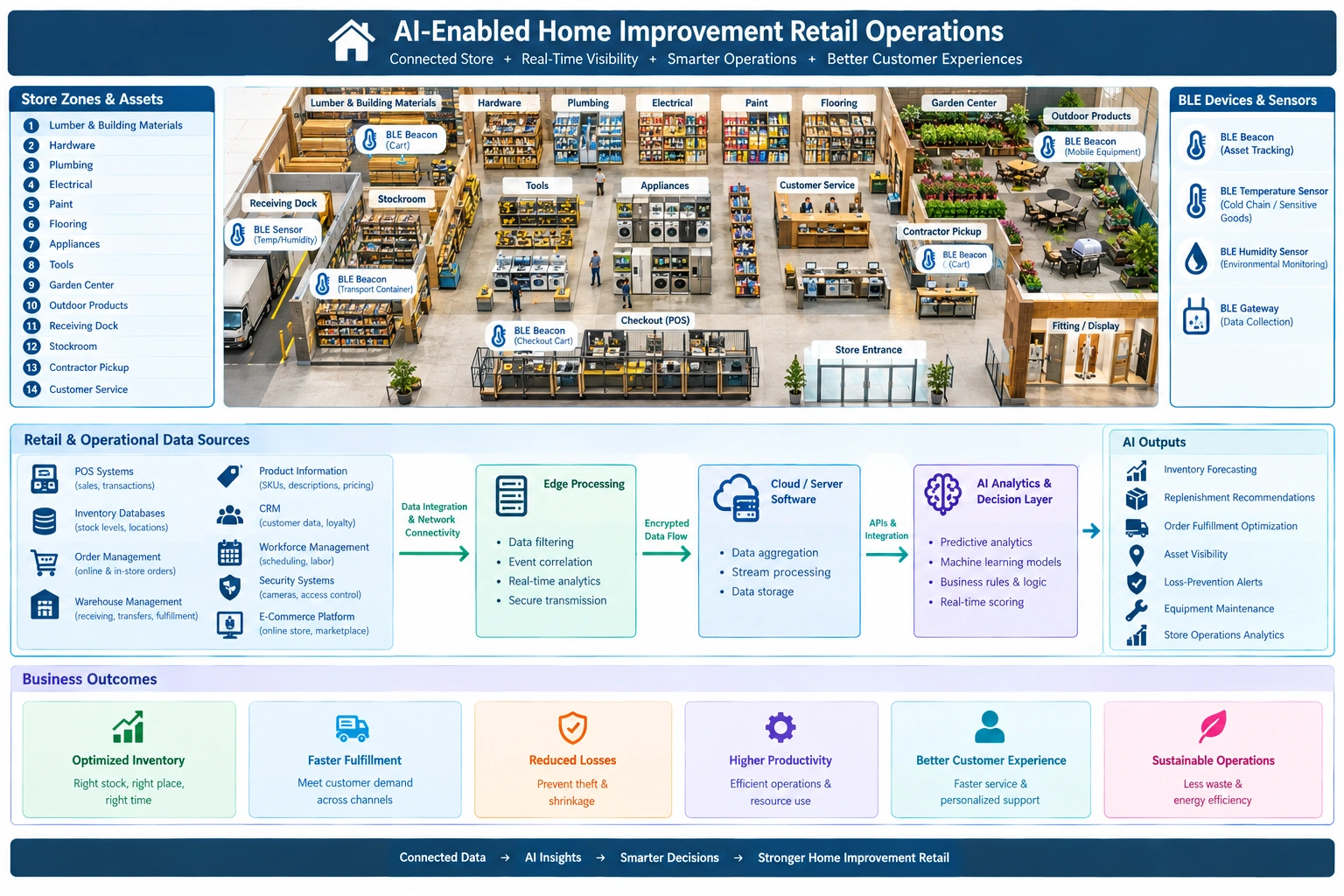
This enterprise overview illustrates how a connected home improvement store combines retail systems, inventory data, order management, workforce information, and BLE-enabled assets with edge processing and cloud or server software. AI analytics support inventory forecasting, replenishment recommendations, order fulfillment optimization, asset visibility, loss-prevention alerts, equipment maintenance, and store operations analytics. The visual highlights business outcomes including optimized inventory, faster fulfillment, reduced losses, higher productivity, better customer experience, and sustainable operations.
AI Applications Across Home Improvement Retail
Home improvement retail generates multiple data streams that can be analyzed together to improve product availability and operating efficiency. AI models can range from time-series forecasting and classification to anomaly detection, recommendation systems, optimization algorithms, and computer vision.
AI Inventory Management and Demand Forecasting
AI demand forecasting can evaluate historical sales, seasonality, weather-related demand patterns where appropriate, promotions, local construction activity, product categories, supplier lead times, inventory positions, and store-level purchasing behavior.
Forecasting is especially important for seasonal merchandise such as lawn and garden products, snow-removal equipment, outdoor power equipment, heating and cooling products, holiday merchandise, and weather-sensitive building supplies.
Models can produce forecasts at store, department, category, SKU, and time-period levels. Forecast outputs can then feed replenishment and allocation systems instead of remaining isolated within an analytics report.
AI Merchandise Allocation and Replenishment
Allocation models can determine how available inventory should be distributed across stores based on expected demand and service requirements. The system can consider current stock, open customer orders, forecasted demand, safety-stock requirements, distribution-center inventory, supplier lead times, and transportation constraints.
Replenishment decisions can also distinguish between fast-moving consumables and bulky or expensive merchandise. This distinction helps avoid applying the same inventory logic to a box of fasteners, a pallet of flooring, a refrigerator, and a large outdoor power product.
AI Omnichannel Fulfillment
Home improvement customers increasingly use online ordering, store pickup, curbside pickup, delivery, and ship-from-store options. AI can evaluate available-to-promise inventory, store capacity, delivery constraints, order priority, customer location, and fulfillment costs.
An AI fulfillment system can recommend the most suitable inventory source while reducing the risk of promising merchandise that is physically unavailable or operationally inaccessible.
BLE can support selected operational assets involved in fulfillment. For example, location information from BLE-enabled carts or transport equipment can help identify whether required equipment is available near a pickup or staging area. Product-level fulfillment confirmation should continue to rely on appropriate inventory identification methods such as barcode scanning, RFID, transaction records, or other validated controls.
AI Loss Prevention and Inventory Anomaly Detection
Inventory discrepancies can originate from receiving errors, incorrect put-away, damaged merchandise, returns, mispicks, transaction errors, unauthorized movement, or theft.
AI can compare expected inventory events with observed transactions and movement records. Anomaly models can prioritize unusual patterns for investigation instead of requiring loss-prevention teams to manually review every event.
Relevant signals can include inventory adjustments, POS transactions, receiving records, transfer activity, returns, access-control events, surveillance analytics, and selected BLE asset-location events.
The objective is not to label every unusual event as loss. AI should provide risk-based prioritization while human teams determine the appropriate response.
AI Customer and Project-Based Product Recommendations
Home improvement purchases are frequently connected to projects rather than isolated products. A customer installing a bathroom may require plumbing fixtures, fittings, sealants, tools, fasteners, electrical products, flooring, and installation materials.
AI recommendation systems can use product relationships, historical purchases, project categories, product specifications, inventory availability, and customer interactions to suggest relevant complementary products.
For professional customers, recommendations can also consider recurring purchasing patterns and frequently purchased product categories. CRM and clienteling systems should apply appropriate privacy and access controls when customer-specific information is used.
AI Store Equipment and Asset Management
Large-format home improvement stores use carts, ladders, pallet jacks, forklifts, mobile workstations, handheld scanners, delivery equipment, tools, maintenance equipment, and other operational assets.
AI can analyze asset utilization, maintenance history, service intervals, location information, downtime, and recovery events. This can help facilities and operations teams determine which assets require maintenance, replacement, relocation, or additional availability.
BLE gateways and beacons can provide location information for selected assets where zone-level visibility is operationally useful. BLE sensors can also monitor relevant environmental or equipment conditions when the hardware supports those measurements.
BLE Hardware and AI Software for Home Improvement Retail
BLE serves as an enabling technology for selected physical-world data requirements in home improvement retail. The strongest deployments use BLE where proximity, zone-level location, asset visibility, or environmental monitoring provides information that existing barcode, RFID, POS, or inventory systems do not provide efficiently.
BLE Beacons for Store Assets and Equipment
BLE beacons can be attached to reusable carts, mobile workstations, transport containers, maintenance equipment, tools, ladders, selected material-handling assets, or other equipment where location visibility is valuable.
For example, a retailer can use beacon-equipped assets to determine whether carts are concentrated near receiving, contractor pickup, garden centers, or other operational areas. AI can analyze these patterns to identify shortages, inefficient asset distribution, or abnormal movement.
Beacon placement should account for cleaning, impacts, mounting surfaces, battery replacement, physical security, and exposure to outdoor or semi-outdoor conditions.
BLE Gateways for Store and Stockroom Data Collection
BLE gateways collect signals from compatible beacons and sensors and transmit events to edge or centralized software. A gateway deployment should be designed around store geometry, required location accuracy, gateway density, network availability, and interference conditions.
Wi-Fi and Ethernet are common backhaul options inside stores, while cellular connectivity may be appropriate for selected remote areas or locations where wired infrastructure is limited. Gateway configuration should include device authentication, secure communication, health monitoring, time synchronization, and remote configuration where supported.
BLE Sensors for Home Improvement Retail Conditions
BLE sensors can monitor selected conditions relevant to merchandise, facilities, and store operations. Depending on the sensor type, applications may include temperature, humidity, equipment status, occupancy-related conditions, or other measurable parameters.
Environmental monitoring can be particularly useful for garden centers, plant areas, paint and chemical storage areas, HVAC-sensitive merchandise, and facilities rooms. Sensor selection must reflect the actual operating environment, measurement range, battery requirements, enclosure rating, and maintenance schedule.
AI can analyze sensor data to identify abnormal conditions, recurring environmental patterns, or potential maintenance requirements.
AI, Middleware, and Home Improvement Retail Software Integration
A complete solution typically connects BLE event data with existing retail software rather than operating as an isolated system. Middleware can normalize device events and map them to store, department, asset, equipment, and workflow identifiers.
Common integration targets include:
- Point-of-sale systems
- Inventory management software
- Order management systems
- Warehouse management systems
- Enterprise resource planning software
- Product information management systems
- Customer relationship management software
- E-commerce systems
- Workforce management software
- Loss-prevention systems
- Computerized maintenance management systems
- Enterprise asset management software
- Business intelligence and data warehouse systems
AI models can consume normalized events together with transaction and operational data. Recommendations can then be returned to inventory, fulfillment, maintenance, workforce, or loss-prevention workflows.
Cloud and Server Deployment for Home Improvement Retail AI
Home improvement retailers often operate across geographically distributed stores, regional distribution centers, warehouses, garden centers, and fulfillment facilities. Deployment decisions should therefore account for network connectivity, data governance, latency requirements, existing IT standards, integration complexity, and the scale of the store network.
Cloud Version
A cloud-hosted deployment can centralize AI models, analytics, device data, dashboards, and integrations across multiple retail locations. This model is useful when a retailer needs centralized forecasting, multi-store inventory analysis, enterprise-wide reporting, and scalable computing resources.
Cloud processing can also simplify model management when AI workloads need substantial compute resources. Store gateways can forward selected events to cloud services while edge processing handles latency-sensitive functions or temporary connectivity interruptions.
Server Version
A server deployment can place software on edge servers, customer-managed servers, private data centers, or other privately hosted enterprise infrastructure. This model may be preferred when home improvement retailers require greater control over data processing, integration boundaries, network connectivity, or internal IT policies.
Server-based processing can also support locations where certain operational decisions need to continue during temporary external network outages. Edge and private-server deployments can be combined with centralized systems when the retailer requires local processing together with multi-store analytics.
The appropriate model depends on store connectivity, data governance requirements, AI workload characteristics, integration policies, operational latency, and the retailer’s existing IT environment.
Engineering Considerations for AI-Enabled Home Improvement Retail
Home improvement retail environments are more physically varied than many conventional stores. A single location may combine indoor aisles, high-bay storage, lumber yards, garden centers, loading docks, contractor pickup areas, appliance departments, secured tool displays, and outdoor merchandising. AI and connected-device deployments therefore require site-specific engineering rather than assuming uniform radio coverage or identical workflows across stores.
GAO supplies BLE gateways, BLE beacons, BLE sensors, RFID products, and other IoT technology-based hardware products and systems that can support these different operating environments.
BLE Coverage and Device Placement
BLE gateway placement should account for store dimensions, shelving density, concrete or metal structures, equipment placement, outdoor areas, and required location granularity. Zone-level visibility may be sufficient for carts and mobile equipment, while higher location precision may be needed for specific operational workflows.
Large stores should normally be divided into logical coverage zones such as receiving, lumber, garden, contractor pickup, tool rental, stockrooms, and customer service. Gateway locations should be validated through site surveys rather than relying solely on theoretical radio coverage.
Battery-powered BLE beacons also require a defined maintenance process. Battery life depends on transmission interval, radio configuration, environmental conditions, and device design. Retail operations teams should establish replacement schedules and maintain spare devices to prevent gradual loss of asset visibility.
Asset Identity and Product Traceability
A home improvement retailer should maintain a clear distinction between merchandise identity and operational asset identity. A product SKU, serial number, pallet identifier, reusable cart, forklift, ladder, handheld scanner, or maintenance tool may each require a different identity model.
BLE can provide location information for selected assets, but it should not automatically be interpreted as proof that a particular SKU has been sold, received, or physically counted. Barcode scanning, RFID, POS transactions, warehouse transactions, computer vision, and physical counts may provide more appropriate evidence for product-level inventory processes.
A strong system maps device identifiers to asset records and associates those records with store locations, departments, maintenance status, ownership, and operational responsibility. This creates a reliable relationship between physical equipment and business software.
Data Quality and Event Normalization
AI models require reliable event data. BLE events should be normalized before entering inventory, maintenance, fulfillment, or analytics workflows.
Useful event fields can include:
- Device identifier
- Gateway identifier
- Store identifier
- Zone identifier
- Timestamp
- Signal information
- Asset identifier
- Event type
- Estimated location
- Confidence level
- Device health status
The software should detect duplicate events, stale devices, missing readings, inconsistent timestamps, and unexpected gateway behavior. Data quality rules should also distinguish a genuine asset movement from a temporary radio fluctuation.
Integration with Home Improvement Retail Systems
AI-driven operations become more useful when connected to the retailer’s existing software. Relevant integrations can include:
- POS systems for sales and transaction information
- Inventory management systems for stock records
- OMS software for customer orders and fulfillment
- WMS software for distribution and warehouse processes
- ERP systems for purchasing, finance, and supplier operations
- PIM systems for product specifications and attributes
- CRM systems for customer and contractor information
- E-commerce systems for online availability
- Workforce management software for staffing and task allocation
- Loss-prevention software for security analysis
- CMMS and EAM systems for maintenance management
- Business intelligence systems for operational reporting
APIs, message queues, integration middleware, databases, and scheduled data exchanges can connect these systems. Each interface should define data ownership, synchronization frequency, authentication, error handling, retry behavior, and audit requirements.
Enterprise Technical Store Map for AI-Enabled Home Improvement Retail
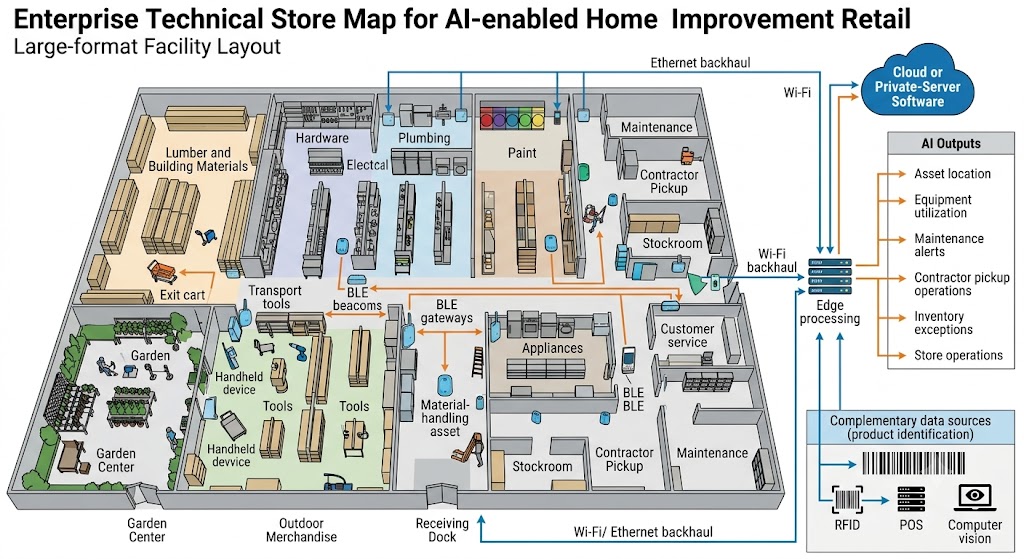
This technical diagram illustrates an end-to-end BLE infrastructure mapped across a large-format home improvement store. Physical data from tracked equipment, mobile tools, and environmental sensors across various departments streams via Wi-Fi and Ethernet backhaul to edge processors and cloud software. Integrated with complementary inputs like RFID, POS, and computer vision, the system drives AI outputs including asset location, maintenance alerts, and operational optimization.
AI Use Cases That Improve Home Improvement Retail Performance
AI can create measurable value when its outputs are connected to actual retail decisions. Forecasts can trigger replenishment, anomaly detection can prioritize investigation, fulfillment models can recommend inventory sources, and predictive maintenance can generate service actions.
Predictive Demand and Seasonal Planning
Home improvement demand can vary significantly by season, geography, weather, construction activity, holidays, renovation cycles, and local customer behavior.
AI models can analyze historical sales together with product attributes, store location, seasonal patterns, supplier lead times, promotions, and inventory availability. Forecasting can then support purchasing, allocation, replenishment, and labor planning.
Seasonal models are particularly useful for garden products, snow equipment, outdoor power equipment, heating and cooling products, holiday merchandise, storm-related supplies, and other demand-sensitive categories.
Inventory Anomaly and Shrink Detection
AI can compare expected inventory behavior with actual transactions and operational events. Potential exceptions include repeated inventory adjustments, unexpected stock movements, unusual return patterns, discrepancies between receiving and put-away, and unexplained differences between system inventory and physical counts.
BLE asset events can provide supplementary evidence when investigating the movement of carts, equipment, tools, or other tagged operational assets. Security teams can combine these signals with POS records, access-control events, surveillance analytics, barcode scans, and inventory transactions.
The objective is to prioritize investigation rather than automatically classify every anomaly as theft. Human review remains important because inventory exceptions can have legitimate operational causes.
Contractor Service and Project Intelligence
Professional customers often make repeat purchases associated with construction, remodeling, maintenance, landscaping, and other projects. AI can analyze purchasing patterns and product relationships to support contractor service.
For example, a system can identify frequently associated products and alert associates when an order may require complementary materials. AI can also identify frequently purchased product categories for individual business customers where appropriate privacy and access controls are in place.
Store inventory availability can be included so recommendations reflect products that can actually be supplied through the relevant store, fulfillment center, or delivery operation.
Store and Equipment Predictive Maintenance
Store operations depend on refrigeration where applicable, HVAC systems, lighting, network equipment, POS equipment, forklifts, pallet jacks, carts, handheld devices, loading equipment, paint-related equipment, garden-center equipment, and maintenance tools.
AI can evaluate maintenance records, equipment utilization, sensor readings, service history, operating hours, and failure patterns to identify equipment that may require attention.
A predictive maintenance workflow can prioritize equipment based on operational impact. A failure involving a critical loading system or refrigeration unit may receive a higher priority than an asset with an available backup.
Omnichannel Fulfillment and Transfer Optimization
AI can optimize fulfillment by comparing inventory availability, customer location, store workload, distribution-center stock, delivery schedules, pickup capacity, and transportation costs.
The model can recommend whether an order should be fulfilled from a store, distribution center, or another inventory location. Similar optimization can support store-to-store transfers.
Heavy and bulky products require additional consideration because transportation costs and handling requirements can materially affect the optimal decision. AI models should therefore include product dimensions, weight, handling requirements, delivery restrictions, and service-level commitments where the data is available.
Cybersecurity and Data Protection for Home Improvement Retail
Connected retail systems extend the technology boundary from conventional business applications to gateways, sensors, handheld devices, network infrastructure, and physical store equipment. Security controls should therefore cover the complete data path.
Recommended controls include:
- Unique credentials for gateways and connected devices
- Strong authentication for administrative and integration accounts
- Encryption for data in transit and at rest where appropriate
- Network segmentation for connected retail devices
- Role-based access control
- API authentication and authorization
- Secure firmware and software updates
- Device certificate and credential lifecycle management
- Centralized logging and security monitoring
- Vulnerability management and patch procedures
- Controlled device commissioning and decommissioning
- Backup and recovery procedures
- Data retention and deletion policies
- Audit trails for important operational changes
Customer and contractor information should be protected according to applicable privacy requirements and organizational policies. Payment-related systems should be designed with applicable PCI DSS requirements in mind.
BLE itself does not make a retail solution compliant with privacy, payment, cybersecurity, or other regulatory requirements. Compliance depends on the complete system, its configuration, data handling practices, access controls, and organizational processes.
Deployment Lifecycle for Home Improvement Retail
A controlled deployment approach helps retailers move from a limited pilot to repeatable multi-store implementation while reducing integration and operational risk.
Planning and Store Assessment
The planning stage should document store layouts, departments, stockrooms, receiving areas, garden centers, lumber yards, contractor pickup zones, network infrastructure, existing software, operational assets, and security requirements.
Teams should first identify the business problem. Inventory accuracy, asset recovery, contractor pickup efficiency, equipment uptime, fulfillment performance, and loss prevention may each require different data and hardware.
A clear baseline should be established before deployment so improvements can be measured after implementation.
Hardware Selection and Pilot Deployment
Hardware selection should consider:
- Required coverage area
- Location accuracy
- Battery life
- Mounting method
- Environmental exposure
- Impact resistance
- Network connectivity
- Device security
- Maintenance requirements
- Gateway density
- Outdoor and semi-outdoor operating conditions
A pilot should use a representative store area rather than an isolated laboratory environment. Testing should include normal employee movement, customer traffic, receiving operations, replenishment, equipment movement, and network interruptions.
GAO’s experience supplying IoT hardware products and systems to organizations supports practical evaluation of device selection, integration requirements, and deployment conditions before broader rollout.
Integration and System Testing
Integration testing should validate the entire workflow from connected devices through business action.
Testing should include:
- Device registration
- Asset identity mapping
- Gateway connectivity
- Data transmission
- Event normalization
- Location estimation
- Inventory synchronization
- API authentication
- Error handling
- Offline operation
- Network recovery
- AI model inputs
- AI recommendation outputs
- Dashboard reporting
- Alert generation
- User permissions
- Audit logging
Performance should be measured under realistic operating conditions. A system that works reliably during low store activity may behave differently during receiving, weekend traffic, seasonal peaks, or large inventory movements.
Commissioning and Optimization
Commissioning should verify gateway placement, device configuration, asset mapping, network connectivity, software integrations, alert thresholds, and operational procedures.
AI models should be monitored after production deployment. Actual store behavior can differ from historical training data, particularly after new product introductions, major promotions, store remodels, seasonal changes, or supply disruptions.
Model accuracy, false-positive rates, inventory reconciliation, fulfillment performance, and user feedback should therefore be reviewed regularly.
Scaling Across Stores and Distribution Facilities
Once a pilot achieves its defined acceptance criteria, deployment can expand across stores, distribution centers, fulfillment facilities, and other locations.
Standardized installation procedures, device naming conventions, gateway configuration, cybersecurity controls, asset records, software interfaces, and support procedures make expansion more manageable.
Store-specific characteristics should remain part of the deployment model. A garden center, urban store, large suburban store, and distribution warehouse may require different coverage and hardware configurations.
KPIs for AI-Enabled Home Improvement Retail
A successful AI and BLE deployment should be measured through business outcomes as well as technical performance. Relevant KPIs include:
- Inventory accuracy
- Stockout rate
- Forecast accuracy
- Replenishment accuracy
- Sell-through rate
- Inventory turnover
- Inventory aging
- Inventory carrying cost
- Order fulfillment time
- Order cycle time
- Omnichannel fill rate
- Buy-online-pickup-in-store fulfillment time
- Contractor pickup cycle time
- Store-to-store transfer cycle time
- Delivery fulfillment rate
- Inventory discrepancy rate
- Shrink rate
- Return rate
- Markdown rate
- Asset utilization
- Asset recovery time
- Equipment uptime
- Maintenance response time
- Maintenance cost
- BLE gateway availability
- BLE device availability
- Sensor data completeness
- Event processing latency
- AI anomaly detection precision
- Demand forecast error
Technical KPIs should be connected to business measurements. For example, improved BLE gateway availability is useful when it produces more complete asset data, while improved forecast accuracy matters when it contributes to better replenishment and fewer stockouts.
Practical Benefits of AI and BLE for Home Improvement Retail
The practical value of AI and BLE comes from connecting physical store operations with inventory, transaction, fulfillment, maintenance, and analytical systems. AI provides the decision-making capability, while BLE can provide additional location and condition signals for selected assets and operational environments.
Key benefits include:
- Improved inventory visibility and reconciliation
- Earlier identification of stockout and replenishment risks
- Better seasonal demand forecasting
- More effective store-to-store inventory balancing
- Improved omnichannel fulfillment decisions
- Better contractor pickup and staging operations
- Increased visibility of carts and selected operational assets
- Faster identification of equipment requiring attention
- More effective loss-prevention investigation
- Better store-zone and merchandising analysis
- Improved maintenance prioritization
- More consistent operational reporting across store networks
These benefits are strongest when AI recommendations are connected directly to workflows. A demand forecast should influence replenishment, an inventory anomaly should create an investigation task, and a maintenance prediction should reach the responsible facilities team.
Implementation Recommendations for Home Improvement Retail
Home improvement retailers should start with operational problems that have measurable business consequences. Deploying BLE devices without a defined workflow can produce data without improving decisions.
Recommended practices include:
- Define measurable objectives for inventory, fulfillment, asset, maintenance, or loss-prevention use cases.
- Map existing store and distribution workflows before selecting hardware.
- Separate merchandise identification from operational asset tracking.
- Conduct RF and network surveys before large-scale BLE deployment.
- Select gateways and beacons according to actual store conditions.
- Establish consistent device and asset identity rules.
- Integrate with existing POS, OMS, WMS, ERP, PIM, CRM, and maintenance software.
- Validate data quality before training AI models.
- Pilot in representative stores with realistic operating conditions.
- Establish procedures for battery replacement and device maintenance.
- Test network outages and recovery behavior.
- Validate AI recommendations with inventory, merchandising, fulfillment, and store operations teams.
- Establish cybersecurity controls before production deployment.
- Monitor model accuracy and false-positive rates after implementation.
- Measure technical performance together with business KPIs.
- Design standardized deployment procedures for future store expansion.
GAO is headquartered in New York City and Toronto, Canada, and is ranked among the top 10 leading B2B and B2G BLE and RFID suppliers globally, with a lesser degree of activity in B2B2C and B2D applications. We provide BLE, RFID, and other IoT technology-based hardware products and systems that can support connected retail applications.
GAO Engineering and Technology Support for Home Improvement Retail
For three decades, GAO and its affiliated companies have served customers across the United States and Canada, including Fortune 500 companies, leading R&D firms, prestigious universities, and U.S. and Canadian government agencies. This experience supports practical engineering requirements ranging from hardware selection and system integration to deployment support and operational troubleshooting.
GAO has invested substantially in R&D for its products and systems and maintains stringent quality-assurance processes. Remote and onsite technical support can help organizations address device configuration, integration, deployment, testing, and operational issues associated with BLE, RFID, and other IoT technologies.
For home improvement retailers, this experience can support solutions involving store operations, inventory visibility, asset tracking, fulfillment, environmental monitoring, equipment management, and other connected retail workflows.
Building the Future of Industrial AI and IoT with Aperture Venture Studio and GAO RFID Inc.
For more than three decades, GAO has invested heavily in R&D involving industrial BLE, RFID, and IoT technologies. As AI became increasingly useful for operational applications, we expanded work combining AI with connected devices and systems. Aperture Venture Studio supports technical collaboration around AI and IoT applications relevant to home improvement retail, including inventory management, store operations, fulfillment, asset tracking, and connected facilities.
Aperture has attracted AI and IoT technical experts, operational executives, investors, and leading companies. The Aperture Ventures Summit and TekSummit provide forums for discussing advanced AI and IoT topics. We welcome technical collaborators, investors, customers, and organizations interested in applying AI and IoT to practical retail operations.