
AI and BLE for Freight Truck Operations
AI-Driven Freight Truck Operations for Safer and More Predictable Fleet Performance
AI-driven freight truck operations combine fleet data, vehicle information, shipment events, driver workflows, maintenance records, and connected asset visibility to improve how trucks are dispatched, loaded, operated, serviced, and returned to service. For trucking fleets, AI can identify operational patterns across tractors, trailers, cargo-handling equipment, routes, stops, loading activities, and maintenance events that are difficult to evaluate through manual monitoring alone.
BLE gateways, BLE beacons, and BLE sensors can provide an additional visibility layer for trailers, cargo-handling assets, tools, reusable containers, equipment, and selected vehicle-related conditions. When BLE events are combined with fleet management software, transportation management systems, telematics, maintenance software, dispatch records, and AI analytics, freight operators can develop a more complete operational view.
The objective is not simply to locate a truck or asset. AI can use physical-world data to predict maintenance requirements, identify abnormal operating patterns, improve trailer utilization, detect cargo-handling exceptions, support dispatch decisions, and reduce avoidable delays across freight truck operations.
How AI Improves Freight Truck Operations
Freight truck operations involve interconnected activities including vehicle dispatch, driver assignment, pre-trip inspection, loading, departure, en-route transportation, delivery, fueling, parking, maintenance, and trailer management. Delays or equipment problems in one stage can affect subsequent loads and customer commitments.
AI helps fleet managers evaluate these relationships by combining historical and real-time information. Time-series forecasting can estimate workload and maintenance demand, anomaly detection can identify unusual vehicle or asset behavior, and optimization methods can support dispatch and resource allocation.
AI applications for freight truck operations include:
- Predictive fleet maintenance based on vehicle condition, mileage, fault history, operating patterns, and service records
- AI route and dispatch support using delivery windows, traffic conditions, vehicle availability, driver schedules, and shipment priorities
- Trailer utilization analysis based on movement, dwell, loading status, and assignment history
- Cargo-handling asset tracking for pallets, carts, totes, tools, and reusable equipment
- Exception detection for unexpected trailer movements, prolonged loading periods, missed checkpoints, or asset separation
- Driver workflow analysis using approved operational data and established safety policies
- Predictive fuel and energy consumption analysis
- Fleet availability forecasting
- AI-assisted inspection prioritization
- Maintenance scheduling based on predicted vehicle availability
- Yard and terminal movement optimization
- Delivery exception prediction
- Freight asset utilization analysis
BLE becomes particularly useful where a trucking operation needs to associate a physical asset with a truck, trailer, terminal zone, maintenance area, or loading operation. GAO provides BLE, RFID, and other IoT technology-based hardware products and systems that can support these connected freight workflows.
AI-Driven Freight Operations: Terminal to Dispatch Network Diagram
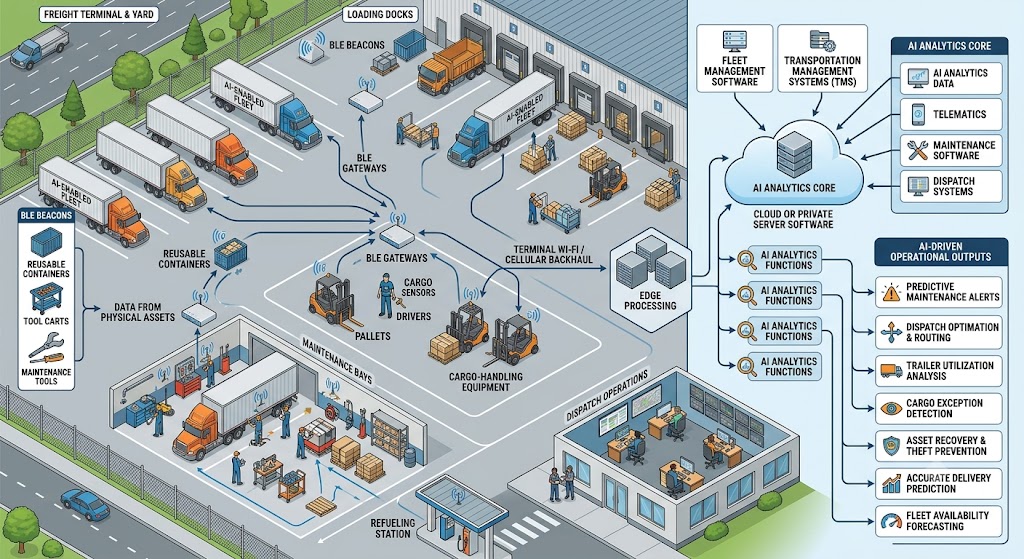
This comprehensive enterprise diagram maps an AI-enabled freight terminal. It illustrates how data from BLE beacons on assets like pallets, containers, and maintenance tools is collected via gateways and integrated with transportation management, telematics, and maintenance software systems. Through cloud-based AI analytics, these inputs are transformed into operational outputs including predictive maintenance alerts, optimized dispatch routing, trailer utilization analysis, and fleet forecasting.
Freight Truck Workflows Supported by AI
Freight truck operations depend on repeatable workflows, but actual conditions vary by route, vehicle, shipment, terminal, driver availability, weather, traffic, loading requirements, and customer schedules. AI can analyze operational deviations and help dispatchers and fleet managers respond earlier.
Dispatch and Vehicle Assignment
Dispatchers must match tractors, trailers, drivers, shipments, routes, and delivery windows while considering vehicle availability, maintenance status, driver hours, equipment restrictions, and customer requirements.
AI can evaluate these variables to recommend vehicle and trailer assignments. A tractor scheduled for preventive maintenance, for example, should not be treated as fully available simply because its current location indicates that it is idle.
BLE-enabled asset visibility can provide additional information about trailers, carts, tools, or other equipment associated with a dispatch operation. This physical data can be matched with transportation management and fleet records.
Pre-Trip Inspection and Departure Readiness
Pre-trip inspections help identify equipment conditions before a truck enters service. AI can use historical defects, maintenance records, inspection results, mileage, fault codes, and operating conditions to identify vehicles that may require additional inspection.
BLE sensors can provide selected equipment or environmental observations where appropriate. The resulting information can supplement, rather than replace, legally required inspections and established driver safety procedures.
A departure-readiness system can combine vehicle status, trailer assignment, cargo readiness, documentation, driver availability, and maintenance conditions to identify potential departure delays.
Loading, Cargo Handling, and Trailer Readiness
Truck loading requires coordination between freight availability, dock operations, trailer assignment, cargo configuration, shipment priority, and departure schedules.
AI can analyze loading duration and historical patterns to identify shipments or facilities where loading delays are likely. BLE beacons attached to carts, pallets, reusable containers, or handling equipment can provide proximity information within terminals and loading areas.
This information can help operations teams identify whether a delayed departure is caused by missing freight, unavailable handling equipment, trailer preparation, dock congestion, or another process constraint.
En-Route Freight Operations
Once a truck departs, fleet managers need to monitor progress against planned routes, delivery windows, service commitments, and operating constraints.
AI can compare expected travel time with actual progress and identify potential delivery exceptions. Telematics, GPS, traffic information, dispatch data, weather information, and shipment records can be combined with selected BLE events from cargo or trailer assets.
BLE should not be treated as a replacement for cellular telematics or GNSS-based vehicle tracking. Its value is strongest for short-range identification and proximity relationships around vehicles, trailers, terminals, cargo assets, and equipment.
Delivery, Return, and Asset Recovery
Delivery operations can generate multiple asset movements. Pallets, carts, reusable containers, tools, load bars, straps, and other handling assets may remain with customers or move between terminals.
AI can identify unusual asset dwell, repeated loss patterns, or delays in returning reusable equipment. BLE visibility can provide event information when tagged assets enter or leave defined terminal or facility zones.
The resulting data can support asset recovery workflows and help fleet operators understand the actual utilization cycle of reusable freight-handling equipment.
AI Applications Across Freight Truck Operations
AI can improve individual truck workflows while also identifying relationships between vehicle utilization, trailer availability, maintenance, loading activity, route execution, and delivery performance.
AI Fleet Maintenance and Vehicle Availability
Unexpected truck downtime can disrupt dispatch plans, driver schedules, trailer assignments, and customer deliveries. Traditional maintenance programs based only on fixed mileage or calendar intervals may not fully represent how individual vehicles are being operated.
AI can combine odometer data, engine hours, diagnostic trouble codes, inspection records, maintenance history, operating conditions, component replacement history, and utilization patterns to estimate maintenance risk.
Predictive maintenance does not eliminate scheduled inspections or manufacturer requirements. Instead, it provides an additional analytical layer that can help maintenance managers prioritize inspections and service activities.
BLE can contribute asset identity and proximity information around maintenance facilities. A BLE beacon associated with a trailer or mobile equipment asset can help maintenance personnel identify the correct asset and associate physical presence with work-order records.
AI Trailer Tracking and Utilization
Trailers can spend significant time away from tractors, at customer locations, in terminals, at maintenance facilities, or in storage yards. Poor trailer visibility can create apparent equipment shortages even when sufficient trailers exist elsewhere in the fleet.
AI can analyze trailer movement, dwell time, assignment history, shipment relationships, and terminal activity to identify utilization patterns.
BLE beacons can provide short-range trailer identification at yards, terminals, maintenance locations, and loading areas. BLE gateways can capture the presence of tagged trailers or associated assets within defined zones.
Combining these events with transportation management data helps distinguish between a trailer that is actively supporting a shipment and one that is simply occupying a location without a current operational assignment.
Predictive Dispatch and Route Exception Detection
Dispatch decisions involve multiple constraints, including driver availability, vehicle condition, trailer type, freight characteristics, delivery windows, route restrictions, and expected travel conditions.
AI can evaluate these factors to identify potential conflicts before dispatch. It can also detect deviations after departure, such as unexpected delays, prolonged stops, or route progress that differs substantially from the planned schedule.
The AI system should maintain clear separation between predictive recommendations and safety-critical controls. Dispatch optimization should respect applicable driver-hours requirements, company policies, vehicle restrictions, and transportation regulations.
Cargo and Handling Asset Visibility
Freight truck operations involve more assets than tractors and trailers. Pallets, roll cages, totes, load bars, straps, tools, portable equipment, and reusable containers can affect loading speed and asset availability.
AI asset tracking can identify where these resources are being used, where they accumulate, and where they frequently become unavailable.
BLE beacons provide a practical identity layer for selected reusable assets. Gateways located at terminals or loading areas can detect asset presence and movement, allowing the resulting events to be associated with shipment and operational records.
AI Fuel and Energy Management
Fuel consumption varies with vehicle configuration, payload, route profile, traffic, driving conditions, idle time, weather, tire condition, and maintenance state.
AI can analyze historical fuel data alongside vehicle and route information to identify unusual consumption patterns. Fleet managers can use these findings to investigate maintenance issues, excessive idling, route inefficiencies, or operational practices.
BLE sensors may provide supporting data for selected equipment conditions, but fuel optimization typically requires integration with vehicle telematics, engine data, and fleet-management software.
Enterprise Data-flow Diagram for AI-Enabled Freight Truck Operations
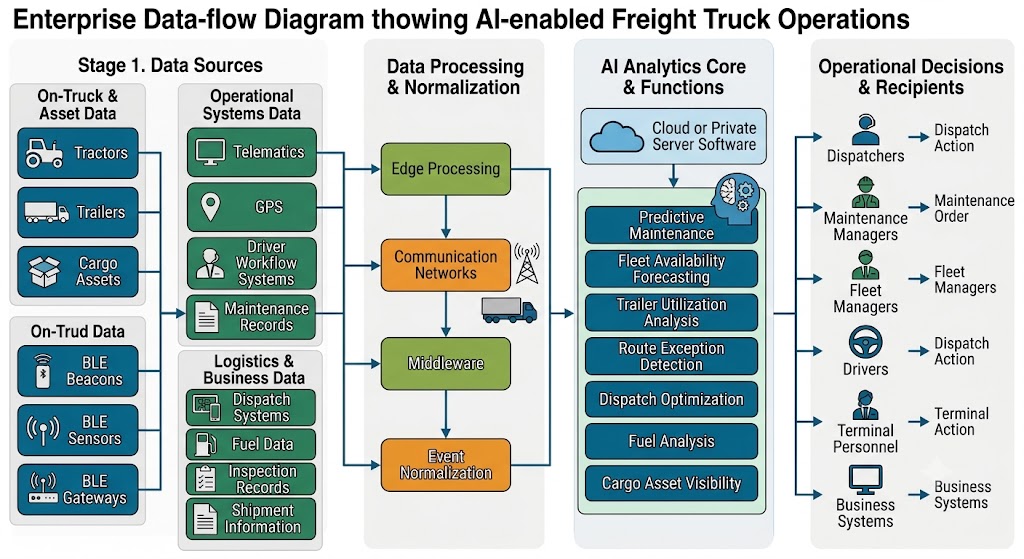
This detailed data-flow diagram illustrates how a modern freight network captures on-truck data, operational system data, and logistics business data for AI-enabled decision-making. The process streams from BLE sensors, telematics, and maintenance records through an edge and core processing layer where artificial intelligence applies functions such as predictive maintenance, fleet forecasting, and route exception detection. Optimized insights are then delivered to key operational roles, from dispatchers to drivers and fleet managers, as well as business systems.
AI Driver and Vehicle Workflow Support
Driver-facing AI applications should be designed carefully because freight truck operations involve safety-critical decisions. AI can support scheduling, inspection prioritization, route information, delivery exception management, and administrative workflows without replacing required driver judgment or regulatory responsibilities.
Operational analytics can identify recurring delays at particular facilities, loading locations, delivery points, or route segments. Fleet managers can use these patterns to improve scheduling and resource planning rather than attributing every delay to driver performance.
BLE Hardware and AI Software for Freight Truck Operations
BLE hardware provides short-range connectivity for identifying assets and capturing selected conditions around trucks, trailers, terminals, and maintenance operations. Its deployment should be based on the operational question being solved.
BLE Beacons for Trucks, Trailers, and Freight Assets
BLE beacons can be attached to trailers, carts, reusable containers, tools, cargo-handling equipment, and other assets that need identification within defined operating zones.
Beacon configuration should consider battery life, advertising interval, transmission power, enclosure requirements, mounting method, temperature range, vibration, moisture, and exposure to loading activities.
Trailer-mounted beacons may operate in environments with significant metal surfaces that can affect radio propagation. Engineers should validate detection performance under real operating conditions rather than relying solely on nominal range specifications.
BLE Gateways for Terminals and Fleet Facilities
BLE gateways receive beacon advertisements and forward relevant events to software systems. Gateway placement can include terminal entrances, loading zones, maintenance bays, yard areas, dispatch areas, and controlled asset-transfer points.
The appropriate placement depends on the desired visibility. A fleet operator may need only arrival and departure events, while another workflow may require more detailed zone transitions.
Network connectivity from gateways may use Ethernet, Wi-Fi, cellular connectivity, or other available IP-based infrastructure. MQTT, HTTPS, or vendor APIs can carry gateway data into middleware or application software.
BLE Sensors for Freight and Vehicle Conditions
BLE sensors can monitor selected environmental or equipment conditions where the use case requires them. Potential applications include temperature, humidity, motion, vibration, or other measurable conditions associated with freight assets or equipment.
For temperature-sensitive freight, sensor selection and placement should be based on the actual cargo environment and required measurement characteristics. A BLE sensor should not be assumed to provide regulatory compliance by itself. Measurement accuracy, calibration, data retention, alarm handling, and chain-of-custody requirements must be evaluated separately.
AI, Telematics, and Fleet Software Integration
BLE data becomes significantly more valuable when integrated with existing fleet systems.
Relevant software can include:
- Fleet management systems
- Transportation management systems
- Telematics software
- Electronic logging systems
- Maintenance management systems
- Enterprise asset management software
- Dispatch software
- Yard management systems
- Warehouse management systems
- ERP systems
- Fuel management software
- Driver workflow applications
- Shipment visibility systems
Middleware can associate a BLE device identifier with a trailer, asset, tool, or equipment record. It can then normalize timestamps and locations before passing the event to AI services.
GAO supplies BLE, RFID, and other IoT technology-based hardware products and systems that can support these connected freight workflows, with hardware selection driven by the physical environment and operational requirements.
Cloud and Server Deployment for Freight Truck Operations
Freight fleets often operate across geographically distributed terminals, maintenance locations, yards, customer sites, and transportation routes. Software deployment should therefore account for intermittent connectivity, centralized fleet analytics, local operational requirements, cybersecurity, and integration with existing fleet systems.
Cloud Version
The Cloud Version hosts fleet analytics and AI software within cloud infrastructure. This approach is useful for fleets operating across multiple terminals or regions that need centralized visibility into vehicle availability, trailer utilization, maintenance risk, asset movement, and delivery performance.
Cloud software can aggregate information from multiple facilities and vehicle systems, allowing fleet managers to compare performance and identify recurring operational patterns.
Edge processing can filter or temporarily store BLE events before forwarding them to cloud services. This is particularly useful at terminals where connectivity may be intermittent.
Server Version
The Server Version deploys software on edge servers, customer-managed servers, private data centers, fleet facilities, or other privately hosted infrastructure.
This approach can be appropriate when a freight operator requires tighter control over data location, network boundaries, integration interfaces, or local processing. It can also support operational environments where certain systems must remain within controlled private infrastructure.
The trade-off is greater responsibility for server capacity, patching, redundancy, backups, cybersecurity, monitoring, and software lifecycle management.
Both deployment models can support AI-enabled freight truck operations. The selection should be based on fleet size, geographic distribution, connectivity, integration requirements, governance, latency, and operational continuity requirements.
Engineering Considerations for AI-Enabled Freight Truck Operations
AI-driven freight truck operations depend on reliable data from tractors, trailers, cargo-handling equipment, drivers, terminals, and transportation software. BLE devices can provide proximity, identification, condition, and location-related events, while AI converts these operational signals into predictions and recommended actions. The engineering objective is to ensure that data collected from moving vehicles and distributed freight assets is accurate enough to support dispatch, maintenance, safety, cargo visibility, and fleet utilization decisions.
GAO provides BLE, RFID, and other IoT technology-based hardware products and systems that can be integrated with freight transportation environments. Deployment should be engineered around vehicle construction, operating routes, terminal conditions, existing telematics, and the data requirements of the fleet management system.
BLE Coverage and Vehicle and Trailer Visibility
Freight trucks contain significant amounts of metal, electrical equipment, cargo, and enclosed compartments that can affect BLE radio performance. Trailer construction, cargo density, vehicle orientation, gateway placement, and terminal congestion can influence signal behavior.
A practical deployment should evaluate:
- BLE gateway placement inside or near the tractor cab, trailer, yard vehicle, or terminal area
- Beacon and sensor mounting locations on trailers, tools, cargo-handling equipment, and other mobile assets
- RF coverage across loading docks, yards, staging lanes, maintenance areas, and parking locations
- BLE advertising intervals and their effect on detection frequency and battery life
- Multipath and signal attenuation around metal trailers and truck bodies
- Cellular, Wi-Fi, or Ethernet backhaul availability for gateways
- Store-and-forward requirements when trucks operate outside network coverage
- Device identity mapping between BLE equipment and specific tractors, trailers, loads, or work orders
BLE should complement rather than replace other truck telematics and positioning technologies when higher precision or continuous vehicle location is required.
Mobile Asset and Battery Management
Freight fleets operate with assets that move between terminals, tractors, trailers, warehouses, maintenance facilities, and customer locations. BLE beacons can provide an economical identity layer for assets that do not justify continuous cellular connectivity.
Battery-powered BLE devices require an operating strategy that considers:
- Expected battery life
- Advertising frequency
- Environmental temperature
- Vibration and mechanical shock
- Waterproofing and enclosure requirements
- Inspection intervals
- Battery replacement procedures
- Device health reporting
- Spare device inventory
- Asset retirement and reassignment
AI can analyze device-event patterns to identify abnormal behavior, missing assets, unusual dwell periods, or repeated failures. Maintenance teams can use these insights to prioritize inspections rather than relying solely on fixed inspection schedules.
Data Quality and Event Normalization
AI recommendations are only as reliable as the operational data provided to the models. Freight operations frequently combine information from TMS software, FMS applications, ELD systems, telematics, maintenance records, dispatch applications, BLE gateways, warehouse systems, and driver applications.
A data normalization layer should establish consistent definitions for:
- Tractor ID
- Trailer ID
- Driver ID
- Load ID
- Shipment ID
- Stop ID
- Terminal ID
- BLE device ID
- Gateway ID
- Work order ID
- Timestamp
- Location
- Event type
- Asset status
The system should distinguish events such as trailer arrival, trailer departure, loading, unloading, staging, maintenance, idle time, detention, and delivery completion. Time synchronization is particularly important when AI models calculate dwell time, ETA accuracy, route deviation, or maintenance intervals.
GAO can support organizations that need connected hardware integrated with broader IoT and enterprise systems, allowing BLE data to become part of a larger operational data flow rather than an isolated monitoring application.
Integration with TMS, FMS, ELD, CMMS and EAM Systems
AI and BLE deployments should integrate with existing freight software rather than creating parallel operational records. Transportation management systems can provide shipment and appointment information. Fleet management systems can provide vehicle utilization and operational status. ELD and telematics systems provide driving and vehicle data. CMMS and EAM software can provide maintenance history, inspections, work orders, parts usage, and service schedules.
Common integration methods include:
- REST APIs
- Webhooks
- MQTT
- HTTPS
- Message queues
- Database integration
- Cloud data services
- Enterprise integration middleware
- File-based interfaces where legacy systems require them
A normalized event model allows AI applications to correlate BLE proximity events with dispatch, maintenance, freight, and vehicle information. For example, a trailer detected at a terminal can be matched with its assigned shipment, appointment window, current status, and predicted departure requirement.
AI Use Cases That Improve Freight Truck Performance
AI can turn freight operating data into forecasts, classifications, anomaly alerts, optimization recommendations, and automated workflows. BLE adds another source of asset and proximity information that can improve the context available to these models.
Predictive ETA and Route Deviation
AI ETA models can combine historical travel patterns, planned routes, current vehicle status, traffic conditions, stop history, appointment schedules, and operational events. BLE events can provide additional confirmation that a trailer or associated asset has entered or departed a terminal, dock, staging area, or other operational zone.
AI can identify:
- Likely late arrivals
- Excessive dwell
- Unexpected route deviation
- Extended terminal stops
- Missed appointment windows
- Unusual stop duration
- Delayed loading or departure
- Potential delivery exceptions
Dispatch teams can use these predictions to adjust appointment coordination, driver instructions, load sequencing, and customer communications.
Trailer Dwell and Detention Prediction
Trailer dwell can reduce fleet productivity and contribute to detention costs. AI can analyze historical terminal behavior, appointment schedules, shipper and receiver characteristics, time of day, day of week, loading patterns, and current operational events.
BLE-based trailer detection can help establish when a trailer enters a yard, reaches a staging area, approaches a dock, leaves a dock, or exits the facility. AI can then estimate whether the current dwell pattern is normal or likely to become an exception.
This supports earlier intervention and helps fleet managers identify recurring bottlenecks across facilities.
Maintenance and Breakdown Risk
Predictive maintenance can combine mileage, engine and telematics data, inspection history, fault events, component replacement records, driving patterns, environmental conditions, and maintenance schedules.
BLE devices can extend visibility to selected mobile equipment, tools, trailer components, temperature devices, batteries, or other assets that are not directly connected to vehicle telematics.
AI models can identify:
- Increasing failure probability
- Abnormal maintenance frequency
- Component deterioration patterns
- Repeated inspection failures
- Trailer equipment issues
- Battery-related risks
- Maintenance backlog conditions
- Vehicles approaching higher-risk operating conditions
Maintenance planners can use these predictions to schedule work during planned downtime and reduce avoidable roadside failures.
Driver and Vehicle Utilization Optimization
AI can evaluate vehicle utilization across loaded miles, empty miles, idle periods, route assignments, stop durations, and available capacity. The resulting models can support driver assignment, vehicle allocation, backhaul planning, and fleet balancing.
BLE proximity data can provide additional information about trailer availability, terminal staging, equipment association, and asset movement. Combined with TMS and FMS data, these events can help identify underutilized trailers or operational bottlenecks.
Fleet managers can use AI recommendations to improve asset utilization without depending entirely on manual status updates.
Cargo Condition and Exception Management
Cargo visibility becomes particularly important for temperature-sensitive, high-value, regulated, or time-critical freight. BLE sensors can collect selected environmental conditions such as temperature or humidity when the device is engineered for the application.
AI can analyze sensor readings against expected operating ranges and shipment schedules to identify potential exceptions. Models can distinguish short-term fluctuations from persistent conditions that may indicate a refrigeration issue, door event, prolonged dwell, or other operational problem.
The resulting alerts can be routed to dispatchers, fleet managers, maintenance personnel, or customer service teams according to the severity and type of exception.
Cybersecurity and Data Protection for Connected Freight Truck Operations
Connected freight systems create data flows between mobile vehicles, BLE devices, gateways, cellular networks, cloud or server environments, and enterprise software. Security controls should therefore cover both the physical devices and the software handling their data.
Recommended controls include:
- Unique device identities and credentials
- Authenticated gateway connections
- Encrypted communications
- Secure API authentication
- Role-based access control
- Network segmentation
- Secure gateway configuration
- Firmware and software update procedures
- Device inventory and lifecycle management
- Centralized logging
- Security event monitoring
- Backup and recovery procedures
- Certificate or credential lifecycle management
- Secure device decommissioning
- Data retention policies
- Access reviews for operational personnel and third parties
BLE devices should not be treated as trusted simply because they operate inside a controlled fleet environment. Device identity, gateway authentication, network access, and application authorization should be considered during system design.
GAO supports connected hardware deployments where security, reliability, interoperability, and long-term maintainability are important engineering requirements.
Deployment Lifecycle for AI and BLE Freight Truck Operations
A successful deployment should progress from operational assessment through controlled pilot testing and measured fleet expansion. This approach allows transportation organizations to validate radio coverage, data quality, AI model performance, integration requirements, and operational value before expanding across the entire fleet.
Planning and Fleet and Terminal Assessment
The planning stage should document fleet composition, operating regions, truck and trailer types, terminal layouts, existing software, network connectivity, maintenance workflows, cargo requirements, and business objectives.
Teams should identify the highest-value use cases first, such as trailer visibility, predictive maintenance, detention reduction, cargo condition monitoring, or AI-driven ETA improvement.
Hardware Selection and Pilot Deployment
Hardware should be selected according to the physical environment and required data quality. BLE beacons, gateways, and sensors should be evaluated for operating temperature, vibration, enclosure requirements, mounting, battery life, communication range, and maintenance requirements.
A pilot should cover representative vehicles, trailers, routes, terminals, and operating conditions. Testing only in a controlled warehouse environment may not reveal the RF and connectivity conditions encountered during actual freight operations.
Integration and System Testing
Integration testing should verify the complete data path from BLE device to gateway, network, processing system, AI application, and enterprise software.
Testing should confirm:
- Device identification
- Gateway connectivity
- Event timestamps
- Asset association
- Data transmission
- Store-and-forward behavior
- API reliability
- TMS and FMS integration
- Maintenance system integration
- Alert generation
- User permissions
- Failure recovery
AI models should also be tested against historical and live operational data to evaluate prediction accuracy and false-alert rates.
Commissioning and Optimization
After deployment, engineering teams should review coverage, device battery performance, event frequency, gateway connectivity, data quality, AI prediction accuracy, and user feedback.
Optimization may involve changing BLE beacon placement, adjusting advertising intervals, improving gateway locations, refining event rules, retraining AI models, changing alert thresholds, or modifying integration logic.
GAO can provide remote and onsite technical support for organizations deploying BLE and other IoT technologies across operational environments.
Scaling Across Fleets and Terminals
Once the pilot demonstrates measurable value, deployment can expand by fleet class, terminal, operating region, or use case. Standard installation procedures should define device labeling, mounting, provisioning, testing, commissioning, inspection, and replacement.
A centralized asset registry should maintain relationships between BLE devices, gateways, tractors, trailers, loads, facilities, and software records. This becomes increasingly important as thousands of connected assets move across multiple terminals.
KPIs for AI-Driven Freight Truck Operations
Transportation organizations should evaluate AI and BLE deployments using operational KPIs rather than device counts alone. Relevant measures include:
- On-time pickup percentage
- On-time delivery percentage
- ETA prediction accuracy
- Empty miles
- Loaded miles
- Fuel efficiency
- Truck utilization
- Trailer utilization
- Detention time
- Terminal dwell time
- Average stop duration
- Route deviation rate
- Dispatch adherence
- Maintenance cost per mile
- Unscheduled downtime
- Breakdown rate
- Mean time between failures
- Mean time to repair
- Driver safety event rate
- Cargo exception rate
- Temperature excursion rate
- Asset recovery time
- Proof-of-delivery cycle time
- Trailer turn time
- Backhaul utilization
AI models should be evaluated for prediction accuracy, false-positive rates, response time, and business impact. BLE deployments should additionally track device availability, gateway connectivity, battery performance, event capture rates, and asset association accuracy.
Practical Benefits of AI and BLE for Freight Truck Operations
AI and BLE can contribute to freight operations by connecting physical asset events with transportation and fleet data. When properly engineered, this combination can help organizations:
- Improve truck and trailer visibility
- Increase ETA accuracy
- Reduce unnecessary trailer dwell
- Identify detention risks earlier
- Improve fleet and trailer utilization
- Reduce empty-mile exposure
- Support predictive maintenance
- Reduce unplanned vehicle downtime
- Improve cargo condition visibility
- Strengthen asset accountability
- Improve dispatch decision-making
- Detect operational exceptions earlier
- Support driver and vehicle safety analysis
- Improve maintenance scheduling
- Provide better operational reporting
- Connect physical freight events with TMS and FMS records
The greatest value comes from connecting these capabilities to specific operational decisions. A BLE event by itself has limited business value. Its value increases when the event is correctly associated with a shipment, vehicle, trailer, facility, work order, or operational exception and then interpreted by AI or business rules.
Implementation Recommendations for Freight Truck Operations
Organizations planning AI and BLE deployments should begin with measurable operational problems rather than technology selection alone. A freight carrier may prioritize trailer dwell, while another may focus on predictive maintenance, ETA accuracy, refrigerated cargo, or asset utilization.
Recommended practices include:
- Establish measurable business objectives before selecting hardware
- Map existing TMS, FMS, ELD, telematics, CMMS, EAM, WMS, and dispatch workflows
- Select BLE hardware according to vehicle, trailer, cargo, and environmental conditions
- Conduct RF testing under real freight operating conditions
- Use standardized asset identities and event definitions
- Integrate BLE events with existing enterprise software
- Validate AI models using representative historical and live operational data
- Establish clear ownership for alerts and recommended actions
- Monitor battery health and device connectivity
- Protect gateways and connected devices with appropriate cybersecurity controls
- Begin with a representative pilot before fleet-wide deployment
- Measure operational KPIs continuously after commissioning
- Refine AI models and business rules as operating conditions change
- Maintain documented procedures for device replacement and decommissioning
- Design the system for future integration with additional IoT technologies
GAO can support organizations evaluating BLE, RFID, and other IoT technology-based hardware products and systems for freight truck applications. Our engineering-oriented approach can help organizations consider hardware selection, deployment conditions, integration requirements, and technical support alongside the operational requirements of the fleet.
Building More Responsive Freight Truck Operations with GAO
GAO supports freight transportation organizations with BLE, RFID, and other IoT technology-based hardware products and systems for connected asset visibility, fleet operations, maintenance, cargo monitoring, and operational data collection. Our solutions can support deployments ranging from individual fleets and terminals to larger transportation networks. By combining connected devices with AI, enterprise software, edge processing, and operational workflows, freight organizations can improve visibility while giving dispatchers, fleet managers, maintenance teams, and operations leaders more actionable information.
Building the Future of Industrial AI and IoT with Aperture Venture Studio and GAO RFID Inc.
For more than three decades, GAO has invested heavily in R&D involving industrial BLE, RFID, IoT, and connected systems. As AI has become increasingly useful in industrial applications, our work has expanded to combine AI with IoT technologies for transportation, logistics, fleet management, and other operational environments.
Aperture Venture Studio supports technical collaboration around AI and IoT applications, bringing together technical experts, operational leaders, investors, and industry organizations. Through technical discussions, summits, and professional communities, Aperture and GAO contribute to knowledge sharing around practical AI and IoT applications. For freight truck operations, these capabilities can help organizations evaluate connected technologies, integrate operational data, and develop more responsive AI-enabled transportation systems.