
AI and BLE for Rail Cargo Networks
AI-Driven Rail Cargo Operations for Freight Visibility and Asset Control
AI and IoT solutions are helping rail cargo networks improve freight visibility, yard coordination, rolling-stock utilization, equipment management, and maintenance planning. For rail freight operators, terminal operators, intermodal facilities, and logistics providers, AI can combine shipment records, railcar information, yard events, BLE location data, maintenance records, telematics, weather conditions, and operational schedules to identify exceptions and support faster decisions. BLE gateways, BLE beacons, and BLE sensors provide localized data for selected assets, equipment, and operating areas where zone-level or proximity-based visibility is useful.
AI-driven rail cargo management can support wagon and container tracking, loading and unloading coordination, yard asset management, locomotive and maintenance equipment monitoring, terminal workflows, and predictive maintenance. The resulting solution connects field data with transportation management software, terminal operating systems, enterprise resource planning systems, maintenance software, and analytics applications. GAO supplies BLE, RFID, and other IoT technology-based hardware products and systems that can support these connected rail cargo workflows.
How AI Improves Rail Cargo Network Operations
Rail cargo networks contain distributed yards, sidings, intermodal terminals, maintenance facilities, warehouses, loading areas, and interchange points. Operational decisions depend on information arriving from multiple systems at different times. AI can correlate these data sources and identify conditions that require action rather than requiring dispatchers or terminal personnel to review every event manually.
AI can support rail cargo operations by:
- Predicting congestion at classification yards and intermodal terminals based on train schedules, available tracks, container movements, and historical dwell patterns.
- Detecting unusual dwell times for railcars, containers, chassis, loading equipment, and other tracked assets.
- Forecasting freight demand and helping operators allocate locomotives, crews, yard capacity, and terminal resources.
- Prioritizing maintenance activities using equipment condition, inspection records, operating hours, fault history, and environmental information.
- Identifying discrepancies between planned and observed cargo movements.
- Improving interchange coordination by comparing expected arrival, departure, handoff, and yard events.
- Supporting terminal personnel with prioritized alerts for delayed loading, unloading, staging, and asset movement.
- Using historical operating data to improve train assembly, yard sequencing, equipment allocation, and service planning.
AI does not replace the underlying transportation records or physical identification methods. Instead, it analyzes information generated by those systems and helps convert operational events into recommended actions.
Rail Cargo Workflows Supported by AI
Railcar and Freight Arrival Management
Arrival planning requires coordination among dispatch operations, terminal personnel, yard crews, customers, and downstream transportation providers. AI can compare scheduled train arrivals with actual movement events and identify likely delays before they affect loading, unloading, interchange, or connecting transportation.
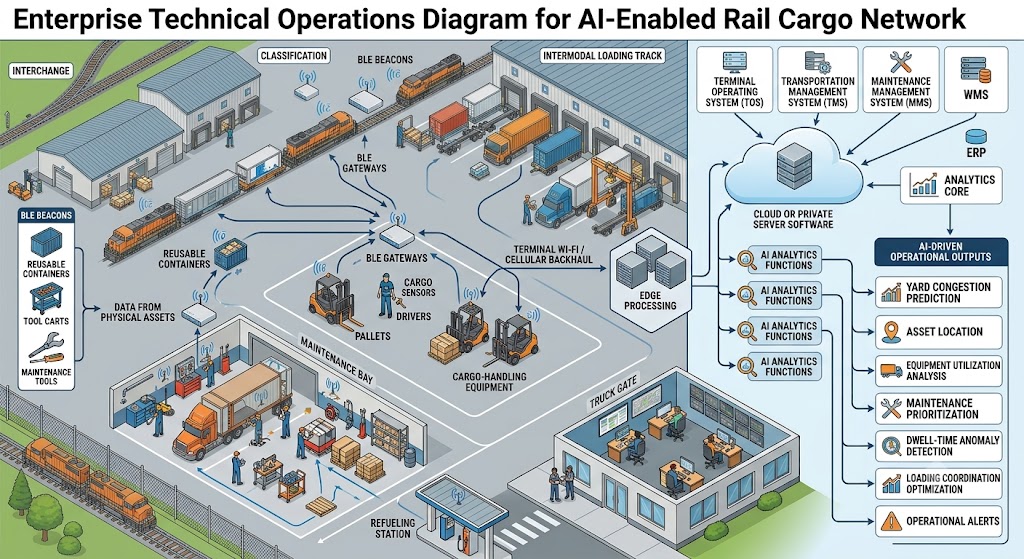
BLE gateways positioned around selected terminal zones can receive beacon transmissions from tagged operational assets such as yard equipment, mobile maintenance equipment, containers, or other designated assets. These events can supplement rail operating records by providing localized information about where selected assets are present.
AI models can correlate arrival schedules, track occupancy, terminal workload, weather conditions, historical dwell times, and equipment availability. The system can then identify terminals likely to experience congestion or resource shortages.
Intermodal Terminal and Yard Operations
Intermodal yards coordinate railcars, containers, chassis, cranes, reach stackers, forklifts, hostlers, trucks, and other equipment. Yard personnel need accurate information about asset status and location to reduce unnecessary searching and movement.
AI can analyze container events, railcar status, equipment utilization, gate transactions, work orders, and yard activity. BLE can provide proximity or zone information for selected mobile assets and equipment where GPS may be excessive or where indoor or localized visibility is required.
A practical deployment can divide the terminal into receiving, staging, loading, unloading, inspection, maintenance, interchange, and restricted areas. BLE gateways collect local beacon events, while the AI system combines these observations with terminal operating data. The result can support equipment dispatch, exception management, and yard resource planning.
Cargo Loading, Unloading, and Staging
Bulk freight, breakbulk cargo, intermodal containers, automotive shipments, agricultural products, chemicals, metals, and other commodities require different handling procedures. AI can evaluate planned cargo movements against loading schedules, available equipment, railcar assignments, and terminal capacity.
For selected reusable handling assets, BLE beacons can indicate movement between loading zones, staging areas, warehouses, maintenance locations, and storage areas. BLE sensors can also capture selected environmental conditions where temperature, vibration, humidity, or equipment condition is operationally relevant.
AI can use these events to identify staging delays, abnormal asset movement, equipment shortages, or recurring bottlenecks.
Railcar Inspection and Maintenance Coordination
Rail cargo networks depend on inspection, servicing, repair, and maintenance processes for locomotives, freight cars, loading equipment, cranes, forklifts, trackside equipment, and facility systems. Maintenance delays can reduce equipment availability and affect freight schedules.
AI can combine inspection findings, maintenance work orders, component histories, operating hours, fault records, and sensor information to prioritize work. BLE can help identify the location of selected maintenance assets, tools, mobile workstations, inspection equipment, and service equipment within maintenance facilities.
GAO can support these deployments with BLE gateways, BLE beacons, BLE sensors, RFID equipment, and other IoT hardware products and systems that provide field-level data for connected rail cargo applications.
Freight Handoff and Interchange Operations
Rail cargo frequently crosses organizational and geographic boundaries. Interchange processes can involve railroads, terminal operators, shippers, logistics providers, ports, warehouses, and trucking companies.
AI can compare planned handoff events with actual yard, gate, inspection, loading, and departure information. Exception models can identify missing events, prolonged dwell, unusual routing, or discrepancies that require investigation.
BLE can supplement these processes when specific reusable assets need zone-level visibility within terminals or facilities. It should not be treated as a universal replacement for railcar identification, container identification, electronic documentation, or shipment transaction systems.
AI Applications Across Rail Cargo Networks
AI Rail Freight Demand Forecasting
Freight volumes can vary by commodity, origin-destination pair, season, customer demand, port activity, agricultural cycles, industrial production, and regional economic conditions. AI forecasting models can evaluate historical shipment volumes together with schedules, customer orders, commodity patterns, weather information, and other relevant variables.
The resulting forecasts can support locomotive allocation, railcar availability planning, terminal staffing, track capacity planning, maintenance scheduling, and interchange coordination. Forecast accuracy should be measured separately by commodity, lane, terminal, and planning horizon because aggregate accuracy can conceal significant operational errors.
AI Railcar and Container Asset Management
Rail cargo operators manage large populations of railcars, containers, chassis, locomotives, maintenance equipment, and specialized handling assets. AI can identify underutilized assets, prolonged dwell, recurring movement patterns, abnormal utilization, and equipment shortages.
BLE is particularly useful when an organization needs localized visibility for selected operational assets inside terminals, workshops, warehouses, or maintenance facilities. A BLE beacon attached to a maintenance cart or mobile workstation can provide zone-level location events, while AI determines whether the asset is being used as expected.
Railcar and container identity should continue to rely on appropriate identification and transaction systems. BLE location events should be treated as complementary operational evidence rather than a substitute for established freight identification.
AI Yard Congestion and Dwell-Time Analytics
Yard congestion directly affects railcar dwell, train assembly, loading schedules, truck interchange, and terminal throughput. AI can evaluate historical dwell patterns alongside current track occupancy, train schedules, equipment availability, labor activity, weather, and terminal workload.
An anomaly model can flag railcars or containers that remain in a zone substantially longer than expected. A predictive model can estimate whether an approaching train or inbound shipment is likely to encounter a capacity constraint.
These capabilities allow dispatchers and terminal managers to prioritize interventions before congestion becomes a larger network problem.
AI Predictive Maintenance for Rail Cargo Equipment
Predictive maintenance uses historical and current equipment data to estimate failure risk or identify deteriorating operating conditions. Rail cargo deployments may incorporate locomotive maintenance records, inspection results, work orders, vibration information, operating hours, temperature data, fault codes, and equipment utilization.
AI can rank maintenance priorities based on failure probability and operational impact. A high-risk asset supporting a critical terminal process may receive attention before a similar asset with lower operational importance.
BLE sensors can contribute localized equipment or environmental measurements in facilities where such measurements are appropriate. BLE gateways can transmit those observations to edge or central systems for analysis.
AI-Based Freight Exception Management
Rail cargo networks generate many operational exceptions, including delayed arrivals, extended dwell, missing handoff events, equipment shortages, loading delays, inspection holds, maintenance constraints, and unexpected asset movements.
AI can classify exceptions according to severity, probable cause, affected shipment, terminal, customer commitment, and available corrective actions. Rather than presenting operators with large volumes of raw alerts, the system can prioritize events that have the greatest effect on service performance.
This approach is especially useful for network control centers and terminal operations teams responsible for coordinating multiple facilities.
BLE Hardware and AI Software for Rail Cargo Networks
BLE Beacons for Rail Cargo Assets and Equipment
BLE beacons can be attached to selected reusable assets such as maintenance carts, inspection tools, mobile workstations, yard equipment, service equipment, trailers, containers used for internal operations, and facility equipment. Their purpose is to transmit an identifiable BLE signal that can be detected by nearby gateways.
Beacon selection should consider battery life, enclosure requirements, mounting method, operating temperature, vibration exposure, maintenance access, and expected detection range. Rail cargo facilities can contain steel structures, locomotives, railcars, containers, cranes, and other objects that affect radio propagation.
BLE Gateways for Rail Terminals and Maintenance Facilities
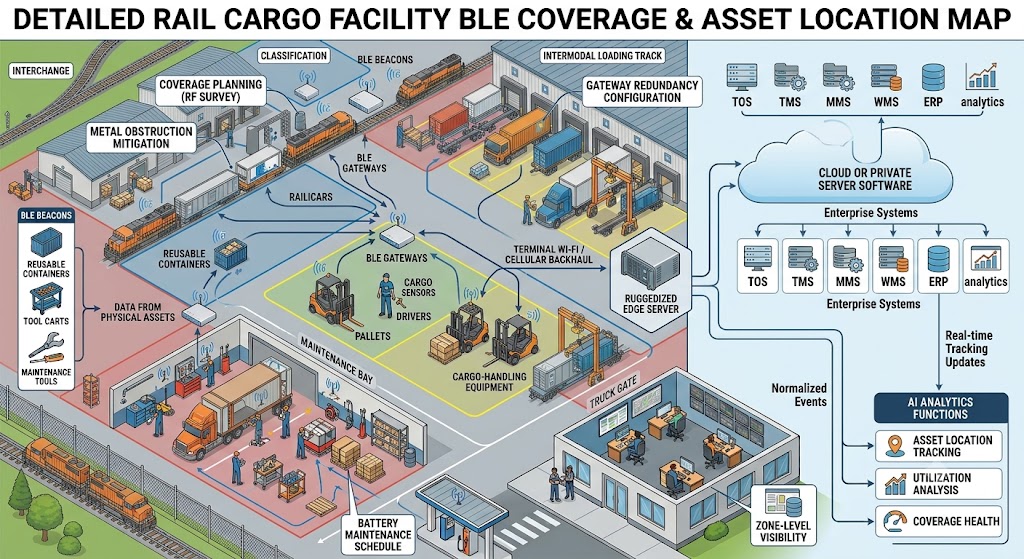
BLE gateways collect beacon transmissions within defined terminal or facility zones and forward relevant events to edge or central software. Gateway placement should reflect the physical geometry of classification yards, workshops, warehouses, loading areas, and restricted zones.
Industrial deployments may use Ethernet, Wi-Fi, cellular connectivity, or other available backhaul methods. Gateway redundancy may be appropriate in critical areas where loss of one communication point could create significant visibility gaps.
BLE Sensors for Rail Cargo Operations
BLE sensors can provide selected measurements related to temperature, humidity, vibration, equipment condition, or other operational parameters. Their use should be based on a defined business requirement rather than deploying sensors simply to generate more data.
For example, temperature information may be useful for selected controlled environments, while vibration monitoring can support maintenance analysis for equipment where the measurement is technically appropriate. Sensor calibration, battery management, sampling intervals, data retention, and maintenance procedures should be defined before deployment.
AI, Middleware, and Rail Cargo Software Integration
BLE events become more useful when they are associated with trusted asset records and operational transactions. Middleware can normalize gateway events and connect them with terminal operating systems, transportation management systems, WMS, ERP, CMMS or EAM software, maintenance databases, fleet systems, analytics repositories, and business intelligence tools.
Integration can use APIs, message queues, event streams, databases, or scheduled data exchanges depending on system requirements. Each integration should define data ownership, event timestamps, asset identifiers, authentication, error handling, retry behavior, audit requirements, and synchronization rules.
AI models can then use normalized data for forecasting, anomaly detection, classification, optimization, and predictive maintenance.
Cloud and Server Deployment for Rail Cargo AI
Rail cargo networks often span multiple terminals, yards, maintenance facilities, interchange locations, and corporate systems. Deployment decisions should therefore consider network availability, data sovereignty, latency, cybersecurity policies, integration requirements, AI processing workloads, and operational continuity.
Cloud Version
A cloud-hosted deployment can centralize data from multiple rail cargo facilities and support network-wide analytics. This model is useful when organizations need centralized dashboards, fleet-wide AI models, cross-terminal performance comparisons, scalable storage, and remote access for authorized personnel.
BLE gateway events can be transmitted to cloud services through secure network connections, with edge processing used where immediate local decisions or temporary connectivity loss require local handling. Cloud systems can also support centralized model management, software updates, reporting, and historical analytics.
Network connectivity must still be engineered carefully. Rail yards may contain remote areas, steel obstructions, intermittent wireless coverage, or restricted network zones. Buffering and store-and-forward mechanisms can prevent temporary communication outages from becoming permanent data gaps.
Server Version
A privately hosted server deployment can place AI, middleware, databases, or operational software on customer-managed servers, private data centers, facility servers, or edge computing infrastructure. This model may be preferred where rail cargo operators require tighter control over operational data, local processing, integration with existing private systems, or reduced dependence on external connectivity.
Edge servers can process BLE events close to the terminal and forward selected information to central systems. This arrangement can reduce latency for local alerts and maintain selected operational functions during temporary WAN interruptions.
Hybrid deployments are also practical. A rail terminal can use local servers for gateway management and immediate event processing while transferring normalized data to a central cloud environment for network-wide AI analytics.
GAO provides BLE gateways, BLE beacons, BLE sensors, RFID, and other IoT technology-based hardware products and systems that can be incorporated into cloud, server, or hybrid rail cargo solutions.
Engineering Considerations for AI-Enabled Rail Cargo Networks
Rail cargo deployments require careful engineering because yards, terminals, maintenance facilities, warehouses, interchange points, and trackside areas have different physical and operational characteristics. Steel railcars, containers, locomotives, cranes, buildings, and other large structures can affect BLE radio propagation. The system should therefore be designed around actual workflows and required visibility rather than assuming uniform wireless coverage.
BLE Coverage and Device Placement
BLE coverage planning should begin with a site survey covering classification yards, loading tracks, intermodal areas, warehouses, maintenance shops, inspection locations, gates, storage zones, and other areas where tracked assets operate.
Gateway placement should account for:
- Required zone-level or proximity-level location accuracy.
- Metal railcars, containers, cranes, shelving, and other obstructions.
- Indoor and outdoor operating conditions.
- Gateway mounting height and physical protection.
- Network connectivity and available power.
- Expected beacon density and simultaneous transmissions.
- Battery replacement and maintenance access.
- Areas where asset visibility is operationally critical.
A rail maintenance shop may require more precise coverage than a large open storage yard because personnel may need to locate tools, inspection equipment, mobile workstations, and maintenance assets within specific work areas.
BLE should be validated under actual operating conditions. A laboratory radio test may not accurately represent a yard containing locomotives, stacked containers, moving railcars, heavy equipment, and changing vehicle positions.
Asset Identity and Freight Traceability
Rail cargo systems commonly manage several different identity domains. Railcar identifiers, container numbers, shipment references, locomotive identifiers, equipment IDs, work-order numbers, customer references, and internal asset IDs should not be treated as interchangeable.
BLE can provide an observation such as “asset beacon detected near maintenance zone,” while a transportation or terminal system may establish that a particular railcar arrived, a container was loaded, or a shipment was handed over.
A strong implementation maintains a mapping between the BLE device identifier and the organization’s asset master record. Identity changes, beacon replacement, asset retirement, and reassignment should be auditable.
BLE therefore complements, rather than replaces, established freight identification technologies and transaction records. RFID, barcode scanning, railcar identification systems, gate systems, computer vision, GPS, telematics, and manual inspections may all contribute different forms of evidence.
Data Quality and Event Normalization
AI results depend heavily on reliable operational data. Raw BLE observations should be normalized before they are used for forecasting or anomaly detection.
A normalized event can include:
- Beacon or sensor identifier.
- Gateway identifier.
- Rail terminal or facility identifier.
- Zone or operating area.
- Asset identifier.
- Timestamp.
- Signal information.
- Event type.
- Estimated location.
- Confidence level.
- Device health status.
- Battery condition where available.
- Connectivity status.
Data processing should identify duplicate events, stale devices, missing transmissions, inconsistent timestamps, gateway failures, incorrect asset mappings, and abnormal signal behavior. Time synchronization is particularly important when AI compares BLE observations with train movement, gate, loading, inspection, or maintenance events.
Integration with Rail Cargo Systems
AI-enabled rail cargo solutions commonly exchange information with transportation management systems, terminal operating systems, fleet management software, WMS, ERP, CMMS or EAM applications, maintenance systems, customer portals, dispatch systems, business intelligence tools, and data warehouses.
Integration design should define:
- Which system owns each operational record.
- Which system generates an event.
- How identifiers are synchronized.
- How API authentication is handled.
- How duplicate events are detected.
- How failed transactions are retried.
- How historical data is retained.
- How operational changes are audited.
A useful integration does more than move BLE events between systems. It establishes the relationship between physical observations and business transactions so AI models can understand why an asset event matters.
AI Use Cases That Improve Rail Cargo Network Performance
Predictive Freight Demand and Capacity Planning
AI forecasting can combine historical freight volumes, commodity flows, customer orders, seasonal patterns, port activity, agricultural production, industrial output, and network schedules.
Rail cargo planners can use these forecasts to anticipate railcar requirements, locomotive demand, terminal capacity, crew requirements, track utilization, and equipment needs. Models should be monitored by lane, commodity, customer segment, and planning horizon because demand behavior can differ substantially across rail freight categories.
Yard Congestion and Dwell-Time Anomaly Detection
Dwell time is a critical rail cargo performance measure because prolonged railcar or container stays can consume terminal capacity and affect customer service.
AI can establish expected dwell patterns by facility, cargo type, operating process, time of day, and traffic condition. It can then flag exceptions when a railcar, container, or operational asset remains in a location longer than expected.
BLE observations can add context for selected assets operating inside terminals. For example, a maintenance cart that remains in a staging area may indicate an equipment allocation issue, while a mobile workstation repeatedly moving between maintenance zones may reveal a recurring workflow pattern.
Rail Equipment and Maintenance Intelligence
Maintenance teams can use AI to prioritize inspections and repairs based on failure history, operating hours, work orders, equipment utilization, sensor measurements, and service schedules.
BLE-enabled location information can help maintenance departments determine where selected tools, mobile service equipment, inspection devices, and other reusable assets are located. AI can combine this information with work orders to improve resource assignment.
The strongest results occur when predictive maintenance recommendations are connected directly to maintenance workflows instead of being presented only as analytical reports.
Intermodal Fulfillment and Transfer Optimization
Intermodal operations require coordination between rail, truck, container, terminal, and warehouse processes. AI can identify bottlenecks between arrival, unloading, staging, loading, gate processing, and departure.
A model can estimate which shipments or containers are at risk of missing planned connections and recommend prioritization based on customer commitments, departure schedules, terminal capacity, and available handling resources.
BLE can provide supporting location information for selected equipment and internal operational assets. It is most useful when the location information directly supports a defined terminal decision.
Asset Utilization and Recovery
Rail cargo organizations often operate fleets of tools, mobile equipment, inspection devices, service carts, containers, chassis, and other reusable assets. Assets can become underutilized, misplaced, or unavailable when their locations are not known.
AI can analyze movement history and utilization patterns to identify assets that remain idle for extended periods or are frequently moved between facilities. BLE can supply location events for selected assets, allowing the organization to investigate utilization and recovery opportunities.
Cybersecurity and Data Protection for Rail Cargo Networks
Rail cargo systems connect operational technology, information systems, wireless devices, enterprise software, maintenance systems, and external business partners. Security therefore needs to cover both the IoT field layer and the systems that consume its data.
Important controls include:
- Unique device identities and credentials.
- Strong authentication for gateways, servers, APIs, and administrative users.
- Encryption for data transmitted between gateways, edge systems, servers, and cloud services.
- Network segmentation between IoT devices and critical operational systems.
- Role-based access control for terminal, maintenance, dispatch, and administrative personnel.
- Secure API authentication and authorization.
- Controlled firmware and software updates.
- Certificate and credential lifecycle management.
- Logging of device, user, API, and system events.
- Vulnerability assessment and patch management.
- Secure commissioning and decommissioning of BLE devices.
- Backup and recovery procedures for operational databases and configurations.
- Defined data retention and deletion policies.
- Incident response procedures covering compromised devices and abnormal network activity.
Rail cargo organizations should also consider cybersecurity requirements associated with critical transportation infrastructure, contractual requirements, privacy obligations, and applicable regulatory frameworks. BLE connectivity by itself does not make a rail cargo system compliant or secure. Security must be engineered across devices, networks, software, identities, interfaces, and operational procedures.
GAO’s experience supplying BLE, RFID, and other IoT hardware products and systems supports deployments where device-level security, communication reliability, and enterprise integration need to be considered together.
Deployment Lifecycle for AI-Enabled Rail Cargo Networks
Planning and Rail Facility Assessment
Deployment planning should start with measurable operational objectives. Examples include reducing asset search time, improving maintenance equipment availability, reducing terminal dwell, increasing visibility of selected assets, improving equipment utilization, or detecting operational exceptions earlier.
The assessment should document:
- Rail yard and terminal layouts.
- Classification and staging processes.
- Intermodal workflows.
- Maintenance operations.
- Existing wireless infrastructure.
- Network availability.
- Power availability.
- Asset populations.
- Existing identification technologies.
- Enterprise software interfaces.
- Cybersecurity requirements.
- Data ownership and retention requirements.
Hardware Selection and Pilot Deployment
BLE gateway, beacon, and sensor selection should reflect environmental exposure, mounting conditions, battery requirements, expected range, temperature, vibration, ingress protection, maintenance practices, and required data frequency.
A pilot should include representative railcars, containers, equipment, maintenance areas, loading zones, and operating conditions. Testing only an empty facility can produce misleading coverage results.
The pilot should establish whether the expected location information is accurate enough to support the intended business workflow.
Integration and System Testing
Integration testing should cover the complete data path from physical event generation to business action.
Testing should verify:
- BLE device registration.
- Asset identity mapping.
- Gateway connectivity.
- Event transmission.
- Location determination.
- Sensor data integrity.
- Middleware normalization.
- API authentication.
- Inventory and asset system synchronization.
- Terminal operating system integration.
- Maintenance system integration.
- Error handling and retries.
- Offline buffering and recovery.
- AI model inputs and outputs.
- Dashboard and alert behavior.
- User permissions.
- Audit records.
AI validation should also test false positives, false negatives, missing data, abnormal operating conditions, and changes in freight patterns.
Commissioning and Operational Optimization
Commissioning should occur under actual rail cargo conditions. Teams should verify that gateways detect expected devices, that asset mappings are correct, and that operational alerts correspond to real workflows.
Optimization may involve changing gateway locations, adjusting beacon transmission intervals, modifying sensor sampling rates, refining zone definitions, improving data filters, retraining models, or changing alert thresholds.
Maintenance procedures should include battery replacement, gateway health checks, device inspection, firmware management, asset reassignment, and periodic coverage validation.
Scaling Across Rail Cargo Facilities
Once the pilot demonstrates measurable value, deployment can expand to additional terminals, maintenance facilities, intermodal yards, warehouses, and interchange locations.
A scalable implementation should standardize device naming, asset identifiers, gateway configuration, cybersecurity controls, data schemas, integration interfaces, commissioning procedures, and maintenance processes.
GAO can provide technology products and engineering-oriented support for organizations expanding connected IoT deployments across multiple operational locations.
KPIs for AI-Enabled Rail Cargo Networks
Rail cargo organizations should measure both business outcomes and technical performance. Useful KPIs include:
- Railcar dwell time
- Terminal throughput
- Train arrival variance
- Train departure variance
- Yard congestion rate
- Freight volume forecast error
- Railcar utilization
- Locomotive utilization
- Intermodal container dwell time
- Loading cycle time
- Unloading cycle time
- Terminal transfer cycle time
- Interchange processing time
- Shipment exception rate
- On-time freight performance
- Asset utilization
- Asset recovery rate
- Equipment availability
- Maintenance response time
- Maintenance completion time
- Unplanned equipment downtime
- Predictive maintenance precision
- AI anomaly detection precision
- BLE gateway availability
- BLE beacon availability
- BLE sensor data completeness
- Event processing latency
- Data synchronization success rate
- API transaction failure rate
- Asset identity accuracy
These measures should be connected to specific operational objectives. A BLE availability metric, for example, is useful only when the corresponding location data supports a meaningful rail cargo workflow.
Practical Benefits of AI and BLE for Rail Cargo Networks
AI and BLE can create value when the technology is connected to defined rail cargo processes rather than deployed simply to increase data collection.
Key benefits include:
- Better visibility of selected operational assets within yards, terminals, warehouses, and maintenance facilities.
- Earlier detection of abnormal railcar, container, equipment, or terminal dwell patterns.
- Improved maintenance prioritization using operational and historical equipment information.
- Better utilization of maintenance tools, mobile workstations, inspection equipment, and selected reusable assets.
- Improved terminal resource planning through AI-based demand and congestion forecasting.
- Faster identification of freight and equipment exceptions.
- Better coordination between loading, unloading, staging, interchange, and departure processes.
- Improved data consistency across terminal, maintenance, transportation, and enterprise systems.
- More effective asset recovery when equipment remains outside expected operating zones.
- Better operational reporting through integration of physical observations with business transactions.
The strongest business results occur when AI recommendations trigger specific actions, such as assigning equipment, prioritizing an inspection, investigating an abnormal dwell event, changing a staging decision, or escalating a freight exception.
Implementation Recommendations for Rail Cargo Networks
Successful implementation should begin with the operational decision the organization wants to improve, followed by identification of the data required to support that decision.
Recommended practices include:
- Define measurable rail cargo objectives before selecting hardware.
- Map yard, terminal, intermodal, maintenance, and interchange workflows.
- Separate freight identification from operational asset location.
- Conduct RF and network surveys before gateway deployment.
- Select BLE hardware based on actual rail cargo environmental conditions.
- Establish a controlled asset identity model.
- Integrate BLE observations with trusted transportation and maintenance records.
- Validate data quality before deploying AI models.
- Pilot representative facilities rather than idealized environments.
- Test steel-heavy and high-density operating conditions.
- Establish battery replacement and device maintenance procedures.
- Design for network outages and store-and-forward operation.
- Validate AI models against real terminal and freight conditions.
- Monitor false positives and false negatives.
- Apply network segmentation and strong identity controls.
- Establish technical and business KPIs together.
- Standardize configurations before expanding across facilities.
- Periodically reassess gateway coverage as yard layouts and workflows change.
GAO is headquartered in New York City and Toronto, Canada, and is ranked among the top 10 leading B2B and B2G BLE and RFID suppliers globally, with a lesser degree of B2B2C and B2D activity. We provide BLE, RFID, and other IoT technology-based hardware products and systems that can support connected rail cargo applications.
GAO Engineering and Technology Support for Rail Cargo Networks
GAO has served customers in the United States and Canada for three decades, including Fortune 500 companies, leading R&D firms, prestigious universities, and U.S. and Canadian government agencies. This experience includes substantial investment in R&D for BLE, RFID, and other IoT products and systems.
For rail cargo applications, our technology portfolio can support connected asset tracking, localized equipment visibility, environmental monitoring, maintenance workflows, terminal operations, and data acquisition. Hardware selection can be aligned with the physical conditions of yards, maintenance facilities, warehouses, and transportation environments.
Our stringent quality assurance processes are designed to support reliable technology deployment, while remote and onsite expert support can assist organizations with product selection, integration considerations, commissioning, troubleshooting, and operational deployment.
Building the Future of Industrial AI and IoT with Aperture Venture Studio and GAO RFID Inc.
For more than three decades, GAO has invested heavily in R&D involving industrial BLE, RFID, and IoT technologies. As AI became increasingly useful for industrial applications, we expanded work combining AI with connected technologies to address practical transportation and logistics requirements. We have founded Aperture Venture Studio to support the development and application of AI and IoT solutions relevant to rail cargo networks, including freight visibility, terminal operations, asset tracking, maintenance, and connected transportation workflows.
Aperture has attracted AI and IoT technical experts, operational executives, investors, and leading companies. We have also developed the Aperture Ventures Summit and TekSummit to discuss advanced AI and IoT topics. We welcome advisors, technical professionals, investors, customers, and organizations interested in applying AI and IoT to practical rail cargo operations.