
AI and BLE for Cold Storage Operations
AI-Driven Meat Processing for Traceability, Quality, and Production Control
AI and RFID for meat processing combines artificial intelligence with connected identification, sensing, production, and enterprise systems to improve how meat plants track products, monitor operations, control inventory, and respond to production conditions. RFID can identify carcasses, primal cuts, cases, pallets, reusable containers, tools, and other production assets, while AI can analyze identification events alongside temperature, equipment, quality, production, and environmental data. The result is a more connected approach to meat processing traceability, cold-chain monitoring, quality assurance, inventory control, and operational decision-making. For regulated meat and poultry establishments, technology should complement established HACCP, sanitation, inspection, and verification procedures rather than replace them. GAO supplies RFID, BLE, and IoT hardware products and systems that can be integrated into meat processing workflows to support automated data capture and operational visibility.
RFID and AI Traceability in a Modern Meat Processing Facility
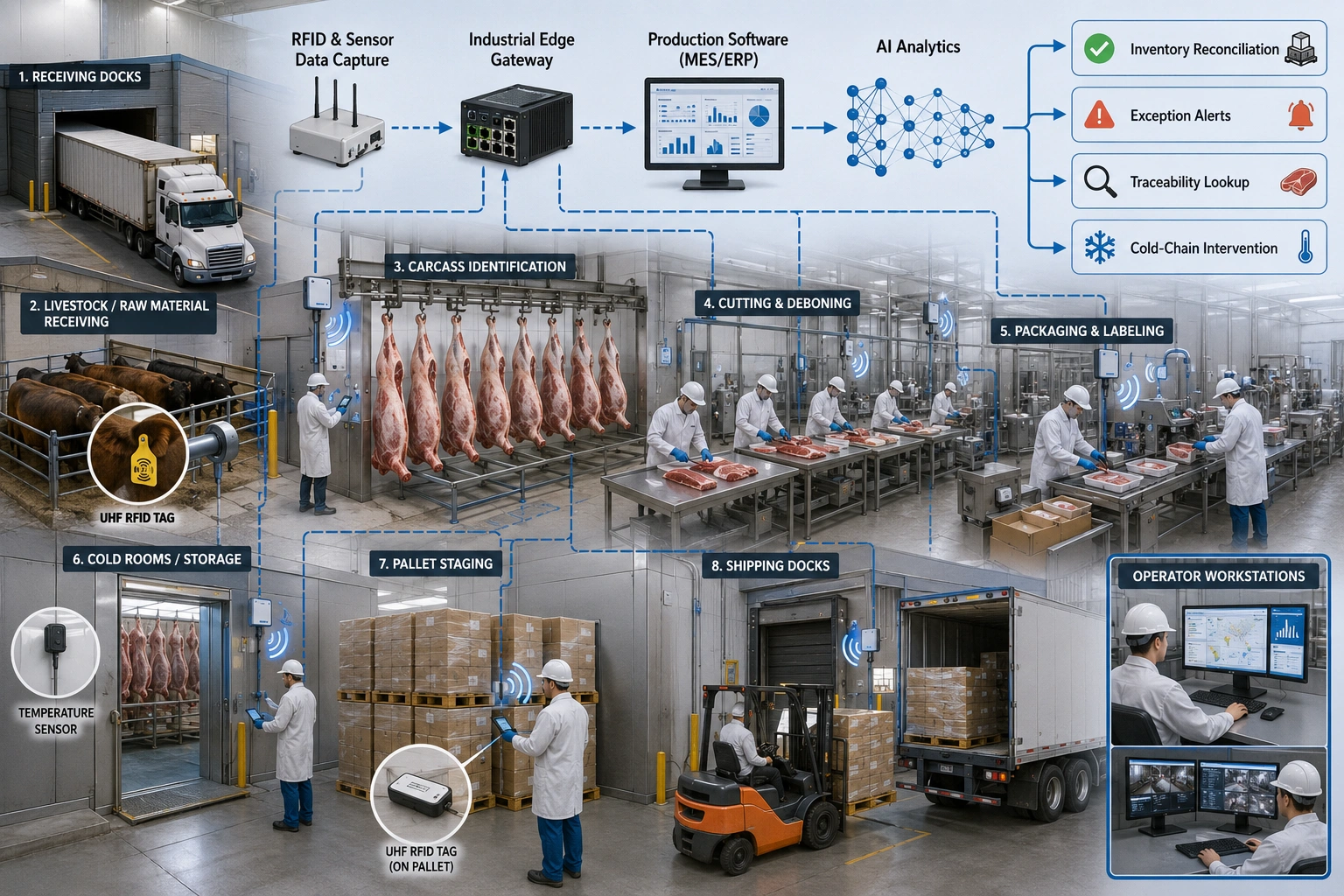
A realistic meat processing facility shows RFID tags, sensors, edge gateways, MES/ERP software, and AI analytics working together across receiving, processing, packaging, cold storage, and shipping. The visual highlights automated traceability, inventory reconciliation, exception alerts, and cold-chain monitoring.
How AI Changes Meat Processing Operations
Traditional meat processing data is often distributed across production records, scales, barcode scans, laboratory results, temperature logs, maintenance systems, inspection records, and manually entered production information. AI becomes useful when these data sources can be connected to operational events and interpreted in context.
For example, a meat processor can associate an RFID identity with a lot, case, pallet, reusable container, or work-in-process unit and then combine that identity with production timestamps, process location, weight, temperature, equipment status, and quality information. AI models can use this combined data to detect unusual patterns, predict operational problems, prioritize exceptions, or recommend actions.
The practical value comes from connecting an AI decision to a physical meat processing event. A model that identifies an abnormal production pattern is more useful when the system can determine which production line, lot, pallet, cold room, conveyor, or packaging station is involved.
Meat processing also requires a clear distinction between prediction and food safety control. AI may help identify risk patterns, prioritize inspections, detect deviations, or improve process visibility, but the facility’s validated food safety controls and regulatory procedures remain authoritative. FSIS HACCP requirements are designed around controlling hazards reasonably likely to occur, while FSIS verification activities examine compliance with pathogen reduction, sanitation, and HACCP requirements.
Where AI Creates the Most Value in Meat Processing
- AI-assisted traceability: Correlates RFID events, lot information, production records, and shipping movements to improve genealogy and retrieval of affected product.
- AI cold-chain monitoring: Analyzes temperature readings, dwell times, door activity, refrigeration conditions, and product movement to identify abnormal thermal conditions.
- AI quality inspection: Combines computer vision and production data to identify visible defects, packaging abnormalities, labeling problems, or process deviations where appropriate.
- AI production monitoring: Detects abnormal throughput, excessive dwell time, line stoppages, recurring bottlenecks, and unusual production patterns.
- AI inventory management: Uses RFID movement events and production consumption data to improve visibility of raw materials, work in process, packaging materials, finished cases, and pallets.
- AI asset tracking: Tracks reusable meat tubs, racks, carts, totes, bins, tools, and other mobile assets to reduce search time and improve asset availability.
- AI predictive maintenance: Combines equipment telemetry, operating conditions, maintenance history, and production events to identify patterns associated with equipment failure or degradation.
- AI sanitation analytics: Correlates sanitation schedules, equipment status, production cycles, environmental observations, and documented corrective actions to help identify recurring operational patterns.
- AI labor and workflow analysis: Uses authorized operational data to identify process congestion, unnecessary movement, delayed material handling, and workflow imbalances without treating AI output as a substitute for management judgment.
GAO’s RFID, BLE, and IoT technologies can provide the physical data-capture layer needed for these applications, while AI software can turn the resulting data into operational insights.
AI Use-Case Matrix for Meat Processing: RFID, IoT & AI Applications
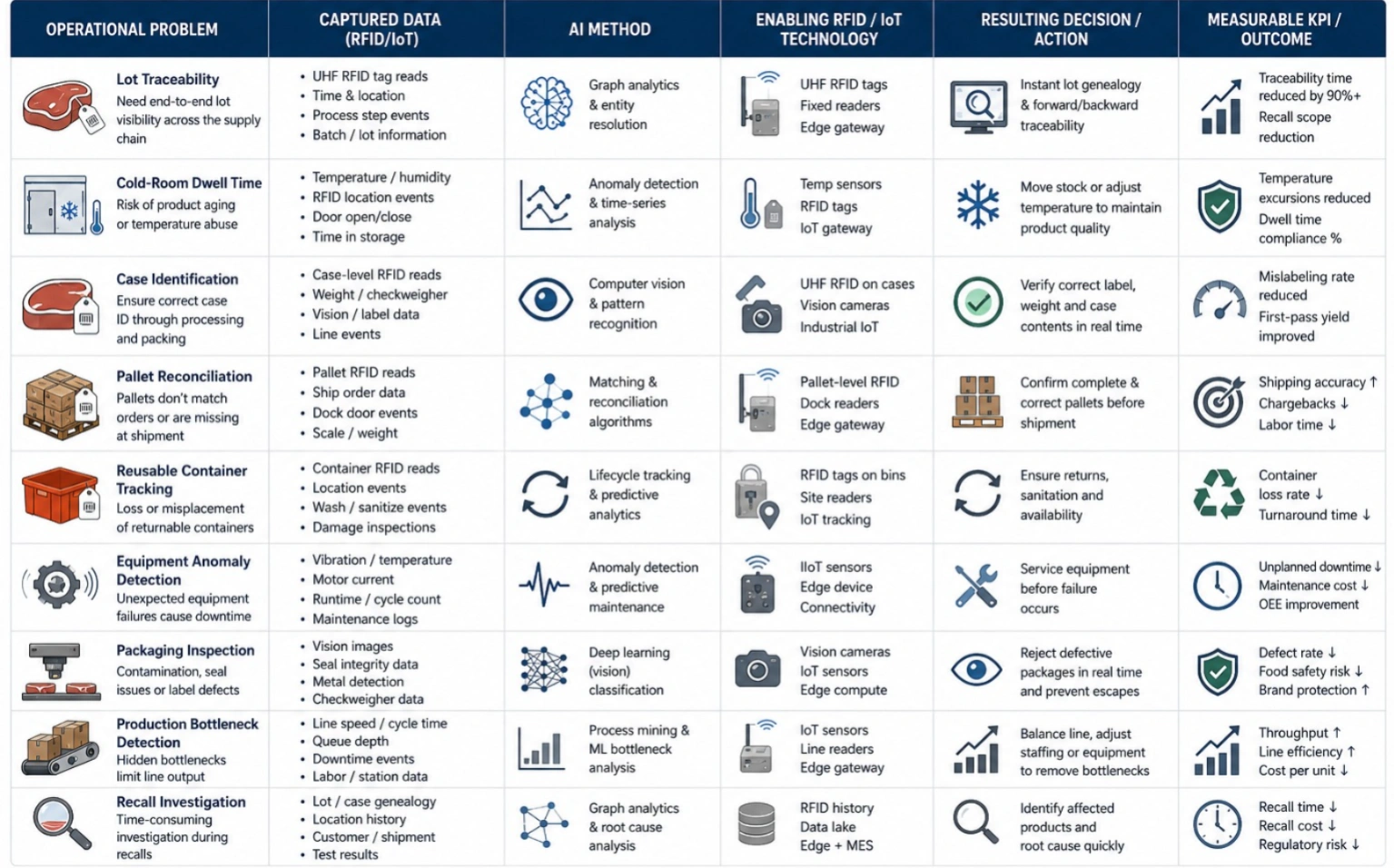
A B2B technology matrix maps key meat-processing challenges to captured RFID/IoT data, AI methods, enabling technologies, operational decisions, and measurable KPIs. It shows how AI can improve traceability, cold-chain monitoring, packaging inspection, equipment maintenance, bottleneck detection, and recall investigations.
Meat Processing Workflows Where AI and RFID Deliver Operational Visibility
Meat processing contains multiple identity transitions. Raw materials enter the facility, production lots move through processing steps, products may be cut or combined, cases are packaged, pallets are assembled, products enter refrigerated storage, and finished goods are dispatched. Each transition creates an opportunity to capture a machine-readable event.
A practical implementation starts by defining the traceability object rather than installing readers first. Depending on the process, the tracked object may be an animal or carcass identifier, production lot, batch, tote, case, pallet, reusable container, or shipping unit. The identification level should match the business question and the required traceability granularity.
Receiving and Raw-Material Identification
Receiving is the first opportunity to establish reliable digital identity. RFID can associate incoming materials or containers with supplier, lot, receiving time, location, and other relevant records. Handheld RFID readers are useful where items are not constrained to a fixed conveyor path, while fixed readers can automate identification at controlled portals.
AI can analyze receiving patterns to identify unusual quantities, unexpected dwell times, recurring receiving delays, or discrepancies between expected and physically observed material.
Cutting, Deboning, Grinding, and Work-in-Process
Processing lines create rapid material movement and frequent transformations. Tracking every individual piece may not always be economically or technically appropriate. A more practical approach can identify containers, production lots, racks, totes, or defined work-in-process units at selected control points.
AI can combine RFID movement events with production counts, weights, machine states, and timestamps to detect bottlenecks. For example, repeated increases in dwell time between two processing stages can indicate a material-handling constraint, equipment issue, staffing imbalance, or scheduling problem that warrants investigation.
Packaging and Case-Level Traceability
Packaging creates a particularly useful point for automated identification. RFID can associate cases with product identifiers, lot information, production time, packaging line, and palletization events. GS1 standards support EPC/RFID identification and visibility-event concepts, while EPCIS provides a standardized framework for sharing visibility event data between applications.
AI can use these events to detect anomalies such as unexpected case counts, unusual pallet composition, repeated identification failures, or inconsistencies between production and shipping records.
Refrigerated Storage and Cold-Chain Control
Cold rooms create a different engineering problem because metal structures, liquids, condensation, refrigeration equipment, and dense product arrangements can affect radio performance and sensor placement.
RFID should therefore be engineered around the physical environment rather than treated as a simple tag-and-reader installation. Temperature sensing may be provided through separate IoT sensors or specialized RFID-enabled sensing devices, depending on the required measurement frequency, accuracy, battery life, and environmental conditions.
AI can evaluate temperature trends together with product dwell time and movement events. This allows a meat processor to prioritize exceptions rather than treating every temperature observation independently.
Shipping and Distribution
Shipping is where product identity becomes operationally important for outbound verification. Fixed RFID portals, handheld readers, barcode systems, weighing equipment, and shipping software can work together to verify that the expected cases or pallets are associated with the correct outbound transaction.
AI can compare planned shipments against actual movement events and flag anomalies before dispatch. The objective is not simply faster scanning. It is improved confidence that the physical shipment corresponds with the digital shipping record.
End-to-End Meat Supply Chain Traceability Flow with RFID, Sensors, MES, and AI Analytics
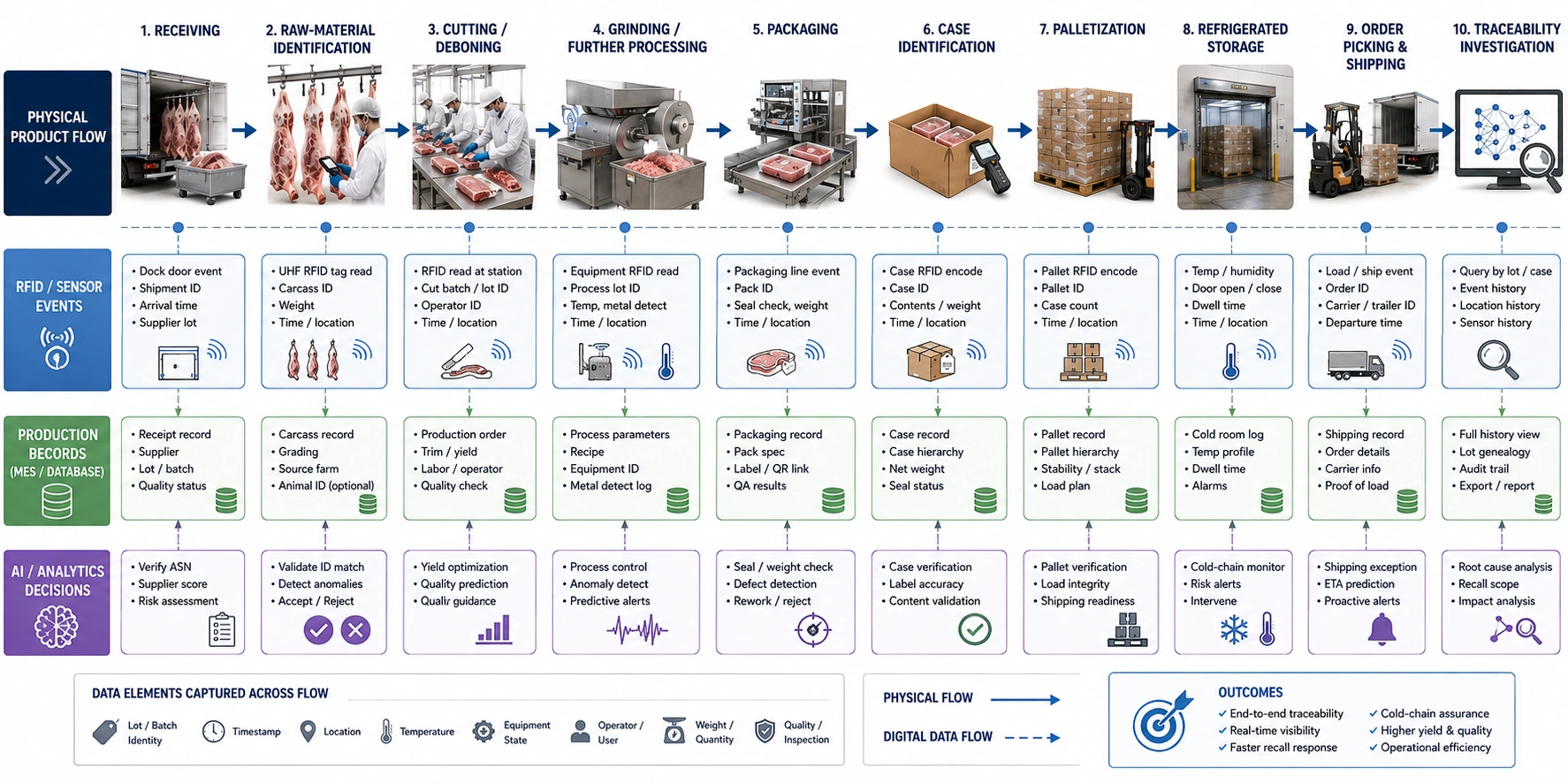
This visual illustrates a complete meat production and supply chain workflow, from receiving raw materials through cutting, processing, packaging, palletization, refrigerated storage, shipping, and final traceability investigation. RFID and sensor events capture real-time data throughout the physical flow, while MES/database records and AI analytics support quality control, anomaly detection, cold-chain monitoring, and end-to-end traceability.
From RFID Events to AI-Driven Meat Processing Decisions
A reliable AI solution begins with disciplined data acquisition. RFID readers capture tag identifiers and timestamps. IoT sensors can provide temperature, humidity, vibration, energy, equipment-state, or other process information. Machine vision systems can provide image-based observations. Production equipment can contribute machine-state and throughput information.
These data streams normally pass through a communication layer and middleware before reaching operational databases, analytics software, or AI models.
Data Acquisition
Fixed RFID readers are appropriate for controlled locations such as receiving portals, conveyor transfer points, packaging areas, palletization stations, cold-room entrances, and shipping docks. Handheld readers provide flexibility for inventory counts, exception handling, cycle counting, and locating mobile assets.
Tag selection depends on the tracked object and environment. UHF RFID is generally attractive for longer-range, multi-item identification, while HF and LF RFID can be appropriate where their respective read characteristics, operating range, form factor, or application constraints fit the meat processing workflow. GS1’s current EPC UHF Gen2 standard defines the UHF RFID air interface used by RAIN RFID systems, with the current GS1 standard updated in 2026.
Edge Processing and Middleware
Edge computing becomes valuable where decisions must be made close to the production line or where continuous cloud connectivity is not guaranteed. An edge computer or industrial server can normalize RFID reads, remove duplicate events, associate identities with locations, buffer data during network interruptions, and apply local rules.
Middleware is particularly important because raw RFID reads are not automatically meaningful business events. A reader may detect the same tag multiple times. Software must convert those observations into events such as “case entered packaging zone,” “pallet entered cold storage,” or “container returned to sanitation.”
AI Analytics and Decision Support
AI models can operate on historical and real-time data after the underlying events have been normalized. Appropriate methods may include anomaly detection, time-series forecasting, classification, computer vision, clustering, predictive maintenance models, and optimization algorithms.
The model should produce an operationally understandable result. Instead of simply reporting a high anomaly score, the software should identify the affected production area, relevant lot or asset, supporting observations, confidence level where appropriate, and recommended next action.
Human review remains important for safety-critical or regulatory decisions. AI output should be treated as decision support unless the application has been specifically validated for automated control.
Technical Components for AI-Enabled Meat Processing
A practical solution typically combines several technical layers rather than relying on a single device or software application.
RFID Hardware
RFID hardware provides automatic identification of physical objects and locations.
- UHF RFID readers and tags: Suitable for many case, pallet, container, and asset-tracking applications where longer read ranges and multi-tag identification are useful.
- HF RFID: Useful for shorter-range identification and applications where HF’s operating characteristics and form factors fit the process.
- LF RFID: Appropriate for specialized short-range identification scenarios where LF characteristics provide a practical advantage.
- Fixed RFID readers: Installed at controlled points such as portals, conveyor areas, production transitions, storage entrances, and shipping locations.
- Handheld RFID readers: Used for inventory verification, exception resolution, asset searches, and mobile traceability activities.
- RFID antennas: Positioned according to conveyor geometry, tag orientation, material composition, read zone, and required coverage.
RFID engineering should account for stainless steel, water-rich meat products, dense case packing, refrigeration areas, conveyor speed, tag orientation, reader interference, and the possibility of unintended reads from adjacent zones.
Sensors, Gateways, and Edge Computing
IoT sensors extend the system beyond identity. Temperature sensors can support refrigerated storage monitoring, while vibration and electrical measurements can contribute to equipment condition monitoring.
Industrial gateways aggregate RFID and sensor information and communicate with local servers or cloud software using appropriate industrial and IT protocols. Depending on the existing plant environment, integration may involve Ethernet, Wi-Fi, cellular connectivity, MQTT, REST APIs, OPC UA, or other supported interfaces.
Edge servers can perform local filtering, event processing, AI inference, and temporary data storage. This is useful when production decisions must continue during WAN interruptions.
AI Software and Enterprise Integration
AI software should integrate with the systems already responsible for production and business records.
Common integration targets include:
- MES for production execution, work orders, production states, and traceability events.
- ERP for purchasing, inventory, production planning, order management, and financial records.
- WMS for refrigerated inventory, pallet locations, warehouse movements, and shipping.
- CMMS or EAM software for maintenance history, work orders, equipment condition, and asset lifecycle management.
- QMS software for quality records, deviations, corrective actions, and inspection workflows.
- SCADA or industrial control systems for equipment and process data where appropriate.
- Laboratory and environmental monitoring systems for relevant testing and verification data.
AIoT Data Flow Architecture for Smart Meat Processing and Enterprise Integration
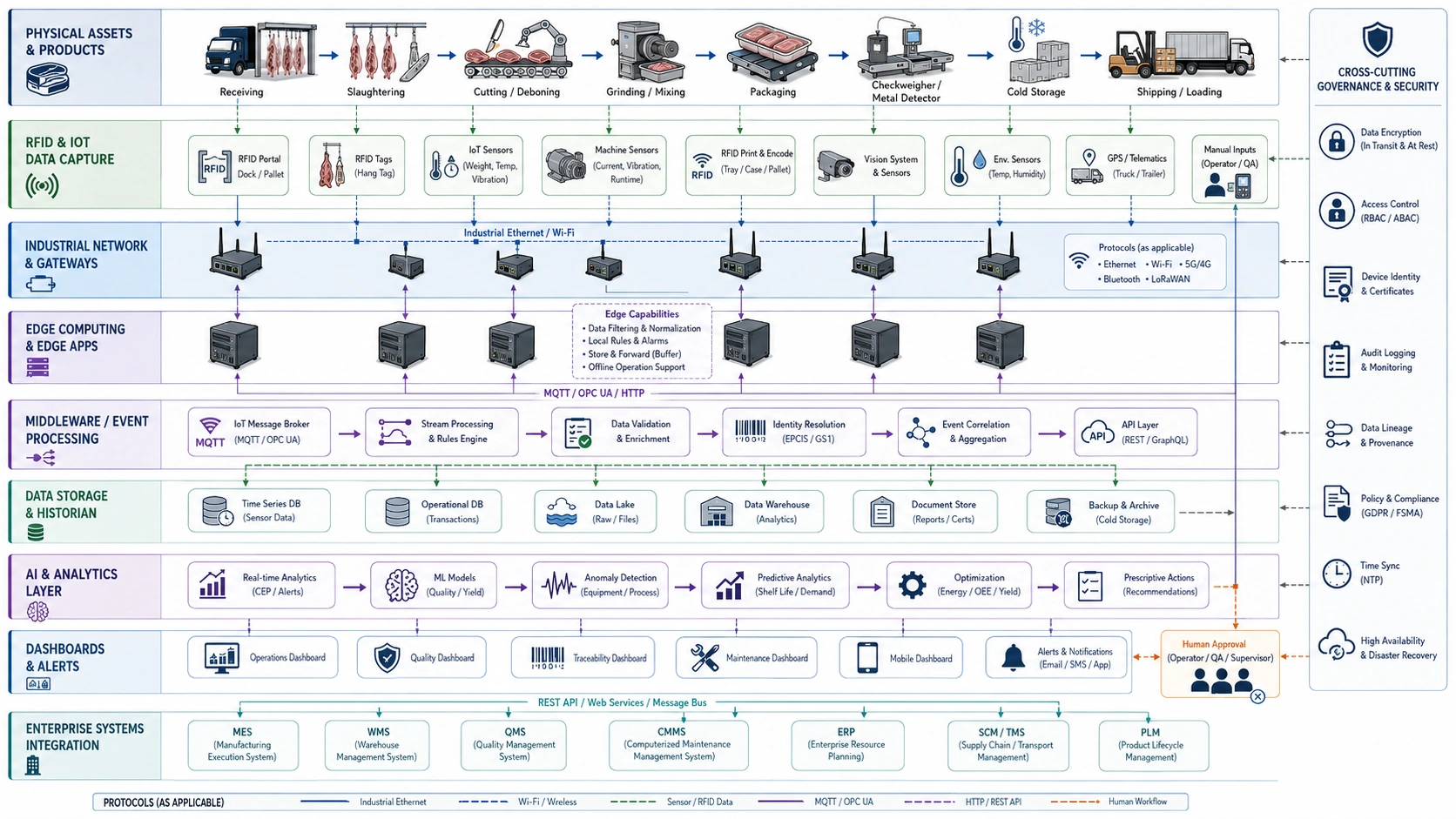
This visual illustrates the complete AIoT data architecture for meat processing, connecting physical assets and products with RFID and IoT sensors, industrial networks, edge computing, middleware, data storage, and AI analytics. It also shows how insights flow into dashboards and enterprise systems while incorporating security, data validation, identity resolution, audit logging, and human approval.
Cloud Version and Server Version
A Cloud Version can host application software, databases, analytics, dashboards, and AI services within managed cloud infrastructure. This model is useful for multi-site meat processors that need centralized reporting, centralized model management, remote monitoring, and common application services across plants.
A Server Version places software on customer-managed edge servers, factory servers, private data centers, or other privately hosted infrastructure. This model can be preferable where plant operations require local processing, strict data-control policies, low-latency decisions, or continued operation during unreliable external connectivity.
Hybrid deployments are often practical. RFID and sensor events can be processed locally for immediate operational decisions while selected historical or aggregated data is synchronized with centralized systems for cross-site analytics.
GAO can support organizations with RFID, BLE, and IoT hardware products and systems that form part of these deployment models, with implementation decisions driven by the plant’s physical environment, network conditions, data requirements, security controls, and existing software systems.
Engineering Priorities for AI-Enabled Meat Processing
Deploying AI in a meat processing facility requires more than connecting RFID readers and feeding production data into an AI model. The solution must account for hygienic design, refrigerated environments, metal surfaces, high-pressure washdown, production-line speed, product transformations, network reliability, data quality, cybersecurity, and the operational consequences of incorrect decisions.
A well-designed deployment begins with the business process and works backward toward the technology. Meat processors should first identify which production decisions are difficult, slow, or dependent on manual records. The RFID and IoT data model can then be designed around those decisions.
RFID Read-Performance Engineering
RFID performance in meat processing depends heavily on tag placement and the physical environment. Water-rich products and liquids can absorb or detune RF energy, while stainless-steel equipment can create reflections and multipath effects. Refrigeration areas can also introduce condensation and temperature-related hardware considerations.
Practical engineering measures include:
- Select tags specifically tested for the material and mounting surface rather than relying only on nominal read distance.
- Test tag orientation on actual cases, totes, racks, pallets, and reusable containers.
- Establish controlled read zones to reduce unintended identification events.
- Validate reader performance at the actual conveyor speed and product density.
- Separate adjacent read zones where the same tag could otherwise be detected by multiple readers.
- Use event filtering to convert repeated reader observations into meaningful production events.
- Perform acceptance testing under realistic operating conditions, including refrigeration and normal product loading.
Data Quality and Event Integrity
AI performance depends on the quality of the data supplied to the model. A meat processing system can generate large numbers of RFID observations, but volume does not guarantee useful information.
Middleware should validate identifiers, timestamps, locations, reader sources, and event sequences. Duplicate reads should be filtered, missing events should be identified, and unexpected movement should be treated as an exception rather than silently accepted.
A useful event model can establish relationships such as:
Product identity → lot/batch → processing step → location → timestamp → equipment → packaging unit → pallet → shipment
This relationship becomes particularly valuable during traceability investigations because personnel can move from a physical product identity to associated processing and shipping records without relying entirely on manual paperwork.
Cybersecurity for Connected Meat Processing Systems
Connecting RFID readers, gateways, sensors, edge servers, and enterprise software increases the number of connected assets that must be protected. Cybersecurity should therefore be incorporated during system design rather than added after deployment.
Relevant controls include:
- Network segmentation between production equipment, IoT devices, business systems, and external services.
- Unique device credentials and controlled administrative access.
- Encryption for communications where supported and appropriate.
- Role-based access controls for operators, maintenance personnel, quality teams, IT administrators, and management.
- Secure software and firmware update procedures.
- Centralized logging and audit trails.
- Backup and recovery procedures for databases and configuration files.
- Monitoring for unauthorized devices or unusual network behavior.
- Controlled API access between RFID software, AI applications, MES, ERP, WMS, QMS, and other systems.
A meat processor should also define what happens when network connectivity, an RFID reader, an edge server, or an AI service becomes unavailable. Production should have a documented fallback procedure rather than depending on continuous availability of a single digital component.
AI Models That Fit Meat Processing Operations
The appropriate AI method depends on the operational question and available data.
Anomaly Detection
Anomaly detection can identify unusual production behavior without requiring every possible failure condition to be explicitly labeled. Examples include unexpected dwell times, abnormal movement patterns, unusual equipment behavior, or deviations in normal production throughput.
For RFID-based applications, the model can evaluate event sequences rather than individual tag reads. A single missed read may not be operationally significant, while a repeated sequence of missing reads at the same processing station could indicate an equipment or reader problem.
Predictive Maintenance
AI-based predictive maintenance can combine machine telemetry, maintenance history, operating hours, vibration, temperature, motor information, and production conditions.
The objective is to identify degradation before an equipment failure disrupts meat processing. Depending on the equipment, useful targets can include conveyors, pumps, motors, compressors, refrigeration equipment, packaging machinery, and other production assets.
RFID can complement predictive maintenance by identifying the equipment, tool, container, or mobile asset associated with a maintenance event. The sensor data provides condition information while identification technology establishes asset context.
Computer Vision for Quality Inspection
Computer vision can analyze images from controlled inspection stations for applications such as package presentation, label placement, seal inspection, foreign-object detection where technically appropriate, or visible product and packaging characteristics.
The engineering challenge is controlling lighting, camera positioning, image quality, product variation, conveyor speed, and model performance. AI inspection should be validated against the actual product range and operating conditions rather than evaluated only with laboratory images.
AI-Assisted Traceability Analysis
Traceability systems generate relationships between product identity, production events, locations, lots, packaging units, pallets, and shipments. AI can help investigators search these relationships and identify unusual patterns.
For example, an AI-assisted system could help identify all affected production units associated with a particular lot, determine their recorded processing locations, and correlate the results with storage and shipping events.
The final traceability decision should remain supported by authoritative production and quality records.
AI Model Selection Guide for Meat Processing: Methods, Data, Use Cases & KPIs
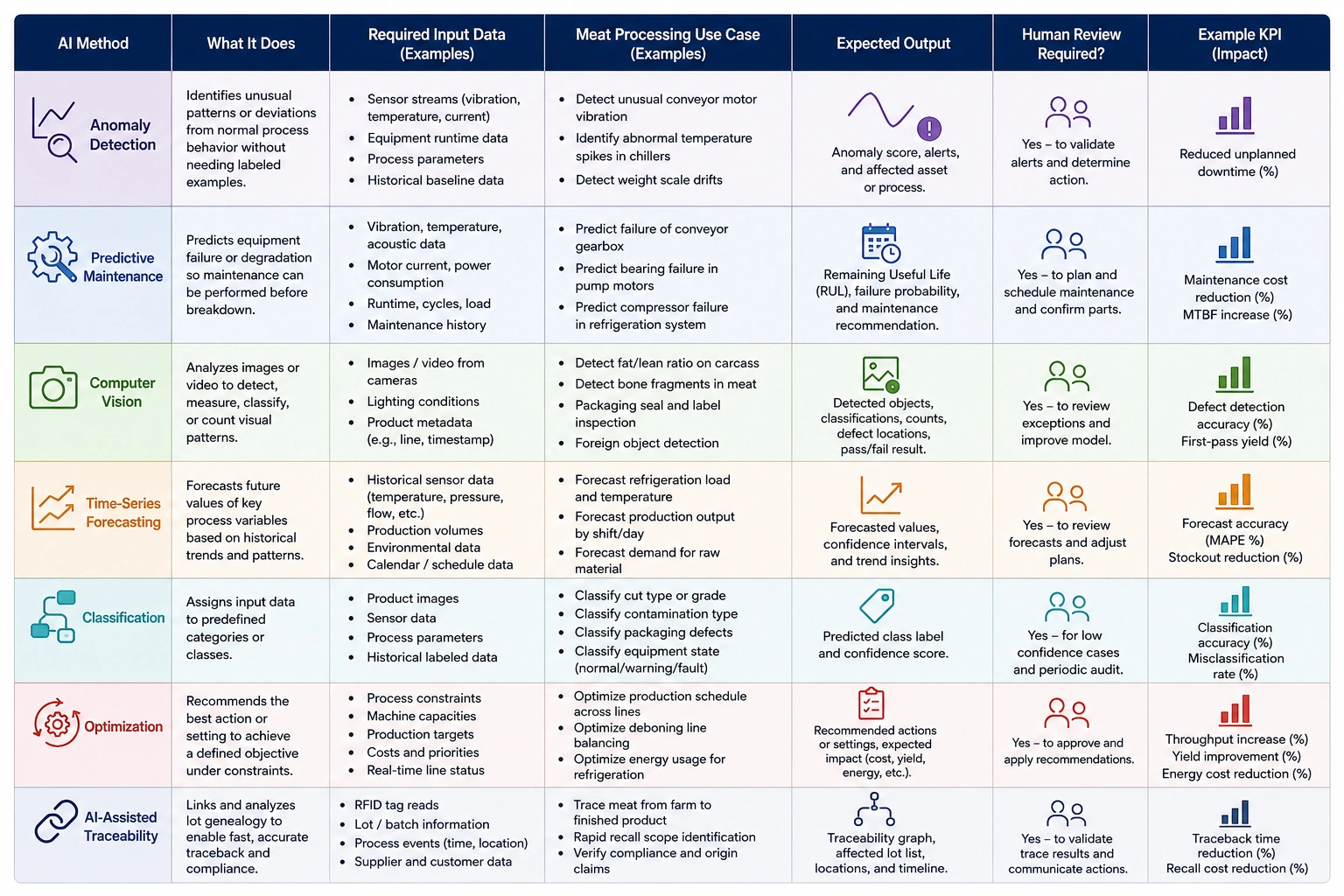
This technical comparison graphic maps seven AI methods to specific meat-processing applications, including anomaly detection, predictive maintenance, computer vision, forecasting, classification, optimization, and AI-assisted traceability. It shows the required data, expected outputs, human review needs, and example KPIs, emphasizing that different problems require different AI approaches.
Implementation Lifecycle for Meat Processing AI
A successful deployment should progress through controlled engineering stages rather than attempting facility-wide automation immediately.
Process Assessment
Start by documenting the target workflow, physical movement of products and assets, existing identification methods, production systems, network infrastructure, environmental conditions, and current manual processes.
Useful questions include:
- Which product or asset needs to be identified?
- Where does its identity change?
- Which processing events must be recorded?
- Which information is currently entered manually?
- Where do traceability gaps occur?
- Which decisions require information that is currently unavailable?
- Which areas have the highest cost of errors or delays?
Site Survey and Hardware Testing
The physical site should be surveyed before final hardware selection. Engineers should document conveyor dimensions, reader mounting positions, metal structures, refrigeration zones, washdown areas, network availability, electrical requirements, tag placement, and expected read-zone boundaries.
A pilot should use the actual products, containers, packaging materials, and operating speeds expected after deployment.
System Integration
The next stage connects RFID and IoT events with production and business software.
Typical integration paths can include:
RFID readers → edge gateway → event middleware → database → AI analytics → MES/ERP/WMS/QMS → operator action
API-based integration can be used where existing software supports it. OPC UA may be appropriate for industrial equipment data, while MQTT can be useful for IoT messaging. The specific protocol selection should be based on the existing plant network and system interfaces rather than protocol popularity.
Commissioning and Validation
Commissioning should verify more than whether a tag can be read.
Testing should include:
- Read accuracy under normal production conditions.
- False-read and missed-read rates.
- Event timestamps and location accuracy.
- Data synchronization between systems.
- Network interruption behavior.
- Edge-server recovery.
- AI alert accuracy.
- Operator notification workflows.
- Database backup and restoration.
- Cybersecurity controls.
- Traceability reconstruction from physical product to digital records.
- Failover and manual fallback procedures.
Optimization and Scaling
Once the pilot demonstrates measurable value, additional processing zones can be added. Scaling should preserve the same identity model, event definitions, security controls, and integration conventions.
Multi-site processors can use centralized analytics to compare production behavior across facilities while keeping plant-level processing local where required.
GAO can provide RFID, BLE, and IoT hardware products and systems that support staged deployments, allowing organizations to validate identification and sensing requirements before expanding to additional processing areas.
Meat Processing KPIs for AI and RFID Projects
Technology should be evaluated against operational outcomes rather than the number of RFID readers installed or AI models deployed.
Relevant KPIs can include:
| KPI | What It Measures | Potential Technology Contribution |
| Traceability lookup time | Time required to locate relevant product records | Automated identity and event retrieval |
| RFID read accuracy | Successful identification under operating conditions | Improved tag, antenna, and reader engineering |
| Missed-read rate | Identification events not captured | Read-zone optimization and exception handling |
| Inventory accuracy | Difference between recorded and physical inventory | Automated movement and counting events |
| Production dwell time | Time material spends between processing stages | RFID event timestamps and AI analysis |
| Cold-room dwell time | Duration product remains in refrigerated storage | Automated movement tracking |
| Shipment verification accuracy | Alignment between expected and actual outbound units | RFID-based shipment verification |
| Asset utilization | Availability and use of reusable containers or equipment | Automated asset identification |
| Unplanned downtime | Production time lost to unexpected equipment problems | Predictive maintenance analytics |
| False alert rate | Percentage of alerts that do not require action | AI model optimization |
| Recall investigation time | Time required to identify affected product | Digital lot and event genealogy |
| Manual data-entry workload | Human effort required to record operational events | Automated data capture |
The most valuable KPI depends on the original operational problem. A processor focused on traceability may prioritize investigation time and event completeness, while a plant focused on production efficiency may prioritize throughput, dwell time, downtime, and asset utilization.
Business Value from Connected Meat Processing Data
AI-enabled identification and sensing can improve meat processing operations when the captured data is directly connected to an operational decision.
Improved traceability can reduce the time required to reconstruct product movement and identify potentially affected production units. Automated inventory events can reduce dependence on manual counts. Better visibility of reusable containers can reduce time spent searching for production assets. AI-based anomaly detection can help maintenance and operations teams focus attention on abnormal conditions.
Cold-chain visibility can also become more actionable when product movement and temperature information are analyzed together. Instead of reviewing isolated temperature readings, personnel can investigate temperature behavior in relation to storage duration, door activity, product movement, and refrigeration conditions.
Production management can benefit from the same principle. RFID provides identity and location events, while AI can analyze event sequences and production data to identify recurring bottlenecks or abnormal process behavior.
The business value therefore comes from better operational decisions, not from RFID or AI in isolation.
Recommended Deployment Strategy for Meat Processing Facilities
A practical implementation should begin with one clearly defined operational problem.
Suitable starting points include:
- Case and pallet traceability.
- Refrigerated inventory visibility.
- Reusable container tracking.
- Production work-in-process tracking.
- Shipping verification.
- Equipment and maintenance asset identification.
- Cold-room movement monitoring.
- AI-assisted production anomaly detection.
The selected application should have measurable baseline KPIs. The facility can then compare performance before and after implementation.
RFID hardware should be selected after testing the actual product, packaging, container, and environmental conditions. AI should be introduced only after the underlying data is sufficiently reliable. Integration should use stable identifiers and documented event definitions so that production, quality, warehouse, maintenance, and business systems interpret the same physical event consistently.
Cybersecurity, data retention, user permissions, backup procedures, and operational fallback should be included in the initial design.
GAO’s experience supplying RFID, BLE, and IoT hardware products and systems can help organizations address the physical identification and connectivity requirements that underpin these applications. The appropriate configuration depends on the meat processing workflow, environmental conditions, integration requirements, and deployment objectives.
Meat Processing AI & RFID Implementation Roadmap: From Assessment to Multi-Site Scaling
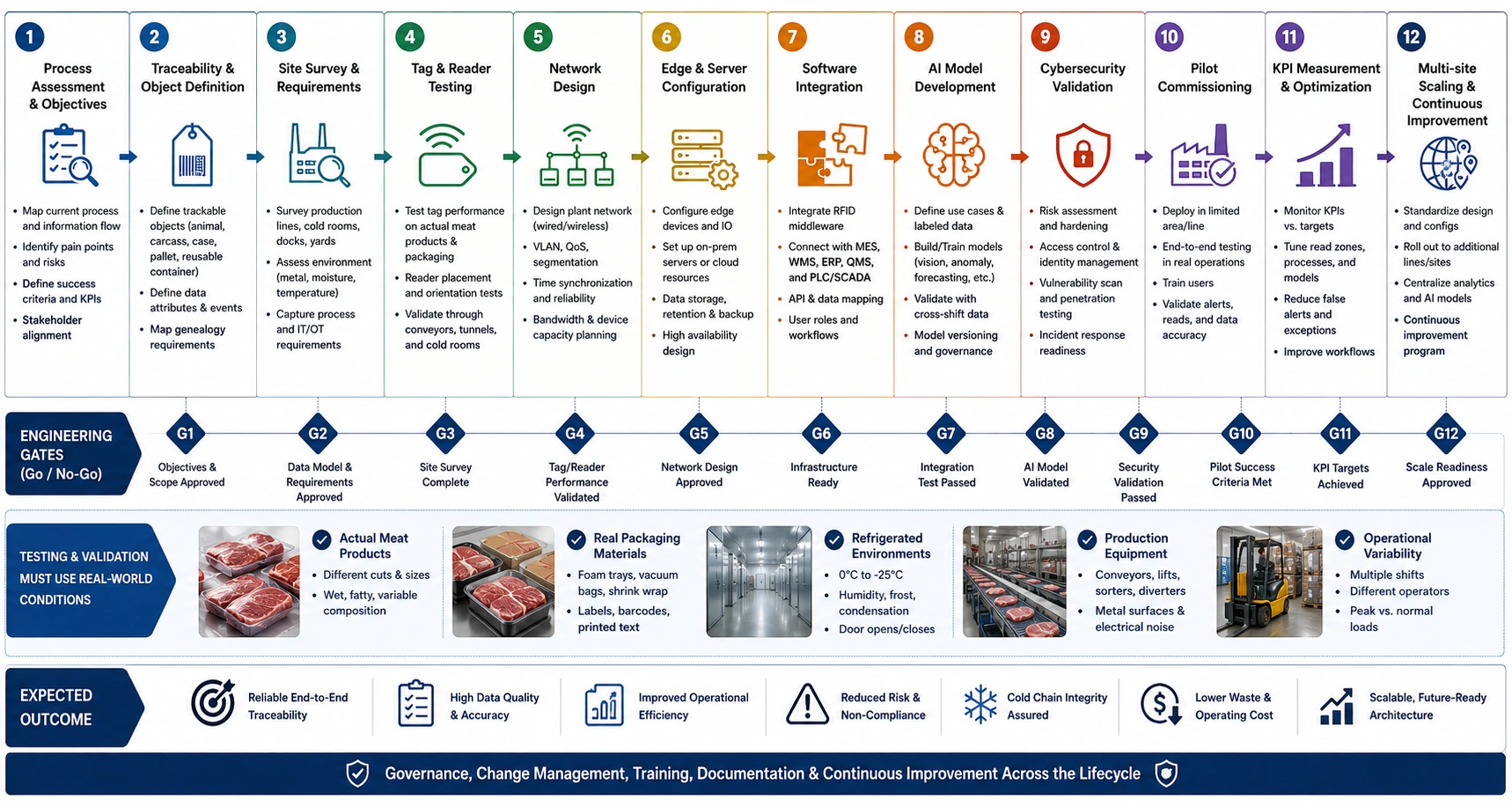
This implementation roadmap illustrates the complete lifecycle for deploying AI and RFID systems in meat-processing facilities, from process assessment and tag testing through network design, software integration, AI development, cybersecurity validation, pilot commissioning, KPI optimization, and multi-site scaling. It emphasizes engineering go/no-go gates and validation using actual meat products, packaging, refrigerated environments, production equipment, and operational conditions.
Advancing Meat Processing with Practical AI and IoT Engineering
AI-enabled meat processing is most effective when artificial intelligence is connected to reliable physical data from production, packaging, refrigeration, inventory, equipment, and logistics operations. RFID can provide identity and movement information, while IoT sensors, computer vision, edge computing, and industrial software add process context. AI can then identify patterns, prioritize exceptions, support traceability investigations, improve asset visibility, and assist operational planning.
The strongest implementations begin with a defined production problem, validate data capture under real plant conditions, integrate with existing systems, and establish measurable KPIs before scaling. GAO supports organizations with RFID, BLE, and IoT hardware products and systems that can form part of these solutions, backed by R&D investment, quality assurance processes, and remote or onsite technical support.
Building the Future of Industrial AI and IoT with Aperture Venture Studio and GAO RFID Inc.
For more than three decades, GAO Group of Companies has invested heavily in R&D for industrial RFID, BLE, and IoT. As generative AI became increasingly useful for industrial applications, we expanded our work across AI and IoT technologies and founded Aperture Venture Studio to build, launch, and scale AI and IoT companies addressing practical industry needs, including connected manufacturing and meat processing applications.
Aperture has attracted AI and IoT technical experts, entrepreneurial and operational executives, investors, and leading companies. We have also developed the Aperture Ventures Summit and TekSummit to explore advanced AI and IoT topics.
Our broader work has helped build technical communities around AI and IoT. We welcome advisors, co-founders, employees, investors, and customers who want to participate in these efforts.