
AI and BLE for Port Logistics
AI-Driven Port Logistics for Cargo Flow and Terminal Operations
AI-driven port logistics combines operational data, connected equipment, cargo records, transportation events, and AI analytics to improve how ports plan, handle, store, inspect, and transfer cargo. The approach can support container terminals, multipurpose ports, marine cargo facilities, intermodal yards, warehouses, and port distribution operations. AI can analyze vessel schedules, berth conditions, yard occupancy, gate activity, cargo dwell, equipment utilization, truck appointments, rail movements, maintenance records, and cargo exceptions to identify risks and recommend operational actions. BLE gateways, BLE beacons, and BLE sensors can provide additional localized information for selected reusable assets, maintenance resources, inspection equipment, and environmental conditions. GAO supplies BLE, RFID, and other IoT technology-based hardware products and systems that can provide data acquisition capabilities within these port logistics workflows. The result is a coordinated AIoT solution that connects physical port operations with software-based planning, prediction, anomaly detection, and decision support.
How AI Transforms Port Logistics
Port logistics involves tightly connected activities where delays in one process can affect vessel turnaround, yard capacity, truck movement, rail transfers, warehouse operations, and customer delivery schedules. AI helps port operators evaluate these dependencies rather than treating each process as an isolated activity.
AI models can process historical and real-time information to identify patterns that are difficult to detect through manual monitoring. Depending on the application, machine learning, predictive analytics, computer vision, optimization algorithms, anomaly detection, and Edge AI can be applied to specific port logistics decisions.
Key applications include:
- AI vessel arrival and berth planning using ETA, ETD, berth availability, weather, tide, vessel characteristics, crane availability, and historical turnaround data
- AI yard capacity planning using container arrivals, departures, stacking blocks, reefer areas, hazardous cargo zones, inspection requirements, and expected vessel operations
- AI container dwell analysis that identifies cargo likely to exceed expected dwell periods
- AI gate flow optimization using truck appointments, gate transaction times, container availability, inspection status, and terminal workload
- AI crane and cargo-handling optimization using work queues, equipment availability, cycle times, container locations, and vessel loading sequences
- AI predictive maintenance for ship-to-shore cranes, RTGs, RMGs, terminal tractors, reach stackers, forklifts, generators, pumps, and other cargo-handling equipment
- AI reefer exception detection using temperature history, alarm conditions, power status, maintenance records, dwell duration, and cargo requirements
- AI empty-container management based on expected demand, depot capacity, trade lanes, vessel schedules, and inland transportation requirements
- AI cargo exception detection for unusual dwell, missed transfers, inspection delays, documentation issues, and unexpected cargo movements
- AI asset utilization analysis for selected reusable terminal resources and maintenance equipment
BLE supports these AI applications selectively. For example, a BLE beacon attached to a maintenance tool can provide localized location events, while AI can determine whether the tool is available near the technician and work order requiring it. BLE should not be presented as a universal replacement for container numbers, RFID, barcode, GPS, OCR, computer vision, or established terminal transaction systems.
Port Logistics Workflows Supported by AI
Vessel Arrival and Berth Planning
Vessel operations create a major source of downstream scheduling dependencies for port logistics. AI can combine vessel ETA updates, berth availability, vessel size, cargo volume, crane availability, weather, tide, labor schedules, and historical vessel turnaround data.
Predictive models can identify potential berth conflicts and estimate how changes to arrival times could affect crane assignments, yard preparation, gate activity, and subsequent vessel calls. Port planners can use these predictions to prioritize resources before congestion develops.
AI should support rather than replace established vessel scheduling and port coordination procedures. Human planners remain responsible for validating operational constraints that may not be represented in historical data.
Container Gate and Truck Flow Management
Truck congestion at port gates can increase cargo dwell and affect drayage schedules. AI can evaluate truck appointment patterns, gate transaction times, container availability, inspection requirements, chassis availability, lane utilization, traffic conditions, and terminal workload.
The system can predict periods of high gate demand and identify conditions associated with extended truck turnaround. These predictions can support appointment management, labor allocation, lane planning, and coordination with drayage providers.
Port logistics teams can also compare planned appointment times with actual gate-in and gate-out events to identify recurring process bottlenecks.
Container Yard Planning and Retrieval
Yard planning requires coordination between container location, vessel loading sequence, cargo status, equipment availability, hazardous cargo requirements, reefer connections, customs or inspection status, and expected pickup activity.
AI can evaluate these variables to recommend yard allocation and retrieval priorities. A model may identify containers likely to require additional handling because their current position conflicts with planned vessel loading or expected truck pickup.
Yard density can also be analyzed by block, zone, container type, destination, dwell time, and operational status. These insights can help planners identify congestion before available storage capacity becomes a critical constraint.
Crane and Cargo Handling Operations
Ship-to-shore cranes, RTGs, RMGs, terminal tractors, reach stackers, forklifts, and other cargo-handling equipment determine how efficiently cargo moves through a terminal.
AI can analyze equipment utilization, work queues, container movement sequences, cycle times, equipment condition, operator activity, and planned maintenance. Optimization models can help assign resources to cargo tasks while reducing unnecessary travel and equipment idle time.
Predictive maintenance models can further identify equipment conditions associated with elevated failure risk. This allows maintenance teams to schedule inspections and repairs around cargo operations instead of responding only after equipment failure.
Cargo Inspection and Customs Coordination
Inspection requirements can create significant cargo dwell when containers remain in the terminal longer than planned. AI can analyze inspection queues, container dwell, cargo classification, destination, handling status, appointment information, and historical processing times to identify potential bottlenecks.
AI can prioritize operational attention based on expected impact while maintaining official inspection, customs, and security procedures. The system should not replace regulatory decisions or official cargo records.
Computer vision, OCR, RFID, barcode identification, and other data sources can complement these workflows by providing additional evidence for cargo identification and inspection processes.
Reefer Cargo Monitoring
Refrigerated containers require continuous attention to temperature, power, refrigeration status, alarms, maintenance conditions, and dwell time. AI can analyze temperature trends and alarm histories to distinguish routine fluctuations from patterns that may indicate a developing problem.
The system can prioritize reefer exceptions according to cargo requirements, duration, severity, historical behavior, and operational context. Maintenance personnel can then focus on higher-risk units.
BLE sensors can supplement environmental monitoring for selected areas or assets, but dedicated reefer monitoring systems remain important for container-level refrigeration information where those systems are already installed.
Port-to-Warehouse and Intermodal Cargo Coordination
Port logistics extends beyond the terminal gate. Containers may move from vessel discharge to yard storage, inspection, truck, rail, container freight station, warehouse, distribution center, or inland facility.
AI can compare planned and actual events across these transfers. It can identify missed rail connections, truck delays, warehouse receiving constraints, unexpected dwell, equipment shortages, and cargo staging problems.
The resulting information can help port operators coordinate with transportation and warehouse teams before a localized delay becomes a larger supply-chain disruption.
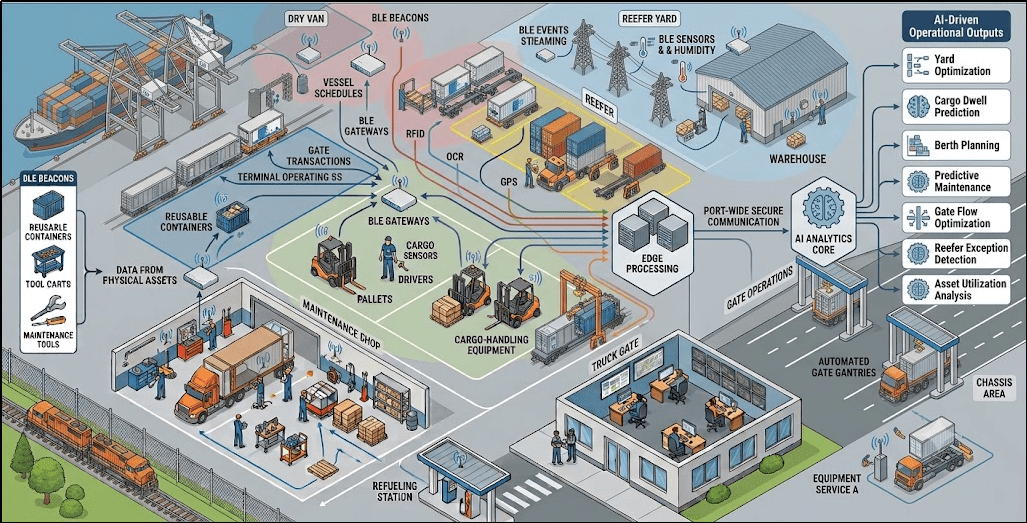
Port Logistics AI and BLE Operations Overview Diagram
This isometric enterprise diagram details an AI-driven commercial port terminal where physical workflows integrate with advanced digital visibility. BLE beacons, deployed on selected maintenance tools, carts, and containers, provide targeted visibility into internal operational assets. The visual maps data streams from diverse sources—including reefer sensors, gate systems, computer vision, and the BLE infrastructure—flowing through edge and cloud processing into an AI analytics core. This technology stack enables automated outputs such as yard optimization, predictive maintenance, and reefer exception detection.
AI Applications Across Port Logistics
AI Container Demand Forecasting and Yard Capacity Planning
Container volumes fluctuate according to vessel schedules, trade lanes, seasonal demand, transshipment activity, regional commerce, inland transportation, and customer requirements. AI forecasting models can combine historical container movements with planned vessel calls, gate activity, rail schedules, and other operational signals.
Port logistics teams can use forecasts to estimate future yard occupancy and identify blocks or zones likely to approach capacity. This supports earlier planning for container relocation, equipment allocation, gate coordination, and cargo staging.
AI-based forecasts can also support scenario analysis. Planners can evaluate the operational effect of delayed vessels, concentrated arrivals, unusual gate demand, or changes in cargo mix before those conditions occur.
AI Container Dwell and Congestion Management
Container dwell is influenced by customs processing, inspection, documentation, consignee pickup, drayage availability, warehouse capacity, vessel schedules, and terminal handling conditions.
AI can classify dwell patterns and identify containers whose expected dwell differs substantially from normal conditions. Rather than applying a single threshold to every container, models can consider cargo type, destination, terminal zone, status, historical behavior, and operational dependencies.
Yard congestion models can similarly identify blocks where increasing density, container retrieval requirements, or equipment movement may create future handling delays.
AI Equipment Utilization and Predictive Maintenance
Cargo-handling equipment represents a major operational dependency for port logistics. AI can analyze operating hours, load cycles, fault codes, vibration, temperature, energy consumption, maintenance history, inspection results, and utilization patterns.
Predictive models can estimate failure risk and identify equipment requiring closer inspection. Maintenance teams can use these predictions to plan service windows, technician assignments, spare parts, and equipment substitutions.
BLE can provide supporting information for selected maintenance resources. For example, location events from BLE-enabled tools can help determine whether required inspection equipment is available near a maintenance work area.
AI Cargo Exception and Anomaly Detection
Cargo exceptions can involve unexpected dwell, missed appointments, inspection delays, container location discrepancies, reefer alarms, documentation problems, equipment availability issues, or unusual movements.
AI can correlate events across systems to distinguish normal operational variation from conditions requiring attention. An anomaly model may detect a combination of extended yard dwell, missed truck appointment, and incomplete cargo status that would be difficult to identify from one system alone.
Exception prioritization allows port logistics personnel to focus on events with the greatest potential effect on vessel turnaround, yard capacity, cargo delivery, or customer service.
AI Empty-Container Management
Empty containers create their own storage and repositioning requirements. AI can estimate future empty-container demand by analyzing shipping schedules, trade lanes, depot inventories, customer requirements, regional demand, and planned equipment movements.
Forecasting can help port logistics teams coordinate empty-container storage and transfers while reducing unnecessary repositioning. The system can also identify situations where empty equipment occupies valuable yard capacity while demand exists elsewhere.
AI Port Logistics Security and Loss Prevention
Cargo security requires correlation across access control, container transactions, inspection records, gate activity, equipment movements, and other operational events.
AI can identify unusual combinations of events, such as unexpected access patterns, cargo movement outside scheduled workflows, repeated transaction anomalies, or equipment activity inconsistent with assigned tasks.
Computer vision, RFID, barcode, GPS, access control, and terminal transaction systems can provide complementary evidence. BLE may support localized awareness of selected assets but should not be treated as the sole security mechanism for a port.
Port Logistics Data Flow and AI Decision Process
A successful AIoT solution for port logistics must connect physical operations with reliable data processing and enterprise software. The workflow generally moves from data acquisition to communication, edge processing, middleware, AI analytics, and operational action.
Data Acquisition
Port logistics data can originate from:
- Terminal operating systems and container transactions
- Vessel schedules and berth planning systems
- Gate and truck appointment systems
- RFID readers and tags
- Barcode scanners
- OCR and computer vision systems
- GPS and fleet telematics
- Crane and cargo-handling equipment telemetry
- Reefer monitoring systems
- BLE gateways, beacons, and selected sensors
- CMMS and EAM maintenance records
- Warehouse and cargo management systems
- Manual inspection and operational records
Combining these sources allows AI to understand operational context rather than relying on isolated sensor readings.
Communication and Edge Processing
Port environments can contain large areas, moving vehicles, steel containers, cranes, warehouses, and intermittent network conditions. Edge processing can therefore be useful for filtering and validating device data before sending it to centralized systems.
BLE gateways can collect nearby beacon and sensor transmissions and forward selected events to edge computing resources or network services. Edge systems can remove duplicate detections, normalize timestamps, buffer events during connectivity interruptions, and monitor device health.
Other port data sources can follow different communication paths, including Ethernet, Wi-Fi, cellular networks, industrial protocols, GPS links, and existing terminal communication infrastructure.
Middleware and Enterprise Software
Middleware connects device and operational data with software already used by port logistics organizations. Common integration targets include:
- Terminal operating systems for container, yard, vessel, and gate operations
- Transportation management systems for inland cargo movement
- Warehouse management systems for cargo storage and fulfillment
- ERP systems for procurement, finance, and asset information
- CMMS and EAM systems for maintenance planning and work orders
- Fleet management systems for terminal vehicles
- Reefer monitoring systems
- Customs and inspection-related systems
- Data warehouses and business intelligence software
API-based integration, message queues, databases, event streams, and other interfaces can be used according to the existing IT environment.
AI Analytics and Operational Action
AI models transform normalized operational data into forecasts, classifications, anomaly scores, optimization recommendations, and maintenance predictions.
The important step is connecting those outputs to an operational action. A congestion prediction may trigger yard planning changes. A maintenance risk score may generate an inspection priority. A reefer anomaly may trigger a technician check. A gate forecast may support appointment adjustments.
GAO can provide BLE gateways, BLE beacons, BLE sensors, RFID products, and other IoT hardware systems that serve as data acquisition components within these broader port logistics solutions.
BLE Hardware and AI Software for Port Logistics
BLE is most useful in port logistics when it supplies localized data that existing terminal systems do not already provide efficiently. BLE gateways, BLE beacons, and BLE sensors can support selected asset location, proximity detection, environmental monitoring, and maintenance workflows. Their value increases when the resulting events are combined with terminal operating systems, RFID, GPS, computer vision, equipment telemetry, and AI analytics.
BLE Beacons for Selected Port Logistics Assets
BLE beacons can identify selected reusable assets moving between maintenance shops, warehouses, inspection areas, cargo staging zones, equipment service areas, and terminal offices. Appropriate assets may include maintenance tools, inspection instruments, mobile workstations, service carts, portable generators, reusable handling equipment, and other resources whose location affects port operations.
Each beacon can have a controlled identifier associated with an asset record. Gateway detections can then be correlated with work orders, technician assignments, inspection schedules, and equipment maintenance requirements.
AI can analyze these location events to identify assets that remain idle for unusual periods, move outside expected zones, or are repeatedly unavailable when required for scheduled work. This provides a practical way to improve asset utilization without attempting to place BLE devices on every container.
BLE Gateways for Port and Terminal Zones
BLE gateways receive transmissions from nearby beacons and sensors and forward relevant events to edge or centralized processing systems. Gateways may be installed in maintenance buildings, warehouses, equipment service areas, inspection facilities, terminal offices, cargo staging areas, or other selected zones.
Port environments require careful gateway placement because steel containers, cranes, trucks, chassis, machinery, buildings, and stacked cargo can influence radio propagation. Gateway mounting height, antenna orientation, physical obstructions, interference, weather exposure, and changing yard layouts should be considered during engineering surveys.
Edge-capable gateways can filter repeated detections, buffer data during network interruptions, normalize messages, and transmit validated events to middleware. This reduces unnecessary data traffic and can improve resilience when connectivity temporarily changes.
BLE Sensors for Port Logistics Environments
BLE sensors can provide selected environmental information for port logistics workflows. Depending on the application, sensors may monitor temperature, humidity, vibration, shock, or other physical conditions associated with cargo areas, equipment, storage locations, and maintenance operations.
Environmental monitoring should be matched to the cargo requirement. Reefer containers, for example, normally require dedicated refrigeration monitoring for container-level temperature, alarm, and power information. BLE environmental sensors can supplement this information in selected areas or for specific assets but should not be represented as a universal replacement for dedicated reefer systems.
AI can correlate environmental readings with cargo dwell, equipment status, weather, handling events, and maintenance information to identify unusual conditions and prioritize operational responses.
AI, Middleware, and Port Logistics Software Integration
BLE data becomes operationally useful when it is connected to established port systems. Middleware can map BLE identifiers to asset master records and exchange events with terminal operating software, transportation management systems, warehouse management systems, ERP software, fleet management systems, and CMMS or EAM applications.
AI can then combine BLE events with vessel schedules, container movements, gate transactions, equipment telemetry, maintenance records, cargo status, and yard conditions.
For example, a system can identify that a maintenance tool required for a crane inspection is located outside its expected service area while a related work order remains open. AI can prioritize the work order and identify the asset-location event as supporting information for technician planning.
GAO provides BLE gateways, BLE beacons, BLE sensors, RFID products, and other IoT technology-based hardware products and systems that can be integrated into these broader port logistics data workflows.
Cloud and Server Deployment for Port Logistics AI
Port logistics organizations can deploy AI and IoT software through cloud-hosted services, privately managed servers, or hybrid environments. The appropriate model depends on network availability, data governance, cybersecurity requirements, latency, existing IT resources, integration requirements, and the number of port facilities involved.
Cloud Version
A cloud-hosted deployment can consolidate data from multiple terminals, warehouses, inland facilities, and transportation operations. This supports centralized dashboards, historical data storage, AI model management, cross-terminal analytics, and standardized reporting.
Cloud processing is particularly useful for organizations managing multiple port facilities that need to compare yard utilization, vessel turnaround, cargo dwell, equipment performance, gate activity, and maintenance trends across locations.
Local edge processing can still remain part of the solution. Gateways and local computing systems can filter, validate, and buffer operational events before sending selected information to cloud services. This prevents every local device from depending on continuous cloud connectivity.
Server Version
A server deployment can place AI applications, databases, middleware, and operational data on customer-managed servers, private data centers, terminal computing facilities, or other privately hosted infrastructure.
This approach can provide greater control over sensitive operational data, network boundaries, retention policies, integration interfaces, and internal security controls. Local server processing can also support applications where low latency or local operational continuity is important.
Port operators should evaluate server capacity, storage, backup, redundancy, operating system support, database requirements, AI compute requirements, patch management, and disaster recovery before selecting this model.
Hybrid Deployment
Hybrid deployment combines local edge or server processing with centralized cloud services. A terminal can process time-sensitive events locally while sending selected historical data to centralized services for long-term analytics, model management, reporting, and multi-site comparisons.
Hybrid systems can be useful where ports require local operational resilience while still needing enterprise-wide visibility. Network failure procedures should be designed so that important local operations can continue and buffered data can be synchronized after connectivity returns.
Engineering Considerations for AI-Enabled Port Logistics
AI deployment in port logistics requires more than connecting devices and training models. Data quality, asset identity, radio conditions, integration, operational ownership, and system resilience all affect the final result.
BLE Coverage and Placement
BLE coverage should be designed around a specific operational requirement. A maintenance workshop, equipment service area, inspection facility, or warehouse may provide greater value than attempting blanket coverage across an entire container yard.
Engineers should evaluate:
- Container stacks and other metal obstructions
- Crane structures and moving equipment
- Gateway mounting height
- Expected asset movement
- Radio interference
- Indoor and outdoor conditions
- Weather exposure
- Gateway power availability
- Network connectivity
- Battery replacement requirements
Pilot measurements should be performed under actual operating conditions because a static site survey may not accurately represent a busy terminal with moving containers and equipment.
Asset Identity and Port Cargo Traceability
Every tracked reusable asset should have a controlled identity linked to a master record. The record may include asset number, equipment type, department, maintenance status, assigned location, ownership, service history, and operational role.
Container identification should continue to use appropriate established mechanisms such as container numbers, barcode, RFID, OCR, and terminal transaction records. BLE should be introduced where localized information provides additional operational value.
This distinction is important because BLE is well suited to selected asset and proximity applications, while container traceability often requires identification systems specifically designed for cargo transactions.
Data Quality and Event Normalization
AI models depend on consistent timestamps, identifiers, status codes, location information, and operational records. Port environments can generate large volumes of duplicate events, missing data, delayed messages, incorrect asset assignments, and inconsistent cargo status.
Data processing should therefore establish rules for:
- Timestamp synchronization
- Duplicate event filtering
- Asset identity validation
- Missing-data handling
- Device health monitoring
- Gateway connectivity monitoring
- Event prioritization
- Location-zone definitions
- Master-data management
- Historical data retention
AI outputs should also be monitored for model drift when cargo volumes, vessel patterns, yard layouts, or operating procedures change.
Integration with Port Logistics Systems
Port AI solutions should work with existing operational software rather than creating isolated information silos. Common integration targets include:
- Terminal operating systems
- Transportation management systems
- Warehouse management systems
- ERP systems
- CMMS and EAM systems
- Fleet management software
- Reefer monitoring systems
- Gate and truck appointment systems
- Customs and inspection systems
- Data warehouses
- Business intelligence software
- Access-control systems
API interfaces, event streams, message brokers, databases, and other integration mechanisms can be selected according to the existing port IT environment.
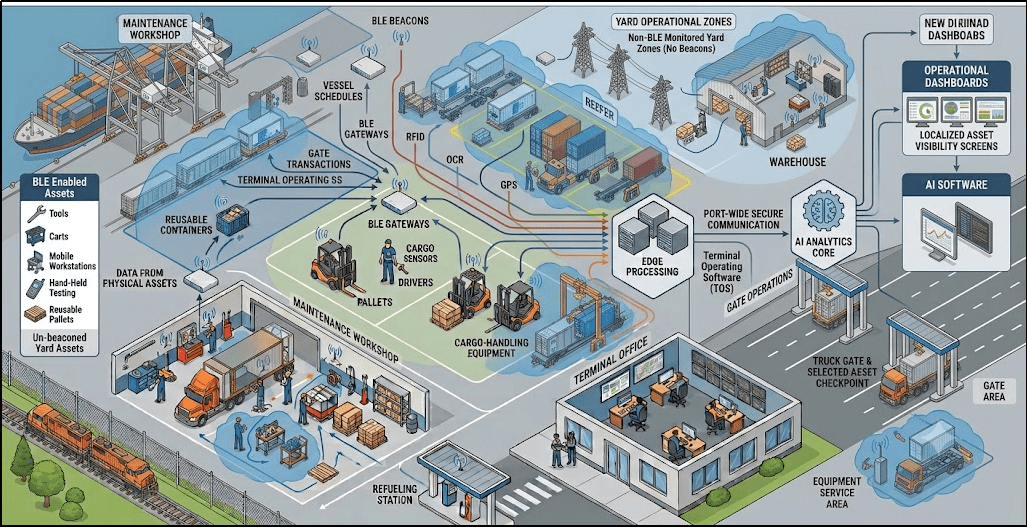
Professional Container Terminal Technical Site Map for Localized BLE Coverage
This isometric technical map details a commercial container port, illustrating the deployment of localized Bluetooth Low Energy (BLE) infrastructure for targeted asset visibility. BLE gateways are selectively positioned in key operational zones like maintenance workshops, a warehouse, and inspection areas, providing coverage clouds around specific maintenance tools, carts, mobile workstations, and reusable assets, rather than attempting universal container tracking. Real-time BLE event data flows from these distinct zones, via edge processing, to connected terminal software and AI operational dashboards for granular operational management.
AI Use Cases That Improve Port Logistics Performance
Predictive Vessel and Berth Planning
AI can continuously compare expected vessel arrivals with berth capacity, crane availability, yard conditions, weather, tide, labor availability, and current vessel operations.
When an ETA changes, the model can estimate downstream effects on berth assignments, yard preparation, crane workloads, gate demand, and vessel turnaround. Port planners can then evaluate alternative resource assignments before congestion develops.
AI Yard Congestion and Dwell Management
Yard congestion can result from concentrated vessel discharge, slow cargo pickup, inspection requirements, equipment constraints, or unexpected truck and rail activity.
AI can forecast block-level congestion by analyzing container density, expected arrivals and departures, cargo type, dwell, vessel sequence, equipment availability, and gate activity. Long-dwell containers can be prioritized according to operational risk rather than relying solely on a fixed age threshold.
Predictive Maintenance for Port Equipment
AI can analyze equipment runtime, load cycles, fault codes, vibration, temperature, utilization, inspection records, and maintenance history for cranes, terminal tractors, RTGs, RMGs, reach stackers, forklifts, generators, pumps, and other equipment.
Maintenance teams can use predicted failure risk to prioritize inspections, schedule service windows, prepare spare parts, and assign technicians. This can reduce unplanned downtime while helping maintenance work fit around vessel and yard schedules.
AI for Intermodal Cargo Transfer
Port logistics increasingly depends on coordination among vessel, terminal, truck, rail, warehouse, and inland distribution operations.
AI can compare planned and actual transfer events and identify missed appointments, rail delays, truck shortages, warehouse receiving constraints, container staging problems, and abnormal dwell.
These insights can help port teams coordinate cargo handoffs before delays propagate to downstream transportation.
AI Reefer Exception Detection
AI can analyze reefer temperature trends, alarm histories, power status, maintenance records, dwell duration, weather conditions, and cargo requirements.
Rather than treating every alarm as having equal operational significance, AI can rank exceptions by severity, duration, cargo sensitivity, and historical patterns. Personnel can then focus on higher-risk units.
AI Asset Utilization and Recovery
Selected BLE-enabled assets can generate location events that indicate where maintenance tools, inspection equipment, mobile workstations, and service carts are located.
AI can evaluate movement frequency, idle time, work-order relationships, and expected operating zones to identify underused resources, repeated retrieval delays, or misplaced equipment. Port maintenance teams can use this information to improve resource allocation and reduce time spent searching for operational equipment.
Cybersecurity and Data Protection for Port Logistics
Port logistics systems connect operational technology, cargo software, wireless devices, equipment, enterprise databases, and external transportation systems. Security should therefore be incorporated into system design and lifecycle management.
Important controls include:
- Device authentication and controlled provisioning
- Secure gateway configuration
- Encryption for applicable communications
- Network segmentation
- Role-based access control
- Strong administrator authentication
- Secure API authentication
- Firmware and software update procedures
- Gateway and server logging
- Device inventory and lifecycle management
- Backup and disaster recovery
- Monitoring for abnormal network and device behavior
- Data retention controls
- Vulnerability assessment
- Security testing before production deployment
AI systems also require protection against poor-quality or manipulated data. Unexpected changes in asset identities, timestamps, device behavior, or event frequency can produce misleading predictions.
High-impact decisions involving hazardous cargo, security incidents, critical cargo-handling equipment, vessel operations, or regulatory processes should retain appropriate human review.
Deployment Lifecycle for Port Logistics
Port Assessment and Planning
Deployment should begin with a detailed review of vessel operations, berth planning, container yard processes, gate activity, truck appointments, rail interfaces, reefer operations, inspection workflows, maintenance facilities, warehouse operations, existing software, network infrastructure, and KPIs.
The assessment should identify where AI can solve a measurable operational problem and where BLE can provide information that existing systems do not adequately capture.
Hardware Selection and Pilot Deployment
BLE beacons, gateways, sensors, RFID devices, edge computers, and related hardware should be selected according to the physical and operational conditions of the port.
A pilot can focus on a representative maintenance facility, equipment service area, warehouse, inspection zone, or selected operational area. Testing should examine detection reliability, radio coverage, battery life, gateway placement, environmental exposure, network availability, and data quality.
Integration and System Testing
Validated device data should be connected to the appropriate port software. Test scenarios should include normal cargo movements, equipment failures, gateway outages, network interruptions, duplicate events, missing data, incorrect asset associations, delayed messages, and unusual cargo conditions.
AI recommendations should be compared with actual operational outcomes before production use.
Commissioning and Optimization
After technical acceptance, port operations personnel should validate whether alerts, forecasts, risk scores, and recommendations correspond with real operating conditions.
Yard planners, crane supervisors, gate personnel, maintenance technicians, reefer teams, cargo coordinators, and IT staff should participate in operational validation because each group sees different parts of the workflow.
Thresholds, alert priorities, data filters, and model parameters can then be adjusted based on actual operating experience.
Scaling Across Port Facilities
After a pilot demonstrates measurable value, the solution can be expanded across additional yards, warehouses, maintenance locations, gates, or terminals.
Standardized asset identifiers, device configurations, APIs, security controls, data models, and operational definitions make multi-site expansion easier while still allowing individual ports to accommodate local workflows.
KPIs for AI-Enabled Port Logistics
Port logistics AI should be measured through operational outcomes rather than the number of connected devices. Useful KPIs include:
- Vessel turnaround time
- Berth utilization
- Crane productivity
- Container moves per hour
- Yard density
- Container dwell time
- Long-dwell container percentage
- Gate turnaround time
- Truck processing time
- Truck appointment adherence
- Rail transfer cycle time
- Cargo transfer completion time
- Reefer exception response time
- Reefer alarm resolution time
- Equipment utilization
- Equipment availability
- Unplanned equipment downtime
- Mean time between failures
- Mean time to repair
- Preventive maintenance compliance
- Maintenance response time
- Asset recovery time
- Asset utilization rate
- Empty-container repositioning efficiency
- Cargo exception resolution time
- Inspection turnaround time
- Inventory accuracy
- Labor utilization
- Energy consumption per cargo movement
- Safety and security incident rates
BLE deployments can additionally be evaluated through gateway availability, detection reliability, battery life, event completeness, and location-zone accuracy.
Practical Benefits of AI and BLE for Port Logistics
AI creates value in port logistics by connecting operational data with decisions that directly affect cargo movement, terminal capacity, equipment availability, and transportation coordination.
Key benefits include:
- Earlier identification of vessel and berth conflicts
- Improved yard capacity forecasting
- Reduced risk of unmanaged container dwell
- Better coordination of cargo retrieval and staging
- More effective crane and handling-equipment allocation
- Earlier identification of equipment failure risk
- Improved maintenance planning and technician utilization
- Faster response to reefer exceptions
- Better gate and truck-flow planning
- Improved coordination between vessel, terminal, truck, rail, and warehouse operations
- Greater visibility into selected reusable port assets
- Faster resolution of operational exceptions
- More consistent KPI reporting across port facilities
- Better use of historical port logistics data for planning
BLE provides the most practical benefit where localized information about selected assets or environments is otherwise difficult to obtain. AI provides the analytical layer that connects those observations with cargo workflows, maintenance activities, and port management decisions.
Implementation Recommendations for Port Logistics
Port operators should approach AI and BLE deployment as an operational improvement project supported by technology rather than as a device installation exercise.
- Define the port logistics problem before selecting BLE hardware or AI software.
- Establish baseline KPIs for vessel, yard, gate, cargo, equipment, reefer, and maintenance operations.
- Map existing terminal operating, transportation, warehouse, ERP, maintenance, fleet, reefer, RFID, GPS, barcode, and computer vision systems.
- Use BLE selectively where asset proximity or localized environmental information has measurable operational value.
- Conduct radio testing around steel containers, cranes, warehouses, vehicles, and other physical obstructions.
- Establish reliable asset master data before connecting AI models to location events.
- Use edge processing where local resilience and low-latency event handling are required.
- Validate AI predictions against actual port operating conditions.
- Maintain human oversight for high-risk operational and regulatory decisions.
- Design cybersecurity, access control, logging, backup, and recovery procedures before production deployment.
- Pilot the solution in a representative port workflow before expanding across multiple facilities.
- Measure operational outcomes rather than device counts.
- Establish battery replacement, gateway maintenance, firmware management, and hardware lifecycle procedures.
- Standardize data models and integration interfaces when scaling across terminals.
GAO Engineering and Technology Support for Port Logistics
GAO provides BLE, RFID, and other IoT technology-based hardware products and systems that can support port logistics data acquisition, asset monitoring, identification, environmental sensing, and connected operational workflows.
GAO is headquartered in New York City and Toronto, Canada. GAO is recognized among the leading B2B and B2G suppliers of BLE and RFID technologies globally, supporting organizations that require practical wireless identification and IoT hardware for operational applications.
For approximately three decades, our organizations have served customers across the United States and Canada, including Fortune 500 companies, leading R&D organizations, universities, and government agencies. Our substantial investment in R&D supports the development and refinement of BLE, RFID, and related IoT technologies.
GAO applies stringent quality assurance processes and provides remote and on-site technical support. For port logistics projects, this can assist engineering teams with technology selection, deployment planning, integration, commissioning, troubleshooting, and system expansion.
Building the Future of Industrial AI and IoT with Aperture Venture Studio and GAO RFID Inc.
For more than three decades, GAO has invested heavily in R&D involving industrial BLE, RFID, and IoT technologies. As AI became increasingly useful for industrial applications, we expanded our work combining AI with connected technologies, and we founded Aperture Venture Studio to advance practical AI and IoT solutions for industries including port logistics, cargo operations, asset tracking, maintenance, and connected transportation. Aperture has attracted AI and IoT technical experts, operational executives, investors, and leading companies. We also developed the Aperture Ventures Summit and TekSummit to discuss advanced AI and IoT topics. We welcome advisors, employees, investors, customers, and organizations interested in practical industrial AI and IoT applications.