
AI and RFID for Hospitals
AI-Driven Hospital Asset Tracking and Inventory Management
AI and RFID for hospitals combines artificial intelligence with real-time identification, location, inventory, equipment, and operational data to improve how hospitals manage medical assets and supplies. RFID can identify and capture movement events for equipment, reusable medical devices, surgical assets, linen, mobile carts, pharmaceutical support items, and other hospital resources, while AI analyzes those events alongside clinical, facilities, supply chain, and workflow data. The resulting system can help hospital teams locate equipment, identify inventory discrepancies, forecast demand, detect unusual movement patterns, reduce search time, and prioritize operational exceptions. UHF RFID is particularly useful for portal, room-transition, storage, and bulk-item identification, while HF and LF RFID can support more localized identification scenarios. GAO supplies RFID hardware products and systems that can provide the underlying identification and data-capture capabilities required for these hospital applications.
AI-Driven Hospital Operations with RFID
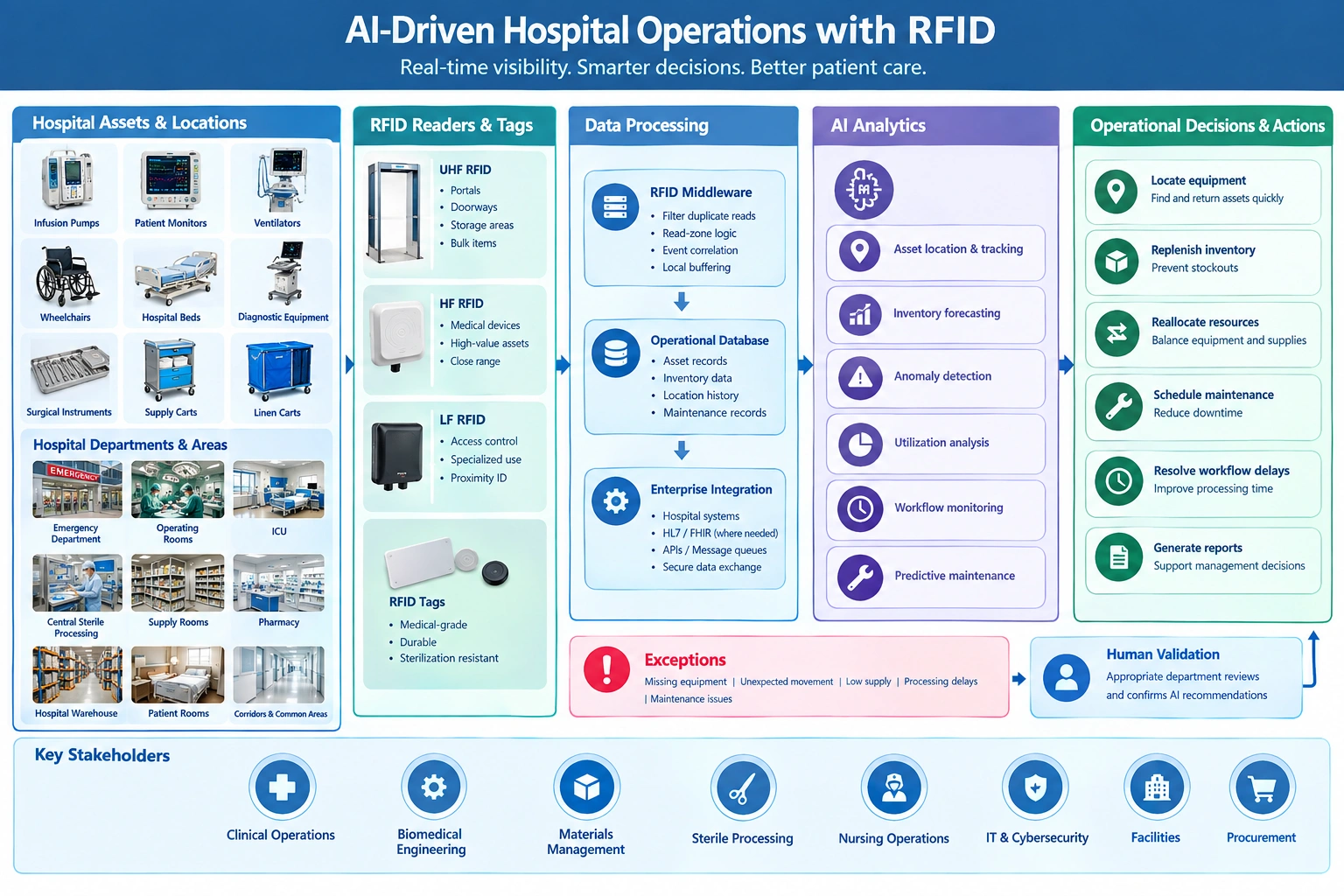
This visual shows how RFID-tagged hospital equipment, supplies, and reusable assets generate data for middleware, AI analytics, and operational decision-making. It highlights applications including equipment location, inventory forecasting, anomaly detection, utilization analysis, predictive maintenance, and workflow monitoring.
What AI-Enabled RFID Means for Hospital Operations
Hospital RFID becomes significantly more useful when identification events are connected to operational context. A reader detecting an infusion pump is only an observation. A hospital information system becomes more valuable when that observation is correlated with the pump’s assigned department, maintenance status, utilization history, cleaning state, service request, patient-care workflow, and expected location.
AI provides the analytical layer that turns these individual observations into operational insights. Machine learning can analyze historical movement and utilization patterns to identify equipment shortages, abnormal dwell times, recurring search events, unexpected movement between departments, or demand changes. Forecasting models can help materials-management teams anticipate supply requirements, while anomaly detection can identify events requiring investigation.
Hospital environments are particularly challenging because equipment constantly moves between clinical and support areas. A single infusion pump may pass through an intensive care unit, transport corridor, biomedical engineering department, cleaning area, storage room, and another patient-care unit within a short period. RFID provides machine-readable identity and movement events, while AI can establish relationships among those events.
The result is not simply better asset visibility. A properly designed system can support hospital asset utilization, medical equipment management, inventory control, sterile processing workflows, supply replenishment, equipment maintenance, and operational decision-making.
GAO’s RFID hardware and systems can serve as the identification and event-capture layer for these applications, with integration into hospital software determined by the hospital’s clinical, operational, security, and interoperability requirements.
Hospital Applications for AI-Enabled RFID
Medical Equipment Location and Utilization
Mobile clinical equipment creates a persistent operational problem for hospitals. Infusion pumps, patient monitors, ventilators, wheelchairs, stretchers, portable ultrasound systems, telemetry equipment, and other movable assets can spend substantial time outside their assigned departments.
RFID events can establish where equipment was last observed, while AI can analyze movement history and utilization patterns.
Relevant applications include:
- Real-time or near-real-time equipment location
- Department-level equipment availability
- Equipment utilization analysis
- Detection of unusually long dwell times
- Identification of equipment frequently transferred between departments
- Search-time reduction for clinical staff
- Identification of underutilized equipment
- Support for equipment fleet balancing
- Biomedical engineering service-location verification
AI can distinguish routine movement from unusual patterns when sufficient historical data exists. An unexpected equipment movement should be treated as an operational exception for human review rather than automatically interpreted as theft, misuse, or error.
Hospital Inventory and Supply Management
Hospitals manage large quantities of consumables, sterile supplies, emergency stock, procedure-specific kits, and other materials. Inventory accuracy becomes difficult when supplies move between central stores, hospital warehouses, nursing units, operating rooms, emergency departments, and specialty departments.
AI-enabled inventory management can combine RFID events with inventory records, consumption data, purchase orders, replenishment transactions, and historical demand.
Potential applications include:
- Medical supply inventory visibility
- Automated receiving and stock movement records
- Supply-room inventory monitoring
- Replenishment prioritization
- Demand forecasting
- Stockout-risk detection
- Overstock identification
- Expiration-risk monitoring where item-level identification supports it
- Procedure-kit tracking
- Interdepartmental inventory reconciliation
The engineering objective is not simply to count RFID tags. The system should establish which observations correspond to confirmed inventory transactions, transfers, consumption, replenishment, returns, or other business events.
Surgical and Central Sterile Processing Workflows
Operating rooms and central sterile processing departments have complex asset flows. Surgical instruments and reusable medical devices may move from procedure areas to decontamination, inspection, assembly, sterilization, storage, and subsequent case preparation.
AI can analyze RFID-linked processing events to identify workflow delays, unusual turnaround times, missing instruments, incomplete sets, or recurring bottlenecks.
A useful implementation distinguishes between an RFID read observation and a confirmed processing event. Middleware can apply reader-zone rules, timestamps, process-state logic, and equipment context before creating a business event.
FDA’s UDI system also establishes a standardized identification framework for medical devices distributed in the United States. UDI information is intended to support identification from manufacturing through distribution and patient use, while hospitals can use device identification information in their own operational and clinical systems where applicable.
RFID does not replace UDI requirements. Rather, where technically and operationally appropriate, RFID can provide an automatic identification mechanism that works alongside device identifiers and other hospital identification technologies.
Hospital Linen, Carts, Beds, and Reusable Assets
Hospitals also operate large closed-loop flows involving linen, transport carts, meal-service equipment, waste containers, beds, stretchers, and other reusable assets.
AI can identify recurring bottlenecks such as:
- Excessive turnaround time
- Accumulation in particular departments
- Repeated loss from expected circulation
- Imbalanced asset distribution
- Unusual movement patterns
- Cleaning or processing delays
- Underutilization of equipment
- Excessive demand during specific periods
These applications are particularly suitable for location-aware RFID because the hospital can establish operational zones rather than attempting to infer exact coordinates from every read.
Hospital RFID Data Workflow from Capture to AI Decision
A practical hospital deployment begins with physical asset identification and ends with an operational action. The intermediate data-processing steps determine whether the resulting information is reliable enough for AI analysis.
Asset Commissioning and Identification
Each tracked asset requires a controlled identity record. Depending on the application, the record can associate an RFID tag identifier with:
- Asset type and model
- Manufacturer and serial number
- Hospital asset number
- Department or cost center
- Equipment status
- Maintenance schedule
- Cleaning or processing state
- Service history
- Assigned location
- Ownership or responsible department
- UDI information where applicable
Tag commissioning should include verification that the physical RFID tag is correctly associated with the intended asset.
RFID Event Capture
Readers collect observations as assets pass through defined read zones. UHF RFID is generally useful where hospitals need non-line-of-sight identification of multiple tagged items, while HF or LF can be considered for shorter-range or specialized identification requirements.
A typical event can contain:
- RFID tag identifier
- Reader identifier
- Antenna or read-zone identifier
- Timestamp
- Signal or read-quality information where available
- Facility
- Department or location zone
- Asset identifier
- Transaction context
- Event classification
- Exception status
Hospital environments require careful reader placement because walls, metal equipment, liquids, dense equipment storage, and human movement can influence RF performance.
Edge Processing and RFID Middleware
Raw reads should normally pass through middleware before they become business events. Middleware can filter duplicate observations, apply read-zone rules, correlate repeated reads, and suppress events that do not represent meaningful movement.
A hospital implementation may therefore transform hundreds of reader observations into a smaller set of validated events such as:
- Asset received
- Asset entered department
- Asset exited department
- Asset placed in storage
- Asset sent for cleaning
- Asset sent to sterile processing
- Asset returned to inventory
- Asset assigned to service
- Asset dispatched
- Asset returned
- Exception detected
Local buffering can preserve events during temporary network interruptions and synchronize them when connectivity returns.
AI Analysis and Operational Decisions
The validated event stream can then be combined with hospital inventory records, computerized maintenance management systems, electronic health record context where appropriate, materials-management software, sterile-processing systems, purchasing records, and other operational data.
AI models can evaluate:
- Asset utilization
- Demand forecasts
- Equipment availability
- Inventory imbalance
- Processing delays
- Unusual movement
- Maintenance patterns
- Replenishment requirements
- Workflow bottlenecks
The final step is an operational decision. For example, an AI model might identify that a particular department repeatedly experiences infusion-pump shortages during a predictable period. Materials management or clinical engineering personnel can then investigate the pattern and rebalance equipment.
The distinction between AI recommendation and automated clinical decision-making is important. Hospital asset and inventory systems should generally support human operational decisions rather than independently making clinical judgments.
Hospital Systems, AI Models, and RFID Technologies
A complete hospital solution normally connects physical identification equipment to software used by clinical, facilities, supply-chain, and biomedical teams.
RFID Hardware for Hospital Environments
The appropriate RFID technology depends on the physical environment and identification objective.
- UHF RFID: Suitable for longer-range identification, controlled entrances, receiving areas, storage zones, equipment rooms, carts, linen operations, and bulk inventory where tag density and read-zone control can be engineered appropriately.
- HF RFID: Useful for shorter-range identification and applications requiring closer interaction between a tagged item and reader.
- LF RFID: Suitable for certain proximity-oriented identification scenarios where short read distance and environmental characteristics make it appropriate.
- RFID readers: Fixed, portal, desktop, handheld, or integrated reader configurations can be selected according to hospital workflow.
- RFID antennas: Antenna placement and polarization should be engineered around doors, corridors, shelves, equipment density, and required read zones.
- RFID tags: Medical-grade or application-specific tags should be evaluated for attachment method, sterilization exposure, cleaning chemicals, temperature, metal surfaces, and repeated handling.
RF performance testing should occur in the actual hospital environment rather than relying exclusively on laboratory specifications.
AI and Software Components
AI-enabled hospital asset management can use several analytical approaches.
- Anomaly detection identifies movement, dwell time, or inventory patterns that differ from established operating behavior.
- Time-series forecasting estimates equipment or supply demand based on historical consumption and operational patterns.
- Classification models can categorize equipment events, workflow states, or operational exceptions.
- Optimization models can support equipment allocation and inventory replenishment decisions.
- Computer vision can complement RFID in applications such as equipment-state verification or visual inspection where cameras are permitted and appropriately secured.
- Natural-language interfaces can allow authorized users to query operational information such as equipment availability or inventory exceptions.
- Predictive maintenance models can combine RFID location history with maintenance records, runtime data, alarms, and service history.
The AI layer should have traceability back to the source data. Hospital operations teams need to understand which RFID events, inventory records, or maintenance records contributed to an alert.
Cloud Version and Server Version
A Cloud Version can provide centrally hosted software for hospitals operating across multiple facilities. This approach can simplify centralized analytics, model management, software updates, multi-site reporting, and aggregation of equipment or inventory information.
A Server Version can operate on hospital-managed edge servers, customer-managed servers, private data centers, facility servers, or other privately hosted infrastructure. This model can be appropriate where hospitals require tighter control over data location, network connectivity, integration boundaries, or internal IT operations.
Neither deployment model is automatically appropriate for every hospital. The decision should consider clinical-network segmentation, security requirements, data governance, latency, connectivity, disaster recovery, integration requirements, IT staffing, and organizational policies.
HHS states that the HIPAA Security Rule requires covered entities and business associates to implement appropriate administrative, physical, and technical safeguards for electronic protected health information, including access control, audit controls, authentication, and transmission security.
Consequently, an AI-enabled hospital RFID deployment should be designed so that RFID event data, system credentials, integrations, and any associated protected health information receive appropriate security controls. RFID itself does not make a hospital system HIPAA compliant; compliance depends on the complete system, data flows, policies, controls, and organizational practices.
Hospital Asset Visibility, Workflow Control, and AI Decision Support
Combining AI with RFID-derived hospital data can improve operational visibility because decisions are based on actual asset movements and historical activity rather than periodic manual counts alone. The value depends on correctly defining hospital workflows, configuring read zones, maintaining accurate asset records, and integrating RFID events with the software already used by hospital departments.
Equipment Utilization and Availability
Hospital equipment can be distributed according to actual utilization rather than static department allocations. AI can compare equipment location, movement frequency, service status, and historical demand to identify departments with persistent shortages alongside areas with underused equipment.
For biomedical engineering teams, this information can also support service planning. An equipment item repeatedly appearing in maintenance or repair workflows may warrant investigation of usage patterns, while an asset that remains inactive for unusually long periods can be reviewed for redeployment.
Useful operational measures include:
- Equipment utilization rate
- Equipment availability rate
- Average equipment search time
- Department-level equipment balance
- Average equipment dwell time
- Equipment turnaround time
- Preventive-maintenance compliance
- Mean time between failures
- Mean time to repair
- Percentage of assets with verified location
Inventory Accuracy and Replenishment
AI-enabled hospital inventory management can combine RFID observations with purchase orders, consumption transactions, par levels, lead times, procedure schedules, and historical demand.
Forecasting can help materials-management personnel distinguish between normal fluctuations and sustained demand changes. This is particularly relevant for emergency supplies, operating-room consumables, critical-care supplies, and specialty inventory.
RFID can provide automated observations of stock movement, but forecasting quality depends on data quality. Incorrect tag-to-item associations, unrecorded consumption, misplaced tags, uncontrolled read zones, and incomplete inventory transactions can propagate errors into downstream AI models.
A practical deployment therefore establishes reconciliation procedures between RFID observations and authoritative inventory records.
Sterile Processing and Surgical Instrument Traceability
Central sterile processing departments require controlled movement through decontamination, inspection, assembly, sterilization, storage, and distribution. AI can analyze the elapsed time between these process stages and identify recurring delays.
RFID can associate reusable instrument containers or suitable tagged assets with processing events. The software can then provide a history of where an item was observed and when it entered or exited a processing zone.
Operational KPIs can include:
- Instrument-set turnaround time
- Sterilization workflow time
- Missing-instrument frequency
- Case-cart completion rate
- Processing backlog
- Rework frequency
- Storage dwell time
- Procedure-kit availability
Any implementation involving reusable medical devices should be validated against the hospital’s infection-control, sterilization, device-manufacturer, and clinical procedures. RFID hardware must not interfere with sterilization processes or compromise device integrity.
Hospital AI and RFID Implementation Engineering
A successful deployment requires more than installing readers and attaching tags. Hospitals should treat the project as an operational engineering initiative involving clinical operations, biomedical engineering, materials management, IT, cybersecurity, facilities, infection prevention, and procurement.
Use-Case Definition and Site Survey
The initial phase should identify a measurable hospital problem.
Examples include:
- Reducing time spent searching for mobile equipment
- Improving inventory accuracy in high-value supply rooms
- Tracking reusable assets through sterile processing
- Monitoring equipment utilization
- Improving linen circulation
- Detecting recurring equipment bottlenecks
- Supporting biomedical service workflows
A site survey should document doors, corridors, elevators, storage rooms, metal structures, clinical equipment density, network availability, electrical power, reader mounting options, and areas where RF transmission may require additional testing.
The hospital should also determine whether the desired result requires room-level, department-level, zone-level, or portal-level visibility. Attempting to provide room-level visibility when the operational requirement only needs department-level information can unnecessarily increase system complexity.
RFID Tag and Reader Selection
Tag selection should follow the asset and environmental requirements rather than relying on a single tag type throughout the hospital.
Testing should consider:
- Plastic and metal asset surfaces
- Curved equipment housings
- Cleaning chemicals
- Repeated disinfection
- Sterilization exposure
- Temperature variation
- Tag attachment methods
- Read distance
- Tag orientation
- Equipment density
- Human-body effects
- Interference from nearby materials
UHF RFID is often useful for broader hospital asset-location and inventory applications, while HF or LF can be evaluated for localized identification requirements.
GAO provides RFID hardware products and systems that can be evaluated according to these physical deployment requirements, including fixed and mobile reader configurations and application-specific RFID tags.
Pilot Deployment and Commissioning
A pilot should use representative hospital equipment and actual workflows rather than a controlled demonstration environment alone.
The pilot can measure:
- Read accuracy
- False-read frequency
- Missed-read frequency
- Location accuracy
- Event latency
- Network reliability
- Tag durability
- Reader-zone containment
- User acceptance
- Inventory reconciliation accuracy
- AI alert precision
Commissioning should document reader settings, antenna positions, tag assignments, network addresses, software configuration, event rules, integration endpoints, and operational responsibilities.
A hospital should establish acceptance criteria before full deployment so that technical performance can be evaluated objectively.
Hospital Software Integration and Interoperability
RFID information becomes operationally valuable when it reaches the systems used by hospital personnel.
Potential integration points include:
- Hospital inventory management software
- Materials management systems
- Computerized maintenance management systems
- Sterile processing software
- Electronic health record systems where appropriate
- Laboratory information systems for applicable workflows
- Pharmacy inventory systems
- ERP software
- Procurement systems
- Facilities management software
- Workforce management systems
- Business intelligence databases
- Hospital reporting systems
REST APIs, webhooks, SQL interfaces, message queues, CSV exchanges, and integration middleware can be used according to the capabilities and security policies of the hospital environment.
HL7 and FHIR may be relevant when hospital information needs to exchange healthcare-related data with clinical systems. However, RFID asset events do not automatically become clinical data simply because they are generated inside a hospital. Integration should therefore be limited to the information actually required by the workflow.
A strong design separates RFID device communication from higher-level hospital application logic. Readers should not need to understand every business rule used by inventory, biomedical engineering, or sterile processing applications.
Hospital Cybersecurity, Privacy, and Data Governance
Healthcare environments require careful control of operational and potentially sensitive information.
A hospital RFID system should consider:
- Network segmentation
- Role-based access control
- Strong authentication
- Encryption in transit
- Encryption at rest where appropriate
- Credential management
- Audit logging
- Secure API authentication
- Reader and gateway hardening
- Software patch management
- Backup and recovery
- Data-retention policies
- Vendor access controls
- Security monitoring
- Incident-response procedures
RFID event data can sometimes be linked to staff members, patients, departments, or clinical workflows. The system should therefore minimize unnecessary personal information and separate asset-management information from protected clinical information wherever practical.
For cloud deployments, hospitals should assess the hosting environment, contractual responsibilities, data residency requirements, identity management, disaster recovery, logging, and integration security. For privately hosted deployments, responsibility for server hardening, patching, backups, monitoring, and physical security generally becomes more dependent on the hospital or its designated IT provider.
GAO’s engineering and technical-support capabilities can support hardware and system implementation, while the hospital remains responsible for defining its organizational security, privacy, clinical, and regulatory requirements.
Hospital AI Performance and Operational KPIs
AI should be evaluated using measurable hospital outcomes rather than model sophistication alone. A technically advanced model that does not improve a hospital workflow provides limited operational value.
A practical KPI framework can include:
| Hospital Area | Example KPI | What It Measures |
|---|---|---|
| Equipment | Equipment search time | Time required to locate mobile equipment |
| Equipment | Utilization rate | Proportion of available equipment actively used |
| Inventory | Inventory accuracy | Agreement between system records and physical inventory |
| Inventory | Stockout frequency | Frequency of unavailable required supplies |
| Inventory | Replenishment lead time | Time from replenishment trigger to stock restoration |
| Sterile Processing | Turnaround time | Time required to process reusable assets |
| Maintenance | Mean time to repair | Average repair duration |
| Operations | RFID read accuracy | Reliability of identification events |
| Operations | Event latency | Time between physical observation and software event |
| AI | Alert precision | Percentage of AI alerts confirmed as relevant |
| AI | False-alert rate | Frequency of alerts requiring no operational intervention |
| IT | System availability | Availability of RFID and associated software |
| Security | Audit completeness | Coverage of relevant system and user activities |
Hospitals should establish baseline measurements before deployment. Comparing post-deployment results with a documented baseline provides stronger evidence than reporting raw system activity such as the number of RFID reads.
Scaling AI-Enabled RFID Across Hospital Facilities
Multi-site healthcare organizations introduce additional challenges because hospitals may use different equipment inventories, software configurations, network policies, workflows, and naming conventions.
A scalable deployment should standardize core data definitions while allowing facility-specific configuration.
Common shared definitions can include:
- Asset identifier
- Asset category
- Department identifier
- Location zone
- Reader identifier
- Event type
- Maintenance state
- Inventory state
- Processing state
- Exception category
Each facility can then maintain its own reader locations, department mappings, operational rules, and workflow parameters.
AI models should also account for differences between facilities. An equipment movement pattern that is normal in a trauma center may be unusual in a specialty hospital. Centralized models should therefore avoid treating every facility as statistically identical without validating the underlying operational context.
Hospital AI-Enabled RFID Implementation Lifecycle
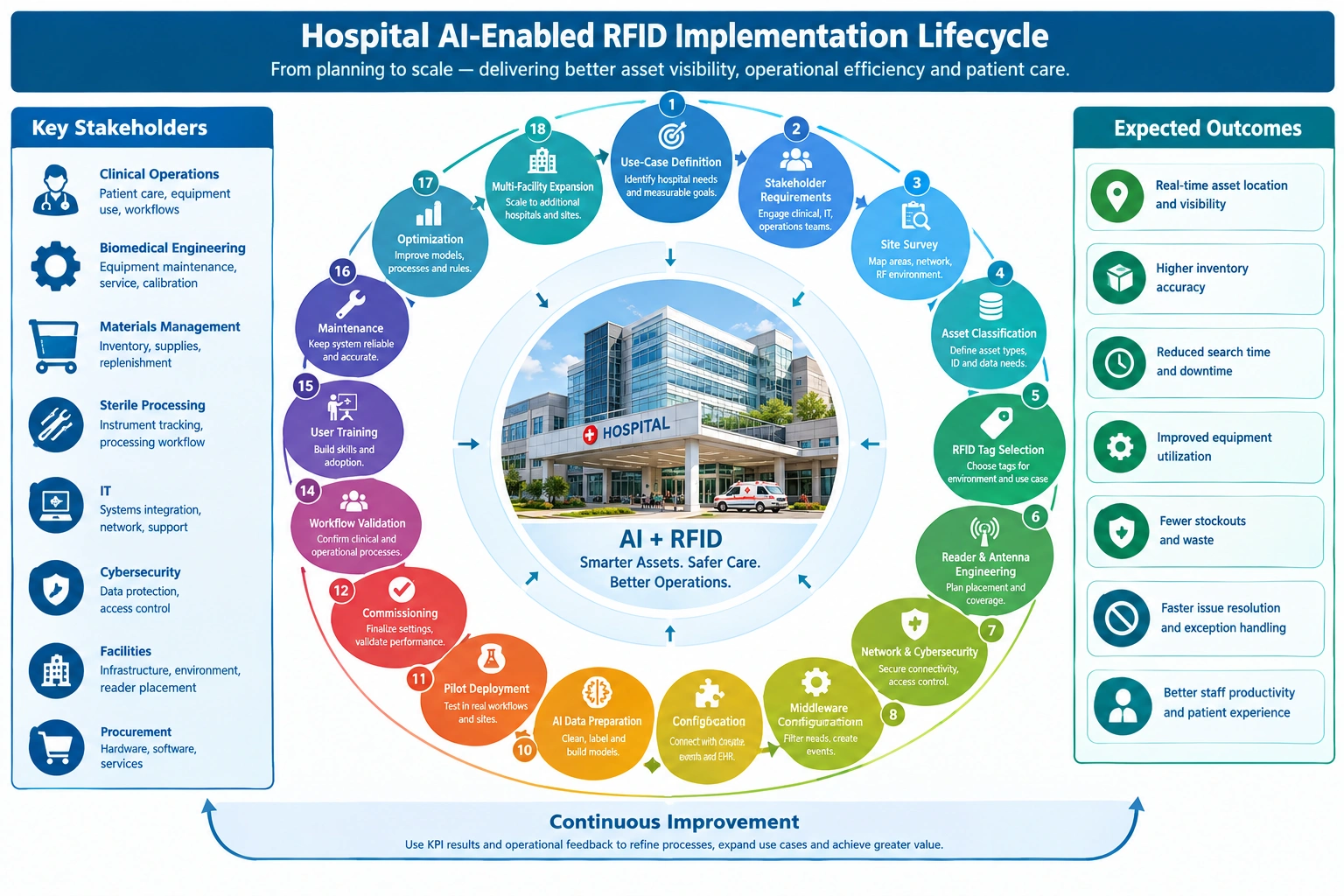
This visual illustrates the hospital RFID implementation lifecycle from use-case definition and site surveying through RFID selection, integration, pilot deployment, commissioning, training, optimization, and multi-facility expansion. It emphasizes cross-functional collaboration and continuous improvement using KPI results and operational feedback.
Practical Recommendations for Hospital Deployment
Hospitals considering AI-enabled RFID should begin with workflows where reliable asset visibility can produce a measurable operational improvement.
Recommended engineering practices include:
- Define the business event before selecting the RFID hardware.
- Identify whether the required visibility is room-level, zone-level, department-level, or portal-level.
- Test RFID performance using actual hospital equipment and environmental conditions.
- Use controlled read zones to reduce unintended observations.
- Maintain a master asset registry linking RFID identifiers to authoritative asset records.
- Separate raw RFID observations from confirmed business transactions.
- Buffer events locally when network outages could otherwise create data gaps.
- Integrate with existing hospital software instead of creating duplicate operational records.
- Establish human validation for AI-generated exceptions.
- Keep clinical decisions separate from asset and operational recommendations unless a separately validated clinical application is being implemented.
- Establish cybersecurity and privacy requirements before connecting the RFID system to hospital networks.
- Measure baseline KPIs before the pilot.
- Test tag durability against cleaning, disinfection, handling, and applicable processing conditions.
- Document reader configuration, antenna placement, network settings, and event-processing rules.
- Design multi-facility deployments around standardized data definitions with facility-specific workflow configuration.
- Review AI models periodically as equipment fleets, departments, procedures, and operational demand change.
GAO RFID Solutions for Hospital Operations
Hospital RFID deployments require hardware, software integration, engineering validation, and ongoing technical support rather than RFID tags alone. GAO has supplied RFID, BLE, and IoT hardware products and systems to organizations in the United States and Canada, including Fortune 500 companies, research and development organizations, universities, and government agencies. The broader GAO Group has operated from New York City and Toronto, Canada, for three decades and has invested substantially in research and development and quality-assurance processes.
For hospitals, that experience can be applied to applications such as medical equipment tracking, inventory visibility, reusable-asset management, workflow monitoring, and location-aware operational systems. GAO can help organizations evaluate RFID hardware and system requirements according to their physical environment, application requirements, integration needs, and deployment model, with remote or onsite technical support available as required.
The appropriate solution should ultimately be determined by the hospital’s asset types, workflow requirements, RF environment, software landscape, cybersecurity policies, regulatory obligations, and measurable operational objectives.
Key Takeaways for AI-Enabled Hospital RFID
AI-enabled hospital RFID can connect physical asset movement with hospital inventory, maintenance, sterile processing, and operational data to support faster and more informed decisions.
The principal technical insights are:
- RFID provides machine-readable asset identity and movement observations.
- AI adds forecasting, anomaly detection, classification, optimization, and utilization analysis.
- Middleware is essential for filtering raw reads and converting observations into reliable operational events.
- UHF, HF, and LF RFID should be selected according to the hospital workflow and physical environment.
- Cloud and privately hosted server deployments can both be appropriate depending on hospital IT, security, connectivity, and governance requirements.
- AI alerts should support human operational review rather than automatically assigning fault or making clinical judgments.
- Integration with existing hospital software is critical for turning RFID observations into useful operational information.
- KPI baselines and pilot testing are necessary to demonstrate measurable value.
- Cybersecurity, privacy, data governance, and interoperability should be designed into the solution from the beginning.
- Multi-site deployments should standardize core data definitions while allowing facility-specific workflow configuration.
GAO’s RFID hardware products and systems can provide the identification and data-capture foundation for hospital applications, while system design and integration can be aligned with each organization’s operational and technical requirements. Hospitals can learn more about GAO’s RFID, BLE, and IoT technologies, engineering capabilities, products, and technical support when evaluating asset tracking, inventory management, equipment utilization, and related AI-enabled applications.
Building the Future of Industrial AI and IoT with Aperture Venture Studio and GAO RFID Inc.
For more than three decades, GAO Group of Companies has invested heavily in R&D for industrial RFID, BLE, and IoT technologies. As generative AI became increasingly useful for industrial and operational applications, we expanded our work across AI and IoT, including RFID and BLE, and founded Aperture Venture Studio to develop and scale AI and IoT solutions relevant to areas such as hospital asset management, healthcare logistics, and connected operational systems.
Aperture has attracted AI and IoT technical experts, entrepreneurial and operational executives, investors, and leading companies. We have also developed Aperture Ventures Summit and TekSummit to discuss advanced AI and IoT topics.
We welcome you to join us as:
- Advisors, Co-founders, or Employees
- Investors
- Customers