
AI and RFID for Convenience Stores
AI-Driven Convenience Store Operations with RFID
AI for convenience stores combines artificial intelligence with real-time inventory, transaction, shelf, replenishment, and operational data to improve decisions across high-turnover retail environments. RFID can provide item-level identification and movement events for selected merchandise, cases, totes, high-value products, backroom inventory, and store assets, giving AI models additional operational data to analyze. Together, these technologies can help convenience stores detect inventory discrepancies, identify unusual movement, improve replenishment timing, monitor product availability, and connect backroom activity with point-of-sale transactions. The approach is particularly relevant to convenience stores because limited selling space, frequent deliveries, rapid product turnover, perishable merchandise, and extended operating hours create constant inventory and labor challenges. GAO supplies RFID, BLE, and IoT hardware products and systems that can support item identification, inventory visibility, data capture, and integration with retail software used in convenience store operations.
AI-Driven Convenience Store Operations with RFID
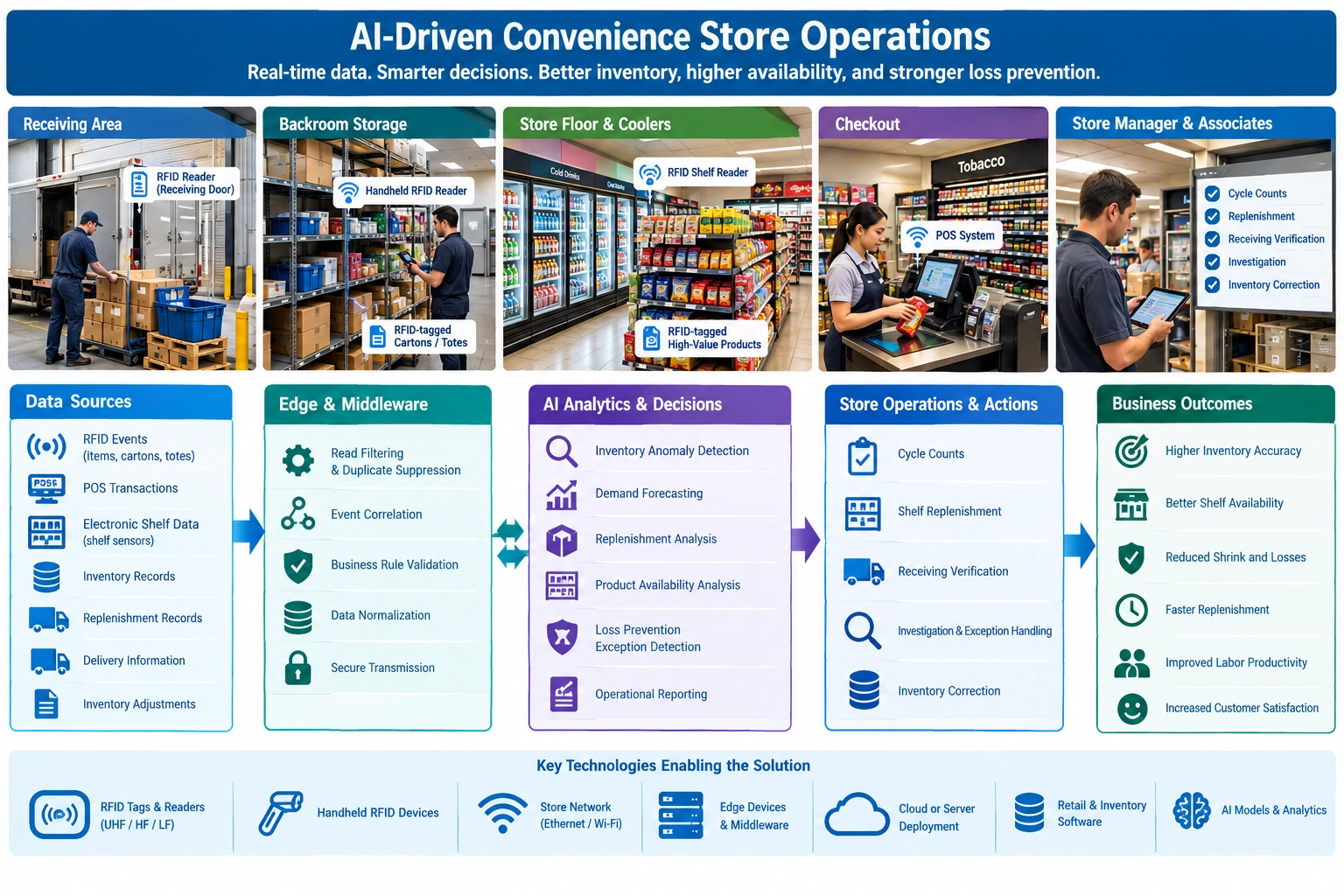
The visual shows how RFID readers, POS transactions, inventory records, and store data flow through edge middleware into AI analytics. AI-generated insights support replenishment, receiving verification, inventory correction, loss-prevention investigation, and other store actions.
What AI-Enabled Inventory Management Means for Convenience Stores
AI-enabled convenience store inventory management uses data from point-of-sale systems, inventory records, receiving transactions, shelf and backroom observations, deliveries, promotions, employee activity, and connected devices to identify patterns that conventional rule-based systems may not detect efficiently.
The primary objective is not simply to automate inventory counting. AI can correlate inventory conditions with sales velocity, delivery schedules, stockout history, product categories, store layouts, daypart demand, promotional activity, and operational exceptions. This allows convenience store operators to move from periodic inventory reconciliation toward more continuous inventory intelligence.
RFID provides one potential source of item-level or container-level data. UHF RFID is particularly relevant where multiple tagged items need to be identified rapidly during receiving, backroom movement, inventory counting, or controlled merchandise handling. HF RFID can support shorter-range identification requirements, while LF RFID can be appropriate for specialized proximity applications where its characteristics fit the operating environment.
For convenience stores, the value of these technologies depends heavily on the business process surrounding the data. A reliable RFID read does not automatically represent a completed receiving transaction, shelf placement, sale, or inventory adjustment. Middleware should distinguish raw observations from validated business events before AI models use them for operational decisions.
Why Convenience Stores Need AI-Based Operational Visibility
Convenience stores operate with a different inventory profile from many large-format retailers. A relatively small selling area can contain thousands of individual SKUs spanning beverages, snacks, prepared foods, packaged groceries, tobacco products, over-the-counter items, automotive products, and other merchandise.
Frequent deliveries create additional receiving activity. Products may move quickly from a receiving door to a backroom staging area and then to shelves, coolers, freezers, displays, or controlled-access storage. Some products have short shelf lives, while others require tighter inventory controls because of value, regulatory considerations, shrink exposure, or age restrictions.
AI can help interpret these conditions by correlating operational signals rather than evaluating each event independently.
- Inventory anomaly detection can identify discrepancies between expected inventory and observed item or container activity.
- Demand forecasting can estimate future requirements using historical sales, daypart patterns, promotions, holidays, local demand, weather-related effects, and replenishment history.
- Stockout analysis can identify products whose recorded inventory does not correspond with expected availability.
- Replenishment analysis can identify backroom inventory that should potentially be moved to shelves based on sales velocity and observed inventory conditions.
- Receiving analysis can compare expected deliveries with received merchandise and identify exceptions for employee verification.
- Loss-prevention analytics can identify unusual movement patterns or unexplained inventory changes for human investigation.
- Perishable inventory analysis can combine sales velocity, receiving records, inventory age, and product information to support waste-reduction decisions.
- Store labor analytics can correlate inventory exceptions with receiving periods, cycle counts, replenishment activity, and workload.
Convenience Store Applications for AI and RFID
AI Inventory Management and Item-Level Visibility
Inventory accuracy is a foundational requirement for convenience store replenishment. A product may exist physically in a backroom but remain unavailable to customers because it has not been replenished onto the selling floor. Conversely, the POS system may show inventory that is no longer physically available because of shrink, receiving discrepancies, damage, misplacement, or transaction errors.
RFID can provide additional observations of tagged merchandise or handling units. AI can compare those observations with POS activity, receiving records, expected inventory, and replenishment history.
A practical implementation can establish a sequence such as:
- Purchase order or delivery record establishes expected merchandise.
- Receiving personnel verify cartons, totes, or selected tagged merchandise.
- RFID readers capture identification events where RFID is deployed.
- Middleware filters duplicate reads and assigns events to receiving or backroom zones.
- Inventory software records validated receiving transactions.
- AI compares expected, received, sold, transferred, and observed inventory.
- Exceptions are routed to store personnel for investigation.
- Confirmed adjustments update the appropriate retail or inventory system.
This separation between RFID observation and business confirmation is important. It prevents a transient read at a receiving doorway from being interpreted as proof that merchandise has been completely received and shelved.
Shelf Availability and Replenishment
Convenience stores depend heavily on rapid replenishment because customers expect commonly purchased products to be available during short shopping visits. A missing beverage, snack, prepared-food item, or high-demand convenience product can result from true stockout, inventory-record error, backroom inventory, misplaced merchandise, or delayed replenishment.
AI can classify these conditions using sales history, inventory records, RFID observations where available, employee activity, and replenishment timing.
For example, if a product has strong sales velocity but observed inventory remains concentrated in a backroom location, the system can generate a replenishment task. If recorded inventory is high but repeated observations fail to locate the merchandise in expected areas, the exception can be routed for cycle counting or investigation.
The objective is not to have AI automatically assume that missing merchandise represents theft or employee error. Exception models should identify conditions requiring human review and provide the underlying events needed for an informed decision.
Receiving and Delivery Verification
Frequent supplier deliveries make receiving accuracy important to convenience store operations. Deliveries may include mixed cases, totes, beverages, refrigerated merchandise, prepared-food products, and other SKU categories with different handling requirements.
RFID can support receiving verification when tags are applied to suitable products, reusable containers, totes, cases, or logistics units. AI can then compare expected shipment information with actual receiving observations and historical discrepancies.
Useful analytical signals include:
- Purchase order quantities
- Advance shipping information
- Delivery timestamp
- RFID observations
- Barcode or handheld scan records
- Receiving employee and workstation
- Product category
- Expected versus observed quantity
- Repeated supplier discrepancies
- Receiving duration
- Backroom staging time
GAO can supply RFID readers, tags, antennas, handheld devices, and related data-capture hardware that can be evaluated according to the merchandise, reading distance, packaging, store layout, and required throughput.
Loss Prevention and Unusual Inventory Movement
Convenience stores can experience inventory discrepancies caused by several factors, including transaction errors, receiving mistakes, damaged products, misplaced merchandise, incorrect counts, and unexplained product movement. AI can help identify patterns that merit investigation.
A store may establish expected movement paths for selected tagged products or containers. Repeated movement between controlled-access areas, receiving zones, storage locations, or sales areas can be correlated with POS activity and inventory changes.
The analytical model should emphasize investigation rather than automatic attribution. An alert can identify an unusual pattern, while store personnel determine whether the cause was an operational error, legitimate movement, product return, damaged merchandise, or another condition.
Perishable Merchandise and Waste Reduction
Fresh food, prepared meals, dairy products, refrigerated beverages, and other time-sensitive merchandise create inventory challenges that differ from durable packaged goods.
AI can combine product attributes, receiving time, inventory age, sales velocity, markdown activity, waste records, and store-level demand patterns. RFID can provide additional identification or movement events where tags and operating conditions make deployment practical.
Potential outputs include:
- Products approaching operational freshness thresholds
- Slow-moving items with elevated waste risk
- Locations requiring different replenishment quantities
- Inventory that remains in backroom storage longer than expected
- Differences between expected and observed product movement
- Opportunities to coordinate markdown or replenishment activities
Such systems should complement established food-safety procedures rather than replace them. AI recommendations need to respect product-specific handling requirements, temperature controls, expiration information, and store operating policies.
Convenience Store Operational Workflow from Data Capture to AI Decisions
A useful AI and RFID solution for convenience stores should follow the physical movement of merchandise and the digital lifecycle of each inventory event. The workflow begins before merchandise reaches the sales floor and continues through receiving, storage, replenishment, sale, adjustment, return, or disposal.
Merchandise Receiving and Identification
Supplier shipments enter the store through a receiving area that may have limited physical space and high employee activity. RFID commissioning, if used, should occur upstream or during an appropriate receiving process rather than relying on unverified reads at the doorway.
Relevant event data can include:
- RFID tag identifier
- Product or container identifier
- Reader identifier
- Antenna or read-zone identifier
- Timestamp
- Receiving station
- Purchase order reference
- Shipment reference
- Store identifier
- Employee or transaction context
- Event classification
- Confidence or read-quality information where supported
Edge Processing and RFID Middleware
Raw RFID observations should normally pass through middleware or edge processing before entering AI workflows. This layer can perform duplicate suppression, read-zone filtering, timing logic, reader health monitoring, event buffering, and correlation with store transactions.
Convenience stores have challenging RF environments. Beverage coolers contain liquids, shelving can contain metal, and dense product arrangements can affect tag readability. Store entrances can also create unintended reads if reader zones are not carefully designed.
A properly engineered deployment therefore treats RF performance as a site-specific engineering problem rather than assuming that one reader configuration will work across every store.
Inventory and Retail Software Integration
Validated events can be integrated with inventory management, POS, retail management, ERP, procurement, replenishment, workforce management, loss-prevention, and reporting systems.
Common integration mechanisms include:
- REST APIs
- Webhooks
- SQL interfaces
- Message queues
- Middleware APIs
- Structured file exchange
- CSV-based imports or exports where appropriate
The integration should preserve traceability between the original RFID observation, the normalized event, the business transaction, and any AI-generated recommendation.
AI Analysis and Store-Level Decision Support
AI services analyze historical and real-time information to identify patterns and exceptions. Depending on the use case, models can include anomaly detection, classification, time-series forecasting, optimization, computer vision, and natural-language query interfaces.
The decision process should expose enough context for a store manager or authorized employee to understand why an alert was generated. A useful exception record might show the expected quantity, observed quantity, recent sales, last known location, receiving event, relevant RFID reads, and the recommended verification step.
This creates a human-supervised workflow in which AI accelerates analysis while operational personnel retain control over inventory adjustments and other consequential actions.
Technical Foundation for AI-Enabled Convenience Store Operations
A convenience store deployment normally combines physical identification devices, store networking, edge or middleware processing, retail software, data storage, AI services, and employee-facing applications.
The underlying components should be selected around the actual business process rather than deployed solely because a particular technology is available.
UHF, HF, and LF RFID for Convenience Stores
UHF RFID is generally the most relevant RFID frequency range when convenience store applications require longer-range identification or rapid reading of multiple tagged items, cartons, totes, or assets. Fixed readers can support receiving and controlled movement zones, while handheld readers can support targeted inventory verification.
HF RFID operates at shorter ranges and can be useful where controlled proximity identification is required. LF RFID has different propagation characteristics and can be appropriate for specialized identification or proximity applications where its operating properties match the use case.
Tag selection is equally important. Beverage products, liquids, foil packaging, metal shelving, refrigerated environments, and dense merchandise can affect RF performance. Tags should therefore be tested against actual packaging and store fixtures before broad deployment.
RFID Readers, Antennas, Handhelds, and Sensors
Fixed RFID readers can monitor defined zones such as receiving doors, backroom transition points, or controlled storage areas. Antenna placement determines the effective read zone and must account for merchandise orientation, doorway geometry, shelving, interference, and unintended reads.
Handheld RFID readers can complement fixed infrastructure by allowing employees to perform targeted searches, cycle counts, exception verification, and location checks.
Additional IoT devices can provide environmental or operational data where useful. For example, connected temperature sensors may provide information relevant to refrigerated inventory workflows, while BLE devices can support selected location or asset-tracking scenarios.
Edge Processing, Networking, and Store Connectivity
Store connectivity should be designed around the operational importance of the application. RFID readers may communicate over Ethernet, Wi-Fi, or other supported network arrangements depending on the device and site.
Edge processing can reduce unnecessary transmission of raw reads and provide local filtering and temporary buffering when connectivity to a central service is interrupted. Store-level resilience is particularly important for receiving and inventory processes that cannot simply stop because a wide-area network connection becomes unavailable.
Cloud Version and Server Version
A Cloud Version can host RFID event processing, databases, AI services, dashboards, and integration services within cloud infrastructure. This model can be appropriate for convenience store groups operating many locations that need centralized monitoring, common software updates, consolidated analytics, and multi-store inventory analysis.
A Server Version can run software on edge servers, customer-managed servers, private data centers, store or regional facility servers, or other privately hosted enterprise infrastructure. This approach may be appropriate when data residency, internal IT policies, local processing requirements, network independence, or integration constraints make privately hosted deployment preferable.
A hybrid arrangement can also be appropriate. Local edge services can process RFID observations and maintain temporary operational continuity, while selected event data and AI analytics are synchronized with centralized systems.
GAO can support the hardware side of these deployments with RFID readers, antennas, tags, handheld devices, and related IoT products, while implementation teams can evaluate device placement, communications, software interfaces, and operating conditions against the specific convenience store workflow.
Security and Data Governance
Security should cover the entire data path from RFID devices and store networks to middleware, databases, AI services, and employee applications.
Relevant controls can include:
- Device authentication and credential management
- Role-based access control
- Encrypted network communication
- Secure API authentication
- Network segmentation
- Firewall controls
- Audit logging
- Software and firmware update procedures
- Data retention policies
- Monitoring of unusual system access
- Backup and recovery procedures
- Secure configuration of store-level edge computers
RFID itself should not be treated as the complete security mechanism. Security depends on the surrounding devices, network, software, identity controls, data flows, and operational procedures.
AI Capabilities That Improve Convenience Store Performance
AI becomes most useful when convenience store data is connected to specific operational decisions. Instead of treating inventory, sales, receiving, replenishment, and loss prevention as separate processes, AI can evaluate their relationships and identify conditions that require attention.
Demand Forecasting and Replenishment Optimization
Demand forecasting models can analyze SKU-level sales history, daypart demand, seasonality, promotions, holidays, store trading patterns, and replenishment history. Convenience stores can use these forecasts to improve ordering decisions for fast-moving beverages, snacks, prepared foods, dairy, tobacco products, and other frequently purchased merchandise.
RFID observations can add another operational signal by showing whether expected inventory is physically present in receiving areas, backrooms, or other defined locations. The resulting model can distinguish between low inventory and inventory that is available but has not reached the selling area.
Useful outputs include:
- SKU-level demand forecasts
- Suggested replenishment priorities
- Stockout-risk alerts
- Backroom inventory availability
- Unusual sales-versus-inventory conditions
- Store-specific ordering signals
- Product-level replenishment exceptions
Forecasting should remain sensitive to data quality. A promotion, temporary closure, supply disruption, local event, or unusual weather condition can create sales patterns that should not automatically be interpreted as a permanent change in demand.
Computer Vision for Shelf and Store Operations
Computer vision can complement RFID where visual information provides context that identification technologies cannot provide by themselves. Cameras or imaging devices can analyze shelf conditions, product facings, empty spaces, merchandising compliance, or selected operational conditions where privacy, security, and applicable policies permit.
A combined solution can use RFID to establish product identity and movement while computer vision evaluates the physical presentation of merchandise. AI can correlate the two data streams to identify situations such as inventory recorded in the store but absent from an expected shelf location.
Computer vision deployments should be designed around camera placement, lighting, privacy requirements, image retention, processing latency, and the distinction between automated detection and confirmed operational events.
AI-Powered Inventory Reconciliation
Traditional reconciliation often occurs through periodic counts and manual investigation. AI can continuously compare expected inventory against multiple operational signals.
A reconciliation model may consider:
- Opening inventory
- Supplier receipts
- Transfers
- POS sales
- Returns
- Damaged merchandise
- Waste
- Manual adjustments
- RFID observations
- Cycle-count results
- Known inventory corrections
This creates a more detailed explanation of inventory variance. Rather than producing only a quantity difference, the system can identify the events that contributed to the discrepancy and prioritize exceptions according to operational significance.
Store Labor and Task Prioritization
Convenience store employees frequently perform several functions during the same shift, including receiving deliveries, stocking shelves, operating checkout, preparing food, conducting inventory checks, handling returns, and maintaining store conditions.
AI can use inventory and transaction information to prioritize tasks. For example, a system may identify a high-demand product with physical backroom inventory and recommend replenishment before lower-priority inventory tasks.
Task prioritization should account for store operating procedures, employee availability, food-handling requirements, customer traffic, and safety considerations rather than relying exclusively on predicted sales.
Predictive Maintenance for Connected Store Equipment
AI and IoT can also extend beyond merchandise. Convenience stores operate refrigeration equipment, freezers, HVAC systems, checkout equipment, security devices, pumps at fuel locations where applicable, and other connected assets.
Sensor telemetry can be analyzed for abnormal temperature, vibration, energy consumption, runtime, or equipment behavior. Predictive maintenance models can identify conditions requiring inspection before an equipment failure disrupts store operations or damages temperature-sensitive merchandise.
RFID can complement this area by identifying equipment, maintenance assets, replacement parts, containers, or other physical resources when tagged identification is appropriate.
Engineering Considerations for Convenience Store RFID Deployments
RFID performance in a convenience store depends on physical conditions that can vary significantly between locations. A technically correct deployment therefore begins with a site survey and controlled testing rather than assuming identical performance across stores.
RF Environment and Tag Selection
Liquids are particularly important because beverages and other liquid-containing products can affect UHF RFID performance. Metal shelving, foil packaging, refrigerators, freezers, dense cartons, and product orientation can also influence read reliability.
Engineering validation should test representative merchandise rather than relying only on tag specifications.
Important variables include:
- Product packaging
- Liquid content
- Metal surfaces
- Tag placement
- Tag orientation
- Reader power
- Antenna polarization
- Reader-to-item distance
- Product density
- Conveyor or employee movement speed
- Store doorway geometry
- Adjacent RF sources
- Required read accuracy
The objective is not to maximize raw reads. Excessive reads outside the intended zone can create false operational events. A controlled read zone with reliable event interpretation is generally more useful than indiscriminate detection.
Event Modeling and Data Quality
Each RFID observation should contain enough information to support later analysis and troubleshooting.
A practical event record can include:
- Tag ID
- Reader ID
- Antenna or read-zone ID
- Timestamp
- Store ID
- Processing station
- Product or asset reference
- Transaction context
- Read quality information
- Event classification
- Exception status
Middleware can suppress repeated observations and convert sequences of reads into business events. For example, dozens of reads from one tag while an employee pauses near a reader should not necessarily produce dozens of separate inventory transactions.
Pilot Deployment and Commissioning
A convenience store RFID pilot should use representative products and actual operating conditions. Testing only during an empty store period may produce misleading results because normal operations introduce employees, customers, carts, deliveries, refrigeration equipment, and dense merchandise.
A practical commissioning process can include:
- Site survey
- Use-case definition
- Product and tag testing
- Reader and antenna positioning
- RF performance testing
- Read-zone calibration
- Middleware configuration
- POS and inventory integration
- AI data validation
- Exception workflow testing
- Employee acceptance testing
- KPI baseline measurement
- Controlled production rollout
GAO’s experience supplying RFID hardware products and systems can support evaluation of readers, tags, antennas, handheld equipment, and related data-capture requirements before broader deployment.
AI and RFID Implementation Lifecycle for Convenience Stores
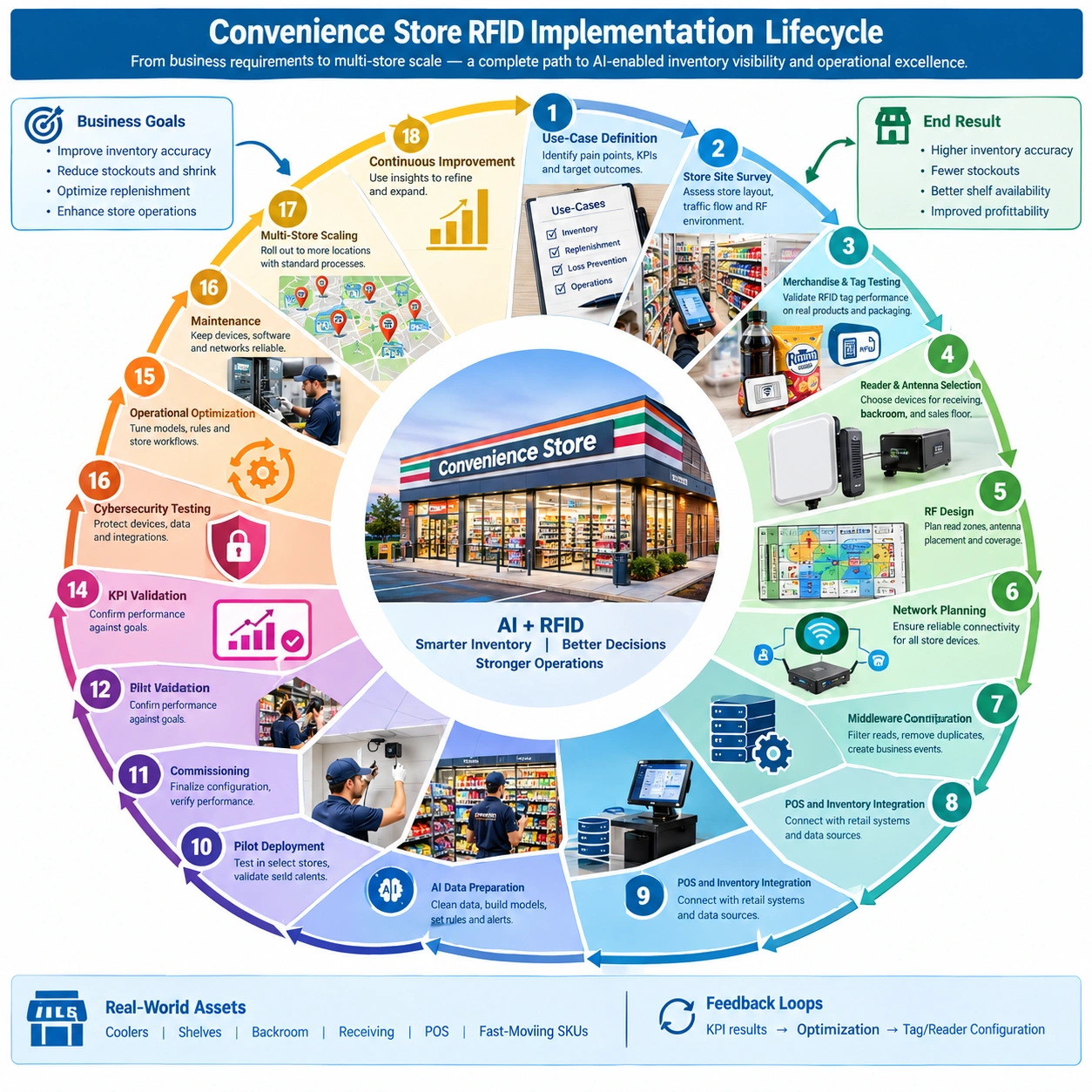
This visual illustrates the complete implementation lifecycle for AI-enabled RFID in convenience stores, covering use-case definition, site assessment, RFID testing, hardware selection, integration, pilot deployment, KPI validation, cybersecurity, optimization, maintenance, and multi-store scaling.
Integration with Convenience Store Software
AI-driven convenience store operations require integration with the software already responsible for commercial and operational transactions. RFID should therefore be treated as a data source within a broader information flow rather than as a replacement for POS or inventory software.
Relevant systems may include:
- Point-of-sale software
- Retail inventory management
- Merchandise management
- Procurement systems
- Supplier and purchase-order systems
- Warehouse management systems
- Order management systems
- ERP software
- Customer relationship management systems
- Workforce management software
- Loss-prevention systems
- Maintenance management software
- Business intelligence and reporting databases
Integration design should establish a clear source of truth for each business object. Product master data, for example, should not be independently maintained in multiple systems unless synchronization rules are explicitly defined.
APIs, Middleware, and Event Integration
REST APIs can exchange structured inventory and transaction information between applications. Webhooks can notify downstream systems when defined events occur. Message queues can support asynchronous processing where high event volumes or temporary service interruptions require buffering.
Middleware can normalize data from RFID readers, handheld devices, POS systems, and other IoT sources. It can also apply business rules before information reaches AI services.
A useful event flow is:
RFID or IoT observation → edge filtering → event normalization → business-event validation → inventory/POS context → AI analysis → exception or recommendation → human action → confirmed transaction
This approach helps preserve traceability while reducing unnecessary raw-data processing.
KPIs for AI-Enabled Convenience Store Operations
Convenience store operators should measure the operational outcome rather than RFID read volume alone. KPIs should establish whether the system improves inventory accuracy, replenishment, receiving, labor productivity, and exception resolution.
Relevant measures include:
- Inventory record accuracy
- Stockout rate
- On-shelf availability
- Backroom-to-shelf replenishment time
- Receiving discrepancy rate
- Receiving processing time
- Inventory variance
- Cycle-count frequency
- Cycle-count labor time
- Shrink investigation volume
- Exception resolution time
- Forecast accuracy
- Replenishment accuracy
- Waste rate for applicable perishable products
- Inventory adjustment frequency
- RFID read-zone accuracy
- False-positive exception rate
- RFID event processing latency
- System availability
- Store-level task completion time
AI models should also be monitored after deployment. Forecast accuracy can change as customer behavior changes, while anomaly models can generate excessive alerts if operational rules or store layouts change.
Scaling AI and RFID Across Convenience Store Locations
Multi-store deployment introduces additional engineering requirements. Stores can differ in floor area, shelf configuration, merchandise assortment, network connectivity, receiving layout, refrigeration equipment, and operating procedures.
A repeatable deployment standard should define:
- Approved RFID hardware configurations
- Tag selection criteria
- Antenna placement guidelines
- Reader configuration
- Network requirements
- Middleware event rules
- API specifications
- Cybersecurity controls
- Data-retention requirements
- Store commissioning procedures
- Employee training procedures
- KPI definitions
- Maintenance procedures
Store-specific configuration should remain possible where physical conditions require it. Standardization should simplify deployment without forcing every location into an identical RF design.
Cybersecurity, Reliability, and Operational Resilience
Convenience store technology operates across many distributed locations, increasing the importance of device management and secure communications.
RFID readers, handheld devices, edge computers, APIs, databases, AI services, and employee applications should be included in the store’s broader cybersecurity program.
Security controls should include device authentication, encrypted communications, role-based permissions, network segmentation, credential management, audit trails, software updates, vulnerability management, backup procedures, and incident-response processes.
Reliability engineering should address more than application uptime. A store should have defined behavior for network interruptions, reader failures, power interruptions, database unavailability, and temporary AI-service outages.
Local buffering can prevent temporary network failures from immediately destroying RFID event continuity. Operational procedures should also define what employees do when automated identification or decision-support services are unavailable.
Practical Implementation Recommendations for Convenience Stores
Successful deployments generally begin with a clearly defined business problem rather than a technology-first rollout.
A convenience store organization evaluating AI and RFID should consider:
- Select a measurable problem such as inventory variance, receiving accuracy, stockouts, backroom replenishment, or controlled merchandise visibility.
- Identify which merchandise and physical movements actually require RFID identification.
- Test UHF RFID against real product packaging, liquids, metal shelving, coolers, cartons, and totes.
- Establish the distinction between raw RFID observations and confirmed inventory transactions.
- Integrate RFID events with POS, inventory, receiving, and product-master information.
- Establish AI data-quality controls before model development.
- Use human validation for consequential inventory and loss-prevention decisions.
- Establish baseline KPIs before deploying AI-driven recommendations.
- Test store connectivity, local buffering, reader failure handling, and recovery procedures.
- Validate cybersecurity controls for readers, edge computers, APIs, databases, and user applications.
- Pilot representative stores before expanding to substantially different store formats.
- Recalibrate models and RF configurations when merchandise, shelving, store layouts, or operating procedures change.
GAO can provide RFID, BLE, and IoT hardware products and systems that support data acquisition, item identification, inventory workflows, and connected operational applications. For organizations evaluating deployment options, engineering review of the physical environment, software interfaces, and intended AI use case should precede equipment standardization.
Technical and Business Takeaways for Convenience Stores
AI-enabled convenience store operations can connect inventory, sales, receiving, replenishment, loss-prevention, and store workflow data into a decision-support process that is more responsive than periodic manual reconciliation.
RFID is most valuable when it supplies reliable identification events for merchandise, containers, or assets where item-level visibility provides a measurable operational advantage. UHF RFID can support longer-range and multi-item identification scenarios, while HF and LF RFID can address more specialized proximity requirements.
AI adds value by interpreting these events alongside POS transactions, inventory records, demand signals, delivery information, and operational history. The result can be more targeted replenishment, earlier identification of inventory discrepancies, improved receiving verification, stronger exception management, and more informed store-level decisions.
The implementation should remain grounded in physical RF testing, reliable event modeling, secure integration, data governance, measurable KPIs, and human oversight.
GAO supports organizations with RFID, BLE, and IoT hardware products and systems and has served customers across the United States and Canada for three decades. Headquartered in New York City and Toronto, Canada, GAO is recognized among the leading B2B and B2G suppliers of BLE and RFID technologies. GAO, GAO Research, and GAO Tek form GAO Group, which has worked with Fortune 500 companies, R&D organizations, universities, and U.S. and Canadian government agencies. Our investment in R&D, quality assurance processes, and remote or onsite technical support provides a practical foundation for organizations evaluating connected inventory and retail technology.
For convenience store operators, system integrators, and technology teams, learning more about GAO’s RFID, BLE, IoT products, systems, and technical support can help clarify the hardware and data-capture requirements for specific store workflows.
Building the Future of Industrial AI and IoT with Aperture Venture Studio and GAO RFID Inc.
For more than three decades, GAO Group of Companies has invested heavily in R&D for industrial RFID, BLE, and IoT. As generative AI has become increasingly useful for operational applications, we have expanded our work in AI and IoT technologies and founded Aperture Venture Studio to build, launch, and scale next-generation AI and IoT solutions relevant to areas such as intelligent convenience store operations, inventory visibility, and connected retail.
Aperture has attracted AI and IoT technical experts, entrepreneurial and operational executives, influential investors, and leading companies. We have also developed Aperture Ventures Summit and TekSummit to discuss advanced AI and IoT topics and foster technical communities.
We welcome you to join us as:
- Advisors, Co-founders, or Employees
- Investors
- Customers