
AI and RFID for Medical Laboratories
AI-Driven Medical Laboratory Operations with RFID
AI and RFID for Medical Laboratories combines artificial intelligence with automated identification, specimen tracking, laboratory inventory data, equipment status, and workflow events to improve how clinical and diagnostic laboratories manage specimens and physical resources. AI can analyze specimen movement, accessioning delays, storage conditions, instrument queues, inventory patterns, and exception events, while RFID can provide automated identification and location information at selected workflow points. The resulting system can connect preanalytical, analytical, and postanalytical activities with laboratory information systems and operational software. This is particularly relevant to high-volume clinical laboratories, hospital laboratories, reference laboratories, pathology laboratories, molecular diagnostics facilities, blood testing environments, and biobanks where specimen traceability and timely processing are critical. ISO 15189:2022 establishes requirements for quality and competence in medical laboratories, making controlled identification, information management, and documented processes important considerations when introducing automation.
Medical Laboratory AI and RFID Workflow
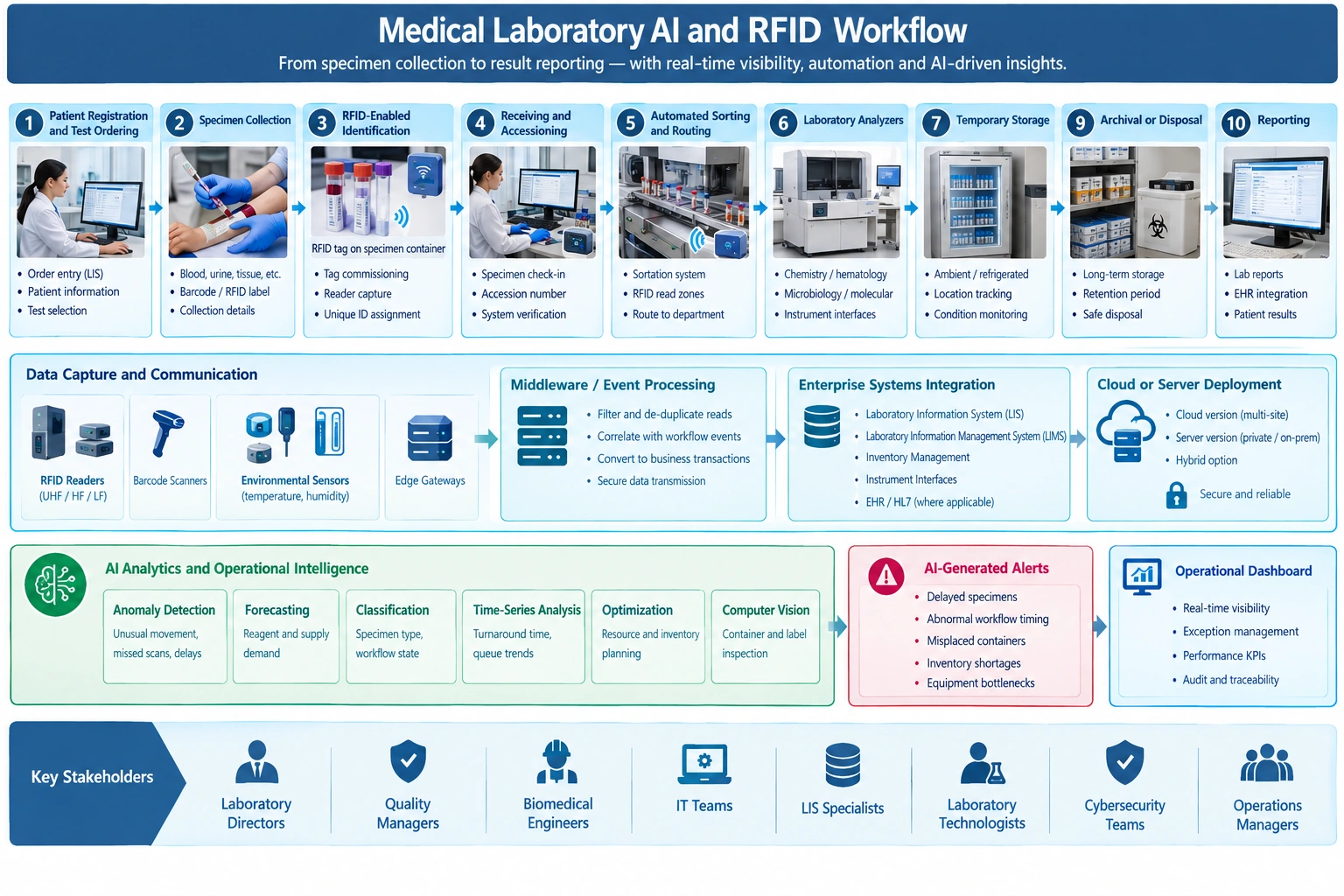
This workflow diagram shows how medical laboratory specimens move from test ordering and collection through RFID-enabled identification, accessioning, sorting, analysis, storage, and reporting. It also illustrates how RFID and other data sources feed middleware, laboratory systems, and AI analytics that generate operational alerts and support laboratory decision-making.
Why AI Matters for Medical Laboratory Workflow Management
Medical laboratories operate through tightly controlled sequences in which specimen identity, patient association, collection requirements, transport conditions, processing status, test priority, instrument availability, and result reporting all influence turnaround time and quality. A conventional laboratory information system records many business transactions, but physical movement and operational conditions can remain dependent on barcode scans, manual observations, workstation updates, or instrument interfaces.
AI adds an analytical layer that can examine these events continuously. Rather than treating every specimen as an isolated transaction, machine learning models can identify recurring patterns across accessioning, centrifugation, aliquoting, analytical queues, storage, and result verification. For example, a laboratory may use historical workflow data to estimate expected processing time for different specimen types, identify unusual queue growth, or detect a specimen whose physical movement does not match the expected workflow state.
RFID serves as one possible automated data-acquisition mechanism. Depending on the specimen container, workflow, read distance, environmental conditions, and required identification process, UHF RFID, HF RFID, or LF RFID may be appropriate. The selection should be based on laboratory workflow requirements rather than RFID frequency alone.
The most useful implementation separates an RFID read from a confirmed laboratory transaction. A reader may observe a tag entering a read zone, but middleware should correlate that observation with workstation location, timestamp, accession number, laboratory department, specimen type, and workflow state before the event becomes an operational record.
Medical Laboratory Use Cases for AI-Enabled Operations
Specimen Tracking and Chain of Custody
Specimen traceability is one of the most important applications for AI-assisted identification in medical laboratories. Blood tubes, urine containers, tissue containers, swab specimens, aliquots, transport carriers, racks, trays, and other laboratory items can pass through numerous physical locations before testing is completed.
An RFID-enabled system can capture selected movement events without requiring personnel to scan every item manually. AI can then evaluate the event history against expected laboratory workflow.
Potential applications include:
- Detecting specimens that remain too long between receiving and accessioning
- Identifying unexpected movement between laboratory departments
- Monitoring specimens entering or leaving controlled storage areas
- Correlating specimen movement with accessioning and test-order records
- Identifying workflow exceptions for laboratory personnel to investigate
- Improving traceability for stored aliquots and retained specimens
- Supporting chain-of-custody documentation for specialized laboratory workflows
The objective is not to replace laboratory identification procedures. RFID should complement validated patient and specimen identification processes. CLSI PRE01 specifically addresses patient and specimen identification, collection, transport, handling, and labeling throughout the preexamination, examination, and postexamination phases.
AI Specimen Flow and Turnaround-Time Management
Turnaround time depends on much more than analyzer speed. Specimens may wait for accessioning, centrifugation, aliquoting, transport, batch processing, analyzer availability, reflex testing, manual review, result verification, or additional quality-control procedures.
AI can analyze timestamped workflow events to identify where delays are occurring. A laboratory could establish expected processing intervals for different specimen classes and use anomaly detection to flag cases that deviate significantly from those patterns.
Relevant data may include:
- Collection timestamp
- Receipt timestamp
- Accessioning timestamp
- Centrifugation start and completion
- Aliquoting events
- Analyzer queue entry
- Test start and completion
- Result verification
- Manual review
- Storage location
- Specimen retrieval
- Disposal or retention status
This creates a more detailed operational view than measuring only total laboratory turnaround time. Laboratory managers can examine the individual stages contributing to delays and distinguish a genuine processing bottleneck from an isolated exception.
Laboratory Inventory and Reagent Management
Medical laboratories manage large inventories of reagents, calibrators, controls, consumables, specimen containers, collection supplies, PPE, storage materials, and specialized laboratory equipment. Inventory errors can lead to unnecessary purchases, stockouts, expired materials, or interruptions to testing.
AI-based inventory management can combine historical consumption, test volumes, expiration dates, storage locations, purchasing records, and laboratory schedules to forecast demand. RFID can provide automated identification for selected inventory categories and storage locations.
Examples include:
- Monitoring reagent and consumable movement
- Detecting inventory discrepancies
- Identifying items approaching expiration
- Forecasting demand based on testing volume
- Monitoring controlled storage locations
- Tracking laboratory equipment and mobile assets
- Detecting unusual consumption patterns
- Supporting replenishment decisions
The strongest implementations maintain separate records for physical observation, inventory transaction, and business confirmation. This distinction reduces the risk of treating an RFID read as definitive proof that an item was consumed or used.
Laboratory Equipment and Asset Visibility
Medical laboratories rely on centrifuges, analyzers, incubators, refrigerators, freezers, biosafety cabinets, microscopes, automated specimen handlers, transport systems, pipetting equipment, racks, carts, and mobile laboratory devices.
AI-assisted asset tracking can combine identification events with equipment maintenance records, utilization data, service schedules, and laboratory workload.
A system may identify:
- Underutilized equipment
- Equipment movement between departments
- Unexpected equipment location changes
- Maintenance intervals approaching due dates
- Abnormal utilization patterns
- Bottlenecks caused by limited instrument capacity
- Laboratory areas where additional equipment may be required
RFID does not need to be attached to every instrument. High-value mobile equipment, transport carts, reusable racks, specialized containers, or assets that frequently move between departments may provide more practical starting points.
Cold Storage and Specimen Retrieval
Refrigerators, freezers, ultra-low-temperature freezers, cryogenic storage systems, and controlled specimen repositories introduce another layer of operational complexity. Location alone is not sufficient because laboratories may also need to know the container, rack, shelf, box, position, retention period, and access history.
An AI-enabled retrieval system can correlate identification events with storage maps and laboratory records. When combined with environmental monitoring, the system can help identify unusual retrieval patterns, prolonged access events, or discrepancies between expected and observed locations.
Environmental sensors can provide temperature, humidity, door-open duration, and other telemetry. AI can analyze this information alongside specimen and equipment events, helping laboratory personnel prioritize operational exceptions.
Medical Laboratory AI and RFID Deployment Scenarios
The most appropriate deployment depends on the laboratory’s physical layout, specimen volume, identification requirements, existing software, and regulatory environment.
Common environments include:
- Hospital clinical laboratories with high-volume blood and chemistry workflows
- Reference laboratories processing specimens from multiple healthcare facilities
- Pathology laboratories handling tissue, slides, blocks, and related materials
- Molecular diagnostics laboratories managing specialized specimen workflows
- Microbiology laboratories handling cultures and diagnostic specimens
- Biobanks and research laboratories managing retained biological materials
- Blood testing and transfusion-related laboratory operations
- Satellite laboratories connected to a central laboratory
- Multi-site laboratory networks requiring shared operational visibility
Each environment creates different requirements for identification, read-zone design, environmental monitoring, software integration, and workflow validation.
End-to-End Medical Laboratory Data and Decision Workflow
A practical AI-enabled medical laboratory system begins with reliable operational data rather than with an AI model. The data pipeline should connect physical events with validated laboratory transactions.
Data Acquisition
Data may originate from RFID readers, barcode scanners, laboratory instruments, environmental sensors, freezers, refrigerators, automated specimen handlers, workstations, mobile devices, and existing laboratory software.
RFID event records can include:
- Tag identifier
- Reader identifier
- Antenna or read-zone identifier
- Timestamp
- Signal or read-quality information where supported
- Physical location
- Workflow station
- Associated specimen, container, rack, or asset identifier
- Accession or transaction context
- Event classification
- Exception status
The system should avoid assuming that every raw RFID observation represents a business event. Duplicate reads, unintended reads from nearby containers, tag orientation, liquid-rich environments, metal surfaces, reader placement, and specimen density can affect RFID performance.
Edge Processing and Middleware
Middleware provides the operational bridge between physical identification and laboratory software. It can filter duplicate reads, apply read-zone rules, buffer events during temporary network interruptions, correlate multiple observations, and convert raw events into meaningful workflow states.
For example, a sequence of observations might be transformed into events such as:
- Specimen carrier received
- Specimen identified
- Specimen entered accessioning
- Specimen transferred to chemistry
- Specimen entered refrigerated storage
- Rack moved to analyzer queue
- Specimen retrieval requested
- Specimen location exception detected
This event layer gives AI software cleaner and more meaningful information than a raw stream of reader observations.
AI Analytics and Operational Decisions
Once laboratory events are normalized, AI can perform classification, anomaly detection, forecasting, time-series analysis, optimization, and other analytical functions.
Examples include:
- Predicting specimen processing delays
- Detecting unusual specimen movement
- Forecasting reagent consumption
- Identifying laboratory workflow bottlenecks
- Predicting equipment service requirements from utilization and maintenance records
- Detecting inventory anomalies
- Prioritizing retrieval tasks
- Identifying recurring causes of turnaround-time variation
AI outputs should generally be treated as decision support. A flagged specimen, asset, or workflow event should be presented to an appropriate laboratory professional for investigation according to the laboratory’s validated procedures.
This approach is particularly important where automated rules could affect patient-related laboratory operations. CLSI’s guidance on laboratory result autoverification emphasizes the need to design, implement, validate, and maintain algorithms and to establish appropriate monitoring and compliance processes.
RFID Technology Selection for Medical Laboratories
Medical laboratories should select RFID technology according to the physical and operational characteristics of the identification point.
UHF RFID is generally relevant where laboratories need longer-range identification or the ability to read multiple tagged items within a controlled zone. Potential applications include specimen carriers, racks, transport containers, laboratory assets, and inventory where tag density and read-zone control can be engineered appropriately.
HF RFID is more suitable for shorter-range, controlled identification interactions where close proximity between a reader and tagged object is desirable. It can be considered for workstation-level identification or specialized laboratory applications requiring deliberate interaction.
LF RFID can support short-range identification scenarios where environmental or application constraints make lower-frequency technology appropriate. The practical selection depends on tag form factor, material, required read distance, reader placement, interoperability, and laboratory workflow.
The goal is not maximum read distance. The goal is reliable and controlled identification at the exact point where a laboratory process requires trustworthy event capture.
Medical Laboratory Systems, Software, and Communication Infrastructure
A typical deployment may connect:
- RFID readers and antennas
- RFID tags and labels
- Barcode scanners
- Edge gateways
- Middleware and event-processing software
- Laboratory information systems
- Laboratory information management systems
- Electronic health record interfaces
- Inventory management software
- Instrument middleware
- Analyzer interfaces
- Environmental monitoring systems
- Maintenance management software
- Purchasing and ERP systems
- Data warehouses
- AI analytics and reporting software
Communication may use Ethernet, Wi-Fi, secure IP networking, REST APIs, webhooks, SQL interfaces, message queues, HL7-based healthcare interfaces where applicable, or vendor-specific integration interfaces.
Integration should preserve the laboratory’s existing system of record. RFID middleware should not create conflicting specimen identities, while AI services should not silently modify validated laboratory records.
Cloud and Server Deployment for Medical Laboratories
A Cloud Version can host AI processing, dashboards, centralized event storage, reporting, and multi-site analytics within managed cloud infrastructure. This approach can be useful for laboratory networks that need centralized visibility across hospitals, reference laboratories, or geographically distributed facilities. Connectivity, data governance, identity management, cybersecurity, and integration with laboratory systems must be evaluated before deployment.
A Server Version can run software on edge servers, customer-managed servers, private data centers, laboratory facility servers, or other privately hosted enterprise infrastructure. This model can be appropriate where laboratories require greater control over data location, network dependencies, integration boundaries, or local processing.
A hybrid arrangement can also place RFID event processing close to laboratory operations while sending selected normalized data to centralized AI services. This can reduce network dependency for time-sensitive workflows and limit the volume of raw event data transmitted outside the facility.
The appropriate deployment model depends on laboratory network design, security requirements, data governance, operational continuity, integration constraints, and the number of facilities involved.
Quality, Compliance, and Engineering Considerations
AI and RFID deployment in medical laboratories should be treated as an operational and quality-system project rather than simply an equipment installation. ISO 15189:2022 specifies requirements for quality and competence in medical laboratories and can be used by laboratories, regulators, and accreditation bodies when assessing laboratory competence.
The implementation should therefore establish clear ownership for identification, data integrity, validation, cybersecurity, system changes, exception handling, and audit records.
Relevant considerations include:
- Defining which physical events must be captured and which do not require RFID
- Validating tag placement and identification performance
- Testing read zones under realistic specimen density and laboratory conditions
- Separating raw observations from confirmed laboratory transactions
- Maintaining traceability between specimen identifiers and laboratory records
- Establishing data-retention and audit requirements
- Testing failure behavior during network or server outages
- Validating AI models against representative laboratory workflow data
- Monitoring false positives and false negatives in AI-generated exceptions
- Controlling software changes through documented change-management procedures
- Protecting interfaces between RFID middleware, LIS, LIMS, EHR, and other systems
- Establishing cybersecurity controls for readers, gateways, servers, APIs, and user accounts
Regulatory requirements can also change. For example, FDA’s current LDT information explains that a May 2024 final rule was vacated by a federal district court in March 2025, followed by an FDA rule in September 2025 reverting the regulatory text to its pre-May-2024 wording. Laboratories should therefore verify applicable current requirements rather than relying on older summaries of LDT regulation.
AI-Enabled RFID Implementation Lifecycle for Medical Laboratories
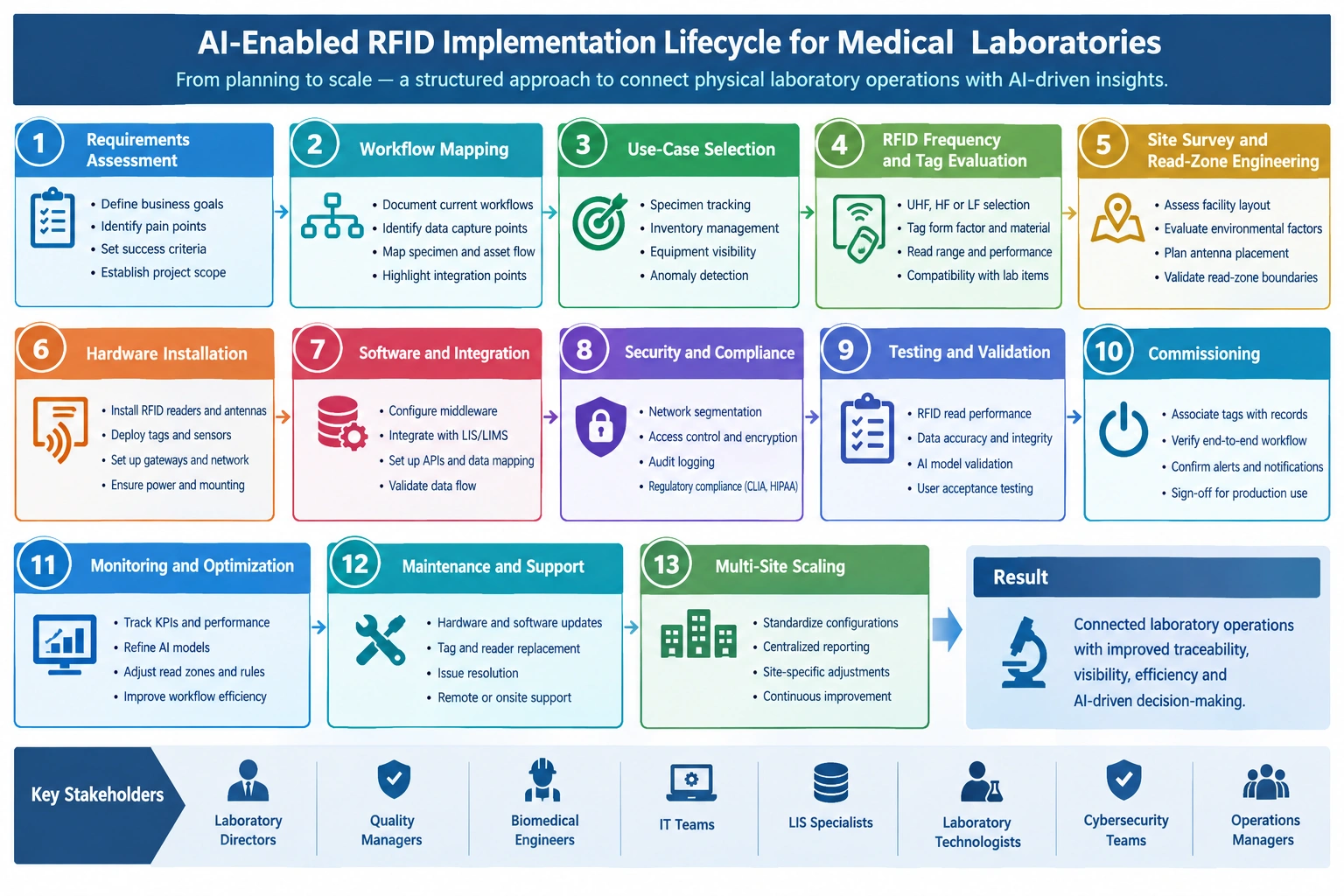
This infographic presents a 13-stage implementation lifecycle for AI-enabled RFID in medical laboratories, from requirements assessment and workflow mapping through hardware deployment, LIS/LIMS integration, validation, optimization, maintenance, and multi-site scaling. It also identifies key stakeholders involved in laboratory deployment and governance.
Engineering Implementation for AI-Enabled Medical Laboratories
Successful deployment starts with workflow engineering rather than hardware placement. A medical laboratory should first identify where physical visibility is currently weak, which workflow stages generate delays or reconciliation work, and which events can be captured reliably without disrupting validated procedures.
Planning and Site Assessment
A laboratory site assessment should document specimen receiving, accessioning, processing benches, analyzer areas, storage rooms, refrigerated storage, freezer locations, transport corridors, waste areas, and interdepartmental transfer points.
Engineering teams should evaluate:
- Specimen and container materials that may affect RFID performance
- Liquid-rich environments and their influence on tag selection
- Metal equipment, cabinets, shelving, and doors near readers
- Read-zone boundaries and unintended tag reads
- Tag orientation and attachment method
- Density of specimens, racks, and transport containers
- Reader antenna positioning
- Network availability at reader locations
- Power requirements and equipment mounting
- Environmental conditions in refrigerators and freezers
- Existing barcode and laboratory identification procedures
A controlled pilot should normally precede broad deployment. The pilot can establish read performance, event accuracy, workflow acceptance, integration reliability, and the operational value of AI-generated alerts before additional laboratory areas are equipped.
Commissioning, Testing, and Validation
RFID commissioning should associate each tag with the correct laboratory object and establish its relationship with the relevant inventory, specimen, rack, carrier, or asset record.
Testing should include normal operating conditions and deliberately difficult scenarios. Examples include multiple tagged specimens passing through a read zone simultaneously, tags positioned differently, closely spaced containers, movement through doors, equipment near antennas, and temporary network interruptions.
AI validation should use representative historical or operational data. A model that identifies an unusual turnaround-time pattern in one laboratory department may perform differently in another department because workflow characteristics, specimen mix, staffing, instrumentation, and operating hours differ.
Model performance should therefore be monitored using measures appropriate to the specific use case, such as precision, recall, false-positive rate, false-negative rate, processing latency, and alert-resolution rate.
AI Methods for Medical Laboratory Operations
Different laboratory problems require different analytical approaches. AI should be selected according to the decision that the laboratory needs to support rather than applied simply because large volumes of data are available.
Anomaly Detection
Anomaly detection can identify events that differ from established laboratory workflow patterns.
Examples include:
- A specimen carrier appearing in an unexpected department
- An unusually long interval between accessioning and processing
- A storage container appearing outside its expected location
- A sudden increase in reagent consumption
- Repeated delays associated with a particular workflow station
- Equipment utilization patterns that differ substantially from historical operation
Anomaly detection should generate an investigation signal rather than automatically assigning blame or assuming specimen loss, operator error, or noncompliance.
Forecasting and Time-Series Analysis
Forecasting models can use historical laboratory volumes, day-of-week patterns, seasonal demand, test mix, staffing information, and inventory consumption to estimate future workload.
Potential outputs include:
- Expected specimen volume
- Reagent consumption
- Consumable requirements
- Analyzer workload
- Storage demand
- Expected processing queues
- Staffing pressure indicators
These forecasts can help laboratory managers prepare resources before a predictable workload increase becomes an operational bottleneck.
Computer Vision and Multimodal AI
Computer vision can complement RFID when physical condition needs to be assessed visually. Depending on the validated application, cameras may help identify damaged labels, improperly positioned containers, visible packaging problems, rack configuration issues, or equipment indicators.
Computer vision should not be presented as a replacement for laboratory professionals or validated diagnostic procedures. Its role can be limited to defined inspection or operational tasks where the visual signal is appropriate and performance can be validated.
Multimodal AI can potentially combine image information, RFID events, laboratory records, environmental telemetry, and equipment data. Such systems require particularly careful data governance because different data sources may have different accuracy, timestamps, retention requirements, and access permissions.
Predictive Maintenance for Laboratory Equipment
AI can analyze equipment utilization, service history, error records, operating conditions, and maintenance intervals to identify patterns associated with service requirements.
For example, laboratory equipment such as centrifuges, analyzers, refrigerators, freezers, and automated specimen handling equipment can generate operational information that supports maintenance planning.
The result can be a maintenance workflow that moves from reactive repair toward condition-informed scheduling, while preserving manufacturer maintenance requirements and laboratory quality procedures.
Security and Data Integrity for Medical Laboratory AI Systems
Medical laboratory systems handle operational information that can be connected to patient care and clinical workflows. Security therefore needs to cover the complete path from physical RFID readers to laboratory applications.
Relevant controls include:
- Unique credentials for readers, gateways, servers, and applications
- Role-based access for laboratory, IT, quality, and management users
- Encryption for data in transit and, where appropriate, at rest
- Network segmentation for RFID and laboratory infrastructure
- Secure API authentication
- Audit logging for important system and data changes
- Controlled administrative access
- Device and software inventory
- Patch and vulnerability management
- Backup and recovery procedures
- Monitoring for unusual system activity
- Secure handling of exported laboratory data
- Defined retention and deletion policies
Data integrity is equally important. An AI recommendation should be traceable to the underlying operational events used to produce it. Laboratory personnel should be able to understand which specimen, asset, location, timestamps, or workflow records contributed to an exception.
This traceability is particularly valuable when laboratory managers investigate turnaround-time deviations, specimen-location discrepancies, inventory variances, or equipment-related delays.
Key KPIs for AI and RFID in Medical Laboratories
The effectiveness of an implementation should be measured through laboratory-specific operational indicators rather than reader counts alone.
Relevant KPIs include:
- Specimen identification accuracy
- Specimen location accuracy
- Specimen traceability completeness
- Accessioning turnaround time
- Preanalytical processing time
- Total laboratory turnaround time
- Percentage of specimens meeting target turnaround time
- Exception detection rate
- Exception resolution time
- False-positive alert rate
- False-negative event rate
- Inventory record accuracy
- Reagent stockout frequency
- Reagent expiration-related loss
- Inventory reconciliation time
- Equipment utilization
- Equipment downtime
- Preventive maintenance compliance
- Freezer and refrigerator alarm response time
- Specimen retrieval time
- Storage-location accuracy
- RFID read-zone accuracy
- Middleware event-processing latency
- Integration message success rate
- System availability
- AI model precision and recall where applicable
- User acceptance and alert-resolution rate
- Cost per processed specimen
- Labor time spent on manual reconciliation
- Operational incidents associated with tracking errors
The most useful KPI set should connect technology measurements with laboratory outcomes. For example, improved RFID read rates have limited value if they do not improve specimen traceability or reduce manual reconciliation.
Business and Operational Value of AI-Enabled Medical Laboratory Tracking
Combining automated identification with AI can improve laboratory operations because physical workflow events become more visible and can be analyzed alongside laboratory records.
Key areas of value include:
- Better specimen traceability by correlating physical movement with laboratory workflow records
- Reduced manual reconciliation when selected movement events are captured automatically
- Faster identification of workflow bottlenecks through timestamp analysis
- More informed inventory planning through demand forecasting
- Improved visibility into mobile laboratory equipment and reusable assets
- More structured investigation of specimen-location exceptions
- Better maintenance planning through equipment utilization and service data
- Improved multi-site operational reporting when laboratories use common event definitions
- Faster response to selected environmental and storage exceptions
- More consistent operational measurements across laboratory departments
GAO supplies RFID, BLE, and IoT hardware products and systems that can support these types of identification, tracking, sensing, and data-capture requirements. For medical laboratories, the practical objective is to connect physical laboratory operations with software records in a controlled and technically supportable manner.
Scaling AI and RFID Across Laboratory Networks
Scaling from one laboratory department to multiple facilities introduces additional requirements. A successful pilot does not automatically guarantee identical performance at every site.
Different laboratories may use different specimen containers, racks, freezers, analyzers, layouts, network configurations, and LIS integrations. Standardized event definitions can help maintain consistency while allowing local configuration where necessary.
A multi-site rollout should establish:
- Common identification and naming conventions
- Standard RFID commissioning procedures
- Standard read-zone testing methods
- Consistent event schemas
- Common API and integration practices
- Site-specific network and security requirements
- Centralized AI model governance
- Local exception-management procedures
- Software version control
- Hardware lifecycle management
- Performance baselines for each facility
Centralized reporting can then compare operational performance without assuming that every laboratory has identical workflow conditions.
Practical Implementation Recommendations for Medical Laboratories
A technically sound implementation generally benefits from a phased approach.
- Start with a narrowly defined operational problem such as specimen-carrier tracking, laboratory inventory reconciliation, or mobile asset visibility.
- Map the physical workflow before choosing reader locations or tag types.
- Determine where UHF RFID, HF RFID, or LF RFID provides an actual operational advantage.
- Preserve validated barcode and specimen-identification procedures where they remain necessary.
- Separate raw RFID observations from confirmed laboratory transactions.
- Establish event timestamps and location semantics before developing AI models.
- Integrate with the existing LIS, LIMS, inventory, analyzer, and maintenance systems rather than creating isolated records.
- Pilot the system under realistic specimen density, environmental, and workflow conditions.
- Validate AI models using representative laboratory data.
- Establish cybersecurity and access controls before production deployment.
- Monitor false alerts and missed events after commissioning.
- Use laboratory-specific KPIs to determine whether the system is delivering operational improvement.
- Create documented procedures for hardware replacement, software updates, model changes, and system failures.
- Expand to additional departments only after the initial workflow demonstrates stable performance.
GAO’s experience supplying hardware products and systems for RFID, BLE, and IoT applications can support laboratories evaluating identification and connected-device requirements, including remote or onsite technical support where appropriate.
GAO’s Engineering Approach to Medical Laboratory RFID and AI
GAO is headquartered in New York City and Toronto, Canada, and provides B2B and B2G RFID and BLE products and systems for organizations that require practical identification, sensing, and connected-device capabilities.
GAO and its sister companies, GAO Research Inc., and GAO Tek Inc., form GAO Group, with operations based in New York City and Toronto. For three decades, GAO Group has served customers across the United States and Canada, including Fortune 500 companies, leading research and development organizations, universities, and government agencies.
The group’s engineering work includes substantial investment in R&D, supported by quality assurance processes and technical support delivered remotely or onsite. For medical laboratory projects, this background is relevant when evaluating RFID readers, tags, gateways, sensors, middleware, and system integration requirements against real laboratory workflows.
GAO is ranked among the top 10 leading B2B and B2G BLE and RFID suppliers globally, providing context for its role as a technology supplier rather than simply a source of individual RFID components.
Conclusion: Building Smarter Medical Laboratory Operations
AI-enabled medical laboratory operations depend on reliable data from the physical workflow, validated laboratory records, and analytical methods that produce actionable information. RFID can provide automated identification and movement events at carefully selected points, while AI can transform those events into workflow insights, forecasts, anomaly alerts, inventory recommendations, and maintenance intelligence.
The strongest implementations begin with a defined laboratory problem, engineer the physical read environment, integrate with existing laboratory software, validate data quality, and establish measurable operational outcomes. Security, auditability, human oversight, and laboratory quality requirements should remain part of the design from the beginning.
Organizations evaluating AI-driven specimen tracking, laboratory inventory management, equipment visibility, or workflow optimization can learn more about GAO’s RFID, BLE, IoT hardware products, systems, and engineering support for specialized operational environments.
Building the Future of Industrial AI and IoT with Aperture Venture Studio and GAO RFID Inc.
For more than three decades, GAO Group of Companies has invested heavily in R&D of industrial RFID, BLE, and IoT. As generative AI became increasingly useful for industrial applications, we expanded our work across AI and IoT technologies, including RFID and BLE, and founded Aperture Venture Studio to build, launch, and scale next-generation AI and IoT companies for various industries. Its work can also support emerging applications connecting AI, RFID, laboratory automation, and connected healthcare operations.
Aperture has attracted AI and IoT technical experts, entrepreneurial and operational executives, influential investors, and leading companies. We have also developed Aperture Ventures Summit and TekSummit to discuss advanced AI and IoT topics and build technical communities.
We welcome you to join us as:
- Advisors, Co-founders, or Employees
- Investors
- Customers