
AI-Driven Inventory and Asset Management for Bonded Warehouses
How AI Improves Bonded Warehouse Inventory Control
Bonded warehouses require precise control over goods that remain under customs supervision until duties, taxes, or other regulatory requirements are satisfied. AI-driven warehouse management can strengthen this control by combining inventory data, movement records, access events, and operational information into continuously updated decision support. RFID provides an important data-capture mechanism, allowing tagged pallets, cartons, containers, and other controlled goods to be identified without requiring every item to be manually scanned.
For bonded warehouse operators, the value of AI is not simply faster inventory counting. Machine learning can identify unusual movement patterns, detect inventory discrepancies, prioritize inspections, predict congestion, and support more accurate warehouse planning. UHF RFID is particularly relevant for pallet and carton identification across receiving docks, storage zones, staging areas, and dispatch points, while HF or LF RFID can be considered for more specialized identification requirements.
GAO supports RFID, BLE, and IoT-based hardware and systems that can provide the physical data layer required for these applications. When connected with warehouse management, customs documentation, security, and analytics systems, RFID-generated data can support a more traceable and responsive bonded warehouse operation.
AI and RFID Deployment in Bonded Warehouses
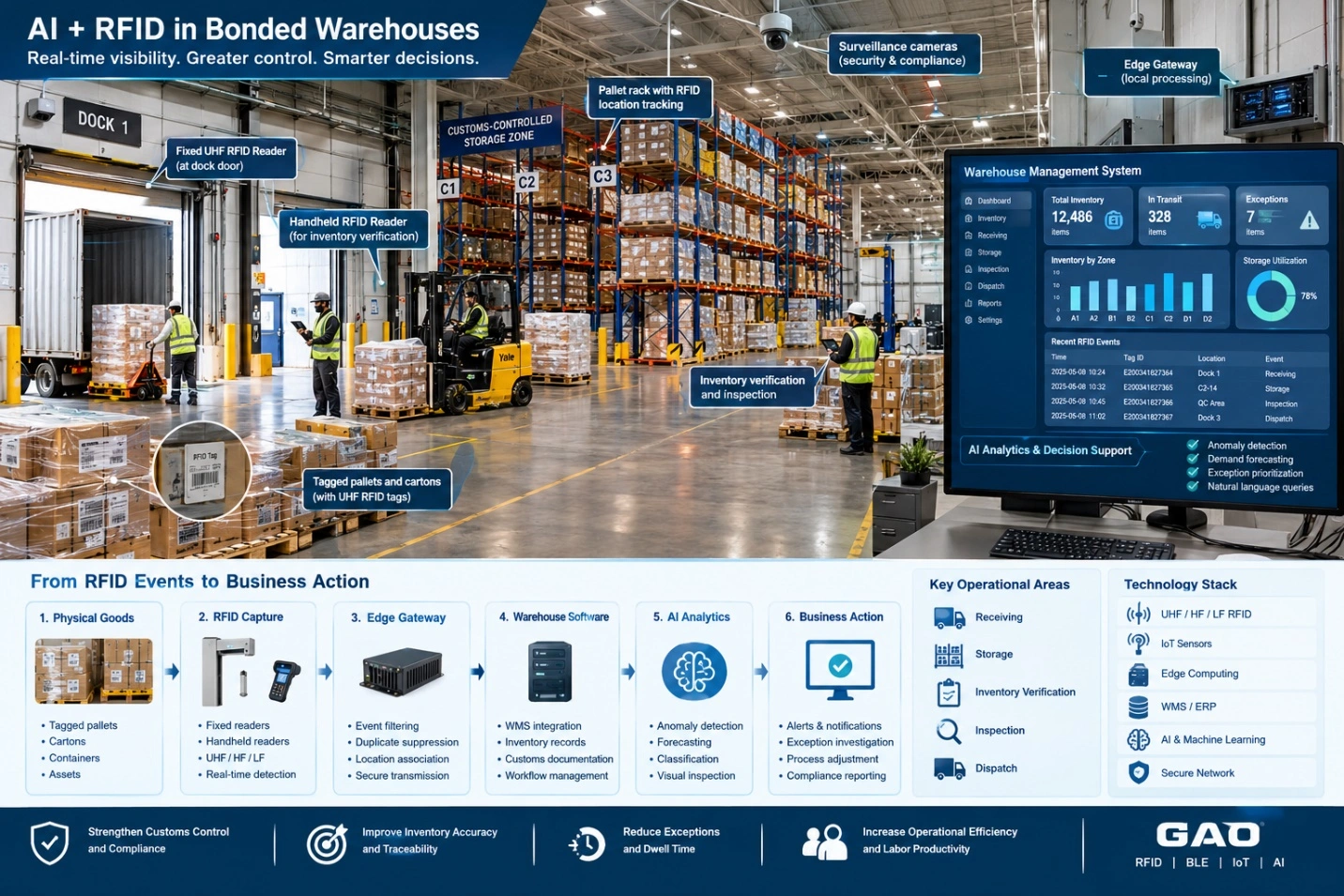
This visual illustrates a realistic bonded warehouse where UHF RFID readers, tagged pallets, handheld devices, edge computing, warehouse management software, and AI analytics work together. It shows how RFID events move from physical goods through edge processing and warehouse software to AI-driven anomaly detection, inventory verification, and operational decision-making.
AI and RFID Fundamentals for Bonded Warehouse Operations
A bonded warehouse must maintain an auditable relationship between physical goods and their associated records. This creates a strong use case for automated identification and AI-assisted data analysis.
RFID uses radio communication between readers and tags to identify objects. The appropriate RFID frequency depends on the physical environment, reading distance, materials, tag placement, and operational objective.
- UHF RFID: Suitable for reading multiple tagged pallets, cartons, cases, or assets across receiving and shipping areas where longer read ranges and rapid bulk identification are required.
- HF RFID: Useful for shorter-range identification and applications where controlled proximity reading is appropriate.
- LF RFID: Can support specialized short-range identification applications where its operating characteristics are suitable for the tagged asset and environment.
- Fixed RFID readers: Can automatically capture tag events at dock doors, controlled passages, storage areas, or other defined checkpoints.
- Handheld RFID readers: Allow warehouse personnel to perform directed inventory verification, locate tagged goods, and investigate discrepancies.
- RFID tags: Provide the physical identifier associated with pallets, cartons, containers, equipment, or other tracked objects.
- RFID middleware: Converts reader events into structured business events that can be consumed by warehouse and enterprise software.
- AI and machine learning: Analyze accumulated operational data to identify patterns, anomalies, forecast workload, and support operational decisions.
The distinction between an RFID event and a business event is important. A reader detecting a pallet does not by itself establish that a customs transaction has been completed. The software must associate the identification event with the relevant inventory record, location, transaction, authorization, and workflow state.
This relationship enables AI to work from operational evidence rather than isolated sensor readings. For example, repeated RFID detections can establish a movement history, while warehouse software can determine whether that movement was expected under the applicable process.
GAO can support this data-capture layer with RFID hardware and related IoT technologies that are selected according to the physical characteristics and operational requirements of the bonded facility.
Bonded Warehouse Applications for AI-Powered RFID
Automated Receiving and Customs Inventory Registration
Receiving is one of the most important control points because discrepancies introduced at the inbound dock can propagate through the entire inventory record.
RFID-enabled receiving can identify tagged pallets or cartons as they pass through defined receiving zones. The resulting identification events can be compared with expected shipment information and warehouse records.
AI can assist by analyzing discrepancies between expected and observed goods.
- Detecting unexpected tags during receiving
- Identifying missing expected items
- Flagging duplicate or unusual identification events
- Prioritizing shipments for manual verification
- Comparing receiving patterns across suppliers or shipment types
- Identifying recurring receiving discrepancies
- Supporting faster reconciliation between physical and digital records
For a bonded warehouse, this can reduce reliance on manual item-by-item identification while preserving human review for exceptions and regulatory decisions.
Continuous Inventory Visibility and Location Tracking
Traditional inventory checks may depend heavily on scheduled manual counts. RFID can provide more frequent identification events, allowing warehouse software to maintain a richer movement history.
AI can use this history to determine expected locations and identify goods that appear to be misplaced, stationary for an unusual period, or moving through an unexpected sequence of warehouse zones.
Useful operational signals include:
- Last known RFID detection
- Current warehouse zone
- Receiving timestamp
- Storage duration
- Movement frequency
- Staging duration
- Dispatch status
- Expected versus observed location
- Inventory record status
The objective is not to replace physical verification. Instead, AI can direct warehouse personnel toward the locations and inventory records that require attention.
Bonded Warehouse RFID Inventory Visibility and AI Exception Management Infographic
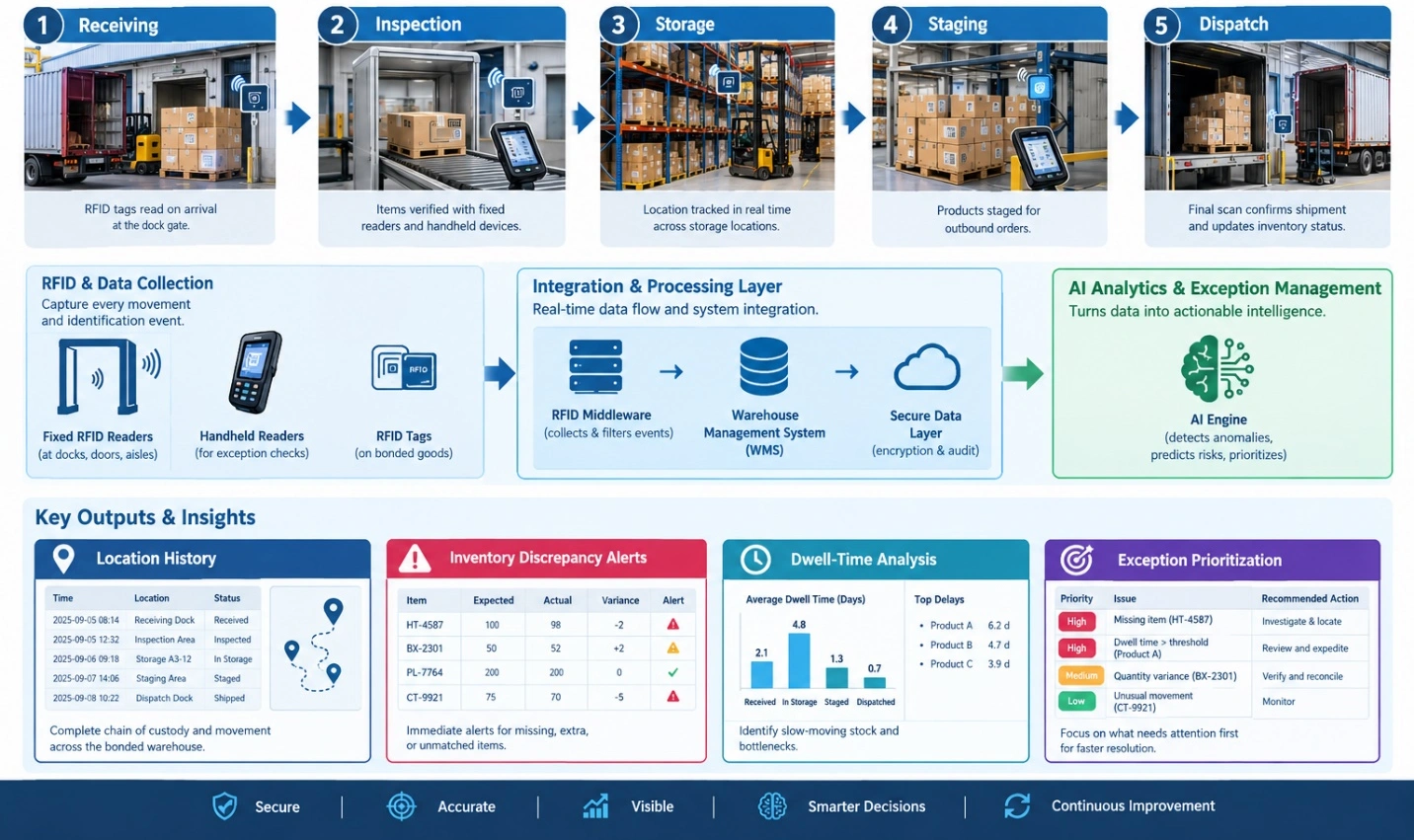
This infographic illustrates how RFID-tagged bonded goods move through receiving, inspection, storage, staging, and dispatch. It shows how RFID readers and handheld devices connect with middleware, warehouse management systems, and AI analytics to provide location history, discrepancy alerts, dwell-time analysis, and prioritized exceptions.
Customs-Controlled Movement Monitoring
Bonded goods may move between defined operational areas according to specific procedures. A warehouse system can use RFID checkpoints to create time-stamped records of physical movement.
AI can analyze these records to identify patterns that warrant investigation.
Examples include:
- Goods appearing at an unexpected checkpoint
- Movement occurring outside an authorized workflow
- Missing checkpoint events
- Unusual dwell times
- Repeated movements between the same zones
- Unexpected movement sequences
- Inventory records that do not correspond with physical detections
These signals can be routed to authorized warehouse personnel for investigation. The system should distinguish between an automated anomaly alert and a confirmed compliance violation. AI can identify patterns for review, but regulatory determinations should remain subject to the warehouse’s established controls and applicable customs procedures.
AI-Assisted Inventory Reconciliation
Inventory reconciliation compares physical inventory information with digital records. In bonded warehouses, this process can involve receiving records, storage locations, movement transactions, dispatch documentation, and customs-related records.
RFID provides additional physical evidence that can improve reconciliation.
AI can group discrepancies according to their characteristics and help warehouse teams prioritize investigation. A recurring discrepancy involving one storage zone may indicate a process problem, while a discrepancy associated with a particular movement sequence may require a different investigation.
The resulting workflow can move from:
RFID detection → data validation → inventory comparison → anomaly identification → human investigation → record correction or operational action
This approach allows warehouse personnel to spend less time searching for discrepancies and more time resolving the underlying causes.
AI-Driven Bonded Warehouse Workflow from RFID Capture to Business Action
A practical AI and RFID solution for bonded warehouses typically involves several connected stages rather than a single RFID reader or AI model.
Physical Data Capture
The process begins when RFID readers detect tagged goods or assets.
Typical capture points can include:
- Receiving dock doors
- Inspection areas
- Storage-zone entrances
- Internal transfer points
- Staging areas
- Dispatch dock doors
- Controlled access points
Reader configuration should account for antenna positioning, tag orientation, metal surfaces, liquids, rack geometry, forklift movement, and the required read zone. These factors directly influence read reliability.
RFID Event Processing
Raw reader observations are normally passed to middleware or an edge gateway. The software can filter duplicate reads, associate detections with readers and locations, and transform low-level observations into useful events.
For example, several consecutive reads of the same pallet at one dock should not necessarily create several independent warehouse transactions. Event processing can consolidate these observations into a meaningful movement event.
Edge Processing and Communication
Edge processing can be useful where the bonded warehouse requires low-latency decisions, local operation during connectivity interruptions, or reduced transmission of raw reader data.
An edge gateway can receive RFID data from fixed and handheld readers and forward validated events to warehouse software.
Depending on the facility, connectivity may use Ethernet, Wi-Fi, cellular networks, or other enterprise communication infrastructure. Network segmentation should separate operational devices from general user networks where appropriate.
RFID Data Flow and Edge Processing for Bonded Warehouses
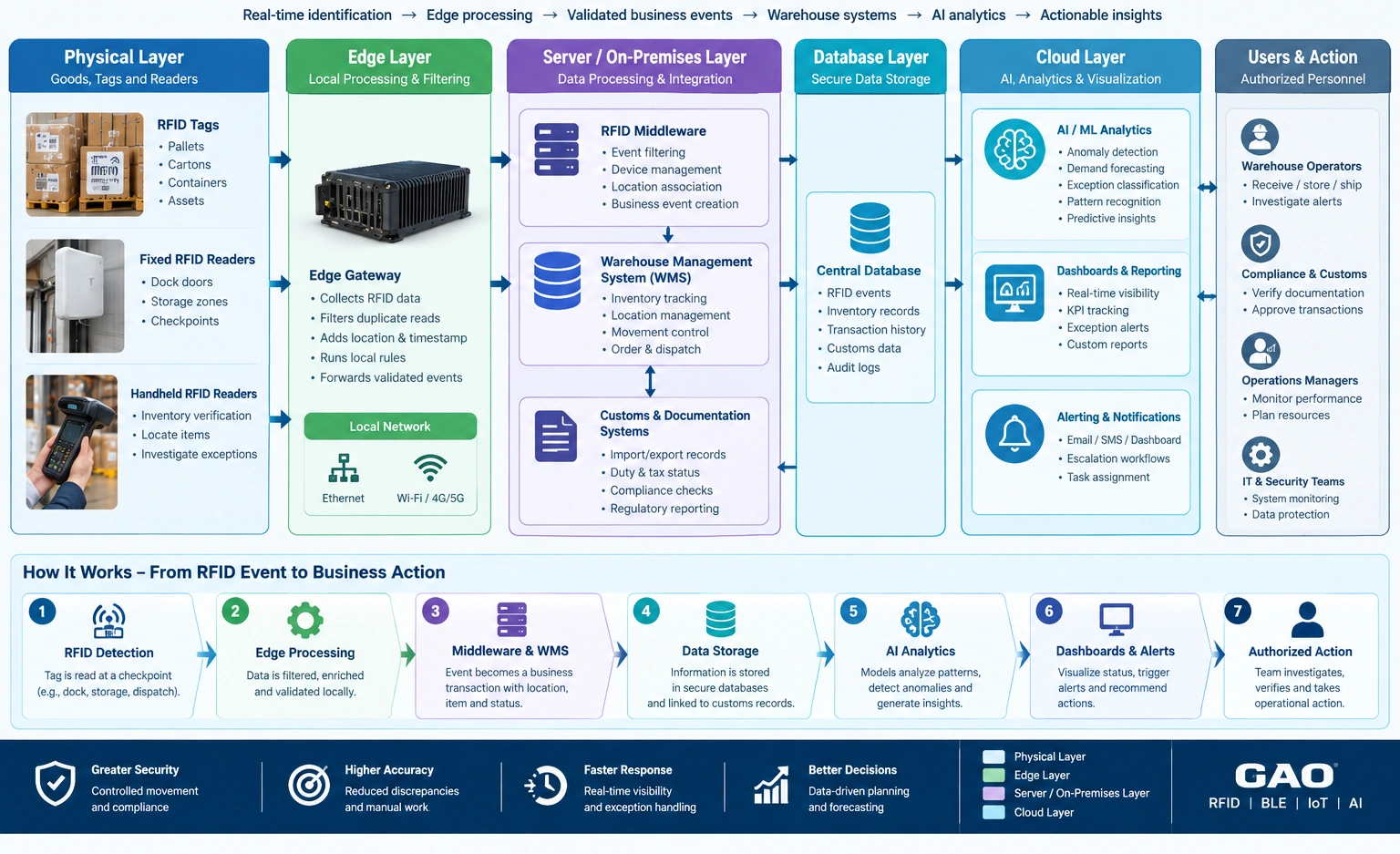
This diagram shows how RFID data moves from tagged pallets, cartons, and warehouse readers through edge processing, RFID middleware, warehouse management software, databases, and AI analytics. It illustrates the transition from RFID detection to validated business events, AI-generated insights, alerts, and authorized operational actions in a bonded warehouse.
Warehouse Software and Enterprise Integration
Validated RFID events can be integrated with warehouse management software and other systems used to manage bonded inventory.
Potential integration points include:
- Warehouse management systems
- Inventory databases
- Enterprise resource planning systems
- Customs documentation systems
- Order and dispatch systems
- Access-control systems
- Security and surveillance systems
- Reporting and analytics software
Integration should preserve the relationship between an RFID identifier, the associated inventory record, location, timestamp, transaction, and workflow status.
APIs, message queues, database interfaces, and event-driven integration methods can be selected according to existing software and operational requirements. A well-designed integration should also define error handling, duplicate-event processing, authentication, logging, and data retention.
AI Analytics and Decision Support
Once sufficient operational data has been collected, AI models can analyze historical and real-time information.
Potential methods include:
- Anomaly detection for unusual inventory movement
- Classification for exception categorization
- Forecasting for receiving and dispatch workloads
- Clustering for identifying recurring operational patterns
- Predictive analytics for congestion and dwell-time risks
- Computer vision where visual inspection data complements RFID information
- Generative AI for querying operational records and producing structured summaries, subject to appropriate data controls
AI output should be connected to a defined business action. An alert that does not result in an investigation, verification, escalation, or process adjustment provides limited operational value.
Human Review and Operational Action
The final stage is action by authorized personnel.
A warehouse supervisor may review an inventory discrepancy, a customs-control team may investigate an unexpected movement, or an operations manager may adjust staffing based on predicted receiving volume.
This human-in-the-loop model is particularly important for bonded warehouse operations because automated analytics should support established procedures rather than independently determine regulatory outcomes.
RFID Hardware, AI Software, and Deployment Options for Bonded Warehouses
A bonded warehouse deployment requires coordination between physical RFID equipment, data-processing software, warehouse applications, communication infrastructure, and security controls. The correct configuration depends on warehouse size, storage layout, inventory characteristics, transaction volume, connectivity, integration requirements, and operational policies.
RFID Hardware Selection
UHF RFID is often suitable for bonded warehouse applications involving pallet, case, and carton identification because fixed readers can capture multiple tags as goods move through defined areas. Antenna configuration, reader power, tag sensitivity, mounting height, and read-zone design should be validated during a site survey.
HF RFID can be appropriate where shorter read distances and controlled proximity identification are required. LF RFID may be considered for specialized identification requirements where its characteristics match the asset and operating environment.
Relevant equipment can include:
- Fixed RFID readers at receiving and dispatch doors
- RFID antennas positioned around defined read zones
- Passive RFID tags for pallets, cartons, cases, and selected assets
- Handheld RFID readers for inventory verification
- RFID printer-encoders for tag issuance
- Edge gateways for local event processing
- Industrial network switches and wireless infrastructure
- Barcode scanners where RFID and barcode workflows must coexist
- Access-control equipment integrated with warehouse security processes
The physical environment should be treated as part of the engineering design. Metal racks, liquid-containing goods, dense pallet loads, forklifts, dock-door geometry, and adjacent RFID zones can affect read performance. A pilot installation can therefore be more valuable than selecting equipment solely from datasheets.
GAO provides RFID and IoT hardware that can form part of these data-capture systems, with equipment selected according to the operational requirements of the warehouse.
RFID Middleware and Data Management
RFID middleware sits between reader infrastructure and business software. Its responsibilities can include device management, event filtering, duplicate suppression, location association, timestamp handling, and communication with warehouse applications.
For bonded warehouses, the middleware should preserve important event attributes such as:
- RFID tag identifier
- Reader identifier
- Antenna or read zone
- Timestamp
- Direction of movement where available
- Associated warehouse location
- Event confidence or validation state
- Related inventory identifier
A well-defined data model makes it easier to connect physical movement with inventory and customs-related records.
AI and Machine Learning Software
AI software can operate on historical and real-time warehouse data. Different models serve different operational objectives.
Anomaly-detection models can identify unusual movement or inventory patterns. Forecasting models can estimate receiving volumes, dispatch workloads, or expected congestion. Classification models can categorize exceptions according to operational characteristics. Computer vision can complement RFID where visual verification is required.
Generative AI can provide natural-language access to approved warehouse information, allowing authorized users to ask questions such as which inventory records have unresolved discrepancies or which storage zones have experienced unusual dwell times.
AI systems should use role-based access controls and carefully defined data boundaries. Sensitive customs, commercial, and inventory information should not be exposed to unauthorized users or uncontrolled AI services.
Communication and Integration Infrastructure
Reliable communication is essential because RFID events have limited operational value if they cannot reach the systems responsible for processing them.
A typical deployment can include:
- Ethernet for fixed readers and servers
- Wi-Fi for handheld RFID devices
- Secure IP networking between warehouse zones
- Edge gateways for local processing
- APIs for warehouse software integration
- Message queues for event-driven processing
- Encrypted connections between local systems and cloud services
- Monitoring services for reader and network health
Network redundancy can be considered for high-value bonded operations where loss of connectivity could interfere with inventory visibility.
Cloud Version
A cloud-hosted deployment places RFID event processing, databases, analytics, dashboards, and selected AI services within cloud infrastructure managed as a cloud service.
This model can be appropriate when a bonded warehouse requires:
- Centralized visibility across multiple facilities
- Remote monitoring
- Elastic computing resources
- Centralized software updates
- Integration with cloud-based warehouse systems
- Rapid deployment without maintaining extensive local server infrastructure
Cloud deployment also requires careful consideration of connectivity, data residency, cybersecurity, identity management, vendor dependencies, and offline operating procedures.
Server Version
A server deployment places the relevant software on customer-managed infrastructure, which can include an edge server inside the warehouse, a private data center, or another privately hosted enterprise environment.
This model can be appropriate when the warehouse requires greater local control over operational data, low-latency processing, integration with existing private systems, or continued local operation during external connectivity interruptions.
A hybrid approach can combine local RFID event processing with centralized cloud analytics. For example, an edge server can continue collecting and validating RFID events locally while approved summarized data is transmitted to centralized AI services.
The choice between cloud and server deployment should therefore be based on operational requirements rather than treating either model as universally preferable.
Operational Benefits of AI-Powered RFID in Bonded Warehouses
The combination of AI with RFID can improve bonded warehouse operations by connecting physical inventory observations with historical records and operational workflows.
Better Inventory Accuracy
RFID can reduce dependence on manual identification during selected inventory processes. AI can then compare observed movement patterns with expected inventory states and highlight exceptions.
The result is a more continuous approach to inventory verification rather than relying exclusively on periodic physical counts.
Faster Exception Detection
A conventional workflow may discover discrepancies during a scheduled inventory check. AI-supported analysis can identify unusual patterns as data accumulates.
Examples include unexpected movement, missing detection events, excessive dwell time, and repeated discrepancies associated with particular warehouse locations.
Improved Traceability
Time-stamped RFID events can contribute to a chronological movement history for tagged goods.
For bonded inventory, this can help warehouse teams reconstruct where an item was detected, when it moved between defined areas, and which operational transaction was associated with the movement.
The resulting records can support internal investigations, inventory reconciliation, and established compliance processes.
More Efficient Warehouse Labor
RFID can automate selected identification tasks that would otherwise require barcode scanning or manual recording. AI can further reduce unnecessary investigation by directing personnel toward exceptions.
Warehouse employees can therefore focus on activities such as physical verification, discrepancy resolution, inspection, documentation, and controlled movement.
Predictive Operational Planning
Historical receiving, storage, staging, and dispatch data can be analyzed to identify workload patterns.
Forecasting can help warehouse managers plan:
- Dock-door utilization
- Receiving labor
- Inspection capacity
- Storage-space requirements
- Staging requirements
- Dispatch workload
- Inventory verification activities
These predictions should be treated as decision-support information and monitored against actual warehouse performance.
Key KPIs for AI and RFID Bonded Warehouse Systems
A deployment should be measured using operational KPIs rather than RFID read counts alone.
Relevant measurements can include:
| KPI | What It Measures | Why It Matters |
|---|---|---|
| Inventory accuracy | Match between physical and recorded inventory | Indicates record reliability |
| RFID read success rate | Successful tag identification within defined read zones | Indicates capture performance |
| Inventory discrepancy rate | Frequency of physical-record mismatches | Identifies control problems |
| Exception resolution time | Time required to investigate discrepancies | Measures operational responsiveness |
| Receiving processing time | Time from dock arrival to completed receiving | Measures inbound efficiency |
| Dispatch processing time | Time required to complete outbound processing | Measures shipping efficiency |
| Dwell time | Duration goods remain in a warehouse or zone | Helps identify operational delays |
| Inventory search time | Time required to locate selected goods | Measures location visibility |
| False alert rate | Alerts that do not result in a meaningful exception | Measures AI alert quality |
| System availability | Availability of RFID and supporting software | Indicates operational reliability |
KPIs should be established during the planning stage so the organization can compare baseline performance with post-deployment results.
Cybersecurity and Data Governance for Bonded Warehouse RFID
RFID systems should be incorporated into the warehouse’s broader cybersecurity program rather than treated as isolated identification equipment.
Security controls can include:
- Device authentication
- Role-based user access
- Network segmentation
- Encrypted communication
- Secure API authentication
- Reader and gateway configuration management
Audit logging
- Software patch management
- Backup and recovery procedures
- Monitoring of abnormal device behavior
Data governance is equally important. RFID events can reveal movement patterns, inventory information, operational schedules, and other commercially sensitive information. Access should therefore be restricted according to job responsibilities.
AI introduces additional considerations. Training datasets, prompts, generated responses, model outputs, and connected databases should be governed according to the sensitivity of the information involved.
An AI-generated anomaly should also remain traceable to the underlying operational evidence. This supports human review and makes it easier to investigate incorrect alerts.
Integration with Warehouse Management and Customs Processes
RFID should not become a separate information silo. Its operational value increases when identification events are connected to existing warehouse processes.
A practical integration sequence can be:
- RFID reader detects a tagged pallet
- Middleware validates and filters the event
- The system associates the tag with a warehouse inventory record
- The warehouse system checks the expected transaction or location
- AI evaluates the event against historical and operational patterns
- An exception is generated if defined conditions are met
- An authorized employee reviews the exception
- The warehouse record is updated after verification
Customs-related decisions should continue to follow the procedures and requirements applicable to the relevant jurisdiction and bonded warehouse authorization. RFID and AI provide operational evidence and decision support rather than replacing legal or regulatory controls.
GAO’s RFID and IoT hardware can support organizations building this type of connected identification and monitoring system, including deployments requiring integration with existing warehouse software.
Implementation Considerations for Bonded Warehouse AI and RFID
A successful deployment normally begins with the operational problem rather than the technology.
Site Survey and Process Mapping
Before installing readers, document the physical and operational flow of bonded goods.
Important questions include:
- Where are goods received?
- Where are inspection activities performed?
- Which storage zones require identification?
- Where do goods enter or leave controlled areas?
- Which assets require individual identification?
- Which existing barcode processes must remain?
- Where do read-zone interference risks exist?
- Which warehouse transactions need automated evidence?
This process identifies the locations where RFID provides measurable operational value.
Tag and Reader Testing
RFID tags should be tested with the actual goods and packaging used in the facility.
Testing should consider:
- Pallet materials
- Carton composition
- Metalized packaging
- Liquids
- Tag placement
- Forklift movement
- Reader antenna position
- Read-zone boundaries
- Adjacent RFID equipment
A controlled pilot can establish actual read performance before full deployment.
Integration and Data Validation
Integration testing should verify that physical RFID events correspond correctly to warehouse records.
Test scenarios should include:
- Expected receiving events
- Duplicate reads
- Missing reads
- Unexpected tags
- Wrong-zone detections
- Network interruption
- Reader failure
- Incorrect tag association
- Duplicate inventory records
- Recovery after system restoration
These tests are particularly important where RFID data contributes to controlled inventory processes.
AI Model Validation
AI models should be evaluated using representative historical and operational data.
Performance evaluation can include:
- Precision of anomaly alerts
- False-positive frequency
- False-negative risk
- Forecast accuracy
- Response time
- Model drift
- Explainability of important decisions
AI models should also have defined escalation procedures when confidence is low or the output conflicts with established warehouse records.
Bonded Warehouse AI and RFID Implementation Lifecycle from Planning to Optimization
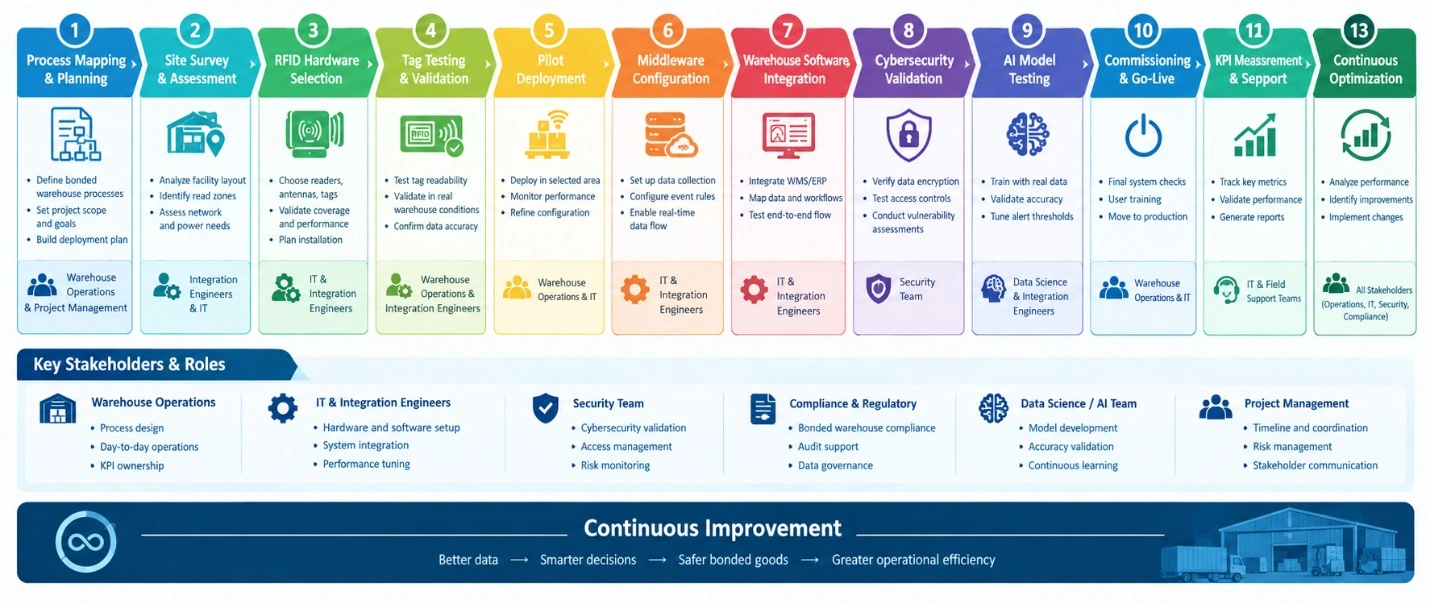
This infographic presents the complete AI/RFID implementation lifecycle for bonded warehouses, from process mapping and site assessment through hardware selection, pilot deployment, software integration, cybersecurity validation, AI testing, commissioning, and KPI measurement. It also highlights the roles of warehouse operations, IT, security, integration, compliance, and data science teams in continuous optimization.
Scaling AI and RFID Across Bonded Warehouse Operations
A pilot should be designed with future expansion in mind. Once RFID identification works reliably at selected receiving or dispatch points, additional storage zones and operational workflows can be added.
Scaling considerations include:
- Standardized RFID tag identifiers
- Consistent location naming
- Reusable integration interfaces
- Centralized device monitoring
- Consistent cybersecurity policies
- Common event schemas
- Model monitoring across facilities
- Centralized KPI definitions
- Maintenance procedures for readers and antennas
Multi-site organizations can use centralized analytics while maintaining local edge processing where required.
This approach can allow a warehouse group to compare receiving performance, inventory discrepancies, dwell times, and exception patterns across facilities without requiring every site to use exactly the same physical layout.
Practical Engineering Recommendations for Bonded Warehouses
The most important design principle is to connect every technology component to a defined operational requirement.
- Use RFID where automated identification provides a measurable advantage over existing manual or barcode processes.
- Select RFID frequency and tag type according to the physical characteristics of the goods and warehouse environment.
- Validate read zones using real pallets, cartons, racks, forklifts, and packaging.
- Keep RFID event processing separate from business transaction logic so unexpected reads do not automatically create incorrect inventory transactions.
- Use edge processing when local response or operation during connectivity interruptions is important.
- Integrate RFID events with warehouse management and inventory systems rather than maintaining isolated RFID databases.
- Use AI to prioritize exceptions, identify patterns, and support planning instead of treating AI output as an automatic regulatory determination.
- Establish cybersecurity, access control, logging, backup, and recovery requirements before production deployment.
- Measure the deployment using operational KPIs such as inventory accuracy, discrepancy rate, dwell time, processing time, and exception resolution.
- Maintain human review for high-impact inventory and compliance decisions.
- Design data models and interfaces so additional warehouse zones, readers, facilities, and AI use cases can be added without rebuilding the entire solution.
GAO’s experience supplying RFID, BLE, and IoT hardware and systems can support organizations evaluating identification and connected-data requirements for warehouse environments. GAO has served organizations in the United States and Canada for three decades, including Fortune 500 companies, research and development organizations, universities, and government agencies, with an emphasis on product R&D, quality assurance, and technical support.
The Role of AI and RFID in the Future of Bonded Warehouse Operations
AI-powered warehouse management is increasingly dependent on reliable physical data. For bonded warehouses, that data must accurately represent the movement and status of controlled inventory.
RFID can provide automated identification at important operational checkpoints, while AI can transform accumulated events into exception detection, forecasting, inventory analysis, and decision support.
The strongest deployments do not treat AI or RFID as isolated technologies. They combine physical identification, edge processing, warehouse software, secure communications, data management, analytics, and human operational controls into one connected workflow.
For organizations evaluating this approach, the practical starting point is a site-specific assessment of inventory flows, controlled zones, identification requirements, existing warehouse software, connectivity, cybersecurity requirements, and measurable operational KPIs. GAO can provide RFID, BLE, and IoT hardware and technical solutions that support these connected warehouse applications.
Building the Future of Industrial AI and IoT with Aperture Venture Studio and GAO RFID Inc.
For more than three decades, GAO Group of Companies has invested heavily in R&D for industrial RFID, BLE, and IoT technologies. As generative AI has become useful for industrial applications, we have expanded our work in AI and IoT, including RFID and BLE, and founded Aperture Venture Studio to build, launch, and scale AI and IoT solutions relevant to industries such as warehousing, logistics, and bonded warehouse operations.
Aperture has attracted AI and IoT technical experts, entrepreneurial and operational executives, investors, and leading companies. We also developed the Aperture Ventures Summit and TekSummit to discuss advanced AI and IoT topics.
These activities have helped build technical communities around AI and IoT. We welcome you to join us as:
- Advisors, co-founders, or employees
- Investors
- Customers
GAO’s work in RFID, BLE, IoT, and AI provides a foundation for organizations exploring practical technologies for automated identification, connected warehouse operations, and industrial decision support.