
AI and BLE for Construction Equipment Operations
AI-Driven Construction Equipment Operations with BLE-Based Asset Visibility
Construction equipment operations depend on the continuous movement, utilization, maintenance, and coordination of heavy machinery across dynamic job sites. Excavators, bulldozers, wheel loaders, motor graders, telehandlers, cranes, compactors, articulated dump trucks, and other equipment generate significant operational data that directly affects productivity, equipment availability, project schedules, fuel consumption, and safety performance.
Artificial Intelligence combined with BLE-enabled equipment visibility is transforming how infrastructure development organizations manage fleets, monitor utilization, reduce downtime, and optimize equipment deployment. BLE beacons, BLE gateways, and BLE sensors provide location, status, environmental, and operational data that AI systems analyze to identify inefficiencies, predict failures, improve maintenance planning, and support real-time operational decisions.
Construction contractors, infrastructure developers, equipment rental companies, and project managers increasingly rely on AI-powered equipment management systems to improve machine utilization, reduce idle time, enhance workforce coordination, and maintain project schedules. By combining connected equipment data with machine learning and operational analytics, organizations can achieve greater visibility across construction sites while supporting safer and more efficient equipment operations.
GAO has helped organizations deploy BLE-enabled monitoring systems that improve operational awareness, equipment tracking, and data collection across complex industrial environments.
Understanding AI-Powered Construction Equipment Management
Construction equipment operations involve numerous interconnected processes including equipment dispatching, machine allocation, operator scheduling, preventive maintenance, fuel management, utilization tracking, jobsite logistics, and equipment transportation between project locations.
AI improves these activities by analyzing operational data collected from connected assets and equipment. Machine learning algorithms can identify patterns associated with excessive idle time, underutilized equipment, maintenance risks, unsafe operating behaviors, and inefficient equipment allocation.
BLE technology serves as a key data acquisition layer within these environments. BLE devices attached to construction equipment, tools, attachments, fuel systems, storage yards, maintenance facilities, and transportation assets provide continuous operational visibility.
Key objectives of AI-driven construction equipment operations include:
- Improving fleet utilization rates
- Reducing equipment downtime
- Optimizing equipment allocation across projects
- Increasing maintenance efficiency
- Enhancing equipment security
- Supporting predictive maintenance programs
- Improving project schedule adherence
- Reducing fuel consumption
- Increasing operator productivity
- Improving jobsite safety monitoring
Modern construction projects generate large volumes of operational information from telematics systems, machine controllers, fuel monitoring systems, maintenance records, work orders, project management software, and BLE-enabled tracking systems. AI solutions transform this information into actionable operational intelligence.
Integrated AI-Driven Construction Equipment Operations Ecosystem
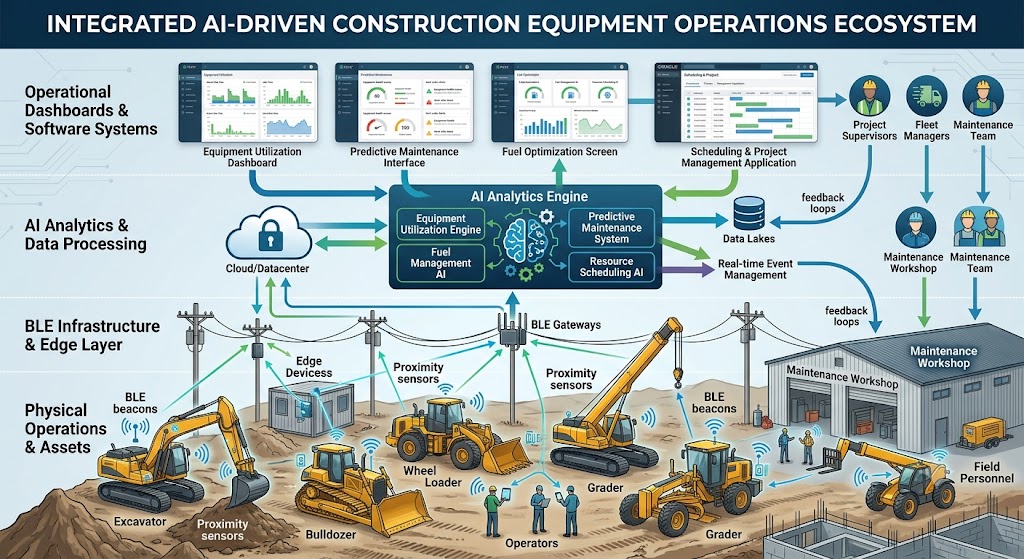
A comprehensive enterprise-grade operations overview diagram illustrating the seamless data flow from heavy construction equipment in the field, through BLE infrastructure, into a central AI analytics engine, which then drives optimized scheduling, maintenance, utilization dashboards, and fuel management for all project stakeholders.
High-Value AI Applications for Construction Equipment Operations
Equipment Utilization Optimization
Construction organizations often struggle with uneven equipment utilization across multiple projects. Some machines remain underutilized while others experience excessive workloads.
AI models evaluate:
- Engine operating hours
- Equipment idle time
- Jobsite activity patterns
- Equipment assignment history
- Project workload forecasts
- Equipment availability
The resulting recommendations help fleet managers allocate machinery more effectively and reduce unnecessary equipment purchases or rentals.
Predictive Equipment Maintenance
Unexpected equipment failures can disrupt critical construction activities and delay project milestones.
AI systems analyze:
- Equipment operating patterns
- Hydraulic system conditions
- Vibration measurements
- Temperature readings
- Maintenance histories
- Fuel consumption trends
- Utilization rates
Predictive maintenance programs help maintenance teams schedule repairs before failures occur, improving equipment availability and reducing emergency repair costs.
Equipment Location and Recovery
Large infrastructure projects frequently involve equipment movement across staging areas, storage yards, haul roads, and active construction zones.
BLE-enabled visibility systems combined with AI analytics support:
- Equipment location monitoring
- Unauthorized movement detection
- Theft prevention
- Equipment recovery support
- Equipment dispatch optimization
- Yard management improvements
Fuel Efficiency Optimization
Fuel represents a major operating expense for construction equipment fleets.
AI solutions can identify:
- Excessive idling
- Inefficient equipment assignments
- Fuel consumption anomalies
- Operator behavior trends
- Equipment performance issues
These insights support cost reduction initiatives while improving sustainability objectives.
Operator Productivity Analysis
Machine productivity varies significantly based on operator practices, environmental conditions, equipment health, and project requirements.
AI-driven analysis helps organizations understand:
- Productivity trends
- Equipment cycle times
- Material movement efficiency
- Utilization performance
- Equipment availability impacts
This information supports workforce planning and operational improvement initiatives.
Construction Equipment Operations AI Use Case Matrix
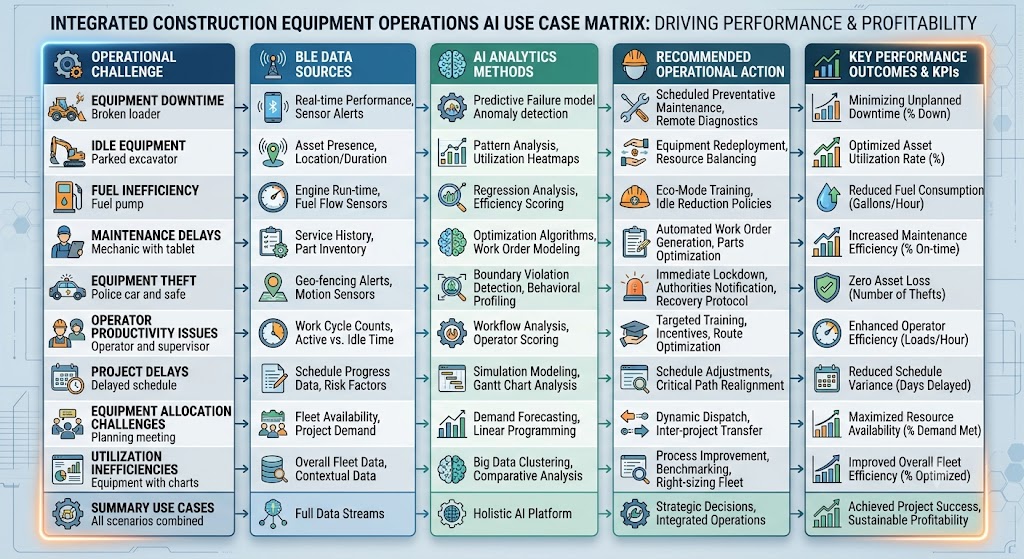
A structured matrix mapping nine critical heavy equipment operational challenges to BLE data sources, AI analytics methods, recommended actions, and measurable KPIs.
Operational Challenges in Construction Equipment Operations
Construction equipment environments present unique operational challenges that require continuous monitoring and rapid decision-making.
Common challenges include:
- Equipment shortages at critical project phases
- Unplanned machinery downtime
- Equipment utilization imbalance
- High idle time percentages
- Delayed maintenance activities
- Fuel theft and fuel wastage
- Equipment transportation inefficiencies
- Operator scheduling conflicts
- Asset visibility limitations
- Equipment theft risks
- Rental equipment tracking challenges
- Harsh environmental operating conditions
AI-driven analysis combined with BLE-enabled operational visibility helps organizations address these challenges through continuous monitoring and data-driven decision support.
Organizations managing earthmoving fleets, road construction equipment, mining support machinery, utility construction assets, and infrastructure development projects benefit from improved operational awareness across multiple project sites.
Construction Equipment Data Flow from Field Operations to AI Decision-Making
Effective AI deployment requires a structured operational workflow that transforms raw equipment data into actionable business intelligence.
Equipment and Operational Data Collection
Construction equipment operations generate information from multiple sources:
- BLE beacons attached to heavy equipment
- BLE sensors monitoring equipment conditions
- Equipment telematics systems
- Fuel monitoring systems
- Maintenance management software
- Operator activity records
- Work order systems
- GPS tracking systems
- Inspection records
- Project scheduling software
These data sources collectively provide visibility into machine performance and operational activities.
Communication and Edge Processing Layer
BLE gateways positioned throughout construction yards, maintenance facilities, staging zones, equipment depots, and active job sites collect information from nearby BLE devices.
Edge computing systems can perform:
- Initial data filtering
- Event detection
- Local anomaly identification
- Data aggregation
- Temporary storage
- Communication management
This approach reduces communication overhead while supporting near real-time operational awareness.
Centralized Data Management
Collected information is transmitted to centralized software systems where data from multiple projects and equipment fleets is consolidated.
Integrated data sources commonly include:
- Fleet management systems
- Construction management software
- Enterprise resource planning software
- Maintenance management systems
- Asset tracking software
- Workforce management applications
- Fuel management systems
Unified operational datasets provide the foundation for advanced AI analysis.
Technology Components Supporting AI-Powered Construction Equipment Operations
Successful deployment of AI-driven construction equipment management requires coordinated integration of hardware, software, communications infrastructure, analytics systems, cybersecurity controls, and operational software.
BLE Hardware Infrastructure
BLE technology provides visibility into equipment location, status, and operational conditions.
Common components include:
- BLE beacons attached to excavators, loaders, bulldozers, cranes, and support vehicles
- BLE sensors monitoring vibration, temperature, operating conditions, and environmental factors
- BLE gateways deployed throughout job sites, equipment yards, maintenance facilities, and staging areas
- Ruggedized industrial communication devices
- Mobile inspection devices used by field personnel
These components provide continuous data collection without requiring extensive communication infrastructure throughout large construction environments.
AI and Analytics Software
AI systems process equipment and operational data to generate actionable insights.
Common analytical functions include:
- Predictive maintenance modeling
- Equipment utilization forecasting
- Equipment allocation optimization
- Fuel consumption analysis
- Operator performance assessment
- Anomaly detection
- Downtime prediction
- Resource planning optimization
- Construction schedule impact analysis
Machine learning models continuously improve as additional equipment and operational data becomes available.
Enterprise Software Integration
Construction equipment operations rarely operate in isolation.
AI solutions commonly integrate with:
- Enterprise Resource Planning (ERP) software
- Computerized Maintenance Management Systems (CMMS)
- Construction management software
- Equipment rental management systems
- Project scheduling software
- Workforce management systems
- Financial management software
- Procurement systems
- Inventory management software
Integrated information enables broader operational visibility and more accurate AI-driven recommendations.
Communication Infrastructure
Reliable communication is critical for large infrastructure projects.
Typical communication methods include:
- BLE communications
- Wi-Fi networks
- Cellular communications
- Private LTE networks
- Industrial Ethernet
- Satellite communications for remote projects
- Edge computing networks
Construction organizations often utilize multiple communication methods depending on project location and connectivity requirements.
Cloud Deployment Model
Cloud-hosted solutions are frequently used when organizations require:
- Rapid deployment
- Centralized fleet visibility
- Multi-project reporting
- Lower infrastructure management requirements
- Scalable analytics capabilities
Cloud environments are particularly beneficial for contractors operating across geographically dispersed construction sites.
Server Deployment Model
Privately hosted server deployments may be preferred when organizations require:
- Enhanced control over operational data
- Compliance with customer security requirements
- Support for isolated project environments
- Reduced dependency on external connectivity
- Integration with existing private infrastructure
Large infrastructure projects, government projects, and highly regulated construction programs often utilize privately managed server environments.
Security Mechanisms
Construction equipment data and operational systems require strong cybersecurity controls.
Recommended security measures include:
- Device authentication
- Secure gateway communications
- Encrypted data transmission
- Role-based access control
- Multi-factor authentication
- Security monitoring systems
- Vulnerability management processes
- Audit logging
These controls help protect operational information and critical project systems.
Benefits of AI-Powered Construction Equipment Operations
Improved Equipment Utilization
AI helps identify underutilized assets and supports more effective equipment allocation decisions.
Benefits include:
- Higher equipment productivity
- Reduced rental expenses
- Improved fleet planning
- Better project resource allocation
Reduced Downtime
Predictive maintenance programs reduce unexpected failures and improve equipment availability.
Benefits include:
- Fewer emergency repairs
- Improved maintenance scheduling
- Longer equipment life
- Reduced project disruptions
Enhanced Project Visibility
Project managers gain improved awareness of equipment operations across multiple sites.
Benefits include:
- Faster operational decisions
- Improved project coordination
- Better resource planning
- Enhanced schedule management
Improved Safety Performance
AI can identify patterns associated with elevated operational risks.
Benefits include:
- Improved compliance monitoring
- Better equipment inspection planning
- Reduced safety incidents
- Enhanced operator accountability
Lower Operating Costs
Operational optimization initiatives help reduce unnecessary expenditures.
Benefits include:
- Reduced fuel consumption
- Lower maintenance costs
- Improved labor utilization
- Reduced equipment losses
Scalable Fleet Management
AI systems support growth without requiring proportional increases in administrative effort.
Benefits include:
- Multi-site visibility
- Centralized reporting
- Standardized operational practices
- Improved executive decision-making
GAO has supplied BLE-based hardware products and connected systems that support equipment visibility, operational monitoring, and asset management initiatives across industrial and infrastructure environments.
Engineering Considerations and Implementation Recommendations
Successful deployments typically begin with a detailed assessment of equipment fleets, operational processes, maintenance workflows, communication coverage, and project requirements.
Recommended implementation practices include:
- Identify critical equipment categories
- Define operational KPIs before deployment
- Establish equipment identification standards
- Evaluate communication coverage requirements
- Integrate maintenance and fleet management systems
- Develop cybersecurity policies
- Validate AI model performance using operational data
- Establish continuous improvement processes
- Train operators and maintenance personnel
- Conduct phased implementation programs
Practical field experience shows that organizations achieve stronger long-term results when operational processes are standardized before AI automation initiatives are expanded.
Equipment visibility alone does not deliver business value. Measurable improvements occur when operational data is integrated into maintenance planning, fleet management, project scheduling, and management decision-making processes.
Advancing Construction Equipment Operations Through AI-Driven Intelligence
AI-powered construction equipment operations enable organizations to improve fleet visibility, equipment utilization, maintenance efficiency, project coordination, safety performance, and operational decision-making. By combining connected equipment data with machine learning, predictive analytics, and operational software integration, construction organizations can manage increasingly complex projects with greater efficiency and control.
Organizations implementing AI-driven equipment management initiatives should focus on operational objectives, data quality, integration requirements, cybersecurity controls, and measurable business outcomes. Properly designed solutions support both immediate operational improvements and long-term scalability across construction programs.
GAO continues to support organizations through BLE-based hardware products, connected systems, technical expertise, and implementation guidance that help improve visibility, operational performance, and equipment management effectiveness.
Building the Future of Industrial AI and IoT with Aperture Venture Studio and GAO
For more than three decades, GAO Group of Companies has invested heavily in research and development involving BLE, RFID, IoT, and industrial monitoring technologies. As AI-powered construction equipment operations become increasingly important for infrastructure development projects, we have expanded our focus on AI and IoT solutions that help organizations improve equipment utilization, predictive maintenance, operational visibility, and project performance.
To further accelerate innovation across industrial AI and IoT applications, we founded Aperture Venture Studio to help advance AI and IoT technologies supporting construction equipment operations and other industrial sectors.
GAO, headquartered in New York City and Toronto, has served customers throughout the United States and Canada for decades, including Fortune 500 companies, leading research organizations, universities, and government agencies. Through extensive R&D investment, stringent quality processes, and expert technical support, we continue helping organizations deploy advanced AI and IoT solutions.
We welcome participation from:
- Advisors and technical experts
- Industry professionals
- Investors
- Customers seeking advanced AI and IoT solutions
Through collaborative technical communities, industry events, and ongoing innovation initiatives, we continue supporting the advancement of industrial AI and IoT technologies.