
AI and RFID for Dairy Processing
AI-Driven Dairy Processing with RFID Traceability and Automation
AI is improving dairy processing by turning production, quality, inventory, and traceability data into actionable decisions. RFID provides machine-readable identification for milk containers, ingredients, packaging materials, reusable transport assets, laboratory samples, and selected processing equipment, while AI analyzes the resulting operational data to identify anomalies, predict events, optimize workflows, and support faster decisions. In a dairy plant, the combination can connect receiving, raw-milk handling, pasteurization, fermentation, separation, filling, packaging, cold storage, and shipment processes with digital records. AI can correlate RFID events with temperature, production, laboratory, maintenance, and enterprise-system data to improve batch genealogy and operational visibility. This is particularly valuable where dairy processors must maintain strict sanitation controls, cold-chain conditions, product segregation, lot traceability, and accurate production records. FDA’s Grade “A” Pasteurized Milk Ordinance addresses areas including processing controls, equipment design, temperature management, laboratory testing, and traceability.
AI and RFID-Enabled Dairy Processing Plant: Real-Time Traceability and Analytics
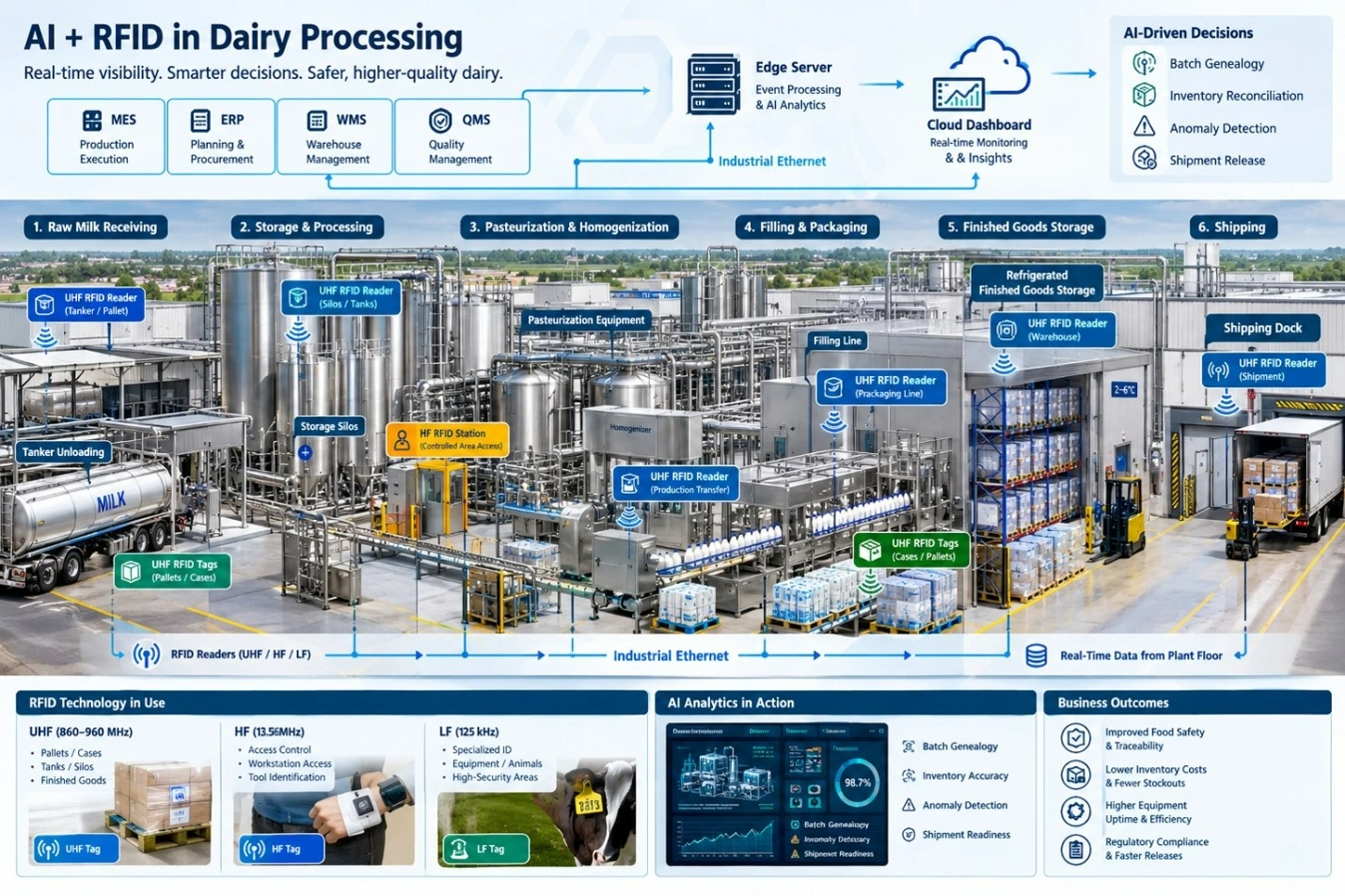
This enterprise infographic illustrates how UHF, HF, and LF RFID technologies capture asset and product data across a dairy-processing facility. Industrial Ethernet connects RFID readers to edge AI, MES, ERP, WMS, QMS, and cloud analytics, enabling batch genealogy, inventory reconciliation, anomaly detection, and shipment readiness.
What AI and RFID Mean for Modern Dairy Processing
Dairy processing generates large quantities of operational data across equipment, products, materials, personnel activities, laboratory checks, and logistics. The difficulty is not simply collecting more data. The engineering challenge is connecting trustworthy identification and process information so that production personnel can determine what happened, where it happened, which lot was affected, and what action should follow.
RFID can provide an automatic identification layer for physical objects moving through dairy-processing operations. AI adds analytical capabilities that can detect relationships and deviations that may not be obvious from individual transactions.
A practical dairy-processing solution can associate an RFID event with:
- Raw-milk receiving records
- Supplier or farm delivery information
- Tanker and receiving-bay identification
- Storage silo assignment
- Batch and lot identifiers
- Pasteurization records
- Production-line assignment
- Ingredient and packaging consumption
- Filling and packaging events
- Case and pallet aggregation
- Cold-storage location
- Shipment and customer order information
- Laboratory and quality-control results
- Equipment maintenance events
- Cleaning and sanitation records
This creates a more useful operational record than an isolated RFID read. AI can evaluate the relationships between these events and identify abnormal sequences, missing transactions, unexpected material movements, unusual production patterns, or potential traceability gaps.
GAO supplies RFID hardware products and systems that can support identification and data-capture requirements across production, inventory, logistics, and asset-management operations. The appropriate RFID configuration depends on the physical environment, tag placement, read distance, material composition, equipment layout, and hygiene requirements rather than simply selecting the longest-range reader.
Dairy Processing Applications for AI-Enabled RFID
Raw Milk Receiving and Lot Identification
Raw milk enters a processing facility through a controlled receiving process involving tanker identification, sampling, testing, unloading, and assignment to storage or production activities. RFID can automatically identify tagged transport assets, containers, samples, or supporting equipment at designated checkpoints.
AI can combine these identification events with laboratory results, receiving timestamps, storage conditions, supplier records, and production requirements. This can help personnel detect discrepancies such as an unexpected tanker assignment, missing receiving event, unusual dwell time, or mismatch between physical movement and production records.
Batch and Product Genealogy
Batch genealogy is central to dairy processing because milk and ingredients may move through multiple tanks, process stages, filling operations, and packaging levels before becoming finished products.
RFID event capture can establish relationships between source materials, intermediate batches, cases, pallets, and finished products. AI can then analyze these relationships to support faster investigation of quality deviations and potential product-hold decisions.
GS1 EPCIS provides a standardized approach for capturing and sharing visibility events, including information about what happened, when, where, and why. EPCIS 2.0 also supports sensor data and supply-chain visibility use cases relevant to temperature-controlled operations.
Packaging Line and Finished-Goods Tracking
Dairy packaging operations can involve high-speed fillers, carton or bottle handling, coding, labeling, case packing, palletizing, and movement into refrigerated storage.
RFID can identify reusable assets and tagged logistics units as they pass through defined checkpoints. AI can compare expected production transactions with actual identification events and flag missing or unexpected movements.
For example, if a pallet is physically moved from a packaging line toward cold storage but the expected RFID event is absent, an AI-enabled monitoring system can generate an exception for investigation instead of allowing the discrepancy to remain hidden until a manual inventory reconciliation.
Cold Storage and Distribution
Finished dairy products often require controlled storage and transportation. RFID can provide location and movement information for pallets, reusable containers, and other identified logistics assets. When RFID events are combined with temperature sensors and shipment records, AI can evaluate whether products followed the expected storage and distribution path.
The resulting system can support:
- Inventory location verification
- FEFO-oriented inventory decisions
- Shipment verification
- Pallet reconciliation
- Cold-room movement analysis
- Exception detection
- Product-hold management
- Distribution traceability
RFID does not replace temperature sensing. Rather, RFID can identify the object or lot associated with a temperature observation, allowing the analytical system to interpret sensor data in its operational context.
Sanitation, Maintenance, and Reusable Asset Management
Dairy plants depend on hygienic equipment, controlled cleaning procedures, and reliable production assets. RFID can identify reusable containers, tools, maintenance assets, mobile equipment, and selected components where tagging is compatible with the operating environment.
AI can analyze usage history, movement patterns, maintenance records, and inspection information to identify abnormal asset behavior or maintenance priorities.
The technology should be deployed carefully around washdown areas and sanitary processing zones. Tag and reader selection must consider moisture, cleaning chemicals, temperature, mounting surfaces, stainless-steel structures, and the possibility of electromagnetic interference or RF shielding.
Dairy Processing RFID Use-Case Map: AI-Enabled Traceability and Plant Intelligence
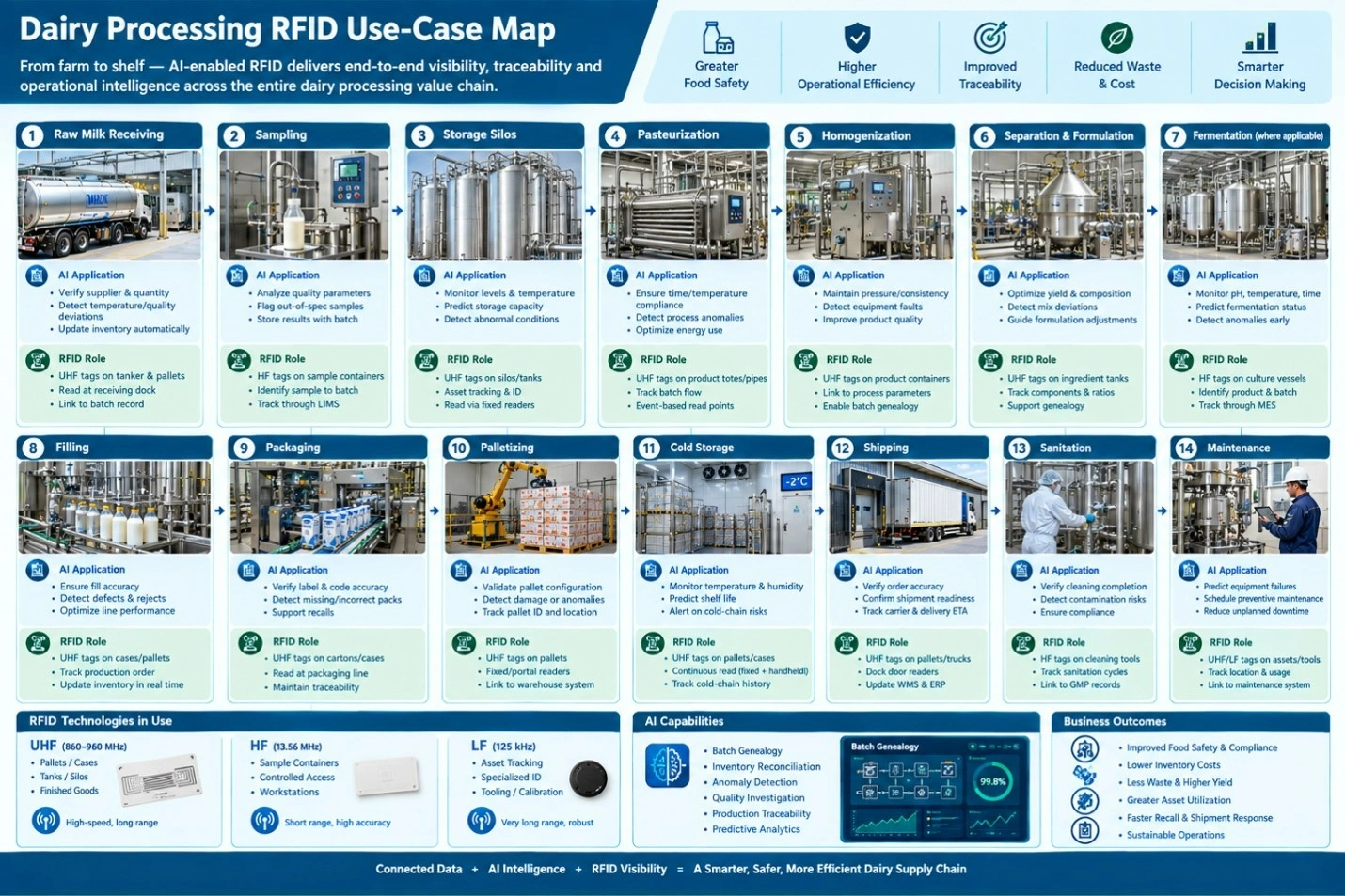
This infographic maps AI and RFID applications across 14 dairy-processing stages, from raw milk receiving and sampling to cold storage, shipping, sanitation, and maintenance. It shows how UHF, HF, and LF RFID support traceability, asset tracking, quality control, cold-chain visibility, and inventory management while AI enables genealogy, anomaly detection, predictive analytics, and operational optimization.
Dairy Processing Challenges AI Can Help Address
AI and RFID should be deployed against specific operational problems rather than introduced simply as new technology. Dairy processors commonly face challenges involving high production velocity, strict sanitation requirements, perishable inventory, complex batch relationships, refrigerated storage, manual data entry, asset loss, and the need to investigate quality events quickly.
Important engineering challenges include:
- Reconciling physical product movement with ERP or MES transactions
- Maintaining accurate batch and lot genealogy
- Identifying the correct production lot during quality investigations
- Reducing manual scanning and data-entry activities
- Managing reusable pallets, totes, racks, containers, and production assets
- Detecting inventory discrepancies between production and warehouse records
- Connecting RFID events with temperature and process data
- Maintaining reliable identification around stainless-steel equipment
- Preventing duplicate or missed RFID reads
- Operating readers reliably in wet and washdown environments
- Integrating RFID events with existing manufacturing software
- Protecting operational data and industrial network connections
- Maintaining traceability during equipment or network outages
The system should therefore be engineered around operational checkpoints. A reader installed without a clearly defined business event may produce large volumes of data without improving decision-making.
Dairy Processing Workflow from RFID Capture to AI Decision
A practical AI-enabled dairy-processing solution follows a sequence that connects physical operations with software decisions.
Data Acquisition
RFID readers capture identifiers as tagged objects pass through designated read zones. UHF RFID is generally suited to longer-range identification of pallets, cases, and logistics units, while HF RFID can be useful for shorter-range controlled identification scenarios. LF RFID can be considered for specialized short-range identification applications where its characteristics fit the environment.
Reader placement should be validated against conveyor speed, tag orientation, metal surfaces, liquid content, antenna polarization, read-zone geometry, and required read reliability.
Industrial Communication and Edge Processing
Reader data can move through industrial Ethernet or other approved plant-network connections to an edge computer or server. Edge processing can filter duplicate reads, validate expected identifiers, apply business rules, normalize events, and continue operating during temporary cloud connectivity problems.
This is especially important in dairy plants where production cannot depend on an uninterrupted external network connection for basic identification and operational-event processing.
Middleware and Event Processing
RFID middleware converts low-level reader observations into useful operational events.
For example:
Reader detects tag → middleware validates read → identifier is associated with pallet/lot → location is determined → event is timestamped → business rule evaluates event → AI receives contextual data → system generates recommendation or exception → operator or enterprise software takes action
The middleware layer should also handle reader health, duplicate suppression, event buffering, device configuration, and integration with plant software.
AI Analytics
AI can analyze RFID events together with MES, ERP, WMS, laboratory, maintenance, temperature, and production data.
Potential analytical approaches include:
- Machine-learning anomaly detection for unexpected material movement
- Time-series models for process and cold-storage behavior
- Predictive models for maintenance planning
- Classification models for identifying operational exceptions
- Computer vision where visual inspection is required alongside RFID
- Optimization algorithms for inventory and material movement
- AI-assisted investigation of batch genealogy and traceability records
AI recommendations should remain connected to validated operational rules. A model should not override food-safety controls, process limits, quality procedures, or authorized release decisions without appropriate validation and governance.
AI-RFID Dairy Data Flow: From Tagged Assets to Intelligent Decisions
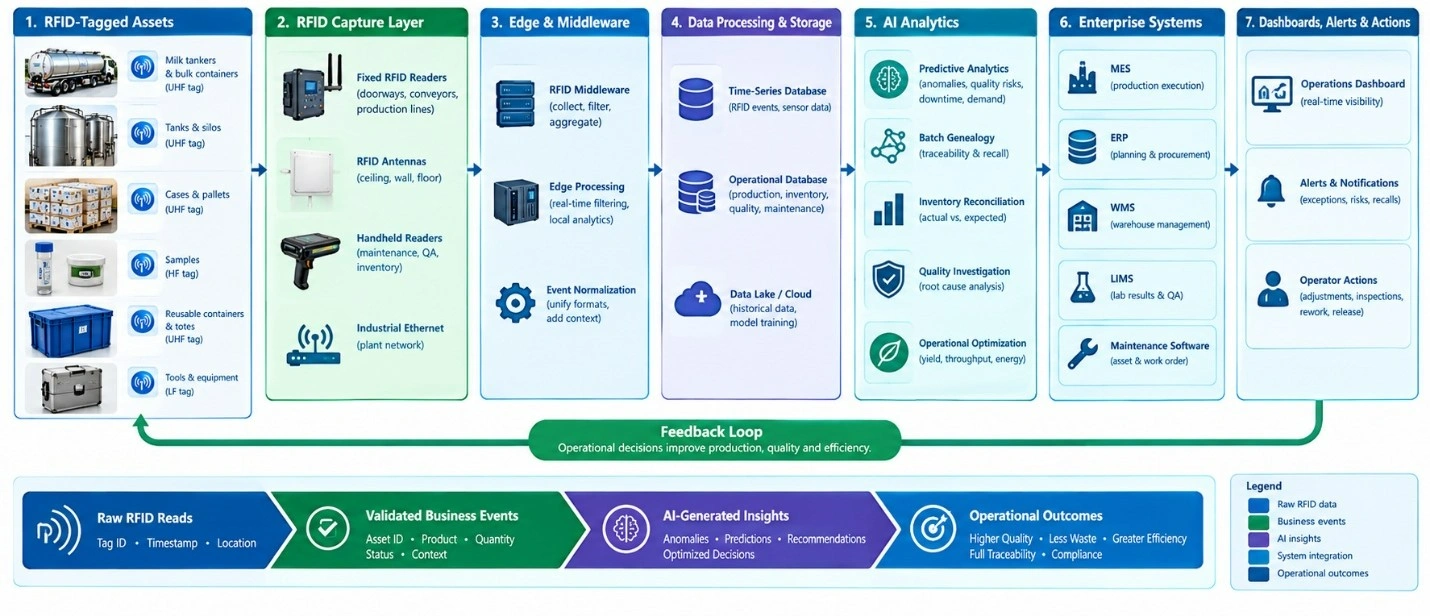
This technical workflow illustrates how RFID-tagged dairy assets generate raw reads that move through RFID capture, industrial Ethernet, edge middleware, data storage, AI analytics, and enterprise systems. The flow culminates in dashboards, alerts, and operator actions, with a feedback loop connecting AI-driven decisions back to dairy operations.
RFID Hardware, AI Software, and Deployment Options for Dairy Plants
A dairy-processing deployment normally combines RFID readers, antennas, tags, edge computing, industrial networking, middleware, databases, AI software, and integration interfaces. The exact combination depends on the process stage and whether the identification target is a pallet, case, container, sample, reusable asset, or equipment-related object.
RFID Identification Layer
UHF RFID is often appropriate for automated identification of pallets, cases, containers, and logistics units where longer read distances and portal-style reading are useful. HF RFID is better suited to controlled, shorter-range identification points and can be useful where proximity-based reads are preferred. LF RFID operates at lower frequencies and can be considered for specialized short-range applications where its characteristics match the asset and operating environment.
Tag selection is equally important. Dairy plants must consider:
- Liquid-rich products that can affect RF performance
- Stainless-steel tanks and machinery
- Plastic containers and cases
- Reusable transport assets
- Refrigerated environments
- Washdown procedures
- Chemical exposure
- Tag attachment method
- Required read distance
- Data-retention requirements
Edge Computing and Local Processing
An edge server can process RFID events close to the production environment. This approach reduces dependence on external connectivity and allows local rules, buffering, event validation, and selected AI workloads to continue operating during connectivity interruptions.
A local server can also be advantageous where dairy production data must remain within customer-controlled infrastructure or where integration with existing factory systems is easier through local network connections.
Cloud Version and Server Version
A Cloud Version can host the software in cloud infrastructure and provide centralized access to dashboards, analytics, databases, and multi-site reporting. This model can be appropriate for dairy processors operating multiple facilities that need consolidated visibility without maintaining the complete application stack at every site.
A Server Version can run on an edge server, factory server, customer-managed server, private data center, or other privately hosted infrastructure. This model can be appropriate when production systems require local processing, customer-controlled data storage, integration with plant networks, or continued operation during unreliable external connectivity.
The two approaches can also be combined. Time-sensitive RFID event processing can remain close to the dairy production line while aggregated operational data and selected AI workloads are synchronized with centralized infrastructure.
Enterprise Software Integration
RFID and AI become substantially more useful when connected to the software already used to operate a dairy facility. Integration targets can include MES, ERP, WMS, laboratory information systems, quality-management software, maintenance-management systems, and production databases.
GS1’s traceability standards provide useful interoperability concepts for identifying and sharing supply-chain events. EPCIS supports event information describing products and assets, their locations, movements, and related business context.
For dairy operations, integration should preserve the relationship between the physical object, identifier, batch, lot, production order, location, timestamp, and operational event. That relationship is what allows AI analytics to produce useful recommendations instead of disconnected statistical outputs.
FDA’s dairy regulatory framework also emphasizes sanitation, processing controls, equipment, laboratory testing, and traceability. The current NCIMS model documents include the 2025 revision of the Grade “A” Pasteurized Milk Ordinance, published in June 2026.
GAO’s RFID products and systems can form part of this identification and data-capture layer, with deployment decisions based on the dairy processor’s physical environment, process requirements, software systems, and operational objectives.
AI Models and Decision Support
AI models should be selected according to the operational decision they are expected to support. Dairy processing rarely benefits from a single model applied across every production stage. A combination of anomaly detection, forecasting, classification, optimization, and computer vision can provide better results when each model has a clearly defined purpose.
Potential applications include:
- Anomaly detection: Identify unusual RFID movement sequences, unexpected pallet locations, abnormal production-cycle durations, or deviations from established material-flow patterns.
- Predictive maintenance: Combine equipment history, production utilization, maintenance records, and sensor information to identify assets requiring inspection before failures interrupt dairy production.
- Inventory forecasting: Analyze production schedules, historical demand, product movement, shelf-life constraints, and warehouse transactions to improve replenishment and finished-goods planning.
- Quality investigation: Correlate batch genealogy, process records, RFID events, laboratory results, and environmental observations to accelerate investigation of deviations.
- Production optimization: Evaluate production orders, equipment availability, material movements, changeovers, and storage capacity to support more efficient scheduling.
- Computer vision: Inspect packaging, labels, seals, fill levels, date codes, or other visible characteristics while RFID provides product or logistics-unit identity.
- AI-assisted traceability: Search large volumes of identification and production events to determine the movement history of a specific batch, pallet, case, or asset.
The most reliable implementation uses AI as decision support alongside validated dairy-processing procedures. Critical food-safety controls, laboratory release decisions, sanitation requirements, and regulatory controls should remain governed by approved procedures and appropriately validated systems.
Key Technical Capabilities for Dairy Processing
Combining AI with RFID-based identification can improve several operational capabilities when the system is correctly engineered.
| Capability | Dairy-processing application | Why it matters |
| Automated identification | Cases, pallets, containers, reusable assets | Reduces dependence on manual identification |
| Batch genealogy | Linking raw materials, production batches, cases, and pallets | Speeds traceability and quality investigations |
| Movement visibility | Production, cold storage, staging, and shipping | Identifies unexpected or missing movements |
| AI anomaly detection | Detecting abnormal process or inventory events | Directs attention to exceptions |
| Inventory reconciliation | Comparing physical movement with system records | Helps reduce unexplained discrepancies |
| Cold-chain context | Linking identified products with temperature observations | Improves interpretation of temperature events |
| Predictive maintenance | Correlating asset use with maintenance information | Supports proactive maintenance planning |
| Production analytics | Evaluating movement and production-cycle data | Helps identify bottlenecks and inefficiencies |
| Automated alerts | Exceptions involving lots, assets, or movements | Reduces delayed response |
| Multi-site reporting | Consolidating selected operational information | Supports consistent analysis across dairy facilities |
GAO can support these applications with RFID readers, antennas, tags, and related identification hardware and systems selected according to the dairy processor’s operating environment. Successful deployment depends on engineering the complete workflow rather than evaluating an RFID reader independently from the software and production process.
Engineering Considerations for RFID Deployment in Dairy Plants
RF Performance Around Liquids and Stainless Steel
Dairy products contain substantial amounts of water, which can affect UHF RFID performance. Stainless-steel tanks, pipes, conveyors, processing vessels, and other conductive structures can also alter RF propagation and create reflections or dead zones.
Consequently, laboratory tag specifications should not be treated as proof of plant-level performance. Tags should be evaluated on their actual mounting surfaces and in representative operating conditions.
A deployment assessment should examine:
- Tag orientation and mounting position
- Product composition and moisture
- Stainless-steel surfaces
- Conveyor geometry
- Reader antenna polarization
- Required read-zone dimensions
- Conveyor speed
- Tag density
- Reader transmit power
- Adjacent reader interference
- Refrigerated and washdown conditions
A controlled RFID portal may be appropriate for pallet movement through a warehouse doorway, while a short-range read point may be more appropriate for a controlled operator workstation.
Washdown and Hygienic Design
Dairy-processing environments can expose hardware to water, detergents, sanitizing chemicals, temperature changes, and repeated cleaning cycles. RFID hardware installed near processing areas therefore requires environmental evaluation rather than selection based solely on read performance.
Engineers should consider enclosure protection, connector selection, mounting method, cable routing, cleaning procedures, and separation from areas subject to direct chemical or high-pressure exposure.
Tags attached to reusable containers and logistics assets should also withstand the asset’s actual cleaning and handling cycle.
Read-Zone Engineering
Reliable RFID deployment depends on controlling where and when a tag is expected to be read. A reader that captures tags outside the intended zone can produce false movement events.
Useful engineering techniques include:
- Shielding or positioning antennas to constrain read zones
- Establishing reader power levels through testing
- Using multiple antennas where directional coverage is necessary
- Applying middleware filtering rules
- Associating reads with conveyor or door events
- Using timing rules to suppress repeated observations
- Testing maximum tag density
- Validating performance during normal production speeds
The objective is not to capture every possible RF response. The objective is to produce trustworthy operational events.
RFID Read-Zone Engineering for Dairy Processing: Antenna Placement and RF Reliability
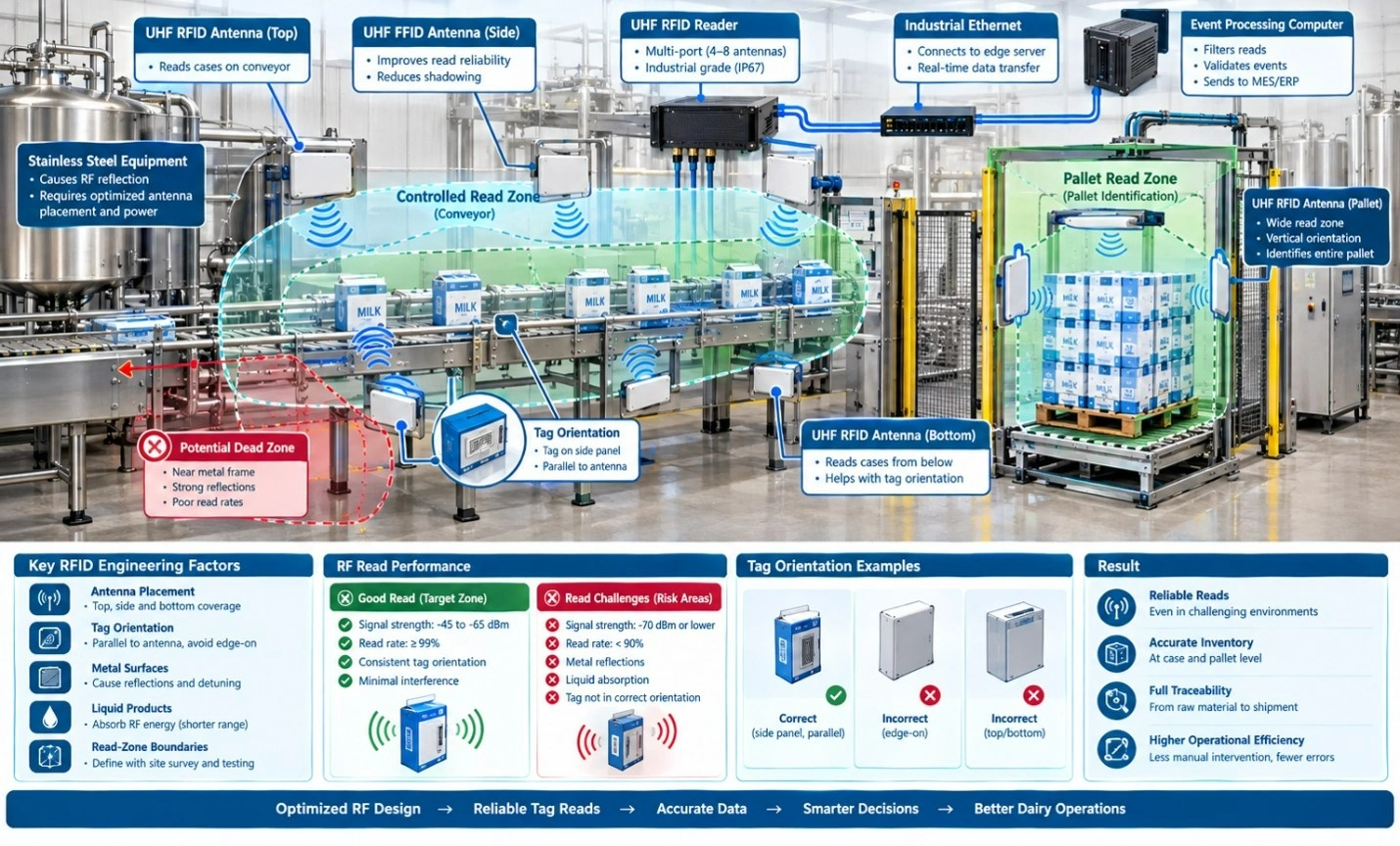
This technical infographic shows how antenna placement, tag orientation, stainless-steel surfaces, liquid-rich products, and read-zone boundaries influence UHF RFID performance in dairy processing. It contrasts reliable and problematic read areas and illustrates how optimized RF design supports accurate tracking, traceability, and operational efficiency.
Cybersecurity and Data Integrity for AI-Enabled Dairy Processing
Connecting RFID readers, edge computers, production databases, and enterprise software introduces cybersecurity considerations that should be addressed during system design rather than after deployment.
A dairy-processing implementation should consider:
- Segmentation between production networks and business networks
- Controlled access to RFID management software
- Authentication for users and system integrations
- Encryption for applicable communications
- Secure configuration of edge servers
- Role-based access to operational data
- Software and firmware update procedures
- Backup and recovery procedures
- Audit logging
- Monitoring of unusual device behavior
- Protection of integration credentials
- Redundant storage for critical event records
- Offline buffering during temporary network failures
Data integrity is equally important. An AI model trained on incomplete or incorrectly associated RFID events can produce misleading conclusions. Middleware should therefore distinguish between a raw reader observation and a validated business event.
For example, three consecutive reads of the same pallet at a single portal should not automatically be interpreted as three separate pallet movements. Event filtering, time windows, reader-zone logic, and process context are needed to transform RF observations into meaningful transactions.
Dairy Processing KPIs for AI and RFID Programs
Technology adoption should be measured against operational outcomes. Relevant KPIs can include:
- Batch genealogy completeness
- Traceability record retrieval time
- RFID read accuracy
- Missed-read rate
- False-read rate
- Inventory record accuracy
- Pallet reconciliation rate
- Cold-storage inventory accuracy
- Material movement exception rate
- Production-line downtime
- Mean time between failures
- Mean time to repair
- Maintenance response time
- Production changeover duration
- Product-hold investigation time
- Order fulfillment accuracy
- Shipment verification accuracy
- Asset utilization
- Reusable-container recovery rate
- Manual data-entry frequency
- AI anomaly detection precision
- AI alert response time
- Data synchronization success rate
- RFID reader availability
The baseline should be measured before deployment. Comparing pre-deployment and post-deployment results allows the dairy processor to determine whether RFID and AI are producing measurable operational improvements.
Implementation Roadmap for Dairy Processing
A phased implementation reduces technical and operational risk.
Assess the Production Process
Document how materials and products actually move through the dairy facility. Map receiving points, storage tanks, processing stages, packaging lines, cold rooms, staging areas, and shipping locations.
Identify which physical events must become digital events and determine which objects require automatic identification.
Select RFID Technology by Process
Do not assume that one RFID frequency is appropriate for every dairy-processing application.
UHF RFID can support longer-range identification of pallets, cases, and logistics units. HF RFID can support controlled short-range identification points. LF RFID can serve specialized applications where its lower-frequency characteristics are advantageous.
The final selection should follow site testing, tag evaluation, read-zone analysis, and operational requirements.
Establish the Data Model
Define the relationships among:
- RFID identifier
- Product identifier
- Batch
- Lot
- Production order
- Location
- Equipment
- Timestamp
- Reader
- Process stage
- Quality event
- Shipment
- Customer order
This data model becomes important when AI is later used for traceability analysis, anomaly detection, and operational optimization.
Pilot One High-Value Workflow
A pilot could focus on pallet identification between packaging, refrigerated storage, and shipping. This workflow is relatively easy to define and provides measurable outcomes such as inventory accuracy, shipment verification, and manual scanning reduction.
Another pilot could focus on reusable dairy-processing assets where loss or misplacement creates measurable operational costs.
Validate Before Scaling
Testing should cover normal production, peak throughput, cleaning conditions, tag density, network interruptions, reader failures, and unusual material configurations.
AI models should also be validated against representative historical and live operational data before their recommendations are used in production decisions.
Expand Through Controlled Integration
Once the pilot is stable, the solution can be extended to additional production lines, cold-storage areas, warehouses, reusable assets, and quality workflows.
The same integration principles should be maintained across each expansion so that event definitions and data relationships remain consistent.
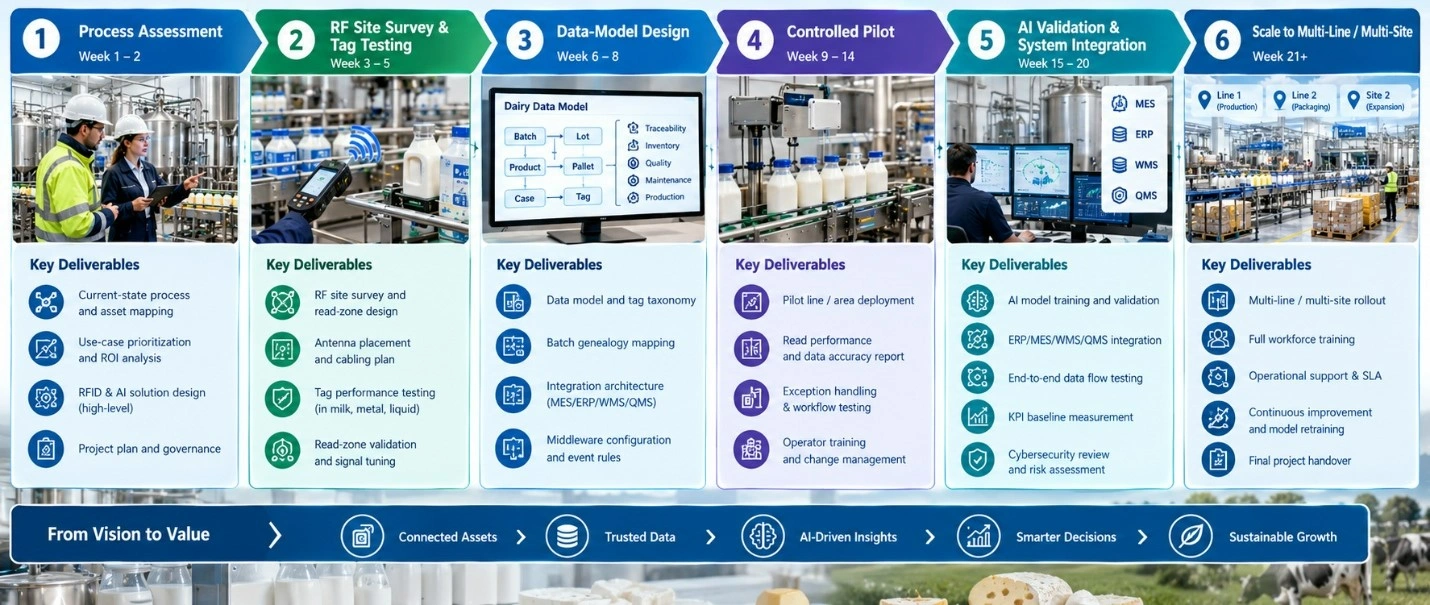
AI-Enabled RFID Dairy Processing Implementation Roadmap
This six-stage roadmap illustrates a practical path from process assessment and RF testing through data-model design, controlled piloting, AI validation, system integration, and multi-site scaling. Each phase highlights key deliverables including read-zone validation, batch genealogy, middleware configuration, enterprise integration, KPI measurement, cybersecurity, and operator training.
Business Value of AI-Enabled RFID in Dairy Processing
The primary value comes from connecting physical dairy-processing activity with reliable operational information.
When the identification layer is correctly deployed, processors can reduce the gap between what the production system says happened and what actually happened on the plant floor. AI can then use this structured information to identify exceptions, prioritize investigations, forecast operational conditions, and support decision-making.
Potential business outcomes include:
- Faster batch and lot traceability
- Better inventory accuracy
- Reduced manual identification activity
- Improved shipment verification
- More efficient reusable-asset management
- Faster quality-event investigation
- Better visibility into cold-storage movements
- Earlier identification of abnormal production patterns
- More informed maintenance planning
- Improved operational reporting
- Greater scalability across production areas
- Stronger data consistency between plant and enterprise software
These benefits are dependent on deployment quality. Poor tag placement, uncontrolled read zones, weak data models, disconnected software, and insufficient process validation can undermine the value of otherwise capable hardware and AI models.
Practical Recommendations for Dairy Processors
Dairy processors considering AI-enabled RFID should prioritize the operational problem before selecting hardware or AI software.
Recommended practices include:
- Begin with a clearly defined traceability, inventory, asset, maintenance, or production problem.
- Map the physical dairy-processing workflow before installing readers.
- Test RFID tags on the actual packaging, pallets, containers, and equipment surfaces.
- Evaluate RF behavior around liquids, stainless steel, conveyors, and refrigerated environments.
- Design controlled read zones instead of attempting unrestricted plant-wide reading.
- Separate raw RFID observations from validated business events.
- Establish batch, lot, asset, location, and production relationships before deploying advanced AI analytics.
- Integrate RFID events with MES, ERP, WMS, quality, laboratory, and maintenance systems where appropriate.
- Keep critical processing and food-safety decisions governed by validated procedures.
- Measure baseline KPIs before implementation.
- Validate AI models against representative dairy-processing data.
- Provide local buffering and recovery mechanisms for network interruptions.
- Apply cybersecurity controls to readers, edge servers, databases, and integration interfaces.
- Train production, warehouse, quality, maintenance, and IT personnel on the new workflow.
- Scale only after read reliability, data integrity, system performance, and operational value have been demonstrated.
GAO’s Role in AI and RFID for Dairy Processing
GAO can help organizations evaluate RFID-based identification requirements and supply hardware products and systems for applications involving inventory, asset tracking, production visibility, and logistics. Our experience supporting customers with RFID and related IoT technologies is relevant when dairy processors need to translate an operational requirement into an appropriate combination of readers, antennas, tags, software, and integration components.
Headquartered in New York City and Toronto, Canada, GAO is ranked among the top 10 leading B2B and B2G RFID and BLE suppliers globally. GAO and its sister companies, GAO Research and GAO Tek, form GAO Group, with operations based in New York City and Toronto. Across three decades, GAO Group has served organizations in the U.S. and Canada, including Fortune 500 companies, leading research and development organizations, universities, and government agencies.
GAO Group has invested heavily in research and development and maintains stringent quality-assurance processes. Remote and onsite technical support can also help customers address deployment and integration requirements.
H2: Key Takeaways for Dairy Processing Leaders
AI-enabled RFID can give dairy processors a stronger connection between physical product movement and digital operational intelligence. RFID provides automatic identification at selected production, packaging, warehouse, and logistics checkpoints, while AI can analyze those events alongside process, quality, maintenance, inventory, and temperature information.
The strongest deployments are built around measurable operational requirements. Dairy processors should begin with a defined workflow, validate RFID performance in the actual plant environment, establish reliable event data, integrate with existing software, and then introduce AI models that address specific decisions.
GAO provides RFID and IoT hardware products and systems that can support this progression. Readers interested in dairy-processing traceability, inventory visibility, asset management, or AI-enabled operational monitoring can learn more about GAO’s RFID technologies, engineering support, and application-focused solutions.
Building the Future of Industrial AI and IoT with Aperture Venture Studio and GAO RFID Inc.
For more than three decades, GAO Group of Companies has invested heavily in R&D of industrial RFID, BLE, and IoT. As generative AI became useful for industrial applications, we expanded our work across AI and IoT technologies, including RFID and BLE, and founded Aperture Venture Studio to help advance practical AI and IoT solutions for applications such as dairy-processing traceability, intelligent asset management, and connected manufacturing operations.
Aperture has attracted AI and IoT technical experts, entrepreneurial and operational executives, influential investors, and leading companies.
We have also developed Aperture Ventures Summit and TekSummit to discuss advanced AI and IoT topics and foster technical collaboration.
As a result, we have built diversified technical communities around AI and IoT.
We welcome you to join us as:
- Advisors, Co-founders, or Employees
- Investors
- Customers