
AI and RFID for Aircraft Maintenance
How AI and RFID Improve Aircraft Maintenance Operations
AIoT, or Artificial Intelligence of Things, combines artificial intelligence with connected devices, sensors, equipment, and industrial systems. Within aircraft maintenance, AI and RFID can connect physical aircraft components and maintenance activities with digital records, enabling more accurate part identification, location visibility, inspection support, inventory control, and maintenance decision-making.
RFID provides automated identification and data capture for aircraft parts, tools, ground support equipment, containers, maintenance kits, and other trackable assets. AI can then analyze the resulting information alongside maintenance records, flight schedules, component histories, inspection findings, and inventory data. This combination can help maintenance, repair, and overhaul (MRO) organizations reduce search time, improve parts traceability, identify maintenance anomalies, optimize inventory, and support more consistent work execution. GAO provides RFID hardware and systems that can support aircraft maintenance workflows requiring reliable identification and digital asset visibility.
AI and RFID Aircraft Maintenance Operations Overview
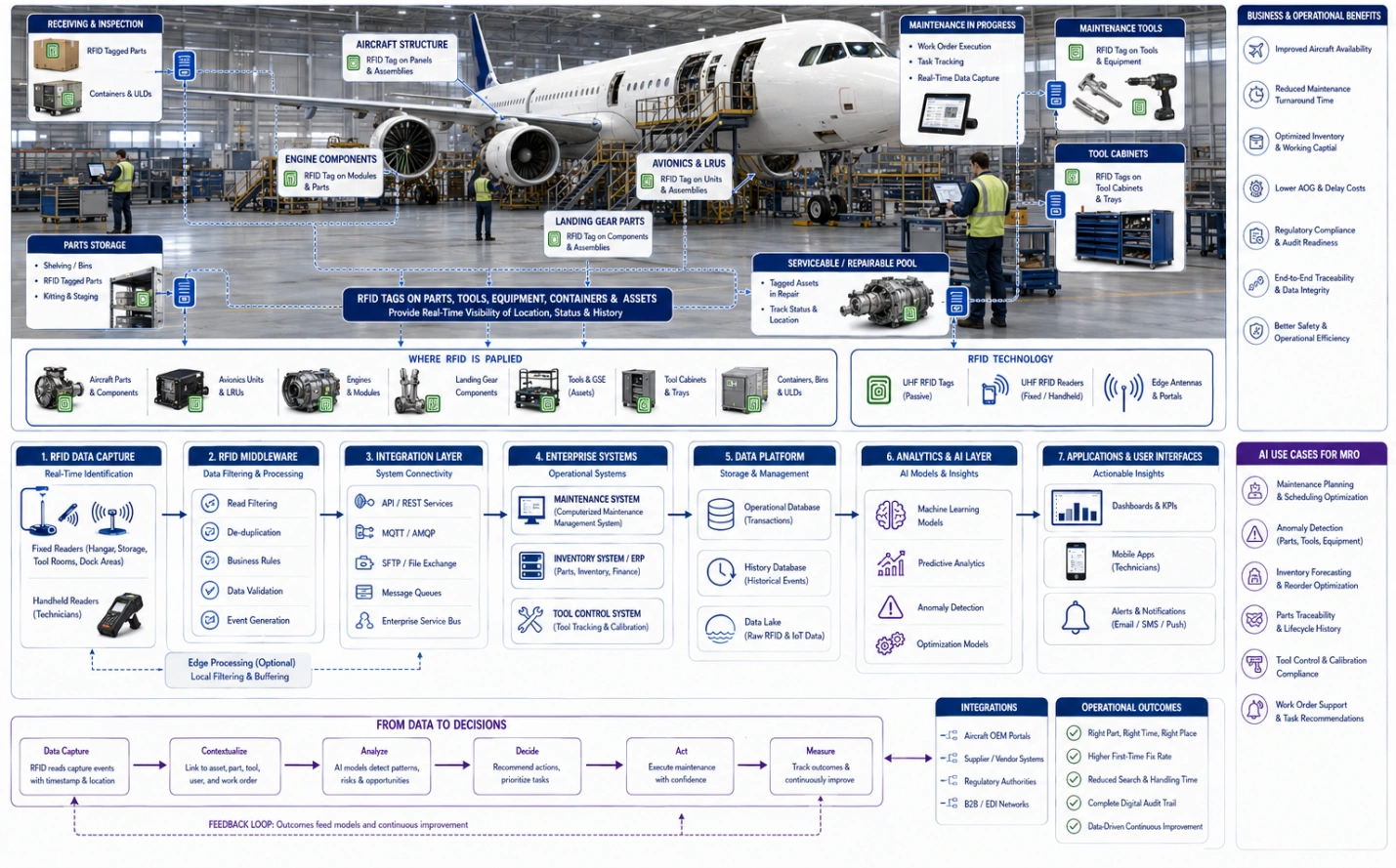
This completed MRO diagram illustrates how RFID-tagged aircraft parts, tools, equipment, containers, and assets generate identification and location data across receiving, storage, and maintenance activities. The data flows through RFID readers, middleware, enterprise maintenance and inventory systems, analytics, and AI models to support maintenance planning, anomaly detection, inventory forecasting, parts traceability, tool control, and work-order decisions.
AIoT Fundamentals for Aircraft Maintenance
Aircraft maintenance generates large volumes of structured and unstructured operational information. Maintenance records, aircraft utilization data, component histories, inspection findings, parts inventories, work orders, tooling records, and technician actions all contribute to maintenance decision-making.
The challenge is connecting this digital information with the physical assets being inspected, removed, installed, repaired, stored, or transported.
RFID provides an automated method for associating a physical object with a digital identity. A tagged aircraft component can be identified without requiring direct line-of-sight scanning, depending on the RFID frequency, reader configuration, tag placement, and operating environment. AI can then use the resulting identification events as contextual information for analysis.
A practical aircraft maintenance solution may combine:
- UHF RFID readers and tags for longer-range identification of parts, tools, containers, and maintenance assets
- HF RFID for applications requiring shorter-range identification or controlled read zones
- LF RFID where low-frequency identification characteristics are appropriate for specific maintenance assets
- RFID antennas positioned at maintenance stores, workstations, hangar entrances, tool-control areas, or other defined read points
- Fixed RFID readers for automated event capture
- Handheld RFID readers for technicians and maintenance personnel requiring mobile identification
- RFID middleware for filtering reads, associating events with asset IDs, and transmitting information to business software
- AI and machine learning for anomaly detection, demand forecasting, maintenance analytics, and decision support
- Maintenance management and MRO software for work orders, component history, inspections, maintenance planning, and compliance records
- ERP and inventory systems for procurement, stock management, purchasing, and financial control
- Databases and data historians for maintaining historical asset and maintenance information
The relationship between RFID and AI is therefore complementary. RFID establishes which physical asset is involved and where an identification event occurred, while AI can analyze that information alongside maintenance and operational data to determine what may require attention.
For example, an RFID system can identify that a serialized component entered a maintenance workstation. AI software can combine that event with the component’s maintenance history, accumulated utilization, previous inspection findings, and current work order to provide relevant information to maintenance personnel.
GAO can support these workflows by supplying RFID readers, tags, antennas, accessories, and related identification systems for aircraft maintenance and MRO applications.
Aircraft Maintenance Processes Where AI Creates Operational Value
Aircraft Parts Identification and Traceability
Aircraft maintenance depends on accurate identification of components. Serialized parts, rotable components, expendable parts, repairable assemblies, line-replaceable units (LRUs), avionics equipment, engine components, landing gear assemblies, and other maintenance-controlled items may need to be associated with specific records.
Manual identification can involve reading part numbers, serial numbers, barcodes, labels, or maintenance documentation. RFID can supplement these processes by providing automated identification at designated locations.
AI can use RFID events together with maintenance records to detect inconsistencies. For example, an unexpected movement event may indicate that a component was moved to the wrong storage area, assigned to an incorrect work order, or removed from inventory without the expected transaction.
This does not mean RFID independently determines airworthiness. Instead, it provides reliable identification and event data that maintenance information systems and qualified personnel can use in established maintenance processes.
AI-Assisted Maintenance Planning
Maintenance planning involves coordinating aircraft availability, scheduled inspections, component life limits, maintenance tasks, labor, tooling, replacement parts, and hangar capacity.
AI can analyze historical maintenance activity and current operational information to identify patterns affecting maintenance workload. RFID contributes physical asset visibility by showing the movement and availability of components, maintenance kits, tools, and other tagged assets.
For example, if a scheduled maintenance event requires several serialized components and specialized tools, RFID event data can help determine whether those items have reached the designated maintenance area. AI can combine that information with work-order status and historical processing times to identify potential preparation delays.
The resulting system can provide maintenance planners with earlier visibility into material or tooling constraints.
Predictive Maintenance for Aircraft Maintenance Equipment
AI-based predictive maintenance is not limited to aircraft components. MRO facilities also depend on support equipment such as ground power units, air compressors, hydraulic test equipment, hoists, jacks, machine tools, battery servicing equipment, engine stands, and other maintenance equipment.
Sensors can collect vibration, temperature, current, pressure, runtime, and other equipment-condition data. RFID can provide the equipment identity and movement context.
AI models can analyze time-series measurements to identify abnormal operating patterns. Maintenance personnel can then prioritize inspection or servicing based on equipment condition rather than relying exclusively on fixed intervals.
This approach is particularly useful for equipment whose failure could delay an aircraft maintenance event.
Tool Control and Technician Workflow
Tool control is a critical operational activity in aircraft maintenance because maintenance organizations need to account for tools used during servicing and ensure that required tools are available and properly controlled.
RFID-enabled tool cabinets, readers, tags, and workstations can automate identification events as tools are issued, returned, transferred, or staged for maintenance tasks.
AI can analyze tool utilization patterns to identify frequently used tools, unusual tool movements, repeated shortages, or workflow bottlenecks. These insights can support tool allocation and maintenance planning.
A properly designed system should retain a clear audit trail showing the relationship between tool identity, workstation, user workflow, time, and applicable maintenance task. RFID should complement established tool accountability procedures rather than replace required physical inspections or foreign object debris (FOD) controls.
Maintenance Stores and Spare Parts Inventory
Aircraft maintenance organizations must manage large inventories of spare parts, consumables, rotable components, repairables, tooling, and maintenance supplies.
RFID can automate identification when tagged items enter or leave controlled storage areas. Fixed readers can capture events at designated points, while handheld readers can support cycle counting and technician searches.
AI can analyze inventory movement and maintenance consumption to improve demand forecasting. Relevant variables can include aircraft fleet activity, historical component replacement rates, scheduled maintenance checks, lead times, repair turnaround times, stock levels, and procurement information.
Potential AI-supported decisions include:
- Forecasting demand for frequently consumed maintenance parts
- Identifying unusual consumption patterns
- Detecting potential inventory discrepancies
- Prioritizing replenishment
- Identifying slow-moving or excess inventory
- Estimating future maintenance-material requirements
- Supporting maintenance-kit preparation
- Identifying components approaching defined inventory or maintenance conditions
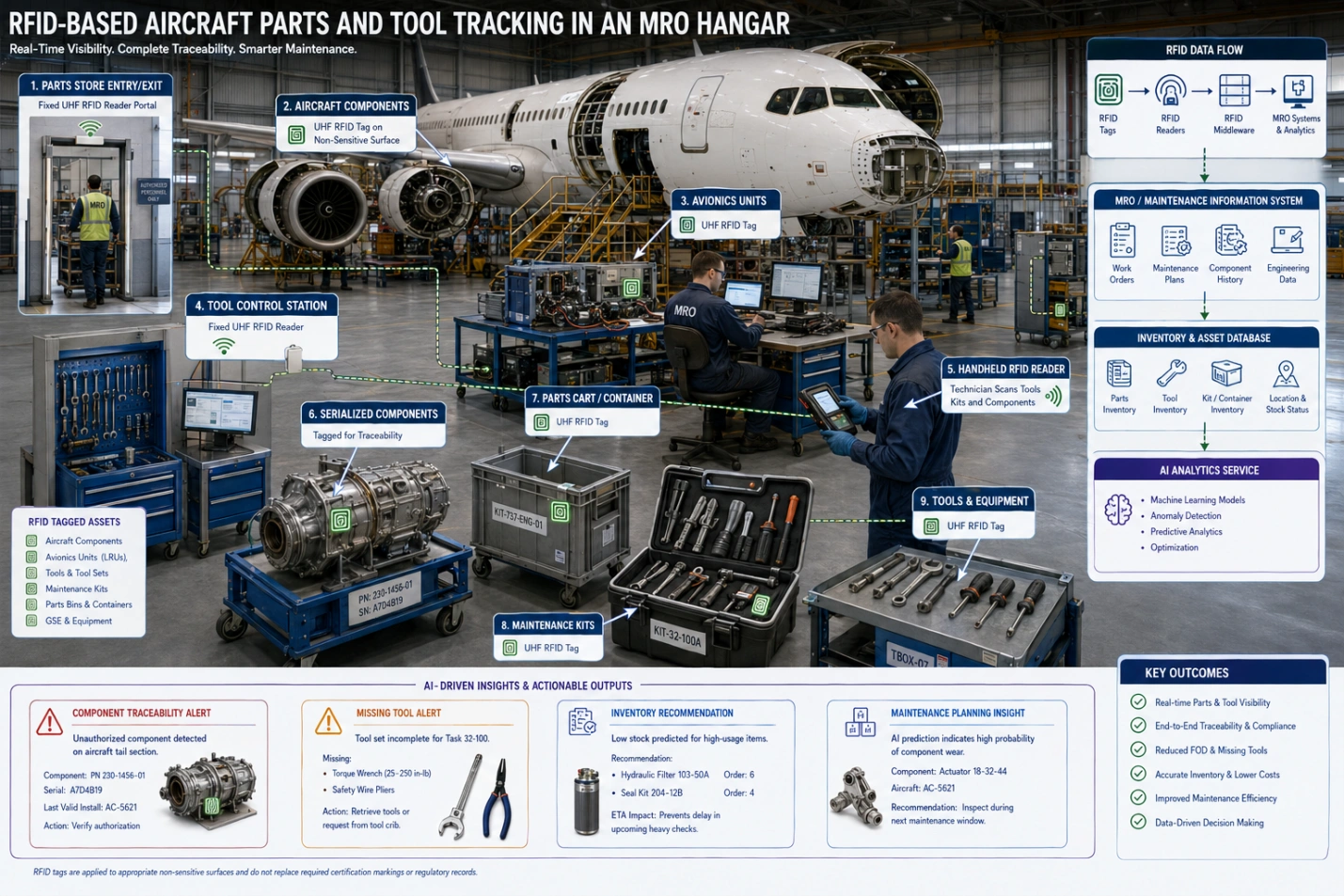
AI and RFID Aircraft Parts and Tool Tracking in an MRO Hangar
This completed visual illustrates a realistic aircraft MRO hangar where UHF RFID tags, fixed readers, and handheld scanners track aircraft components, tools, maintenance kits, carts, and containers. RFID data flows into MRO information systems, inventory databases, and AI analytics to support traceability alerts, missing-tool detection, inventory recommendations, and maintenance planning.
Component Removal, Installation, and Maintenance History
Component removal and installation create important maintenance events. A digital system should associate the component’s identity with the aircraft, position, work order, technician workflow, date, and applicable maintenance record.
RFID can automate part identification at selected maintenance stations. AI can analyze historical component events to identify unusual replacement patterns or recurring maintenance issues.
For example, if a particular component family shows a higher-than-expected replacement frequency across aircraft in a fleet, AI analytics can flag the pattern for engineering review. Maintenance engineers can then investigate whether the pattern relates to operating conditions, supplier variation, installation practices, environmental exposure, or another factor.
The AI system should support engineering investigation rather than independently making airworthiness determinations.
Inspection and Maintenance Documentation
Aircraft inspections generate records associated with scheduled maintenance checks, defect findings, corrective actions, component replacements, and return-to-service activities.
AI can assist with document classification, information extraction, anomaly detection, and maintenance-record analysis where appropriate. RFID can provide the physical asset identity that helps associate an inspection activity with the correct component or maintenance location.
Computer vision may also be incorporated for specific inspection-support applications, although its use should be validated for the particular inspection task and operating environment. AI-generated findings should remain subject to the inspection procedures, qualification requirements, and approval processes applicable to the maintenance organization.
Ground Support and Maintenance Asset Visibility
MRO operations depend on many mobile assets that move between hangars, maintenance shops, parts stores, ramps, and staging areas.
Examples include:
- Tool carts
- Maintenance stands
- Ground power units
- Hydraulic servicing equipment
- Oxygen servicing equipment
- Nitrogen carts
- Engine stands
- Component transport carts
- Maintenance platforms
- Test equipment
- Battery servicing equipment
- Specialized maintenance tooling
RFID can provide automated identification at controlled locations, while AI can analyze movement history and utilization patterns.
This can help maintenance organizations determine where assets are located, identify underutilized equipment, reduce unnecessary searching, and improve preparation for scheduled maintenance events.
AI and RFID Data Flow Across Aircraft Maintenance Operations
A complete AI and RFID solution should define how physical maintenance events become validated data, analytical insights, and operational actions.
RFID Data Capture
The process begins when a tagged component, tool, container, or maintenance asset passes through an RFID read zone or is scanned using a handheld reader.
A reader captures the RFID identifier and associated event information. Depending on the system design, the event may include:
- RFID tag identifier
- Reader identifier
- Antenna or read-zone identifier
- Timestamp
- Signal information
- Location or workstation
- Asset identifier
- Transaction or workflow context
Tag selection is important. Aircraft maintenance environments contain extensive metal structures, cables, equipment, fluids, and other materials that can affect RFID performance. Tags designed for metal-mounted applications may be required for suitable assets, while tag placement must be validated to prevent unintended read behavior.
RFID Communication and Middleware
Readers transmit identification events to middleware or an edge computing system. Middleware can filter duplicate reads, apply business rules, associate readers with locations, and convert low-level RFID events into useful operational events.
For example, multiple reads of the same tool while it remains near an antenna should not necessarily create multiple tool-movement transactions. Middleware can apply timing, location, and event rules to transform raw reads into meaningful records.
The communication layer may use Ethernet, Wi-Fi, or other appropriate network infrastructure depending on the facility. System designers should account for network segmentation, reader density, electromagnetic conditions, physical cable routing, and connectivity redundancy.
Maintenance Data Integration
Filtered RFID events can then be associated with maintenance and enterprise systems.
Relevant systems may include:
- Maintenance, repair, and overhaul software
- Computerized maintenance management systems
- Enterprise resource planning systems
- Inventory management systems
- Warehouse management systems
- Electronic maintenance records
- Procurement systems
- Quality management systems
- Document management systems
- Business intelligence software
A component movement event becomes significantly more valuable when associated with a work order, aircraft registration, component serial number, maintenance task, and inventory transaction.
AI Analytics and Maintenance Decisions
AI models operate on the contextualized data rather than isolated RFID reads.
A machine learning model could identify unusual component movement patterns. A forecasting model could estimate spare-part demand. An anomaly-detection model could identify unusual tool usage or inventory activity. A predictive model could combine equipment sensor data with maintenance history to estimate potential support-equipment failures.
AI outputs may then become:
- Maintenance planning recommendations
- Inventory replenishment recommendations
- Tool-control alerts
- Component traceability alerts
- Equipment maintenance alerts
- Workflow exceptions
- Parts-preparation notifications
- Management dashboards
- Engineering analysis inputs
The final decision should remain aligned with approved maintenance procedures and organizational authority. AI should improve information quality and decision support while maintaining the controls required for safe aircraft maintenance.
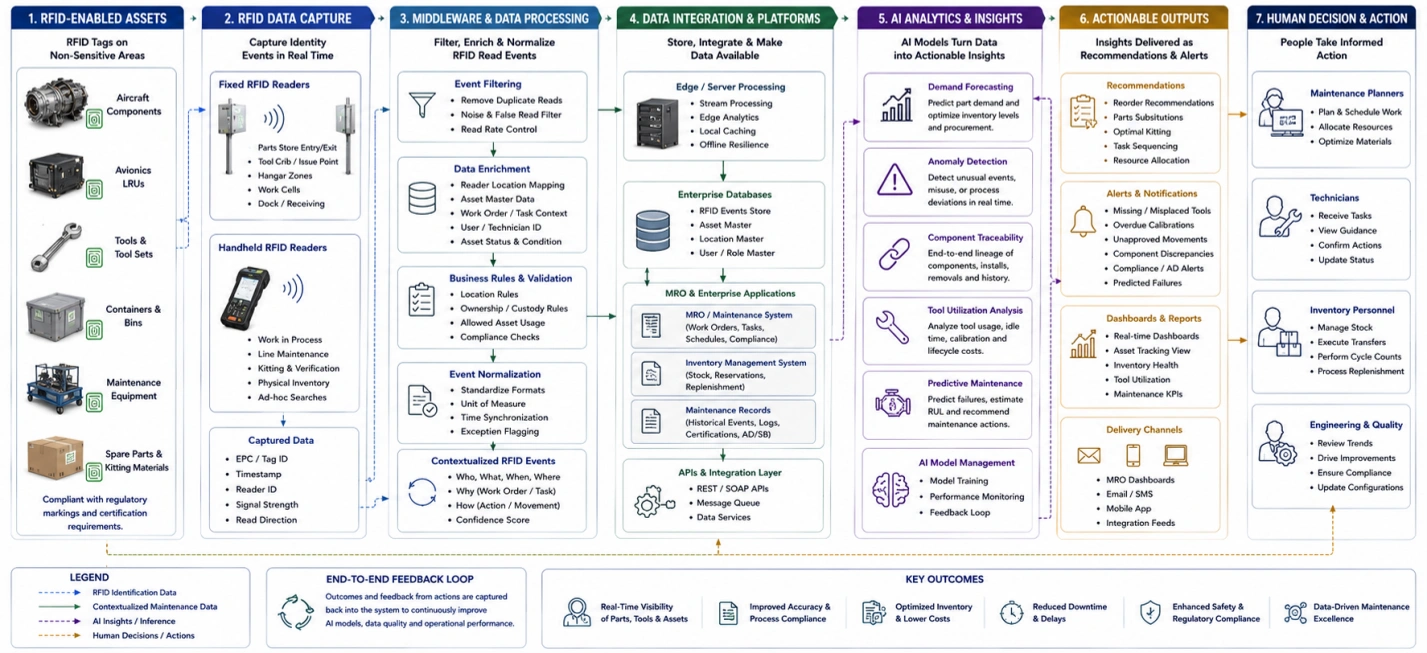
RFID-to-AI Aircraft Maintenance Decision Workflow
This completed workflow shows the end-to-end path from RFID-tagged aircraft components, tools, containers, equipment, and spare parts through RFID readers, middleware, data platforms, MRO systems, and AI analytics. It illustrates how contextualized maintenance data supports demand forecasting, anomaly detection, component traceability, tool utilization analysis, predictive maintenance, alerts, recommendations, and informed decisions by planners, technicians, inventory personnel, and engineering teams.
Technical Components for AI and IoT in E-Waste Recycling
A reliable AIoT solution for e-waste recycling combines sensing hardware, communications, edge processing, AI models, databases, operational software, and secure enterprise integration. Each layer should be selected according to the material streams, equipment environment, throughput requirements, and regulatory controls of the recycling facility.
IoT Hardware and Data Acquisition
IoT devices provide the operational data required for automated decisions and process monitoring. Typical equipment includes:
- Optical and imaging sensors for identifying electronic devices, components, plastics, metals, cables, printed circuit boards, and other material categories.
- Motion and position sensors for conveyor monitoring, equipment-state detection, actuator positioning, and material movement.
- Proximity and presence sensors for detecting objects at sorting stations, loading areas, bins, and processing equipment.
- Environmental sensors for temperature, humidity, particulate conditions, volatile compounds, and other facility conditions.
- Chemical and gas sensors for detecting potentially hazardous conditions associated with damaged batteries, chemical residues, or processing activities.
- RFID and NFC devices for tracking tagged containers, reusable assets, material batches, and selected electronic equipment.
- BLE beacons and gateways for location visibility across receiving, storage, dismantling, and processing areas.
- GPS and cellular IoT devices for tracking mobile containers, vehicles, trailers, and shipments outside the facility.
- LoRaWAN, NB-IoT, Wi-Fi HaLow, Zigbee, and Z-Wave devices where their range, power consumption, network topology, or environmental characteristics fit the application.
Sensor selection should account for dust, vibration, electromagnetic interference, temperature variation, washdown requirements, mounting constraints, calibration intervals, and maintenance accessibility.
Edge Computing and AI Inference
Edge computing is particularly useful where recycling equipment requires rapid decisions. Cameras can send images to an industrial computer or device-edge processor rather than transmitting every raw image to a remote service. The edge system can preprocess images, execute an AI model, apply confidence thresholds, and send only relevant events or classifications upstream.
Computer vision implementations may use:
- Object detection to locate individual devices or components.
- Image classification to assign material or equipment categories.
- Segmentation to separate overlapping objects or estimate material boundaries.
- Optical character recognition for selected labels, markings, or serial information.
- Anomaly detection for damaged, unexpected, or improperly presented material.
Conveyor speed and image-acquisition timing must be coordinated. Camera triggering, lighting, exposure, image resolution, inference latency, and actuator response time all influence sorting accuracy. Low-confidence classifications should be routed to an exception process rather than automatically forcing an uncertain material into the wrong stream.
IoT Connectivity and Middleware
The communications layer transfers sensor events and device telemetry to edge computers, servers, databases, and enterprise applications. MQTT, HTTP/HTTPS, OPC UA, Modbus, Ethernet, Wi-Fi, BLE, RFID, LoRaWAN, cellular IoT, and other protocols may coexist within the same facility.
Middleware normalizes these different data sources and associates measurements with operational context. A sensor reading becomes more useful when the system knows which machine, material batch, workstation, container, shift, or processing stage generated it.
AI Models and Analytics
AI models can analyze historical and real-time data to support:
- Material identification and classification.
- Sorting decisions.
- Equipment anomaly detection.
- Predictive maintenance.
- Throughput forecasting.
- Material recovery optimization.
- Inventory and container-flow analysis.
- Safety and environmental anomaly detection.
- Quality-control inspection.
Model validation should use representative facility data rather than relying solely on generic training datasets. Changes in camera position, lighting, conveyor speed, material composition, device models, and contamination levels can produce model drift. Facilities should therefore establish procedures for monitoring accuracy, reviewing misclassifications, retraining models, and controlling model versions.
Databases and Enterprise Software
Structured operational data can be stored in time-series databases, relational databases, object storage, or other appropriate repositories. Integration with existing enterprise systems is important when AI-generated decisions affect production, inventory, maintenance, compliance, or logistics.
Relevant systems may include:
- ERP for purchasing, financial, supplier, and material information.
- WMS for inventory, storage locations, and material movement.
- CMMS for maintenance work orders and asset history.
- MES or production software for process execution and production records.
- Quality systems for inspection results and nonconformance records.
- IAM systems for user authentication and role-based access.
- API management or integration middleware for controlled exchange between systems.
Data retention, backup, disaster recovery, and access controls should be defined before production deployment.
Cloud Version vs. Server Version
A cloud deployment can support centralized analytics across multiple recycling facilities. It is useful when organizations need consolidated reporting, fleet-wide model management, remote monitoring, scalable data storage, or centralized analytics. The design should account for connectivity interruptions, bandwidth requirements, data-transfer costs, and security controls.
A server-based or on-premise deployment keeps processing and operational data within the facility or corporate network. This approach can be advantageous when low latency, local availability, data governance, or operational continuity is important. It can also support facilities where continuous internet connectivity is not guaranteed.
A hybrid model is often practical. Time-critical computer vision, machine monitoring, and safety-related inference can operate locally, while aggregated data, historical analytics, reporting, and model-management functions can be synchronized with centralized infrastructure.
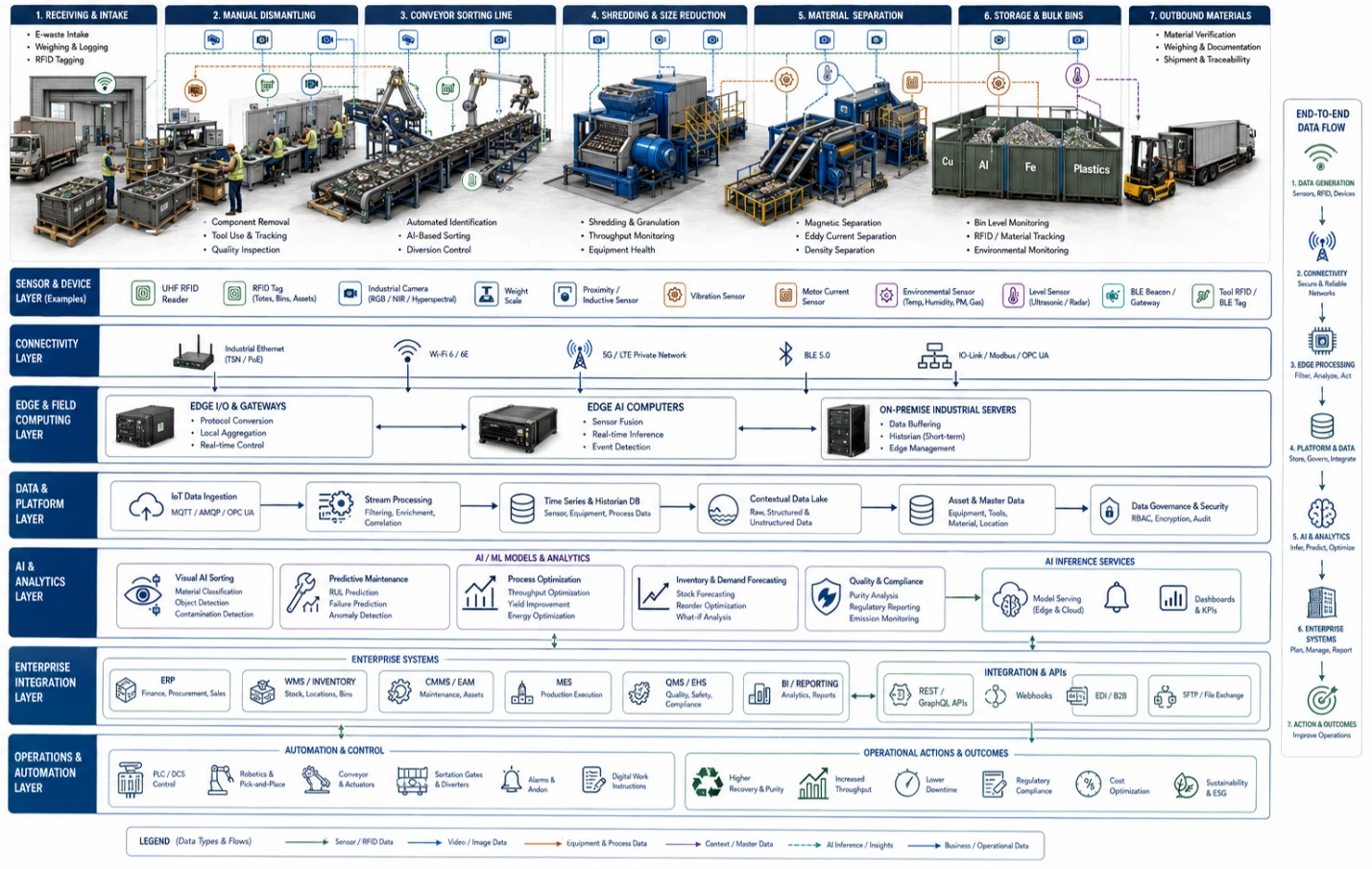
AIoT Technical Components for E-Waste Recycling
This technical infographic illustrates the complete AIoT architecture for e-waste recycling, from sensors, RFID, cameras, and connected equipment through industrial connectivity, edge computing, data platforms, AI analytics, enterprise integrations, and automation. It shows how plant-floor data supports material classification, predictive maintenance, process optimization, inventory forecasting, quality monitoring, compliance, and operational decision-making.
Cybersecurity and Operational Resilience
Connecting recycling equipment and sensors introduces cybersecurity requirements across both IT and operational technology environments. Devices should use authenticated access, appropriate encryption, secure credential management, controlled firmware updates, and network segmentation.
A practical deployment should separate critical operational equipment from general business networks wherever feasible. Firewalls, access-control rules, device inventories, security logging, vulnerability management, and endpoint protections should be incorporated into the design.
Operational resilience also requires local fallback behavior. If cloud connectivity becomes unavailable, essential sorting, monitoring, equipment protection, and data-buffering functions should continue locally where the process permits. Store-and-forward mechanisms can synchronize accumulated data after connectivity is restored.
For data-bearing devices such as computers, smartphones, storage media, and enterprise equipment, the recycling process should also distinguish material recovery from data security. Chain-of-custody records, device identification, approved data-destruction procedures, and evidence of disposition may be required before equipment proceeds to dismantling or resale.
Engineering Considerations for E-Waste AIoT Deployment
E-waste streams are inherently variable. A recycling line may process different device generations, manufacturers, form factors, materials, contamination levels, and damage conditions within the same shift. AIoT systems therefore require engineering controls beyond simply installing sensors and an AI model.
Material Variability
AI models should be evaluated against representative material streams, including:
- Lithium-ion and other batteries.
- Printed circuit boards.
- Copper and aluminum cables.
- Ferrous and non-ferrous metals.
- Plastics and composite materials.
- Screens and display assemblies.
- Data-bearing electronic devices.
- Small electronic components.
- Hazardous or damaged components.
The facility should define which materials require automatic classification, manual inspection, dedicated handling, or downstream processing.
Computer Vision Performance
Lighting should remain sufficiently consistent for the image-processing model. Cameras should be mounted to minimize vibration and maintain a controlled field of view. Conveyor synchronization should ensure that the system associates each classification with the correct physical object.
Performance metrics should include precision, recall, false-positive rate, false-negative rate, inference latency, and classification confidence. Exception handling is especially important for unfamiliar devices or damaged components that fall outside the training distribution.
Sensor Calibration and Maintenance
Sensors should have defined calibration procedures, inspection intervals, replacement criteria, and fault-detection mechanisms. A failed temperature sensor, blocked camera lens, disconnected RFID reader, or depleted wireless device should generate an operational alert rather than silently producing missing or misleading data.
Human-in-the-Loop Operations
Automation should not eliminate operator judgment where material uncertainty or safety risk is high. Low-confidence classifications, damaged batteries, unusual components, and suspected hazardous materials can be directed to trained personnel for inspection.
This approach allows AI to handle repetitive classification and monitoring while maintaining human control over exceptions.
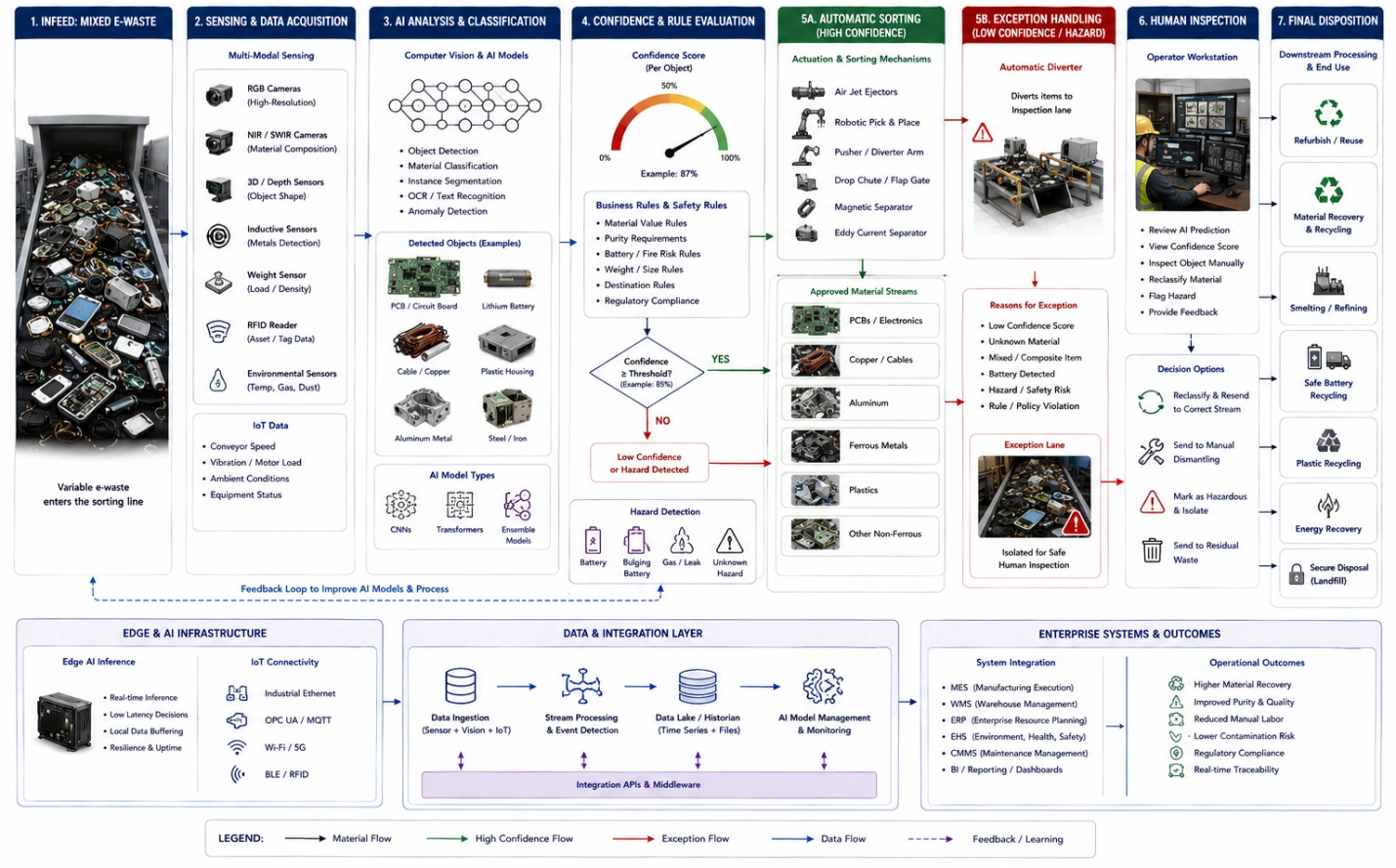
AI-Based E-Waste Sorting and Exception-Handling Workflow
The visual shows how AI classification, confidence thresholds, automated sorting, safety rules, and human inspection work together to manage mixed e-waste. High-confidence materials are routed to approved recovery streams, while low-confidence or hazardous items are diverted for controlled human inspection and final disposition.
Capabilities and Business Benefits
A properly engineered AIoT deployment can improve several operational dimensions simultaneously.
More Accurate Material Identification
Computer vision, RFID, sensor data, and historical records can provide multiple signals for identifying incoming equipment and recovered materials. Combining these signals can reduce dependence on manual visual inspection alone.
Improved Material Recovery
Better classification can help direct materials into appropriate processing streams, supporting recovery of metals, plastics, cables, printed circuit boards, and reusable components.
Better Equipment Reliability
Machine-condition sensors and AI anomaly detection can identify abnormal operating conditions before they become major failures. Maintenance teams can prioritize inspections based on equipment condition rather than relying exclusively on fixed intervals.
Stronger Traceability
RFID, BLE, cellular IoT, and other location technologies can associate containers, equipment, batches, and shipments with specific process stages. This improves material accountability and supports chain-of-custody requirements.
Improved Worker and Environmental Monitoring
Environmental and chemical sensors can provide continuous visibility into facility conditions. AI can correlate sensor trends with equipment states, material types, and operating conditions to help identify abnormal situations.
Better Operational Planning
Historical IoT data can reveal throughput patterns, equipment utilization, processing bottlenecks, inventory accumulation, and material-flow constraints. Managers can use these insights to adjust staffing, maintenance schedules, processing priorities, and downstream logistics.
Reduced Manual Data Entry
Automated identification and data capture reduce repetitive recording tasks. Information collected during receiving, sorting, dismantling, storage, and shipment can flow into operational records with fewer manual transcription points.
Implementation Recommendations
A successful deployment should begin with a clearly defined operational problem rather than with a specific IoT device or AI model.
Establish the Operational Baseline
Document current throughput, sorting accuracy, recovery yield, downtime, manual inspection rates, material dwell time, safety incidents, and other relevant KPIs.
Select High-Value Use Cases
Prioritize processes where automated sensing or AI can produce measurable improvement. Candidate areas include material classification, sorting, predictive maintenance, battery detection, asset tracking, and environmental monitoring.
Define the Data Model
Establish identifiers for devices, material batches, containers, equipment, workstations, operators, and process stages. Consistent identifiers make downstream analytics and traceability substantially more useful.
Pilot the Sensing Layer
Install representative sensors and communications equipment in a controlled production area. Evaluate connectivity reliability, sensor accuracy, environmental tolerance, maintenance requirements, and data quality before scaling.
Validate AI with Production Data
Use representative images and sensor records from the actual recycling environment. Establish acceptance thresholds for accuracy, latency, false positives, false negatives, and exception handling.
Integrate with Existing Systems
Connect the AIoT workflow to ERP, WMS, CMMS, MES, quality systems, or other operational applications where required. Avoid creating an isolated data collection system that cannot influence business or production processes.
Commission Automation Carefully
Test actuator timing, conveyor synchronization, fail-safe behavior, emergency stops, manual overrides, and exception handling. Production acceptance testing should cover normal, abnormal, and disconnected operating conditions.
Monitor and Improve
Track model performance, sensor health, equipment reliability, network availability, and business KPIs after commissioning. Changes in material composition or operating conditions should trigger periodic model and process reviews.
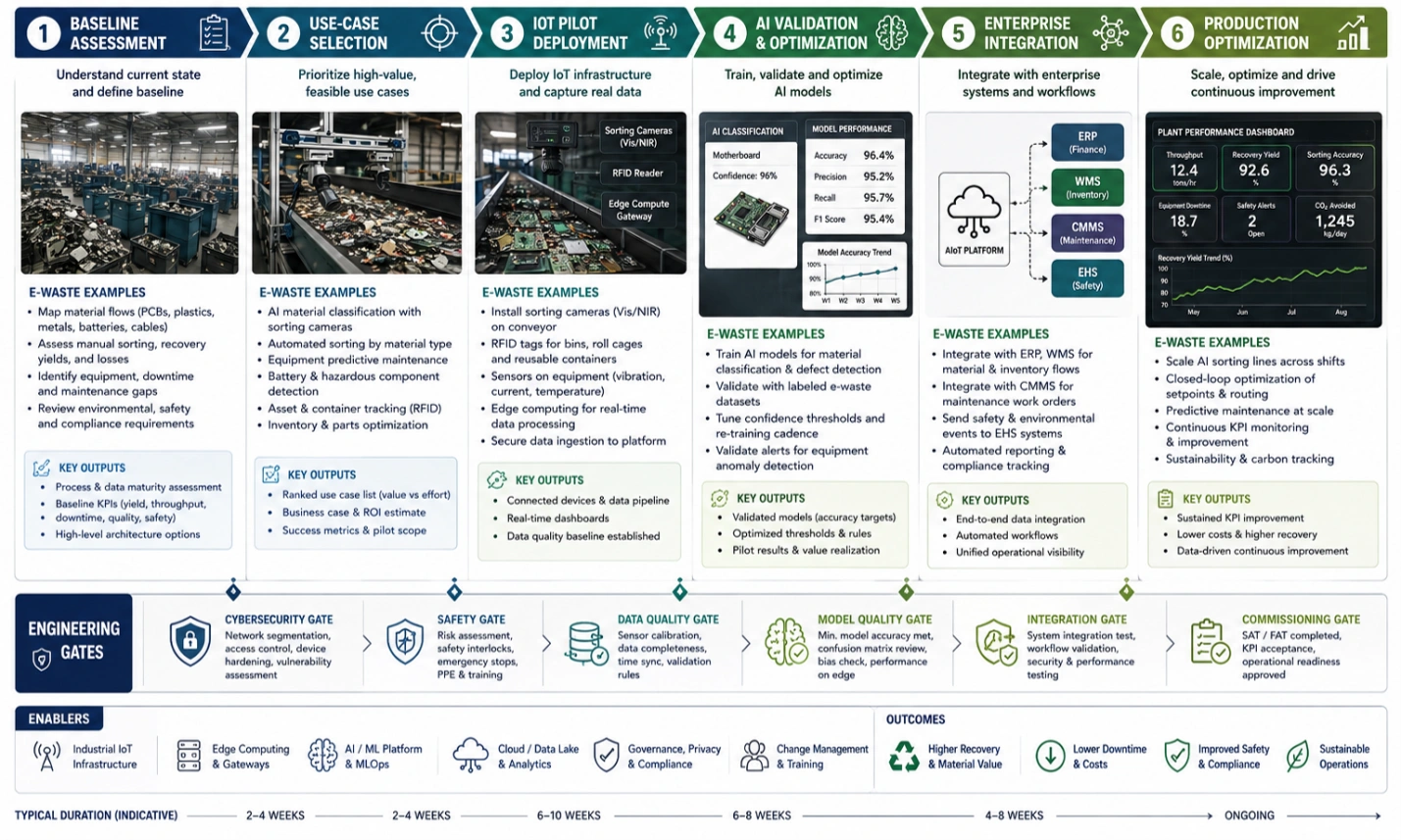
AIoT Implementation Roadmap for E-Waste Recycling Facilities
The completed roadmap presents a six-stage approach to AIoT implementation, progressing from baseline assessment and use-case selection through IoT pilot deployment, AI validation, enterprise integration, and production optimization. It highlights practical e-waste applications, engineering gates, enabling technologies, and expected operational outcomes.
Building Smarter E-Waste Recycling Operations
AI and IoT can give e-waste recycling facilities a more measurable and responsive way to manage material identification, sorting, equipment performance, traceability, safety, and resource recovery. The strongest implementations do not treat AI as a standalone technology. Instead, AI interprets data captured from cameras, RFID systems, environmental sensors, machine-condition sensors, location devices, and connected equipment, then turns that information into controlled operational decisions.
For engineering teams, implementation should focus on data quality, sensor reliability, model validation, network resilience, cybersecurity, integration, and safe exception handling. A phased deployment can establish measurable value before expanding across additional recycling processes.
GAO supports organizations evaluating connected sensing, RFID, BLE, IoT, edge computing, and related technologies for industrial applications. Its engineering and technical resources can help organizations assess appropriate hardware and deployment approaches for demanding operational environments.
Building the Future of Industrial AI and IoT with Aperture Venture Studio and GAO RFID Inc.
Aperture Venture Studio works with GAO Group R&D and technical experts to advance practical AI and IoT solutions across industrial applications. With experience spanning engineering, connected devices, and applied technology development, the collaboration brings together technical expertise and industry-focused implementation knowledge. GAO Group, comprising GAO RFID Inc., GAO Research Inc., and GAO Tek Inc., has served organizations across the United States and Canada for three decades, including Fortune 500 companies, R&D organizations, universities, and government agencies. GAO RFID Inc., headquartered in New York City and Toronto, Canada, is ranked among the top 10 leading B2B/B2G BLE and RFID suppliers globally. Its continued investment in R&D, stringent quality assurance, and remote or onsite technical support helps organizations advance dependable AI and IoT solutions for industrial operations.