
AI and RFID for Postal Services
AI-Driven Postal Operations with Intelligent Mail Tracking
Artificial intelligence is changing postal services by helping postal operators analyze the large volumes of operational data generated across mail acceptance, processing, sorting, transportation, delivery, and returns. AI-enabled postal operations can combine machine learning, computer vision, predictive analytics, and connected identification technologies to improve mail visibility, processing decisions, delivery planning, and exception management. RFID can provide machine-readable identification events for reusable postal assets, containers, trays, sacks, carts, bins, and selected mail-handling workflows, while AI analyzes those events together with scanning, routing, transportation, workforce, and customer-service data. The result is a more connected approach to postal operations in which postal facilities can identify process delays, detect routing anomalies, forecast workload, optimize asset allocation, and support faster investigation of missing or misrouted items. GAO supplies RFID, BLE, and IoT hardware products and systems that can support postal tracking, facility operations, asset visibility, and data acquisition requirements.
AI-Driven Postal Services Operations Workflow
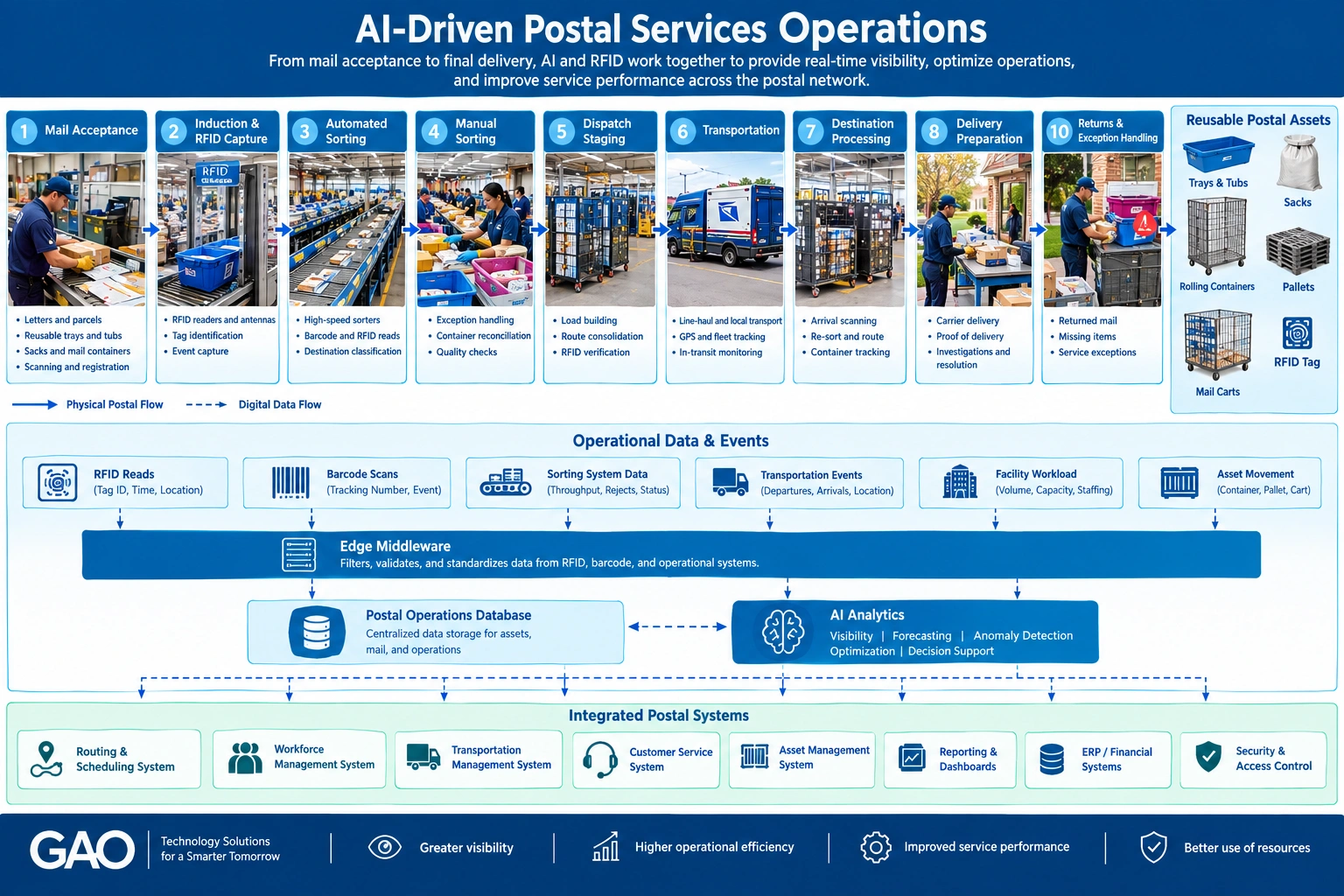
This workflow illustrates how postal mail and reusable assets move from acceptance through sorting, transportation, destination processing, and delivery, with RFID and operational data feeding edge middleware, AI analytics, and connected postal systems.
What AI-Enabled Postal Services Mean for Modern Mail Operations
AI-enabled postal services use operational data to support decisions that traditionally depended on fixed rules, manual inspection, historical averages, or fragmented systems. Postal operators can apply AI to workload forecasting, parcel and mail-flow analysis, processing-time prediction, route planning, anomaly detection, equipment monitoring, and customer-service exception management.
The underlying objective is not simply to identify mail. Postal organizations need to understand what entered a facility, where it was processed, whether it followed the expected routing sequence, how long it remained at each processing stage, which reusable transport assets carried it, and whether operational conditions could affect service performance.
RFID contributes identification and event capture where tagged postal assets or mail-handling processes require automated recognition. UHF RFID is particularly relevant where many tagged trays, sacks, carts, containers, or other assets must be identified without requiring individual barcode presentation. HF RFID can support controlled short-range identification scenarios, while LF RFID can be considered for specialized applications where longer-wavelength characteristics or proximity identification requirements are appropriate.
AI becomes more valuable when RFID events are correlated with other postal information. A single RFID read is only an observation. A postal management system may need to determine whether that observation represents arrival, dispatch, transfer, container closure, sorting completion, or another confirmed business event.
Postal Workflows That Benefit from AI
Postal operations contain multiple connected workflows where AI can provide measurable operational value:
Mail and parcel acceptance can use AI to identify workload patterns, predict inbound volume, and identify unusual acceptance conditions.
Automated and manual sorting operations can use AI to analyze throughput, processing queues, routing exceptions, and equipment utilization.
Reusable postal containers can be tracked across induction, sorting, dispatch, transportation, destination processing, and return-to-service workflows.
Transportation operations can combine facility events, dispatch records, vehicle information, route schedules, and historical transit data to identify potential delays.
Delivery preparation can use workload forecasting and operational analytics to improve staffing, staging, and route readiness.
Returns and undeliverable mail workflows can use event histories to identify recurring causes, processing delays, and asset-routing problems.
Postal facility managers can use AI-generated exception lists to focus human investigation on events that differ materially from expected operational patterns.
AI Applications Across Postal Services
The strongest applications are those where AI has access to consistent operational data and a clearly defined business action.
AI mail-flow forecasting: Predicts expected mail and parcel volumes by facility, processing window, service type, destination region, or historical demand pattern.
AI sorting analytics: Identifies unusual processing rates, queue growth, routing deviations, and recurring bottlenecks.
AI postal asset tracking: Uses RFID and other identification events to maintain visibility of trays, sacks, carts, rolling containers, pallets, and other reusable equipment.
AI route and dispatch analysis: Compares planned dispatch sequences with actual processing and departure events.
AI exception detection: Flags missing expected events, unusual dwell times, unexpected facility appearances, duplicate movements, and routing inconsistencies.
AI equipment monitoring: Combines machine telemetry, maintenance records, error logs, and production history to identify conditions associated with sorter, conveyor, scanner, or material-handling equipment problems.
AI customer-service support: Gives service personnel a consolidated event history that can help explain shipment status, processing delays, delivery exceptions, or asset-related issues.
AI workforce planning: Uses historical workload and processing data to help postal managers anticipate staffing requirements around peaks, holidays, seasonal campaigns, and facility-specific demand patterns.
Postal Services Deployment Workflow from Data Capture to AI Decisions
A practical postal AI and RFID solution begins at the physical processing point rather than in the analytics layer. The system first captures operational observations from RFID readers, barcode scanners, computer-vision systems, weighing equipment, conveyors, sorters, vehicle systems, handheld devices, and other connected equipment.
RFID readers can be positioned at receiving points, container transfer areas, sorting zones, dispatch staging locations, and controlled movement points. Reader placement should reflect the postal workflow rather than simply maximizing read coverage. Dense stacks of tagged trays, metal carts, liquids, tag orientation, conveyor speed, antenna placement, and adjacent read zones can affect RFID performance.
Postal Data Acquisition and Edge Processing
RFID observations should normally pass through local middleware or edge software before becoming business transactions. This layer can filter duplicate reads, apply read-zone logic, associate events with facility locations, and buffer data during temporary network interruptions.
A useful event structure can include:
- RFID tag identifier
- Reader identifier
- Antenna or read-zone identifier
- Timestamp
- Facility and processing area
- Postal asset identifier
- Mail container or handling-unit context
- Route, dispatch, or transportation reference
- Transaction identifier
- Event classification
- Exception status
Separating raw observations from confirmed postal transactions is important. For example, an RFID tag detected near a dispatch door does not automatically prove that the corresponding container was officially dispatched. Business rules can correlate RFID observations with manifest records, scan events, conveyor states, operator actions, or transportation records before creating a confirmed transaction.
Postal Communication and Software Integration
The edge layer can communicate with a central operational database or cloud software through Ethernet, Wi-Fi, cellular connectivity, or other appropriate enterprise communications. Postal facilities with demanding latency or network-continuity requirements can perform selected filtering and event processing locally.
The resulting events can be integrated with postal operations software, parcel management systems, transportation management systems, warehouse or distribution software, customer-service applications, ERP systems, workforce management software, maintenance systems, and reporting databases.
Common integration mechanisms include REST APIs, webhooks, SQL interfaces, message queues, middleware APIs, and structured file exchange. The appropriate method depends on the existing postal software environment, data governance requirements, transaction volume, and integration constraints.
AI Processing and Operational Actions
After validated events reach the analytical layer, AI models can correlate current activity with historical postal behavior. Time-series models can forecast volume. Classification models can categorize operational exceptions. Anomaly-detection models can identify unusual asset movements or processing delays. Optimization methods can support dispatch, staffing, staging, or resource-allocation decisions.
Human review remains important for operational exceptions. An AI model should generally flag a potentially abnormal movement rather than automatically interpret it as theft, employee error, or deliberate misrouting. Postal personnel can then examine manifests, scans, facility records, transportation information, and physical conditions before taking corrective action.
RFID, AI Software, Hardware, and Deployment Design for Postal Services
A postal AI solution requires coordinated physical identification, data processing, communications, software integration, analytics, and security controls. The engineering design should reflect postal facility layouts, processing speeds, asset density, network conditions, existing sorting systems, and operational continuity requirements.
UHF RFID is generally useful for postal applications requiring automated identification of multiple tagged assets over controlled read zones. This can support reusable trays, sacks, carts, rolling containers, pallets, and other postal handling equipment. HF RFID can be considered for shorter-range controlled identification points, while LF RFID may serve specialized proximity-oriented applications. Tag selection should account for attachment surfaces, plastics, fabrics, metal exposure, expected handling conditions, temperature, moisture, abrasion, and the required read distance.
RFID readers, antennas, tags, handheld readers, industrial gateways, edge computers, network equipment, and local monitoring devices form the physical data-capture layer. Postal facilities should validate tag placement and reader performance under actual operating conditions, particularly where containers are densely loaded or move rapidly through portals.
Middleware provides an important control point between RFID hardware and postal software. It can normalize device data, suppress repeated reads, apply location logic, maintain event timing rules, and convert low-level observations into standardized events. Local buffering also helps maintain continuity when a facility temporarily loses connectivity to centralized software.
AI software can operate on centralized or distributed computing resources depending on latency, data volume, security requirements, and postal operating conditions. Cloud Version deployment can provide centralized software management for organizations operating multiple postal facilities and needing shared analytics, consolidated reporting, and scalable computing resources. It can be useful when facilities have reliable connectivity and the organization prefers centrally managed software services.
Server Version deployment places the software on edge servers, customer-managed servers, private data centers, facility servers, or other privately hosted enterprise infrastructure. This model can be appropriate where postal organizations require greater control over data location, local processing, network independence, or integration with privately hosted operational systems.
Security should be designed across the complete data path. Postal deployments can use authenticated devices, encrypted communications, role-based access control, network segmentation, certificate management, audit logging, secure API authentication, controlled administrative access, and software patch management. RFID tag identifiers should also be treated as operational data rather than as inherently secure credentials.
AI-Enabled Postal Asset Visibility and Operational Intelligence
Combining AI with automated identification gives postal operators more than location records. The value comes from correlating asset movements with postal workflows, service commitments, processing capacity, transportation schedules, and historical operating patterns. A tray detected at an induction point, for example, becomes more useful when the system can associate that event with a facility, mail stream, processing window, dispatch plan, and expected next destination.
GAO provides RFID and IoT hardware products and systems that can support these postal data-capture requirements, including fixed readers, antennas, tags, handheld equipment, and related identification technologies. Deployment results depend on correct tag selection, reader placement, middleware configuration, software integration, and operational validation.
Postal Asset Lifecycle Visibility
Reusable postal equipment can move through many facilities and transportation stages during its service life. AI-supported tracking can establish expected movement sequences and identify exceptions when observed events do not correspond with normal workflows.
Relevant assets include:
- Mail trays and tubs
- Sacks and reusable mail containers
- Rolling containers and postal carts
- Pallets and transport units
- Sorting and handling equipment
- Reusable delivery containers
- Specialized transport equipment
Lifecycle records can include commissioning, facility assignment, loading, dispatch, transportation, receipt, processing, storage, cleaning or maintenance where applicable, reassignment, and retirement.
AI can analyze these records to identify unusually long asset dwell times, repeated movement between facilities, unexpected facility appearances, low utilization, or gaps in expected event sequences.
AI-Based Mail and Parcel Flow Analysis
Postal facilities experience substantial variation in workload. Daily volumes can change according to holidays, seasonal campaigns, commercial mail activity, weather events, service disruptions, and regional demand.
AI-based forecasting can combine historical volumes with operational variables to estimate future processing requirements. Postal managers can use those forecasts when planning labor, sorting capacity, staging space, transportation resources, and shift schedules.
A useful implementation should distinguish between forecast output and an operational commitment. Forecasts provide decision support, while postal managers remain responsible for validating staffing, transportation, equipment availability, and service requirements.
Exception and Misrouting Detection
Exception detection is one of the practical areas where RFID event histories can complement conventional postal scans.
An AI model can compare expected and observed sequences and identify conditions such as:
- A reusable container remains at a facility longer than the normal processing interval.
- An asset appears at an unexpected facility.
- A container is detected without the corresponding expected transaction.
- Multiple facilities report an asset within an implausibly short interval.
- A dispatch event occurs without the expected preceding processing event.
- A destination facility receives an asset associated with an unexpected routing sequence.
- A processing queue develops outside its normal operating pattern.
These conditions should generate investigation tasks rather than automatic accusations or irreversible actions. Postal personnel can validate the event against manifests, barcode scans, transportation records, reader diagnostics, and physical inventory.
AI Decision Support for Postal Sorting, Transportation, and Delivery
AI can extend beyond asset visibility by helping postal organizations interpret operational conditions across sorting and transportation processes. The most useful implementations connect predictions and exceptions to actions that postal personnel can actually perform.
Sorting Center Optimization
Automated sorting equipment generates operational information about throughput, rejects, jams, processing times, destination patterns, and equipment status. AI can analyze this information together with RFID and barcode events to identify bottlenecks.
For example, if a sorting area repeatedly experiences queue growth during particular processing windows, analytics can compare historical workload, staffing, equipment availability, container arrival patterns, and downstream dispatch requirements. The resulting analysis can help supervisors determine whether the issue is related to inbound volume, sorting capacity, staffing, equipment performance, or downstream staging.
Computer vision can also support selected postal inspection processes, such as identifying damaged parcels, label-placement problems, unreadable markings, or other visible conditions. Such systems should be validated against representative postal materials and operating environments before being used for operational decisions.
Transportation and Dispatch Intelligence
Postal transportation involves scheduled departures, facility transfers, line-haul operations, local distribution, and last-mile delivery. AI can combine facility events with transportation schedules to identify conditions that may affect dispatch readiness.
A practical system can compare:
- Expected container completion time
- Actual processing completion
- Planned dispatch time
- Actual loading time
- Vehicle departure
- Destination arrival
- Historical transit duration
- Facility workload
- Transportation capacity
This provides a more complete operational picture than a single scan or RFID read. When a dispatch is at risk, postal supervisors can prioritize unfinished processing, investigate missing containers, adjust staging activities, or coordinate with transportation personnel.
Delivery Preparation and Last-Mile Operations
AI can support delivery preparation by analyzing expected workload, route characteristics, historical delivery patterns, available personnel, and downstream processing status.
RFID can contribute by identifying reusable containers and handling units entering delivery preparation areas. Combining those events with route-management software can help determine whether expected containers have reached the appropriate staging area.
The objective is not to replace postal personnel but to provide timely information about route readiness, missing handling units, processing delays, and unusual operational conditions.
AI Decision Layer for Postal Operations
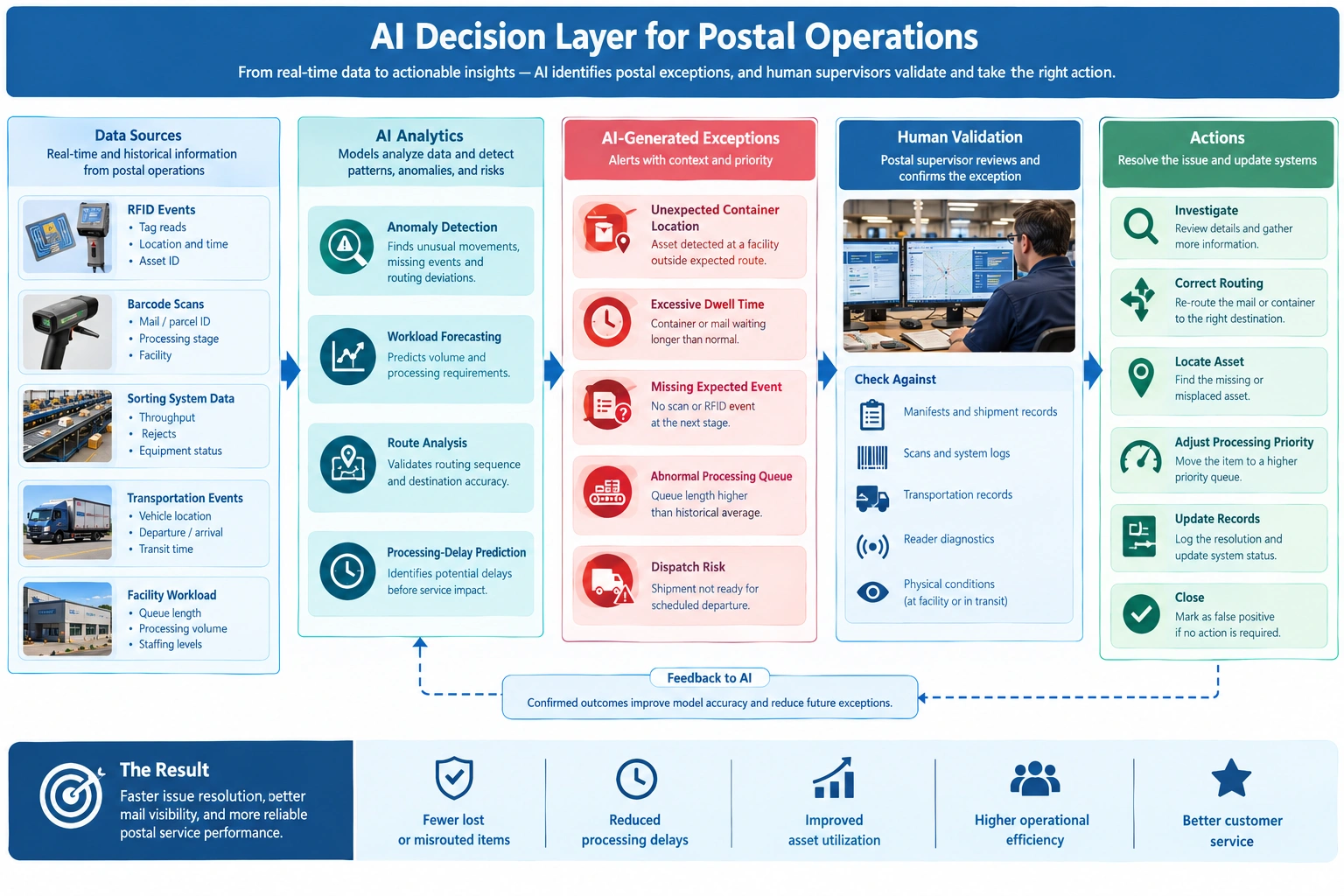
This diagram shows how RFID, barcode, sorting, transportation, and facility data feed AI models that identify postal exceptions and operational risks. Postal supervisors validate alerts against operational records before taking corrective action.
Postal Systems Integration, Security, and Interoperability
AI and RFID deployments should integrate with existing postal software rather than create isolated operational data stores. Relevant systems can include mail processing software, parcel management, transportation management, asset management, warehouse or distribution applications, customer-service systems, ERP, workforce management, maintenance software, reporting databases, and security systems.
A normalized event model can simplify integration. Instead of allowing every RFID reader to produce proprietary events directly into business applications, middleware can convert device-level information into standardized postal events.
Typical integration methods include:
- REST APIs for application-to-application exchange
- Webhooks for event notifications
- SQL interfaces for approved database integration
- Message queues for high-volume asynchronous processing
- CSV or structured file exchange for legacy systems
- Middleware APIs for device and event management
Interoperability testing should cover normal operations and failure conditions. Engineers should test duplicate RFID reads, missing reads, disconnected readers, delayed network traffic, duplicate transactions, incorrect tag associations, facility clock differences, server outages, and recovery after connectivity is restored.
Cybersecurity for Postal RFID and AI Systems
Postal infrastructure can contain operationally sensitive information, making cybersecurity an integral part of deployment planning.
Recommended controls include:
- Network segmentation between RFID equipment, operational systems, corporate networks, and administrative systems
- Device authentication and controlled provisioning
- Encryption for data transmitted between readers, edge systems, servers, and cloud services
- Role-based access controls for postal operators, supervisors, administrators, and technical personnel
- Audit logging for configuration changes, administrative access, and operational transactions
- Secure API authentication and authorization
- Certificate and credential lifecycle management
- Controlled software updates and security patch procedures
- Backup and recovery procedures for operational databases and configuration data
- Monitoring for unusual device communication or unauthorized access
RFID itself should not be treated as a complete security mechanism. A tag identifier can establish identity or association, but access control, cryptographic protection, network security, and application authorization must be implemented at the appropriate system layers.
Implementation, Commissioning, and Optimization for Postal Services
Successful deployment requires more than installing readers. Postal environments have variable conveyor speeds, changing container configurations, metal structures, dense material, electromagnetic interference, network constraints, and constantly changing operating conditions.
A postal RFID implementation should begin with a workflow and asset analysis. Engineers can identify which assets require persistent identification, where automated reads provide operational value, which events already exist through barcode systems, and where RFID can reduce manual handling.
Planning and Hardware Selection
Tag selection should be based on the physical characteristics of postal assets and the intended read zone. A tag mounted on a plastic tray can behave differently from one mounted near metal, liquid-containing material, or dense stacks of parcels.
Reader and antenna selection should consider:
- Required read distance
- Asset density
- Conveyor or vehicle speed
- Read-zone dimensions
- Antenna polarization
- Orientation of tagged assets
- Potential RF reflections
- Adjacent read zones
- Environmental conditions
- Required transaction latency
GAO can supply RFID hardware products and systems that organizations can evaluate for these deployment requirements, with engineering support available for appropriate configurations and integration considerations.
Pilot Testing and Commissioning
A pilot should reproduce real postal operating conditions rather than testing only an empty reader portal. Test scenarios should include full containers, partially loaded containers, different tag orientations, workers moving through the area, normal conveyor speeds, adjacent tagged assets, and representative facility conditions.
Performance measurements can include:
- Read success rate
- False-read rate
- Duplicate-event rate
- Event-processing latency
- Asset association accuracy
- Data transmission reliability
- Reader uptime
- Exception-detection precision
- AI alert validation rate
Commissioning should establish acceptance criteria before the system enters production. Reader power, antenna configuration, tag placement, middleware timing rules, event classification, and software integrations should be documented as part of the deployment baseline.
Scaling Across Postal Facilities
A multi-facility postal deployment should use consistent event definitions, asset identifiers, integration interfaces, security policies, and operational reporting while allowing individual facilities to accommodate local workflows.
Centralized AI analysis can compare facility-level performance, while edge processing can preserve local operation when connectivity is interrupted. This hybrid approach can be particularly useful when postal facilities vary substantially in network reliability, processing volume, physical layout, or existing software.
Postal KPIs for AI and RFID Performance Measurement
Postal organizations should measure both technology performance and operational outcomes. A high RFID read rate alone does not demonstrate business value if the resulting events do not correspond accurately to postal transactions.
Useful measurements include:
- Asset identification accuracy
- RFID read success rate
- False-read and duplicate-event rate
- Container location accuracy
- Processing dwell time
- Mail and parcel throughput
- Sorting queue duration
- Dispatch readiness
- Missed or delayed dispatches
- Asset turnaround time
- Asset utilization
- Missing asset rate
- Exception resolution time
- Forecast accuracy
- AI alert precision
- False-positive alert rate
- Equipment availability
- Network and reader uptime
- Manual scanning reduction
- Inventory reconciliation time
KPIs should be tied to operational decisions. For example, reducing manual asset searches can be evaluated through search time, labor effort, and exception-resolution duration rather than simply counting RFID reads.
Engineering Recommendations for AI-Enabled Postal Services
Postal organizations considering AI-enabled RFID should establish a clear operational objective before selecting hardware or AI models. A focused deployment around reusable container visibility, processing exceptions, dispatch readiness, or asset reconciliation can provide measurable requirements for subsequent expansion.
Recommended engineering practices include:
- Define the postal workflow and business events before installing RFID readers.
- Identify which assets require persistent identification and which already have sufficient barcode or vision coverage.
- Test RFID tags on the actual trays, sacks, carts, containers, and materials used by the postal organization.
- Design read zones around physical workflow boundaries instead of attempting unrestricted facility-wide tracking.
- Use middleware to distinguish RFID observations from confirmed postal transactions.
- Preserve event timestamps and facility context so AI models can reconstruct asset and processing histories.
- Establish human validation procedures for AI-generated exceptions.
- Integrate RFID events with existing postal, transportation, maintenance, and customer-service systems.
- Test network interruptions, reader failures, duplicate reads, missing reads, and software recovery procedures.
- Establish cybersecurity controls before connecting RFID infrastructure to operational networks.
- Measure both technical RFID performance and postal operating outcomes.
- Begin with a controlled facility or workflow, validate KPIs, and then standardize the configuration before broader deployment.
GAO has served organizations in the United States and Canada for three decades through RFID, BLE, and IoT products and systems. GAO and its sister companies, GAO Research and GAO Tek, form GAO Group, with operations based in New York City and Toronto. The group has worked with Fortune 500 companies, research and development organizations, universities, and U.S. and Canadian government agencies, supported by product R&D, quality-assurance processes, and technical assistance delivered remotely or onsite.
Building the Future of Postal AI and IoT with Aperture Venture Studio and GAO RFID Inc.
For more than three decades, GAO Group of Companies has invested heavily in R&D for industrial RFID, BLE, and IoT. As generative AI became increasingly useful for industrial applications, we expanded our work across AI and IoT technologies and founded Aperture Venture Studio to develop and scale practical AI and IoT solutions relevant to areas such as postal operations, asset visibility, logistics, and intelligent infrastructure.
Aperture has attracted AI and IoT technical experts, operational executives, investors, and leading companies. We have also developed Aperture Ventures Summit and TekSummit to discuss advanced AI and IoT topics.
We welcome you to join us as:
- Advisors, Co-founders, or Employees
- Investors
- Customers
Learn More About AI-Enabled Postal Services
AI-enabled postal operations can connect identification events, sorting activity, transportation records, reusable asset movements, facility workloads, and customer-service information into a more actionable operational record. RFID provides automated identification where postal workflows require it, while AI helps interpret the resulting data and prioritize decisions.
For postal organizations evaluating such systems, the most important considerations are workflow definition, tag and reader performance, event quality, software interoperability, cybersecurity, AI validation, and measurable operational outcomes. GAO can provide RFID, BLE, and IoT hardware products and systems, together with technical expertise for postal asset tracking, facility identification, data acquisition, and integration requirements. Organizations can learn more about GAO’s relevant technologies, engineering capabilities, products, and technical support when planning or expanding postal automation initiatives.