
AI and RFID for Freight Rail
Intelligent Freight Rail Operations with AI and RFID
Freight railroads manage thousands of locomotives, freight cars, tank cars, intermodal containers, maintenance assets, and shipments across geographically distributed yards, terminals, mainlines, and interchange points. AI for freight rail can turn identification, movement, inspection, and equipment data into operational predictions and actionable decisions. RFID provides an important data-acquisition layer, particularly for automatically identifying rail equipment and associating physical assets with digital records. North American railroads already use Automatic Equipment Identification (AEI), where trackside readers interrogate RFID-based tags on freight equipment as trains pass. FRA documentation describes AEI readers at yards, terminals, and junctions using UHF radio frequency to identify cars and transmit train-consist information to operating systems.
The combination becomes more valuable when RFID events are correlated with train consists, wayside detector data, maintenance records, shipment information, schedules, and operational conditions. AI can then support asset tracking, anomaly detection, maintenance prioritization, terminal optimization, and exception management without making RFID responsible for decisions it was never designed to make.
AI-Enabled Freight Rail RFID Deployment: Real-Time Train Identification and Analytics
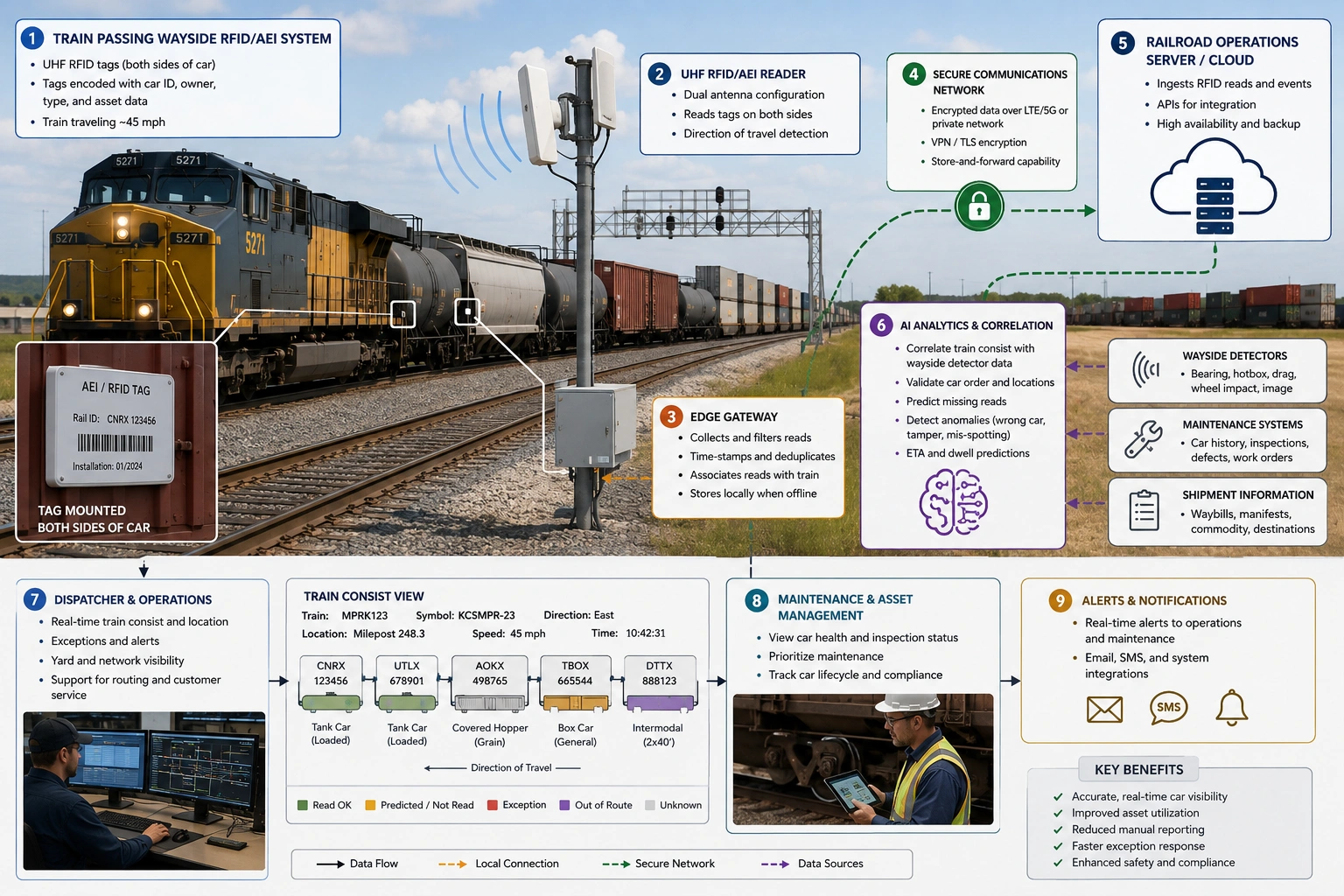
This technical deployment scenario illustrates how UHF RFID/AEI identification works across a North American freight railroad environment. It shows trackside readers, edge gateways, secure communications, railroad servers or cloud services, and AI analytics integrating train consist, wayside detector, maintenance, and shipment data to support real-time operations.
What AI Means for Freight Rail Asset Intelligence
AI for freight rail is best understood as a decision-support capability built around operational data rather than as a standalone automation product. A railroad can collect identification events from RFID readers, train-consist information, wheel and bearing detector measurements, brake-related inspection information, locomotive telemetry, work-order history, shipment data, and yard activity. Machine learning models can then identify patterns that are difficult to detect through static business rules.
For example, an RFID event can establish that a specific car passed a location at a known time. By itself, that event does not establish whether the car is healthy, whether its shipment is delayed, or whether its next maintenance action should be accelerated. AI becomes useful when that identification event is joined with other operational signals.
A freight railroad can use this combined data to answer questions such as:
- Which freight cars are approaching a maintenance threshold?
- Which cars have abnormal movement or routing patterns?
- Which equipment is repeatedly generating inspection exceptions?
- Which train consists are likely to require additional terminal attention?
- Which assets are approaching a scheduled interchange or service location?
- Which RFID or AEI locations are generating inconsistent identification data?
- Which maintenance activities should receive priority based on predicted equipment risk?
- Where are yard dwell times increasing beyond normal operating patterns?
Railinc already uses AEI-derived information to identify problematic tags and reader-related issues, demonstrating that identification quality itself can become an operational data-quality concern.
GAO supplies RFID readers, tags, gateways, and related hardware that can be incorporated into identification and IoT systems. Our experience spans multiple RFID frequencies and industrial form factors, allowing system designers to select hardware according to the physical environment rather than forcing every freight rail application into one reader or tag configuration.
Freight Rail Applications for AI-Driven Asset Visibility
AI Freight Car Tracking and Movement Intelligence
Freight car location is more useful when identification events are connected to the operational context surrounding the movement. RFID or AEI reads can establish equipment presence at a yard, terminal, interchange point, or wayside location. AI can compare those events with planned movements, historical transit patterns, consist information, and expected arrival windows.
This enables exception-based workflows rather than requiring personnel to manually inspect every asset record. A system might flag an unexpected dwell period, an equipment movement inconsistent with the planned route, or a car that has not generated an expected identification event.
Predictive Maintenance for Freight Rail Equipment
Predictive maintenance becomes particularly valuable when equipment identification is connected to mechanical condition data. Freight railroads already collect information from systems such as hot bearing detectors, wheel temperature detectors, acoustic bearing detectors, dragging equipment detectors, and other wayside inspection technologies. Railinc’s asset-health programs demonstrate how detector information can be converted into equipment-level data summaries and operational alerts.
AI can correlate these observations with:
- Car identity and historical movement
- Component replacement history
- Inspection findings
- Mileage or movement history
- Previous detector alerts
- Maintenance work orders
- Fleet-level failure patterns
The resulting model can rank equipment according to predicted risk or maintenance urgency. This does not replace required railroad inspections or mechanical rules. Instead, it can help maintenance planners determine where limited inspection and shop capacity should be directed first.
AI for Freight Rail Yard and Terminal Operations
Yards introduce a different problem because equipment moves through a constrained operational environment with frequent coupling, uncoupling, switching, inspection, loading, unloading, and classification activities.
RFID identification events can provide additional evidence of where a car entered or left a defined zone. AI can combine those events with yard-management information to identify abnormal dwell time, recurring bottlenecks, equipment accumulation, or inconsistencies between expected and observed movements.
The engineering challenge is not simply installing more readers. Reader placement, antenna orientation, RF interference, tag condition, train speed, track geometry, environmental exposure, and read-zone design all affect data quality. Railinc has specifically worked on AEI data quality and bad-tag identification, illustrating why identification reliability should be measured as an operational KPI rather than assumed.
Shipment and Intermodal Visibility
Freight rail shipments can involve multiple handoffs between railroad yards, terminals, ports, warehouses, and connecting transportation modes. AI can use identification events to improve exception detection around expected shipment movements.
For intermodal operations, RFID may complement rather than replace existing identification mechanisms such as barcodes, OCR, GPS, EDI transactions, and terminal operating systems. A practical solution should determine which identifier is authoritative for each workflow and use data reconciliation when different systems disagree.
Hazardous Material and Tank Car Operations
Tank cars carrying hazardous materials require particularly disciplined asset identity, inspection, routing, and documentation processes. Federal hazardous-material transportation requirements include specific provisions for carriage by rail under 49 CFR Part 174, while FRA regulations cover freight car safety and other railroad safety obligations. (eCFR)
AI can assist by correlating equipment identity, inspection status, shipment information, and operational exceptions. However, safety-critical decisions should remain governed by applicable regulations, railroad operating rules, qualified personnel, and validated procedures. AI-generated recommendations should not be treated as substitutes for mandatory inspections or regulatory compliance.
Freight Rail Data-to-Decision Workflow
A production-grade AI and RFID solution should be designed as a continuous data path from physical railroad equipment to an operational decision.
Physical identification and sensing begins with RFID tags, AEI tags, fixed readers, handheld readers, antennas, and other IoT sensors. A trackside reader may capture the identifier of a freight car as it passes through a defined read zone. Other systems contribute bearing temperature, wheel condition, acoustic signatures, locomotive information, GPS position, inspection results, and maintenance records.
Edge processing can filter duplicate reads, validate identifiers, timestamp events, associate reads with a track or site, and temporarily buffer data when network connectivity is unavailable. This is especially important for geographically distributed rail infrastructure where communications availability cannot always be assumed.
Communication infrastructure then transfers normalized events using suitable wired or wireless connectivity. Depending on the location, this may include Ethernet, cellular connectivity, private wireless networks, serial interfaces, TCP/IP, MQTT, REST APIs, message queues, or railroad-specific integration mechanisms.
Middleware and data services normalize device events before forwarding them to operational applications. This layer is useful when a railroad has multiple reader vendors, different tag technologies, legacy databases, and separate yard or maintenance systems.
AI processing can operate on historical and streaming data. Classification models can identify abnormal events, time-series models can estimate equipment behavior, anomaly-detection models can identify unusual patterns, and optimization methods can support resource allocation or scheduling.
Business systems and personnel consume the resulting information. Relevant systems can include maintenance-management software, asset-management databases, train-management applications, yard-management systems, transportation-management systems, shipment systems, ERP software, data warehouses, and operational dashboards.
The final action may be as simple as creating an exception for a planner or as consequential as prioritizing a maintenance inspection. Human review, rule validation, audit trails, and clear confidence indicators are therefore important for operational AI.
Freight Rail RFID/AEI Data Flow Architecture: From Rail Assets to AI-Driven Decisions
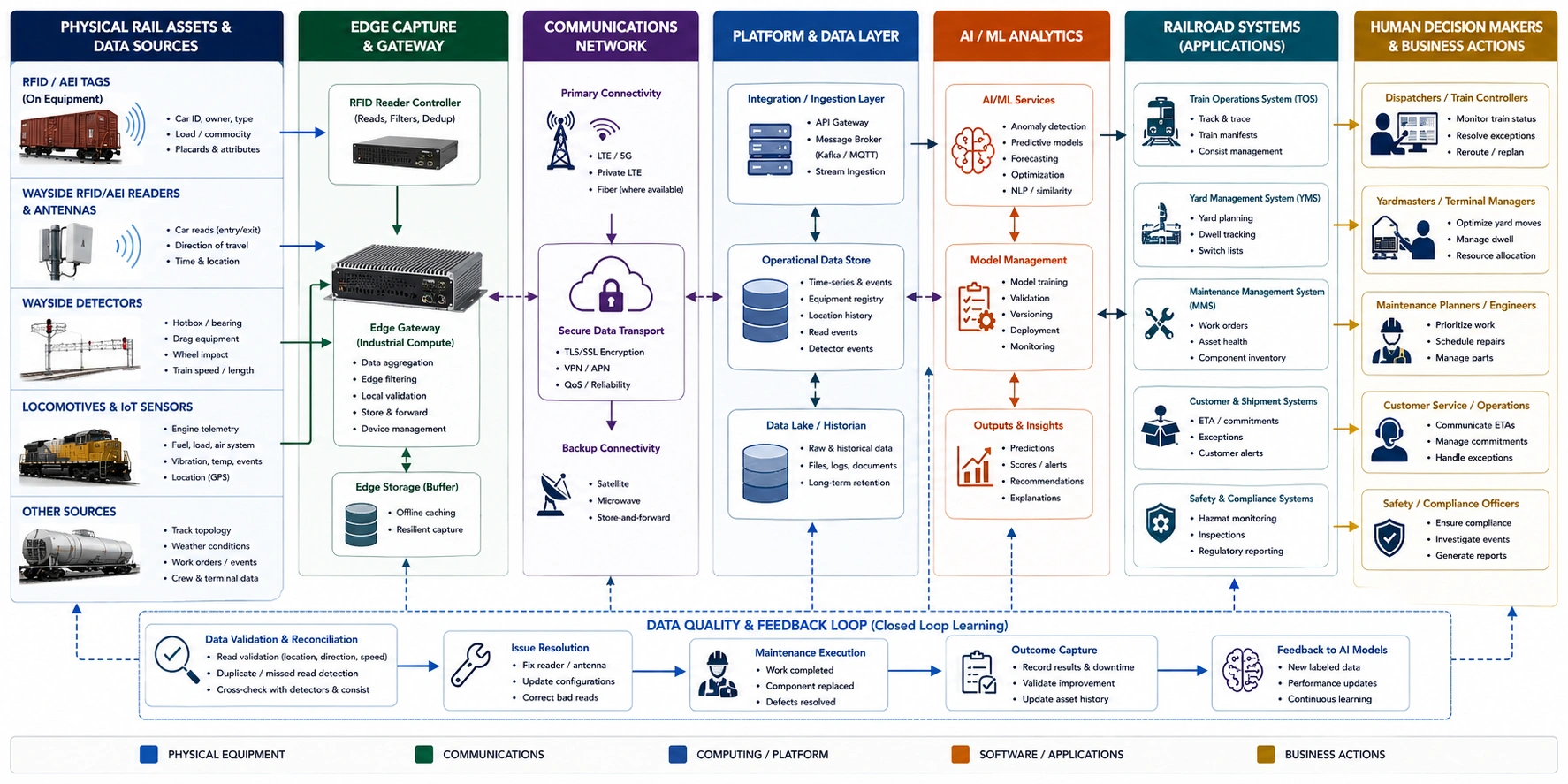
This technical data-flow diagram illustrates how freight-rail RFID/AEI tags, wayside detectors, locomotive sensors, and other data sources move through edge gateways, secure communications, data platforms, AI/ML analytics, and railroad software systems. A closed-loop feedback process connects data validation and maintenance outcomes back to AI models for continuous improvement.
RFID and AI Technology Stack for Freight Rail
The technology stack should be selected around the operating environment and the railroad workflow, not around a single RFID frequency or AI model.
UHF RFID and AEI Identification
UHF RFID is particularly relevant to freight rail identification because trackside systems need to identify equipment at distance and at operational speed. ISO/IEC 18000 standards define RFID air-interface parameters, including the 860 to 960 MHz range covered by ISO/IEC 18000-6 and ISO/IEC 18000-63.
For freight rail, engineering decisions include reader power, antenna placement, read-zone geometry, tag orientation, metal coupling effects, environmental exposure, interference, train speed, and redundant detection requirements.
HF and LF RFID for Supporting Rail Workflows
HF RFID at 13.56 MHz can be appropriate for shorter-range identification workflows, such as controlled maintenance or inventory processes where equipment passes close to the reader. ISO/IEC 18000-3 defines air-interface communications at 13.56 MHz.
LF RFID can serve specialized short-range identification requirements where its propagation characteristics and reader geometry are advantageous. It is generally not a direct replacement for UHF-based wayside identification of moving freight cars.
Edge Computing and AI Models
Edge computing can perform event filtering and low-latency inference near a yard, wayside detector, or maintenance facility. Cloud or centralized server processing is better suited to fleet-wide analytics, model training, long-term historical analysis, and cross-location optimization.
AI methods may include anomaly detection, supervised classification, time-series forecasting, predictive maintenance models, clustering, optimization, and computer vision where cameras are part of the inspection workflow.
A practical implementation should also address model drift, missing data, false positives, false negatives, explainability, and human override procedures. NIST’s AI Risk Management Framework emphasizes trustworthy characteristics including validity, reliability, safety, security, resilience, accountability, transparency, explainability, and privacy.
Cloud Version and Server Version
A Cloud Version can host AI analytics, databases, dashboards, APIs, and model-management services within cloud infrastructure. This approach is useful for geographically distributed freight rail operations requiring centralized fleet-level analytics, elastic computing resources, and access across multiple locations.
A Server Version can run on customer-managed edge servers, railroad data centers, private infrastructure, or other controlled enterprise computing environments. It can be preferable where connectivity is limited, data must remain within controlled infrastructure, latency requirements are stringent, or existing railroad IT policies restrict external processing.
A hybrid deployment is often practical: edge servers handle local event processing and buffering, while centralized cloud or private servers perform fleet-wide analytics and model training.
Cybersecurity and Data Governance
Freight rail systems connect physical infrastructure with operational software, making cybersecurity part of the engineering design rather than an afterthought. Reader credentials, device authentication, encrypted communications, network segmentation, secure APIs, role-based access control, software patching, logging, backup procedures, and configuration management should be addressed during commissioning.
AI introduces additional concerns because incorrect, incomplete, or manipulated training data can influence model outputs. Railroads should maintain data lineage, monitor model performance, document model changes, and establish escalation procedures for anomalous recommendations. NIST describes AI risk management as a continuous lifecycle activity rather than a one-time deployment exercise.
Freight Rail AI/RFID Cybersecurity Architecture and Security Controls Diagram
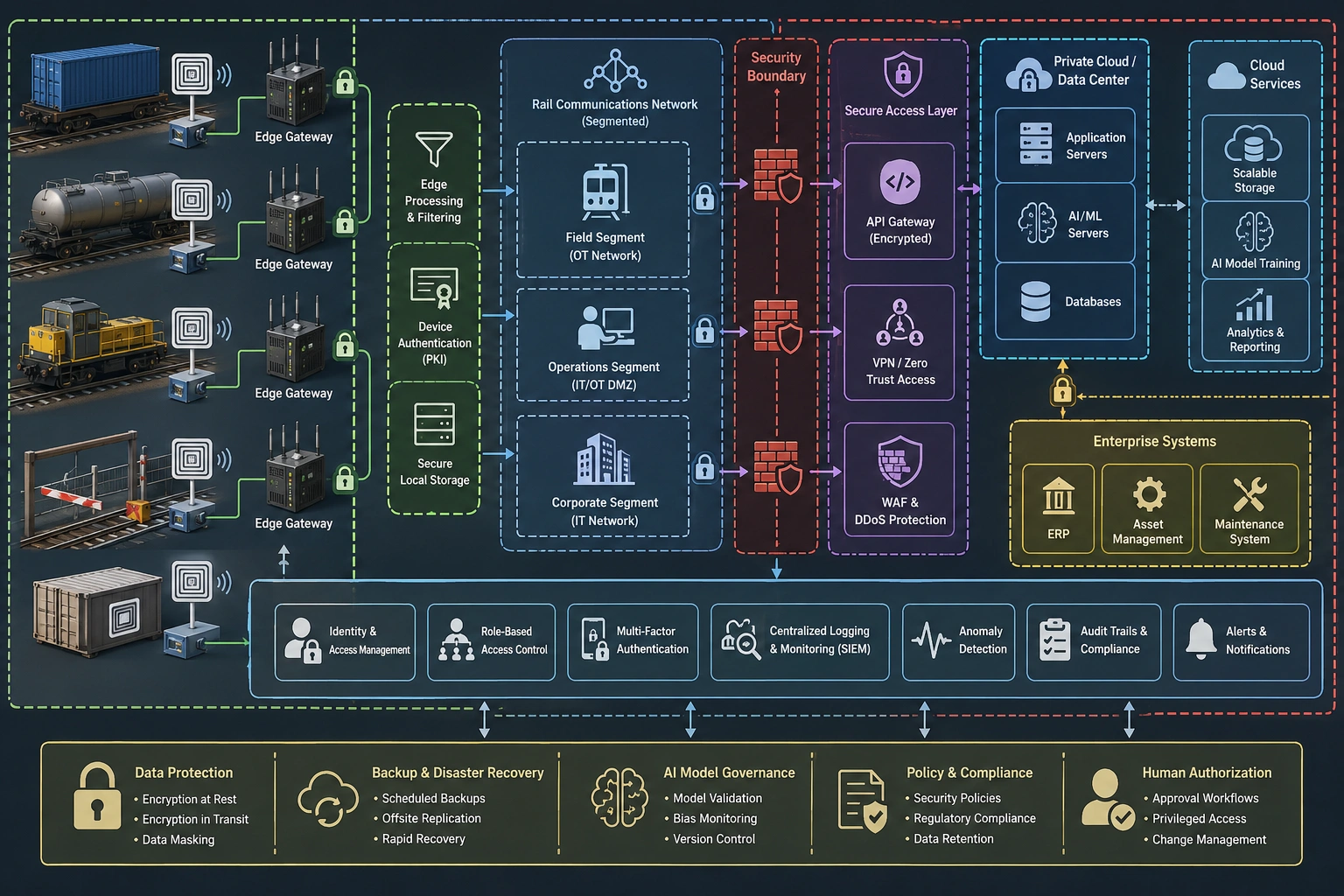
This layered diagram illustrates a comprehensive cybersecurity architecture for freight rail AI and RFID deployments. It highlights secure edge devices, segmented networks, firewalls, encrypted APIs, identity management, cloud systems, monitoring, backups, AI governance, and human authorization. The key takeaway is that effective security requires protection across physical infrastructure, networks, data, AI systems, and human access.
Engineering Priorities for Freight Rail AI Deployment
Deploying AI for freight rail requires more than connecting RFID readers to an analytics system. The strongest results come from designing the solution around specific railroad workflows, measurable operational outcomes, and the quality of the underlying data.
Start with a Defined Operational Problem
A deployment should begin with a measurable freight rail requirement such as reducing car-search time, improving yard visibility, identifying abnormal dwell, supporting maintenance prioritization, or improving equipment-location accuracy.
Useful project requirements include:
- Define which freight cars, locomotives, containers, tank cars, or maintenance assets must be identified.
- Establish where identification events must be captured, such as classification yards, repair facilities, interchange locations, terminals, or wayside points.
- Define acceptable read accuracy, latency, availability, and data-retention requirements.
- Identify which railroad systems will consume the resulting information.
- Establish the operational action associated with each AI-generated exception.
Select RFID Hardware Around the Rail Environment
RFID hardware selection should account for the physical characteristics of freight rail equipment and the operating environment.
Metal freight cars, weather exposure, vibration, electromagnetic interference, variable train speeds, antenna positioning, and long read distances can materially affect performance. A controlled maintenance shop may require a very different RFID configuration from a wayside installation.
GAO provides RFID readers, tags, antennas, handheld equipment, and related IoT hardware that can be evaluated according to the specific freight rail workflow and installation environment. (gaorfid.com)
Commission the System Before AI Model Deployment
A useful AI model cannot compensate for unreliable source data. Commissioning should therefore begin with the identification infrastructure.
Testing should verify:
- Tag readability under representative train and equipment conditions
- Reader coverage and antenna positioning
- Correct association between tag ID and rail equipment ID
- Timestamp accuracy
- Duplicate-event filtering
- Network resilience and offline buffering
- Integration with railroad databases
- Exception handling when reads are missing or inconsistent
- Reader and gateway health monitoring
A baseline period should be established before model deployment so that the railroad can distinguish normal operating variation from genuine anomalies.
Integrate with Existing Railroad Systems
Most freight rail organizations already operate multiple specialized systems. The AI/RFID solution should therefore complement existing applications rather than create an isolated data store.
Potential integration points include:
- Asset-management and maintenance systems
- Yard-management systems
- Train-consist applications
- Transportation-management systems
- ERP and procurement systems
- Shipment and customer-information systems
- Data warehouses and operational databases
- Wayside detector databases
- Dispatching and train-control information systems
- APIs, message queues, and enterprise integration services
A well-designed integration process preserves the authoritative source for each data element. For example, an RFID event can provide physical identification evidence while a railroad’s operational system remains authoritative for train assignment or shipment status.
Measuring AI Performance in Freight Rail
Freight rail AI projects should be evaluated using operational KPIs rather than model accuracy alone. A technically accurate prediction that does not improve a railroad workflow provides limited business value.
| KPI | What It Measures | Why It Matters |
| RFID read success rate | Percentage of expected equipment reads successfully captured | Indicates identification reliability |
| Asset identification accuracy | Correct association between tag and equipment | Prevents incorrect asset records |
| Yard dwell time | Time equipment remains within a yard or terminal | Reveals process bottlenecks |
| Equipment search time | Time required to locate a specific asset | Measures visibility improvement |
| Maintenance alert precision | Percentage of alerts that require meaningful action | Controls unnecessary maintenance workload |
| False-positive rate | Incorrect AI or system alerts | Measures operational noise |
| False-negative rate | Missed abnormal conditions | Important for risk-sensitive workflows |
| Mean time to repair | Time from identified issue to completed repair | Measures maintenance responsiveness |
| Equipment availability | Percentage of assets available for service | Connects maintenance to fleet utilization |
| Data latency | Time from physical event to usable system record | Important for time-sensitive decisions |
| System availability | Operational uptime of readers and software | Measures production reliability |
| Model drift | Change in AI performance over time | Identifies when retraining may be required |
AI performance should also be evaluated against business baselines. If an AI-assisted maintenance workflow reduces unnecessary inspections while maintaining required safety procedures, that result is more meaningful than reporting a generic model accuracy percentage.
Freight Rail Deployment Scenarios
Wayside Freight Car Identification
A fixed UHF RFID reader can be installed near a track to capture passing equipment identifiers. The reader sends events to an edge gateway, where data can be filtered and associated with a location and timestamp.
The resulting event can be matched with train-consist and operational data. AI can then identify unusual movement patterns, missing expected events, or equipment that has remained in a location longer than its normal operating range.
H3: Classification Yard Visibility
A classification yard can combine RFID events with switch operations, yard zones, consist information, and equipment records. AI can identify congestion patterns and abnormal dwell conditions.
This approach is particularly useful when railroad personnel currently depend on multiple systems to determine where a car is located and what operational action is required.
Maintenance Facility Identification
Maintenance facilities can use RFID to associate incoming equipment with inspection and work-order records. A technician can identify a freight car and retrieve its relevant digital information without relying exclusively on manual data entry.
AI can further prioritize work based on historical defects, inspection observations, maintenance history, and equipment condition data.
Interchange and Terminal Operations
Interchange locations require accurate identification when equipment transfers between railroad organizations. RFID events can provide an additional physical observation that can be reconciled against interchange records.
AI can identify discrepancies such as unexpected equipment presence, missing expected movement events, or unusual dwell around transfer locations.
Freight Rail AI and RFID Deployment Case Study: From Trackside Data to Operational Action
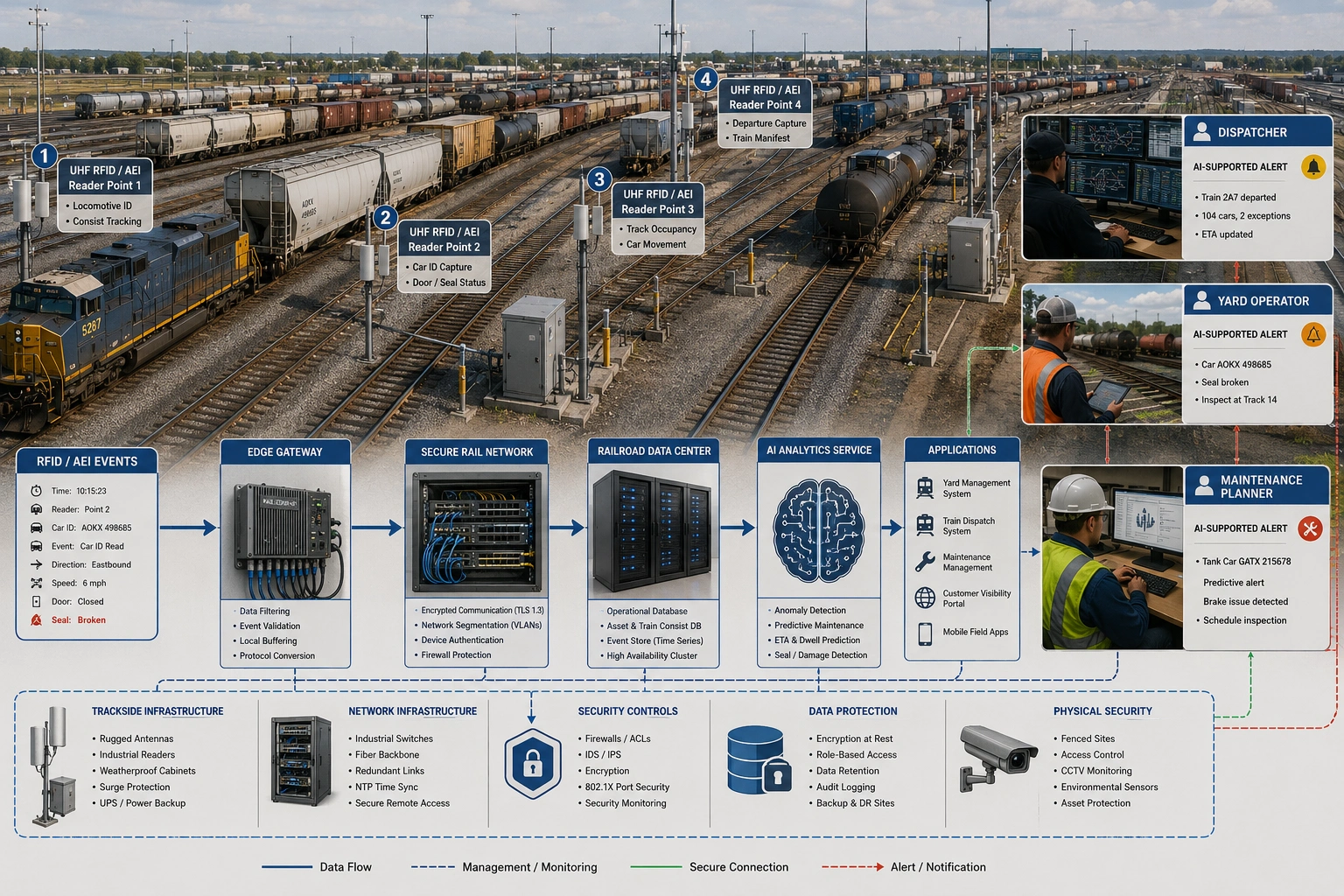
This detailed illustration shows a complete freight rail classification-yard deployment using UHF RFID/AEI technology. It traces RFID events from trackside readers through edge gateways, secure rail networks, databases, and AI analytics to yard management and maintenance applications. The key takeaway is how connected data enables different railroad personnel to receive timely, AI-supported operational alerts.
Scaling AI and RFID Across Freight Rail Operations
Scaling should occur after the initial installation demonstrates reliable data capture and measurable operational value. A railroad can begin with a controlled site such as one maintenance facility, classification yard, or selected wayside location before expanding to additional operating territories.
A repeatable deployment process should standardize reader configuration, tag commissioning, network settings, device authentication, data schemas, API integration, monitoring, and maintenance procedures.
Centralized device management can help engineering teams monitor reader health, communication status, configuration changes, and event volumes across multiple sites. Edge buffering is particularly valuable at remote rail locations because temporary network outages should not automatically result in lost equipment events.
AI models also need lifecycle management. A model trained using one railroad territory or fleet may not perform identically after deployment across another territory because equipment populations, operating patterns, weather, yard procedures, and data distributions can differ.
Model retraining should therefore be triggered by measured performance and data changes rather than performed simply according to an arbitrary calendar.
Operational Resilience, Maintenance, and Lifecycle Management
Freight rail infrastructure operates continuously, so RFID and AI systems should be designed for maintainability as well as initial performance.
Preventive maintenance can include inspection of reader enclosures, antennas, cabling, mounting structures, network equipment, power supplies, and environmental protection. Device health telemetry can help identify equipment failures before an entire identification point becomes unavailable.
Software maintenance should include controlled updates, configuration backups, security patching, API version management, database maintenance, and AI model validation.
Redundancy should be evaluated according to operational importance. A critical wayside identification point may require backup communications, local event buffering, redundant power, or overlapping detection points. Not every location requires the same level of redundancy, so engineering decisions should be based on operational consequences and recovery requirements.
GAO’s Role in Freight Rail RFID and AI Solutions
GAO can support freight rail technology projects by supplying RFID, BLE, and IoT hardware products and systems that form part of larger identification, monitoring, and data-collection solutions. Our product portfolio can support different RFID frequencies, reader configurations, tags, antennas, and deployment requirements.
GAO Group companies are based in New York City and Toronto, Canada, and have served U.S. and Canadian organizations for three decades, including Fortune 500 companies, R&D organizations, universities, and government agencies. The group has invested substantially in R&D and maintains quality-assurance processes with technical support available remotely or onsite.
For freight rail projects, this experience is relevant when RFID hardware must operate as one component within a broader system involving edge computing, communications, databases, AI analytics, and existing railroad software.
From Rail Asset Data to Operational Intelligence
AI for freight rail is most effective when it converts reliable physical observations into decisions that railroad personnel can act upon. RFID can provide an important identification layer, while wayside detection, locomotive telemetry, maintenance records, shipment information, and yard data provide the additional context required for useful analytics.
The practical implementation priorities are clear: define the operational problem, engineer the identification points carefully, validate data quality, integrate with existing railroad systems, secure the complete data path, establish measurable KPIs, and continuously validate AI performance.
GAO can help organizations evaluate RFID and IoT hardware requirements and develop technically appropriate systems for freight rail asset identification and monitoring. Readers looking to advance freight rail visibility, maintenance intelligence, and connected operations can explore GAO’s RFID and IoT solutions and consult our technical specialists for deployment guidance.
Freight Rail AI and RFID Implementation Lifecycle: From Planning to Continuous Optimization
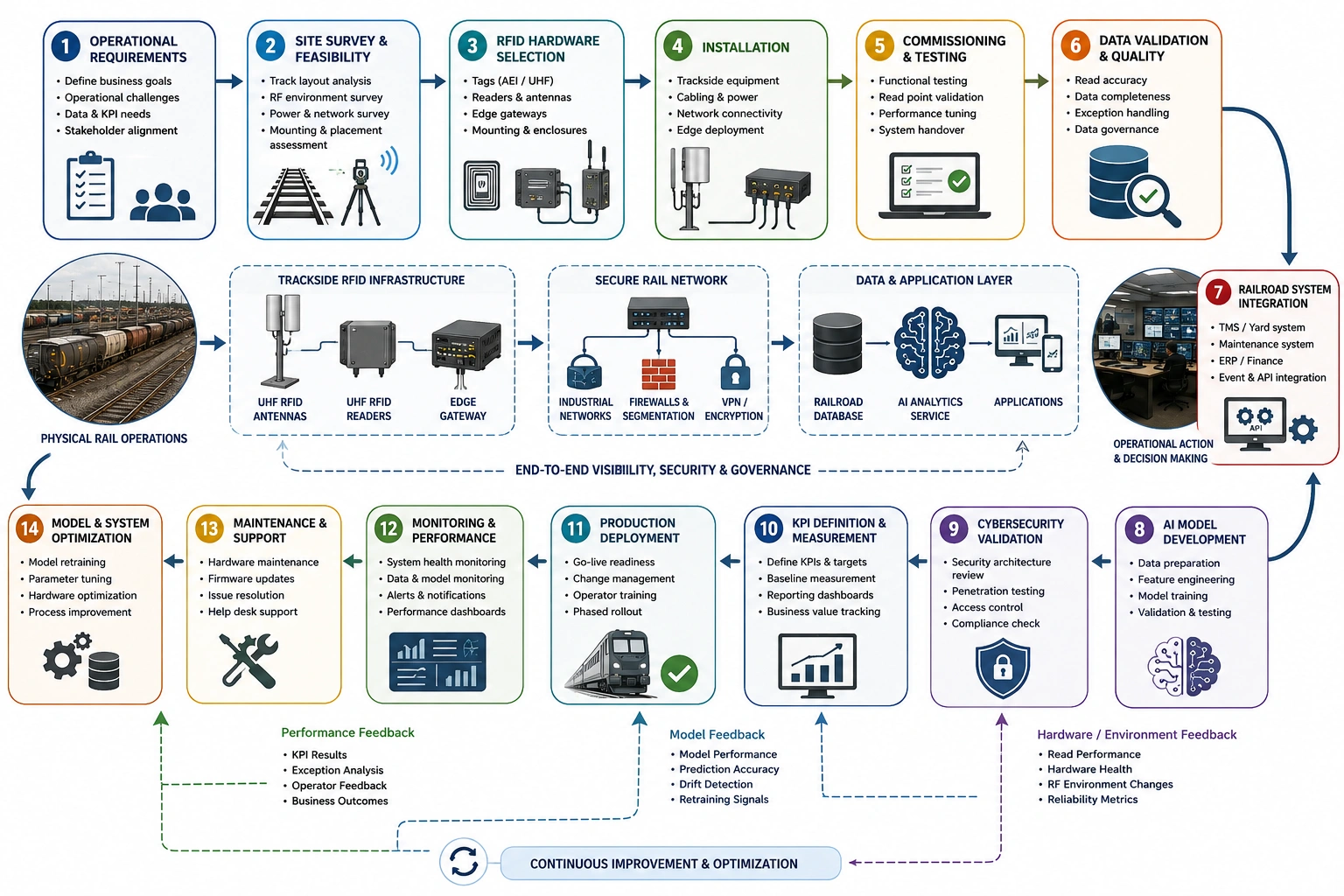
This enterprise engineering diagram illustrates the complete lifecycle of implementing AI and RFID technologies in freight rail operations. It follows each stage from operational requirements and site surveys through hardware installation, data validation, system integration, AI development, cybersecurity, deployment, monitoring, maintenance, and continuous optimization. The key takeaway is that successful implementation is an ongoing lifecycle supported by performance and feedback loops.
Building the Future of Industrial AI and IoT with Aperture Venture Studio and GAO RFID Inc.
For more than three decades, GAO Group of Companies has invested heavily in industrial RFID, BLE, and IoT R&D. As AI has become increasingly useful for industrial applications, we have continued developing AI and IoT technologies that can support connected freight rail operations, asset intelligence, and industrial data workflows. We have also founded Aperture Venture Studio to advance AI and IoT solutions for practical industrial applications, including areas where connected asset data can improve operational decision-making.
Aperture brings together technical experts, operational executives, investors, and leading companies, while our Aperture Ventures Summit and TekSummit provide forums for discussing advanced AI and IoT technologies.
We welcome you to join us as:
- Advisors, co-founders, or employees
- Investors
- Customers