
AI and RFID for Cold Storage Warehouses
How AI Improves Cold Storage Warehouse Operations with RFID
AI-driven cold storage warehouse management combines artificial intelligence, connected sensors, warehouse data, and RFID identification to improve inventory visibility, product traceability, storage utilization, and operational decision-making. RFID helps identify and locate tagged pallets, cases, totes, and other handling units, while AI analyzes movement records, environmental data, order activity, and equipment conditions to identify exceptions and support timely actions. In refrigerated and frozen facilities, this combination is especially valuable because limited visibility, temperature-sensitive products, condensation, insulated doors, and strict handling requirements can increase operational risk. AI and RFID solutions can support receiving, putaway, cold-room inventory checks, order picking, staging, shipping verification, and recall investigations. GAO supplies RFID and IoT hardware and systems that can be incorporated into cold storage workflows, with the final design selected according to temperature range, packaging materials, read performance, connectivity, and warehouse operating procedures.
AI-Enabled Cold Storage Warehouse
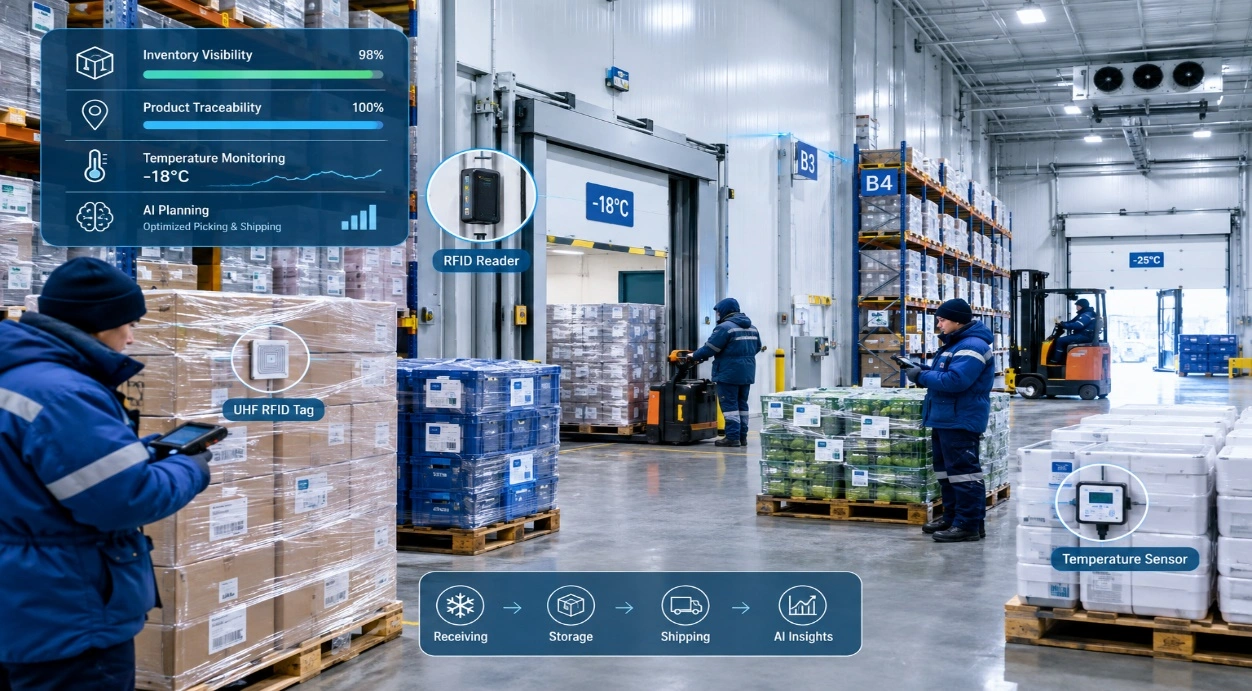
A modern refrigerated warehouse uses UHF RFID tags, RFID readers, handheld devices, and temperature sensors to support inventory visibility and product traceability. Digital overlays illustrate temperature monitoring, AI-assisted planning, and the operational flow from receiving to storage and shipping.
Understanding AI-Enabled Cold Storage Warehouse Management
Cold storage warehouses operate under constraints that differ from ambient-temperature distribution centers. Inventory may include frozen foods, chilled dairy, meat, seafood, pharmaceuticals, produce, or other temperature-sensitive goods, depending on the facility’s operating license and customer requirements. Each product category can have different storage temperatures, shelf-life expectations, handling procedures, and traceability obligations.
AIoT, or the Artificial Intelligence of Things, combines artificial intelligence with IoT devices, sensors, connected equipment, and industrial systems. In a cold storage warehouse, AIoT may combine RFID identification with temperature and humidity sensors, refrigeration equipment data, dock activity, warehouse management software, and machine learning models.
RFID is an enabling data-capture technology rather than a complete warehouse management solution. Its role is to associate a physical item or handling unit with a digital identity when that item passes a reader field or is scanned using a handheld device. AI uses RFID events alongside other data sources to answer operational questions such as:
- Which pallets were received but not yet assigned to a storage location?
- Which cases or pallets are approaching their required shipping window?
- Which inventory movements do not match the expected warehouse workflow?
- Which storage zones have recurring dwell-time or congestion issues?
- Which refrigeration or material-handling assets show patterns associated with maintenance needs?
- Which shipment records require additional verification before dispatch?
Why RFID and AI Matter in Temperature-Controlled Warehousing
RFID can reduce dependence on manual barcode line-of-sight scanning in selected workflows, although read performance depends on tag placement, packaging, product composition, reader configuration, and the physical environment. AI adds value by interpreting large volumes of identification and operational data rather than merely recording individual reads.
For example, an RFID event at a receiving portal can confirm that a tagged pallet entered the facility. A warehouse management system may then assign a destination location. AI can analyze receiving time, product priority, storage availability, order demand, and expected shelf-life to identify putaway priorities or exceptions. The resulting recommendation still needs to respect warehouse procedures, food safety requirements, customer rules, and authorized operator decisions.
The combination is particularly relevant when cold storage operations involve:
- High pallet or case throughput
- Multiple temperature zones
- Frequent cross-docking
- Short shelf-life products
- Strict lot and batch traceability
- High-cost inventory
- Labor-intensive inventory verification
- Complex dock scheduling
- Frequent movement between ambient, chilled, and frozen areas
GAO’s experience supplying RFID, BLE, and IoT technologies can support organizations evaluating how physical identification and sensor data should connect with warehouse software and operational processes.
Cold Storage Warehouse Applications for AI and RFID
AI and RFID should be applied to specific warehouse problems rather than deployed as a generic technology layer. The appropriate solution depends on the inventory unit being tracked, the required identification accuracy, the operating temperature, the packaging, the reader environment, and the existing warehouse software.
RFID-Enabled Receiving and Inbound Verification
Receiving is a critical control point because errors introduced at the dock can affect inventory accuracy, lot traceability, storage allocation, and customer fulfillment.
RFID readers installed at receiving portals or used with handheld devices can identify tagged pallets, cases, returnable containers, or other handling units. The captured identity can be compared with advance shipping notices, purchase orders, expected quantities, lot records, and receiving documentation.
AI can support inbound operations by identifying unusual receiving patterns, prioritizing urgent or short-life products, detecting quantity discrepancies, and highlighting shipments requiring manual inspection. For example, a model may identify that a pallet’s observed movement or contents do not align with the expected receiving record. Such an alert should initiate verification rather than automatically alter inventory records.
Engineering considerations:
- Confirm whether the required identification unit is a pallet, case, tote, carton, or individual item.
- Test RFID performance with actual packaging, including liquids, foil-lined materials, dense products, and frozen goods.
- Account for condensation, ice accumulation, protective enclosures, and temperature-related material changes.
- Define how duplicate reads, missed reads, and partial reads are handled.
- Preserve lot, batch, expiration, and customer-specific traceability information in the warehouse system.
Cold Storage Inventory Visibility and Location Tracking
Inventory visibility is one of the most practical applications for RFID in cold storage warehouses. Tagged handling units can be associated with receiving events, storage zones, rack locations, staging areas, and shipping activities.
RFID does not automatically provide continuous real-time location in every warehouse. A portal reader may establish that an item passed a specific point, while handheld readers or appropriately designed fixed-reader installations can provide additional location evidence. The required level of visibility should be defined before selecting hardware.
AI can analyze RFID movement histories to identify:
- Pallets that remain in staging longer than expected
- Inventory recorded in one location but repeatedly observed elsewhere
- Unusual movement sequences
- Stock that has not moved within a defined period
- Congestion around particular cold rooms or dock areas
- Inventory discrepancies requiring cycle counting
For cold storage facilities, inventory visibility may also support FEFO, or first-expired, first-out, where product expiry or best-before dates influence allocation and picking decisions. FIFO may remain appropriate for other inventory policies. AI recommendations must follow the warehouse’s actual product rotation rules rather than assume that one rotation method applies universally.
Cold Storage Warehouse RFID Deployment Scenario
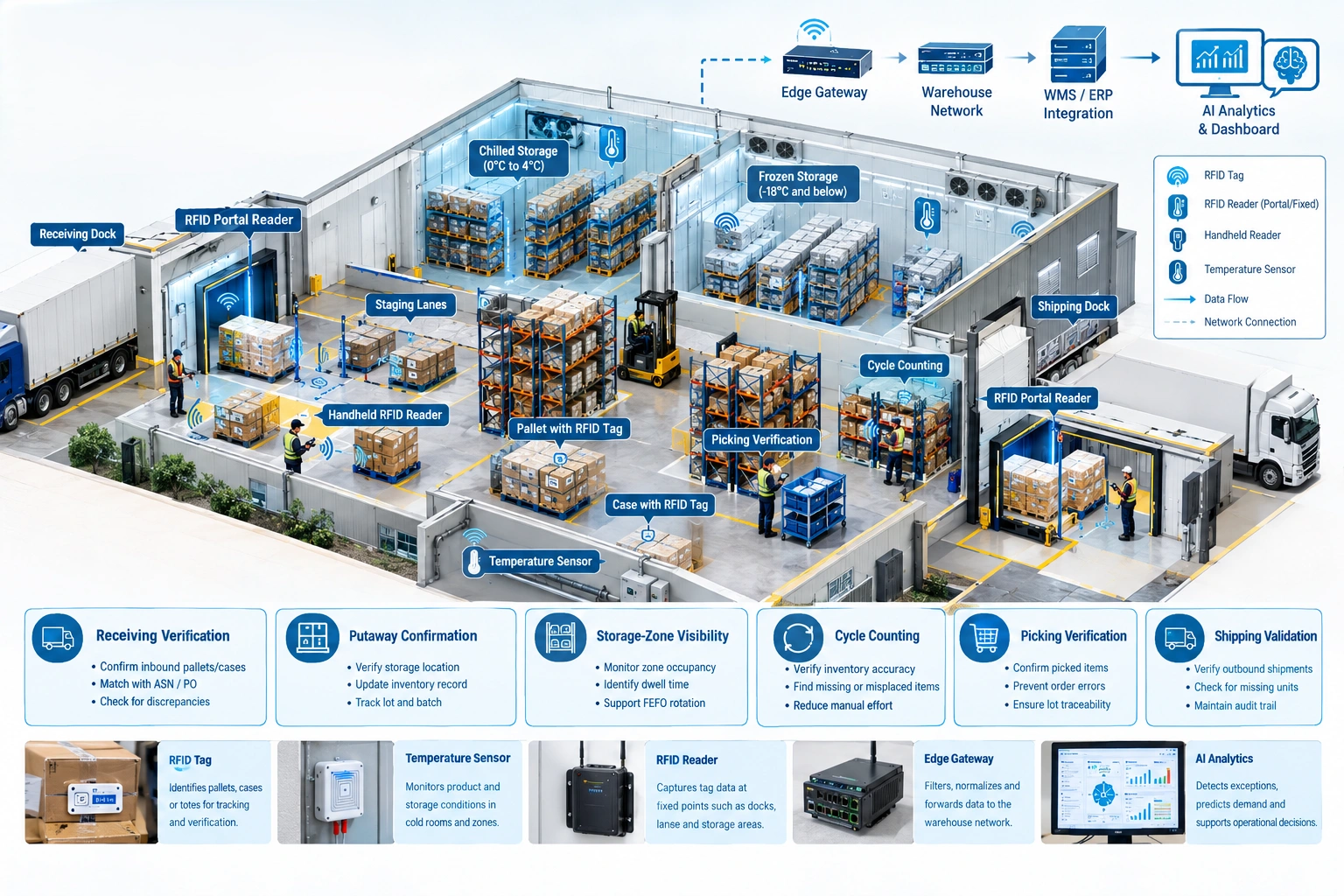
This isometric facility illustration shows RFID portals, handheld readers, tagged pallets and cases, temperature sensors, and separate chilled and frozen storage areas. Data flows from warehouse devices through an edge gateway and WMS/ERP integration to AI analytics, supporting receiving, putaway, inventory counting, picking, and shipping validation.
Lot, Batch, and Product Traceability
Cold storage operators may need to trace products through receiving, storage, repacking, order assembly, staging, shipping, and returns. The required level of traceability varies by product category, customer agreement, regulatory obligations, and the warehouse’s role in the supply chain.
RFID can associate a unique identifier with a pallet, case, tote, or other handling unit. When linked with lot, batch, production date, expiration date, and shipment records, RFID events can strengthen the evidence available for traceability investigations.
AI can help analyze traceability records to identify incomplete movement histories, unusual product flows, mismatched lot associations, or potential recall exposure. It may also support faster retrieval of affected inventory records during a product-quality investigation.
However, RFID identification is not a substitute for validated food safety procedures, lot-control processes, or required documentation. The system should preserve source records, timestamps, reader locations, and data-quality indicators so that operators can distinguish verified events from inferred relationships.
AI-Assisted Picking, Staging, and Shipping Verification
Picking and shipping errors can create customer service problems, product waste, rework, and traceability gaps. In cold storage warehouses, correcting an error may also require additional door openings, product handling, or exposure to unsuitable temperatures.
RFID can support picking verification by identifying tagged cases, totes, or pallets at designated checkpoints. Shipping portals can compare observed items with the expected shipment, while handheld readers can support exception resolution in areas where fixed infrastructure is impractical.
AI can improve these workflows by analyzing order composition, product priority, dock schedules, inventory availability, and historical exceptions. Applications may include:
- Prioritizing picks based on shipping windows and product handling requirements
- Identifying orders with unusual substitutions or missing handling units
- Detecting staging dwell times that threaten dispatch schedules
- Predicting congestion near high-volume shipping lanes
- Highlighting shipment records that require additional verification
The operational objective is not simply faster scanning. It is to reduce preventable errors while maintaining product integrity, traceability, and compliance with established handling procedures.
Cold Room Utilization and Inventory Dwell Analysis
Cold storage capacity is expensive to operate. Poor slotting, excessive staging time, unbalanced room utilization, and unnecessary product movements can increase labor and energy costs.
RFID movement events can provide evidence about how long tagged inventory remains in receiving, staging, storage, picking, and shipping areas. AI can combine these records with order demand, storage capacity, product attributes, and temperature-zone requirements to identify operational bottlenecks.
Potential applications include:
- Detecting recurring congestion at cold-room entrances
- Identifying underused or overburdened storage zones
- Analyzing dwell time by product category or customer
- Supporting storage assignment decisions
- Identifying repeated relocation of the same inventory
- Improving labor planning around receiving and shipping peaks
AI recommendations should account for physical constraints such as rack configuration, forklift access, pallet dimensions, product compatibility, temperature zoning, and food safety separation requirements.
Cold Storage Warehouse Operational Workflow from RFID Data to AI Decisions
An effective AI and RFID solution connects physical warehouse activity with validated digital records. The workflow should be designed around the warehouse’s existing receiving, storage, picking, and shipping processes rather than forcing operators to adopt disconnected technology procedures.
Data Acquisition at Warehouse Touchpoints
The process begins with data capture from operational events and connected equipment.
Typical sources include:
- RFID portal readers at receiving and shipping docks
- Fixed RFID readers at selected transition points
- Handheld RFID readers for cycle counting and exception handling
- RFID tags attached to pallets, cases, totes, returnable containers, or other handling units
- Temperature and humidity sensors for cold rooms, staging areas, and transport interfaces where required
- Refrigeration equipment controllers and monitoring systems
- Door sensors, dock equipment, forklifts, pallet trucks, and conveyor systems where integration is practical
- Barcode scanners, weighing equipment, and existing warehouse terminals
- WMS, ERP, transportation management, order management, and quality systems
RFID events should include relevant context such as tag identity, reader identity, timestamp, read confidence or quality indicators where available, and physical zone. A raw RFID read is not necessarily equivalent to a confirmed inventory transaction. Middleware should apply business rules before an event becomes a warehouse movement or inventory status update.
Communication, Edge Processing, and Event Normalization
RFID readers may communicate through Ethernet, Wi-Fi, serial interfaces, or vendor-specific interfaces depending on the equipment. Industrial gateways or edge computers can collect reader events, buffer data during temporary network interruptions, filter duplicate reads, and normalize device messages.
Common integration methods may include:
- Ethernet-based reader connectivity
- Secure Wi-Fi for approved handheld or mobile workflows
- MQTT for selected IoT messaging patterns
- HTTPS or REST APIs for application integration
- OPC UA where compatible industrial equipment or control systems expose relevant data
- Vendor SDKs or middleware connectors for RFID reader management
- Message queues or integration services for event delivery
The communication design should reflect cold storage conditions. Network coverage must be validated inside insulated rooms, around metal racks, near dock doors, and across transitions between temperature zones. Equipment enclosures, condensation, battery performance, and maintenance access should be considered during site surveys.
Edge processing is useful when the warehouse needs local event filtering, low-latency exception handling, or continued operation during intermittent connectivity. It can also reduce unnecessary transmission of duplicate RFID reads to centralized software.
AI Analytics and Warehouse Software Integration
After event normalization, RFID data can be joined with warehouse master data and operational transactions. Relevant systems may include:
- Warehouse management systems, or WMS
- Enterprise resource planning systems, or ERP
- Transportation management systems, or TMS
- Order management systems
- Laboratory information or quality management systems where relevant
- Maintenance management software, or CMMS/EAM
- Cold-chain monitoring software
- Business intelligence and reporting tools
- Customer portals and electronic data interchange systems
AI models may use historical movement events, inventory transactions, order demand, product attributes, dwell times, and equipment data. Depending on the use case, methods may include anomaly detection, classification, time-series forecasting, optimization, and predictive maintenance models.
The output may be a prioritized exception, a forecast, a recommended action, or a dashboard insight. Human review remains important for decisions involving inventory adjustments, product disposition, recalls, food safety, or equipment intervention.
Cold Storage RFID-to-AI Operational Workflow
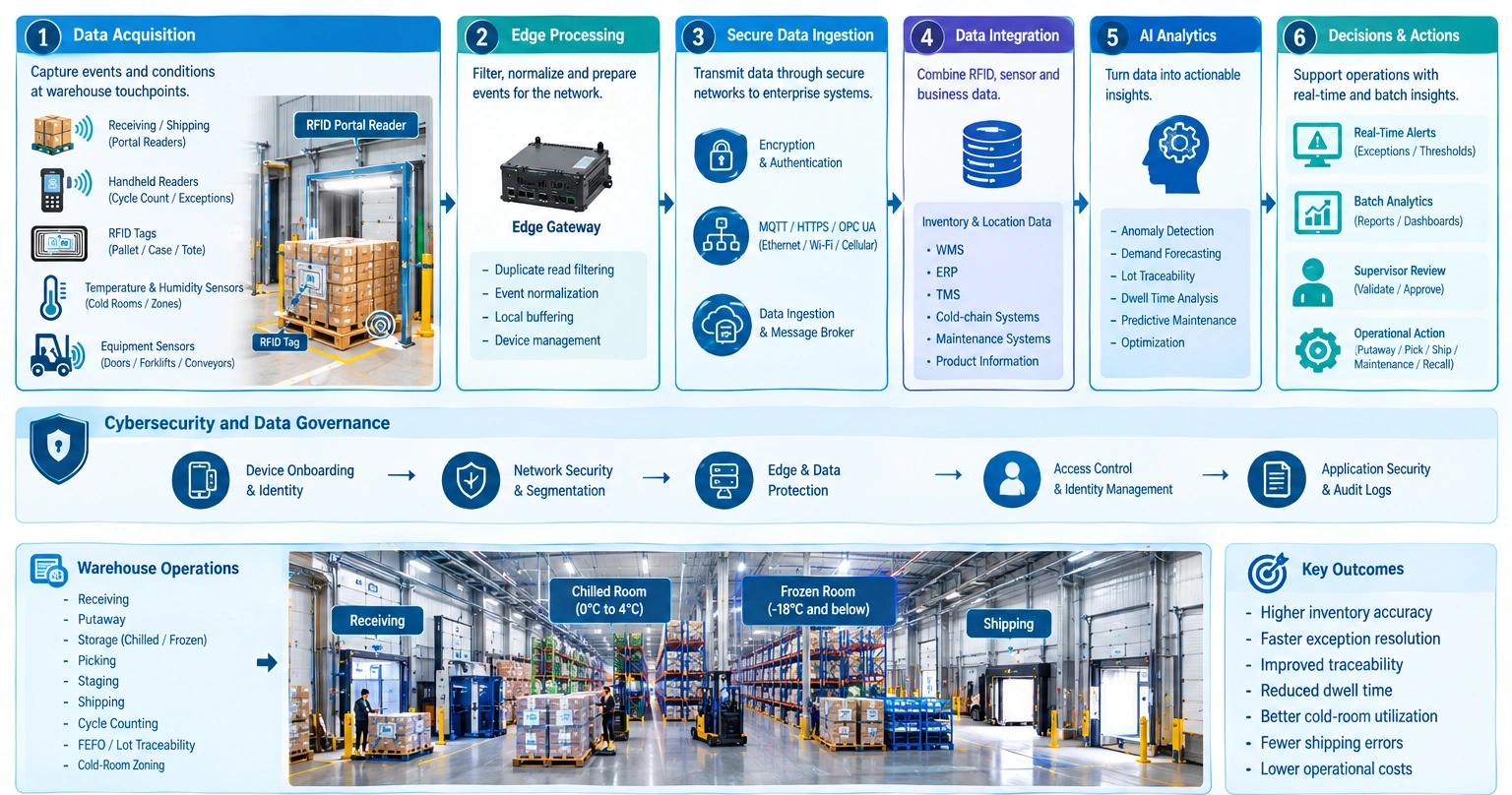
This enterprise workflow diagram illustrates how RFID events, temperature and equipment sensor data, and warehouse activities move through edge processing, secure ingestion, system integration, and AI analytics. It highlights real-time alerts, batch analytics, cybersecurity controls, and operational actions such as putaway, FEFO, cycle counting, shipment verification, and maintenance.
RFID, AI, and Supporting Technologies for Cold Storage Warehouses
Selecting RFID Types for Cold Storage Applications
RFID selection should be based on the identification task, read distance, tag form factor, packaging, operating environment, and required integration method.
| RFID Type | Relevant Cold Storage Applications | Key Engineering Considerations |
|---|---|---|
| UHF RFID | Pallet, case, tote, dock, and portal identification; inventory checks; transition-point tracking | Longer read ranges and multi-tag reading are useful, but performance depends heavily on packaging, liquids, metals, tag orientation, reader configuration, and RF interference |
| HF RFID | Short-range item identification, controlled workstation verification, selected reusable-container or specialized identification tasks | Shorter read range can support deliberate point-of-use interactions; tag and reader placement must suit the workflow |
| LF RFID | Specialized short-range identification applications, selected industrial assets, and environments where LF characteristics are appropriate | Limited data capacity and shorter read distances may make it less suitable for high-throughput pallet-level warehouse visibility |
UHF RFID is often considered for pallet and case-level cold storage workflows because it can support longer-range reading and multiple tagged items. Nevertheless, liquids, dense food products, foil packaging, metal structures, and stacked pallets can affect performance. HF and LF RFID may be appropriate for narrower identification tasks where short-range, deliberate reads are acceptable.
A site-specific proof of concept should test actual tags, packaging, pallet configurations, freezer temperatures, condensation conditions, reader mounting positions, and expected throughput.
RFID Hardware and Cold-Environment Deployment
A cold storage RFID installation may include:
- Fixed RFID readers
- Integrated or external antennas
- Handheld RFID readers
- RFID sleds for mobile computers
- RFID tags and labels
- Industrial edge gateways
- Network switches and secure wireless infrastructure
- Reader mounting brackets and protective enclosures
- Power supplies and backup power where required
- Temperature and humidity sensors
- Industrial computers or local servers
Tag selection is especially important. A tag that performs well on dry cardboard may not perform similarly when attached to a liquid-filled container, a foil-lined package, a metal rack, or a frozen product. Adhesive behavior, condensation, frost, cleaning procedures, and the expected lifecycle of reusable containers should also be evaluated.
GAO can provide RFID and IoT hardware options for organizations developing cold storage identification and monitoring systems. Product selection should follow application testing and integration requirements rather than relying solely on nominal reader range or tag specifications.
AI Models and Analytical Functions
AI methods should be matched to the operational question.
- Anomaly detection: Identifies unusual RFID movement sequences, unexpected dwell times, inventory discrepancies, or abnormal equipment readings.
- Time-series forecasting: Estimates inventory demand, receiving volume, order activity, or cold-room workload based on historical and contextual data.
- Classification models: Categorize operational exceptions, shipment risks, or maintenance conditions using labeled historical records.
- Optimization models: Support slotting, labor allocation, dock scheduling, or movement prioritization under defined constraints.
- Predictive maintenance models: Analyze refrigeration, conveyor, forklift, or other equipment data to identify patterns associated with potential failures.
- Computer vision: Supports selected inspection, pallet verification, safety, or quality workflows where cameras and lighting can be appropriately deployed.
- Edge AI: Runs selected inference tasks near the warehouse operation when low latency, local processing, or limited connectivity makes that useful.
AI model performance depends on data quality, labeling, process consistency, and ongoing validation. A model trained on ambient warehouse data may not generalize to frozen storage operations without additional testing.
Cloud Version and Server Version
Cold storage operators may choose cloud-hosted or privately hosted software depending on IT policy, connectivity, data governance, integration requirements, and operational resilience.
Cloud Version
A cloud-hosted SaaS deployment can centralize RFID event processing, inventory analytics, dashboards, device management, and AI services across multiple warehouses. It may be appropriate when organizations need remote visibility, centralized reporting, multi-site analytics, and reduced responsibility for maintaining application servers.
The design still requires reliable site connectivity, local buffering or edge processing, secure device onboarding, identity management, API integration, and clear data-retention policies. A cloud deployment should not assume that every cold room has uninterrupted connectivity.
Server Version
A server deployment may run on local edge servers, customer-managed servers, private data centers, or other privately hosted enterprise infrastructure. It can be suitable where data must remain under customer control, local operation is important, integration with existing warehouse systems is complex, or IT policy requires privately hosted applications.
A server-based solution may still synchronize selected data with other sites or cloud services. Local deployment does not eliminate the need for patching, backups, monitoring, access control, disaster recovery, and cybersecurity management.
Hybrid Deployment
A hybrid approach can place RFID event filtering, local workflow services, or selected AI inference near the warehouse while synchronizing relevant data with centralized systems. This can help balance local resilience, multi-site reporting, and centralized model management.
Engineering Considerations for Reliable Cold Storage RFID Systems
Deploying RFID in a cold storage warehouse requires more than selecting readers and tags. The system must operate within the physical, environmental, and procedural constraints of refrigerated logistics. AI can improve decisions only when the underlying identification events, inventory records, and sensor data are sufficiently accurate and consistently interpreted.
RF Performance, Packaging, and Temperature Conditions
Cold storage environments can introduce several factors that affect RFID performance:
- High water content: Meat, seafood, produce, beverages, and other liquid-rich products can absorb or detune UHF RF energy, reducing read performance.
- Metallic surfaces: Racks, forklifts, insulated panels, equipment housings, and foil-based packaging can reflect or interfere with RF signals.
- Dense pallet configurations: Closely packed cartons and stacked pallets can create tag shielding and inconsistent read angles.
- Condensation and frost: Moisture accumulation can affect labels, adhesives, equipment enclosures, and maintenance procedures.
- Temperature extremes: Freezer applications require tags, adhesives, batteries, and reader accessories rated for the actual operating conditions.
- Door transitions: RFID performance may differ between receiving docks, ante-rooms, chilled rooms, and frozen rooms because of changes in construction materials and reader placement.
A practical deployment should test RFID tags on the actual products and packaging used by the warehouse. Testing should include representative pallet loads, different tag positions, forklift movement, door opening conditions, and the expected speed of material handling. Nominal read distance alone is not a sufficient acceptance criterion.
Read Zones, Event Accuracy, and False Movement Prevention
RFID systems should be designed around controlled read zones. A reader that detects a tag does not necessarily establish that the tagged item completed a specific warehouse transaction.
For example, a reader near a shipping dock may detect a pallet that is waiting in staging rather than one that has been loaded onto a truck. Similarly, a reader near a cold-room entrance may capture tags moving in either direction unless the installation and business rules distinguish entry from exit.
Engineering controls may include:
- Antenna placement and orientation designed for the intended movement path
- Shielding or RF containment where adjacent read zones could overlap
- Reader power and sensitivity configuration
- Directional logic using multiple antennas or readers
- Portal sensors, photoelectric sensors, or other event triggers
- Integration with dock-door, conveyor, or forklift workflow signals
- Duplicate-read suppression and time-based filtering
- Correlation with WMS transactions and operator confirmation
- Exception queues for uncertain or conflicting events
AI can help identify suspicious movement patterns, but it should not be used to conceal poor read-zone design. Reliable physical data capture remains the foundation of trustworthy inventory analytics.
Cold-Chain Data and RFID Data Are Complementary
RFID identifies tagged objects or handling units. It does not inherently measure product temperature, core temperature, humidity, or food quality. Cold-chain monitoring requires appropriate temperature sensors, calibrated instruments, validated procedures, and, where applicable, regulatory or customer-specific controls.
A combined solution may associate RFID identity with environmental data to improve traceability. For example, a temperature-monitoring device can record conditions for a storage zone, shipment, pallet, or reusable container, while RFID events establish where the associated asset was observed.
The data model should distinguish:
- Identity data: Which tag, pallet, case, tote, or asset was identified?
- Location evidence: Where and when was the item observed?
- Environmental data: What temperature, humidity, or other measurements were recorded?
- Transaction data: What receiving, putaway, picking, or shipping action was recorded?
- Inference: What operational conclusion was generated by software or AI?
This separation helps prevent a common design error: treating an RFID read as proof that product temperature remained within specification.
Business and Operational Benefits of AI-Enabled Cold Storage Management
The value of combining AI with RFID depends on how well the solution addresses a measurable warehouse problem. Benefits should be evaluated against a baseline and validated through operational KPIs rather than assumed from technology deployment alone.
Improved Inventory Accuracy and Search Efficiency
RFID can reduce the manual effort required to identify selected pallets, cases, or reusable handling units. AI can further analyze movement histories to identify inventory that may be misplaced, unconfirmed, or inconsistent with expected warehouse records.
The operational value may include:
- Faster cycle-counting activities in selected zones
- Reduced time spent searching for handling units
- Earlier identification of location discrepancies
- Better visibility into staging and storage movements
- More reliable inventory status for planning and fulfillment
Results depend on tag coverage, reader placement, transaction integration, and the percentage of inventory represented in the system. RFID should not be presented as a guarantee of perfect inventory accuracy.
Stronger Lot Traceability and Recall Readiness
Cold storage warehouses may handle products requiring lot, batch, expiration, or shipment traceability. RFID events can provide additional evidence of when and where tagged handling units were observed.
AI can support traceability investigations by correlating movement records with lot data, customer orders, storage zones, and shipping transactions. This may help teams locate potentially affected inventory more efficiently during a recall or quality investigation.
The system should preserve auditable source records and avoid replacing validated traceability procedures with unverified AI-generated conclusions.
Better FEFO Execution and Shelf-Life Management
For products managed under FEFO principles, the warehouse must consider expiration or best-before dates when allocating inventory. AI can analyze product dates, order requirements, storage locations, and movement history to identify inventory that requires prioritization.
RFID supports this process by providing more timely identification of tagged handling units at relevant warehouse checkpoints. The combined solution may help identify:
- Pallets approaching defined shipping or handling thresholds
- Inventory remaining in storage longer than planned
- Products staged for the wrong order or temperature zone
- Cases or pallets requiring additional verification before allocation
- Repeated delays affecting short-life inventory
FEFO recommendations must remain consistent with product-specific handling rules, customer agreements, and approved warehouse procedures.
Reduced Operational Disruptions and Better Labor Planning
AI can analyze receiving patterns, order volumes, staging dwell, dock activity, and historical movement data to identify workload patterns. RFID provides additional event data for understanding how inventory moves through the facility.
Potential applications include:
- Forecasting receiving and shipping workload
- Identifying congestion around high-volume dock periods
- Supporting labor allocation for cycle counting or picking
- Detecting repeated handling or unnecessary relocation
- Prioritizing exceptions that require supervisor attention
The benefit comes from better coordination and earlier visibility, not simply from collecting more data. Warehouse managers should define which decisions will change as a result of the analytics.
More Informed Equipment Maintenance
Cold storage operations depend on refrigeration systems, evaporators, compressors, condensers, fans, conveyors, forklifts, pallet trucks, dock equipment, and other assets. Equipment failures can disrupt product handling and increase operational risk.
RFID may identify maintenance assets, tools, containers, or equipment assigned to particular areas. However, predictive maintenance generally relies on condition data such as vibration, temperature, current, pressure, runtime, fault codes, or maintenance history.
AI can analyze these data sources to identify abnormal equipment behavior or estimate maintenance needs. RFID can provide asset identity and movement context where useful, such as associating a mobile asset with a warehouse zone or maintenance record.
A credible maintenance solution should distinguish between:
- RFID-based asset identification
- Sensor-based condition monitoring
- AI-based anomaly detection
- Maintenance scheduling and work-order management
These functions complement one another but are not interchangeable.
AI-Enabled Cold Storage Operations: From Warehouse Data to Operational Value
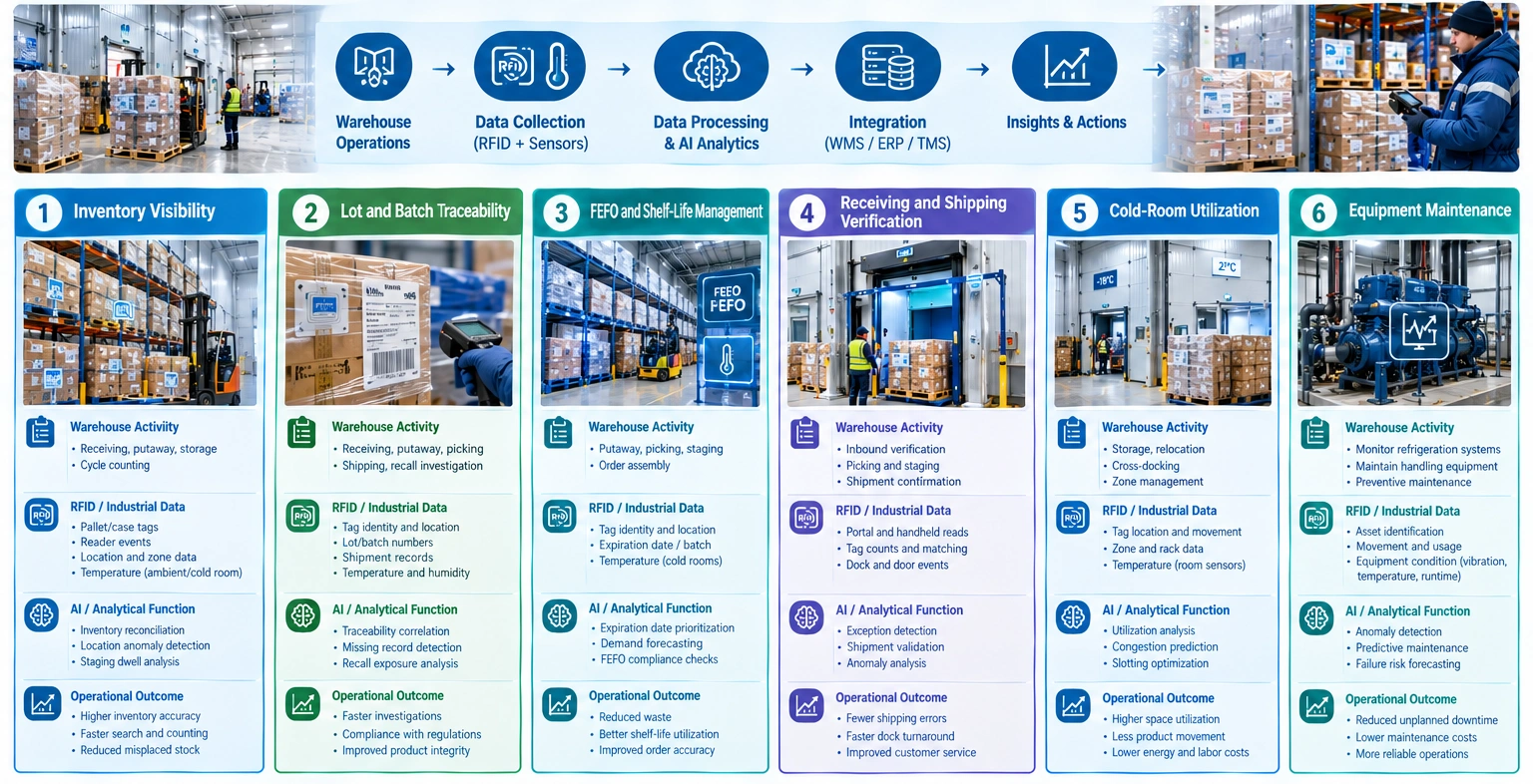
This technical infographic connects six cold storage activities with RFID identity data, temperature and equipment-condition data, AI functions, and operational outcomes. It covers inventory visibility, lot and batch traceability, FEFO management, receiving and shipping verification, cold-room utilization, and equipment maintenance.
Implementing AI and RFID in Cold Storage Warehouses
A successful deployment should begin with an operational problem, measurable acceptance criteria, and a clear understanding of the warehouse’s existing systems. Technology selection should follow the workflow rather than precede it.
Define the Operational Objective and Tracking Unit
The first step is to identify what the warehouse needs to improve and what physical object must be identified.
Possible objectives include:
- Pallet-level receiving and shipping verification
- Case-level traceability
- Reusable tote or container tracking
- Cold-room inventory visibility
- Cycle-counting efficiency
- Staging dwell analysis
- FEFO execution support
- Returnable asset management
- Equipment or tool identification
- Temperature-event association
The tracking unit matters. A pallet-level RFID design cannot automatically provide item-level traceability. If cases are mixed on pallets, the warehouse must determine whether pallet tags, case tags, barcode associations, or another identification method is appropriate.
GAO can help organizations evaluate RFID hardware and IoT system requirements according to the intended workflow, tag format, operating environment, and integration needs.
Select RFID Tags, Readers, and Supporting Sensors
Hardware selection should be based on actual warehouse conditions.
RFID selection factors:
- UHF, HF, or LF suitability for the required read interaction
- Tag attachment surface and packaging composition
- Read range and throughput requirements
- Tag durability and adhesive performance
- Freezer and chilled-environment operating conditions
- Reader and antenna mounting options
- Mobile versus fixed reading requirements
- Reader integration interfaces
- Maintenance and replacement procedures
Supporting sensor selection factors:
- Required temperature range and accuracy
- Measurement frequency
- Calibration and validation requirements
- Battery life at operating temperature
- Sensor placement and protection
- Data storage during connectivity interruptions
- Alarm thresholds and escalation procedures
- Integration with cold-chain monitoring software
RFID and temperature sensors should be selected as complementary components. A tag may identify a pallet, while a separate sensor measures the conditions relevant to that pallet or its storage environment.
Conduct a Site Survey and Controlled Proof of Concept
Before a full rollout, the warehouse should assess the physical and operational environment.
A site survey should examine:
- Receiving and shipping portal locations
- Chilled and frozen storage zones
- Rack layout and aisle widths
- Metal structures and insulated panels
- Network coverage and power availability
- Condensation and frost exposure
- Forklift and pallet movement patterns
- Reader mounting and maintenance access
- Existing barcode and WMS workflows
- Areas where read-zone overlap may occur
A proof of concept should use representative products and actual operating conditions. Testing should measure read success, missed reads, duplicate reads, false reads, event latency, tag durability, operator acceptance, and integration behavior.
The pilot should also test exception scenarios, such as:
- A pallet entering the wrong cold room
- A shipment missing one expected handling unit
- A tag being read multiple times in a staging area
- A pallet being moved without a corresponding WMS transaction
- Network connectivity becoming temporarily unavailable
- A damaged or unreadable tag requiring manual fallback
Integrate with WMS, ERP, and Cold-Chain Systems
RFID data becomes operationally useful when it is connected to the systems that manage warehouse transactions and product information.
Integration planning should define:
- Master data ownership
- Pallet, case, lot, and serial-number relationships
- Event-to-transaction mapping
- Location master synchronization
- Product and expiration-date data
- Receiving and shipping confirmation rules
- Inventory adjustment authorization
- Exception handling and audit trails
- API, message, or middleware requirements
- Data retention and reporting needs
Common enterprise systems may include WMS, ERP, TMS, order management software, quality management systems, cold-chain monitoring applications, and maintenance management systems.
The integration should prevent duplicate transactions and preserve the distinction between a raw RFID observation and a confirmed warehouse action.
Establish Cybersecurity and Data Governance Controls
Cold storage RFID systems connect physical devices, warehouse networks, operational software, and potentially cloud services. Security should be addressed during design rather than added after installation.
Relevant controls may include:
- Unique device identities
- Secure device onboarding
- Role-based access control
- Strong authentication for administrative access
- Network segmentation where appropriate
- Encrypted communications
- Secure API authentication
- Firmware and software update procedures
- Vulnerability management
- Logging and audit trails
- Backup and recovery procedures
- Data-retention policies
- Vendor access controls
- Incident response procedures
AI systems introduce additional considerations, including model access, training-data governance, data-quality monitoring, model drift, and review of automated recommendations. A warehouse should define which actions AI may recommend and which actions require authorized human approval.
Cold Storage Warehouse KPIs for AI and RFID Projects
KPIs should be selected according to the deployment objective. Measuring every available metric can create reporting complexity without improving operations.
| KPI | What It Measures | Relevance to AI and RFID |
|---|---|---|
| Inventory accuracy | Agreement between system records and verified physical inventory | Evaluates whether identification and transaction workflows improve inventory reliability |
| RFID read success rate | Percentage of expected reads successfully captured | Helps assess tag, reader, antenna, packaging, and installation performance |
| False-read rate | Reads incorrectly associated with a movement or transaction | Indicates whether read-zone design and event filtering require improvement |
| Receiving verification accuracy | Correctness of inbound identification and quantity confirmation | Measures the quality of RFID-assisted receiving workflows |
| Shipping verification accuracy | Correctness of outbound handling-unit confirmation | Helps evaluate shipment error prevention |
| Inventory search time | Time required to locate selected inventory | Measures operational visibility and labor efficiency |
| Cycle-counting productivity | Inventory units or locations verified per labor hour | Evaluates the impact of RFID-supported counting |
| Staging dwell time | Time inventory remains in staging before the next process | Supports congestion and dispatch analysis |
| Putaway completion time | Time from receiving confirmation to storage placement | Helps identify workflow delays |
| FEFO compliance | Degree to which inventory rotation follows defined product-date rules | Evaluates shelf-life management support |
| Lot traceability completeness | Availability of required movement and lot relationships | Measures traceability data quality |
| Cold-room utilization | Use of available storage capacity by zone or temperature class | Supports storage planning and capacity analysis |
| Temperature excursion response time | Time from detected exception to acknowledged action | Evaluates cold-chain alert workflows |
| Sensor availability | Percentage of time required sensors report valid data | Measures monitoring reliability |
| Equipment downtime | Time refrigeration or material-handling assets are unavailable | Supports maintenance improvement analysis |
| Predictive alert precision | Proportion of actionable alerts among generated alerts | Helps evaluate AI maintenance or operational models |
| Order fulfillment accuracy | Correctness of picked and shipped orders | Measures the combined effect of inventory and verification improvements |
| Dock-to-stock time | Time from receiving to available inventory status | Evaluates inbound process performance |
| Manual exception rate | Percentage of transactions requiring manual intervention | Identifies workflow friction and data-quality issues |
| System availability | Availability of RFID, integration, and analytics services | Measures operational reliability |
A baseline should be recorded before deployment. KPI definitions should also specify the measurement period, population, data source, and exclusion rules. For example, RFID read success should not be calculated only from successful events; the warehouse must define what constitutes an expected read.
Scaling AI and RFID Across Cold Storage Operations
A pilot that works at one dock or storage zone may not automatically scale across a multi-site cold storage network. Each facility may use different rack layouts, packaging types, WMS configurations, temperature zones, and operating procedures.
Standardize Data and Deployment Practices
Scaling is easier when the organization defines reusable standards for:
- Tag identification and labeling conventions
- Pallet, case, tote, and lot relationships
- Reader configuration and naming
- Location and zone identifiers
- Event schemas and timestamps
- Exception categories
- Device monitoring
- Cybersecurity controls
- Integration interfaces
- KPI definitions
- Support and maintenance procedures
Standardization should not eliminate site-specific testing. A freezer warehouse, chilled distribution center, and mixed-temperature facility may require different tag types, reader configurations, sensor specifications, and operational rules.
Manage AI Model Performance Over Time
AI models should be monitored after deployment because warehouse conditions change. Product mix, order volume, packaging, reader configuration, storage layout, and operating procedures may all affect data patterns.
Model management should include:
- Monitoring input-data quality
- Reviewing false positives and false negatives
- Validating recommendations against operational outcomes
- Detecting changes in inventory or movement patterns
- Updating models when workflows change
- Maintaining version control
- Documenting model limitations
- Providing operator feedback mechanisms
- Establishing approval rules for automated actions
AI should support operational teams rather than obscure uncertainty. When the system lacks sufficient evidence, it should identify the exception for review rather than produce an overly confident conclusion.
Plan for Maintenance, Training, and Operational Adoption
RFID systems require ongoing attention to tag quality, reader health, antenna alignment, network availability, software integration, and device firmware. Cold storage conditions may increase the importance of inspection and replacement procedures.
Operational adoption also depends on clear responsibilities. Warehouse personnel should understand:
- When RFID reads are expected
- What to do when a tag cannot be read
- How to handle damaged or replaced tags
- When manual confirmation is required
- How exceptions appear in the WMS
- Who investigates inventory discrepancies
- How temperature-related events are escalated
- How equipment or network failures affect workflows
GAO’s technical support and RFID/IoT product expertise can be relevant when organizations need assistance evaluating hardware, integration requirements, deployment options, or system expansion.
Advancing Cold Storage Warehouse Intelligence with AI and RFID
AI-enabled cold storage warehouse management is most effective when it connects a defined operational objective with reliable physical data, validated workflows, and measurable outcomes. RFID can support pallet, case, tote, and asset identification, while AI can analyze movement history, inventory records, order activity, environmental measurements, and equipment data to identify exceptions and improve planning.
Key implementation principles include:
- Select the tracking unit and RFID type according to the actual warehouse process.
- Test tags and readers with real products, packaging, freezer conditions, and pallet configurations.
- Treat RFID observations as data inputs that require event validation and business rules.
- Use temperature sensors and cold-chain systems for environmental monitoring rather than treating RFID as a temperature measurement technology.
- Integrate RFID events with WMS, ERP, TMS, quality, maintenance, and cold-chain software where appropriate.
- Establish cybersecurity, auditability, data governance, and manual fallback procedures.
- Measure inventory, traceability, throughput, read performance, and exception-handling outcomes against a baseline.
- Scale through standardized data models and deployment practices while preserving site-specific testing.
Organizations exploring AI-driven inventory visibility, cold-chain traceability, or RFID-enabled warehouse operations can learn more about GAO’s RFID, BLE, and IoT hardware products, systems, engineering expertise, and technical support at GAO.
Building the Future of Industrial AI and IoT with Aperture Venture Studio and GAO RFID Inc.
For more than three decades, GAO Group of Companies has invested heavily in R&D for industrial RFID, BLE, and IoT technologies. As generative AI has become useful in industrial applications, we have continued developing AI and IoT solutions that support areas such as cold storage inventory visibility, asset identification, traceability, and operational analytics. We have also founded Aperture Venture Studio to build, launch, and scale next-generation AI and IoT companies for various industries.
Aperture has attracted AI and IoT technical experts, entrepreneurial and operational executives, influential investors, and leading companies. We have also developed the Aperture Ventures Summit and TekSummit to discuss advanced AI and IoT topics.
GAO RFID Inc., GAO Research Inc., and GAO Tek Inc. form GAO Group, with operations based in New York City and Toronto, Canada. GAO RFID Inc. is recognized among the world’s leading B2B and B2G RFID and BLE suppliers. For three decades, GAO Group has served U.S. and Canadian customers, including Fortune 500 companies, leading R&D firms, prestigious universities, and government agencies. Our R&D investment, quality assurance processes, and remote or onsite technical support help customers evaluate and deploy connected technology solutions.
We welcome you to join us as:
- Advisors, co-founders, or employees
- Investors
- Customers