
AI and RFID for Inland Ports
AI-Driven Inland Port Operations and RFID-Enabled Visibility
AI for inland ports combines operational data from gates, container yards, rail interfaces, trucks, chassis, handling equipment, appointments, and transportation systems with machine learning, computer vision, and other AI methods to improve how cargo moves through an inland port. RFID provides a practical identification layer for selected containers, chassis, reusable transport assets, equipment, and operational items, allowing physical movements to generate machine-readable events.
The resulting AIoT solution can correlate RFID observations with gate transactions, yard locations, truck appointments, rail schedules, equipment telemetry, OCR, GPS, and transportation management data. AI models can then identify abnormal dwell times, predict yard congestion, detect possible container mislocations, forecast gate demand, and help dispatch personnel respond to operational exceptions. For inland ports handling growing intermodal volumes, this combination can turn fragmented operational events into timely information for gate operators, yard supervisors, dispatchers, terminal managers, and logistics coordinators. GAO supplies RFID and IoT hardware products and systems that can support these data-capture requirements across transportation and logistics operations.
AI and RFID in Inland Ports: End-to-End Operational Flow
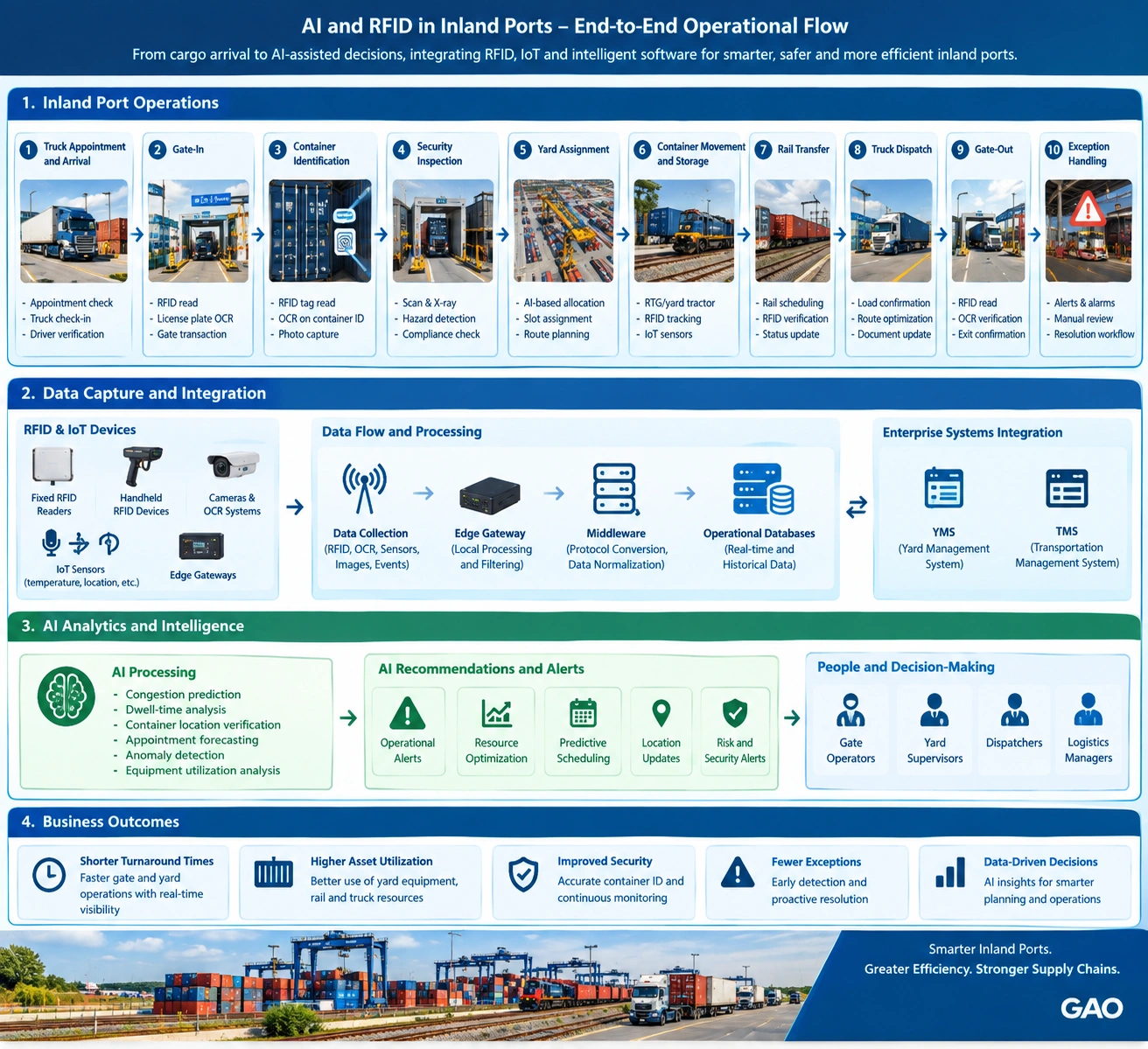
This enterprise workflow diagram shows how RFID, OCR, IoT sensors, edge processing, middleware, operational databases, and AI support inland-port operations from truck arrival through gate-out and exception handling. It also illustrates AI-driven congestion prediction, dwell-time analysis, location verification, scheduling, anomaly detection, and decision support for gate operators, yard supervisors, dispatchers, and logistics managers.
What AI Means for Modern Inland Port Operations
AI becomes useful in an inland port when it is connected to operational events rather than treated as a standalone analytics tool. A yard supervisor may need to know which containers are approaching an excessive dwell threshold, whether a planned yard block is becoming congested, whether trucks are arriving in a pattern that will overload a gate, or whether an asset recorded at one location has unexpectedly appeared in another. These questions require multiple sources of operational data to be correlated.
AIoT combines artificial intelligence with IoT devices, sensors, connected equipment, and industrial systems. For inland ports, this can include RFID readers, cameras, OCR systems, GPS devices, environmental sensors, equipment telemetry, gate controllers, handheld terminals, and connected yard machinery. Machine learning models can evaluate historical and real-time events to identify patterns that are difficult to detect through static reports.
RFID is particularly useful when an inland-port process requires reliable identification of tagged physical assets. UHF RFID is generally suited to longer-range identification and automated reading at controlled points such as gates, staging lanes, equipment areas, and selected transfer locations. HF and LF RFID can serve more localized identification requirements where shorter read ranges or specific tag-reader relationships are appropriate.
The important engineering distinction is that an RFID read is an observation, not automatically a confirmed business transaction. Middleware should determine whether a sequence of reads represents a meaningful event such as container arrival, yard entry, equipment assignment, staging, or dispatch. AI should operate on validated operational events whenever possible.
GAO’s experience supplying RFID hardware products and systems gives organizations a practical foundation for connecting physical identification with operational software, while the AI layer can add prediction, anomaly detection, optimization, and decision support.
Inland Port Applications for AI-Driven Operational Intelligence
AI Container Tracking and Location Verification
Container visibility is a core operational requirement for inland ports because a container may move between gate lanes, inspection areas, yard blocks, rail transfer zones, staging areas, and outbound truck positions before reaching its next transportation leg. AI can correlate identification events, yard transactions, timestamps, GPS information, OCR results, and handling records to maintain a more complete movement history.
RFID can provide automated identification at selected controlled locations. When an expected event does not occur, AI can compare the planned movement with observed activity and generate an exception for investigation.
Relevant applications include:
- Container arrival and departure event capture
- Yard location verification
- Container transfer confirmation
- Misrouting and unexpected movement detection
- Dwell-time monitoring
- Exception-based container search
- Rail transfer visibility
- Interchange event support
- Empty-container movement tracking
- Chassis and reusable asset identification
The operational objective is not simply to know that a tag was read. The objective is to establish whether the physical movement matches the inland port’s expected operational state.
AI Yard Management and Congestion Prediction
Yard congestion can result from uneven container arrivals, limited storage capacity, rail schedules, truck appointment patterns, equipment availability, inspection requirements, and unexpected operational disruptions. Traditional reports often describe congestion after it occurs.
AI can analyze historical container flow, current yard occupancy, appointment schedules, dwell patterns, gate activity, rail movements, and equipment availability to estimate emerging bottlenecks. The output can support decisions such as changing staging priorities, adjusting equipment assignments, or redirecting operational attention toward specific yard blocks.
RFID events can strengthen this analysis by providing additional evidence about when tagged assets enter or leave defined operational zones. RFID should complement, rather than replace, yard management transactions, OCR, GPS, and other location technologies where those systems provide more appropriate data.
AI Gate Management and Truck Flow
Gate operations directly affect truck turnaround time and yard workload. An inland port can use AI to analyze appointment schedules, truck arrivals, transaction processing times, lane utilization, container availability, inspection requirements, and historical traffic patterns.
Potential AI applications include:
- Truck arrival forecasting
- Gate queue prediction
- Appointment demand analysis
- Lane utilization analysis
- Estimated truck turnaround prediction
- Exception detection for abnormal processing times
- Gate staffing decision support
- Container availability verification
RFID-enabled identification can automate selected asset recognition events when tags are installed and positioned appropriately for the operating environment. OCR and license-plate recognition can provide complementary vehicle and container identification, allowing software to reconcile multiple observations before generating a confirmed gate event.
AI Rail Transfer and Intermodal Coordination
Many inland ports operate as an interface between truck transportation and rail freight. Rail cuts, container staging, loading sequences, equipment availability, and scheduled departures create dependencies that can affect yard capacity.
AI can evaluate rail schedules, container readiness, yard locations, dwell times, equipment availability, and transportation orders to identify potential conflicts. Predictive models can help operations personnel prioritize attention toward containers that are at risk of missing planned transfer windows.
RFID can support identification at controlled rail staging or transfer areas when the physical deployment provides adequate read reliability. UHF RFID is generally more appropriate for automated bulk or longer-range identification than HF or LF, although site-specific radio conditions and tag construction must determine final hardware selection.
AI Chassis and Yard Equipment Management
Chassis, terminal tractors, forklifts, reach stackers, cranes, maintenance assets, and other equipment contribute directly to inland-port throughput. Poor asset visibility can result in unnecessary searching, uneven equipment utilization, maintenance delays, and inefficient dispatching.
AI can combine asset identification with utilization records, equipment telemetry, maintenance history, location events, and work assignments. This allows operations teams to analyze utilization patterns and identify equipment that may require attention.
Possible applications include:
- Chassis availability monitoring
- Terminal tractor utilization analysis
- Equipment location verification
- Maintenance-event prediction
- Idle-time analysis
- Dispatch optimization
- Equipment assignment support
- Unauthorized or unexpected movement alerts
RFID is most valuable when the asset identification problem requires repeatable automated recognition at defined locations. GPS, telematics, BLE, or other technologies may be more appropriate when continuous outdoor location is required.
Inland Port Operational Challenges AI Can Address
AI applications should be selected according to measurable operational problems rather than simply adding AI to existing software. Inland ports have several interconnected variables that make this approach particularly important.
Container Dwell and Yard Capacity
Long container dwell can consume storage capacity and increase handling requirements. AI can identify dwell patterns by container type, customer, route, yard location, operational status, and historical movement behavior. Predictive models can identify containers approaching defined dwell thresholds so personnel can investigate before storage pressure becomes critical.
Mislocated Containers and Manual Searches
A container recorded in one yard location may physically move before the software record is updated. This discrepancy can cause search work, additional equipment movements, and delayed truck or rail transactions.
A useful AI solution compares expected location states with observed identification and operational events. The system can flag discrepancies for human verification rather than automatically treating every inconsistent event as an error.
Gate Queues and Variable Arrival Patterns
Truck arrival patterns can change because of appointment behavior, highway conditions, rail availability, customer schedules, weather, and upstream disruptions. AI forecasting can estimate expected gate demand and provide operations personnel with earlier visibility into emerging queue conditions.
Fragmented Operational Data
An inland port may maintain information in a yard management system, transportation management system, terminal operating software, ERP, billing software, appointment system, OCR system, telematics service, and maintenance database. AI requires these records to be correlated without destroying source-system ownership.
A well-designed integration process therefore preserves the original event, timestamp, source, asset identifier, and transaction reference. This makes AI-generated recommendations traceable to operational evidence.
Equipment Utilization and Maintenance
Equipment availability can constrain throughput even when container capacity exists. AI can analyze operating hours, idle periods, utilization, maintenance records, fault codes, and assignment history to identify maintenance or dispatch patterns that deserve attention.
Predictive maintenance should be implemented carefully. A model should generate a maintenance recommendation based on measurable indicators rather than automatically removing equipment from service without operational validation.
AI and RFID Data Flow Across an Inland Port
A practical inland-port solution normally begins with physical events and progressively converts them into business information.
Data Acquisition
Data acquisition can include RFID readers, handheld RFID devices, OCR cameras, license-plate recognition, GPS, gate controllers, equipment telematics, environmental sensors, appointment systems, and operator-entered transactions.
RFID reader placement should follow the actual process. A gate reader may need to identify an asset while a truck passes through a controlled lane, whereas a handheld reader may be better for exception investigation or inventory verification. Antenna orientation, tag mounting, reader power, vehicle speed, metal structures, container density, and nearby radio sources should be evaluated during commissioning.
Edge Processing and Event Filtering
Raw RFID observations can contain duplicate reads, unintended reads from nearby lanes, and repeated detections while an asset remains within a reader zone. Edge software or middleware can filter these observations using timing, reader-zone, antenna, tag, and process-state rules.
The resulting event might contain:
- RFID tag identifier
- Reader identifier
- Antenna or read-zone identifier
- Timestamp
- Processing location
- Asset or container identifier
- Associated truck or equipment information
- Transaction identifier
- Event classification
- Confidence or validation state
- Exception status
Separating raw observations from confirmed business events is important for troubleshooting and auditability.
Operational Database and Integration
Validated events can be stored alongside container master data, customer references, appointment records, yard locations, equipment information, and transportation transactions.
Integration with existing software can use REST APIs, webhooks, SQL interfaces, message queues, CSV exchange, or middleware APIs depending on the systems involved. The integration design should prevent duplicate transactions and preserve source-system identifiers.
GAO can supply RFID hardware and related IoT products that form part of this physical data-acquisition layer. The final software integration should be designed around the inland port’s existing operational processes and system interfaces rather than forcing every facility into an identical deployment model.
AI Processing and Human Decision Support
Once operational events are normalized, AI services can analyze them using methods such as anomaly detection, classification, time-series forecasting, optimization, and predictive modeling.
Examples include:
- Predicting container dwell-time risk
- Forecasting gate demand
- Detecting unusual yard movements
- Identifying possible location discrepancies
- Estimating equipment utilization
- Predicting operational bottlenecks
- Prioritizing exceptions
- Supporting yard allocation decisions
Human supervisors should remain responsible for operational decisions where an AI result can affect cargo handling, security investigation, equipment dispatch, or customer commitments.
Planning an AI-Enabled Inland Port Deployment
Successful deployment begins with process mapping rather than reader installation. The project team should first identify which operational decisions require better information and which physical events provide evidence for those decisions.
A useful planning exercise maps the relationship between:
- Container or asset identity
- Physical location
- Expected operational state
- Actual observed event
- Transaction record
- Responsible operating team
- AI decision or alert
- Resulting business action
This mapping helps determine whether RFID is the appropriate identification technology for each process. UHF RFID can be evaluated for controlled, longer-range automated identification. HF RFID can be considered for shorter-range identification points or specific equipment interfaces. LF RFID may be appropriate for specialized short-range identification applications where its characteristics fit the physical environment.
RFID should not be selected solely because a facility wants more data. The project should establish the required read zone, identification distance, throughput, tag mounting position, environmental exposure, metal interaction, interference conditions, and required event accuracy.
Commissioning and Site Validation
Commissioning should include controlled tests using representative containers, chassis, equipment, tags, vehicles, and operating speeds. Testing should cover both successful reads and failure conditions.
Important validation areas include:
- Read reliability at actual gate speeds
- Detection of multiple tagged assets
- Unintended reads from adjacent lanes
- Tag performance on metal surfaces
- Reader performance around containers and machinery
- Antenna positioning
- Network availability
- Edge buffering during communication loss
- Event timestamp accuracy
- Middleware filtering
- Integration with yard transactions
- AI alert traceability
A pilot should measure operational KPIs before and after deployment. This makes it possible to distinguish genuine process improvements from changes caused by seasonal volume, staffing, traffic patterns, or other external variables.
Inland Port KPIs for AI-Driven Optimization
AI initiatives should be connected to measurable inland-port operating metrics. Suitable KPIs depend on the facility’s operating model, but commonly relevant measurements include:
- Average container dwell time
- Median container dwell time
- Truck turnaround time
- Gate queue duration
- Gate transaction processing time
- Yard occupancy
- Yard block utilization
- Container location accuracy
- Container search time
- Rail transfer cycle time
- On-time rail departure rate
- Chassis utilization
- Terminal tractor utilization
- Equipment idle time
- Equipment availability
- Exception resolution time
- RFID event validation rate
- False-positive exception rate
- Container movement transaction accuracy
- Appointment adherence
- Throughput per operating hour
- Manual intervention frequency
- Unplanned equipment downtime
- Data latency from physical event to business transaction
These KPIs provide the operational context needed to evaluate whether AI is producing useful decisions rather than merely generating additional alerts.
Technical Infrastructure for AI-Enabled Inland Ports
An AI-enabled inland port requires a coordinated set of identification devices, communications infrastructure, operational software, data services, and AI processing. The design should reflect the physical characteristics of container yards, gate lanes, rail transfer areas, equipment routes, and control rooms rather than assuming that one sensing method can cover every operating zone.
RFID Hardware for Inland Port Identification
UHF RFID is generally the primary RFID option when inland-port operations require longer-range identification of tagged assets at controlled locations. Fixed readers and directional antennas can be positioned at selected gate lanes, transfer points, staging areas, or equipment checkpoints. Handheld UHF readers can support exception investigation and physical asset verification.
HF RFID provides shorter-range identification and can be appropriate for controlled interactions where a tag and reader are intentionally brought into proximity. LF RFID can serve specialized short-range identification requirements where its propagation characteristics and operating environment are suitable.
RFID tag selection is equally important. Tags used on chassis, equipment, reusable transport assets, or other objects exposed to metal, vibration, weather, and mechanical handling require appropriate industrial construction. Container-related deployments should account for metal surfaces and tag orientation because these factors can materially affect read performance.
Other hardware may include:
- Fixed and handheld RFID readers
- Directional RFID antennas
- Industrial edge gateways
- Rugged tablets and operator terminals
- OCR and license-plate recognition cameras
- GPS and telematics devices
- Industrial Ethernet switches
- Wireless access points
- Gate controllers
- Industrial computers
- Equipment sensors
- Environmental sensors
- Network and power infrastructure
GAO provides RFID, BLE, and IoT hardware products and systems that can be incorporated into these physical data-capture environments according to site-specific requirements.
Middleware and Event Processing
RFID middleware provides the processing layer between readers and inland-port applications. Its responsibilities can include reader management, duplicate suppression, read-zone logic, event correlation, filtering, buffering, and transformation into application-ready events.
A gate reader may observe the same tag several times as a truck passes through a read zone. Sending every observation directly to a yard management system could create duplicate transactions. Middleware can instead evaluate the sequence and create one validated event when the read pattern satisfies predefined rules.
Local buffering is also important. If a gate temporarily loses its connection to a central server or cloud service, edge software can retain events and forward them when communications recover. Event timestamps should preserve when the physical observation occurred rather than simply recording the later upload time.
Communication Infrastructure
Inland ports often combine wired Ethernet, industrial Wi-Fi, cellular connectivity, private wireless networks, GPS, and other communication methods. Network selection should reflect the location and mobility of each device.
Fixed gate readers and edge computers can commonly use industrial Ethernet where cabling is practical. Mobile handhelds may use Wi-Fi or cellular connectivity. Remote yard equipment can use wireless communication when cabling is impractical.
Network segmentation should separate operational devices from general corporate traffic. Firewall policies, authenticated devices, encrypted communication, monitored network interfaces, and controlled remote access can reduce the exposure of RFID readers and edge computers.
AI Models and Analytics
AI processing should be selected according to the inland-port problem being solved.
Time-series forecasting can estimate future gate demand or container dwell patterns. Anomaly detection can identify movements or transaction sequences that differ from expected behavior. Classification models can categorize operational exceptions. Optimization methods can support yard allocation, dispatching, or resource assignment when sufficient operational constraints and data are available.
Computer vision can complement RFID for applications involving container condition, truck identification, license plates, lane activity, or visual verification. RFID provides electronic identity while computer vision provides visual evidence. Combining these sources can improve event confidence when each technology is used for the part of the problem it handles best.
Cloud Version and Server Version
A Cloud Version uses cloud-hosted software and services managed within cloud infrastructure. This model can be useful for inland-port organizations operating multiple facilities that need centralized reporting, common AI services, remote administration, or consolidated operational analytics. Cloud deployment can simplify scaling of compute resources when data volumes fluctuate across facilities.
A Server Version places the software on edge servers, customer-managed servers, private data centers, facility servers, or other privately hosted enterprise infrastructure. This model can be appropriate when an inland port requires greater control over data location, network dependencies, integration boundaries, or local operational processing.
The two approaches can also be combined. A facility may perform immediate RFID event processing locally while sending normalized operational data to centralized AI services. Such a hybrid arrangement can reduce the effect of WAN interruptions on gate and yard processes while still enabling multi-site analytics.
The appropriate choice depends on data governance, latency requirements, connectivity, IT policies, existing software, cybersecurity controls, maintenance responsibilities, and the number of inland-port facilities involved.
Integrating AI and RFID with Inland Port Software
AI-generated information becomes operationally valuable only when it reaches the software and personnel responsible for acting on it. Inland-port deployments may need to exchange information with yard management systems, transportation management systems, terminal operating applications, appointment systems, gate management software, ERP systems, billing applications, warehouse or distribution systems, rail scheduling software, fleet management systems, maintenance systems, and reporting databases.
Integration should preserve the relationship between physical identification and business transactions. A container ID, RFID tag ID, truck identifier, yard location, timestamp, transaction ID, and event source should remain traceable throughout the processing chain.
Common integration mechanisms include:
- REST APIs for application-to-application communication
- Webhooks for event-driven notifications
- SQL interfaces for controlled database integration
- Message queues for asynchronous event delivery
- CSV exchange for systems with limited integration capabilities
- Middleware APIs for RFID event normalization
- Secure file transfer for scheduled data exchange
An event-driven approach can be useful for time-sensitive operations. For example, a validated container identification event at a gate can trigger a transaction update, while an AI service can subsequently evaluate whether the container’s expected status and location are consistent with the event.
Data ownership should remain clear. The AI system should not silently overwrite source records simply because a model predicts a different state. Instead, discrepancies should be represented as exceptions requiring appropriate operational validation.
Cybersecurity and Data Governance for Inland Port AI Systems
Connected gate equipment and yard devices expand the number of systems that must be protected. Cybersecurity should therefore be included during system design rather than added after deployment.
Relevant controls can include:
- Device authentication
- Role-based access control
- Network segmentation
- Encrypted communications
- Secure API authentication
- Credential rotation
- Centralized logging
- Security monitoring
- Controlled remote administration
- Software and firmware update procedures
- Backup and recovery procedures
- Configuration management
- Audit trails for operational changes
RFID itself does not make an inland-port system secure or insecure. The security posture depends on the reader configuration, network, middleware, connected applications, identity controls, software lifecycle, and operational procedures surrounding the RFID equipment.
AI introduces additional governance requirements. The source of training data should be documented, model versions should be controlled, and significant AI-generated recommendations should remain traceable to the operational data that produced them.
For security-related alerts, the system should distinguish between a detected anomaly and a confirmed security incident. An unexpected container movement, for example, may result from a legitimate operational change, delayed transaction, reader misread, or incorrect asset association. Human investigation remains important before assigning a cause.
Engineering Trade-Offs in Inland Port RFID Deployment
RFID deployment in a container yard differs significantly from RFID deployment in a controlled indoor environment. Large metal structures, containers, trucks, chassis, heavy machinery, outdoor weather, variable vehicle speeds, and adjacent operating lanes can affect radio performance.
Read-zone engineering should therefore be based on the actual physical process.
A gate deployment may prioritize directional containment to reduce reads from neighboring lanes. A staging area may require broader coverage, while a handheld workflow may prioritize operator control rather than continuous automated detection.
Important engineering considerations include:
- Tag mounting position
- Metal proximity
- Antenna polarization
- Reader transmit power
- Reader sensitivity
- Vehicle speed
- Lane width
- Adjacent read zones
- Container density
- Environmental exposure
- Electromagnetic interference
- Network latency
- Power availability
- Physical protection of readers and antennas
- Maintenance accessibility
More reader coverage is not automatically better. Excessive coverage can increase unintended reads and make event interpretation more difficult. The objective is controlled, meaningful identification aligned with the inland-port workflow.
Implementation Lifecycle for AI-Enabled Inland Ports
Process Assessment and Requirements
The project should begin by documenting gate, yard, rail, equipment, and exception-handling workflows. Each proposed AI use case should have a defined operational owner and measurable KPI.
Requirements should identify:
- Assets requiring identification
- Required read locations
- Required read distance
- Event latency requirements
- Existing software interfaces
- AI decision requirements
- Data retention requirements
- Network constraints
- Cybersecurity requirements
- Cloud or private hosting requirements
Hardware Selection and Site Survey
A physical survey should identify gate geometry, antenna mounting locations, container stacking patterns, power sources, network availability, equipment routes, environmental exposure, and potential RF interference.
Representative RFID tags should be tested on the actual asset surfaces rather than selected solely from laboratory specifications.
Pilot Deployment
A pilot can begin with a limited operational process such as one gate lane, one staging area, a chassis pool, or a selected container-transfer workflow.
The pilot should measure read performance and business outcomes simultaneously. A technically successful RFID read does not necessarily represent a successful business event if the event cannot be reliably associated with the correct transaction.
Integration and Acceptance Testing
Testing should cover normal operations, high-volume conditions, communication interruptions, duplicate reads, missing reads, incorrect asset associations, application failures, and recovery procedures.
Acceptance criteria should include both technical and operational measurements.
Optimization and Expansion
After commissioning, event rules can be adjusted based on observed traffic patterns and operational exceptions. AI models can be retrained or recalibrated when sufficient validated data becomes available.
Expansion to additional gate lanes, yard blocks, rail interfaces, or facilities should use lessons from the pilot rather than simply duplicating the original installation.
AI and RFID in Inland Ports: Implementation Lifecycle
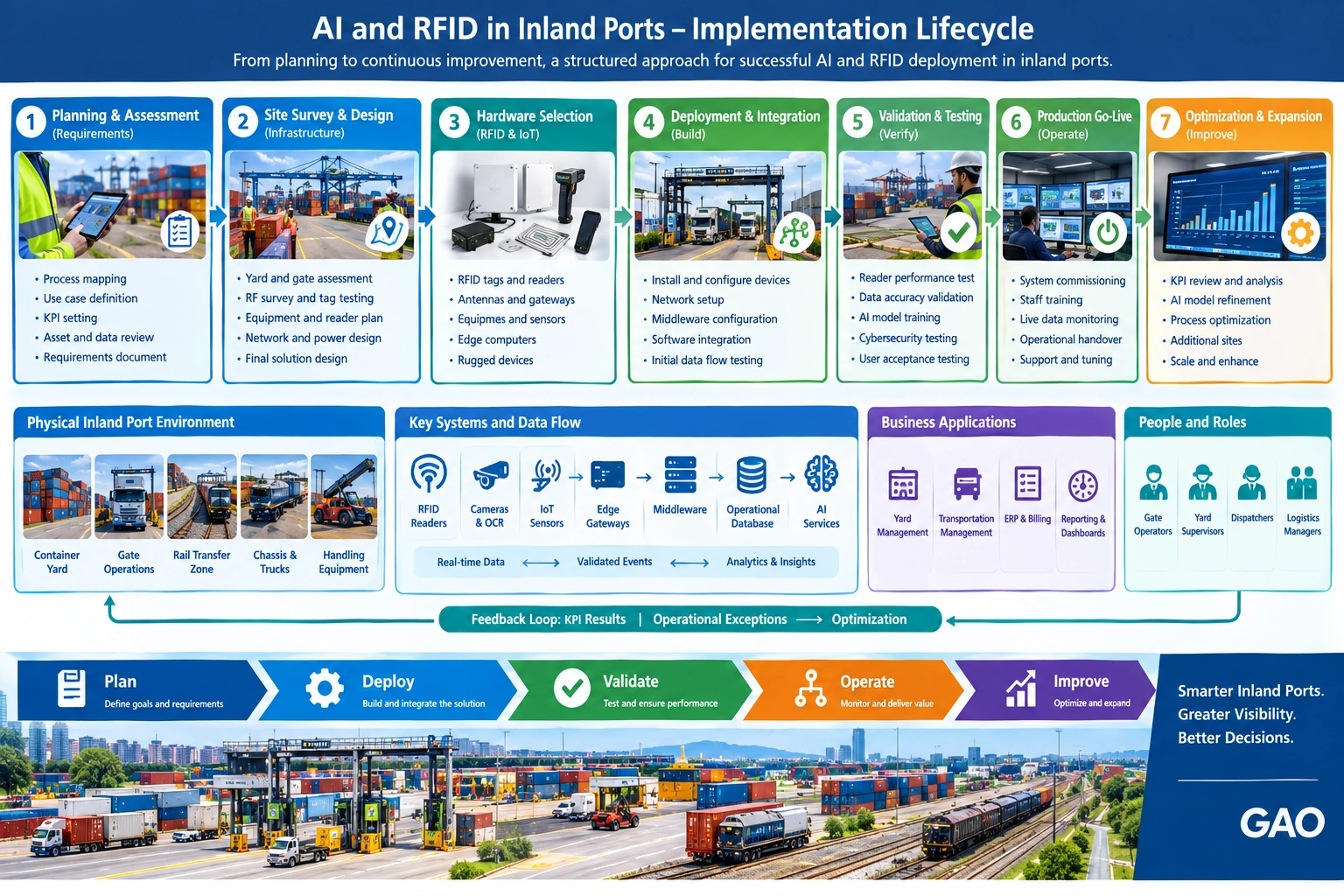
This lifecycle diagram presents the progression from operational planning and site assessment through RFID and IoT deployment, integration, validation, production commissioning, and continuous optimization. It connects physical inland-port operations with data systems, AI services, business applications, operational roles, KPI feedback, cybersecurity testing, and multi-site expansion.
Operational Benefits of AI-Enabled Inland Port Visibility
The value of AI for inland ports comes from improving decisions made from operational data rather than from the presence of AI itself.
Faster Exception Detection
AI can continuously evaluate movement and transaction data instead of relying exclusively on periodic manual reports. This can bring attention to unusual dwell times, possible mislocations, unexpected movements, and processing delays sooner.
Improved Yard Utilization
Predictive analysis can help operations teams understand how container arrivals, departures, dwell times, and yard occupancy interact. Better visibility can support more informed storage and staging decisions.
Reduced Manual Searching
Location verification and historical event analysis can reduce the time personnel spend reconstructing where a container, chassis, or other tracked asset was last observed. This is especially useful when multiple yard blocks and transportation interfaces are involved.
Better Gate Throughput
Forecasting truck arrival patterns and analyzing gate transaction duration can provide earlier visibility into potential queues. RFID-based asset identification can automate selected identification steps where the physical deployment supports reliable reads.
Improved Equipment Utilization
Combining asset identification, telematics, work assignments, and maintenance information allows operations teams to analyze how terminal tractors, chassis, reach stackers, and other equipment are being used.
Scalable Multi-Site Reporting
A common event model can allow organizations operating multiple inland-port facilities to compare operational measurements while retaining facility-specific workflows. Cloud-based AI services can centralize analytics, while local processing can continue handling time-sensitive identification events.
Stronger Operational Traceability
A properly designed system can preserve a chronological relationship between physical observations, validated events, software transactions, AI analysis, and human actions. This supports operational investigation and makes AI recommendations more explainable.
GAO Expertise for Inland Port RFID and IoT Systems
GAO is headquartered in New York City and Toronto, Canada, and is ranked among the top 10 leading B2B and B2G BLE and RFID suppliers globally. GAO provides RFID, BLE, and IoT hardware products and systems for organizations that require physical asset identification, data capture, and connected operational processes.
GAO and its sister companies, GAO Research Inc. and GAO Tek Inc., form GAO Group, with operations based in New York City and Toronto. For three decades, GAO Group has served organizations across the United States and Canada, including Fortune 500 companies, leading research and development organizations, universities, and government agencies.
Our engineering approach emphasizes matching RFID hardware and IoT devices to the physical environment and the operational process. For inland ports, this can involve evaluating fixed readers, antennas, handheld devices, tags, gateways, and related connectivity according to gate configuration, container handling, yard conditions, and integration requirements.
GAO Group has invested heavily in research and development and maintains stringent quality assurance processes. Technical support is available remotely or onsite, which can be important when RFID performance depends on physical installation conditions and operational commissioning.
Key Recommendations for AI and RFID in Inland Ports
Successful AI-enabled inland-port operations depend on treating identification, data quality, AI, and human workflows as one operational process.
- Start with measurable inland-port problems such as container dwell, gate queues, mislocated assets, equipment utilization, or rail-transfer coordination.
- Define the operational event before selecting the RFID reader or tag.
- Use UHF RFID for appropriate longer-range automated identification scenarios and evaluate HF or LF where shorter-range identification better matches the workflow.
- Combine RFID with OCR, GPS, telematics, computer vision, and existing yard transactions when those technologies provide complementary evidence.
- Use middleware to filter raw RFID observations and create validated business events.
- Preserve source identifiers, timestamps, locations, and transaction references for traceability.
- Design edge processing and local buffering for gate and yard processes that must continue during temporary network interruptions.
- Select Cloud Version, Server Version, or a hybrid deployment according to connectivity, data governance, latency, IT control, and multi-site requirements.
- Establish cybersecurity controls for readers, gateways, servers, APIs, operator applications, and remote administration.
- Test RFID performance using representative containers, chassis, vehicles, and operating speeds before scaling.
- Keep human personnel involved when AI identifies operational, security, or asset-location exceptions.
- Measure operational KPIs before and after deployment to verify actual improvements.
- Expand successful pilots using documented engineering measurements and lessons learned rather than assuming identical performance at every yard.
Moving Toward AI-Enabled Inland Port Operations
AI can give inland-port teams a more predictive view of gate demand, container dwell, yard congestion, equipment utilization, and movement exceptions when operational data is timely, correctly identified, and connected to business context. RFID can contribute the physical identification events required to connect selected assets and movements with those AI workflows.
The most effective implementation is therefore not simply an RFID installation or an AI project. It is a coordinated operational improvement program covering process definition, identification, event processing, software integration, cybersecurity, AI analytics, human validation, and KPI measurement.
GAO can support organizations evaluating RFID and IoT hardware products and systems for inland-port applications, including the technical considerations involved in moving from site assessment and pilot deployment toward production operation. Readers can explore GAO’s RFID, BLE, and IoT technologies, technical resources, and engineering support to determine how these capabilities may fit their specific inland-port requirements.
Building the Future of Industrial AI and IoT with Aperture Venture Studio and GAO
For more than three decades, GAO Group of Companies has invested heavily in R&D for industrial RFID, BLE, and IoT. As generative AI became useful for industrial applications, we expanded our work in AIoT, including RFID and BLE technologies, and founded Aperture Venture Studio to develop AI and IoT capabilities relevant to operational environments such as inland ports and transportation logistics.
Aperture has attracted AI and IoT technical experts, entrepreneurial and operational executives, investors, and leading companies. We have also developed the Aperture Ventures Summit and TekSummit to discuss advanced AI and IoT topics.
We welcome participation as:
- Advisors, co-founders, or employees
- Investors
- Customers