
AI and RFID for Luxury Retail
AI-Driven Luxury Retail Operations with RFID and IoT
Luxury retail is increasingly using Artificial Intelligence of Things, or AIoT, to connect product-level data with inventory intelligence, store operations, loss prevention, fulfillment, and client service. AI models can turn continuous data from RFID-tagged merchandise, IoT sensors, point-of-sale systems, cameras, and enterprise software into operational recommendations for luxury boutiques, distribution centers, stockrooms, and omnichannel fulfillment.
For luxury brands, the objective is not simply to identify a handbag, watch, garment, shoe, or accessory. The objective is to understand where an item is, whether its recorded status is correct, how quickly it can be located, whether it is available for a client order, and whether an operational event requires attention. RFID provides item-level identification while AI can interpret inventory movements, discrepancies, demand patterns, and operational signals.
GAO supplies RFID, BLE, and IoT hardware products and systems that can support these applications. Headquartered in New York City and Toronto, Canada, GAO serves organizations across the United States and Canada, including Fortune 500 companies, R&D organizations, universities, and government agencies. Its engineering-oriented approach combines hardware selection, system integration, quality assurance, and technical support.
What AIoT Means for Luxury Retail
AIoT combines artificial intelligence with connected devices, sensors, equipment, and digital systems. In luxury retail, this means that product-level information can become an input to AI-assisted operational decisions rather than remaining isolated in inventory records.
The practical relationship is straightforward:
- RFID identifies individual merchandise and captures item-level inventory events.
- IoT connectivity transports information from readers, sensors, handheld devices, and other connected equipment.
- Middleware filters, validates, and associates raw identification events with business transactions.
- Retail software connects item information with inventory, order management, warehouse management, point-of-sale, and customer-service processes.
- AI and machine learning analyze historical and real-time information to identify patterns, anomalies, demand signals, and operational priorities.
- Store associates and operations teams receive actionable information through applications, dashboards, alerts, or automated workflows.
For luxury retail, this distinction is important. A traditional inventory report may indicate that ten units of a particular SKU should be present. An item-level RFID system can determine which specific units were detected and where they were last observed. AI can then analyze discrepancies between expected and observed inventory, identify unusual movement patterns, prioritize cycle counts, or support replenishment decisions.
Computer vision can provide another source of information. For example, image-based systems may help assess shelf or display conditions, while RFID provides product identity. Combining these sources can give retail teams a more complete view of merchandise and store conditions.
Luxury Retail Applications for AI-Based Inventory Intelligence
AI Inventory Management for High-Value Merchandise
Inventory accuracy is particularly important when individual products have high unit values and may move between sales floors, stockrooms, distribution centers, repair facilities, and client orders.
AI-assisted inventory management can use RFID observations and transactional data to identify discrepancies between expected and observed merchandise. Instead of treating every discrepancy equally, analytical models can help prioritize exceptions according to factors such as product value, sales velocity, location, historical discrepancy rates, or time since the last confirmed observation.
Potential operational applications include:
- Automated identification of inventory discrepancies
- Prioritized cycle counting for high-value merchandise
- Faster location of specific products for client requests
- Detection of unexpected product movements
- Improved visibility of stockroom and sales-floor inventory
- Support for omnichannel order fulfillment
- Analysis of recurring inventory adjustment patterns
GAO can support these deployments with RFID readers, antennas, handheld equipment, tags, gateways, and related IoT components selected according to the physical characteristics of the luxury retail environment.
AI-Assisted Stockroom and Store Operations
Luxury boutiques often require rapid movement of merchandise between stockrooms and sales floors. Associates may need to locate a specific size, color, model, collection, or individual serialized item while serving a client.
An AI-enabled system can combine item-level RFID observations with inventory records to determine which merchandise requires attention. A staff application could identify products expected in a particular stockroom but not recently observed, or suggest a search sequence based on the item’s last known location.
This approach can reduce time spent manually searching racks, drawers, cabinets, display areas, and back-of-house storage. The resulting operational data can also reveal recurring bottlenecks, such as frequently misplaced products or areas where inventory records require repeated reconciliation.
AI for Omnichannel Fulfillment
Luxury retailers increasingly coordinate boutique inventory with online orders, client appointments, ship-from-store processes, and reserve-online workflows. These processes depend on accurate availability information.
RFID can provide a physical confirmation layer for merchandise that enterprise software believes is available. AI can use this information alongside order and inventory data to identify potential fulfillment risks.
Relevant applications include:
- Identifying inventory that is theoretically available but has not been recently observed
- Prioritizing physical verification before confirming high-value orders
- Supporting store-to-store inventory searches
- Identifying suitable fulfillment locations
- Detecting repeated fulfillment exceptions
- Improving order allocation using historical operational data
The objective is not to have AI independently determine every fulfillment decision. Rather, AI can provide a decision-support layer that helps associates and operations teams act on more reliable merchandise information.
AI and RFID Luxury Retail Order Fulfillment Workflow
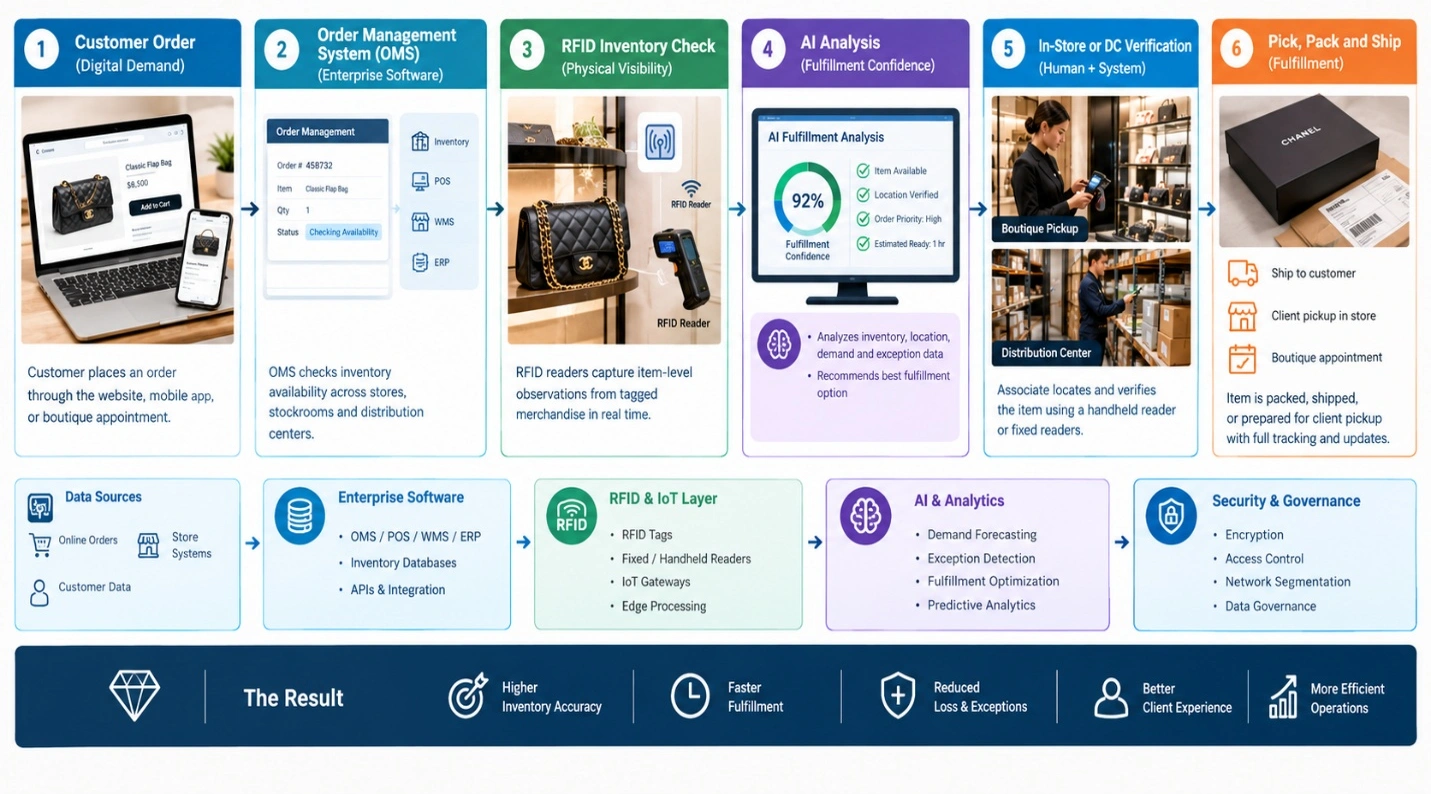
This workflow illustrates how a luxury retail order moves from digital customer demand through the order management system, RFID-based physical inventory verification, AI fulfillment analysis, and human item verification to final shipment or client pickup. It highlights how RFID, enterprise software, AI analytics, and human actions work together to improve inventory visibility and fulfillment operations.
From Product Detection to AI-Assisted Business Action
A practical luxury retail AIoT deployment begins with physical data acquisition. RFID readers installed at suitable locations or used through handheld devices detect tagged merchandise. The raw observations can contain identifiers, timestamps, reader information, antenna information, and other event attributes.
Communication infrastructure transfers those events to local computing resources or centralized software. Middleware can remove duplicate reads, apply filtering rules, associate observations with locations, and correlate item events with inventory records.
The resulting information can then be integrated with retail applications such as inventory management, warehouse management, order management, point-of-sale systems, enterprise resource planning software, and other operational databases.
AI processing can occur after this normalization stage. Depending on the use case, models may perform anomaly detection, demand forecasting, classification, pattern recognition, or prioritization. The output should normally be an operationally meaningful event or recommendation rather than an unexplained prediction.
A representative workflow is:
- RFID readers and handheld devices capture merchandise observations.
- IoT gateways or local networks transport identification events.
- Edge processing filters duplicate or low-value events where appropriate.
- RFID middleware converts raw reads into usable inventory events.
- Enterprise software associates item observations with SKU, serial number, location, order, and transaction information.
- AI models analyze historical and current data.
- Rules engines or workflow software convert model results into alerts or recommended actions.
- Store associates, inventory teams, loss-prevention personnel, or distribution staff perform the appropriate business action.
- Confirmed actions are written back into operational systems, creating additional data for future analysis.
This closed operational loop is important because AI accuracy depends not only on the model but also on the quality and context of the underlying data.
AI and RFID Technical Architecture for Luxury Retail
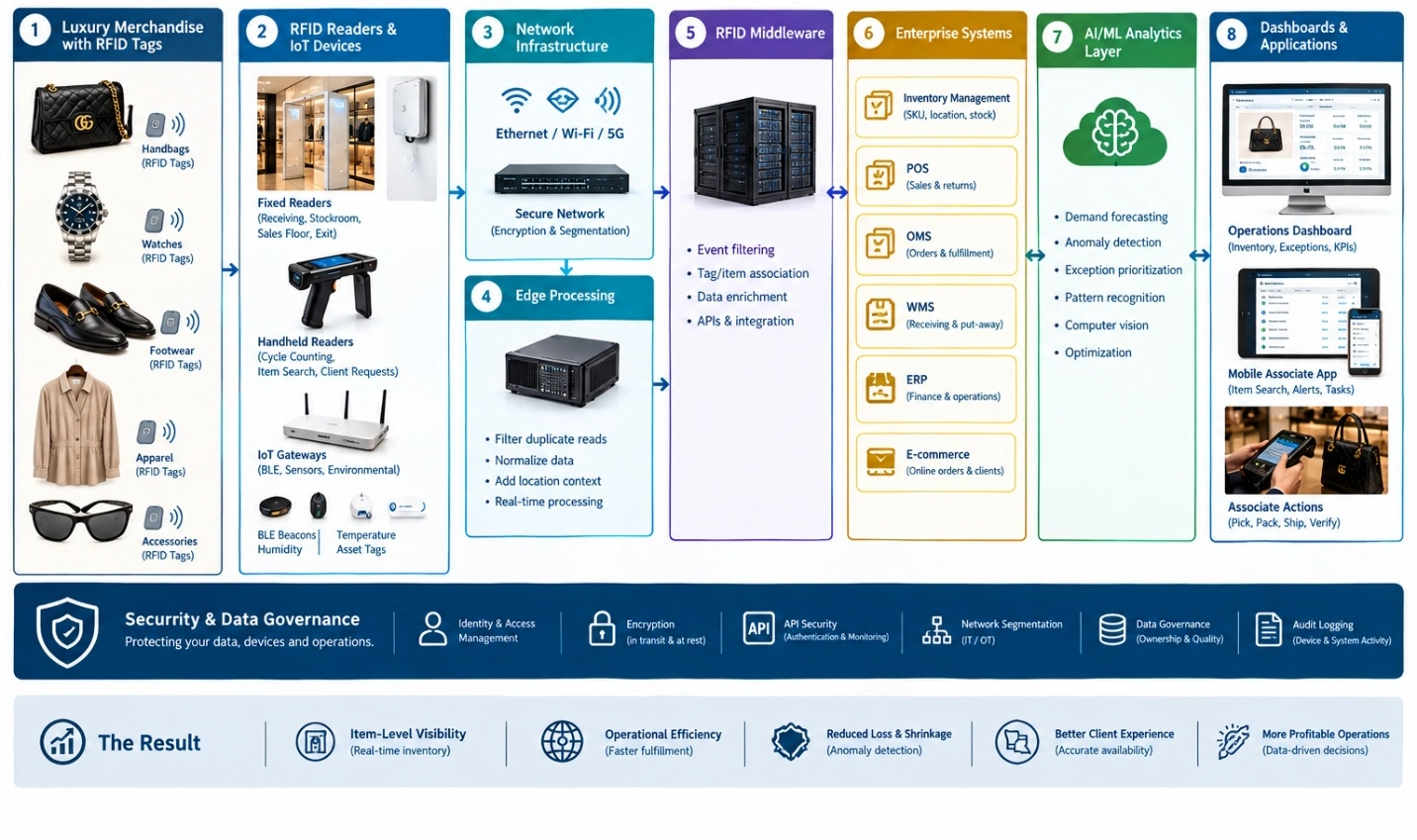
This enterprise architecture diagram illustrates how RFID-tagged luxury merchandise connects with fixed and handheld RFID readers, IoT networks, edge processing, RFID middleware, and retail enterprise systems. It also shows the AI/ML analytics layer, dashboards, mobile associate applications, and security controls that support item-level visibility and intelligent retail operations.
Hardware, Software, AI Models, and Deployment Choices
Luxury retail deployments require careful coordination between physical merchandise, store layouts, inventory processes, network infrastructure, enterprise applications, and AI services. RFID is an enabling identification technology rather than the complete solution.
UHF RFID is generally relevant when item-level identification and longer read ranges are required across merchandise, stockrooms, receiving areas, and inventory operations. HF or NFC technologies can be appropriate for selected close-range interactions depending on the product and application. LF RFID is generally associated with shorter-range identification applications and specific asset or access scenarios.
Hardware selection should consider:
- RFID tags suitable for the material and physical construction of luxury products
- Fixed RFID readers for controlled read zones
- Handheld RFID readers for cycle counting and item search
- Antennas selected according to store geometry and required read zones
- IoT gateways and network equipment
- Edge computing resources where local processing is beneficial
- Barcode or other identification technologies where dual identification is operationally useful
Software typically includes RFID middleware, inventory applications, APIs, databases, analytics software, mobile applications, and integrations with existing retail systems.
AI methods may include anomaly detection for inventory discrepancies, machine learning for demand analysis, computer vision for selected visual inspection tasks, and predictive models for operational forecasting. Edge AI can be useful when low latency or reduced transmission of raw data is important.
For cloud-hosted SaaS deployment, centralized software can provide shared access to inventory intelligence across boutiques, distribution facilities, and regional operations. This approach can simplify centralized analytics and software management.
A server deployment can instead place software on customer-managed servers, private data centers, edge servers, or other privately hosted infrastructure. This model can be appropriate where luxury retail organizations require greater control over data location, integration boundaries, network connectivity, or operational dependencies.
Security should be considered throughout the deployment. Appropriate measures can include authenticated device access, encrypted communications, API security, role-based permissions, network segmentation, logging, software patching, and controlled access to item-level and operational data.
GAO’s experience supplying RFID, BLE, and IoT hardware products and systems provides a practical foundation for deployments where physical identification equipment must work reliably with software and retail workflows.
Engineering Considerations for Luxury Retail RFID Deployment
RFID performance depends heavily on the physical environment. Luxury retail stores contain glass display cases, metal fixtures, dense product arrangements, shelving, packaging, security equipment, and changing store layouts. Materials and tag orientation can affect read performance.
A deployment should therefore begin with a site survey and representative product testing rather than assuming that one RFID configuration will work equally well throughout every store.
Important engineering considerations include:
- Tag placement and orientation on handbags, apparel, footwear, watches, accessories, and packaging
- Read-zone design for receiving, stockroom, sales-floor, and inventory-counting workflows
- Potential interference from metal surfaces and other RF-sensitive materials
- Antenna positioning and power configuration
- Reader density and network connectivity
- Separation between inventory identification and other RF systems
- Physical protection of fixed readers and network equipment
- Mobile reader ergonomics for store associates
- Integration with existing POS, inventory, OMS, WMS, and ERP processes
- Validation of read accuracy under real merchandise conditions
- Monitoring for unexpected reads and missed reads
- Procedures for tag replacement, commissioning, maintenance, and exception handling
Pilot testing should use actual merchandise and realistic operating procedures. A technically successful laboratory test does not necessarily demonstrate reliable performance when associates are moving products rapidly through a stockroom or when merchandise is densely arranged in display areas.
AI-Assisted Loss Prevention and Inventory Exceptions
Luxury merchandise creates a strong need for accurate visibility of unusual product movements, inventory discrepancies, and process exceptions. AI can help analyze patterns that may be difficult to identify through manual review.
For example, a system can compare expected inventory movements with observed RFID events. Repeated deviations from normal receiving, stock transfer, replenishment, or checkout processes may become candidates for investigation.
The technology should not be treated as an automatic determination of wrongdoing. A more appropriate operational design is to generate prioritized exceptions for trained personnel to review, using contextual information such as transaction records, item history, location, and timestamps.
Potential applications include:
- Detecting unexpected merchandise movement between controlled areas
- Identifying repeated discrepancies associated with particular workflows
- Prioritizing investigation of high-value inventory exceptions
- Supporting audit trails for merchandise movements
- Correlating RFID events with POS or inventory transactions
- Identifying process weaknesses that produce recurring discrepancies
This approach can also provide value beyond loss prevention. Repeated exceptions may indicate incorrect receiving procedures, incomplete stock transfers, inaccurate master data, tag-placement problems, or inadequate read-zone coverage.
GAO Support for Luxury Retail RFID and AIoT Systems
GAO Group companies have invested substantially in research and development of RFID, BLE, IoT, and related technologies for more than three decades. GAO supports organizations with hardware products and systems and maintains quality assurance processes alongside remote and onsite technical support.
For luxury retail, the practical focus is on matching identification hardware and IoT components to actual merchandise, store layouts, inventory workflows, and software integration requirements. The resulting solution can provide the data foundation needed for AI-assisted inventory management, fulfillment, operational analytics, and exception handling.
The next stage of a deployment should move from business requirements to site assessment, representative product testing, RFID hardware selection, software integration, pilot validation, and controlled expansion across additional stores or facilities.
Operational and Business Value of AI-Driven Luxury Retail
Combining AI with item-level identification can improve luxury retail operations by connecting physical merchandise events with business processes. The value comes from making inventory information more timely, contextual, and actionable.
Higher Inventory Accuracy
RFID observations can provide more frequent physical confirmation of merchandise than periodic manual counts. AI can analyze differences between expected and observed inventory and identify exceptions requiring attention.
For luxury retailers, this can improve visibility into high-value merchandise across stockrooms, boutiques, receiving areas, and fulfillment operations.
Faster Product Location
Associates can use handheld RFID equipment to search for specific merchandise rather than relying entirely on manual shelf-by-shelf searches. AI can further prioritize likely locations using recent item observations and inventory history.
This is particularly useful when a client requests a particular product during a sales appointment and the item must be located quickly.
Better Omnichannel Inventory Visibility
Online availability is only useful when physical inventory records correspond reasonably well with actual merchandise. Combining RFID observations with order management and inventory systems can provide an additional physical verification layer.
AI can identify items or locations where availability confidence is lower and direct operational attention toward those exceptions.
Reduced Manual Inventory Work
Traditional cycle counting can consume significant associate time. RFID can automate portions of item identification, while AI can help determine which areas or products should receive additional attention.
The result is not simply fewer manual counts. The more important improvement is directing human effort toward exceptions that require investigation.
Improved Loss-Prevention Investigation
AI-assisted analysis can identify unusual movement patterns and discrepancies across controlled merchandise processes. RFID provides the underlying item-level event information needed to establish a more detailed audit trail.
Human review remains important because an unusual event may result from a legitimate operational activity, an incorrect transaction, a system integration problem, or a physical inventory issue.
More Scalable Retail Operations
A well-designed system can extend from one boutique to multiple stores and distribution facilities while maintaining consistent data structures and operational procedures. Centralized analytics can provide cross-location visibility, while local processing can support workflows that require rapid response.
GAO can supply the RFID, BLE, and IoT hardware components needed as luxury retailers expand from pilot locations to broader deployments.
AI and RFID Benefits for Luxury Retail Operations
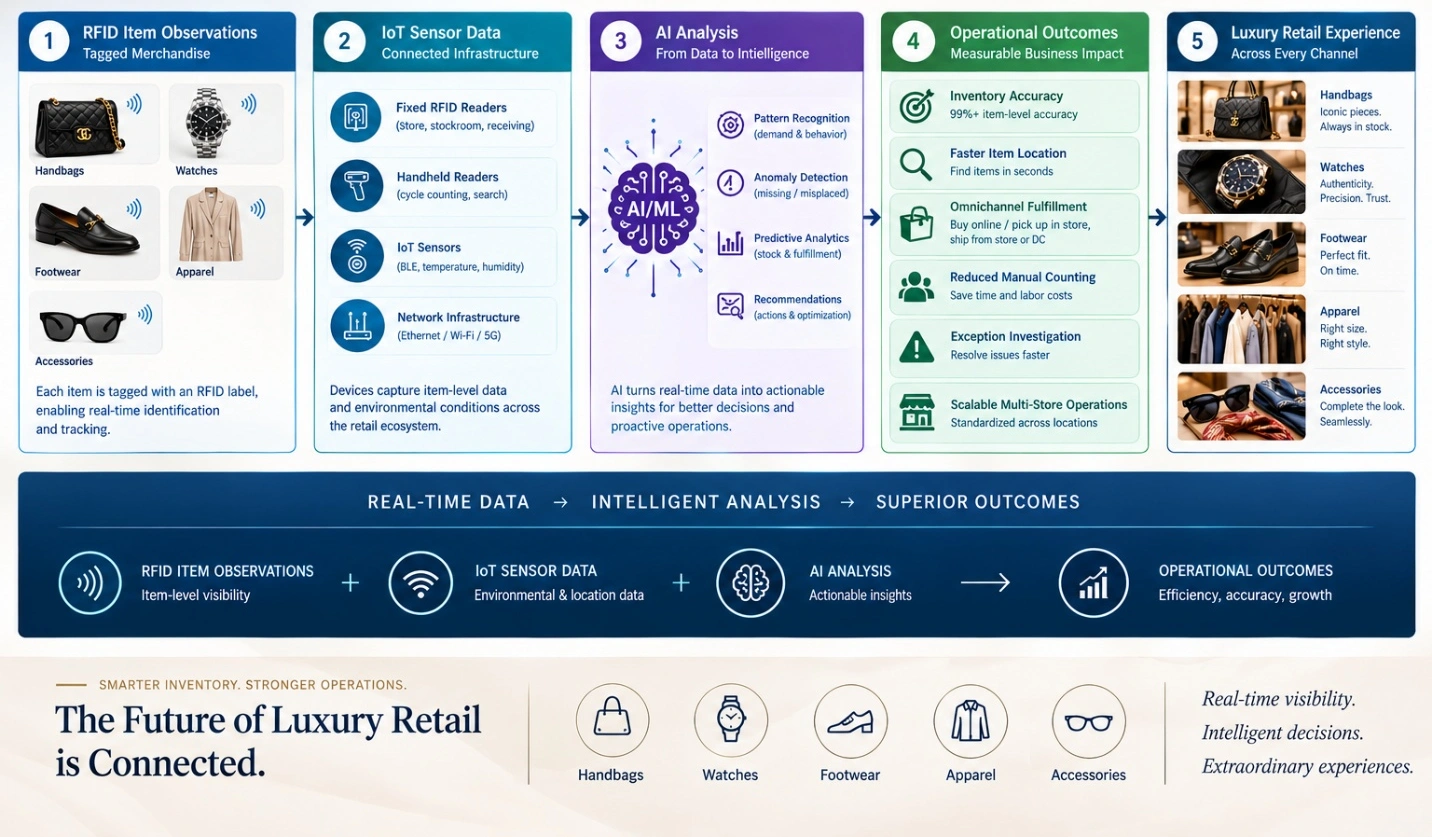
This enterprise infographic illustrates how RFID item observations and IoT sensor data flow into AI analysis to support measurable luxury retail outcomes. It highlights improved inventory accuracy, faster product location, omnichannel fulfillment, reduced manual counting, exception investigation, and scalable multi-store operations across handbags, watches, footwear, apparel, and accessories.
Key Luxury Retail KPIs for AI and RFID Deployments
Technology deployment should be evaluated using operational measurements rather than technology adoption alone. Luxury retailers can establish a baseline before implementation and compare results during pilot and production operation.
Relevant KPIs include:
- Inventory accuracy by store, stockroom, product category, or merchandise class
- Percentage of inventory physically confirmed within a defined period
- Time required to locate a specific item
- Cycle-count labor hours
- Inventory discrepancy rate
- Inventory adjustment frequency
- Order fulfillment exception rate
- Ship-from-store fulfillment accuracy
- Time required to complete receiving and put-away
- Stock transfer reconciliation time
- Merchandise availability accuracy
- Number of unresolved inventory exceptions
- High-value item discrepancy frequency
- RFID read-event quality within defined read zones
- System availability and device uptime
- Time required to resolve technical exceptions
These KPIs should be interpreted alongside operational conditions. For example, a lower discrepancy rate may result from improved physical inventory accuracy, better transaction discipline, improved read-zone coverage, or changes in counting procedures. KPI definitions should therefore remain consistent throughout the pilot and production phases.
Implementation Roadmap for Luxury Retail AIoT
A successful deployment should begin with the business process rather than with a particular RFID reader or AI model.
Requirements and Process Mapping
Document how merchandise currently moves through receiving, tagging, stockroom storage, sales-floor replenishment, client transactions, transfers, returns, fulfillment, repair, and other relevant processes.
Identify where inventory uncertainty occurs and determine which decisions would benefit from better physical visibility.
Merchandise and Site Assessment
Test representative luxury products before selecting the final RFID configuration. Handbags, apparel, watches, footwear, jewelry packaging, and accessories can have very different RF characteristics.
The site assessment should examine store construction, display fixtures, stockroom layouts, receiving areas, network availability, and potential sources of RF interference.
RFID and IoT Hardware Selection
Select tags, fixed readers, antennas, handheld readers, gateways, and associated equipment according to the actual workflow.
Hardware should be tested under realistic conditions rather than evaluated only from nominal reader specifications.
Software and Integration
Define how RFID events will connect to inventory, POS, OMS, WMS, ERP, analytics, and mobile applications. APIs and middleware should establish clear interfaces between physical identification systems and existing retail software.
Master data quality is particularly important. Item identifiers, SKU information, store identifiers, locations, and transaction records must be consistent enough for AI systems to interpret the data correctly.
Pilot Commissioning and Validation
A controlled pilot should measure operational performance against predefined KPIs. Testing should include normal operations as well as exceptions such as missing items, incorrect locations, duplicate reads, incomplete transactions, transfers, returns, and network interruptions.
AI recommendations should also be validated against actual operational outcomes before being incorporated into automated workflows.
Expansion and Optimization
After pilot validation, additional locations can be introduced according to standardized deployment procedures. Performance monitoring should continue because merchandise assortments, fixtures, store layouts, software configurations, and operating procedures can change over time.
Luxury Retail AIoT Implementation Timeline
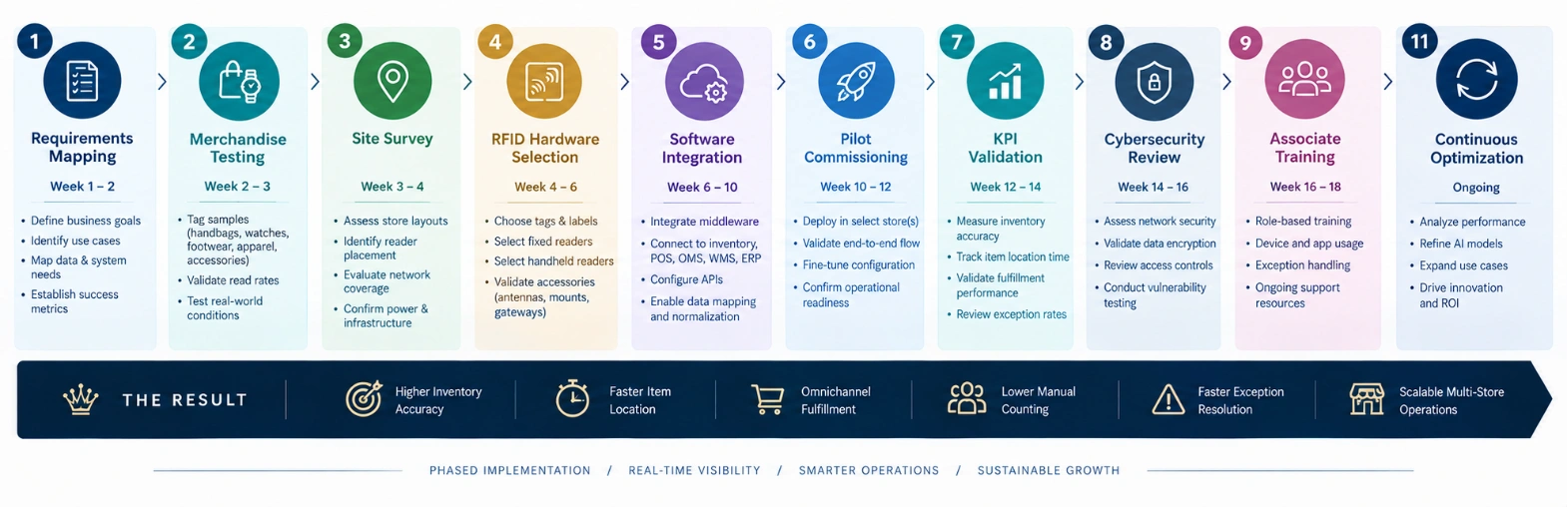
This horizontal timeline illustrates an 11-stage AIoT implementation lifecycle for luxury retail, from requirements mapping and merchandise testing through hardware selection, software integration, pilot commissioning, KPI validation, cybersecurity review, associate training, production rollout, and continuous optimization. It shows how a structured deployment approach progresses toward improved inventory accuracy, faster item location, omnichannel fulfillment, and scalable multi-store operations.
Cybersecurity, Data Quality, and Interoperability
AI-driven retail systems are only as dependable as the information entering them. Cybersecurity and data governance should therefore be incorporated from the beginning of the project.
Device identities should be controlled, communications should use appropriate encryption, and network segmentation can help isolate RFID and IoT equipment from unrelated systems. Access to operational dashboards and inventory information should follow role-based permissions.
API endpoints connecting RFID middleware with retail software should be authenticated and monitored. Logging can provide visibility into device activity, system changes, integration errors, and unusual data events.
Data quality requires equal attention. Duplicate RFID reads, missed reads, incorrect tag associations, stale inventory records, and inconsistent location identifiers can produce misleading analytical results.
AI models should therefore receive normalized and contextualized data. A model trained on clean inventory events may behave poorly when deployed against noisy or incomplete event streams.
Interoperability is also important for long-term deployment. Luxury retailers may already operate POS, OMS, WMS, ERP, CRM, e-commerce, warehouse, and analytics systems from multiple vendors. RFID and AI solutions should connect to these systems through documented interfaces rather than creating isolated operational data.
Practical Trade-Offs in Luxury Retail Deployment
There is no single RFID or AI configuration suitable for every luxury retail environment. Engineering decisions involve trade-offs.
Higher reader coverage may improve visibility in certain areas but can increase installation complexity and the number of RF events requiring filtering. More frequent physical observations can improve inventory freshness but may also increase data-processing requirements.
Cloud deployment can simplify centralized analytics and support multi-location visibility, while privately hosted server deployments can provide greater control over infrastructure and data handling. The appropriate choice depends on organizational requirements, network conditions, integration constraints, and operational policies.
Automation also requires careful boundaries. Fully automated decisions may be appropriate for some low-risk workflow events, while high-value inventory exceptions may require human verification.
The most effective implementation is therefore usually the one that balances read performance, data quality, operational simplicity, security, integration effort, and measurable business outcomes.
Where AI Adds the Most Value to Luxury Retail RFID Data
AI should be applied where conventional rules and reporting are insufficient to manage the volume or complexity of retail information.
Useful AI applications include:
- Anomaly detection for unexpected merchandise movements
- Predictive analysis of inventory discrepancies
- Demand forecasting using historical sales and inventory signals
- Exception prioritization for high-value merchandise
- Pattern analysis across stores and stockrooms
- Computer vision for selected display and visual inspection applications
- Intelligent search and item-location assistance
- Forecasting of operational workload
- Detection of recurring fulfillment problems
- Natural-language interfaces for querying operational information
The strongest use cases generally combine a clear operational decision with measurable data inputs. AI should not be added merely because data is available.
For example, an inventory team may ask, “Which discrepancies should we investigate first?” This is a more actionable AI problem than simply asking for a generic prediction of inventory accuracy.
GAO’s Role in AI-Enabled Luxury Retail Solutions
GAO’s work across RFID, BLE, and IoT technologies provides hardware and system components that can serve as the physical data layer for intelligent retail applications. Its sister companies, GAO Research and GAO Tek, form the broader GAO Group, with operations based in New York City and Toronto, Canada.
For more than three decades, GAO Group has served customers in the United States and Canada, including Fortune 500 companies, leading R&D organizations, prestigious universities, and U.S. and Canadian government agencies. The group has invested substantially in R&D and maintains quality assurance processes and technical support capabilities.
For luxury retail projects, GAO’s relevant contribution can include RFID tags, readers, antennas, handheld equipment, BLE and IoT devices, gateways, and related systems. These components can be incorporated into inventory visibility, stockroom management, asset tracking, fulfillment, and AI-assisted operational solutions.
The practical objective is to connect reliable physical data capture with the software and workflows that luxury retailers already depend on.
Building a Reliable AIoT Foundation for Luxury Retail
Luxury retail AI initiatives should begin with a clearly defined operational problem, measurable KPIs, representative merchandise testing, and an integration plan.
RFID can provide item-level physical visibility, while AI can transform large volumes of inventory and operational data into prioritized information. IoT connectivity, edge processing, middleware, enterprise software, and secure communications connect these capabilities into an operational workflow.
Key implementation recommendations include:
- Start with a high-value workflow where improved visibility can be measured.
- Test RFID tags and readers with actual luxury merchandise.
- Map receiving, stockroom, sales-floor, transfer, return, and fulfillment processes before implementation.
- Establish baseline inventory and labor KPIs.
- Normalize RFID events before feeding them into AI models.
- Integrate with existing retail systems rather than creating isolated information stores.
- Use human review for high-impact inventory exceptions.
- Apply cybersecurity controls to devices, networks, APIs, applications, and data.
- Validate AI recommendations against real operational results.
- Scale only after the pilot demonstrates repeatable performance.
GAO can help organizations evaluate RFID, BLE, and IoT hardware and system requirements for these applications, including technical support for deployment and integration.
Key Takeaways for AI and RFID in Luxury Retail
AI-driven luxury retail is fundamentally about improving the connection between physical merchandise and operational decisions. RFID can identify individual products and provide physical inventory observations, while AI can analyze those observations alongside transactions, orders, locations, and historical patterns.
The combination can support more accurate inventory management, faster product location, better omnichannel fulfillment, exception prioritization, and more informed loss-prevention investigations.
Successful deployments depend on practical engineering. Tag selection, reader placement, RF testing, data normalization, integration, cybersecurity, KPI design, associate workflows, and ongoing maintenance all influence the final result.
GAO provides RFID, BLE, and IoT hardware products and systems that can form part of these solutions. Organizations evaluating luxury retail AIoT can begin by identifying a measurable inventory or operational problem and determining what physical data is required to solve it.
Building the Future of Industrial AI and IoT with Aperture Venture Studio and GAO RFID Inc.
For more than three decades, GAO Group of Companies has invested heavily in R&D involving industrial RFID, BLE, and IoT. As generative AI has demonstrated practical value in industrial applications, we have continued developing AI and IoT technologies, including RFID and BLE, and founded Aperture Venture Studio to build, launch, and scale next-generation AI and IoT companies and solutions relevant to industries such as luxury retail.
Aperture has attracted AI and IoT technical experts, entrepreneurial and operational executives, influential investors, and leading companies.
We have also developed the Aperture Ventures Summit and TekSummit to discuss advanced topics in AI and IoT and foster technical communities around these technologies.
We welcome you to join us as:
- Advisors, Co-founders, or Employees
- Investors
- Customers