
AI and BLE for Satellite Integration
AI-Enabled Satellite Integration with BLE Asset Tracking and Monitoring
Satellite integration requires precise control of flight hardware, avionics, payload components, ground-support equipment, tooling, test equipment, serialized materials, and maintenance resources across receiving, inspection, integration, testing, storage, and launch preparation. AI and IoT can transform these operations by converting asset-location, environmental, inspection, and operational data into actionable decisions. BLE beacons, BLE sensors, and BLE gateways provide localized wireless data acquisition, while AI models can correlate that information with manufacturing records, configuration data, maintenance history, and integration schedules. For satellite integration teams, the result is better visibility into where hardware is located, whether controlled conditions are being maintained, which components are ready for integration, and where process deviations may require attention. GAO provides BLE, RFID, and other IoT hardware products and systems that can support these data-driven workflows across aerospace facilities and controlled technical environments.
Satellite Integration AIoT Operations Overview
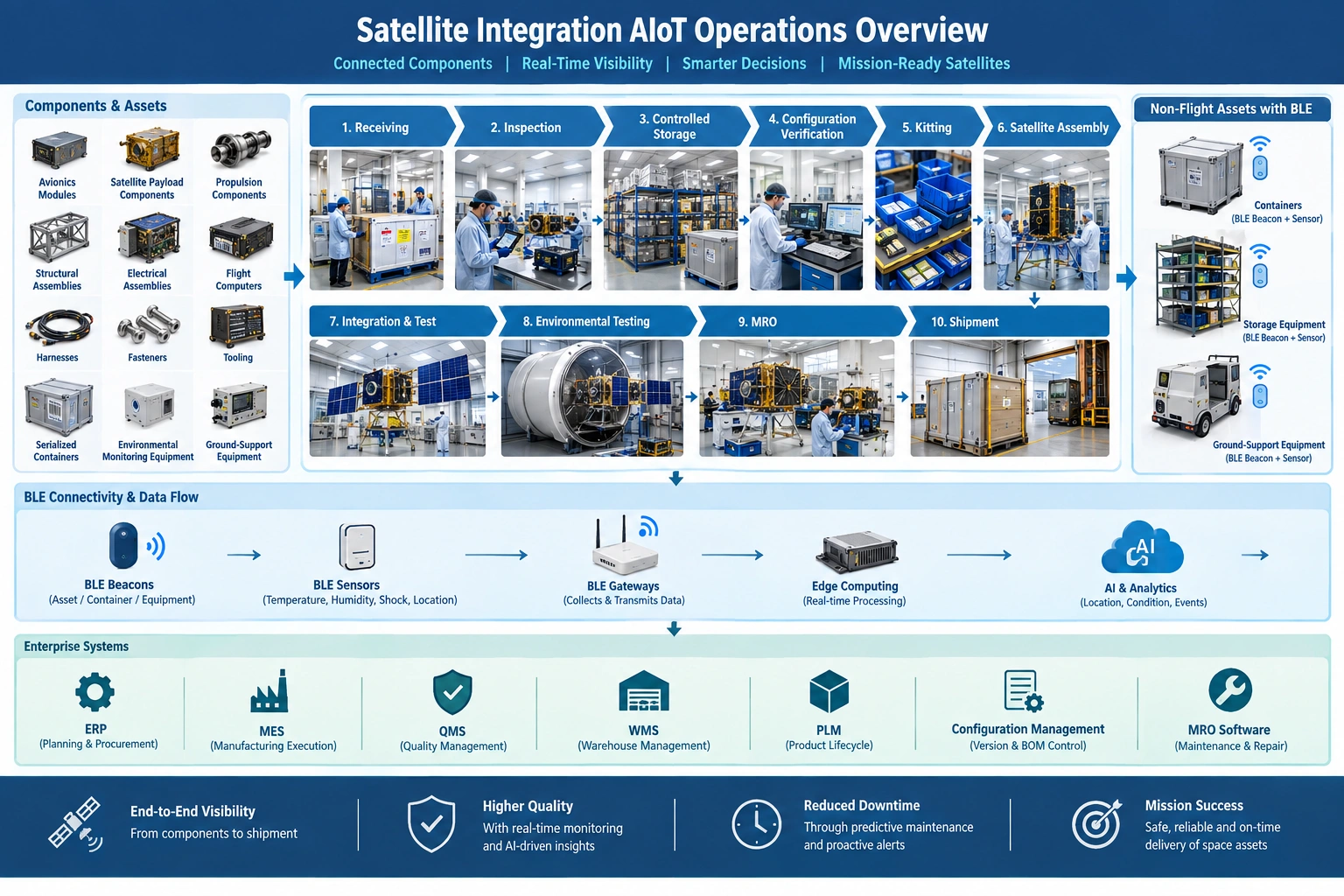
This infographic illustrates how AIoT, BLE connectivity, edge computing, and enterprise systems support satellite component tracking and monitoring across receiving, inspection, storage, assembly, testing, MRO, and shipment.
How AI Supports Modern Satellite Integration
Satellite integration involves tightly controlled activities where configuration accuracy, hardware traceability, environmental control, and schedule coordination directly affect mission readiness. AI can help integration teams interpret operational data from connected equipment and identify patterns that are difficult to detect through manual monitoring. A practical AIoT solution does not replace configuration management, engineering approvals, quality procedures, or established aerospace controls. Instead, it adds an analytical capability that can correlate sensor observations with authorized engineering and operational records. For example, AI can evaluate whether a satellite component has remained in an approved storage area, identify unusual movement of a serialized container, detect environmental excursions, predict maintenance requirements for ground-support equipment, or flag inconsistencies between physical assets and integration records. BLE supports these applications by providing short-range wireless identification, location, and sensing capabilities. BLE gateways collect data from beacons and sensors and forward relevant events to edge or server-based software. The resulting information can then be associated with PLM, ERP, MES, QMS, WMS, MRO, or configuration-management records. The most valuable implementation is therefore not simply an asset-location system. It is a controlled information flow connecting physical satellite hardware and integration operations with AI-assisted operational decisions.
Satellite Integration Workflows Where AI Delivers the Most Value
Satellite integration facilities contain multiple operational zones with different requirements for traceability, environmental control, access, handling, and configuration management. AI applications should therefore be designed around specific workflows rather than deployed as a generic monitoring solution.
Receiving and Hardware Verification
Incoming satellite components may include avionics, payload hardware, electrical assemblies, structural components, test equipment, and specialized tooling. Receiving teams need to confirm that physical items correspond to procurement, engineering, quality, and configuration records. AI-assisted receiving can correlate identification events, supplier information, inspection results, and historical records to identify discrepancies before hardware reaches the integration floor. BLE-enabled containers can provide location visibility after receiving, particularly for high-value equipment that moves between inspection areas, controlled storage, laboratories, and integration cells. GAO BLE hardware can be incorporated into these workflows where wireless visibility is appropriate and where the facility’s RF environment permits reliable operation.
Controlled Storage and Environmental Monitoring
Satellite components can have strict requirements concerning temperature, humidity, shock, vibration, electrostatic discharge controls, contamination, or handling procedures. BLE sensors can collect environmental measurements from storage locations or transport containers. AI can analyze historical readings and detect abnormal patterns rather than relying only on threshold alarms. For example, a temperature reading that remains technically within an approved range but gradually trends toward an unacceptable condition can trigger an earlier operational review. This capability is particularly useful for long-duration storage of sensitive electronic assemblies, batteries, payload equipment, materials, and specialized components.
Kitting and Integration Preparation
Satellite integration depends heavily on correct kitting. Engineering teams may require specific components, fasteners, harnesses, instruments, adapters, tooling, and test equipment for a particular integration operation. AI can compare planned work orders with physical availability and movement records to identify missing or incorrectly staged resources. Location information from BLE beacons can help technicians locate containers, mobile tooling, test equipment, and other tagged resources without manually searching multiple work areas. The AI system should remain connected to authorized work orders and configuration records so that recommendations do not override formal engineering controls.
Assembly, Integration and Test
During satellite assembly and integration, hardware can move through cleanrooms, integration bays, electrical test areas, functional-test stations, and environmental-test facilities. AI can correlate asset movement with scheduled operations and identify unusual events such as equipment remaining in an unexpected zone, test equipment being moved before a scheduled procedure, or a required resource not reaching an integration cell within the expected window. BLE gateways positioned around relevant operational areas can provide the underlying location events. Edge processing is useful when immediate local decisions are required or when facility connectivity is restricted.
Ground-Support Equipment and Tooling
Ground-support equipment, calibration instruments, lifting equipment, specialized tooling, and test systems are essential to satellite integration even though they are not necessarily part of the flight configuration. AI-driven asset management can analyze utilization, movement, inspection status, calibration dates, and maintenance history. This can help integration managers identify underused equipment, prevent unavailable tooling from delaying scheduled operations, and prioritize maintenance based on actual usage.
AI-Driven Satellite Integration Workflow
A robust implementation follows a defined data path from physical events to operational action.
- Data acquisition: BLE beacons identify tagged containers, tooling, mobile equipment, and other approved assets, while BLE sensors capture relevant environmental or condition measurements.
- Wireless communication: BLE gateways collect local advertisements and sensor transmissions from defined operational areas.
- Edge processing: Gateway or edge software can filter duplicate events, normalize sensor readings, apply local rules, and reduce unnecessary transmission.
- Data transport: Validated events can be transferred through the facility network using appropriate IP-based communication methods and secure APIs.
- Data storage: Operational records can be stored in databases or enterprise applications according to the organization’s retention and configuration-control requirements.
- AI analysis: Machine-learning models, anomaly detection, forecasting, classification, or rules-assisted AI can evaluate movement, environmental, utilization, and operational data.
- Enterprise integration: Relevant events can be associated with PLM, ERP, MES, QMS, WMS, MRO, inventory, maintenance, or configuration-management records.
- Operational decision: Authorized personnel receive alerts, dashboards, exceptions, recommendations, or workflow tasks.
- Action and verification: The integration team investigates the event, performs the required action, records the result, and maintains an auditable operational history.
BLE, AI Models and Supporting Systems for Satellite Integration
The technical implementation should begin with the satellite integration workflow and its data requirements rather than with a specific wireless device. BLE beacons, BLE sensors, and BLE gateways become useful when they provide reliable data that can be associated with engineering, quality, inventory, maintenance, or integration records.
BLE Beacons for Asset and Container Visibility
BLE beacons can be attached to approved non-flight assets such as serialized containers, mobile tooling, ground-support equipment, test instruments, material carts, and maintenance equipment. Their primary role is to provide a wireless identity that can be detected by nearby gateways. Depending on deployment design, beacon observations can support zone-level or more granular location estimation. Flight hardware requires special consideration. Wireless devices should not automatically be attached to flight-qualified hardware simply because they are technically capable of doing so. Electromagnetic compatibility, contamination, battery safety, mechanical attachment, qualification, and mission-specific requirements must be evaluated before any deployment involving flight articles.
BLE Sensors for Condition Monitoring
BLE sensors can measure parameters such as temperature, humidity, acceleration, vibration, or other supported conditions. For satellite integration, the important engineering question is not how many parameters can be measured, but which measurements have operational significance. A temperature sensor inside a controlled component container, for example, can provide useful evidence for storage and handling conditions. An accelerometer attached to appropriate transport equipment can potentially identify shock events during movement. Sensor calibration, measurement accuracy, sampling frequency, battery life, data retention, and placement should be specified according to the actual operational requirement.
BLE Gateways for Facility-Level Data Collection
BLE gateways receive wireless data from nearby beacons and sensors and transfer it to software systems. Gateway placement should consider cleanroom layouts, walls, metallic structures, equipment enclosures, RF interference, required coverage, and the expected movement paths of tagged assets. A satellite integration facility may require different gateway densities in receiving areas, cleanrooms, integration bays, storage rooms, laboratories, and test facilities. A site survey and commissioning process should therefore precede large-scale deployment.
AI and Machine Learning
AI can operate on several classes of satellite integration data.
- Anomaly detection can identify unusual movement or environmental behavior.
- Predictive analytics can estimate maintenance requirements for frequently used ground-support equipment.
- Classification models can categorize operational events based on historical patterns.
- Time-series models can analyze environmental sensor readings and identify developing trends.
- Computer vision can complement wireless asset data during inspection or assembly activities where camera deployment is permitted.
- Optimization models can support resource allocation, staging, equipment utilization, and maintenance scheduling.
AI outputs should be treated as decision support unless the applicable aerospace process has explicitly validated and authorized automated control.
Cloud and Server Deployment for Satellite Integration
Satellite integration organizations often have strict requirements concerning data sovereignty, cybersecurity, network segmentation, facility connectivity, and control over engineering information. These requirements influence whether AI and BLE software should operate through cloud-hosted services, privately hosted servers, or a hybrid arrangement.
Cloud Version
A cloud-hosted deployment can centralize BLE event data, analytics, dashboards, device management, and multi-site reporting. This approach can be useful when an organization operates multiple integration facilities or needs centralized visibility across geographically separated warehouses, laboratories, manufacturing locations, and MRO operations. Cloud deployment can also simplify software scaling and centralized analytics. However, network availability, cybersecurity controls, data classification, supplier access, and integration with restricted engineering systems must be assessed before transmitting operational data outside the facility.
Server Version
A privately hosted server deployment can run on an edge server, customer-managed server, private data center, factory server, or other controlled infrastructure. This model can be appropriate where satellite integration data must remain within an organization’s controlled network or where facility operations must continue during loss of external connectivity. Edge or local processing can also reduce latency for time-sensitive alerts. A hybrid design may retain sensitive operational data locally while transferring approved analytical information to a central service. GAO can support organizations evaluating BLE hardware and IoT system requirements for these deployment scenarios, including applications involving controlled facilities, asset monitoring, and operational data collection.
Cybersecurity and Interoperability Considerations
Satellite integration systems should be treated as part of a broader controlled information environment. BLE devices may sit at the physical edge of the system, but the resulting information can ultimately interact with engineering, manufacturing, quality, maintenance, and logistics applications. Security controls should therefore address the entire data path.
- Use authenticated gateways and controlled device enrollment.
- Segment wireless and operational networks according to facility requirements.
- Encrypt data during network transmission and protect stored operational records.
- Apply role-based access controls to dashboards, APIs, configuration records, and administrative functions.
- Maintain device inventories and software or firmware version records.
- Monitor gateway connectivity and unexpected device behavior.
- Establish retention and audit policies for operational events.
- Validate API integrations before connecting production systems.
Interoperability is equally important. BLE data becomes significantly more useful when standardized event structures and APIs allow location, condition, and asset information to be associated with existing satellite integration records instead of creating another isolated database.
Technical Capabilities and Operational Improvements
AI-enabled satellite integration can provide value across traceability, environmental monitoring, equipment utilization, maintenance planning, integration readiness, and exception management. The value comes from combining physical observations with engineering and operational context rather than from wireless sensing alone. A BLE event indicating that a container entered an integration area becomes more useful when software can associate that event with a work order, approved storage condition, component record, or scheduled integration activity.
AI-Assisted Asset Traceability
Satellite programs often handle serialized components and support equipment that must remain associated with accurate records throughout their lifecycle. AI can correlate location events with asset identity, movement history, work orders, and configuration information to identify inconsistencies.
A system can flag situations such as a component appearing in an unauthorized area, a required container remaining in storage beyond its planned release time, or ground-support equipment being unavailable when an integration procedure is scheduled.
The objective is not simply to display the last known location. The objective is to turn location history into operational intelligence.
Environmental Condition Intelligence
Environmental monitoring can generate substantial time-series data. AI can analyze temperature, humidity, vibration, acceleration, and other available measurements to identify trends and abnormal conditions.
Traditional threshold monitoring may generate an alert only after a value crosses a predefined limit. Anomaly detection can identify unusual changes before a fixed threshold is exceeded.
For satellite integration, this distinction can be important when components have tightly controlled storage or handling requirements. Historical sensor data can also support investigation after an environmental event by providing an auditable record of conditions.
Predictive Maintenance for Ground Equipment
Ground-support equipment and specialized test equipment can become operational bottlenecks when maintenance or calibration is overdue.
AI can combine equipment usage, movement, inspection records, operating hours, historical failures, and maintenance events to estimate maintenance requirements.
A maintenance team can then prioritize equipment based on operational risk and actual utilization instead of relying exclusively on fixed calendar intervals, where permitted by the applicable maintenance procedure.
GAO’s IoT hardware can provide the underlying data collection needed for equipment monitoring, while the analytical software can connect those observations with maintenance workflows.
Integration Readiness and Resource Planning
Integration managers need to know whether required components, tooling, test equipment, documentation, and personnel are ready for scheduled activities.
AI can compare planned integration activities against physical asset availability and historical movement patterns. The resulting analysis can identify potential resource conflicts before they affect the integration schedule.
For example, if a required test instrument is still located in another laboratory while an integration operation is approaching, the system can generate an exception for the responsible team.
This provides a practical connection between asset visibility and production planning.
Faster Exception Investigation
When an operational problem occurs, engineers and quality personnel often need to reconstruct what happened from multiple records.
Location histories, environmental measurements, maintenance records, inspection data, and work-order information can provide a chronological event trail.
AI can help summarize relevant events and identify correlations for human review. This can reduce the time required to locate potentially relevant records while preserving the underlying source information for verification.
Satellite Integration KPIs for AIoT Deployment
A successful implementation should be evaluated using measurable operational outcomes rather than the number of BLE devices installed.
| KPI | What It Measures | AIoT Relevance |
| Asset location accuracy | Accuracy of reported asset location | Determines whether movement decisions can rely on location data |
| Asset search time | Time required to locate equipment or containers | Measures productivity improvement |
| Inventory record accuracy | Agreement between physical and digital records | Indicates traceability quality |
| Environmental excursion rate | Frequency of out-of-condition events | Measures condition-control effectiveness |
| Excursion response time | Time from detection to investigation | Evaluates alert effectiveness |
| Gateway availability | Reliability of wireless data collection | Indicates system continuity |
| Sensor data completeness | Percentage of expected measurements received | Identifies data-quality problems |
| Equipment utilization | Actual use of tooling and support equipment | Supports resource planning |
| Unplanned equipment downtime | Unexpected loss of equipment availability | Supports predictive maintenance |
| Calibration compliance | Equipment available within required calibration status | Supports quality control |
| Integration delay events | Delays associated with missing resources | Connects asset visibility to schedule performance |
| Mean time to investigate | Time required to reconstruct an operational event | Measures analytical value |
These KPIs should be established during requirements definition so that baseline measurements exist before deployment. Otherwise, organizations may have difficulty determining whether the solution actually improved satellite integration operations.
Engineering Design Considerations for Satellite Integration
Successful deployment requires more than selecting BLE beacons and installing gateways. Satellite integration environments can contain cleanrooms, metallic structures, test chambers, equipment racks, restricted areas, and electrically sensitive hardware. Each condition can affect wireless propagation, device placement, maintenance, and data quality.
RF Planning and Location Accuracy
BLE operates in the 2.4 GHz ISM band, so deployment teams should evaluate potential interference and physical obstructions before defining gateway locations.
Metallic structures, equipment cabinets, walls, doors, and other objects can alter signal propagation. Cleanroom construction can also create different RF characteristics from conventional warehouse environments.
The required location accuracy should be defined first. A receiving operation may only require room-level visibility, while a large integration facility may require more precise zone-level information.
Increasing gateway density can improve location resolution, but it also increases installation, network, power, maintenance, and commissioning requirements. The correct design therefore balances accuracy against deployment complexity.
Flight Hardware and Electromagnetic Compatibility
Wireless monitoring requires additional caution around flight-qualified hardware. BLE devices should not be attached to flight articles without appropriate engineering evaluation and authorization.
Potential considerations include electromagnetic compatibility, radio emissions, battery chemistry, mechanical attachment, contamination, outgassing, thermal behavior, vibration, and qualification requirements.
For many deployments, BLE is more appropriate for supporting assets such as containers, tooling, transport equipment, ground-support equipment, and environmental monitoring rather than directly tagging flight hardware.
Data Quality and Sensor Calibration
AI cannot compensate indefinitely for poor source data. Missing sensor readings, duplicate gateway observations, incorrect asset identifiers, clock inconsistencies, and uncalibrated sensors can produce unreliable analytical results.
Commissioning should therefore include device identity validation, gateway coverage testing, timestamp verification, sensor calibration checks, battery-status monitoring, and API data validation.
Data-quality rules can also be implemented before AI processing. Invalid or incomplete events should be identified and handled explicitly instead of being silently incorporated into analytical models.
Edge Processing and Connectivity Resilience
Satellite integration facilities may contain areas where network connectivity is restricted or temporarily unavailable.
Edge processing allows gateways or local servers to buffer observations, perform preliminary filtering, and continue collecting events during temporary network interruptions.
A resilient system should define what happens when connectivity fails, including how long data is buffered, how duplicate events are prevented after reconnection, and how timestamps are preserved.
These details are often more important operationally than the choice between two similar wireless devices.
AI Model Selection and Validation
AI model selection should follow the operational problem and available data.
An anomaly-detection model may be suitable when the objective is to identify unusual environmental behavior but there are insufficient examples of historical failures. A supervised classification model may be appropriate when a sufficiently large set of labeled operational events exists.
Time-series forecasting can support environmental trends or equipment utilization, while optimization algorithms can help schedule resources.
Model validation should include representative satellite integration conditions rather than relying only on laboratory datasets. Performance should be evaluated against false positives, false negatives, detection latency, explainability requirements, and operational consequences.
Human review remains important for safety-sensitive or configuration-controlled decisions. An AI recommendation should identify the evidence behind the recommendation whenever practical, allowing engineers or authorized personnel to verify the underlying records.
Integration with Aerospace Enterprise Software
AIoT data becomes operationally useful when it connects with existing business and engineering systems.
PLM and Configuration Management
Product lifecycle management and configuration-management systems maintain important engineering relationships between components, assemblies, revisions, and approved configurations.
Location or condition events should complement these records rather than become an alternative source of configuration authority.
ERP and Inventory Management
ERP systems can provide procurement, inventory, supplier, and material information. AI can combine this information with physical asset observations to identify discrepancies between expected and observed inventory status.
MES and Integration Operations
Manufacturing execution systems can provide work-order and production context. Connecting physical asset events with work orders can help determine whether required resources are staged for upcoming satellite integration activities.
QMS and Inspection Records
Quality management systems contain inspection, nonconformance, corrective-action, and quality-control information. AI can correlate physical movement and environmental history with quality events when appropriate.
WMS and MRO Systems
Warehouse management systems can manage storage and material movement, while MRO software can maintain equipment maintenance and service records. BLE observations can provide additional physical evidence that supports these processes.
GAO can provide BLE, RFID, and IoT hardware products and systems that serve as data-collection components within these broader software environments.
Satellite Integration Enterprise System Integration Map
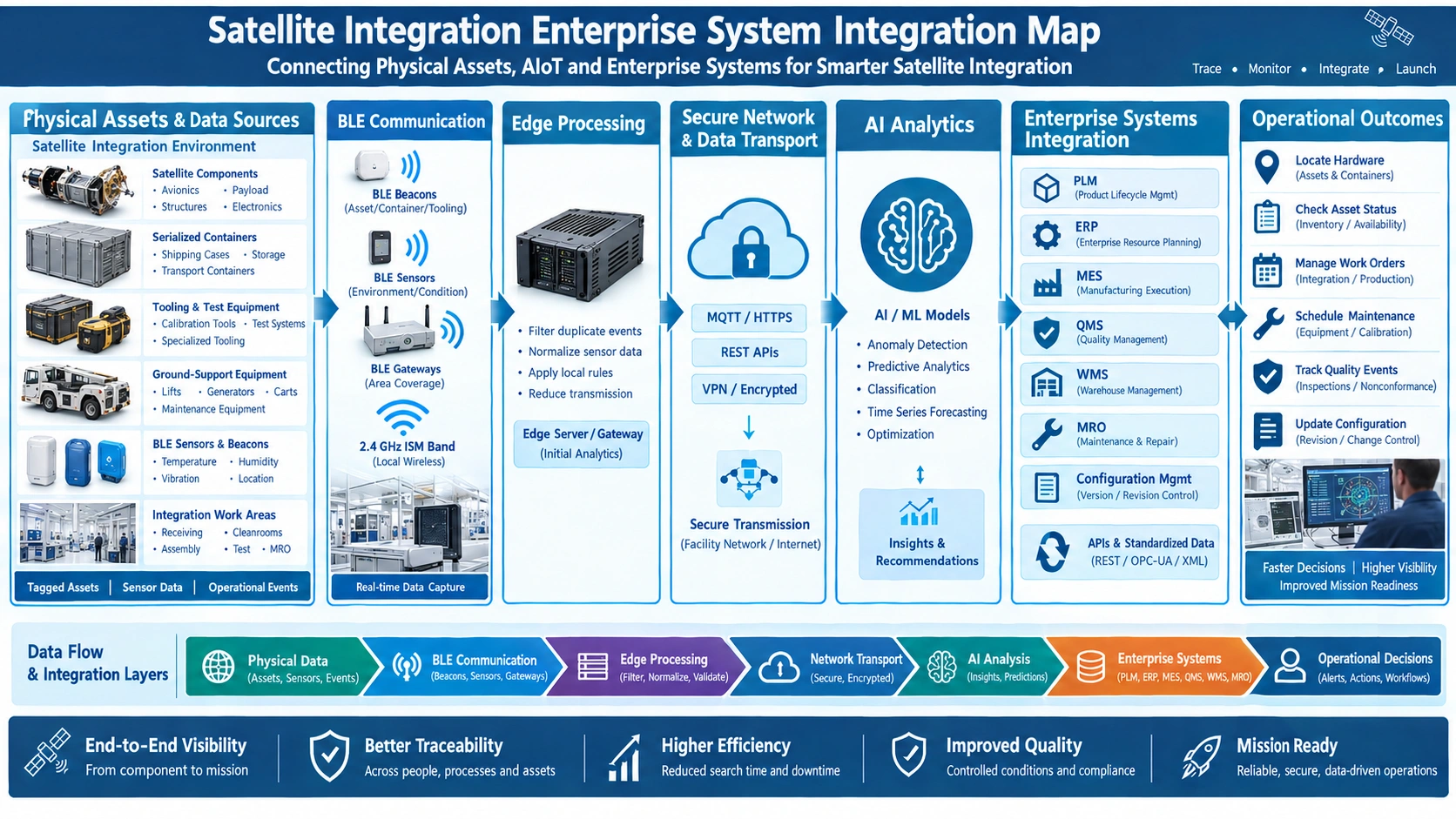
This integration diagram shows how BLE beacons, sensors, gateways, and edge IoT systems connect satellite integration assets with AI analytics and enterprise platforms. It illustrates data exchange with PLM, ERP, MES, QMS, WMS, MRO, inventory, maintenance, and configuration-management systems to support traceability, resource planning, quality, and operational decisions.
Implementation Strategy for AI-Enabled Satellite Integration
A phased deployment is generally more practical than attempting to instrument an entire satellite integration facility simultaneously.
Requirements and Site Assessment
Begin by identifying the operational problems that require better information. Define the assets, workflows, location accuracy, environmental parameters, retention requirements, integration points, and KPIs.
A physical site assessment should evaluate RF conditions, facility construction, gateway mounting locations, network availability, power requirements, restricted areas, cleanroom requirements, and potential sources of interference.
Pilot Deployment
A pilot should focus on one clearly defined workflow, such as serialized container tracking, ground-support equipment monitoring, or controlled-storage environmental monitoring.
The pilot should establish baseline KPIs and test actual device behavior under operational conditions.
Commissioning and Integration Testing
Commissioning should verify device identification, wireless coverage, gateway performance, sensor readings, network connectivity, API behavior, database records, alerts, and enterprise-system integration.
Testing should include normal operations as well as failure scenarios such as gateway outages, sensor battery depletion, network interruptions, duplicate events, and incorrect asset associations.
AI Model Deployment
AI should be introduced after sufficient operational data has been collected and its quality has been assessed.
Initial models can operate in observation mode, allowing engineers to compare AI outputs against known operational events before enabling automated alerts or workflow actions.
Optimization and Scaling
Once the pilot demonstrates measurable value, deployment can expand to additional storage areas, integration cells, laboratories, maintenance zones, and facilities.
Gateway placement, device configuration, data-retention policies, AI models, and software integrations should be reviewed as the operational footprint increases.
Practical Recommendations for Satellite Integration Teams
AI-enabled satellite integration delivers the strongest results when the deployment is driven by measurable operational requirements.
- Define the business and engineering problem before selecting BLE hardware or AI models.
- Establish required location accuracy for each operational zone rather than applying one accuracy target across the entire facility.
- Separate flight-hardware requirements from ground-support and logistics asset requirements.
- Perform RF surveys before finalizing BLE gateway locations.
- Use calibrated sensors when environmental measurements influence quality or handling decisions.
- Establish data-quality rules before training AI models.
- Integrate with existing PLM, ERP, MES, QMS, WMS, and MRO records instead of creating disconnected operational information.
- Keep configuration authority within approved engineering and quality systems.
- Validate AI recommendations against historical operational events before enabling automated actions.
- Measure asset search time, environmental excursions, equipment availability, inventory accuracy, and integration delays before and after deployment.
- Design cybersecurity controls across devices, gateways, networks, APIs, servers, databases, and user access.
- Plan for network interruptions and local data buffering where satellite integration operations require continuity.
- Scale only after the pilot demonstrates measurable operational value.
GAO Solutions for AI-Enabled Satellite Integration
Satellite integration increasingly depends on accurate information connecting physical hardware with engineering and operational processes. AI can provide the analytical capability needed to identify anomalies, forecast equipment requirements, improve resource visibility, and support faster operational decisions. BLE beacons, sensors, and gateways can provide the physical data required for these applications when deployed according to RF, cybersecurity, environmental, and aerospace engineering requirements.
GAO has served organizations across the United States and Canada for three decades, including Fortune 500 companies, leading R&D organizations, prestigious universities, and government agencies. Headquartered in New York City and Toronto, Canada, GAO is recognized among the leading global B2B and B2G suppliers of BLE and RFID technologies. Our hardware products and systems can support asset identification, location monitoring, condition sensing, and IoT data acquisition for controlled aerospace environments. GAO also maintains stringent quality-assurance processes and provides technical support remotely or onsite.
Organizations evaluating AI-enabled satellite integration can use these capabilities as building blocks for controlled asset visibility, environmental monitoring, equipment management, and integration with existing engineering and operational software. The appropriate solution depends on facility conditions, asset classification, RF requirements, cybersecurity policies, data architecture, and the specific satellite integration workflow being improved.
Building the Future of Industrial AI and IoT with Aperture Venture Studio and GAO RFID Inc.
For more than three decades, GAO Group of Companies has invested heavily in R&D of industrial BLE, RFID, and IoT. As generative AI has become increasingly useful for industrial applications, we have continued developing AI and IoT technologies that can support applications such as satellite integration, asset visibility, condition monitoring, and intelligent operations. We have also established Aperture Venture Studio to develop AI and IoT solutions relevant to these emerging industrial applications. Aperture brings together technical experts, operational leaders, investors, and technology companies, while our Aperture Ventures Summit and TekSummit provide forums for discussing advanced AI and IoT topics. We welcome qualified advisors, employees, investors, and customers to engage with these initiatives and our technology solutions.