
AI and BLE for Shipping Container Logistics
AI-Powered Shipping Container Logistics with BLE Visibility
Artificial intelligence is transforming shipping container logistics by converting location, movement, environmental, and operational data into actionable decisions. AI-powered container tracking can identify abnormal dwell times, predict handling delays, detect unusual movement, and improve visibility across container yards, depots, ports, terminals, and transportation routes. BLE beacons, BLE sensors, and BLE gateways provide the connected data needed to support these applications, particularly where containers, handling equipment, and temporary storage locations require continuous monitoring.
For shipping container logistics providers, the value of AI is not simply knowing where a container was last detected. The greater opportunity is understanding why a container is delayed, whether its condition is changing, whether it is following the expected operational sequence, and what action should occur next. AIoT combines artificial intelligence with connected sensors, equipment, and industrial systems to support this decision-making process. GAO provides BLE hardware, RFID technologies, IoT systems, and related software that can be incorporated into container tracking and logistics applications.
AI-Powered Shipping Container Logistics End-to-End Workflow
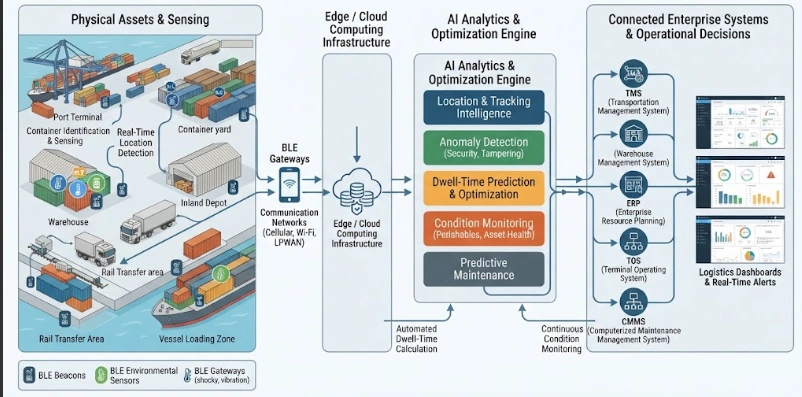
This diagram illustrates the data flow from physical shipping containers at various transit points (port, depot, truck) through BLE sensor technology and gateways. The data is processed by a central AI analytics engine to provide predictive insights, such as anomaly detection and dwell-time optimization. These insights feed directly into connected enterprise systems (TMS, WMS, ERP) and real-time logistics dashboards to enable automated operational decisions.
Why AI Matters in Shipping Container Logistics
Shipping container logistics involves a distributed chain of physical assets and operational events. A container may move through a marine terminal, container yard, inspection area, maintenance depot, customs holding area, truck staging zone, rail terminal, warehouse, and final delivery location. Each transition introduces opportunities for delay, misrouting, damage, unauthorized movement, or incomplete operational records.
Traditional tracking methods can provide useful identification events, but AI adds a decision layer to the information collected from connected containers and logistics systems. Machine learning models can compare current events with historical movement patterns, planned schedules, container status, weather or environmental measurements, handling records, and transportation milestones.
Relevant AI applications include:
Container location prediction based on historical movement and current detection events
Dwell-time analysis for containers waiting in yards, depots, ports, or customs areas
Anomaly detection for unexpected container movement or prolonged inactivity
Predictive identification of delivery delays and missed transfer milestones
Condition monitoring for temperature, humidity, shock, vibration, or other measurable parameters
Container utilization analysis to identify underused or repeatedly delayed equipment
Exception management for containers that deviate from planned routes or operational sequences
Yard movement optimization based on container location, status, priority, and handling requirements
Predictive maintenance for container handling equipment using sensor and operating data
Risk scoring for containers requiring inspection, intervention, or additional monitoring
The strongest results occur when AI is connected to the operational systems that already control transportation and terminal activities. Container data becomes more useful when it can be correlated with transportation management systems, terminal operating systems, warehouse management software, enterprise resource planning systems, maintenance records, customs processes, and shipment schedules.
Shipping Container Logistics Applications for AI and BLE
AI Container Tracking and Yard Visibility
Container yards frequently contain large numbers of similar-looking containers distributed across stacks, lanes, transfer areas, inspection zones, and staging locations. Manual searches can consume labor and create delays when a container is needed for loading, inspection, pickup, or onward transportation.
BLE beacons can associate a digital identity with selected containers, while BLE gateways installed at strategic locations capture nearby beacon signals. AI software can interpret these location events alongside container status and planned movement information.
A useful system should distinguish between a normal temporary absence of a detection event and a genuine operational exception. For example, a container may be intentionally moved outside gateway coverage during crane handling. AI can use historical movement patterns and subsequent detections to reduce unnecessary alerts while identifying containers that remain unexpectedly stationary.
AI-Powered Container Dwell-Time Optimization
Container dwell time is a critical operational metric because prolonged stays can consume yard capacity, increase handling requirements, and delay downstream transportation.
AI models can analyze arrival timestamps, gate events, yard locations, customs status, inspection requirements, pickup schedules, and historical dwell patterns. BLE location information can provide additional event data when a container changes zones.
The resulting system can identify:
Containers approaching abnormal dwell thresholds
Yard zones with recurring congestion
Containers repeatedly relocated before pickup
Containers waiting for documentation or inspection
Bottlenecks between terminal, depot, trucking, and rail operations
Operational patterns associated with extended container residence
Rather than treating every delayed container equally, AI can prioritize exceptions according to expected operational impact.
Container Condition Monitoring
Some shipping-container applications require more than location visibility. Environmental and physical conditions may need to be monitored during storage, handling, and transportation.
BLE sensors can collect measurements such as temperature, humidity, vibration, shock, door status, or other application-specific parameters. AI can analyze these measurements against expected operating conditions and historical patterns.
For example, an isolated temperature excursion may require investigation, while a repeated pattern of abnormal readings during a particular handling stage may indicate an equipment, loading, routing, or environmental problem. The AI system can therefore support condition-based intervention rather than relying entirely on fixed alarm thresholds.
Container Condition Monitoring & AI Anomaly Detection Workflow
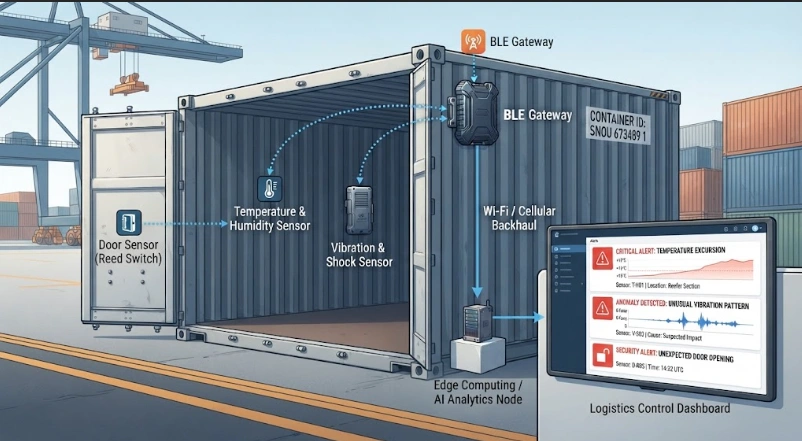
This technical illustration demonstrates how internal BLE sensors track temperature, humidity, shock, vibration, and door status on a shipping container. Sensor data transmits wirelessly to a nearby BLE gateway and edge computing node for AI analysis. The AI engine immediately identifies physical and environmental anomalies, generating real-time alerts on a logistics control dashboard.
AI-Based Security and Unauthorized Movement Detection
Container security requires visibility into movement events, access events, and changes in expected operating conditions. BLE-enabled monitoring can provide additional detection points around container yards, depots, warehouses, and other controlled areas.
AI can establish expected movement patterns and identify deviations such as:
A container moving outside its expected operational zone
Unexpected movement during restricted hours
Unusual dwell behavior following a gate event
Repeated movement between specific yard locations
Door or access events that do not correspond with scheduled operations
A container appearing at an unexpected facility
AI-based anomaly detection should support human investigation rather than automatically assuming that every abnormal event represents theft or tampering. Operational context is essential because legitimate activities such as customs inspection, maintenance, re-stacking, crane handling, or emergency relocation can also produce unusual movement patterns.
End-to-End AI Data Workflow for Shipping Containers
A practical AI-enabled shipping container logistics solution begins with physical data acquisition and ends with an operational action. The quality of each stage affects the reliability of the final decision.
Container and Operational Data Acquisition
BLE beacons provide an identifiable wireless signal associated with a container or logistics asset. BLE sensors can add measurements for environmental or physical conditions. Depending on the deployment, RFID tags, RFID readers, GPS devices, telematics systems, barcode scans, gate systems, and existing terminal equipment can provide complementary data.
The objective is not to replace every existing tracking method. A stronger design uses each technology where it is technically appropriate.
BLE Gateway Data Collection
BLE gateways receive data from nearby BLE beacons and sensors. Gateway placement should account for container stacking, metal surfaces, cranes, vehicles, terminal buildings, interference sources, and the required detection zones.
Container yards require particular attention to radio coverage because stacked metal containers can affect signal propagation. A site survey should therefore
precede final gateway placement. Detection zones should be tested with representative containers and operating equipment rather than relying solely on theoretical radio range.
Edge Processing and Data Normalization
Gateway data can be filtered and normalized before being forwarded to centralized software. Edge processing can reduce unnecessary traffic and support local event handling where connectivity to a central server is intermittent.
Typical processing tasks include:
Device identification
Timestamp normalization
Duplicate-event filtering
Signal-strength interpretation
Sensor validation
Gateway health monitoring
Local threshold checks
Temporary data buffering
The normalized events can then be forwarded through IP networks to edge servers, private servers, or cloud-hosted software.
End-to-End Data Flow: AI-Powered Shipping Container Logistics
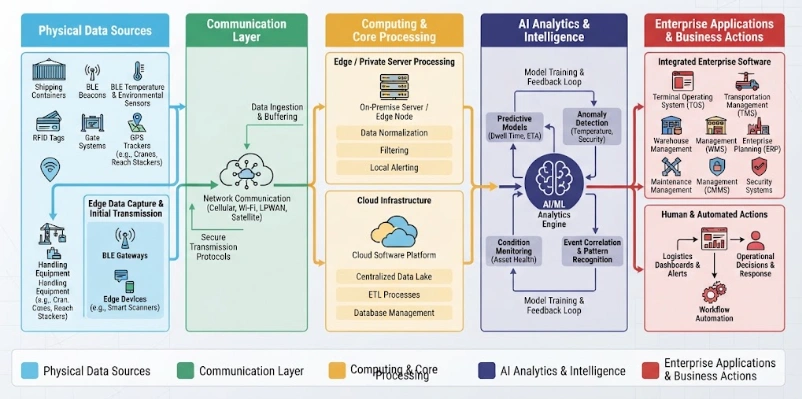
This technical block diagram visualizes the complete data journey in an AI-powered shipping container logistics system, starting from physical assets like sensors and containers. The data moves through a communication layer to edge and cloud processing, where the AI/ML analytics engine generates insights. Finally, these insights are integrated into enterprise software (TOS, TMS, ERP) and drive operational actions and dashboards.
AI Analytics and Operational Decision-Making
AI models operate on the normalized data together with historical logistics information. Depending on the application, models may include classification, regression, clustering, time-series forecasting, anomaly detection, predictive maintenance models, and optimization algorithms.
A shipping container logistics system can use these models to generate practical outputs such as:
Predicted container arrival or movement times
Estimated dwell-time risk
Location anomalies
Condition alerts
Security exceptions
Equipment maintenance predictions
Yard congestion indicators
Priority recommendations for container handling
The final step is integration with the people and systems responsible for acting on these recommendations. A prediction that cannot reach a dispatcher, yard manager, maintenance team, security operator, or transportation coordinator has limited operational value.
Deployment Considerations for AI-Enabled Container Logistics
Deployment design should reflect the physical characteristics of container terminals, depots, yards, warehouses, and transportation facilities. Network availability, radio coverage, environmental exposure, data volume, latency requirements, cybersecurity controls, and integration requirements all affect hardware and software selection.
GAO supplies BLE gateways, BLE beacons, RFID hardware, and related IoT systems that can be selected according to the operating environment and tracking requirements. GAO’s broader RFID and BLE portfolio supports applications including asset tracking, logistics, transportation, and other connected operational environments.
Cloud Version for Distributed Shipping Container Operations
A cloud-hosted deployment is appropriate when container data must be consolidated across multiple depots, terminals, logistics facilities, transportation partners, or geographically distributed operations.
The cloud can provide centralized AI analytics, dashboards, data storage, model management, and integration services. It can also simplify cross-site comparison of container dwell time, movement patterns, condition events, and operational exceptions.
Cloud deployment should still use appropriate controls for identity management, encryption, API security, network segmentation, device authentication, logging, and data retention.
Server Version for Controlled Logistics Environments
A server deployment can place software on customer-managed edge servers, private data centers, facility servers, or other privately hosted infrastructure. This approach can be appropriate where organizations require greater control over data location, network connectivity, integration boundaries, or operational processing.
Server-based processing can also support sites where selected AI functions must remain local because connectivity to external infrastructure is limited or because operational decisions require low latency.
Deployment Model Comparison: Cloud vs. Server (On-Premises) for AI-Enabled Logistics
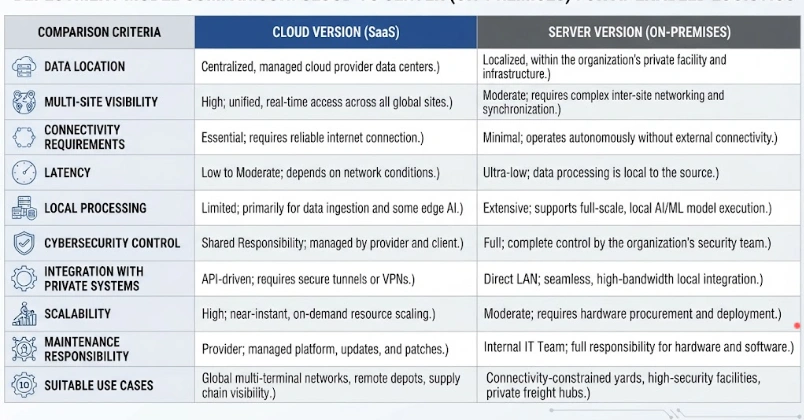
This comparison table evaluates cloud (SaaS) and server (on-premises) deployment models for AI-enabled shipping container logistics across ten key criteria, including data location, connectivity, latency, and cybersecurity control. It
highlights how cloud architectures excel in multi-site scalability and global visibility, whereas on-premises servers offer autonomous operation, ultra-low latency, and enhanced control for high-security facilities.
Integration with Shipping and Transportation Systems
AI-enabled container visibility becomes significantly more useful when connected to the software already used to manage freight movements. BLE events should not remain isolated in a tracking application. They should be associated with container numbers, shipment records, planned routes, terminal events, transportation orders, maintenance records, and operational exceptions.
Common integration targets include:
Transportation management systems (TMS) for shipment planning, carrier coordination, dispatching, and delivery status
Terminal operating systems (TOS) for container yard, gate, vessel, and handling operations
Warehouse management systems (WMS) for container receiving, unloading, staging, and outbound coordination
Enterprise resource planning (ERP) systems for orders, inventory, procurement, and financial processes
Computerized maintenance management systems (CMMS) for container and handling-equipment maintenance
Security and access-control systems for facility entry, restricted zones, and incident investigation
Customs and trade-compliance systems for inspection, clearance, and release events
Analytics and business-intelligence software for operational reporting and KPI analysis
APIs, message brokers, database interfaces, and event-driven integration can transfer normalized container events between these systems. A practical implementation should define a common event model so that a BLE detection, gate scan, RFID read, GPS event, or manual update can be associated with the same container and shipment record.
Testing and Commissioning in Container Yards
Radio-frequency performance should be validated under actual operating conditions before a large deployment is commissioned. Container stacks, steel structures, cranes, trucks, trailers, buildings, and other equipment can influence BLE signal behavior.
Commissioning should verify:
BLE beacon identification accuracy
Gateway coverage in required yard zones
Detection reliability around stacked containers
Sensor measurement accuracy
Battery performance and replacement intervals
Gateway network connectivity
Event timestamp consistency
Data transmission reliability
Duplicate and stale-event handling
Integration with logistics software
AI alert accuracy
Failure recovery and offline buffering
Testing should include normal container movements as well as exceptional situations. Examples include container re-stacking, temporary gateway outages, network interruption, unexpected gate movement, customs inspection, and extended dwell periods.
A pilot deployment across a representative portion of the yard can reveal radio and workflow issues before the system is expanded to additional facilities.
Container Yard BLE Gateway Deployment & Coverage Strategy
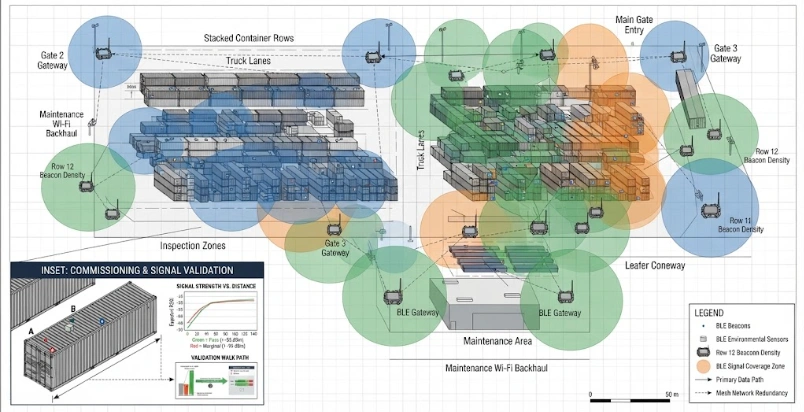
This technical diagram illustrates a strategic BLE gateway deployment in a modern shipping container yard, showing optimal placement on infrastructure around stacked containers and operational zones. It visualizes the resulting wireless signal coverage, demonstrating how gateways overcome physical obstructions to ensure reliable location detection for tagged assets. A detailed inset provides a commissioning checklist and signal validation data to confirm network performance.
AI Capabilities That Improve Container Operations
Combining AI with BLE-generated operational data can improve shipping container logistics because machine learning can identify relationships that are difficult to manage through isolated tracking events or fixed rules.
Predictive Dwell-Time Analysis
Historical container movements can be used to estimate how long a container is likely to remain at a terminal, depot, or staging area. Models can consider container type, location, arrival time, operational status, historical congestion, scheduled pickup, inspection requirements, and other available variables.
The resulting prediction can help logistics teams prioritize containers before they become critical exceptions.
Movement Anomaly Detection
Anomaly detection models establish patterns of normal container activity and identify deviations. A container detected repeatedly in an unexpected area, remaining stationary beyond an operational threshold, or moving at an unusual time can be assigned an exception score.
The system can combine BLE events with gate transactions, GPS information, RFID reads, and transportation schedules to reduce false positives.
Predictive Maintenance for Handling Equipment
AI-enabled logistics solutions can also extend beyond the container itself. Container cranes, reach stackers, forklifts, terminal tractors, conveyors, and other handling equipment generate operational data that can support predictive maintenance.
Sensor readings, operating hours, vibration information, fault records, and maintenance history can be analyzed to identify conditions associated with equipment failure.
This can help maintenance teams schedule interventions before failures interrupt container handling operations.
AI-Based Yard Optimization
Yard capacity is influenced by container volume, stack configuration, retrieval requirements, equipment availability, and expected departure schedules. AI can analyze these variables to recommend operational priorities.
For example, containers expected to leave soon can receive different handling priorities from containers with longer expected dwell times. Such recommendations can reduce unnecessary re-handling and improve use of available yard space.
Security, Privacy, and Reliability for Connected Containers
Shipping container logistics systems can contain operationally sensitive information, including container identities, shipment movements, facility locations, transportation schedules, and condition data. Security should therefore be considered during system design rather than added after deployment.
Relevant controls include:
Device authentication and authorization
Encrypted communication where supported by the deployment
Secure gateway configuration
Network segmentation
Role-based access control
Strong administrator authentication
Audit logging
Firmware and software update procedures
Device inventory management
Credential rotation
Backup and recovery procedures
Data retention policies
Monitoring for unusual device or network activity
BLE security should also be considered alongside the security of gateways, networks, APIs, databases, cloud services, and connected enterprise software. Protecting only the wireless sensor is insufficient if an attacker can compromise the gateway or downstream application.
Reliability is equally important. Container tracking systems should define what happens when a gateway loses connectivity, a sensor battery becomes depleted, a server becomes unavailable, or duplicate events are received. Local buffering and store-and-forward mechanisms can preserve events during temporary connectivity failures.
Operational KPIs for AI-Powered Container Logistics
AI deployment should be evaluated using operational measurements rather than technology adoption alone. Useful KPIs can include:
Container location detection accuracy
Container tracking coverage
Average container dwell time
Percentage of containers exceeding dwell thresholds
Container retrieval time
Yard re-handling frequency
Gate processing time
Shipment delay rate
Exception detection rate
False-positive alert rate
Condition-monitoring alert response time
Unauthorized movement detection time
Container utilization rate
Yard capacity utilization
Handling-equipment availability
Mean time between equipment failures
Mean time to repair
BLE gateway availability
Sensor battery life
Data transmission success rate
AI models should also be evaluated using model-specific metrics. Depending on the application, precision, recall, false-positive rate, mean absolute error, prediction accuracy, or forecast error may be more meaningful than a generic “AI accuracy” measurement.
Implementation Strategy for Shipping Container Logistics
A successful deployment normally begins with the operational problem rather than with hardware selection. Logistics teams should first identify where visibility gaps or recurring exceptions have measurable business consequences.
A practical implementation sequence includes:
Define the container workflows that require better visibility
Identify containers, yard zones, depots, terminals, and handling equipment to monitor
Establish required location and condition-detection granularity
Determine whether BLE, RFID, GPS, cellular, or a combination is appropriate
Conduct a physical radio and connectivity assessment
Select beacon, sensor, and gateway configurations
Define data ownership and retention requirements
Select cloud-hosted or privately hosted software based on operational requirements
Establish interfaces with TMS, TOS, WMS, ERP, CMMS, and other required systems
Run a controlled pilot
Measure detection reliability and operational KPIs
Tune alert thresholds and AI models
Train operational and maintenance personnel
Expand deployment to additional facilities or container groups
A common implementation mistake is attempting to automate every workflow during the first deployment. A focused use case, such as dwell-time monitoring or abnormal movement detection, generally provides a clearer basis for measuring value and refining the system.
Engineering Trade-Offs in BLE Container Tracking
BLE is useful for many container-tracking applications, but it should be selected according to the required operating conditions rather than treated as a universal replacement for other technologies.
BLE can be particularly useful when organizations need relatively low-power wireless identification or sensor connectivity over defined facility areas. RFID may be preferable for specific identification workflows involving reader infrastructure and controlled read points. GPS or cellular connectivity can be more appropriate when continuous wide-area location is required outside gateway coverage.
A multimodal solution can therefore combine technologies according to the operational stage:
BLE for local container and sensor visibility around yards, depots, and facilities
RFID for controlled identification events at gates, checkpoints, and process stations
GPS for wide-area vehicle or container location
Cellular networks for mobile connectivity
Wi-Fi or Ethernet for fixed gateway backhaul
Industrial sensors for environmental and equipment condition measurements
AI and machine learning for prediction, anomaly detection, and optimization
This approach allows shipping container logistics operators to match sensing technology to the physical and operational requirements of each workflow.
Scaling AI and BLE Across Container Logistics Operations
Scaling from a pilot to multiple facilities introduces additional engineering requirements. Each site may have different container densities, gateway layouts, network infrastructure, environmental conditions, and operational procedures.
A scalable implementation should standardize device identities, data structures, event definitions, alert categories, software interfaces, and maintenance procedures while allowing site-specific radio configurations.
Device health monitoring is particularly important at scale. Logistics operators should be able to identify gateways that stop reporting, sensors with declining battery levels, and communication zones that experience abnormal event loss.
AI models should also be monitored after deployment. Changes in container volumes, yard layouts, seasonal transportation patterns, new facilities, or changes in operational procedures can alter the data distribution on which a model was trained. Model performance should therefore be reviewed periodically rather than assuming that a model remains accurate indefinitely.
GAO’s experience supplying BLE, RFID, and IoT hardware and systems provides a practical foundation for organizations evaluating connected asset and logistics applications. GAO Group companies have served customers across the United States and Canada for approximately three decades, including Fortune 500 companies, research organizations, universities, and government agencies. Their
work has included significant investment in product and system R&D, supported by quality assurance and technical assistance delivered remotely or onsite.
Practical Design Recommendations for Shipping Container AI
Several engineering principles are particularly important when designing AI-enabled container visibility.
Start with measurable container logistics problems such as dwell time, search time, re-handling, condition excursions, or unauthorized movement.
Define the required location granularity before selecting BLE gateway density.
Test BLE performance with real metal containers and normal yard equipment.
Treat container identity, sensor identity, gateway identity, and shipment identity as separate but linkable records.
Use edge filtering where high-frequency sensor data would create unnecessary network traffic.
Keep operational event timestamps synchronized across gateways and enterprise systems.
Combine BLE data with existing RFID, GPS, gate, transportation, and terminal events where available.
Design exception management around operational actions rather than generating alerts without ownership.
Measure false positives as carefully as successful detections.
Provide local buffering for connectivity interruptions.
Monitor battery condition and gateway health as part of normal maintenance.
Apply cybersecurity controls to the entire data path from sensor to business application.
Revalidate AI models when operating conditions or container workflows change.
Use pilot results to determine the appropriate scale and technology mix before broad deployment.
The Business Value of AI-Enabled Shipping Container Visibility
The business value of AI-powered shipping container logistics comes from turning fragmented operational events into decisions that can be acted upon.
Better container visibility can reduce the time required to locate equipment, identify delayed containers, investigate abnormal movements, and respond to environmental events. Predictive analytics can help operations teams focus attention on containers and handling processes most likely to create downstream disruption.
For terminal and depot operators, improved visibility can support better yard utilization and reduce unnecessary re-handling. For transportation coordinators, more reliable status information can improve dispatching and exception management. For maintenance teams, connected equipment data can support earlier intervention. For security personnel, correlated movement events can make investigations more targeted.
The value should ultimately be demonstrated through measurable improvements in dwell time, handling efficiency, detection accuracy, equipment availability, service reliability, and response time.
GAO Solutions for AI and Connected Shipping Container Operations
GAO supplies BLE, RFID, and IoT hardware products and systems that can support shipping container tracking, asset visibility, condition monitoring, and connected logistics applications. Our approach is to select sensing and identification technologies according to the operational requirement rather than applying a single technology to every workflow.
Headquartered in New York City and Toronto, Canada, GAO is recognized among the leading B2B and B2G suppliers of BLE and RFID technologies. GAO, GAO Research Inc., and GAO Tek Inc. form GAO Group, with operations based in New York City and Toronto.
For organizations evaluating AI-enabled shipping container logistics, technical planning should address the complete chain from container identification and sensing through wireless communication, gateway deployment, data processing, AI analytics, software integration, cybersecurity, commissioning, and ongoing support.
GAO can provide relevant hardware products and technical expertise for organizations developing or upgrading these connected logistics systems. Readers can explore GAO’s BLE, RFID, and IoT solutions to determine which technologies fit their container tracking, sensing, and operational visibility requirements.
Building the Future of Industrial AI and IoT with Aperture Venture Studio and GAO RFID Inc.
For more than three decades, GAO Group of Companies has invested heavily in R&D of industrial BLE, RFID, and IoT. As generative AI became increasingly useful for industrial applications, we expanded our work on AI and IoT, including BLE and RFID, and founded Aperture Venture Studio to help advance practical AI and IoT solutions for applications such as connected logistics, asset visibility, and industrial operations.
Aperture has attracted AI and IoT technical experts, entrepreneurial and operational executives, influential investors, and leading companies.
We have also developed Aperture Ventures Summit and TekSummit to discuss advanced AI and IoT topics.
These activities have helped build diverse technical communities around AI and IoT.
We welcome you to join us as:
Advisors, co-founders, or employees
Investors
Customers
Applying AI to More Predictable Shipping Container Logistics
AI-enabled shipping container logistics is most effective when machine learning and operational analytics are connected to reliable physical data. BLE beacons, sensors, and gateways can provide useful container and facility-level events, while RFID, GPS, telematics, and enterprise systems can contribute additional context.
AI can then transform those events into predictions, anomaly detection, condition insights, and operational recommendations.
A well-designed implementation should begin with measurable logistics problems, validate wireless performance under real container-yard conditions, integrate with existing transportation and terminal software, and continuously measure operational outcomes. GAO provides BLE, RFID, and IoT hardware and systems that can support these requirements from pilot deployment through broader logistics operations.