
AI and RFID for Air Cargo
Transforming Air Cargo Visibility and Decision-Making with AI-Driven RFID Systems
Air cargo operations depend on accurate shipment visibility, rapid cargo handling, regulatory compliance, and precise coordination across airlines, ground handlers, freight forwarders, customs agencies, and airport cargo terminals. AI-powered air cargo management solutions increasingly rely on RFID technologies to provide real-time cargo intelligence, automate operational workflows, and improve decision-making throughout the cargo journey.
Within air cargo environments, RFID-enabled cargo identification combined with AI analytics helps organizations monitor Unit Load Devices (ULDs), pallets, containers, temperature-sensitive shipments, dangerous goods, express freight, pharmaceutical cargo, and high-value assets. RFID-generated operational data becomes significantly more valuable when AI models analyze movement patterns, predict bottlenecks, identify exceptions, optimize resource allocation, and support operational planning.
Modern air cargo facilities generate large volumes of operational data from RFID readers, cargo handling equipment, warehouse management systems, flight schedules, customs documentation systems, and transportation management software. AI transforms this data into actionable intelligence that improves cargo throughput, shipment traceability, asset utilization, security, and service-level performance.
Organizations across the transportation and logistics sector increasingly deploy AI-enabled RFID solutions to reduce cargo dwell time, improve chain-of-custody visibility, enhance compliance, and support predictive operational management. GAO has supported organizations with RFID hardware, readers, tags, antennas, and IoT solutions that contribute to these operational objectives.
AI-Powered RFID Air Cargo Workflow: End-to-End Shipment Visibility and Predictive Logistics Management
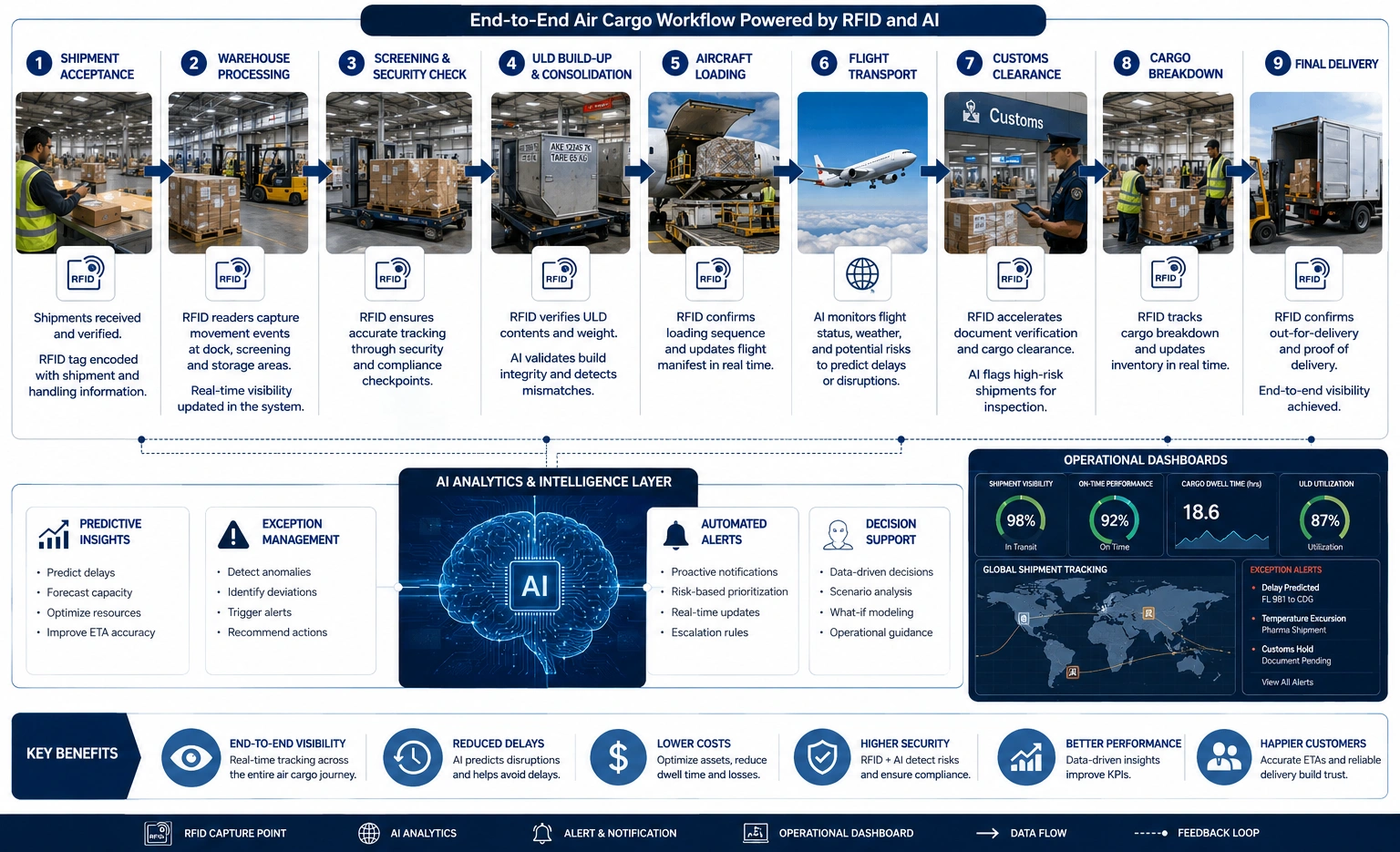
This infographic illustrates how RFID-enabled cargo tracking and AI analytics work together across the entire air cargo lifecycle, from shipment acceptance to final delivery. It highlights key operational stages including warehouse processing, ULD build-up, aircraft loading, customs clearance, and cargo breakdown while showing how AI supports predictive alerts, exception management, operational dashboards, and decision-making. The key takeaway is that combining RFID data capture with AI-driven intelligence improves visibility, reduces delays, enhances security, and optimizes air cargo performance.
Fundamental Concepts of AI-Powered RFID in Air Cargo
Air cargo organizations operate highly time-sensitive logistics networks where shipment delays, misplaced cargo, inaccurate documentation, and inefficient resource utilization can significantly affect operational performance and customer satisfaction.
RFID provides automated identification and tracking capabilities for cargo assets moving through airports, cargo terminals, bonded warehouses, transfer facilities, and airline networks. Common RFID technologies used in air cargo include:
- UHF RFID for long-range cargo and asset identification
- HF RFID for specialized applications requiring controlled read zones
- LF RFID for niche asset identification scenarios
Artificial Intelligence enhances RFID-enabled cargo operations by converting raw operational data into predictive and prescriptive insights. Rather than simply identifying shipment locations, AI systems help determine:
- Which cargo may miss scheduled flights
- Which storage areas are becoming congested
- Which ULDs are underutilized
- Which shipments require priority handling
- Which operational processes create recurring delays
- Which resources should be reassigned to improve throughput
Air cargo organizations increasingly view AI-enabled RFID solutions as strategic operational infrastructure rather than isolated tracking systems because they support both real-time visibility and intelligent decision-making.
Air Cargo Applications Where AI Delivers Value Through RFID Data
Cargo Tracking and Shipment Visibility
Cargo visibility remains one of the most important operational requirements in air freight operations.
AI models analyze RFID-generated location events to:
- Predict shipment arrival times
- Detect abnormal cargo movement patterns
- Identify misplaced cargo
- Forecast transfer delays
- Improve shipment chain-of-custody management
Operational outcomes include:
- Improved shipment traceability
- Reduced lost cargo incidents
- Better customer communication
- Faster exception resolution
ULD and Asset Management
Airlines and cargo operators manage large fleets of ULDs, pallets, containers, dollies, and ground support equipment.
AI-driven RFID systems help:
- Track asset utilization
- Predict asset shortages
- Identify idle equipment
- Optimize equipment allocation
- Reduce asset loss
Key KPIs improved include:
- ULD utilization rate
- Equipment availability
- Asset recovery rate
- Turnaround time
Pharmaceutical and Temperature-Controlled Cargo Monitoring
Pharmaceutical air cargo requires strict compliance with temperature-control requirements.
AI systems combined with RFID-enabled monitoring can:
- Identify temperature excursion risks
- Predict storage capacity constraints
- Prioritize sensitive shipments
- Recommend corrective actions
Benefits include:
- Reduced product spoilage
- Enhanced regulatory compliance
- Improved shipment quality assurance
Security and Cargo Integrity Monitoring
Security remains a critical concern throughout air cargo operations.
AI-supported RFID solutions assist by:
- Detecting unauthorized cargo movement
- Identifying unusual handling activity
- Monitoring restricted cargo areas
- Supporting audit and investigation processes
These capabilities improve operational security while supporting regulatory compliance requirements.
Cargo Terminal Throughput Optimization
Large cargo terminals process thousands of shipments daily.
AI algorithms analyze RFID movement data to:
- Predict congestion zones
- Balance workload distribution
- Optimize dock utilization
- Improve staging operations
- Reduce cargo dwell time
Operational improvements frequently include higher throughput and improved resource efficiency.
AI-Assisted Air Cargo Workflow Diagram: RFID Tracking, Predictive Analytics, and Airport Cargo Operations
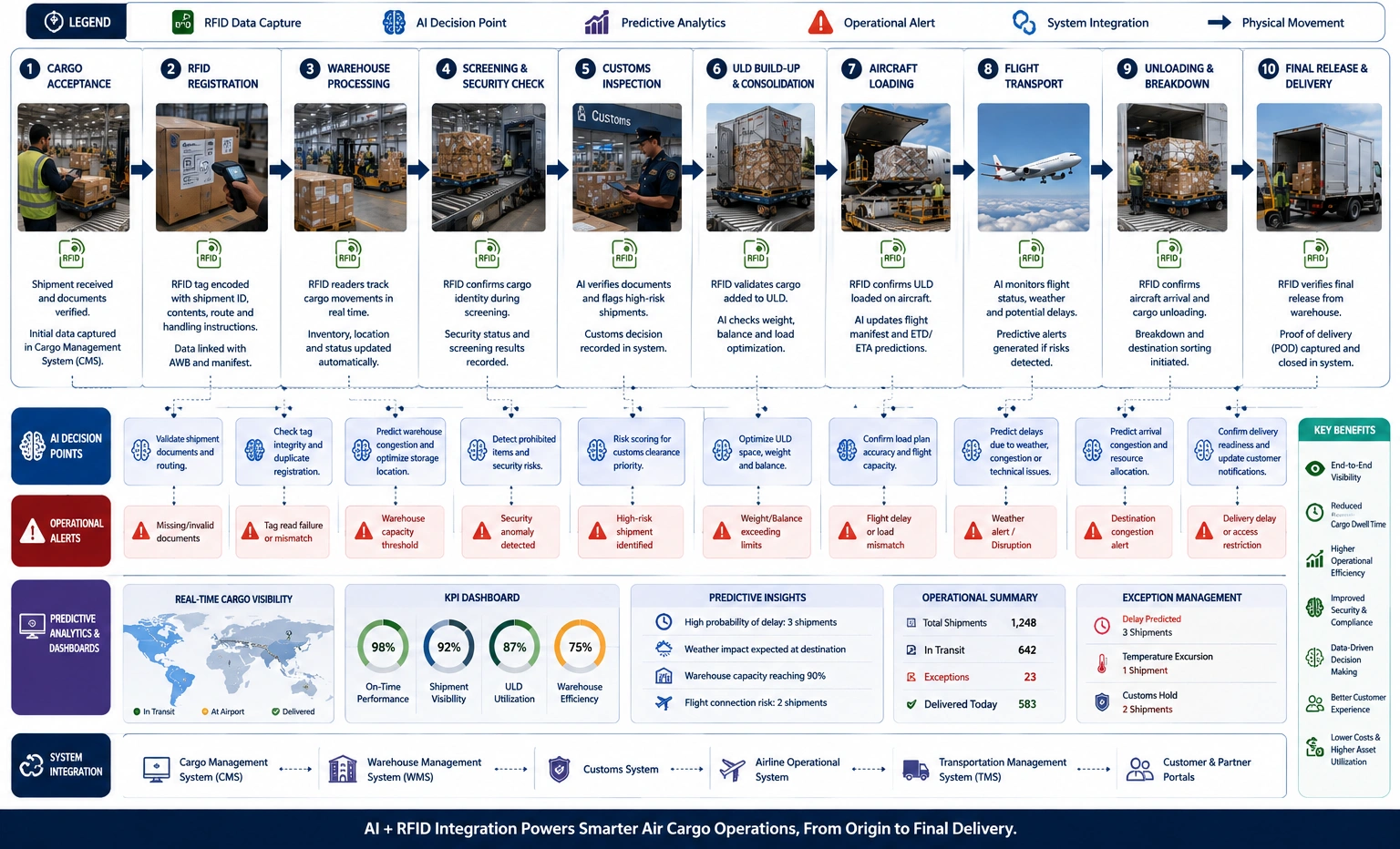
This workflow diagram illustrates the complete movement of air cargo through airport facilities, beginning with cargo acceptance and RFID registration and continuing through screening, customs inspection, ULD build-up, aircraft loading, flight transport, unloading, and final delivery. AI decision points, predictive analytics, operational alerts, and integrated enterprise systems are embedded throughout the workflow to support intelligent cargo management. The key takeaway is that AI-powered RFID solutions enable real-time visibility, proactive exception handling, improved operational efficiency, and enhanced cargo security across the entire air freight lifecycle.
Operational Workflow of AI-Enabled RFID Systems in Air Cargo
Successful deployment requires coordination among physical cargo operations, communication systems, operational software, and AI analytics.
Cargo Identification and Data Acquisition
The workflow begins when cargo enters an airport cargo facility.
RFID tags are associated with:
- Air waybills
- Shipment identifiers
- Cargo manifests
- ULD identifiers
- Handling instructions
- Security classifications
RFID readers capture cargo movement events throughout:
- Receiving docks
- Screening stations
- Storage zones
- Build-up areas
- Aircraft loading zones
- Transfer facilities
Communication and Data Transport
Captured RFID events are transmitted through communication infrastructure that may include:
- Ethernet networks
- Industrial Wi-Fi
- Private cellular networks
- Secure VPN connections
- Airport operational networks
Data is transported to operational software and analytics environments for processing.
Edge Processing
Edge computing systems located within cargo terminals perform:
- Event filtering
- Duplicate read removal
- Device health monitoring
- Operational alert generation
- Local exception processing
Edge processing reduces latency and minimizes unnecessary data transmission.
Enterprise Software Integration
Air cargo operations typically require integration with:
- Cargo Management Systems (CMS)
- Warehouse Management Systems (WMS)
- Transportation Management Systems (TMS)
- Enterprise Resource Planning (ERP) software
- Customs processing systems
- Airline operational systems
- Cargo Community Systems (CCS)
AI models depend on accurate integration across these systems to produce reliable operational recommendations.
AI Analytics and Decision Support
Machine learning models evaluate operational data for:
- Cargo delay prediction
- Throughput forecasting
- Resource allocation optimization
- Capacity planning
- Risk assessment
- Shipment prioritization
Outputs are delivered through dashboards, alerts, reports, and automated workflows.
Operational Action Execution
Business actions generated from AI insights may include:
- Reassigning cargo handlers
- Adjusting warehouse locations
- Prioritizing urgent shipments
- Allocating additional ULDs
- Rescheduling cargo movements
- Escalating exception cases
The result is a closed-loop operational process where RFID-generated visibility continuously feeds AI-driven decision-making.
AI-Powered RFID Deployment in Airport Cargo Terminals: Real-Time Visibility, Cargo Tracking, and Operational Intelligence
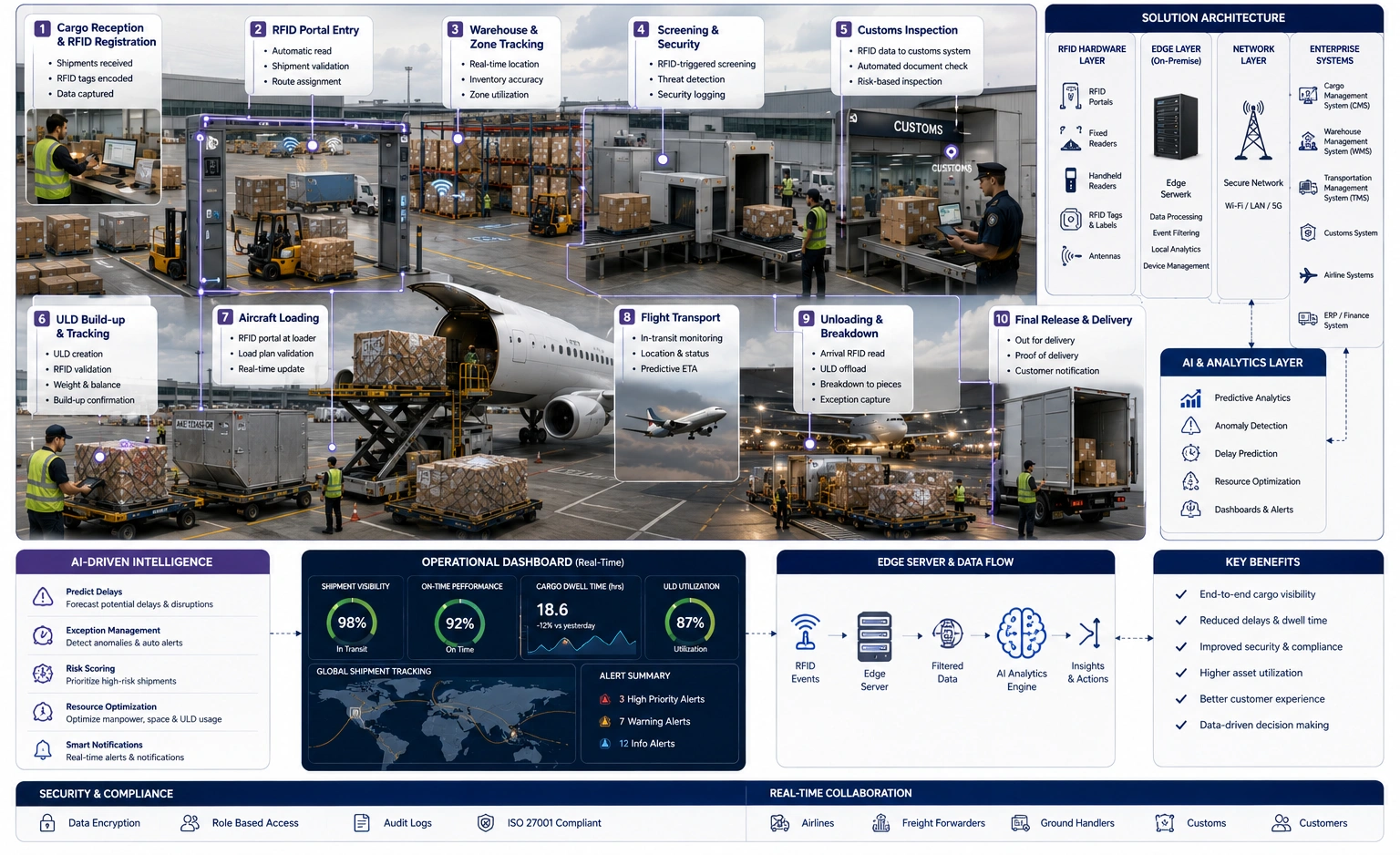
This deployment diagram illustrates a realistic international airport cargo terminal where RFID portals, handheld readers, ULD tracking systems, warehouse operations, aircraft loading activities, customs processes, and airline systems are connected through edge computing and AI analytics. The visual demonstrates how RFID-generated operational data flows through edge servers and enterprise software to support predictive analytics, exception management, operational dashboards, and data-driven decision-making. The key takeaway is that AI-enabled RFID deployments create end-to-end cargo visibility, improve resource utilization, strengthen security, and enhance operational efficiency across the air cargo lifecycle.
Technology Components Supporting AI-Based Air Cargo Intelligence
AI-powered air cargo solutions depend on coordinated hardware, software, communication, security, and data processing components.
RFID Hardware Components
Key RFID hardware deployed within air cargo environments includes:
- Fixed RFID readers
- Handheld RFID readers
- RFID portals
- UHF RFID tags
- Asset tracking tags
- Ruggedized industrial antennas
- Mobile cargo tracking devices
These devices provide the operational visibility required for AI analytics.
AI Software Components
Common AI technologies include:
- Machine learning models
- Predictive analytics engines
- Anomaly detection systems
- Optimization algorithms
- Forecasting models
- Natural language processing for documentation workflows
- Computer vision systems for cargo inspection support
Cloud Deployment Model
Cloud-hosted deployments are commonly selected when organizations require:
- Multi-airport visibility
- Rapid scalability
- Centralized reporting
- Global shipment monitoring
- Simplified software maintenance
Cloud environments are particularly beneficial for multinational airlines, freight forwarders, and logistics providers operating across multiple regions.
Server Deployment Model
Privately managed server deployments are frequently preferred when organizations require:
- Strict data governance
- Airport-specific security controls
- Regulatory restrictions on data residency
- Ultra-low latency processing
- Integration with legacy operational systems
Private deployments may operate within airport data centers, airline facilities, regional logistics hubs, or customer-managed infrastructure.
Cybersecurity and Operational Protection
Air cargo RFID deployments require protection against:
- Unauthorized reader access
- Data tampering
- Network intrusion
- Device compromise
- Credential misuse
Security controls commonly include:
- Encryption
- Identity and access management
- Network segmentation
- Secure device authentication
- Audit logging
- Continuous monitoring
GAO has worked with organizations seeking secure RFID and IoT deployments where operational reliability, asset visibility, and compliance requirements are critical components of project success.
AI-Powered RFID Technology Stack for Air Cargo Operations: Edge Intelligence, Enterprise Integration, and Real-Time Cargo Visibility
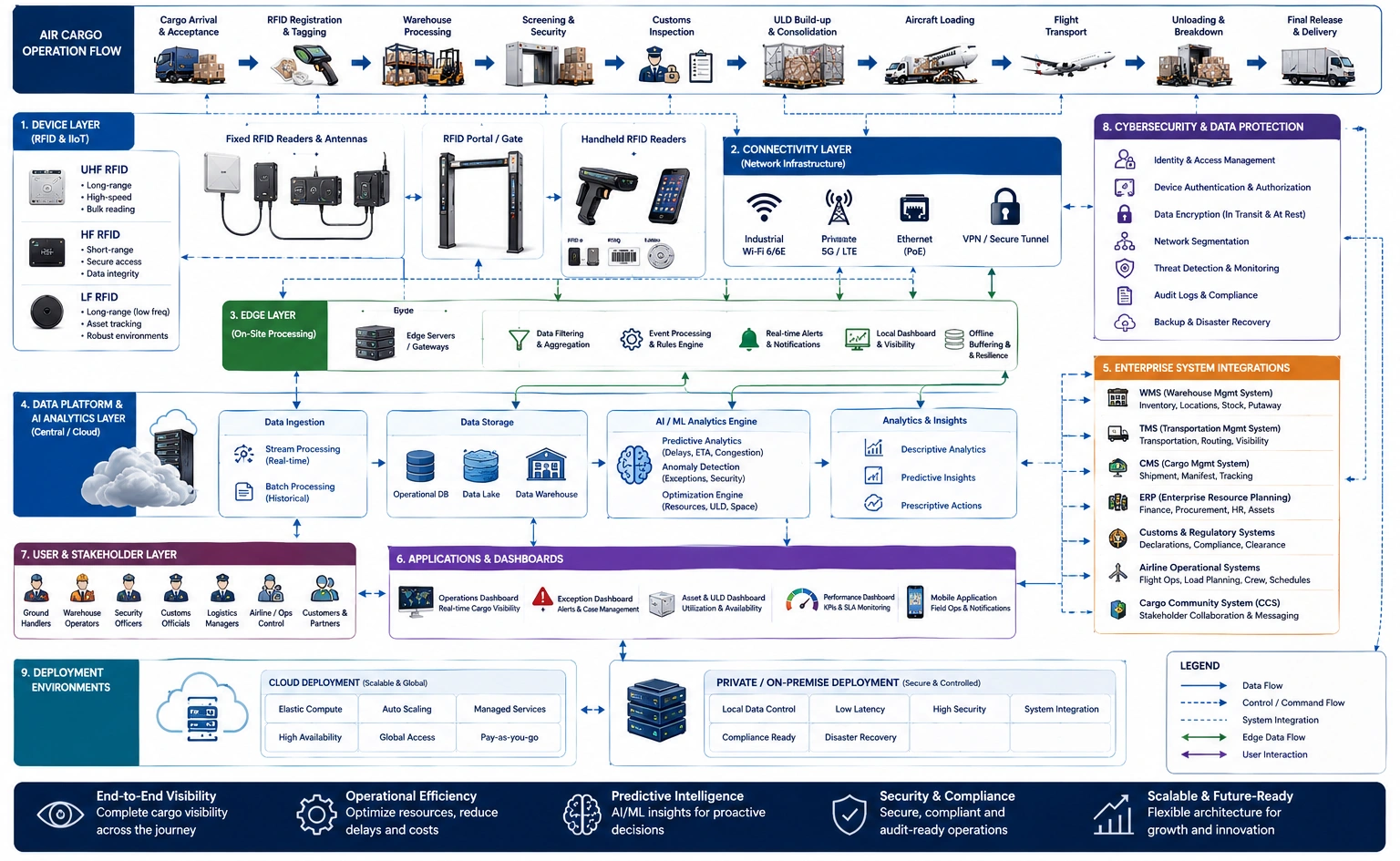 This system diagram illustrates the complete technology stack supporting AI-powered air cargo operations, from RFID tags, readers, antennas, and communication networks to edge processing, AI analytics engines, enterprise software integrations, and operational dashboards. The visual demonstrates how cargo data flows through cloud and private server environments while cybersecurity controls protect operational systems and information assets. The key takeaway is that integrating RFID data collection with AI-driven analytics and enterprise systems enables end-to-end cargo visibility, predictive decision-making, operational efficiency, and secure air cargo management.
Technical Capabilities and Business Benefits of AI-Driven Air Cargo Operations Supported by RFID
AI-powered air cargo solutions supported by RFID technologies deliver value because they combine continuous cargo visibility with data-driven operational intelligence. Rather than relying solely on manual scanning, barcode checkpoints, or operator intervention, cargo organizations gain the ability to continuously monitor assets, predict disruptions, and optimize operational performance across airport cargo facilities.
H3: Enhanced Shipment Visibility and Traceability
Air cargo operations involve numerous handoffs among airlines, freight forwarders, ground handlers, customs agencies, screening facilities, and transportation providers.
AI systems use RFID-generated movement data to create:
- Real-time shipment visibility
- Automated chain-of-custody tracking
- Cargo status verification
- Transfer point monitoring
- Shipment milestone validation
Benefits include:
- Reduced shipment search times
- Fewer lost cargo incidents
- Improved customer service performance
- Better compliance documentation
- Increased operational transparency
Reduced Cargo Dwell Time
Cargo dwell time remains one of the most important operational performance indicators in air freight.
AI models identify:
- Storage bottlenecks
- Cargo congestion patterns
- Resource shortages
- Process inefficiencies
- Delayed transfer activities
Using RFID-generated movement data, cargo operators can proactively intervene before delays become operational problems.
Expected improvements include:
- Faster cargo processing
- Improved warehouse utilization
- Increased cargo throughput
- Reduced storage costs
- Better flight connection performance
Improved ULD and Asset Utilization
ULDs represent critical operational assets for airlines and cargo operators.
AI-driven analysis helps organizations:
- Track ULD circulation patterns
- Identify underutilized assets
- Predict shortages
- Improve positioning strategies
- Reduce asset losses
Operational benefits often include:
- Lower replacement costs
- Better equipment availability
- Improved fleet utilization
- Reduced operational disruptions
Predictive Resource Allocation
Air cargo facilities experience fluctuations caused by:
- Flight schedules
- Seasonal demand
- Weather disruptions
- Customs processing delays
- Peak shipment volumes
Machine learning models can forecast operational demand and recommend resource allocation adjustments involving:
- Cargo handlers
- Forklift operators
- Screening resources
- Warehouse space
- ULD inventory
This predictive capability enables more efficient labor and equipment utilization.
Security Enhancement and Risk Reduction
Air cargo security requires continuous monitoring of cargo movements and restricted operational areas.
AI systems evaluate RFID activity patterns to identify:
- Unauthorized access attempts
- Suspicious cargo movement
- Route deviations
- Missing assets
- Operational anomalies
Benefits include:
- Improved cargo security
- Faster incident response
- Better audit support
- Reduced operational risk
Scalability for Global Cargo Networks
Large airlines and logistics providers frequently operate across multiple airports and countries.
AI-enabled RFID solutions support:
- Global shipment visibility
- Multi-terminal coordination
- Cross-border cargo monitoring
- Standardized reporting
- Centralized performance analysis
These capabilities support scalable growth without proportionally increasing manual operational workloads.
Engineering Considerations for Air Cargo RFID and AI Deployments
Successful air cargo implementations require careful planning beyond hardware installation.
Read Zone Design
Airport cargo facilities contain complex operational environments that may include:
- Metal ULDs
- Cargo containers
- Aircraft structures
- Conveyor systems
- Storage racks
- Vehicle traffic
RFID read zones should be engineered to maximize read accuracy while minimizing interference.
Design considerations include:
- Antenna positioning
- Reader placement
- Power configuration
- Environmental conditions
- Cargo density
Data Quality Management
AI performance depends heavily on data quality.
Organizations should establish procedures for:
- Reader calibration
- Data validation
- Duplicate event removal
- Exception management
- Asset identification consistency
Poor data quality can significantly reduce prediction accuracy and operational effectiveness.
System Integration Planning
Air cargo organizations often operate diverse software environments.
Integration planning should address:
- Data mapping
- Interface design
- Event synchronization
- Workflow automation
- Reporting requirements
Common integration targets include cargo management software, customs systems, transportation management systems, and warehouse management software.
Cybersecurity Governance
Air cargo infrastructure forms part of critical transportation operations.
Recommended practices include:
- Role-based access controls
- Secure communication channels
- Continuous vulnerability assessment
- Security monitoring
- Incident response planning
Performance Measurement
Organizations should establish measurable success criteria before deployment.
Common air cargo KPIs include:
- Cargo dwell time
- ULD utilization rate
- Shipment visibility percentage
- Asset recovery rate
- Cargo processing time
- Throughput volume
- Exception resolution time
- Service-level compliance
GAO frequently supports organizations evaluating RFID deployment requirements by helping identify suitable hardware configurations and operational objectives aligned with business goals.
Implementation Recommendations for Air Cargo Organizations
Organizations pursuing AI-driven cargo intelligence supported by RFID should follow a structured deployment strategy.
Recommended practices include:
- Define measurable business objectives before technology selection.
- Prioritize operational pain points such as shipment visibility, ULD tracking, cargo dwell time, or warehouse congestion.
- Conduct site surveys to evaluate read-zone requirements and environmental conditions.
- Establish data governance policies before AI model deployment.
- Integrate RFID event data with existing operational software.
- Begin with pilot deployments focused on high-value operational processes.
- Measure performance improvements using clearly defined KPIs.
- Expand deployment incrementally across terminals and cargo facilities.
- Continuously retrain AI models using updated operational data.
- Maintain cybersecurity and compliance oversight throughout the deployment lifecycle.
Organizations that follow phased deployment strategies generally achieve faster adoption, lower operational risk, and better long-term performance outcomes.
Why AI-Powered RFID Is Becoming Essential for Air Cargo Operations
Air cargo organizations face growing pressure to improve shipment visibility, accelerate cargo processing, optimize asset utilization, strengthen security, and meet increasingly demanding customer expectations.
AI-enabled cargo intelligence supported by RFID technologies helps organizations transform operational data into actionable insights that improve both day-to-day execution and long-term planning. Through continuous cargo tracking, predictive analytics, operational automation, and intelligent resource allocation, air cargo operators can improve throughput, reduce delays, enhance service reliability, and strengthen regulatory compliance.
Airlines, freight forwarders, airport cargo terminals, and logistics providers increasingly view AI-driven RFID solutions as foundational components of modern cargo operations. Organizations seeking greater visibility, operational efficiency, and data-driven decision-making can benefit from carefully planned deployments aligned with operational objectives and business requirements.
GAO continues to support organizations across transportation and logistics environments by supplying RFID hardware, IoT technologies, and technical expertise that help enable intelligent cargo operations, asset visibility, and operational optimization initiatives.
Building the Future of Industrial AI and IoT with Aperture Venture Studio and GAO
For more than three decades, GAO Group of Companies has invested heavily in research and development involving industrial RFID, BLE, IoT, and intelligent operational technologies. As AI adoption has accelerated across transportation and logistics operations, we established Aperture Venture Studio to help advance AI and IoT innovations that address complex operational challenges such as cargo visibility, asset tracking, predictive logistics, and intelligent decision support.
Aperture has attracted leading AI and IoT experts, investors, technology leaders, and industry professionals. Through initiatives such as the Aperture Ventures Summit and TekSummit, we continue to foster technical collaboration and knowledge sharing across AI and IoT disciplines.
We welcome participation from:
- Advisors, co-founders, and employees
- Investors
- Customers seeking advanced AI and IoT solutions