
AI and BLE for Printed Circuit Board Production
How AI Improves Printed Circuit Board Production with Connected BLE Data
AI-enabled Printed Circuit Board Production uses machine learning, Industrial AI, computer vision, process analytics, and connected production data to improve throughput, quality, traceability, maintenance, and material flow. BLE Gateways, BLE Beacons, and BLE Sensors can provide location, presence, environmental, equipment, and work-in-process data that complements machine controllers and manufacturing systems. The resulting data can help production teams correlate material movement, process conditions, equipment status, inspection results, and operator activities with manufacturing outcomes. For PCB fabrication and PCBA operations, this is particularly useful when production involves tightly controlled process windows, high-value electronic materials, frequent product changeovers, and stringent traceability requirements. GAO provides BLE and IoT hardware products and systems that can be integrated into such production environments, while AI software can convert connected operational data into alerts, predictions, quality insights, and recommended actions.
AI-Enabled Printed Circuit Board Production with BLE and AI Analytics
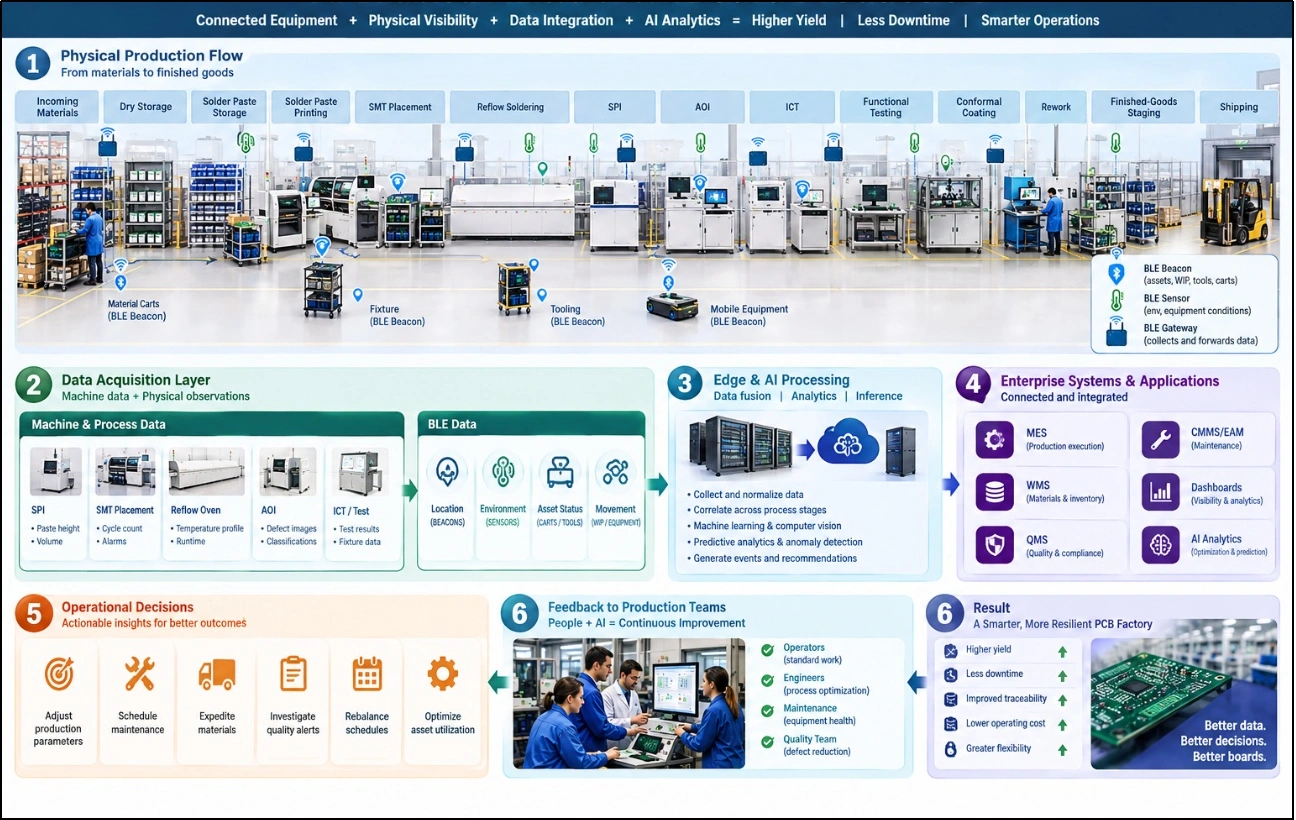
The infographic illustrates an end-to-end AI-enabled PCB production workflow, from incoming materials and SMT processing through inspection, testing, rework, and shipping. It shows how BLE Beacons, BLE Sensors, and BLE Gateways complement machine and process data before edge AI and analytics connect insights with MES, WMS, QMS, CMMS/EAM, dashboards, and production decisions.
AI-Driven Printed Circuit Board Production: Technical Foundation
AIoT in Printed Circuit Board Production combines artificial intelligence with connected sensors, production equipment, industrial networks, edge computing, and enterprise software. The objective is not simply to connect machines. The objective is to create reliable operational data that can be used to detect process deviations, predict equipment problems, identify material-flow constraints, improve traceability, and support production decisions.
PCB production generally includes two closely related manufacturing domains.
- PCB fabrication produces the bare circuit board through processes such as laminate preparation, imaging, etching, drilling, plating, solder mask application, surface finishing, electrical testing, routing, inspection, and final packaging.
- Printed circuit board assembly (PCBA) populates fabricated boards through solder paste printing, solder paste inspection, component placement, reflow, automated optical inspection, selective or wave soldering where applicable, programming, electrical testing, rework, conformal coating, and final inspection.
AI applications must account for the substantially different data characteristics of these operations. PCB fabrication produces large volumes of process, chemical, dimensional, environmental, and electrical test data. PCBA produces high-frequency machine events, component identities, feeder information, stencil and solder-paste conditions, placement records, inspection images, test results, and WIP movement data.
BLE is most valuable where physical movement, location, condition, and presence are difficult to capture through fixed machine interfaces alone. A BLE Beacon can identify a WIP carrier, material cart, fixture, tooling set, or mobile asset. BLE Sensors can provide selected temperature, humidity, vibration, or other condition measurements. BLE Gateways positioned around production areas can collect these signals and forward them to local or centralized software.
AI then correlates this information with MES production orders, WMS material transactions, QMS nonconformance records, CMMS or EAM maintenance histories, machine telemetry, inspection results, and test data.
This distinction is important. BLE should not replace deterministic machine-control networks or safety systems. Rather, it can add a physical-context data layer around PCB manufacturing processes where conventional machine interfaces do not provide sufficient visibility.
High-Value AI Applications Across Printed Circuit Board Production
AI Work-in-Process Tracking
WIP tracking is one of the most practical AI applications for PCB manufacturing. Boards, panels, component kits, feeder carts, reels, fixtures, test carriers, and rework lots can move between receiving, kitting, SMT lines, inspection stations, test cells, rework areas, and finished-goods staging.
AI can analyze movement history to identify abnormal dwell times, queue accumulation, routing deviations, and stalled production orders. BLE identification can provide additional location evidence when material or WIP does not pass a machine interface that records its position.
The useful output is not simply “where is the cart?” A production system can instead answer questions such as:
- Which work orders are accumulating before AOI?
- Which WIP carriers repeatedly remain too long near rework?
- Which production routes experience abnormal material movement?
- Which fixtures are unavailable when a scheduled job reaches a test station?
- Which line-side materials are repeatedly moved between incompatible storage or production zones?
AI Material and Component Flow Optimization
PCBA operations depend on accurate material staging. Component reels, moisture-sensitive devices, solder paste, stencils, feeders, trays, and production kits must reach the correct line at the appropriate time.
AI can combine WMS transactions, MES work orders, feeder information, production schedules, and BLE-based location observations to identify material-flow constraints.
For example, if a high-priority work order is scheduled for an SMT line but its feeder cart remains in another production zone, the system can identify the discrepancy before the line reaches the material shortage. Historical movement patterns can also reveal recurring staging delays.
For moisture-sensitive devices and other controlled materials, condition monitoring requires more than location. Environmental readings can be evaluated against approved storage and handling requirements, while quality personnel can investigate excursions through QMS procedures.
AI Predictive Maintenance for PCB Production Equipment
PCB manufacturing contains expensive and highly utilized equipment, including SMT placement machines, solder paste printers, reflow ovens, AOI systems, SPI equipment, ICT systems, functional testers, drilling equipment, plating systems, imaging equipment, compressors, HVAC systems, and material-handling equipment.
AI-based predictive maintenance can combine equipment telemetry, maintenance history, alarm events, production rates, inspection results, and operating conditions to identify emerging failure patterns.
BLE Sensors can be useful for selected equipment that lacks native condition-monitoring interfaces, particularly mobile assets, auxiliary equipment, fixtures, carts, or retrofit targets. They should not be treated as a universal substitute for machine-native telemetry, PLC data, vibration instrumentation, or safety-rated monitoring.
A practical maintenance model can estimate failure risk from variables such as operating hours, temperature, vibration, alarm frequency, cycle count, maintenance intervals, and historical failure signatures. Maintenance planners can then prioritize inspections or planned interventions before a failure disrupts an SMT line or PCB fabrication process.
AI-Driven Printed Circuit Board Production Workflow with BLE and AI Analytics
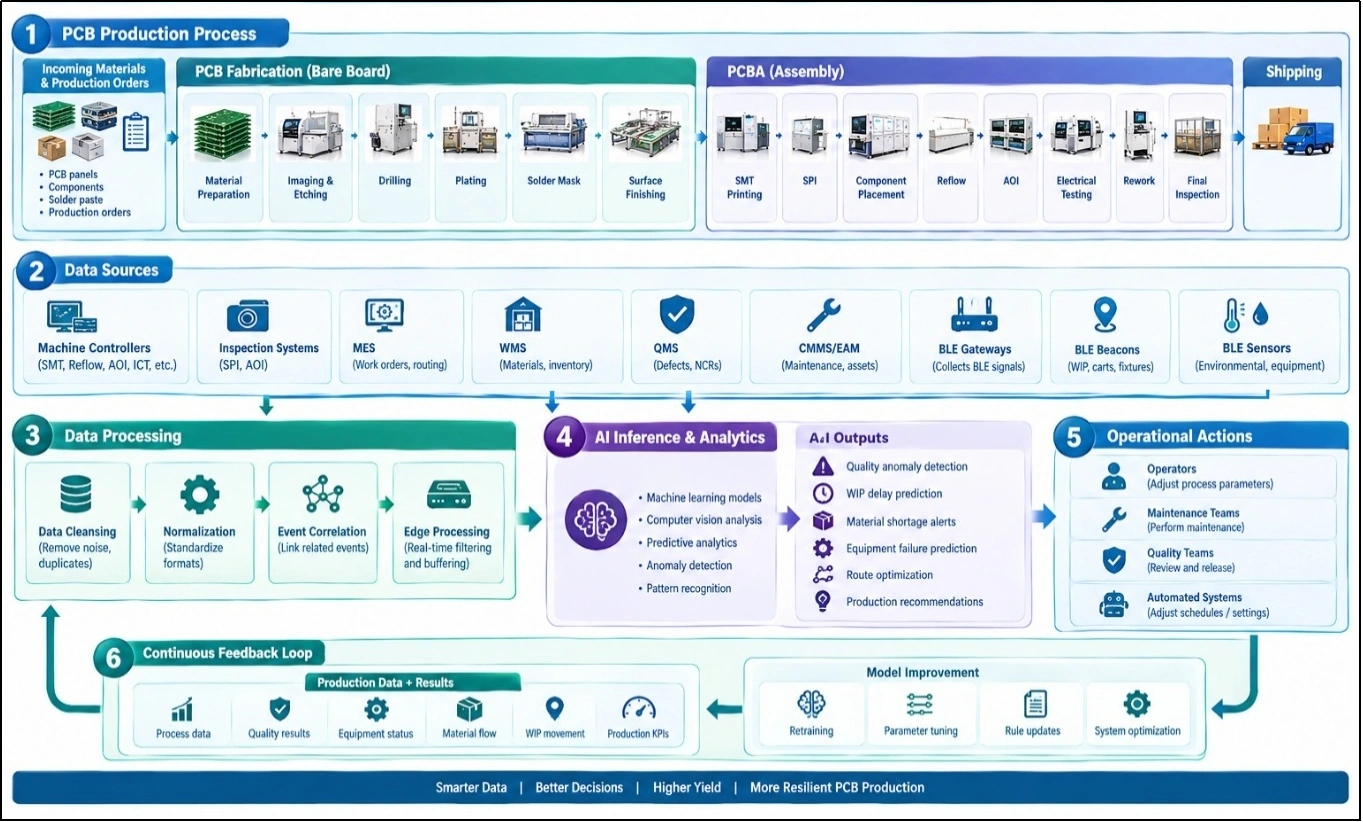
The workflow diagram shows how PCB fabrication and PCBA production activities generate data from machine controllers, inspection systems, MES, WMS, QMS, CMMS/EAM, BLE Gateways, BLE Beacons, and BLE Sensors. Data is cleansed, normalized, correlated, and processed at the edge before AI models generate quality anomaly detection, WIP delay prediction, material alerts, equipment failure predictions, route optimization, and production recommendations. A continuous feedback loop connects production results to AI model improvement.
AI Quality and Defect Analysis
PCB quality problems can originate from material condition, process parameters, equipment condition, component placement, solder-paste deposition, thermal profiles, handling, contamination, or downstream electrical performance.
AI can correlate inspection and test results with process history. Computer vision models can analyze AOI images for solder bridges, insufficient solder, component misalignment, tombstoning, polarity errors, lifted leads, and other visually detectable defects. Machine learning can also identify statistical relationships between process conditions and recurring defects.
The strongest implementations maintain traceability between a board or panel, production order, component lot, machine program, stencil, feeder configuration, process recipe, operator intervention, inspection result, and test outcome.
BLE-based physical tracking can strengthen this traceability by establishing where WIP carriers, fixtures, or production materials were located during relevant production stages.
AI Production Scheduling and Bottleneck Detection
PCB manufacturers frequently manage high product mix, short production runs, engineering changes, expedited orders, component constraints, and shared test resources. These conditions make static scheduling difficult.
AI scheduling models can consider machine availability, changeover requirements, feeder preparation, material readiness, test capacity, rework queues, staffing, and historical cycle times.
Production-location data can add another useful variable. If WIP is physically present but not progressing through its expected route, AI can distinguish a scheduling problem from a material, equipment, quality, or logistics problem.
Operational Challenges AI Must Address in PCB Production
AI deployment should begin with manufacturing problems rather than with a sensor or algorithm. PCB production creates several recurring challenges that influence solution design.
- High product mix: Different PCB assemblies may require different component sets, machine programs, test procedures, and inspection criteria.
- WIP visibility gaps: Boards and material carriers can move between processes without generating sufficiently granular location events.
- Traceability requirements: Production teams need relationships between materials, processes, inspection records, equipment, and finished assemblies.
- Machine heterogeneity: SMT lines and PCB fabrication equipment often use different interfaces, data formats, and vendor-specific software.
- Quality root-cause complexity: Defects can emerge from interactions among material lots, process parameters, machine condition, and environmental factors.
- Changeover losses: Feeder preparation, stencil changes, program loading, line clearance, and verification can create substantial nonproductive time.
- Rework accumulation: Defective boards can create hidden queues that distort production schedules and consume skilled technician capacity.
- Material constraints: Component shortages, incorrect staging, moisture exposure, and inventory discrepancies can interrupt otherwise available production capacity.
- Environmental sensitivity: Temperature and humidity can affect materials, solder processes, storage conditions, and equipment performance.
- Data fragmentation: MES, QMS, WMS, CMMS/EAM, machine software, inspection systems, and test equipment may hold related information in separate systems.
AI is effective only when these underlying data and process issues are addressed. Poor event quality, inconsistent equipment timestamps, missing identifiers, duplicate observations, and disconnected work-order records can produce misleading model outputs regardless of algorithm sophistication.
AI and BLE Deployment Considerations for PCB Manufacturing
A production-grade solution should begin by defining the operational event model. Engineers should identify the entities being tracked, the production states they can occupy, the events that change those states, and the systems that own each authoritative record.
Typical tracked entities include:
- PCB panels and WIP carriers
- Component reels and material carts
- Feeder carts and feeder banks
- SMT fixtures and tooling
- Stencils and inspection fixtures
- Test fixtures and programming fixtures
- Mobile maintenance equipment
- Finished assemblies awaiting inspection or shipment
A BLE deployment can then be engineered around production zones rather than simply maximizing gateway density. RF propagation is affected by metal equipment, cabinets, production racks, human bodies, EMI sources, and changing line configurations. Gateway placement should therefore be validated through an RF site survey and representative production trials.
Signal strength alone should not automatically be interpreted as precise location. Where zone-level visibility is sufficient, geofenced presence can be more robust than attempting to derive highly precise coordinates from BLE RSSI. Higher accuracy requirements may require additional positioning methods, calibrated gateway layouts, or complementary technologies.
Data should pass through a controlled ingestion and normalization layer before AI processing. Duplicate observations should be removed, timestamps synchronized, device identities validated, and events associated with production orders or asset identifiers wherever possible.
GAO can support such deployments with BLE hardware products and IoT systems that provide the sensing and connectivity layer required for production visibility. The engineering objective is to integrate those devices with the existing PCB manufacturing workflow rather than create an isolated tracking application.
40opBLE-Enabled Data Flow for AI-Driven Printed Circuit Board Production
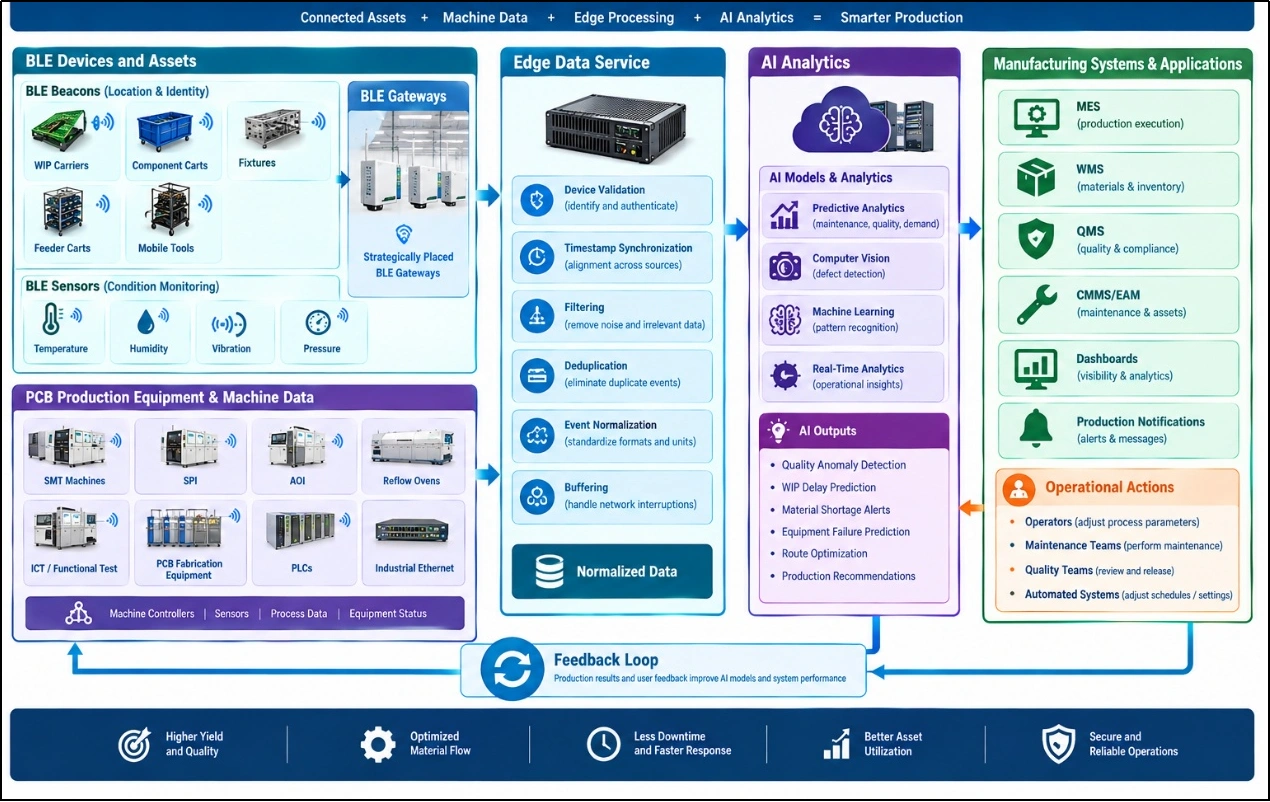
This technical block diagram illustrates how BLE Beacons, BLE Sensors, and BLE Gateways capture asset, location, movement, and condition data across PCB production. Machine and process data from SMT, SPI, AOI, reflow, ICT, PCB fabrication equipment, PLCs, and industrial Ethernet are combined at an edge data service, where validation, synchronization, filtering, deduplication, normalization, and buffering prepare data for AI analytics. AI outputs then support MES, WMS, QMS, CMMS/EAM, dashboards, notifications, and controlled operational actions through a continuous feedback loop.
Printed Circuit Board Production Systems and Data Integration
AI depends on relationships among manufacturing records rather than isolated sensor readings. A typical PCB production deployment may integrate the following systems:
| System | PCB Production Data | AI-Relevant Contribution |
| MES | Work orders, routing, recipes, WIP states | Production context and process genealogy |
| WMS | Components, reels, kits, storage locations | Material availability and movement |
| QMS | Defects, NCRs, inspection results, CAPA | Quality labels and root-cause analysis |
| CMMS/EAM | Maintenance work orders and asset history | Failure prediction and maintenance planning |
| SCADA/PLC systems | Equipment states and process variables | Real-time machine context |
| AOI/SPI | Images, inspection measurements, defect classifications | Computer vision and quality analytics |
| ICT/functional test | Electrical test results | Product-quality correlation |
| ERP | Orders, purchasing, inventory, costing | Business and supply-chain context |
Data integration should preserve source-system authority. MES should generally remain authoritative for production routing and work-order status, while QMS retains quality records and CMMS/EAM retains maintenance history. The AI system should correlate these records rather than silently becoming the master database for every manufacturing function.
Interoperability can use REST APIs, database interfaces, message brokers, MQTT, OPC UA, industrial Ethernet, vendor APIs, or file-based interfaces where legacy equipment requires them. Interface selection should reflect latency, determinism, cybersecurity, vendor support, and lifecycle requirements.
AI Processing from Edge to Private Server or Cloud
PCB manufacturing environments benefit from separating time-sensitive processing from centralized analytics.
Edge processing can validate BLE observations, perform filtering, buffer data during network interruptions, and generate local events with low latency. Server-based AI processing can provide centralized analysis across production lines, plants, and historical datasets.
Cloud deployment is appropriate when the manufacturer requires centralized analytics across multiple facilities, scalable computing resources, remote model management, or integration with cloud-based enterprise software. A private server deployment is often preferable where production data must remain within customer-controlled infrastructure, where factory connectivity is constrained, or where corporate IT policies restrict external data transfer.
Neither model should be selected solely because it is technologically fashionable. Engineers should evaluate data residency, latency, network reliability, cybersecurity requirements, model-compute requirements, integration constraints, disaster recovery, maintenance responsibility, and total operating cost.
Cloud vs. Server AI Deployment for Printed Circuit Board Production
| Evaluation Factor | Cloud AI Deployment | Server AI Deployment |
| Deployment location | AI software and analytics run in managed cloud infrastructure and are accessed securely by PCB production sites. | AI software runs on customer-managed servers, factory servers, private data centers, or other privately hosted infrastructure. |
| PCB production latency | Usually suitable for analytics, reporting, cross-site analysis, and non-time-critical predictions. Network latency should be evaluated for operational alerts. | Well suited to low-latency factory analytics because processing can remain close to SMT lines, inspection systems, test cells, and BLE Gateways. |
| Factory connectivity | Requires reliable outbound connectivity between the production environment and cloud services. | Can continue operating within the customer’s network during external connectivity interruptions, depending on system design. |
| Data residency | PCB production, quality, maintenance, and operational data is transferred to approved cloud infrastructure according to the deployment and data-governance model. | Data can remain within customer-controlled infrastructure, which can simplify requirements for organizations with strict data-residency policies. |
| Cybersecurity control | Security responsibilities are shared between the cloud provider, software provider, and customer. Secure authentication, encryption, network controls, and access management remain essential. | Customers retain greater direct control over server, network, identity, segmentation, and security configurations, but also assume more operational responsibility. |
| Multi-site PCB analytics | Strong option for comparing SMT lines, PCB fabrication operations, quality trends, and production KPIs across geographically distributed facilities. | Effective for multi-site analysis when facilities are connected to a centralized private data center or customer-managed server environment. |
| AI model management | Centralized model deployment, monitoring, updates, and analytics can simplify management across multiple production facilities. | Models can be managed within customer-controlled infrastructure, supporting organizations with internal AI governance or restricted data policies. |
| Scalability | Computing resources can generally be expanded as production data, AI workloads, image analytics, and facility count increase. | Scaling requires additional customer-managed compute, storage, networking, or virtualization resources as workloads grow. |
| AOI and computer vision | Suitable when inspection images can be securely transmitted and processing latency and bandwidth are acceptable. | Particularly useful when large AOI image datasets should remain inside the manufacturing network or require local processing. |
| BLE data processing | BLE Gateway observations can be forwarded to cloud analytics after local filtering, buffering, and normalization. | BLE Gateway data can be processed locally, reducing dependence on external network connectivity for operational analytics. |
| MES/WMS/QMS integration | Integrates through secure APIs, message brokers, database interfaces, or other approved enterprise integration methods. | Can provide direct connectivity to customer-managed MES, WMS, QMS, CMMS/EAM, and manufacturing databases where permitted. |
| Disaster recovery | Cloud infrastructure may provide geographically distributed backup and recovery capabilities depending on the selected service. | Recovery depends on the customer’s backup, replication, redundant-server, and disaster-recovery design. |
| IT operational responsibility | Infrastructure maintenance is shared, reducing the amount of physical server administration required from the PCB manufacturer. | Customer IT teams or managed service providers typically handle server capacity, operating systems, backups, patching, monitoring, and hardware lifecycle. |
| Network dependency | Higher dependency on reliable connectivity between PCB facilities and cloud services. Local edge buffering can reduce the effect of temporary outages. | Lower dependency on external connectivity when AI processing and manufacturing integrations remain within the private network. |
| Best fit for PCB production | Multi-facility analytics, centralized KPI management, large-scale AI workloads, remote model management, and geographically distributed operations. | Data-sensitive factories, low-latency analytics, restricted networks, local AOI/image processing, private-data requirements, and customer-controlled AI infrastructure. |
| Typical implementation | BLE Gateways → Edge processing → Secure network → Cloud AI → MES/WMS/QMS/CMMS/EAM and dashboards. | BLE Gateways → Edge processing → Private server → AI analytics → MES/WMS/QMS/CMMS/EAM and local dashboards. |
| Primary trade-off | Greater centralized scalability and multi-site accessibility, with stronger dependency on connectivity and cloud governance. | Greater infrastructure and data control, with increased responsibility for compute capacity, maintenance, cybersecurity, and disaster recovery. |
Engineering Controls for Reliable AIoT Data
Reliable AI begins with reliable production events. PCB manufacturers should establish controls for device commissioning, identifier management, time synchronization, network availability, data retention, and system health.
BLE devices should receive unique identifiers and documented installation locations. Gateways should be monitored for connectivity and operational status. Sensor calibration requirements should be defined according to the measurement’s intended use. Environmental measurements that influence product quality should be governed by appropriate calibration and quality procedures rather than treated as informal IoT observations.
AI data pipelines should also distinguish between observations, inferred events, and confirmed manufacturing records. For example, a BLE gateway detecting a carrier in a zone is an observation. A software rule may infer that the carrier entered an AOI queue. MES confirmation that the corresponding work order entered AOI is a different class of event.
Maintaining these distinctions makes AI recommendations easier to audit and reduces the risk of automated decisions being based on assumptions that production personnel cannot verify.
AI Data Quality and Continuous Improvement for Printed Circuit Board Production
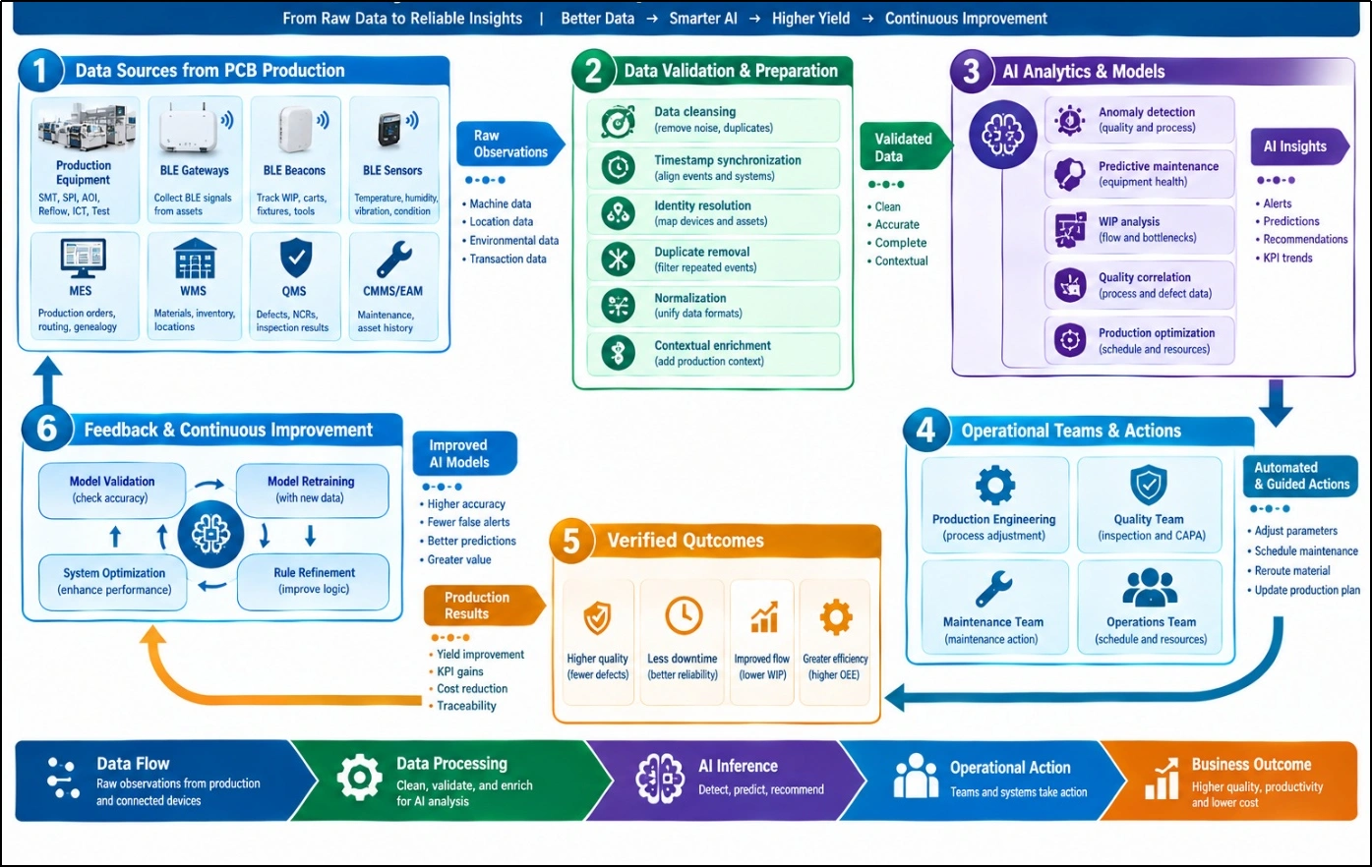
The completed control-loop diagram shows how PCB production data from SMT, SPI, AOI, reflow, ICT, test systems, PCB fabrication equipment, enterprise systems, and BLE devices is validated and enriched before AI analysis. It illustrates AI-driven anomaly detection, predictive maintenance, WIP analysis, quality correlation, and production optimization leading to operational actions, verified outcomes, and continuous model and system improvement.
AI-Enabled Quality Improvement in Printed Circuit Board Production
AI becomes particularly valuable when PCB production data can be correlated across multiple process stages rather than analyzed as isolated machine events. A defect detected by AOI, for example, may be associated with solder-paste printing parameters, stencil condition, component placement data, reflow thermal profiles, component lot information, machine maintenance history, and the physical movement history of the associated WIP carrier.
This creates a practical foundation for root-cause analysis.
- Anomaly detection: Machine-learning models can identify production behavior that differs from established process patterns.
- Defect prediction: Historical process and inspection data can be used to estimate the probability of specific defect classes.
- Root-cause analysis: Correlation models can identify combinations of machine, material, environmental, and process variables associated with failures.
- Process optimization: AI can identify parameter relationships that improve yield without unnecessarily narrowing production capacity.
- Rework prediction: Models can identify WIP characteristics associated with increased probability of rework.
- Maintenance prediction: Equipment telemetry and maintenance history can be used to estimate failure risk.
- Material-flow optimization: AI can identify recurring delays involving component kits, feeder carts, fixtures, WIP carriers, and line-side inventory.
- Production bottleneck detection: AI can distinguish equipment constraints from material shortages, quality holds, changeover delays, or downstream test capacity limitations.
Computer vision is particularly relevant to AOI and other visual inspection processes. However, production teams should distinguish between detecting a visual anomaly and determining whether a board is actually acceptable. Human quality engineers, established inspection criteria, statistical process control, and formal QMS procedures remain important controls for model-assisted quality decisions.
AI-Based WIP and Asset Visibility for PCB Assembly
Physical visibility is frequently more difficult than machine data visibility. SMT machines know when a board is processed, but they may not know where a feeder cart is waiting, where a fixture has been stored, or why a WIP carrier has remained outside the expected process zone.
BLE-enabled location data can help fill these operational gaps.
A typical implementation may attach BLE Beacons to WIP carriers, production carts, fixtures, feeder carts, tooling, and selected mobile equipment. BLE Gateways receive beacon transmissions and forward observations to the production software. BLE Sensors can add environmental or condition information where appropriate.
AI can then evaluate movement patterns over time.
For example, a model may learn that a particular product family normally moves from SMT placement to reflow and then AOI within a defined process interval. Repeated deviations can trigger investigation before the deviation becomes a significant production delay.
This approach also supports asset utilization analysis. Production engineering teams can determine whether expensive fixtures and test resources are being actively used, sitting idle, awaiting maintenance, or accumulating in staging areas.
GAO has supplied BLE and RFID hardware products and systems to organizations that require connected asset and operational visibility. For PCB production, the practical value comes from applying those capabilities to specific manufacturing events rather than tracking every object indiscriminately.
AI for PCB Production Maintenance and Equipment Utilization
Maintenance strategy should reflect the characteristics of each asset.
A reflow oven, SMT placement machine, AOI system, drilling machine, plating line, compressor, and test fixture have different failure mechanisms and different available telemetry. Consequently, a single predictive-maintenance model should not automatically be applied to every asset.
A stronger approach establishes asset-specific features.
| PCB Production Asset | Useful AI Inputs | Potential AI Output |
| SMT placement machine | Cycle counts, alarms, downtime, maintenance history | Failure-risk prediction |
| Reflow oven | Temperature profiles, alarms, operating hours | Thermal-performance anomaly |
| SPI system | Paste measurements, defect trends | Printing-process drift |
| AOI system | Defect images and classifications | Defect-pattern detection |
| ICT equipment | Test failures, fixture history | Test anomaly prediction |
| Test fixtures | Usage cycles, location, maintenance | Fixture replacement planning |
| Drilling equipment | Spindle condition, cycle count, alarms | Tool or equipment maintenance risk |
| Plating equipment | Process variables, bath measurements | Process deviation detection |
| HVAC/environmental equipment | Temperature, humidity, runtime | Environmental-condition anomaly |
| Material carts and mobile assets | BLE location, movement, utilization | Utilization and congestion analysis |
BLE Sensors can supplement native equipment data where practical, particularly for retrofit monitoring. For critical machine parameters, native PLC, controller, or instrumentation data should normally remain the preferred source when it provides the required accuracy and sampling rate.
PCB Production Cybersecurity and Data Governance
Connecting production assets introduces additional cybersecurity requirements. BLE devices, gateways, edge computers, industrial networks, APIs, and AI software should be included in the manufacturer’s security assessment.
A defense-in-depth approach can include:
- Device identity and controlled provisioning
- Strong authentication for administrative access
- Encrypted communications where supported and appropriate
- Network segmentation between production equipment, IoT devices, corporate IT, and external services
- Role-based access controls
- Secure API authentication
- Gateway and server hardening
- Firmware and software patch management
- Centralized logging and security monitoring
- SIEM integration for relevant security events
- Backup and recovery procedures
- Asset inventory and configuration management
- Controlled remote-access mechanisms
BLE should not be placed directly into a safety-critical control path merely because it provides wireless connectivity. Production control, emergency shutdown, machine safety, and deterministic control functions require technologies and controls appropriate to their risk and performance requirements.
AI introduces another governance issue. Production personnel need to understand whether an output is a measured value, a rule-based alert, a statistical prediction, or an AI-generated recommendation. Model versions, training datasets, confidence thresholds, validation results, and significant configuration changes should be documented for applications that influence quality or production decisions.
Implementation Lifecycle for AI and BLE in PCB Production
A successful deployment should progress from an operational problem to a validated production solution.
Define the Manufacturing Objective
Begin with a measurable problem such as excessive WIP dwell time, feeder-cart search time, recurring AOI defects, fixture shortages, unexpected equipment downtime, material staging delays, or incomplete traceability.
The objective should have a baseline KPI and a defined operational owner.
Map PCB Production Events and Data Sources
Document the movement and transformation of materials and WIP across the selected process.
Identify:
- Production orders
- PCB panels and assemblies
- Component lots and reels
- Material kits
- Feeder carts
- Fixtures and tooling
- SMT lines
- Inspection stations
- Test cells
- Rework stations
- Quality holds
- Maintenance events
- Finished-goods staging
Map each event to its source system. This prevents BLE data from being collected without a clear operational purpose.
Select BLE Hardware and Gateway Locations
BLE Beacon selection should consider battery life, mounting method, enclosure requirements, transmission behavior, and the physical environment.
BLE Sensor selection should consider measurement range, accuracy, calibration, sampling interval, battery requirements, and environmental exposure.
Gateway placement should account for metal enclosures, production racks, line density, RF attenuation, gateway redundancy, network availability, and expected zone boundaries.
A pilot should reproduce actual PCB production conditions. Testing an empty production area can produce misleading RF results because populated SMT lines, carts, personnel, cabinets, and WIP materials substantially change signal behavior.
Commission the Data Pipeline
Commissioning should verify more than device connectivity.
Test teams should confirm:
- Correct device identity
- Correct physical-to-digital asset mapping
- Timestamp consistency
- Gateway coverage
- Duplicate-event handling
- Network failover behavior
- Data buffering
- API reliability
- MES/WMS/QMS/CMMS integration
- Alert generation
- Dashboard accuracy
- AI inference latency
- Recovery after gateway or network interruption
Validate AI Models Against Production Reality
Historical data should be evaluated for missing values, process changes, labeling errors, class imbalance, equipment replacement, and changes in product mix.
A model that performs well on historical data can still fail after an SMT line is reconfigured or a new PCB product family is introduced.
Validation should therefore include production trials and defined acceptance criteria.
Model performance can be evaluated through measures such as precision, recall, false-positive rate, false-negative rate, prediction lead time, and business KPI improvement.
Establish Continuous Optimization
Production conditions change. New component packages, machine programs, PCB designs, suppliers, process recipes, and quality requirements can alter the data distribution.
AI systems should therefore include controlled model monitoring and retraining procedures.
Operational teams should periodically review:
- Model accuracy
- Alert frequency
- False alarms
- Missed anomalies
- Production KPI changes
- Sensor and gateway health
- Data completeness
- New product-family behavior
- Changes in equipment configuration
AI and BLE Deployment Lifecycle for Printed Circuit Board Production
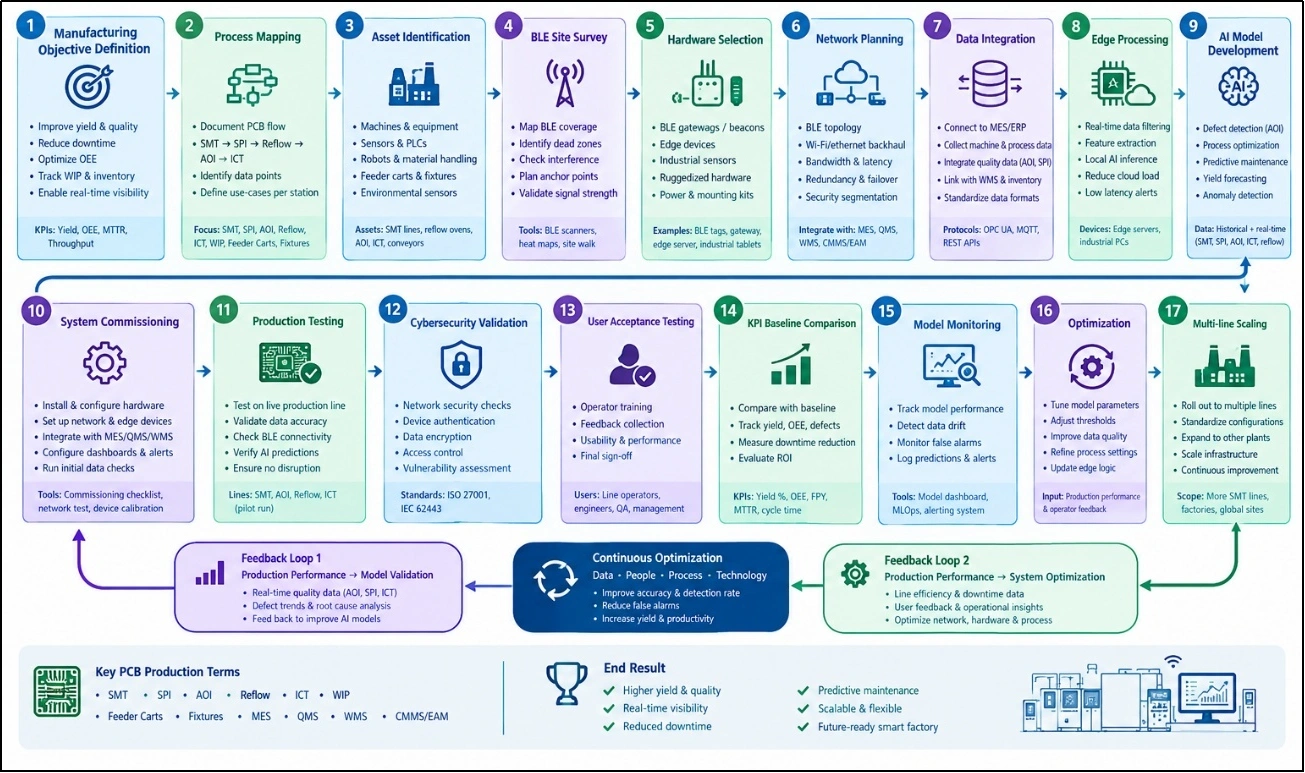
This lifecycle diagram illustrates the end-to-end deployment of AI and BLE technologies in PCB manufacturing, from manufacturing objectives, process mapping, and BLE site surveys to AI development, commissioning, testing, monitoring, optimization, and multi-line scaling. Feedback loops connect production performance with model validation and system optimization to support continuous improvement, higher yield, reduced downtime, and scalable smart manufacturing.
KPIs for AI-Enabled Printed Circuit Board Production
AI deployment should be measured using production outcomes rather than the number of BLE devices installed.
Relevant KPIs include:
| KPI | What It Measures | AI/BLE Contribution |
| OEE | Availability, performance, and quality | Correlates equipment and production events |
| First-pass yield | Boards passing without rework | Identifies process-quality relationships |
| Defects per million opportunities | Defect frequency | Supports defect-pattern analysis |
| WIP dwell time | Time spent between operations | Identifies stalled production |
| Changeover time | Time required between product runs | Finds recurring preparation delays |
| Line utilization | Productive equipment usage | Detects idle capacity |
| Unplanned downtime | Unexpected production interruption | Predictive maintenance |
| Rework rate | Assemblies requiring correction | Quality prediction and analysis |
| Material shortage events | Production interruptions from missing materials | Material-flow prediction |
| Fixture utilization | Usage of production/test fixtures | Asset optimization |
| AOI false-positive rate | Incorrect visual defect classifications | Model and inspection optimization |
| Predictive-maintenance precision | Accuracy of maintenance alerts | Measures AI usefulness |
| Traceability completeness | Availability of required genealogy records | Connects physical and digital events |
| Energy consumption per unit | Energy efficiency | Correlates equipment and production conditions |
The correct KPI set depends on the manufacturing objective. A WIP-location project should not be judged primarily by model accuracy. It should be evaluated through reduced search time, reduced WIP dwell, fewer material-related interruptions, improved traceability, or other measurable outcomes.
Practical Recommendations for PCB Manufacturers
AI and BLE deployments are most effective when the physical production problem is clearly defined before hardware is selected.
Recommended engineering practices include:
- Start with one measurable production constraint rather than attempting to instrument the entire PCB factory.
- Establish baseline KPIs before deploying AI.
- Use MES, QMS, WMS, CMMS/EAM, machine controllers, SPI, AOI, and test systems as primary sources where those systems already provide authoritative data.
- Use BLE to capture physical context that existing systems cannot reliably provide.
- Prefer zone-level BLE positioning when the business requirement does not justify high-precision positioning.
- Conduct RF surveys under representative production conditions.
- Separate production-control networks from general IoT connectivity.
- Validate gateway coverage during normal line operation.
- Establish device identity and asset-mapping procedures before commissioning.
- Treat sensor calibration as an engineering and quality requirement when measurements influence manufacturing decisions.
- Keep raw observations, inferred events, AI predictions, and confirmed manufacturing records distinguishable.
- Introduce AI recommendations with human review when the consequence of an incorrect decision could affect product quality or production continuity.
- Define model-performance thresholds before production deployment.
- Monitor model drift after product, machine, supplier, or process changes.
- Design the system so additional SMT lines, inspection stations, test cells, or facilities can be added without redesigning the complete data pipeline.
- Document cybersecurity responsibilities across BLE devices, gateways, servers, cloud services, and enterprise applications.
GAO’s experience supplying BLE, RFID, and IoT hardware products and systems can support organizations evaluating these physical connectivity requirements. Our engineering support can also help customers consider device selection, system integration, deployment, and technical support requirements for production environments.
Scaling AI Across PCB Production Lines and Facilities
Once a pilot demonstrates measurable value, scaling should preserve the validated event model and integration approach while adapting to differences among lines and facilities.
An SMT line may require high-frequency equipment data and feeder information, while a PCB fabrication area may emphasize environmental conditions, process equipment, panels, tooling, and electrical test records. Consequently, scaling should not mean deploying identical sensors everywhere. It should mean applying common data definitions and cybersecurity controls to different manufacturing requirements.
Multi-site deployments can use centralized AI analysis where appropriate while maintaining local edge processing for connectivity resilience and immediate event handling. A private server deployment can consolidate production data across facilities when customer-controlled infrastructure is preferred. Cloud deployment can provide centralized analytics when corporate data policies and network conditions permit.
GAO Group companies, including GAO and its sister companies GAO Research and GAO Tek, operate from New York City and Toronto, Canada. GAO has served organizations across the United States and Canada, including Fortune 500 companies, major research and development organizations, universities, and government agencies. This background is supported by substantial R&D investment, stringent quality assurance practices, and technical support that can be delivered remotely or onsite.
Conclusion: Building a More Observable and Predictive PCB Factory
AI-enabled Printed Circuit Board Production is most valuable when intelligence is connected to measurable manufacturing outcomes. Machine learning, computer vision, predictive analytics, and Industrial AI can transform fragmented production data into quality predictions, maintenance alerts, WIP insights, and operational recommendations. BLE Gateways, BLE Beacons, and BLE Sensors can complement existing machine and enterprise systems by providing physical context for WIP, fixtures, materials, mobile equipment, and selected environmental conditions.
The strongest deployments begin with a defined production problem, establish reliable data relationships, validate AI models against real manufacturing conditions, and introduce automation according to operational risk. GAO can provide BLE, RFID, and IoT hardware products and systems that support these connected manufacturing requirements, together with technical expertise for evaluating practical deployment approaches.
AI-Enabled Smart Printed Circuit Board Production Facility
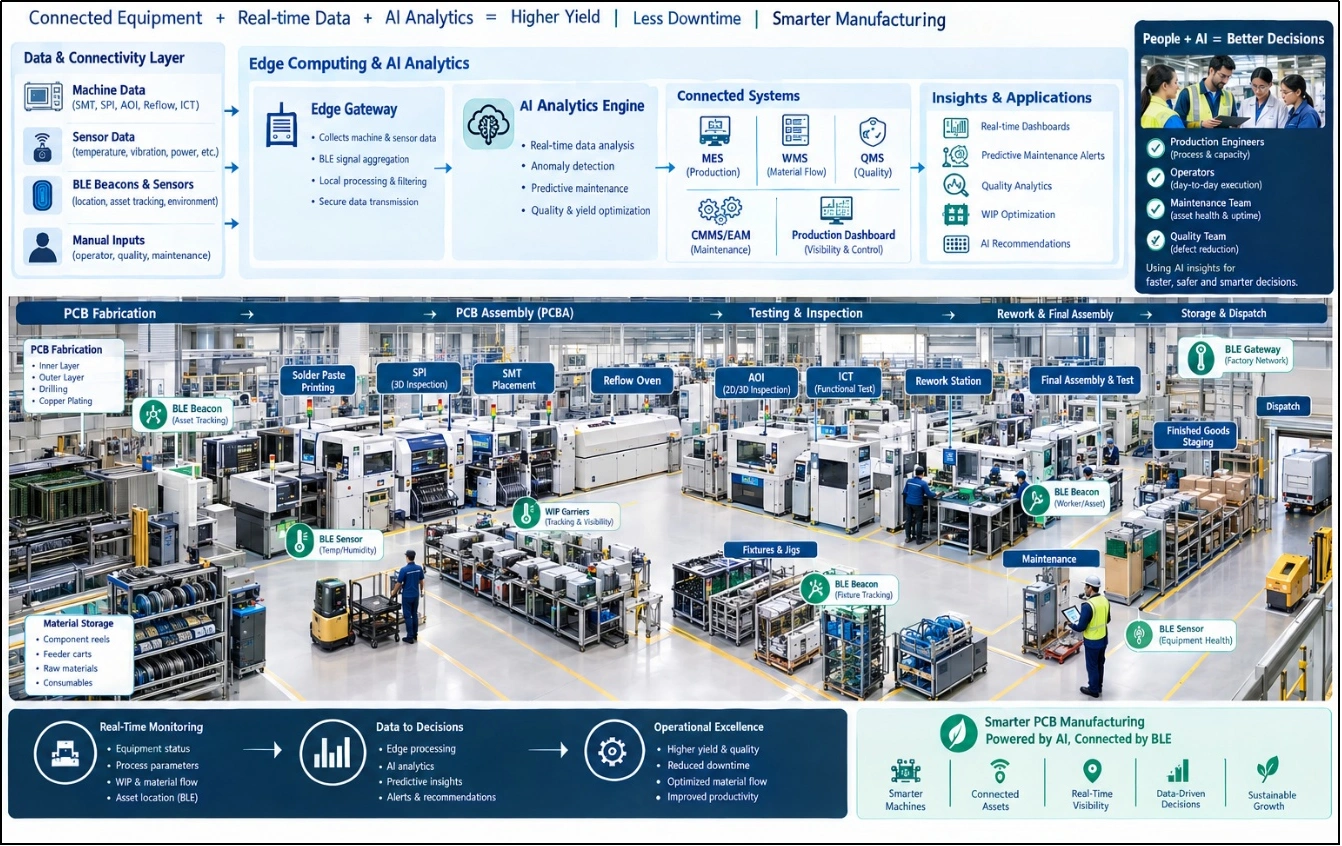
This industrial illustration presents an integrated smart PCB manufacturing facility where AI analytics, BLE-enabled asset tracking, connected equipment, and enterprise systems work together. It shows the flow from PCB fabrication and PCBA through inspection, testing, rework, storage, and dispatch, while demonstrating how real-time data supports predictive maintenance, quality improvement, WIP optimization, and smarter production decisions.
Building the Future of Industrial AI and IoT with Aperture Venture Studio and GAO RFID Inc.
For more than three decades, GAO Group of Companies has invested heavily in R&D for industrial BLE, RFID, and IoT. As generative AI became useful for industrial applications, we expanded our work across AI and IoT technologies and founded Aperture Venture Studio to help advance practical AI and IoT solutions, including technologies relevant to connected Printed Circuit Board Production.
Aperture brings together AI and IoT technical experts, entrepreneurial and operational executives, investors, and leading companies. We also developed Aperture Ventures Summit and TekSummit to discuss advanced AI and IoT topics and foster technical communities.
We welcome you to join us as:
- Advisors, Co-founders, or Employees
- Investors
- Customers