
AI and BLE for Correctional Facilities
AI-Powered Correctional Facility Operations Using BLE-Enabled Location Intelligence
Correctional facilities face increasing demands for inmate accountability, officer safety, contraband prevention, facility security, operational efficiency, and regulatory compliance. AI-powered correctional management solutions supported by BLE gateways, BLE beacons, and BLE sensors provide real-time visibility into inmate movement, personnel locations, critical assets, and facility operations.
Within correctional facilities, AI analyzes data collected from housing units, segregation blocks, medical clinics, visitation centers, educational facilities, recreation yards, intake and release areas, control rooms, perimeter zones, maintenance workshops, and transportation operations. By transforming location and operational data into actionable intelligence, correctional administrators can improve security monitoring, optimize staffing, reduce incident response times, and enhance institutional safety.
AIoT combines artificial intelligence with connected devices, sensors, software systems, and operational infrastructure. For correctional facilities, AIoT enables predictive security monitoring, inmate movement intelligence, officer accountability, emergency response coordination, and asset utilization optimization. These capabilities help correctional organizations move beyond reactive management toward data-driven decision-making.
GAO has supported organizations with BLE, RFID, and IoT hardware systems that help improve operational visibility, location awareness, and security monitoring in demanding environments.
Understanding AI-Driven Correctional Facility Intelligence
Correctional facilities operate complex environments involving inmates, correctional officers, healthcare personnel, contractors, visitors, transportation teams, and security personnel. Daily operations require continuous monitoring of inmate movements, facility access, asset utilization, incident management, and emergency preparedness.
Traditional monitoring approaches often rely on:
- Manual inmate counts
- Paper-based logs
- Fixed surveillance systems
- Radio communications
- Periodic inspections
- Manual incident reporting
AI transforms these processes by continuously analyzing operational data and identifying patterns that may indicate security risks, resource shortages, operational inefficiencies, or emerging threats.
BLE-enabled location awareness supports AI systems by providing visibility into:
- Inmate movement paths
- Officer patrol activities
- Medical equipment locations
- Emergency response resources
- Maintenance assets
- Transportation operations
- Restricted-area access events
- Facility occupancy conditions
The combination of AI and location intelligence creates a more comprehensive operational picture across correctional institutions.
Integrated Correctional Facility Operational Intelligence Platform (AI & BLE Powered)
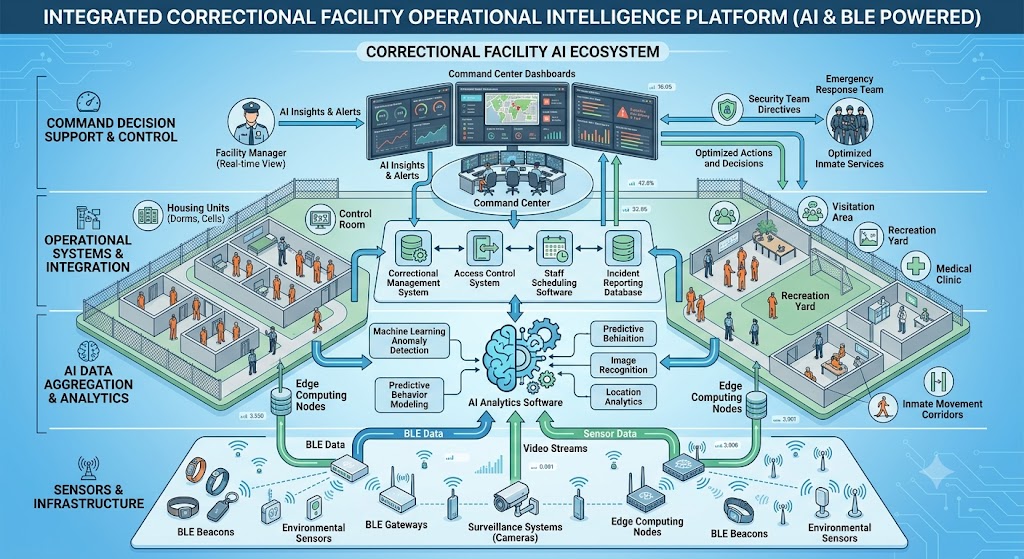
A comprehensive enterprise-grade operations overview diagram illustrating the real-time data flow from diverse correctional facility zones—housing, security, medical, visitation—via Bluetooth Low Energy (BLE) infrastructure into a central AI analytics system, powering command dashboards and optimized decision support for security, management, and inmate services.
Critical AI Applications in Correctional Facilities
AI Inmate Movement Monitoring
Correctional facilities must continuously track inmate movement throughout the institution.
AI systems analyze:
- Housing unit transfers
- Recreation schedules
- Medical appointments
- Education program attendance
- Visitation activities
- Court transportation preparation
- Work assignment movements
- Restricted area access attempts
AI can identify unusual movement patterns, unauthorized congregation events, route deviations, and potential security concerns before they escalate.
AI Officer Safety Monitoring
Officer safety remains one of the most important priorities in correctional operations.
AI-supported monitoring solutions help identify:
- Isolated personnel situations
- Delayed patrol completion
- Emergency distress events
- Personnel accountability gaps
- Response team deployment requirements
- Security checkpoint coverage issues
Location-aware intelligence improves emergency coordination while supporting officer safety procedures.
AI Contraband Prevention
Contraband introduces significant operational and security risks.
AI solutions help analyze:
- Movement irregularities
- Unusual gathering behavior
- Restricted area access attempts
- Inventory discrepancies
- Maintenance area activities
- Visitor interaction patterns
Machine learning models can identify operational conditions commonly associated with contraband movement and storage.
AI Emergency Response Management
Correctional emergencies require immediate situational awareness.
AI supports:
- Facility lockdown coordination
- Evacuation management
- Tactical response deployment
- Medical emergency routing
- Incident command support
- Personnel accountability verification
These capabilities reduce response delays while improving command center decision-making.
AI Asset and Equipment Monitoring
Correctional facilities manage thousands of operational assets.
Examples include:
- Medical carts
- Emergency equipment
- Communication devices
- Maintenance tools
- Security inspection equipment
- Transportation resources
- Mobile surveillance systems
- Facility maintenance assets
AI improves visibility into asset utilization, availability, movement, and maintenance requirements.
Correctional Facility AI Operational Solutions Matrix: Challenges to KPI Outcomes
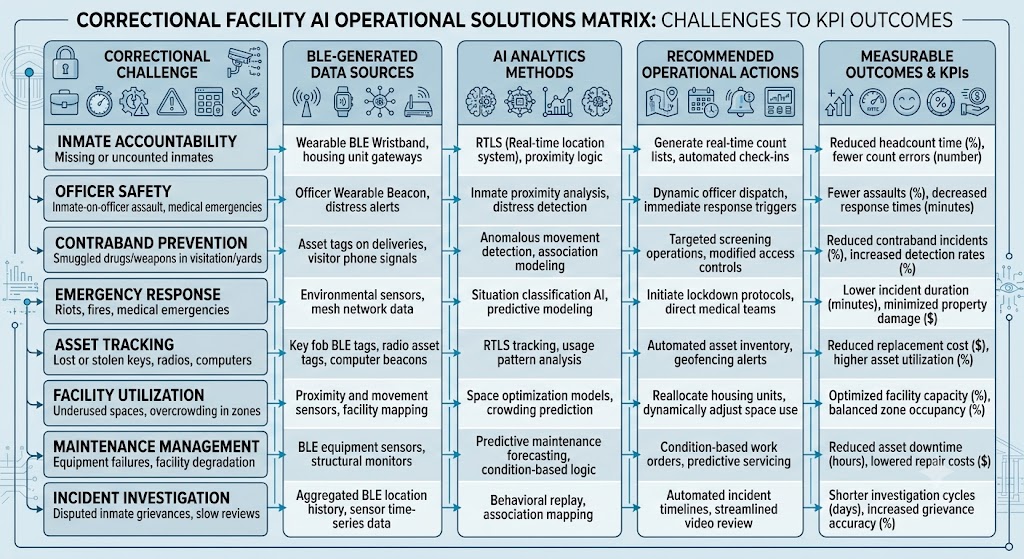
An enterprise solution matrix mapping eight critical correctional facility operational functions—inmate accountability, officer safety, contraband prevention, emergency response, asset tracking, facility utilization, maintenance, and incident investigation—to specific BLE sensor streams, AI analytical methods, operational actions, and measurable performance KPIs.
Operational Workflow from Data Collection to AI Decision Support
AI-powered correctional facility solutions depend on structured operational workflows that convert physical events into actionable intelligence.
Data Acquisition Layer
Data originates from multiple operational sources across the correctional environment.
Examples include:
- Personnel location events
- Inmate movement events
- Door access activities
- Environmental sensors
- Security checkpoints
- Medical facility operations
- Transportation staging areas
- Surveillance systems
BLE beacons, BLE gateways, and BLE sensors collect location and operational information across monitored areas.
Communication Infrastructure Layer
Collected information is transmitted through secure communications networks.
Common components include:
- Ethernet networks
- Secure Wi-Fi systems
- Fiber backbone infrastructure
- Edge communication devices
- Secure wireless links
- Redundant communications paths
Correctional facilities often require resilient communication systems capable of supporting mission-critical operations.
Edge Processing Layer
Edge computing devices process data near operational sources.
Functions include:
- Event filtering
- Data normalization
- Location calculations
- Signal validation
- Local alert generation
- Temporary data storage
Edge processing reduces latency and supports rapid operational response.
AI Analytics Layer
AI software evaluates operational data using:
- Machine learning
- Behavioral analytics
- Predictive analytics
- Anomaly detection
- Pattern recognition
- Risk scoring
- Event correlation
These techniques transform raw operational information into meaningful intelligence.
Enterprise Software Integration Layer
AI solutions integrate with:
- Correctional management systems
- Inmate information systems
- Incident reporting software
- Access control systems
- Video management systems
- Workforce management software
- Maintenance management systems
- Emergency response software
Integrated environments provide broader operational visibility.
BLE Infrastructure, AI Models, Security Controls, and Deployment Considerations
Successful correctional facility deployments require coordinated implementation of hardware, software, communication systems, cybersecurity controls, and AI analytics capabilities.
BLE Hardware Components
Correctional facility deployments commonly utilize:
- BLE gateways positioned throughout housing units and operational zones
- BLE beacons attached to approved personnel, equipment, and authorized assets
- BLE sensors monitoring environmental and operational conditions
- Ruggedized communication equipment
- Edge computing servers
- Backup power systems
Hardware placement requires careful planning due to reinforced concrete structures, steel barriers, security doors, and restricted operational zones.
AI Models Supporting Correctional Operations
Common AI technologies include:
- Behavioral anomaly detection
- Predictive risk assessment
- Incident forecasting
- Resource optimization algorithms
- Personnel deployment optimization
- Occupancy analytics
- Pattern recognition systems
- Event correlation engines
These models continuously improve as operational data accumulates.
Communication Protocols and Data Exchange
Correctional environments typically utilize:
- Bluetooth Low Energy
- TCP/IP
- HTTPS
- MQTT
- REST APIs
- Secure message queues
- Syslog integration
- Identity management protocols
Cloud Version vs. Server Version Deployments for Correctional Facilities
Correctional facilities often require different deployment approaches depending on regulatory requirements, cybersecurity policies, facility ownership models, and operational risk tolerance.
Cloud Version
Cloud-hosted deployments are managed within secure cloud infrastructure and are often selected when correctional agencies require centralized management across multiple facilities.
Advantages include:
- Centralized software administration
- Simplified updates and maintenance
- Multi-facility visibility
- Faster deployment timelines
- Scalable analytics resources
- Disaster recovery support
- Centralized reporting and compliance monitoring
Cloud deployments are frequently suitable for correctional agencies managing regional or national correctional systems where multiple institutions must be monitored through a unified management environment.
Server Version
Server-based deployments utilize edge servers, private data centers, government-operated computing environments, or customer-managed infrastructure.
Advantages include:
- Greater control over sensitive operational data
- Compliance with government security requirements
- Reduced external network dependency
- Support for air-gapped environments
- Local processing of critical security events
- Greater customization flexibility
Many high-security correctional institutions prefer server-hosted deployments due to strict operational security requirements.
GAO supports organizations with BLE hardware, IoT infrastructure, and technical expertise that can support either deployment model based on operational and security requirements.
Key Technical Capabilities and Operational Benefits for Correctional Facilities
AI-driven correctional intelligence solutions provide substantial improvements in institutional safety, inmate accountability, resource utilization, and operational decision-making.
Enhanced Inmate Accountability
AI continuously evaluates inmate movement across housing units, recreation yards, educational facilities, healthcare clinics, visitation centers, transportation staging areas, and secure operational zones.
Benefits include:
- Improved inmate location visibility
- Reduced manual headcount requirements
- Faster discrepancy identification
- Better movement authorization validation
- Improved investigation support
- Reduced administrative workload
Correctional personnel can quickly identify unusual movement patterns and potential security concerns.
Improved Officer Safety
Correctional officers frequently operate in dynamic and potentially hazardous environments.
AI-supported monitoring helps improve:
- Personnel accountability
- Patrol verification
- Emergency response coordination
- Staff location awareness
- Duress event response
- Tactical team deployment
Location-aware intelligence supports faster decision-making during emergencies and critical incidents.
Predictive Security Monitoring
Machine learning models can identify patterns associated with elevated security risk.
Examples include:
- Unusual inmate congregation
- Repeated restricted-area activity
- Facility congestion trends
- Contraband-related movement patterns
- Incident recurrence indicators
- Staffing imbalance risks
Predictive intelligence allows correctional administrators to implement preventative actions before operational conditions escalate.
Contraband Prevention Support
Contraband remains a major operational challenge within correctional environments.
AI supports contraband prevention through:
- Behavioral pattern analysis
- Movement anomaly detection
- Restricted area monitoring
- Asset utilization analysis
- Visitor activity assessment
- Operational risk scoring
These capabilities assist security teams in focusing resources on areas requiring investigation.
Operational Efficiency Improvements
Correctional facilities manage numerous operational processes simultaneously.
AI assists with:
- Workforce scheduling
- Medical appointment coordination
- Transportation planning
- Maintenance prioritization
- Resource allocation
- Facility utilization analysis
- Inventory management
- Compliance monitoring
Operational improvements may include:
- Reduced administrative effort
- Better resource utilization
- Improved response times
- Enhanced operational visibility
- Increased staff productivity
- More effective planning
Scalability and Long-Term Operational Value
Modern correctional facilities require solutions capable of supporting future operational growth.
AI-enabled systems support:
- Multi-facility expansion
- Increasing inmate populations
- Additional operational zones
- New security technologies
- Expanded analytics capabilities
- Long-term modernization initiatives
Scalable deployments help agencies maximize technology investments while maintaining operational continuity.
Deployment Best Practices for Correctional Facilities
Successful correctional facility deployments require detailed planning, validation, and ongoing optimization.
Facility Assessment and Planning
Before implementation, organizations should evaluate:
- Facility layouts
- Security classifications
- Housing unit configurations
- Reinforced structures
- Restricted zones
- Communications coverage
- Existing security systems
- Operational workflows
Comprehensive site surveys help ensure optimal technology performance.
Cybersecurity Requirements
Correctional technology systems frequently operate within highly regulated environments.
Recommended controls include:
- Network segmentation
- Role-based access control
- Multi-factor authentication
- Device identity management
- End-to-end encryption
- Security information monitoring
- Vulnerability assessments
- Audit logging
Strong cybersecurity practices help protect operational systems and sensitive correctional data.
Enterprise System Integration
Maximum value is achieved when AI solutions integrate with:
- Correctional management systems
- Inmate records systems
- Video management software
- Access control systems
- Incident management systems
- Human resource systems
- Maintenance management software
- Emergency response systems
Integration reduces operational silos and improves decision-making.
Performance Validation and Optimization
Following deployment, organizations should continuously monitor:
- Location accuracy
- System availability
- Alert performance
- Response times
- Data quality
- Operational KPIs
- Security effectiveness
- User adoption metrics
Ongoing optimization ensures sustained operational benefits.
GAO Expertise in AI and BLE Solutions for Correctional Facilities
Correctional organizations require reliable technologies that improve security, accountability, operational visibility, and decision-making.
Headquartered in New York City and Toronto, Canada, GAO is recognized among the world’s leading B2B and B2G suppliers of BLE and RFID technologies. Through decades of research, development, product innovation, and customer support, we have supplied hardware products and systems used across demanding operational environments.
GAO Group, consisting of GAO, GAO Research, and GAO Tek, has served organizations throughout the United States and Canada, including Fortune 500 companies, leading research institutions, universities, and government agencies. Our experience supporting complex deployments helps organizations implement BLE-enabled solutions that align with operational requirements, security policies, and long-term modernization goals.
Advancing Correctional Facility Operations Through AI-Driven Intelligence
AI-powered correctional facility solutions supported by BLE-enabled location awareness provide significant improvements in institutional safety, inmate accountability, staff protection, asset visibility, operational efficiency, and incident response readiness.
Key implementation recommendations include:
- Conduct comprehensive facility surveys before deployment
- Define measurable operational objectives
- Integrate correctional systems early in project planning
- Establish cybersecurity requirements from the outset
- Validate location accuracy under real operational conditions
- Deploy in phases to reduce operational disruption
- Train correctional personnel on AI-supported workflows
- Continuously monitor performance indicators
- Review and optimize operational processes regularly
Organizations seeking to modernize correctional operations can benefit from AI-driven operational intelligence, predictive analytics, location awareness, and automated decision support. GAO helps correctional facilities evaluate, deploy, integrate, and support BLE-based hardware systems and AI-enabled solutions that improve security, accountability, efficiency, and operational performance.
Building the Future of Industrial AI and IoT with Aperture Venture Studio and GAO RFID Inc.
For more than three decades, GAO Group of Companies has invested heavily in research and development involving BLE, RFID, and IoT technologies. As artificial intelligence has become increasingly valuable for correctional facility security, inmate accountability, operational intelligence, and public-sector modernization, we have expanded our development efforts in AI and IoT solutions that address complex operational challenges.
We have established Aperture Venture Studio to help accelerate the advancement of AI and IoT technologies supporting public-sector services, critical infrastructure operations, security monitoring, and connected operational environments.
Aperture has attracted leading AI and IoT technical experts, operational executives, investors, and industry leaders. Through Aperture Ventures Summit and TekSummit, we continue fostering collaboration and knowledge sharing around advanced AI and IoT technologies.
As a result, we have developed strong technical communities and collaborative networks focused on AI and IoT innovation.
We welcome you to join us as:
- Advisors, Co-founders, or Employees
- Investors
- Customers