
AI and BLE for Defense Support Operations
AI-Powered Asset Visibility and Operational Intelligence for Defense Support Operations
Defense support operations depend on accurate logistics coordination, equipment readiness, maintenance execution, supply chain visibility, personnel accountability, and resource availability. AI-powered operational intelligence supported by BLE-enabled sensing infrastructure helps defense organizations improve situational awareness across warehouses, maintenance depots, transportation hubs, fuel distribution facilities, supply centers, and mission support locations.
AI analyzes data collected from connected assets, personnel, vehicles, containers, tools, repair parts, environmental monitoring devices, and operational facilities to identify patterns, predict risks, optimize resource allocation, and improve operational readiness. BLE gateways, BLE beacons, and BLE sensors serve as enabling technologies that provide location, condition, movement, and utilization data for AI-driven decision making.
Defense support organizations increasingly deploy AIoT solutions to reduce maintenance delays, improve inventory accuracy, strengthen security controls, increase mission readiness, and improve sustainment efficiency. GAO has supplied BLE, RFID, and IoT hardware products and systems that help organizations improve operational visibility and asset management across complex operational environments.
AI-Powered Defense Support Operations Platform (AI & BLE Integration)
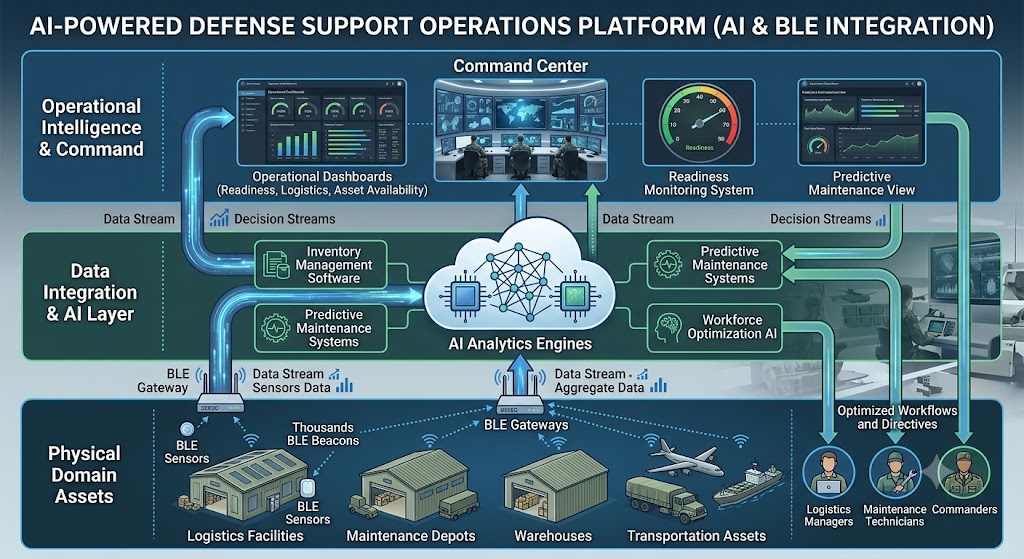
A comprehensive enterprise-grade diagram illustrating the end-to-end operational data flow from physical defense assets—including logistics facilities, maintenance depots, warehouses, and transportation assets—via a high-density Bluetooth Low Energy (BLE) sensor mesh and gateways to a central AI analytics engine, powering real-time readiness monitoring, predictive maintenance, inventory management, and optimized command decision dashboards.
Fundamental Concepts of AI-Driven Defense Support Operations
Modern defense support operations involve a broad range of sustainment activities that ensure equipment, supplies, personnel, facilities, and transportation resources remain available when needed. These activities include logistics planning, maintenance execution, inventory control, transportation coordination, fuel management, medical logistics, warehouse operations, and equipment readiness management.
AI improves these operations by converting large volumes of operational data into actionable intelligence. Machine learning algorithms identify usage trends, detect operational anomalies, predict future requirements, and recommend actions that improve performance.
Within defense support environments, BLE technology acts as a data collection layer supporting AI initiatives. Connected devices continuously generate information regarding asset location, equipment utilization, storage conditions, personnel movement, inventory status, and facility operations.
Key AI objectives in defense support operations include:
- Improving mission readiness
- Enhancing sustainment efficiency
- Increasing inventory visibility
- Reducing equipment downtime
- Optimizing maintenance activities
- Strengthening asset accountability
- Supporting logistics planning
- Improving workforce productivity
- Reducing operational risk
AIoT deployments combine artificial intelligence with connected sensors, monitoring devices, operational systems, and communication infrastructure to provide continuous operational intelligence.
GAO works with organizations requiring dependable BLE and RFID hardware systems that support real-time operational awareness and connected asset management initiatives.
Key AI Applications Across Defense Support Operations
AI Asset Tracking and Accountability
Defense organizations manage large inventories of mission-critical equipment, tools, repair parts, weapons support equipment, communication devices, transportation assets, and warehouse resources.
AI-powered asset tracking solutions help:
- Locate critical equipment
- Identify misplaced assets
- Monitor utilization patterns
- Reduce asset loss
- Improve inventory accuracy
- Support lifecycle management
BLE-enabled location awareness provides the operational data required for these AI models.
AI Predictive Maintenance
Maintenance readiness directly affects operational effectiveness.
AI analyzes:
- Equipment utilization history
- Maintenance records
- Environmental conditions
- Vibration data
- Temperature readings
- Failure trends
This analysis helps maintenance teams schedule service before failures occur.
Applications include:
- Vehicle fleets
- Power generation systems
- Ground support equipment
- Aviation support assets
- Communication infrastructure
- Mechanical systems
AI Logistics Optimization
Defense logistics networks involve complex movement of supplies, equipment, fuel, medical resources, and repair components.
AI assists with:
- Route planning
- Distribution optimization
- Inventory forecasting
- Supply prioritization
- Warehouse utilization
- Transportation scheduling
Organizations can improve throughput while reducing delays and resource waste.
AI Inventory Management
Warehouses and distribution centers support operational readiness through accurate inventory control.
AI improves:
- Stock level forecasting
- Reorder planning
- Demand prediction
- Inventory accuracy
- Storage optimization
- Material allocation
Operational teams gain improved visibility into supply chain performance and inventory availability.
AI Workforce Optimization
Defense support operations rely on maintenance technicians, logistics specialists, warehouse personnel, transportation coordinators, security teams, and operational planners.
AI helps organizations:
- Allocate resources efficiently
- Predict workforce requirements
- Balance workloads
- Optimize shift scheduling
- Improve operational productivity
AI Security and Facility Monitoring
Support facilities frequently contain valuable assets, controlled materials, repair equipment, and mission-critical resources.
AI enhances:
- Access monitoring
- Restricted-area protection
- Asset movement monitoring
- Incident detection
- Security risk analysis
- Compliance monitoring
Defense Support Operations: AI & BLE Use Case Matrix
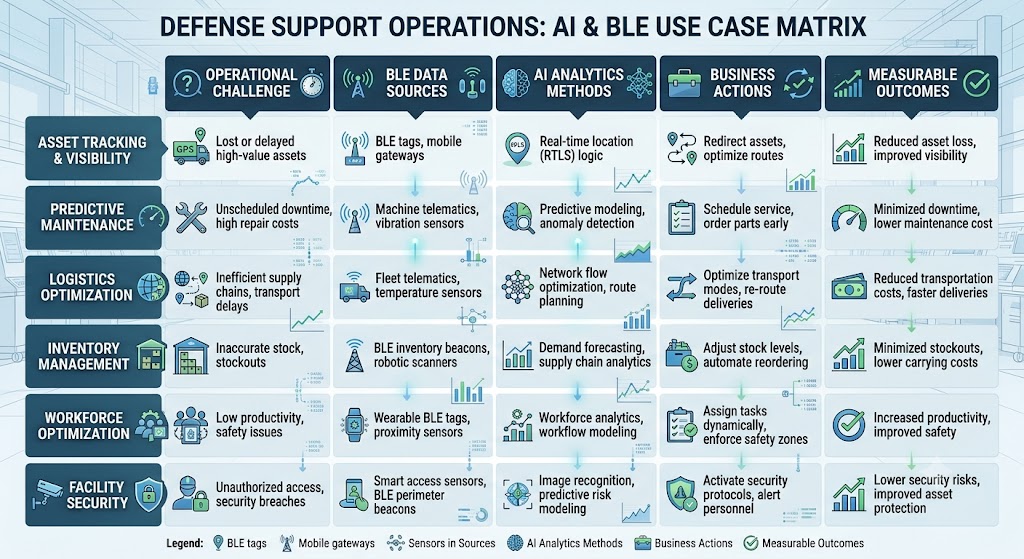
An enterprise solution matrix mapping six defense support functions—asset tracking, predictive maintenance, logistics, inventory, workforce, and facility security—to operational challenges, BLE data streams, AI analytics methods, business actions, and measurable KPIs.
Operational Challenges Driving AI Adoption in Defense Support Operations
Defense support organizations operate in environments characterized by complex logistics requirements, distributed facilities, mission readiness demands, and strict accountability standards.
Common challenges include:
- Limited real-time visibility into asset locations
- Inventory discrepancies across facilities
- Maintenance scheduling inefficiencies
- Spare parts shortages
- Equipment downtime
- Supply chain disruptions
- Resource allocation challenges
- Personnel accountability requirements
- Facility security concerns
- Operational readiness risks
Traditional reporting systems often provide historical information rather than real-time operational awareness. AI-powered analytics improve decision-making by continuously evaluating current operational conditions and identifying emerging risks before they affect mission support activities.
Engineering Considerations for Defense Support Deployments
Successful deployments require consideration of:
- Facility layout complexity
- Asset density
- Communications coverage
- Cybersecurity requirements
- Operational continuity needs
- Existing software integration
- Data governance policies
- Environmental conditions
- Scalability requirements
- Regulatory compliance obligations
Defense support organizations frequently operate across multiple facilities, warehouses, depots, transportation hubs, and maintenance centers. Solution designs must accommodate large-scale operational environments while maintaining reliable performance.
Expected Operational Outcomes
Organizations implementing AI-driven operational intelligence commonly seek improvements in:
- Asset utilization
- Inventory accuracy
- Equipment availability
- Maintenance efficiency
- Workforce productivity
- Logistics performance
- Security monitoring
- Operational readiness
- Resource allocation
- Decision-making speed
AI-Driven Operational Workflow for Defense Support Operations
Defense support operations generate large volumes of data from logistics facilities, maintenance depots, forward operating support sites, supply warehouses, transportation hubs, fuel storage facilities, medical logistics centers, and equipment staging areas. AI transforms these operational data streams into actionable intelligence that improves mission readiness, sustainment efficiency, and asset accountability.
Data Acquisition Layer
Data is collected from personnel identification badges, supply containers, weapon storage cages, maintenance tools, repair components, fuel distribution assets, mobile equipment, transport vehicles, storage racks, environmental monitoring devices, and facility infrastructure. BLE beacons, BLE sensors, and BLE gateways provide location, condition, movement, and utilization information across defense support environments.
Communication and Data Transport Layer
BLE devices communicate with gateway infrastructure deployed throughout warehouses, depots, hangars, maintenance facilities, command support centers, and logistics compounds. Gateways transmit data through secure Ethernet, fiber, Wi-Fi, LTE, private cellular networks, or tactical communication systems.
Edge Processing Layer
Edge servers perform:
- Signal filtering
- Device authentication
- Sensor validation
- Event correlation
- Anomaly detection
- Local alert generation
- Mission-critical decision support
Edge AI reduces latency and maintains operational continuity when communication links become constrained.
Enterprise Integration Layer
Processed data integrates with:
- Logistics Information Systems
- Asset Management Systems
- Maintenance Management Software
- Supply Chain Management Systems
- Fleet Management Software
- Warehouse Management Systems
- Defense Resource Planning Systems
- Operational Readiness Reporting Systems
- Security Information Management Systems
AI Analytics Layer
AI software performs:
- Predictive maintenance analysis
- Inventory forecasting
- Mission readiness scoring
- Asset utilization optimization
- Workforce allocation analysis
- Route optimization
- Supply chain risk assessment
- Resource demand prediction
- Operational anomaly detection
Decision and Action Layer
AI-generated insights support:
- Maintenance scheduling
- Inventory replenishment
- Asset redeployment
- Workforce assignments
- Logistics planning
- Security responses
- Readiness improvement initiatives
- Supply chain optimization
GAO has helped organizations implement connected asset visibility solutions by supplying BLE hardware systems that support real-time operational awareness and decision support initiatives.
BLE Infrastructure, AI Models, Software Systems, and Deployment Considerations
Successful defense support operation deployments require coordinated implementation of sensing technologies, AI software, communications infrastructure, cybersecurity controls, and operational software systems.
BLE Hardware Components
BLE Beacons
BLE beacons support:
- Personnel location awareness
- Equipment tracking
- Warehouse asset identification
- Vehicle location monitoring
- Supply chain visibility
BLE Sensors
BLE sensors monitor:
- Temperature
- Humidity
- Vibration
- Shock exposure
- Fuel conditions
- Storage environments
- Equipment operating conditions
BLE Gateways
Gateways aggregate sensor data and securely transfer information into operational software systems.
AI Technologies
Defense support operations commonly utilize:
- Machine Learning
- Deep Learning
- Predictive Analytics
- Computer Vision
- Reinforcement Learning
- Time-Series Forecasting
- Natural Language Processing
- Edge AI
AI models help identify patterns that are difficult to detect using traditional reporting methods.
Communication Infrastructure
Common communication technologies include:
- BLE
- Ethernet
- Wi-Fi
- LTE
- 5G
- Private Cellular Networks
- Fiber Networks
- Tactical Communication Systems
Cloud Version
Cloud-hosted deployments are often appropriate for:
- Multi-site logistics organizations
- Centralized command visibility
- Large-scale analytics
- Long-term data retention
- Cross-regional sustainment operations
Benefits include:
- Simplified scalability
- Centralized management
- Rapid software updates
- Consolidated reporting
Server Version
Privately hosted deployments are frequently selected when:
- Sensitive operational data must remain under organizational control
- Security requirements prohibit external hosting
- Mission-critical operations require local processing
- Communications availability is limited
Server-based deployments may operate from:
- Defense data centers
- Secure regional facilities
- Operational headquarters
- Private cloud environments
- Edge computing facilities
Security Mechanisms
Security controls often include:
- Device authentication
- Certificate management
- Data encryption
- Secure key management
- Identity and access management
- Network segmentation
- Security monitoring
- Threat detection software
- Audit logging
- Zero-trust security principles
Organizations working in defense support environments typically place significant emphasis on cybersecurity, operational resilience, and compliance requirements.
Benefits of AI-Powered Defense Support Operations
Combining AI with connected sensing technologies provides measurable improvements across logistics, sustainment, maintenance, security, and operational readiness functions.
Improved Asset Visibility
Real-time monitoring improves awareness of:
- Mission equipment
- Repair parts
- Maintenance tools
- Vehicles
- Containers
- Fuel assets
- Mobile support resources
Enhanced Mission Readiness
AI identifies operational risks before they impact readiness by analyzing utilization patterns, maintenance indicators, and supply chain conditions.
Reduced Maintenance Costs
Predictive maintenance minimizes:
- Unexpected failures
- Emergency repairs
- Spare part shortages
- Downtime events
Better Supply Chain Performance
AI improves:
- Inventory accuracy
- Demand forecasting
- Distribution planning
- Resource allocation
- Procurement planning
Stronger Security Operations
AI supports:
- Unauthorized movement detection
- Restricted-area monitoring
- Asset protection
- Personnel accountability
- Security event analysis
Workforce Optimization
Operations managers can improve:
- Technician scheduling
- Maintenance staffing
- Logistics workforce utilization
- Training allocation
- Operational planning
Scalability Across Multiple Facilities
Solutions can support:
- Regional logistics centers
- Defense depots
- Maintenance facilities
- Transportation hubs
- Storage compounds
- Distribution warehouses
Advancing Defense Support Operations with AI and BLE Solutions
AI-powered defense support operations are transforming how organizations manage logistics, sustainment, maintenance, security, and readiness activities. By combining AI analytics with real-time data collected from connected assets, facilities, personnel, and equipment, organizations gain improved visibility, faster decision-making, stronger resource utilization, and more reliable operational performance.
Successful implementations require careful planning around communications infrastructure, cybersecurity, software integration, scalability, data governance, and operational workflows. Organizations that align AI initiatives with sustainment objectives, asset management strategies, and readiness goals are better positioned to improve operational effectiveness while reducing risk and cost.
GAO supplies BLE, RFID, and IoT hardware products and systems that help support connected asset visibility, operational monitoring, and AI-driven decision support initiatives across complex defense support environments. Our technical teams assist customers with hardware selection, deployment planning, integration strategies, and long-term operational support.
Building the Future of Industrial AI and IoT with Aperture Venture Studio and GAO RFID Inc.
For more than three decades, GAO Group of Companies has invested heavily in research and development of industrial BLE, RFID, and IoT technologies. As AI has become increasingly valuable for defense support operations, logistics visibility, predictive maintenance, and operational readiness applications, we have expanded our AIoT capabilities and established Aperture Venture Studio to accelerate innovation in AI and IoT solutions for mission-critical operational environments.
Aperture has attracted leading AI and IoT technical experts, operational leaders, investors, and technology organizations. Through Aperture Ventures Summit and TekSummit, advanced topics in AI, IoT, industrial automation, and operational intelligence continue to be explored and discussed.
This ongoing collaboration has created strong technical communities focused on AI and IoT innovation.
We welcome you to join us as:
- Advisors, Co-founders, or Employees
- Investors
- Customers