
AI for Battery Mineral Extraction: Intelligent Operations with BLE
AI-Driven Battery Mineral Extraction and Connected Field Operations
AI can improve battery mineral extraction by converting data from drilling, blasting, loading, hauling, crushing, stockpiling, processing, maintenance, and worker operations into actionable operational intelligence. Battery mineral extraction sites handling lithium, nickel, cobalt, graphite, manganese, and other critical minerals often involve large mobile fleets, remote work areas, hazardous zones, variable ore characteristics, and geographically distributed equipment. AI can analyze equipment, environmental, production, and location data to support maintenance, process optimization, safety monitoring, material movement, and operational planning. BLE beacons, BLE sensors, and BLE gateways can provide a practical connectivity layer for tracking personnel, tools, mobile assets, containers, and selected operating conditions. Combined with edge computing, industrial networks, databases, AI models, and mine-management or maintenance software, these data sources can support faster decisions while retaining appropriate controls for safety-critical operations. GAO provides BLE, RFID, and IoT hardware products and systems that can be incorporated into connected battery mineral extraction solutions.
AI Applications Across Battery Mineral Extraction Operations
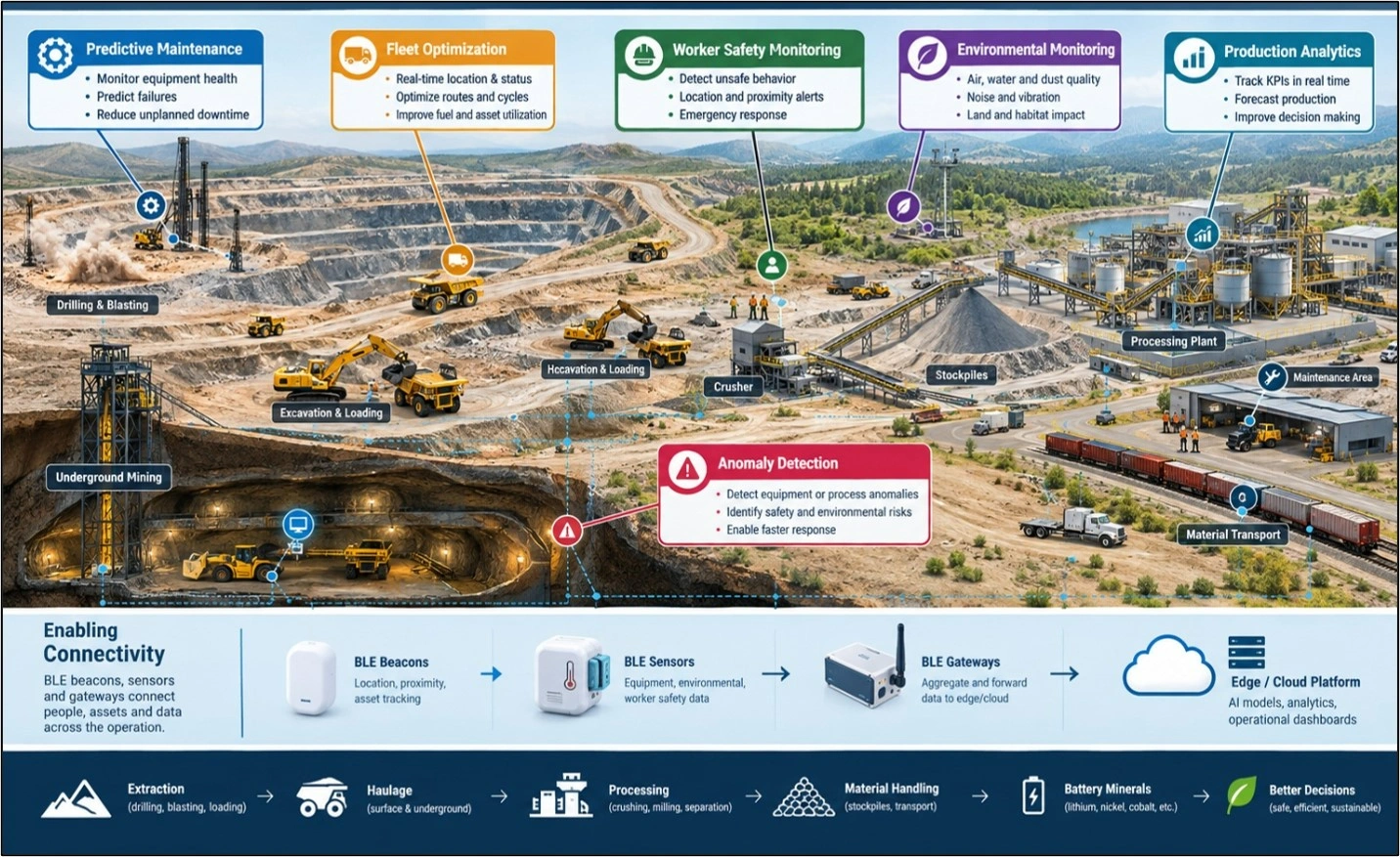
This enterprise infographic illustrates how AI supports battery mineral extraction across drilling, blasting, excavation, hauling, processing, maintenance, and material transport. It highlights predictive maintenance, fleet optimization, worker safety, environmental monitoring, anomaly detection, and production analytics, with BLE beacons, sensors, and gateways enabling operational connectivity.
What AI Means for Battery Mineral Extraction
AI for battery mineral extraction refers to the application of machine learning, Industrial AI, computer vision, predictive analytics, optimization algorithms, and related methods to operational data generated throughout the mineral extraction lifecycle. The objective is not simply to collect more data. The value comes from correlating data from physical assets, personnel, materials, geological conditions, production processes, and environmental conditions to identify patterns and support operational decisions.
Battery mineral extraction creates several conditions where AI can provide practical value:
- Haulage fleets generate continuous information about utilization, cycle times, idle periods, fuel or energy consumption, routes, and equipment condition.
- Drilling equipment can produce operating data that helps identify deviations in drilling performance and equipment behavior.
- Crushers, conveyors, pumps, mills, and other processing equipment generate measurements that can support condition monitoring and process analysis.
- Maintenance organizations need to combine equipment condition, work orders, inspection results, spare-parts information, and operating history.
- Remote mining areas can make continuous personnel and asset visibility difficult, particularly where cellular coverage is incomplete or inconsistent.
- Stockpiles and material-handling operations require accurate identification and movement information to maintain traceability.
- Workers may operate across large sites where location awareness and access to timely alerts can contribute to safer operating procedures.
BLE can complement these AI applications by providing localized identification, proximity, presence, and sensor data. BLE does not replace mine-control networks, industrial Ethernet, cellular networks, Wi-Fi, or other connectivity methods. Instead, BLE is particularly useful where short-range wireless communication can simplify the collection of data from people, equipment, tools, containers, and distributed sensing points.
Battery Mineral Extraction Applications for AI and BLE
AI-Assisted Equipment Condition Monitoring
Heavy equipment downtime can affect drilling, loading, hauling, crushing, and material-handling schedules. AI-based condition monitoring can evaluate time-series measurements and historical maintenance information to identify abnormal operating patterns.
BLE sensors can contribute localized measurements or identify the presence and operating context of assets. For example, a BLE-enabled sensor attached to a selected auxiliary asset can transmit temperature, vibration, utilization, or other supported measurements to a nearby BLE gateway. The gateway can forward the information to edge or server software where it can be correlated with maintenance records and equipment operating data.
The resulting analysis can help maintenance teams distinguish normal operating variation from conditions that warrant inspection. A maintenance management system can then associate detected conditions with equipment records, inspection activities, work orders, or technician workflows.
Mobile Equipment and Fleet Visibility
Battery mineral extraction operations can involve haul trucks, loaders, service vehicles, drilling equipment, portable generators, maintenance equipment, and other mobile assets. Knowing where equipment is located and whether it is available can support dispatching and maintenance coordination.
BLE beacons attached to selected assets can provide identity and proximity information to BLE gateways positioned around maintenance facilities, workshops, processing areas, warehouses, charging locations, or other defined zones. AI software can combine these observations with fleet-management information to identify utilization patterns, unusual dwell times, congestion, or movement anomalies.
BLE-based location information should be engineered around the required accuracy. Zone-level presence may be sufficient for a maintenance workshop, while higher-precision positioning may be required for applications involving detailed equipment movement. Site geometry, gateway placement, radio interference, metallic structures, equipment movement, and environmental conditions should be evaluated during commissioning.
BLE and AI for Battery Mineral Extraction Asset Visibility
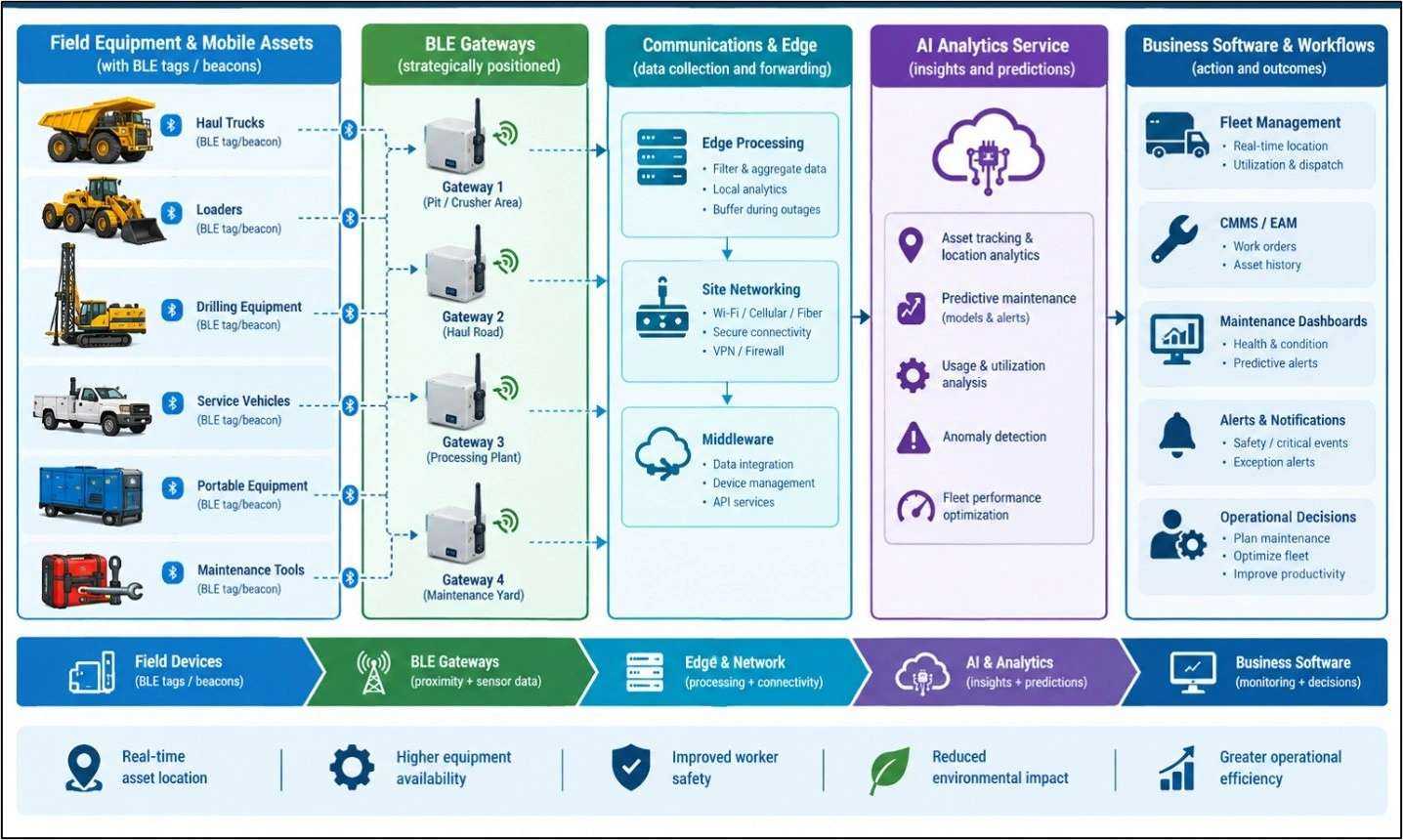
This technical block diagram shows how BLE-tagged mining assets transmit location and sensor data through strategically positioned BLE gateways, edge processing, site networking, and middleware. AI analytics then converts the data into asset tracking, predictive maintenance, anomaly detection, and fleet optimization insights that support fleet management, CMMS/EAM, dashboards, alerts, and operational decisions.
Worker Presence and Safety-Zone Monitoring
Worker location and presence information can support defined operational procedures around restricted areas, maintenance zones, processing facilities, and other controlled locations. BLE badges, tags, or wearable devices can communicate with BLE gateways to establish presence within configured zones.
AI can use this information alongside equipment status, access-control records, work schedules, and other operational data to identify situations requiring attention. For example, a software rule or AI-assisted workflow could correlate personnel presence with equipment states or maintenance activities and generate an alert when an established operating condition is violated.
Such systems should supplement, rather than replace, established mine safety procedures, engineering controls, lockout/tagout practices, access controls, emergency response procedures, and regulatory requirements. Location accuracy must also be validated for the specific safety use case before relying on it operationally.
Material and Container Tracking
Battery mineral extraction operations can involve samples, ore containers, spare parts, maintenance equipment, chemical containers, intermediate materials, and other movable items. Manual identification can become difficult when items move between extraction, processing, laboratories, warehouses, and maintenance areas.
BLE tags can provide electronic identification and zone-level movement visibility. AI software can analyze movement histories to detect unusual dwell times, unexpected movement sequences, or discrepancies between expected and observed workflows.
BLE can also be used alongside RFID, barcode systems, industrial sensors, and enterprise databases. The appropriate identification technology depends on read distance, environmental conditions, item density, required accuracy, tag attachment constraints, and the existing software environment.
AI and BLE Operational Workflow for Battery Mineral Extraction
A practical solution begins with field data acquisition and ends with an operational action. The complete workflow can include:
- BLE beacons, BLE sensors, and BLE tags collect identification, presence, proximity, or supported sensor measurements from selected assets and operating areas.
- BLE gateways receive nearby device transmissions and forward data through the site’s available communications infrastructure.
- Edge computing can perform local filtering, aggregation, protocol conversion, buffering, or selected analytics where connectivity to centralized systems is intermittent or latency requirements are stringent.
- Middleware normalizes incoming information and associates device identifiers with equipment, personnel, locations, materials, or operational records.
- Server or cloud software stores historical observations and makes data available to analytics applications.
- AI models analyze time-series, location, maintenance, production, inspection, and other relevant datasets.
- Analytics applications generate alerts, anomaly indicators, predictions, recommendations, dashboards, or prioritized work queues.
- Maintenance, operations, safety, dispatch, engineering, or management personnel evaluate the resulting information and initiate appropriate actions.
- Confirmed operational outcomes can be returned to enterprise systems as work orders, inspection records, maintenance updates, production information, or other controlled business records.
AI Data-to-Decision Workflow for Battery Mineral Extraction
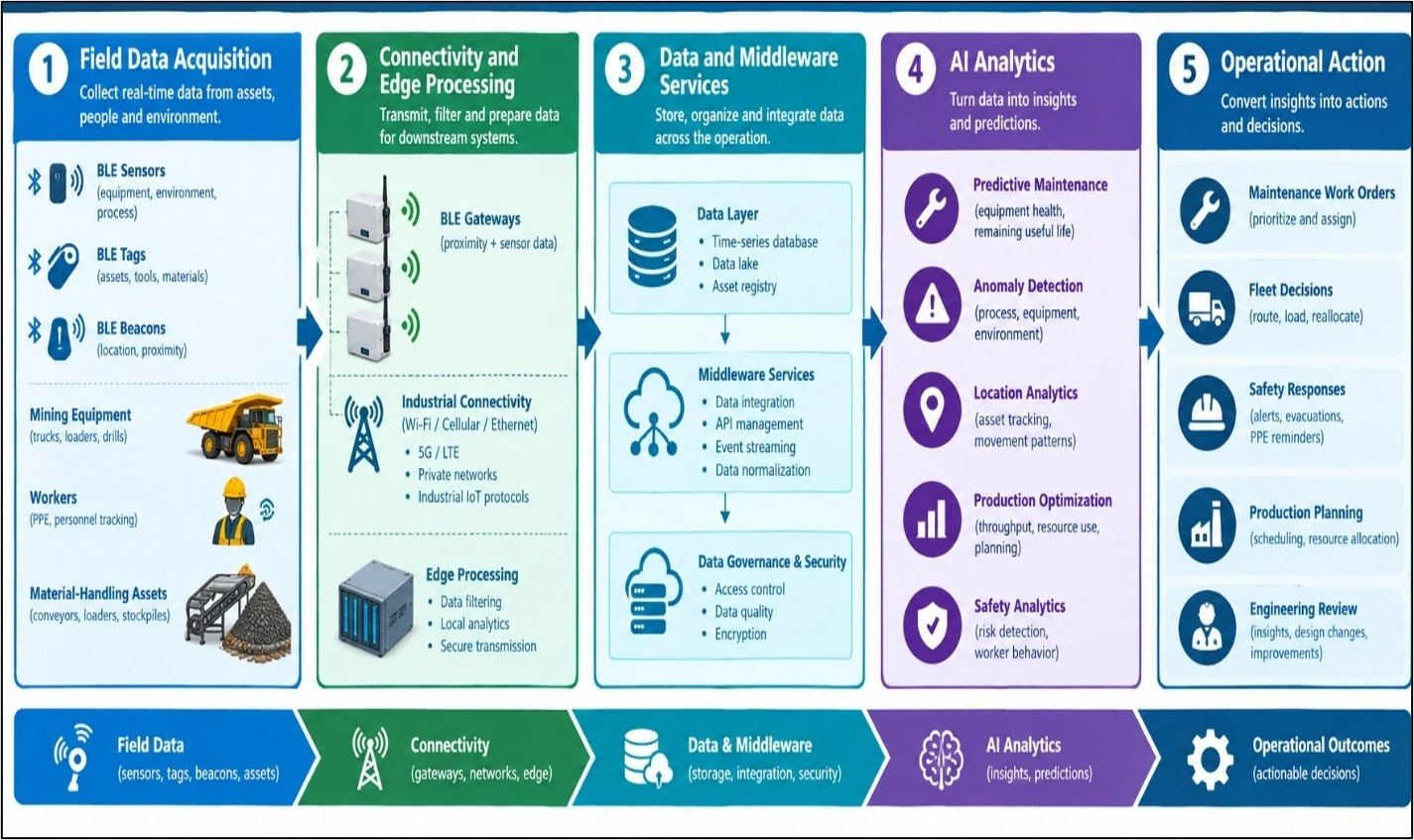
This enterprise workflow diagram illustrates the end-to-end journey from field data acquisition through connectivity, edge processing, data and middleware services, and AI analytics. It shows how insights such as predictive maintenance, anomaly detection, location analytics, production optimization, and safety analytics support operational actions and engineering decisions.
Technical Foundations for AI-Enabled Battery Mineral Extraction
BLE Field Devices and Gateways
BLE devices should be selected according to the operating environment and the information required by the AI application. Battery-powered beacons can provide asset identity or location-related observations, while BLE sensors can transmit supported measurements. Gateway placement determines coverage, data availability, battery impact, and the reliability of observations.
Mining environments introduce practical engineering constraints. Large metal structures, mobile equipment, dust, vibration, temperature variation, electromagnetic interference, changing equipment locations, and large outdoor areas can affect wireless performance. A site survey and pilot deployment should therefore precede broad installation.
GAO supplies BLE and RFID hardware products and systems that can support connected industrial applications. For battery mineral extraction, hardware selection should be driven by the required sensing function, environmental rating, battery requirements, mounting method, gateway density, data frequency, and integration requirements rather than by the wireless technology alone.
Edge Processing for Remote Mining Locations
Edge computing can reduce dependence on continuous wide-area connectivity. A gateway or local server can buffer incoming BLE observations, perform filtering, aggregate sensor information, and forward validated data when upstream connectivity is available.
This approach can be particularly relevant at remote extraction sites where network availability varies between pits, underground areas, processing facilities, workshops, warehouses, and administrative locations. Edge processing can also reduce unnecessary transmission of raw measurements when only summarized information is required by centralized AI software.
Cloud Version and Server Version
A Cloud Version can centralize data storage, analytics, dashboards, software management, and multi-site reporting within cloud infrastructure. This model can be appropriate when battery mineral extraction organizations operate multiple locations and require centralized visibility, scalable computing resources, or integration with cloud-based enterprise applications.
A Server Version can run on customer-managed edge servers, private servers, data centers, site servers, or other privately hosted infrastructure. This approach can be useful when connectivity is constrained, operational data must remain within controlled infrastructure, or site-specific integration and data-governance requirements favor private deployment.
A hybrid arrangement can also divide responsibilities. Local servers can retain operational data and provide immediate processing while selected datasets or analytical results are synchronized with centralized cloud systems.
AI Models and Industrial Data Integration
AI methods should be selected according to the operational problem and the quality of available data. Time-series models can support equipment condition analysis, anomaly detection can identify unusual sensor behavior, classification models can categorize events, and optimization algorithms can support operational planning.
AI output should be treated according to its operational consequence. A recommendation concerning maintenance prioritization may be reviewed by a reliability engineer before action, while a safety-related alert may require deterministic rules and established controls alongside AI analysis.
Integration with existing software is equally important. Relevant systems can include:
- Computerized maintenance management systems and enterprise asset management systems
- Fleet management and dispatch software
- Production management and mine operations software
- Warehouse and inventory systems
- Laboratory information systems
- Access-control systems
- Industrial control and supervisory systems where appropriate
- Data historians and time-series databases
- Business intelligence and operational reporting software
The integration layer should preserve equipment identifiers, timestamps, locations, units of measurement, event types, and other metadata required to interpret AI results correctly. Data quality controls are essential because incorrect asset mapping or inconsistent timestamps can produce misleading analytics even when the underlying AI model is technically sound.
Deployment Considerations for Battery Mineral Extraction
A successful implementation should begin with a clearly defined operational problem rather than deploying BLE hardware simply to increase connectivity. Engineering teams should identify the assets, workflows, decisions, and KPIs that need better data.
Deploying AI and BLE Across Battery Mineral Extraction Operations
A production deployment should progress from operational requirements through site assessment, hardware selection, commissioning, integration, validation, and ongoing optimization. Battery mineral extraction sites vary substantially in geography, equipment density, network availability, environmental conditions, and operational workflows, so the same BLE deployment should not be assumed to work identically across every pit, underground area, processing facility, or maintenance location.
Planning and Site Assessment
The first engineering activity is to identify the operational decisions that require better information. Examples include determining where mobile maintenance equipment is located, identifying prolonged asset inactivity, monitoring defined worker zones, improving material traceability, or identifying abnormal equipment behavior.
The assessment should document:
- Equipment and asset types requiring identification or sensing
- Operating zones and expected movement paths
- Existing Wi-Fi, cellular, Ethernet, private wireless, or other connectivity
- Locations where BLE gateways can obtain reliable power and network connectivity
- Environmental conditions including dust, moisture, temperature, vibration, and metallic obstructions
- Required location accuracy and update frequency
- Existing equipment identifiers and enterprise-system data models
- Data-retention and cybersecurity requirements
- AI use cases and the operational personnel responsible for acting on results
A limited pilot can then validate radio coverage, gateway placement, battery life, data quality, integration behavior, and AI usefulness before expanding to additional areas.
Hardware Selection and Commissioning
BLE hardware should be selected against the actual conditions of battery mineral extraction rather than laboratory specifications alone. Tags and sensors may be mounted on mobile equipment, containers, tools, personnel equipment, or fixed infrastructure, and each mounting configuration can influence radio performance and maintenance requirements.
Commissioning should verify:
- Device identity and asset association
- BLE transmission behavior
- Gateway coverage
- Data packet reception
- Timestamp consistency
- Battery status and expected replacement intervals
- Network connectivity
- Environmental suitability
- Gateway failover or buffering behavior where required
- Correct transfer of data into middleware and downstream applications
GAO’s experience supplying BLE, RFID, and IoT hardware products and systems can support organizations evaluating device and gateway requirements for connected extraction and processing operations. The final hardware configuration should still be validated against the customer’s site-specific engineering requirements.
Data Modeling and Enterprise Integration
AI applications require consistent data relationships. A BLE device identifier should be associated with the correct equipment, worker credential, container, tool, or location. Asset hierarchies should also align with maintenance and operational software.
A practical data model can associate:
Device → Asset → Location → Operational Event → AI Analysis → Action
For example, a BLE beacon may identify a service vehicle entering a maintenance zone. Middleware can associate the beacon ID with the vehicle’s equipment record and location. AI or rules-based analytics can then correlate the observation with a maintenance schedule or work order. The resulting information can appear in a maintenance dashboard rather than remaining isolated within the BLE system.
This integration approach prevents connected-device data from becoming another independent data store that operators must monitor separately.
Testing and AI Validation
AI systems should be validated using representative battery mineral extraction data before their outputs are incorporated into operational decisions. Historical data can be used for model development where sufficient records exist, while controlled field trials can evaluate how the model behaves under actual operating conditions.
Testing should examine:
- False positives and false negatives
- Missing or delayed sensor observations
- Equipment identifier mismatches
- Changes in operating conditions
- Sensor drift
- Gateway outages
- Network interruptions
- Model performance across different equipment types
- Human review requirements
- Alert prioritization
- Integration with maintenance and operational workflows
Safety-related applications require particular care. AI should not be assumed to provide a sufficient safety control merely because it detects a pattern accurately in a test environment. Deterministic safeguards, established procedures, engineering controls, and applicable regulatory requirements remain important.
Operational Benefits and Performance Improvements
Combining AI with connected battery mineral extraction data can improve several aspects of operations when the underlying data is reliable and the resulting insights are integrated into existing workflows.
Predictive Maintenance and Reduced Unplanned Downtime
AI can identify changes in equipment behavior that may precede a maintenance issue. Combining sensor observations with maintenance history, operating hours, inspection records, and equipment utilization can provide reliability teams with additional evidence for maintenance prioritization.
The benefit is not simply an AI prediction. The operational value comes from connecting that prediction to an inspection or maintenance workflow. A reliability engineer can investigate the equipment, confirm the condition, and determine whether corrective action is required.
Improved Asset Utilization
Asset-location and utilization information can help operations teams understand how equipment is distributed across extraction, processing, maintenance, and storage areas.
AI analytics can identify patterns such as:
- Extended equipment dwell time
- Repeated movement between operating zones
- Underutilized mobile assets
- Maintenance-related delays
- Unusual asset movement
- Bottlenecks around selected operational areas
These observations can support fleet planning and maintenance coordination without requiring every operational decision to be automated.
Better Material Traceability
AI can correlate material identification, location observations, processing events, laboratory information, and inventory records to create a more complete view of material movement.
BLE can provide localized identification where tags can be practically attached to containers, equipment, or other tracked objects. RFID, barcodes, and other identification technologies can complement BLE where they provide better performance for specific material-handling processes.
More Contextual Safety Monitoring
BLE-based presence information can provide context for operational monitoring. Rather than treating a location observation as an isolated event, AI software can correlate it with equipment states, work schedules, maintenance activities, access information, and defined operational zones.
This can help safety and operations teams investigate conditions that require attention. The system should distinguish between an analytical alert and a confirmed safety event, with human procedures defining the appropriate response.
Scalability Across Extraction and Processing Sites
A modular deployment allows organizations to start with a defined operational problem and extend the solution as requirements become clearer. Additional BLE gateways, sensors, and tracked assets can be introduced without requiring every application to be redesigned.
Scalability depends on more than device quantity. Gateway capacity, network bandwidth, data storage, database design, AI processing requirements, device management, cybersecurity controls, and integration interfaces all influence the practical scale of the system.
Cybersecurity, Reliability, and Interoperability
Connected mining systems extend the organization’s technology boundary from enterprise software into field devices and gateways. Cybersecurity should therefore be considered during system design rather than added after installation.
Relevant controls can include:
- Device identity management
- Secure gateway configuration
- Network segmentation
- Encryption appropriate to the communication path
- Role-based access control
- Strong authentication
- Software and firmware update procedures
- Vulnerability management
- Logging and security monitoring
- Backup and recovery procedures
- Controlled API access
- Data-retention policies
- Physical protection of gateways and computing equipment
BLE itself should be treated as one component of the overall security design. Security requirements extend across BLE devices, gateways, edge servers, site networks, middleware, cloud or private servers, databases, APIs, dashboards, and enterprise applications.
Interoperability is equally important. Battery mineral extraction organizations frequently operate equipment and software from multiple vendors. A useful solution should therefore define interfaces and data models that can accommodate existing systems rather than requiring unnecessary replacement of established operational software.
KPIs for AI-Enabled Battery Mineral Extraction
Organizations should establish baseline measurements before evaluating operational changes. Relevant KPIs can vary according to the selected use case.
Potential measures include:
- Equipment availability
- Equipment utilization
- Unplanned equipment downtime
- Mean time between failures
- Mean time to repair
- Preventive-maintenance compliance
- Maintenance backlog
- Asset-location data availability
- Asset dwell time
- Haul-cycle duration
- Equipment idle time
- Production throughput
- Material traceability completeness
- Sensor-data availability
- Gateway uptime
- AI alert volume
- AI alert review time
- Confirmed anomaly rate
- False-alert rate
- Time from anomaly detection to engineering review
These measures should be interpreted against operational context. For example, increased alert volume does not necessarily represent improved performance if the additional alerts are mostly false positives. Similarly, higher asset-location data availability has value only when the resulting information supports a defined operational workflow.
Implementation Recommendations for Battery Mineral Extraction
A practical implementation can follow a controlled progression:
- Define one or more measurable operational problems before selecting hardware.
- Identify the equipment, personnel, materials, and locations involved in the workflow.
- Conduct a site survey before finalizing BLE gateway locations.
- Validate BLE performance around heavy machinery, metallic structures, processing equipment, and other sources of radio complexity.
- Establish consistent asset identifiers and location definitions.
- Integrate BLE observations with existing maintenance, fleet, production, or inventory systems.
- Use edge processing where local continuity, latency, or intermittent connectivity requires it.
- Select cloud or privately hosted server deployment according to connectivity, governance, integration, and operational requirements.
- Establish cybersecurity controls for devices, gateways, networks, servers, APIs, and user access.
- Test AI models using representative operational data.
- Keep human review in workflows where decisions have significant maintenance, production, or safety consequences.
- Establish baseline KPIs before deployment and monitor them after commissioning.
- Expand the system only after the initial use case demonstrates reliable data capture and a workable operational process.
Building a Scalable AI and BLE Strategy for Battery Mineral Extraction
The strongest implementations treat AI, connected sensing, operational software, and engineering workflows as parts of one controlled solution. BLE can provide useful localized data for asset identification, proximity, presence, and selected sensing applications, while AI converts appropriately structured operational information into predictions, anomaly indicators, and decision support.
Battery mineral extraction organizations should avoid collecting data without a defined operational purpose. Every connected device should have a clear relationship to an asset, process, location, KPI, or decision. Every AI output should have an identified user and response workflow.
GAO can support these initiatives through BLE, RFID, and IoT hardware products and systems, together with engineering-oriented technical support. GAO and its sister companies have served organizations in the United States and Canada, including Fortune 500 companies, research organizations, universities, and government agencies, while investing in R&D and quality-assurance processes.
Key Takeaways for AI-Enabled Battery Mineral Extraction
AI can help battery mineral extraction organizations analyze equipment, location, production, maintenance, material, and environmental information to support better operational decisions. BLE beacons, BLE sensors, and BLE gateways can contribute localized identification and sensing data where their range and environmental characteristics match the use case.
The most important implementation considerations are:
- Start with a defined extraction or processing problem.
- Design data flows from field devices through gateways, edge computing, middleware, analytics, and operational software.
- Validate BLE coverage under actual mining conditions.
- Choose cloud, private server, or hybrid processing according to site requirements.
- Integrate AI outputs with existing maintenance, fleet, production, and safety workflows.
- Establish cybersecurity and interoperability controls from the beginning.
- Measure outcomes with operational KPIs rather than device counts alone.
- Keep engineering and human review involved in consequential decisions.
GAO provides BLE, RFID, and IoT hardware products and systems that can serve as components of these connected workflows. Organizations evaluating AI-assisted battery mineral extraction can explore suitable hardware, system integration requirements, and technical support based on their specific operating environment.
Building the Future of Industrial AI and IoT with Aperture Venture Studio and GAO RFID Inc.
For more than three decades, GAO Group of Companies has invested heavily in R&D involving industrial BLE, RFID, and IoT. As generative AI became increasingly useful for industrial applications, we expanded our work across AI and IoT technologies and founded Aperture Venture Studio to develop and scale AI and IoT solutions relevant to applications such as battery mineral extraction, connected equipment, industrial sensing, and operational intelligence.
Aperture has attracted AI and IoT technical experts, entrepreneurial and operational executives, investors, and leading companies. Our related summits and technical communities provide opportunities to discuss advanced AI and IoT applications. We welcome advisors, co-founders or employees, investors, and customers interested in these technologies.