
AI and BLE for Gene Therapy Facilities: Intelligent Monitoring, Asset Tracking, and Operational Control
Why AI Matters in Gene Therapy Facilities
Gene therapy manufacturing introduces operational conditions that make continuous data collection particularly valuable. Manufacturing suites, cell-processing areas, laboratories, cryogenic storage, controlled-temperature storage, material staging zones, and support areas can contain large numbers of movable assets and sensitive materials. Operators may need to coordinate equipment availability, environmental conditions, cleaning status, material movement, maintenance activities, and production schedules while maintaining documented procedures.
AI can transform these data streams from passive records into operational intelligence. Machine learning can detect abnormal temperature patterns, identify unusual equipment behavior, predict maintenance requirements, and recognize recurring workflow bottlenecks. AI-assisted anomaly detection can also prioritize exceptions for operators rather than requiring personnel to manually inspect every sensor reading.
GAO provides BLE sensors, gateways, beacons, RFID equipment, and IoT systems that can support this type of connected operational data collection. The engineering objective is to select the sensing and communication method according to the process requirement rather than treating BLE as a universal solution.
AI and BLE for Gene Therapy Facilities
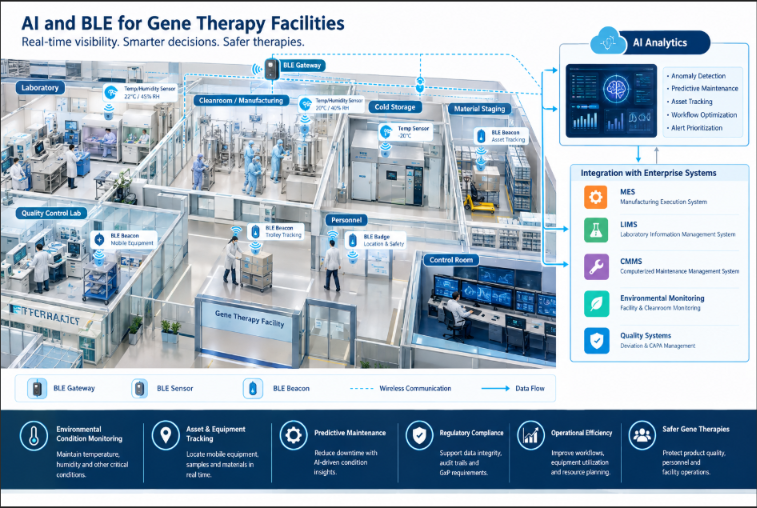

Enable real-time visibility, smarter operations, and safer gene therapy manufacturing with AI and BLE-enabled monitoring, asset tracking, predictive maintenance, and compliance.
Why AI Matters in Gene Therapy Facilities
Gene therapy manufacturing introduces operational conditions that make continuous data collection particularly valuable. Manufacturing suites, cell-processing areas, laboratories, cryogenic storage, controlled-temperature storage, material staging zones, and support areas can contain large numbers of movable assets and sensitive materials. Operators may need to coordinate equipment availability, environmental conditions, cleaning status, material movement, maintenance activities, and production schedules while maintaining documented procedures.
AI can transform these data streams from passive records into operational intelligence. Machine learning can detect abnormal temperature patterns, identify unusual equipment behavior, predict maintenance requirements, and recognize recurring workflow bottlenecks. AI-assisted anomaly detection can also prioritize exceptions for operators rather than requiring personnel to manually inspect every sensor reading.
For example, a temperature sensor associated with a critical storage location can continuously transmit measurements through BLE infrastructure. An AI model can evaluate the current reading alongside historical patterns, door activity, ambient conditions, refrigeration equipment status, and configured operating limits. A small deviation that would not independently trigger an obvious operational response may become significant when correlated with other signals.
This approach is particularly useful where gene therapy facilities need to distinguish between routine operational variation and conditions that warrant investigation.
GAO provides BLE sensors, gateways, beacons, RFID equipment, and IoT systems that can support this type of connected operational data collection. The engineering objective is to select the sensing and communication method according to the process requirement rather than treating BLE as a universal solution.
Gene Therapy Facility Processes That Benefit from AI-Driven Visibility
AI applications should begin with specific operational problems rather than with the wireless technology itself. Several gene therapy facility workflows are especially suitable for continuous sensing and analytics.
Controlled Material and Equipment Tracking
Gene therapy facilities frequently move materials, containers, mobile workstations, carts, instruments, and specialized equipment between laboratories, manufacturing suites, staging areas, storage locations, and quality-control spaces.
BLE beacons can identify selected mobile assets while gateways installed at strategically selected locations provide location events. AI software can analyze movement histories to identify prolonged dwell times, unexpected routing, repeated equipment searches, or congestion around critical work areas.
The practical value is greatest when tracking is integrated with operational context. A cart remaining in a staging area for two hours may be normal during one manufacturing step and abnormal during another. AI can therefore use production schedules, workflow states, or historical patterns to distinguish expected from unexpected behavior.
Environmental Monitoring for Sensitive Operations
Temperature and humidity monitoring is particularly relevant to controlled storage, laboratories, material staging, and facility support systems. BLE sensors can provide distributed measurements without requiring every sensor to be directly wired into facility infrastructure.
AI can establish normal environmental profiles and detect changes that precede a formal threshold violation. This supports earlier investigation of refrigeration problems, HVAC instability, repeated door openings, localized environmental variation, or sensor abnormalities.
The system should not replace validated environmental monitoring procedures or established quality controls. Instead, AI can function as an analytical layer that helps personnel detect patterns and prioritize investigation.
Equipment Availability and Utilization
Gene therapy laboratories and manufacturing environments can depend on specialized equipment with limited availability. Examples include centrifuges, incubators, biosafety cabinets, freezers, refrigerators, mobile workstations, analytical instruments, and other laboratory assets.
BLE-based location information can establish where mobile equipment is located, while equipment telemetry or external sensors can provide operating-state information where appropriate. AI can combine these inputs to estimate utilization, detect underused equipment, identify recurring demand peaks, and support maintenance planning.
This can reduce time spent searching for equipment and provide evidence for capacity planning without relying entirely on manually maintained asset records.
Personnel and Workflow Movement
Personnel movement can also be analyzed at an aggregate operational level where appropriate controls, privacy policies, and facility procedures permit it. BLE infrastructure can provide zone-level presence information that helps determine occupancy patterns around manufacturing suites, laboratories, staging areas, or support spaces.
AI can use these patterns to identify bottlenecks, excessive movement, unusual workflow sequences, or periods of high operational demand. The objective should be process optimization rather than unnecessary individual surveillance.
Predictive Maintenance for Facility and Laboratory Equipment
A gene therapy facility cannot depend exclusively on corrective maintenance for critical equipment. Unexpected failures involving refrigeration, HVAC systems, environmental controls, laboratory equipment, or supporting infrastructure can disrupt scheduled operations.
AI models can combine sensor measurements, equipment operating history, maintenance records, alarm events, and usage patterns to estimate failure risk. BLE sensors can provide an economical way to collect vibration, temperature, humidity, or other relevant measurements from selected equipment when direct integration is impractical.
The resulting maintenance recommendation can then flow into a computerized maintenance management system, where technicians can review the condition, work history, required parts, and maintenance procedure.
AI-Driven Gene Therapy Facility Workflow
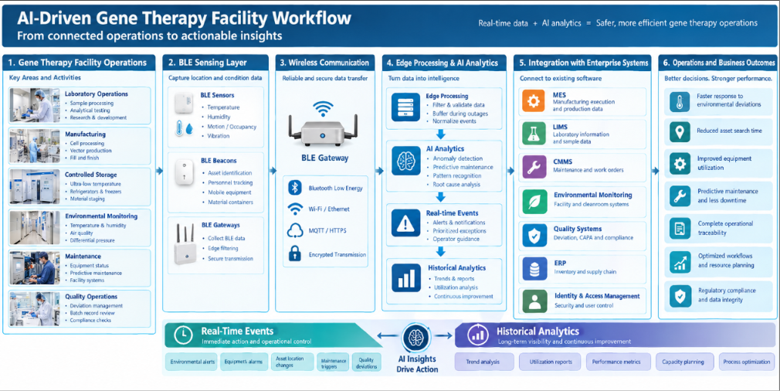

Connect facility operations, BLE sensing, wireless communication, AI analytics, and enterprise systems to deliver real-time insights and smarter, more efficient gene therapy operations.
From Sensor Data to AI-Assisted Decisions
A practical AIoT deployment for a gene therapy facility should be engineered as a complete operational data flow rather than as an isolated tracking installation.
Data Acquisition at the Facility Level
The first layer consists of physical observations. BLE sensors can capture temperature, humidity, motion, occupancy, vibration, or other supported parameters. BLE beacons can provide identification for selected mobile assets, containers, carts, or equipment.
Sensor selection should follow the criticality of the process. A sensor intended for operational awareness is not automatically suitable for a regulated measurement requiring validated instrumentation. The engineering team should establish accuracy, calibration, operating range, battery requirements, ingress protection, cleaning compatibility, installation method, and maintenance requirements before selecting hardware.
BLE Communication and Gateway Collection
BLE gateways receive wireless data from sensors and beacons and forward the information to processing software. Gateway placement should account for room construction, cleanroom boundaries, equipment density, metallic obstructions, radio interference, antenna orientation, and required location resolution.
A gateway deployment designed only from a floor plan can produce unreliable results. RF surveys and commissioning measurements are valuable, particularly around equipment rooms, cold storage, mechanical spaces, and areas containing dense metal infrastructure.
Edge Processing and Data Normalization
Edge processing can filter duplicate events, validate message formats, buffer data during temporary network interruptions, and reduce unnecessary traffic to centralized software. This becomes important when a gene therapy facility has numerous BLE endpoints transmitting continuously.
A normalized event model can associate an asset identifier, sensor identifier, timestamp, gateway, location zone, measurement, and quality indicator with each observation. Consistent time synchronization is also important when AI models correlate BLE events with equipment alarms, manufacturing activities, and quality records.
AI Analytics and Exception Management
The analytics layer can apply statistical models, machine learning, rules engines, or combinations of these techniques.
Common approaches include:
- Threshold and rule-based detection for clearly defined operating limits
- Statistical anomaly detection for unusual environmental behavior
- Time-series forecasting for temperature, humidity, equipment demand, and utilization
- Predictive maintenance models using sensor and maintenance-history data
- Classification models for identifying operational states
- Clustering for discovering recurring workflow or equipment-use patterns
- Computer vision where visual inspection or occupancy analysis is appropriate
- Generative AI for controlled summarization, search, and operator assistance when connected to approved enterprise data sources
AI outputs should remain traceable. Operators need to understand which observations contributed to an alert, what confidence or severity applies, and which procedure governs the response.
Gene Therapy Facility System Integration
AI-generated insights become operationally useful when they connect with the software already responsible for manufacturing, laboratory, quality, maintenance, and facility processes.
MES and Manufacturing Operations
Manufacturing execution systems can provide production context to AI analytics. Combining equipment location, material movement, environmental data, and manufacturing status can help distinguish normal process activity from abnormal conditions.
For example, equipment movement between designated manufacturing areas may be expected during a particular production sequence. The same movement outside the expected sequence can become an exception requiring review.
LIMS and Laboratory Data
Laboratory information management systems contain valuable context around testing, samples, analytical workflows, and laboratory operations. AI systems can correlate operational events with laboratory scheduling and equipment availability without replacing the controlled records maintained by the LIMS.
CMMS and Maintenance Management
CMMS software can receive maintenance-related events generated from AI analysis. A recurring temperature anomaly from a freezer, for example, can become a maintenance investigation rather than remaining only as a dashboard warning.
Quality and Environmental Monitoring Systems
Environmental monitoring and quality systems should remain authoritative for regulated records where required. AI can provide supplementary detection, trend analysis, and prioritization while preserving the system-of-record responsibilities of validated applications.
This separation is an important engineering principle: AI should improve operational awareness without silently becoming the uncontrolled source of truth for regulated records.
Gene Therapy Facility AI and BLE Software Integration Map
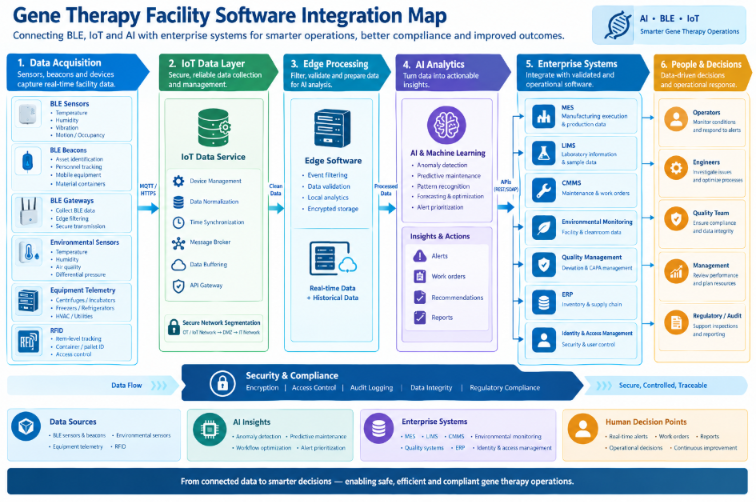

This integration map shows how BLE sensors, beacons, gateways, equipment telemetry, and RFID data flow through secure IoT data processing and AI analytics into MES, LIMS, CMMS, environmental monitoring, quality, ERP, and identity systems. It emphasizes the separation between data acquisition, AI analysis, validated system-of-record applications, and human operational decisions.
Engineering Considerations for AI and BLE Deployment
Gene therapy facilities impose requirements that differ from ordinary office or warehouse deployments. Wireless hardware must be evaluated alongside facility hygiene, environmental conditions, maintenance procedures, network security, and operational qualification requirements.
Key engineering considerations include:
· Cleanroom compatibility: Hardware enclosure materials, mounting methods, cleaning procedures, and surface characteristics should be evaluated for the intended controlled environment.
· RF propagation: Stainless-steel equipment, insulated walls, cold rooms, ductwork, racks, and laboratory equipment can affect BLE signal behavior.
· Battery management: Battery-powered BLE devices require a replacement strategy that does not interfere with manufacturing schedules or controlled-area procedures.
· Sensor calibration: Measurement devices used for operational monitoring should have documented accuracy and calibration practices appropriate to their intended role.
· Data integrity: Timestamping, event validation, buffering, synchronization, auditability, and access controls should be designed before production deployment.
· Network segmentation: BLE gateways should communicate through appropriately secured network segments with controlled access to backend services.
· Redundancy: Critical monitoring functions may require overlapping gateway coverage, local buffering, redundant network paths, or independent monitoring mechanisms.
· Commissioning: RF surveys, sensor verification, gateway connectivity testing, alarm testing, data reconciliation, and failure-mode testing should be part of commissioning.
· Scalability: A design should accommodate additional manufacturing rooms, laboratories, storage areas, sensors, and mobile assets without requiring wholesale replacement of the initial installation.
GAO has supplied hardware products and IoT systems to organizations requiring practical deployment support, including organizations in the United States and Canada. Its engineering approach can encompass remote technical assistance as well as onsite support when deployment requirements warrant it.
BLE Deployment Engineering Diagram for a Gene Therapy Facility

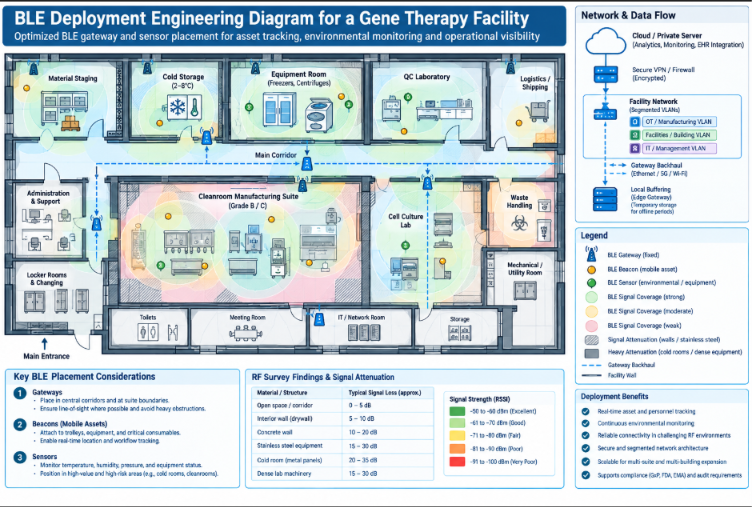
A detailed BLE deployment layout showing gateway, beacon, and sensor placement for asset tracking, environmental monitoring, secure connectivity, and operational visibility across a gene therapy facility.
Cloud and Server Deployment for Gene Therapy Facilities
Gene therapy facilities generally need a deployment model that balances operational accessibility, data governance, cybersecurity, network resilience, and integration with existing laboratory and manufacturing systems. Both cloud-hosted and privately hosted software can support AI-driven BLE solutions, but the appropriate choice depends on the facility’s IT policies, validation strategy, data flows, and operational requirements.
Cloud Version
A cloud-hosted deployment can aggregate BLE gateway data from multiple facilities, laboratories, storage areas, or geographically distributed operations. This approach is useful when centralized analytics, remote monitoring, fleet-wide reporting, and scalable computing resources are priorities.
The cloud service can receive normalized sensor events through secure APIs or messaging protocols and apply centralized analytics. AI models can process historical temperature trends, equipment utilization, asset movement, maintenance events, and other approved data sources. Role-based access controls, encryption in transit and at rest, identity federation, audit logging, retention policies, and network controls should be incorporated into the deployment.
Cloud deployment is particularly useful when organizations need centralized oversight across multiple gene therapy facilities or want to avoid maintaining substantial local computing infrastructure.
Server Version
A server deployment places the software on customer-managed infrastructure such as an edge server, private data center, facility server, or other privately hosted computing environment. This model can be appropriate when organizational policies require greater control over data location, network connectivity, application access, or integration boundaries.
Private deployment can also reduce dependence on external connectivity for selected operational functions. Local processing and data buffering can allow BLE monitoring to continue during temporary WAN or Internet interruptions.
A hybrid arrangement is also possible. Time-sensitive processing can occur locally while approved historical data or analytics results are transferred to centralized systems.
AI & BLE Solution for Gene Therapy Facility: Cloud vs. Server Deployment
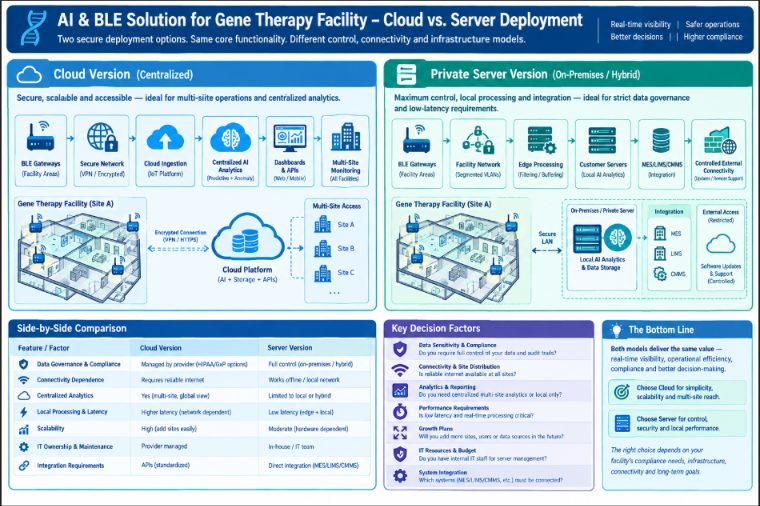

A side-by-side comparison of cloud and private server BLE deployments, highlighting data flow, analytics, connectivity, compliance, scalability, security, and integration considerations for gene therapy facilities.
Security, Data Integrity, and Compliance Considerations
AI-driven monitoring in gene therapy facilities should be designed around the principle that wireless convenience cannot compromise data integrity or cybersecurity.
BLE communications should use appropriate Bluetooth security mechanisms, while gateways require hardened configurations, authenticated communications, secure credentials, controlled administrative access, and timely security maintenance. Backend interfaces should use encrypted communications and authenticated APIs.
Network segmentation is particularly important. BLE gateways should not automatically receive unrestricted access to manufacturing, laboratory, quality, or corporate networks. Firewall rules and access-control policies should restrict communications to the services that the solution actually requires.
Relevant considerations may include:
- Role-based access control for operators, engineers, administrators, quality personnel, and other authorized users
- Encryption for data in transit and at rest
- Secure device provisioning and credential management
- Gateway hardening and controlled administrative interfaces
- Network segmentation and firewall policies
- Audit logging for important configuration and administrative events
- Time synchronization across gateways, servers, and enterprise applications
- Data retention and archival policies
- Backup and recovery procedures
- Vulnerability management and software patching
- Documented change control
- Appropriate validation and qualification activities where the system contributes to regulated processes
Gene therapy organizations may operate under requirements associated with FDA-regulated manufacturing, quality systems, electronic records, data integrity, and computerized systems. Depending on the specific application and jurisdiction, organizations may need to consider frameworks and regulations such as FDA 21 CFR Part 11, 21 CFR Parts 210 and 211, EU GMP Annex 11, GxP expectations, ALCOA+ data-integrity principles, and applicable privacy requirements.
The critical distinction is whether BLE and AI are being used for regulated decision-making, supplementary operational awareness, or facility convenience. The validation and control strategy should reflect that intended use rather than applying the same requirements to every sensor.
AI Models for Gene Therapy Facility Operations
AI should be selected according to the operational question being answered.
Environmental Anomaly Detection
Time-series models can learn normal temperature and humidity behavior for defined locations and identify deviations that may warrant investigation. Combining sensor readings with door events, equipment status, and historical patterns can improve contextual interpretation.
Predictive Equipment Maintenance
Machine-learning models can identify relationships between vibration, temperature, operating cycles, alarms, and previous maintenance events. Maintenance teams can use these predictions to prioritize inspections before a developing problem causes equipment downtime.
Asset Utilization Analytics
AI can analyze BLE location events and equipment activity to determine utilization patterns. This can help identify equipment that is chronically underused, frequently unavailable, or repeatedly moved between areas.
Workflow Bottleneck Detection
Movement histories can reveal recurring dwell points in material staging, equipment handoffs, or laboratory workflows. AI can compare actual process behavior with expected operational sequences and identify areas where delays repeatedly occur.
Intelligent Alert Prioritization
Not every deviation has the same operational significance. AI-assisted prioritization can combine magnitude, duration, historical behavior, equipment criticality, location, and concurrent events to rank alerts for human review.
AI outputs should remain explainable enough for operational personnel to determine why an alert was generated. For regulated environments, organizations should also establish clear boundaries around model changes, training data, version control, performance monitoring, and human approval.
Practical Benefits of AI-Enabled BLE Operations
Combining AI with BLE-enabled sensing can improve gene therapy facility operations in several measurable ways.
Faster Detection of Environmental Deviations
Continuous sensor data reduces dependence on periodic manual checks. AI trend analysis can identify abnormal behavior earlier, giving facility or quality personnel more time to investigate.
Reduced Equipment Search Time
BLE location events can show the last known zone of mobile equipment, carts, instruments, or other tagged assets. This is especially valuable where equipment is frequently transferred between laboratories and manufacturing areas.
Better Equipment Utilization
Historical location and activity data provide evidence for understanding how often specialized equipment is used and where demand occurs. This can support equipment allocation and capacity decisions.
More Predictable Maintenance
AI-based condition analysis can supplement scheduled maintenance with evidence derived from actual equipment behavior. Maintenance teams can use this information to prioritize higher-risk assets.
Improved Operational Traceability
A time-stamped history of sensor observations, asset movements, gateway events, and system actions can provide greater operational visibility. Where such information is relevant to controlled procedures, it can complement established documentation and system-of-record processes.
Scalable Facility Monitoring
BLE’s wireless deployment characteristics can make incremental expansion practical. Additional sensors, beacons, gateways, rooms, and equipment can be incorporated as operational requirements evolve, subject to RF planning and network capacity.
Gene Therapy AIoT Implementation Roadmap
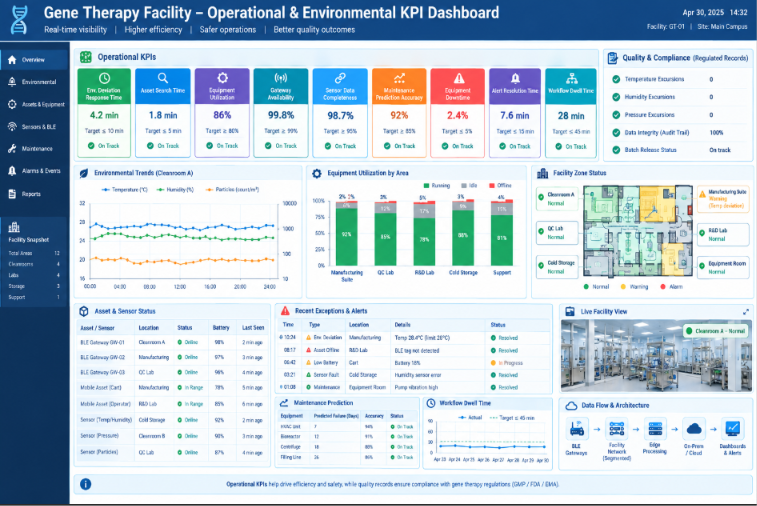

A visual roadmap showing how AIoT (Artificial Intelligence of Things) can be planned, deployed, and scaled within gene therapy facilities. It highlights the major implementation steps and the involvement of facility engineering, IT, quality assurance, manufacturing, laboratory, maintenance, and operations teams.
Gene Therapy Facility KPIs for AI and BLE Systems
Measurement should begin before deployment so the organization can determine whether the solution actually improves operations.
Useful KPIs include:
- Environmental anomaly detection time
- Mean time to acknowledge an operational alert
- Mean time to resolve an exception
- Temperature excursion frequency
- Temperature excursion duration
- Sensor data availability
- Sensor data completeness
- BLE gateway availability
- Wireless event delivery rate
- Asset location accuracy
- Average equipment search time
- Equipment utilization rate
- Critical equipment downtime
- Preventive maintenance compliance
- Predictive maintenance precision
- Maintenance-related unplanned downtime
- Workflow dwell time
- Material staging duration
- Equipment handoff duration
- False-alert rate
- Alert prioritization accuracy
- Battery replacement interval
- Gateway communication recovery time
- Data synchronization latency
- Integration transaction success rate
- AI model drift indicators
- User response time
- System scalability per additional monitored zone
- Cost per monitored asset or sensing point
- Mean time to restore service
These KPIs should be tied to business and engineering objectives. For example, measuring the number of BLE messages received has limited value unless data completeness, location accuracy, or alert latency affects an actual gene therapy facility workflow.
Deployment Lifecycle for Gene Therapy Facility AIoT
A successful implementation should progress through controlled engineering stages.
Planning and Site Assessment
Begin by mapping the facility’s manufacturing suites, laboratories, controlled storage, material flow, equipment population, network infrastructure, and existing software systems. Identify which operational problems require continuous data and which can remain manual.
A site survey should examine RF propagation, gateway locations, mounting constraints, network connectivity, environmental conditions, and maintenance access.
Hardware Selection
Select BLE sensors, beacons, and gateways according to the measurement requirement and environment. Critical selection criteria include sensing accuracy, battery life, enclosure characteristics, operating temperature, communication range, installation method, gateway capacity, and software compatibility.
RFID can be incorporated where passive identification or item-level tagging is more appropriate, while BLE is particularly useful for wireless sensor data and location-aware mobile assets. The two technologies can complement each other rather than being treated as mutually exclusive.
Pilot Deployment
A pilot should represent a meaningful operational workflow rather than simply demonstrating that a BLE device can communicate with a gateway. A useful pilot might involve a controlled storage area, selected mobile equipment, environmental sensing, and integration with an operational dashboard.
Baseline measurements should be captured before evaluating improvement.
Commissioning and Testing
Testing should cover:
- Sensor measurement verification
- BLE communication reliability
- Gateway coverage
- Battery reporting
- Network failover or interruption behavior
- Local data buffering
- Data timestamp consistency
- API transactions
- Alarm generation
- AI anomaly detection
- User notification
- Integration with relevant enterprise software
- Security controls
- Backup and recovery
- Failure and recovery scenarios
Optimization and Expansion
After commissioning, analyze false positives, missed events, RF dead zones, battery performance, alert fatigue, and integration errors. AI models should be tuned against actual operational data rather than relying exclusively on assumptions established during design.
Expansion can then proceed to additional laboratories, manufacturing rooms, storage areas, equipment groups, and facilities.
GAO Engineering Support for Gene Therapy Facility IoT
GAO’s experience supplying BLE, RFID, and IoT hardware products and systems can support organizations that need to move from technology evaluation to practical deployment. Its product and engineering capabilities encompass BLE gateways, BLE beacons, BLE sensors, RFID equipment, and associated IoT systems.
GAO RFID Inc. is headquartered in New York City and Toronto, Canada, and is ranked among the top 10 leading B2B and B2G BLE and RFID suppliers globally. GAO RFID Inc., GAO Research Inc., and GAO Tek Inc. form GAO Group, with operations based in New York City and Toronto.
For three decades, GAO Group has served organizations across the United States and Canada, including Fortune 500 companies, leading R&D organizations, prestigious universities, and government agencies. Its substantial investment in product and system R&D is complemented by stringent quality-assurance processes and technical support available remotely or onsite.
For gene therapy facilities, the practical objective is to deploy connected sensing where it improves an identifiable workflow, then connect those observations to appropriate analytics and operational systems. Organizations evaluating AI-driven asset tracking, environmental monitoring, predictive maintenance, or workflow intelligence can use GAO’s BLE, RFID, and IoT capabilities as components of a broader engineered solution.
Key Takeaways for AI and BLE in Gene Therapy Facilities
AI-enabled BLE systems can provide gene therapy facilities with continuous operational visibility across environmental conditions, mobile equipment, asset movement, maintenance, and facility workflows. The greatest value comes from combining sensor observations with manufacturing, laboratory, maintenance, and facility context.
A technically sound deployment should:
- Start with a defined gene therapy facility operational problem
- Select BLE sensing according to environmental and measurement requirements
- Conduct RF and site surveys before final gateway placement
- Separate operational monitoring from regulated systems of record
- Design cybersecurity and data integrity controls from the beginning
- Use edge processing where low latency or connectivity resilience matters
- Select cloud or private-server deployment according to organizational requirements
- Integrate AI outputs with existing MES, LIMS, CMMS, environmental monitoring, and quality workflows where appropriate
- Establish measurable KPIs before implementation
- Validate, commission, monitor, and continuously optimize the deployed system
The strongest implementations treat AI as an analytical decision-support capability and BLE as an enabling data-collection technology. That combination can help gene therapy facilities move from fragmented operational observations toward more timely, contextual, and measurable decision-making.
Organizations interested in applying AI, BLE, RFID, and IoT technologies to gene therapy manufacturing, laboratory operations, controlled storage, equipment management, or facility monitoring can learn more about GAO’s technology solutions, engineering capabilities, and technical support.
Gene Therapy Facility – Operational & Environmental KPI Dashboard
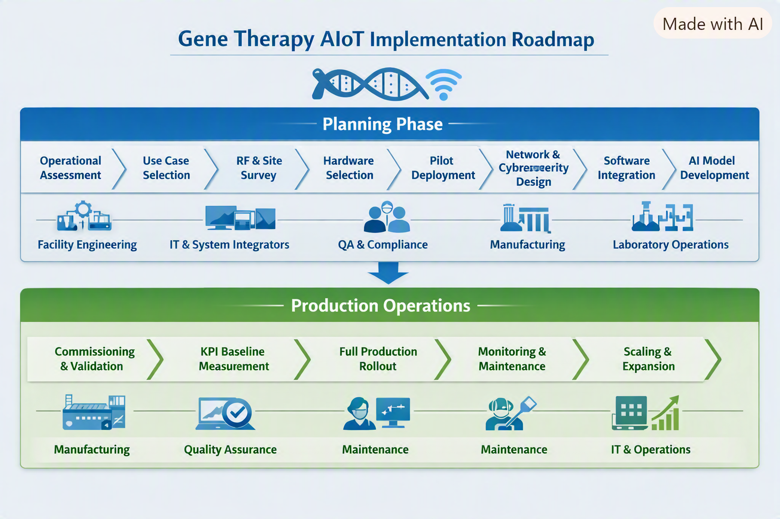

This dashboard provides centralized, real-time visibility into the operational and environmental performance of a gene therapy facility. It integrates IoT sensor data, equipment monitoring, environmental trends, predictive maintenance, alerts, and compliance information to support efficient, safe, and regulated facility operations.
Building the Future of Industrial AI and IoT with Aperture Venture Studio and GAO
For more than three decades, GAO Group of Companies has invested heavily in R&D of industrial BLE, RFID, and IoT. As generative AI has become increasingly useful for industrial applications, we have continued developing AI and IoT technologies, including BLE and RFID, relevant to demanding environments such as gene therapy facilities. We have also founded Aperture Venture Studio to advance AI and IoT solutions addressing complex industrial and biotechnology challenges.
Aperture has attracted AI and IoT technical experts, entrepreneurial and operational executives, influential investors, and leading companies. We have also developed the Aperture Ventures Summit and TekSummit to discuss advanced AI and IoT topics.
These activities have helped build diversified technical communities around AI and IoT. We welcome participation as advisors, co-founders or employees, investors, or customers.