
AI and BLE for Gene Therapy Facilities: Intelligent Monitoring, Asset Tracking, and Operational Control
What AI-Enabled Cell Manufacturing Means for GMP Operations
AI-enabled cell manufacturing uses artificial intelligence to interpret operational and process data generated throughout cell production. The objective is not simply to connect more equipment. The objective is to convert manufacturing data into useful decisions that improve process control, asset utilization, environmental awareness, material handling, maintenance, and operational consistency.
Cell manufacturing generates data from many sources, including cell culture equipment, incubators, bioreactors, centrifuges, refrigerators, freezers, cryogenic storage systems, environmental monitoring sensors, laboratory instruments, production records, and operator activities. Some of these systems are permanently installed, while others are mobile or difficult to monitor continuously.
BLE provides a practical wireless data layer for selected assets and sensors. BLE beacons can identify equipment or material locations, BLE sensors can measure parameters such as temperature and humidity, and BLE gateways can collect nearby sensor data and transmit it to software systems.
The same principle can apply to mobile cell processing equipment. BLE location data can show whether critical equipment is available in the required processing area, while manufacturing software can associate equipment status with a production batch or manufacturing step.
AI-Driven Cell Manufacturing Workflow with BLE Sensors and Gateways
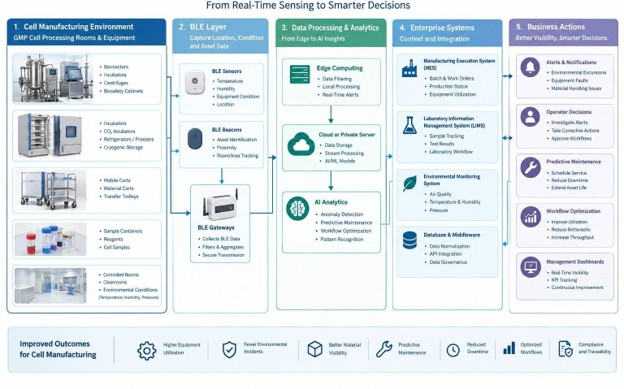
This workflow diagram shows how BLE sensors and beacons collect equipment, environmental, location, and asset data across cell manufacturing operations. BLE gateways transmit the data to edge or private/cloud servers, where AI analytics support anomaly detection, predictive maintenance, workflow optimization, alerts, and operational decisions.
What AI-Enabled Cell Manufacturing Means for GMP Operations
AI-enabled cell manufacturing uses artificial intelligence to interpret operational and process data generated throughout cell production. The objective is not simply to connect more equipment. The objective is to convert manufacturing data into useful decisions that improve process control, asset utilization, environmental awareness, material handling, maintenance, and operational consistency.
Cell manufacturing generates data from many sources, including cell culture equipment, incubators, bioreactors, centrifuges, refrigerators, freezers, cryogenic storage systems, environmental monitoring sensors, laboratory instruments, production records, and operator activities. Some of these systems are permanently installed, while others are mobile or difficult to monitor continuously.
BLE provides a practical wireless data layer for selected assets and sensors. BLE beacons can identify equipment or material locations, BLE sensors can measure parameters such as temperature and humidity, and BLE gateways can collect nearby sensor data and transmit it to software systems.
AI adds another layer of analysis. Machine learning models can compare current operating conditions with historical patterns, detect unusual combinations of events, predict equipment problems, identify process bottlenecks, and prioritize operational alerts.
For example, an AI system could correlate repeated incubator temperature excursions with door-opening frequency, room conditions, equipment utilization, and maintenance history. The resulting analysis can provide a more useful indication of operational risk than a single temperature alarm.
The same principle can apply to mobile cell processing equipment. BLE location data can show whether critical equipment is available in the required processing area, while manufacturing software can associate equipment status with a production batch or manufacturing step.
Why BLE Matters in Cell Manufacturing
Cell manufacturing facilities have a distinctive combination of controlled environments, expensive equipment, sensitive biological materials, strict procedures, and complex movement patterns. Many assets move between rooms, processing areas, staging locations, laboratories, and storage areas.
BLE is particularly useful when continuous visibility is required but installing additional Ethernet cabling or fixed sensors for every asset would be impractical.
BLE Beacons for Equipment and Material Identification
BLE beacons can be attached to mobile manufacturing assets such as carts, transport containers, portable instruments, sample carriers, and selected pieces of laboratory equipment.
A gateway receiving beacon transmissions can estimate the presence or location of an asset within a defined area. Depending on the required accuracy, the system can use RSSI-based proximity, multiple gateways, BLE angle-of-arrival technology, or other positioning techniques.
For cell manufacturing, location data can support:
- Verification that critical equipment is in the designated processing area
- Visibility of mobile cell processing carts and transport equipment
- Tracking of reusable containers and laboratory assets
- Identification of equipment approaching a maintenance location
- Detection of equipment remaining outside its expected area
- Support for material movement and staging workflows
- Improved utilization analysis for expensive laboratory and manufacturing equipment
BLE location should not automatically be treated as proof of a GMP process step. For validated operations, the system should define what constitutes authoritative evidence and how BLE observations are reconciled with manufacturing records.
BLE Sensors for Environmental and Equipment Monitoring
BLE sensors can collect operational measurements without requiring a dedicated wired connection to every monitored point. Depending on the sensor design, measurements may include temperature, humidity, pressure, differential pressure, vibration, door status, and other parameters.
Potential cell manufacturing applications include monitoring:
- Temperature-sensitive materials during internal movement
- Refrigerated storage equipment
- Freezer and cold-storage areas
- Equipment operating conditions
- Environmental conditions around selected processing areas
- Transport containers
- Laboratory storage units
- Mobile equipment conditions
Sensor selection requires careful consideration of calibration, measurement accuracy, battery life, cleaning procedures, enclosure materials, RF performance, and validation requirements.
A BLE temperature sensor used for operational monitoring should not automatically replace a validated environmental monitoring system. Instead, it can supplement existing monitoring where its measurement characteristics, data handling, validation status, and intended use are appropriate.
AI Applications Across the Cell Manufacturing Workflow
AI applications become more valuable when BLE observations are combined with data from manufacturing, laboratory, equipment, and environmental systems.
AI Asset Tracking for Cell Manufacturing Equipment
AI-based asset tracking can transform raw BLE location observations into operational information. Rather than simply displaying where an asset is located, analytics can identify utilization patterns, unnecessary movement, congestion, and equipment availability.
For example, repeated movement of a centrifuge or cell processing cart between processing rooms may indicate an inefficient workflow or insufficient equipment capacity.
A machine learning model can analyze historical movement patterns and identify frequently occurring delays. Operations teams can then investigate whether the problem originates from equipment availability, room scheduling, cleaning requirements, operator availability, or material staging.
This creates a stronger connection between asset tracking and manufacturing improvement.
AI Environmental Monitoring and Excursion Detection
Environmental monitoring is particularly important in controlled cell manufacturing environments. AI can evaluate temperature, humidity, pressure, equipment status, door events, and other available signals to identify abnormal patterns.
Instead of treating every alarm independently, AI can examine multiple variables together.
For example:
- A temperature increase may coincide with repeated door openings.
- A pressure deviation may occur only during a specific operational activity.
- A freezer temperature trend may change gradually before a conventional alarm threshold is reached.
- A sensor may produce unusual readings compared with nearby sensors.
- An equipment condition may correlate with recurring environmental excursions.
AI-assisted anomaly detection can help personnel investigate these events earlier. However, the system should clearly distinguish between an analytical recommendation and a validated manufacturing control or release decision.
Environmental Monitoring for GMP Cell Manufacturing
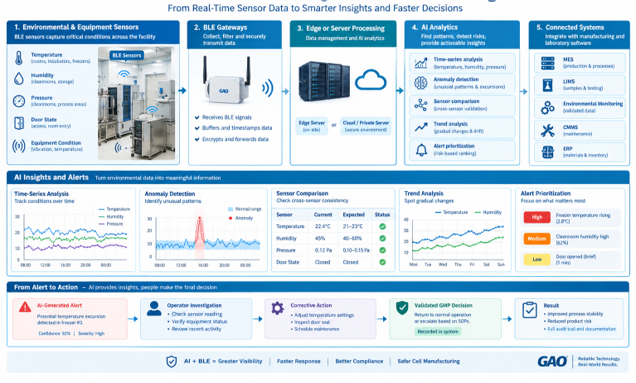

This infographic illustrates how BLE temperature, humidity, pressure, door-state, and equipment sensors feed environmental data through BLE gateways into edge or server-based AI analytics. It shows time-series analysis, anomaly detection, sensor comparison, trend analysis, alert prioritization, and the human-led process from AI alert to investigation and validated GMP decision.
Predictive Maintenance for Cell Manufacturing Equipment
Equipment failure can disrupt manufacturing schedules, compromise material handling, and create expensive downtime. AI-based predictive maintenance can analyze equipment condition data together with maintenance history and utilization.
BLE vibration or condition sensors can be useful for selected rotating or mobile equipment when the sensor’s measurement range and installation method are appropriate.
The AI model can evaluate:
- Vibration patterns
- Equipment operating cycles
- Temperature trends
- Utilization frequency
- Maintenance history
- Alarm history
- Operating duration
- Repeated abnormal events
The objective is to identify changes that may indicate developing equipment problems before a major failure occurs.
For GMP operations, maintenance recommendations must remain consistent with equipment qualification, maintenance procedures, change control, and applicable quality requirements.
AI Workflow Optimization for Cell Processing
Cell manufacturing involves tightly controlled sequences of activities. Materials, equipment, personnel, samples, and documentation must often reach the correct location at the correct time.
AI can analyze historical workflow data to identify recurring delays and unnecessary movement.
BLE location observations can provide information about asset movement, while MES or laboratory systems provide process context.
A workflow model could identify that a particular manufacturing step frequently waits for a mobile cart, that equipment remains idle between batches, or that material staging causes repeated delays.
The value comes from combining location information with process information rather than analyzing BLE data independently.
Cell Manufacturing Data Flow From Sensor to Decision
A practical AIoT implementation normally contains several layers. Each layer should have a clearly defined technical purpose.
Data Acquisition
BLE sensors and beacons generate the initial observations.
Sensors may capture environmental or equipment measurements, while beacons primarily provide identity and presence information. Sensor configuration should account for sampling intervals, transmission power, battery life, measurement accuracy, and expected RF conditions.
Cell manufacturing facilities can contain stainless-steel equipment, insulated rooms, doors, walls, liquid containers, and other materials that affect radio propagation. A site survey should therefore precede final gateway placement.
BLE Communication and Gateway Collection
BLE gateways receive transmissions from nearby sensors and beacons. The gateway can filter, buffer, timestamp, normalize, and forward data to higher-level software.
Gateway placement should consider:
- Cleanroom and controlled-area requirements
- RF interference
- Gateway coverage
- Physical obstructions
- Network availability
- Power availability
- Maintenance access
- Data buffering requirements
- Cybersecurity controls
Gateway failure should not automatically result in lost critical data. Buffering and store-and-forward capabilities can reduce data gaps when network connectivity is temporarily unavailable.
Edge Processing
Edge processing can reduce latency and limit unnecessary transmission of raw data. An edge computer or gateway can perform basic filtering, validation, threshold detection, data normalization, and local event processing.
For example, an edge system could detect a rapid temperature change and immediately generate an operational alert while retaining the underlying sensor records for later analysis.
Edge AI can also be useful when low latency, local processing, restricted network connectivity, or data residency requirements make continuous cloud transmission undesirable.
Cloud or Private Server Processing
Processed data can be transmitted to a cloud-hosted software environment or a privately managed server.
Cloud deployment can be appropriate when geographically distributed facilities need centralized access, rapid deployment, scalable data storage, and managed infrastructure.
A server deployment can be preferable when cell manufacturing organizations require greater control over data location, network segmentation, internal cybersecurity policies, integration with private systems, or restricted connectivity.
Both models can support AI analytics, provided the selected software can integrate with the organization’s manufacturing and laboratory systems.
Middleware and Enterprise Software Integration
BLE data becomes significantly more useful when associated with manufacturing context.
Integration may involve:
- Manufacturing Execution Systems
- Laboratory Information Management Systems
- Environmental Monitoring Systems
- Building Management Systems
- Computerized Maintenance Management Systems
- Enterprise Resource Planning systems
- Equipment monitoring software
- Quality management systems
- Time-series databases
- Data historians
- Identity and access management systems
Common integration mechanisms may include REST APIs, MQTT, OPC UA, database interfaces, message brokers, and other controlled interfaces appropriate to the existing environment.
The integration layer should preserve timestamps, device identifiers, sensor identifiers, asset identifiers, location information, units of measurement, and data-quality indicators.
Technical Components for AI and BLE Cell Manufacturing Solutions
A cell manufacturing deployment normally combines BLE hardware, network infrastructure, software, AI analytics, and existing manufacturing systems rather than relying on a single technology.
BLE Hardware
The BLE hardware layer can include:
- BLE beacons for asset and equipment identification
- BLE sensors for environmental and condition monitoring
- BLE gateways for data collection
- Industrial or controlled-environment gateway enclosures
- Battery-powered wireless sensors
- Fixed gateway antennas where required
- Local edge computing hardware
The hardware should be selected according to the actual manufacturing environment. A device suitable for an office or warehouse may not be appropriate for a controlled cell processing area.
AI and Machine Learning Software
Different AI methods are appropriate for different cell manufacturing problems.
Anomaly detection can identify unusual environmental or equipment behavior.
Time-series models can analyze temperature, pressure, vibration, and utilization trends.
Classification models can categorize operating states or identify recurring event patterns.
Predictive models can estimate equipment failure risk or maintenance requirements.
Optimization algorithms can evaluate equipment utilization, material movement, scheduling, and workflow bottlenecks.
Computer vision may complement BLE-based monitoring where visual inspection, PPE compliance, material identification, or equipment-state recognition is required.
The selected AI model should be explainable enough for the intended operational use and should be monitored for model drift, false positives, false negatives, and changing process conditions.
Cloud Version and Server Version
A cloud version uses cloud-hosted software and infrastructure for data storage, analytics, dashboards, AI processing, user access, and system management. It can be suitable for organizations that want centralized management across multiple facilities or require scalable computing resources.
A server version deploys the software on customer-managed servers, edge servers, private data centers, factory servers, or other privately hosted infrastructure. It can be appropriate where data governance, network isolation, cybersecurity policies, low-latency processing, or restricted external connectivity are important.
For regulated cell manufacturing, deployment selection should be based on the organization’s validation strategy, cybersecurity controls, data governance requirements, integration constraints, and operational model rather than simply choosing cloud or server deployment based on cost.
Cloud vs. Server Deployment for AI and BLE in Cell Manufacturing
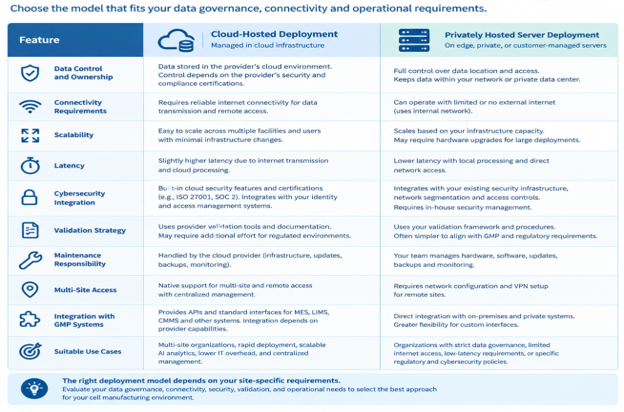

This comparison table shows how cloud-hosted and privately hosted server deployments differ for AI and BLE cell manufacturing systems. It compares data control, connectivity, scalability, latency, cybersecurity, validation, maintenance, multi-site access, GMP integration, and suitable use cases to help organizations select an appropriate deployment model.
Engineering Design Considerations for GMP Cell Manufacturing
The technical design of an AI and BLE solution should begin with the manufacturing problem rather than with the wireless technology.
A useful implementation starts by defining the operational question:
- Which equipment needs to be located?
- Which environmental conditions require additional visibility?
- Which manufacturing delays need to be measured?
- Which equipment failures create significant operational risk?
- Which assets require continuous monitoring?
- Which data must become part of an official manufacturing record?
- Which information is only intended for operational intelligence?
These questions determine whether BLE beacons, BLE sensors, gateways, AI analytics, or another sensing technology is appropriate.
RF Site Survey and Gateway Placement
BLE performance depends heavily on the physical environment. Stainless-steel surfaces, equipment density, insulated walls, doors, people, liquids, and other obstructions can change signal behavior.
Gateway placement should therefore be validated through a site survey rather than estimated solely from theoretical radio range.
Coverage testing should examine normal operating conditions, not only an empty room. Equipment movement, doors, operators, carts, and material containers can change RF conditions.
Battery and Maintenance Planning
Battery-powered BLE sensors reduce wiring requirements but introduce a maintenance requirement.
Battery life depends on transmission interval, payload size, radio power, environmental conditions, sensor type, and gateway proximity.
For cell manufacturing, battery replacement should be incorporated into preventive maintenance planning. Critical sensors should have appropriate battery-status monitoring and defined replacement procedures.
Data Integrity and Cybersecurity
AI analytics are only as reliable as the data entering the system.
The solution should provide appropriate controls for device authentication, user authentication, access permissions, encrypted communication, software updates, audit records, time synchronization, backup, logging, and network segmentation.
Where data contributes to regulated processes, organizations should define data ownership, retention, auditability, change control, validation responsibilities, and procedures for handling missing or anomalous data.
GAO’s experience supplying BLE, RFID, and IoT hardware products and systems can support organizations evaluating the hardware and connectivity layer, while the final validated configuration should be established according to the customer’s quality, engineering, IT, and regulatory requirements.
GMP Cell Manufacturing Data Integrity and Cybersecurity with BLE
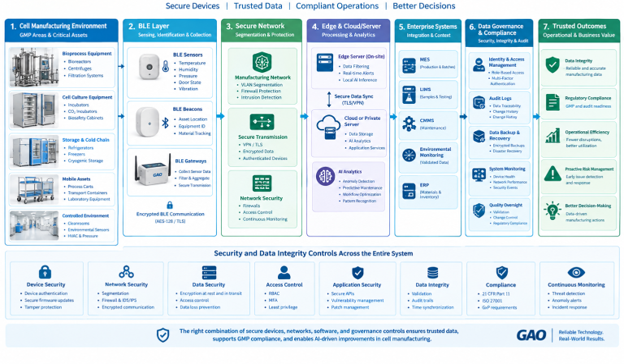

This diagram illustrates how BLE sensors, beacons, and gateways connect cell manufacturing equipment to secure networks, edge or cloud servers, AI analytics, and MES/LIMS systems. It highlights device authentication, network segmentation, encryption, access control, audit logs, backups, monitoring, data integrity, and quality oversight.
GAO Experience Supporting Connected Cell Manufacturing Operations
GAO is headquartered in New York City and Toronto, Canada, and is recognized among the leading B2B and B2G BLE and RFID suppliers globally. GAO and its sister companies, GAO Research Inc. and GAO Tek Inc., form GAO Group, with operations based in New York City and Toronto.
For three decades, GAO Group has served organizations in the United States and Canada, including Fortune 500 companies, major R&D organizations, universities, and government agencies. Its investment in research and development, quality assurance, and technical support provides a foundation for supplying connected hardware and systems for specialized operational environments.
For cell manufacturing projects, this experience is relevant when organizations need to evaluate BLE sensors, beacons, gateways, RFID technologies, IoT hardware, connectivity options, and system integration requirements against actual operating conditions.
The engineering objective should remain practical: collect the right data, establish reliable connectivity, integrate that information with manufacturing systems, apply appropriate analytics, and turn the resulting information into decisions that improve cell manufacturing operations.
Connected BLE Equipment in a GMP Cell Manufacturing Facility

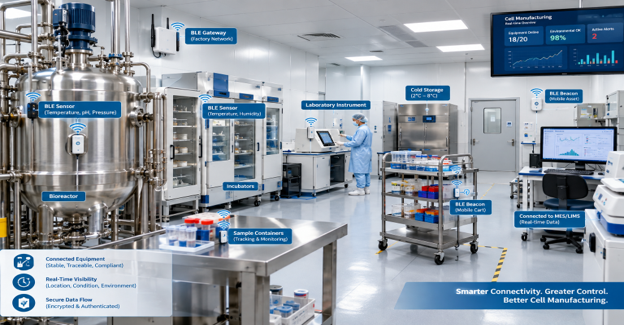
This photorealistic visual shows a controlled cell manufacturing facility with bioreactors, incubators, laboratory instruments, cold storage, mobile carts, and sample containers connected through BLE sensors, beacons, and gateways. It illustrates how real-time equipment, environmental, location, and sample data can support connected manufacturing operations and integration with MES and LIMS.
Practical Starting Point for AI-Enabled Cell Manufacturing
A successful deployment should begin with a narrowly defined manufacturing problem and a measurable baseline.
For example, a facility may first address mobile equipment utilization, cold-storage monitoring, environmental event analysis, or recurring equipment downtime. The pilot can then establish baseline measurements for detection accuracy, asset visibility, alert latency, battery performance, data completeness, and operator response.
Once the sensing and data pipeline are proven, AI models can be introduced against historical and live data. This staged approach reduces unnecessary hardware deployment and makes it easier to determine whether an AI model produces actionable information.
The next stage is controlled integration with manufacturing and laboratory software, followed by cybersecurity testing, validation activities where applicable, user acceptance testing, commissioning, and ongoing performance monitoring.
Cell Manufacturing Deployment Lifecycle for AI and BLE
AI-enabled cell manufacturing should be implemented as an engineering and operational improvement program rather than as a standalone wireless installation. Each stage should establish measurable requirements before the next stage is expanded.
Planning and Requirements Definition
The planning stage establishes what the cell manufacturing operation needs to observe, why the information is required, and how it will be used.
Key requirements may include:
- Asset location accuracy for mobile cell processing equipment
- Temperature visibility for sensitive materials and storage containers
- Equipment condition monitoring
- Environmental event correlation
- Manufacturing workflow analysis
- Equipment utilization measurement
- Predictive maintenance
- Operator notification
- Integration with MES, LIMS, CMMS, or environmental monitoring software
- Data retention and audit requirements
- Cybersecurity and network segmentation requirements
A requirements matrix should distinguish between information used for operational decision-making and information intended to become part of a controlled or regulated record.
Hardware Selection and Site Assessment
Hardware selection should account for the actual cell manufacturing environment.
Important factors include:
- BLE radio performance
- Sensor measurement accuracy
- Sampling interval
- Battery life
- Operating temperature range
- Enclosure requirements
- Cleaning and disinfection procedures
- Mounting method
- Gateway network connectivity
- RF interference
- Equipment density
- Potential obstruction from stainless-steel equipment
- Calibration requirements
- Maintenance accessibility
A pilot should use representative equipment and operating conditions. Testing only in an empty laboratory can produce misleading conclusions about BLE coverage and sensor reliability.
Installation and Commissioning
Gateway locations should be documented, sensors should have unique identifiers, and every monitored asset should have a defined relationship between its physical identity and its digital record.
Commissioning activities can include:
- Device registration
- Sensor identification
- Gateway configuration
- Network configuration
- Time synchronization
- RF coverage testing
- Sensor measurement verification
- Data transmission testing
- Battery-status verification
- Alert testing
- Integration testing
- User acceptance testing
The commissioning record should make it possible to determine whether a missing observation resulted from a sensor problem, gateway problem, network interruption, software problem, or another cause.
Integration and Validation
Integration should be tested from the physical device through to the operational application.
A typical test path may be:
BLE sensor → BLE gateway → edge or server software → database → analytics → manufacturing software → user notification → documented response.
Where the system supports regulated activities, validation requirements should be determined according to the intended use and the organization’s quality procedures.
AI-generated recommendations should also be clearly identified. A predictive model indicating increased equipment risk is different from an authorized manufacturing decision.
Optimization and Scale-Up
After the initial deployment demonstrates reliable data collection, additional assets, rooms, sensors, or AI models can be introduced.
Scaling should be based on measured results rather than the number of devices installed.
Useful questions include:
- Is the data complete enough for the intended AI model?
- Are false alarms creating unnecessary investigations?
- Are operators responding to alerts within the expected time?
- Does asset location data accurately reflect operational reality?
- Has equipment utilization improved?
- Have maintenance interruptions decreased?
- Are wireless devices creating additional cleaning or maintenance work?
- Does the system remain reliable as device density increases?
AI and BLE Cell Manufacturing Deployment Lifecycle
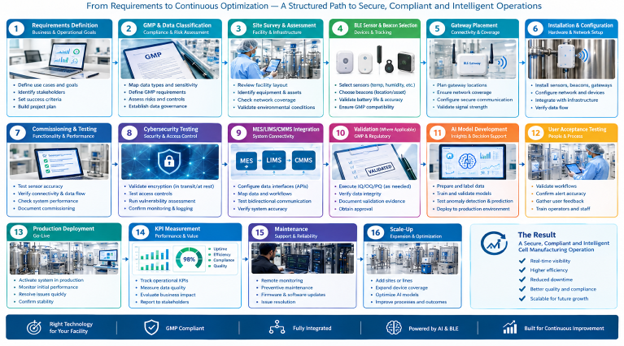

This lifecycle diagram presents the implementation path for AI and BLE in cell manufacturing, from requirements definition and GMP data classification through site assessment, hardware deployment, cybersecurity, system integration, validation, AI model development, and production deployment. It also covers KPI measurement, maintenance, and scale-up for continuous operational improvement.
Operational Benefits of AI-Enabled Cell Manufacturing
The strongest business case for AI and BLE comes from connecting technical measurements to specific manufacturing outcomes.
Improved Equipment Utilization
Cell manufacturing equipment can represent a substantial capital investment. Yet utilization is often difficult to measure when equipment moves between rooms or is shared by different teams.
BLE asset identification and location observations can establish actual utilization patterns.
AI can analyze these records alongside production schedules and equipment status to identify underused equipment, recurring waiting periods, excessive movement, or capacity constraints.
The resulting information can support equipment planning and scheduling decisions.
Faster Response to Environmental Events
A conventional alarm tells personnel that a parameter has exceeded a threshold. AI-assisted monitoring can add context.
For example, an abnormal temperature trend can be evaluated against door activity, equipment operating state, nearby sensor measurements, and historical behavior.
This helps personnel distinguish between isolated measurements and developing patterns.
The practical benefit is improved prioritization. Operators can investigate higher-risk events sooner while reducing unnecessary attention to repetitive low-value alerts.
Better Cold-Chain and Material Visibility
Cell manufacturing often involves sensitive biological materials, reagents, intermediates, samples, and finished or semi-finished products that require controlled conditions.
BLE sensors can provide additional visibility during internal movement and staging.
AI can combine temperature histories, location observations, dwell time, and process context to identify potentially problematic handling patterns.
For example, a material container repeatedly spending longer than expected outside controlled storage could trigger an operational investigation.
The technology should not independently determine product disposition unless it has been specifically validated and approved for that purpose.
Predictive Equipment Maintenance
Reactive maintenance can create unexpected manufacturing interruptions. AI-supported predictive maintenance shifts attention toward equipment condition and failure probability.
A useful model may combine equipment utilization, maintenance history, vibration measurements, temperature trends, alarm events, and operating cycles.
Maintenance personnel can then prioritize inspection or servicing based on measured risk instead of relying exclusively on fixed maintenance intervals.
Reduced Workflow Bottlenecks
AI can identify repeated delays in cell processing workflows by combining equipment location, production schedules, operator activity, and process timestamps.
A recurring delay may result from:
- Insufficient shared equipment
- Poor equipment staging
- Long material movement paths
- Cleaning turnaround
- Equipment maintenance
- Room availability
- Scheduling conflicts
- Sample transport delays
BLE provides useful observations about physical movement, while manufacturing systems provide the process context required to interpret those movements.
Key KPIs for AI and BLE Cell Manufacturing
Performance measurement should be established before deployment so that improvements can be demonstrated quantitatively.
Relevant KPIs include:
- Asset location accuracy
- BLE data availability
- Sensor data completeness
- Gateway uptime
- Alert latency
- Environmental excursion detection rate
- False alarm rate
- Mean time to acknowledge an alert
- Mean time to respond to an operational event
- Equipment utilization
- Equipment idle time
- Equipment downtime
- Mean time between failures
- Mean time to repair
- Predictive maintenance precision
- Temperature excursion frequency
- Temperature excursion duration
- Material dwell time
- Internal transport time
- Manufacturing cycle time
- Batch-related equipment waiting time
- Workflow bottleneck frequency
- Battery replacement frequency
- Sensor calibration compliance
- Network availability
- Data synchronization accuracy
- AI model false-positive rate
- AI model false-negative rate
- Manufacturing schedule adherence
The most important KPI should connect directly to the original manufacturing problem. Installing hundreds of sensors without demonstrating operational improvement does not establish a successful AIoT project.
AI and BLE Cell Manufacturing Operations KPI Dashboard

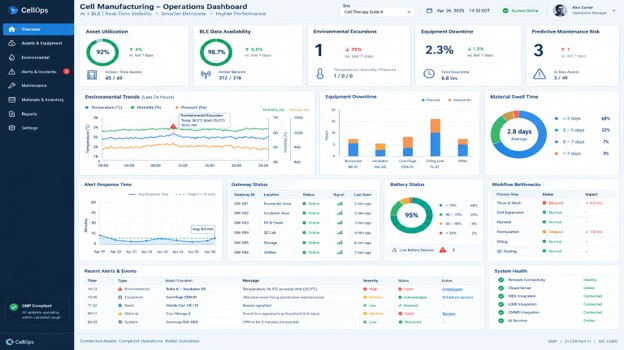
This dashboard visualizes key operational metrics for AI-enabled cell manufacturing, including asset utilization, BLE data availability, environmental excursions, equipment downtime, predictive maintenance risk, material dwell time, alert response, gateway status, battery health, and workflow bottlenecks. It provides a consolidated view for monitoring manufacturing performance, connected equipment, and operational events.
Interoperability With Cell Manufacturing Systems
BLE data becomes significantly more useful when it is connected to systems that already contain manufacturing context.
MES Integration
A Manufacturing Execution System can provide batch, work-order, equipment, operator, process-step, and production-status information.
Combining MES records with BLE observations can help determine whether equipment was available during a scheduled operation or whether material movement contributed to a process delay.
The integration should preserve the original source and timestamp of each observation.
LIMS Integration
A Laboratory Information Management System can provide sample, test, laboratory workflow, and analytical context.
BLE tracking can supplement LIMS records by providing information about the physical movement of selected sample containers or laboratory assets where appropriate.
The system should clearly distinguish a location observation from an authoritative sample identity or chain-of-custody record.
CMMS Integration
Computerized Maintenance Management Systems can provide maintenance history, work orders, inspection records, and equipment service schedules.
AI can use these data together with BLE-enabled equipment condition observations to identify assets that may require inspection.
This creates a practical connection between condition monitoring and maintenance planning.
Environmental Monitoring Integration
Environmental monitoring systems can provide validated environmental measurements. BLE sensors may supplement these systems for selected operational use cases.
Where both systems measure related parameters, organizations should establish which measurement is authoritative and how discrepancies are investigated.
AI Model Governance for Cell Manufacturing
AI models used in manufacturing should be treated as engineered software components rather than opaque decision-making tools.
Model development should consider:
- Training-data quality
- Sensor calibration
- Missing data
- Data drift
- Process changes
- Equipment replacement
- Seasonal environmental changes
- False-positive rates
- False-negative rates
- Model explainability
- Human review
- Version control
- Performance monitoring
A model trained using one type of incubator, production process, or facility configuration may not perform identically after equipment or process changes.
Change control should therefore include AI model behavior where the model influences operational decisions.
Human-in-the-Loop Decision Making
For many cell manufacturing applications, AI should assist personnel rather than remove human oversight.
An AI system may identify:
“Incubator 12 has an increased probability of abnormal temperature behavior.”
The operational workflow can then require maintenance personnel to inspect the equipment.
This is more appropriate than allowing an unverified model to independently initiate a manufacturing disposition.
The level of automation should correspond to the reliability, validation status, risk, and intended use of the AI application.
Cybersecurity and Reliability for Connected Cell Manufacturing
Connected sensors increase the number of devices that must be managed and secured.
A practical cybersecurity program should address the complete path from BLE device to enterprise application.
Key controls can include:
- Unique device identification
- Controlled device enrollment
- Secure gateway configuration
- Network segmentation
- Encryption for transmitted data where supported
- Role-based access control
- Strong administrator authentication
- Software and firmware update procedures
- Vulnerability management
- Security logging
- Backup and recovery
- Device decommissioning
- Credential management
- Monitoring for unauthorized devices
BLE should also be evaluated within the wider wireless security environment. A secure BLE device does not compensate for weak gateway credentials, poorly segmented networks, or insecure downstream software.
Reliability engineering is equally important. Critical monitoring paths should have defined failure behavior, including gateway outages, network interruptions, depleted batteries, sensor faults, and server downtime.
Practical Trade-Offs When Deploying BLE in Cell Manufacturing
No wireless sensing technology is appropriate for every measurement or every room.
BLE is useful when wireless asset identification, proximity, environmental sensing, and condition monitoring are required, but engineering teams should evaluate alternatives and complementary technologies where necessary.
For example, RFID may be more appropriate for certain identification workflows requiring controlled reads at specific locations. Wired sensors may remain preferable for permanently installed critical measurements. Wi-Fi, Ethernet, industrial wireless networks, or other communication technologies may be appropriate for higher-bandwidth equipment or existing infrastructure.
A mixed technology solution can therefore be more practical than attempting to force every use case into BLE.
The engineering decision should consider:
- Measurement requirements
- Location accuracy
- Data frequency
- Physical environment
- Installation cost
- Maintenance burden
- Battery requirements
- Existing infrastructure
- Cybersecurity requirements
- Integration requirements
- Validation requirements
- Total cost of ownership
Recommended Implementation Strategy for Cell Manufacturing
A practical implementation can follow a phased approach.
- Select one high-value manufacturing problem such as equipment utilization, environmental event analysis, cold-chain visibility, or predictive maintenance.
- Establish the baseline KPI before installing additional sensors.
- Conduct an RF and physical site assessment.
- Select BLE sensors, beacons, and gateways based on actual environmental and measurement requirements.
- Establish device identity and asset relationships.
- Deploy a limited pilot using representative equipment and operating conditions.
- Verify data completeness, measurement accuracy, gateway coverage, and network reliability.
- Integrate the collected data with the appropriate manufacturing or laboratory software.
- Develop AI analytics using historical and live operational data.
- Measure false positives, false negatives, alert latency, and operator response.
- Perform cybersecurity, integration, and validation activities appropriate to the intended use.
- Commission the production system.
- Monitor KPIs continuously.
- Expand to additional rooms, equipment classes, and workflows only after the initial use case demonstrates measurable value.
This approach limits technical risk and creates evidence for subsequent investment.
Where AI and BLE Deliver the Most Value in Cell Manufacturing
The strongest applications generally occur where physical conditions and manufacturing processes must be understood together.
Examples include:
- AI asset tracking for mobile cell processing equipment
- AI equipment utilization analysis
- AI predictive maintenance
- AI environmental anomaly detection
- AI temperature excursion analysis
- AI cold-chain monitoring
- AI material movement analysis
- AI workflow bottleneck detection
- AI equipment availability forecasting
- AI maintenance prioritization
- AI-assisted room and equipment utilization planning
- AI-driven operational alert prioritization
These applications illustrate the broader AIoT principle: sensors and connected equipment produce operational observations, while AI converts those observations into patterns, predictions, recommendations, and, where appropriately validated, automated actions.
Key Takeaways for AI and BLE in Cell Manufacturing
AI-enabled cell manufacturing is most effective when artificial intelligence is connected to reliable physical-world data.
BLE beacons, sensors, and gateways can provide useful information about equipment location, environmental conditions, material movement, and selected equipment conditions. AI can then correlate these observations with MES, LIMS, CMMS, environmental monitoring, maintenance, and production data.
The main engineering priority should be data quality and operational relevance rather than device volume. Site-specific RF testing, appropriate sensor selection, secure connectivity, system integration, validation, and KPI measurement should form the foundation of the deployment.
GAO can support organizations evaluating BLE, RFID, and IoT hardware products and systems for these applications, including technology selection and technical support. Organizations planning an AI-enabled cell manufacturing project can learn more about GAO’s technologies and discuss requirements based on their facility, equipment, connectivity, and monitoring objectives.
AI and BLE Cell Manufacturing Reference Architecture
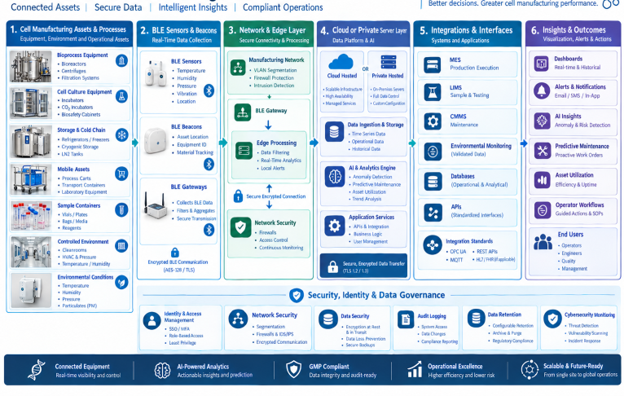

This reference diagram illustrates the complete data flow for AI-enabled cell manufacturing, from bioprocess equipment, mobile assets, samples, and environmental conditions through BLE sensors, beacons, gateways, edge processing, and cloud or private server software. It also shows MES, LIMS, CMMS, environmental monitoring, AI analytics, dashboards, alerts, and cybersecurity controls that support connected and data-driven manufacturing operations.
Building the Future of Industrial AI and IoT with GAO and Aperture Venture Studio
For more than three decades, GAO Group of Companies has invested heavily in R&D covering industrial BLE, RFID, and IoT technologies. As generative AI has become increasingly useful for industrial applications, we have continued developing AI and IoT solutions, including connected BLE and RFID technologies, while Aperture Venture Studio supports the development and scaling of practical AI and IoT solutions for applications such as cell manufacturing.
Aperture has attracted AI and IoT technical experts, entrepreneurial and operational executives, investors, and leading companies. We have also developed the Aperture Ventures Summit and TekSummit to discuss advanced AI and IoT topics and strengthen technical communities around these technologies.
We welcome organizations and professionals interested in contributing as advisors, co-founders or employees, investors, or customers to engage with us as AI and IoT technologies continue to develop.