
AI and BLE for District Energy Systems
How AI Improves District Energy System Efficiency and Operations
AI for District Energy Systems combines connected thermal assets, operational data, machine learning, and automated analytics to improve how district heating and cooling networks are monitored, operated, maintained, and optimized. BLE sensors and gateways provide a practical wireless data layer for collecting temperatures, differential pressure, equipment conditions, valve states, occupancy-related signals, and other operational measurements from energy plants, substations, distribution networks, and connected buildings. AI models can then identify abnormal operating conditions, forecast thermal demand, detect equipment degradation, optimize control decisions, and support maintenance planning.
For district energy operators, the value is not simply adding wireless sensors. The objective is to convert distributed field measurements into actionable decisions across central plants, heat-transfer stations, chilled-water loops, hot-water networks, pumps, heat exchangers, meters, and building interfaces. GAO provides BLE, RFID, and IoT hardware and systems that can support this connected data layer, helping organizations collect operational information from difficult-to-wire locations while integrating field data with existing control and energy-management systems.
AI and BLE Architecture for District Energy Systems
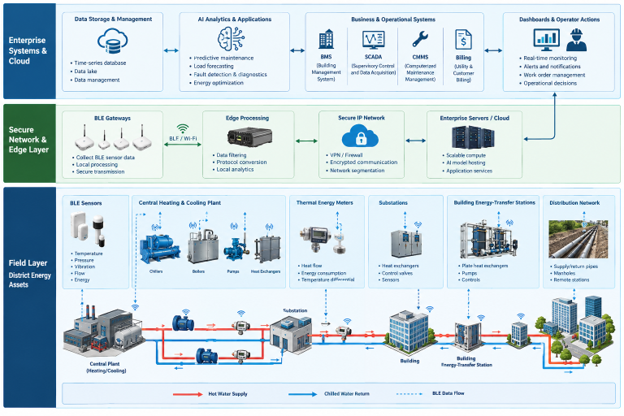
This diagram illustrates how BLE sensors and gateways connect district energy assets such as chillers, boilers, pumps, heat exchangers, substations, and thermal energy meters to edge processing, secure networks, AI analytics, and operational systems. It shows the flow of field data into SCADA, BMS, CMMS, billing, dashboards, and operator actions.
AIoT Fundamentals for District Energy Systems
Artificial Intelligence of Things, or AIoT, combines artificial intelligence with IoT devices, sensors, connected equipment, and industrial systems. Within District Energy Systems, AIoT extends conventional supervisory control and energy monitoring by turning measurements from physical infrastructure into models that can support prediction, diagnosis, optimization, and operational decision-making.
A district energy network contains many variables that interact over different time scales. Supply and return temperatures change with weather and customer demand. Differential pressure changes as valves open and close. Pump efficiency varies with operating point. Chillers and boilers have different efficiency curves at different loads. Heat exchangers can gradually foul while continuing to operate. Thermal energy meters can develop data-quality problems without immediately producing an obvious equipment alarm.
AI is useful because these conditions can be analyzed together rather than treated as isolated alarm points.
Relevant AI methods include:
- Time-series forecasting for chilled-water, hot-water, steam, or thermal-load prediction.
- Anomaly detection for identifying abnormal temperature, pressure, flow, vibration, or energy-consumption patterns.
- Predictive maintenance models for pumps, chillers, boilers, cooling towers, heat exchangers, valves, and other rotating or thermal equipment.
- Fault detection and diagnostics for identifying relationships among multiple operating variables.
- Regression models for estimating thermal demand, equipment efficiency, or expected energy consumption.
- Optimization algorithms for evaluating equipment dispatch, supply-temperature setpoints, pump operation, and load allocation.
- Computer vision where cameras are appropriate for inspection of mechanical rooms, equipment indicators, leaks, or physical conditions.
- Edge AI for low-latency analysis when data should be processed locally before being transmitted to centralized software.
The engineering objective is not to replace established control logic with an opaque AI model. A safer approach is usually to let existing PLC, DDC, SCADA, and building-management controls retain deterministic control authority while AI supplies forecasts, diagnostics, recommendations, and carefully governed optimization inputs.
ASHRAE Guideline 36-2024 emphasizes standardized HVAC sequences intended to improve efficiency, control stability, and real-time fault detection and diagnostics. District energy projects can use this type of standardized control thinking as a foundation for analytics rather than attempting to make AI compensate for poorly defined control sequences.
Where AI Creates Value Across District Energy Operations
District Energy Systems include interconnected assets extending from the energy-generation plant to customer substations and building-side equipment. AI applications should therefore be mapped to specific operating problems rather than deployed as a generic analytics layer.
Central Heating and Cooling Plants
AI can analyze boiler, chiller, heat-pump, cooling-tower, pump, and heat-exchanger operating data to identify inefficient operating regions and emerging faults.
Useful applications include:
- Chiller efficiency monitoring using cooling load, chilled-water temperatures, condenser conditions, and electrical consumption.
- Boiler performance analysis using supply temperature, return temperature, firing conditions, flow, and fuel consumption.
- Pump performance monitoring using differential pressure, flow, motor current, speed, and vibration.
- Cooling-tower optimization using outdoor conditions, condenser-water temperatures, fan operation, and cooling load.
- Equipment sequencing analysis to identify inefficient staging or excessive cycling.
- Predictive maintenance for bearings, motors, pumps, fans, and other rotating equipment.
BLE sensors can supplement existing instrumentation where additional measurements are required and where installing new wired points would involve substantial cabling, shutdown time, or construction work.
Energy Transfer Stations and Substations
District energy substations provide an important boundary between the distribution network and individual buildings or customer loads. AI can correlate primary-side and secondary-side temperatures, differential pressure, flow, valve position, thermal energy consumption, and historical demand.
Potential applications include:
- Heat-exchanger fouling detection.
- Abnormal differential-pressure detection.
- Control-valve performance monitoring.
- Return-temperature optimization.
- Abnormal thermal-energy consumption detection.
- Substation-level load forecasting.
- Detection of simultaneous heating and cooling conditions where applicable.
- Identification of sensor drift or inconsistent meter readings.
This is particularly useful when a district energy operator manages many substations and cannot manually investigate every change in operating behavior.
District Distribution Networks
AI can evaluate network-level behavior across chilled-water, hot-water, or steam distribution systems.
Relevant analytics include:
- Supply and return temperature analysis.
- Differential-pressure trend analysis.
- Hydraulic imbalance detection.
- Abnormal flow identification.
- Thermal-loss estimation.
- Peak-demand forecasting.
- Network temperature optimization.
- Detection of unusual changes between adjacent substations.
- Correlation of weather conditions with network demand.
- Identification of persistent high-return-temperature conditions.
A key engineering consideration is data synchronization. Temperature, flow, pressure, valve, and energy-meter readings need reliable timestamps if an AI model is expected to identify causal relationships.
Connected Buildings and Customer Loads
District energy performance depends partly on how connected buildings consume and return thermal energy. AI can combine building-level thermal consumption with weather, occupancy schedules, historical demand, equipment status, and substation measurements.
Applications can include:
- Building thermal-load forecasting.
- Peak-demand prediction.
- Abnormal consumption detection.
- Return-temperature optimization.
- Heating and cooling schedule analysis.
- Energy-use benchmarking between comparable facilities.
- Identification of buildings contributing disproportionately to network inefficiency.
For district energy operators, this allows customer-side conditions to be analyzed as part of the thermal network rather than as completely separate facilities.
AI Network Flow for District Heating and Cooling Systems
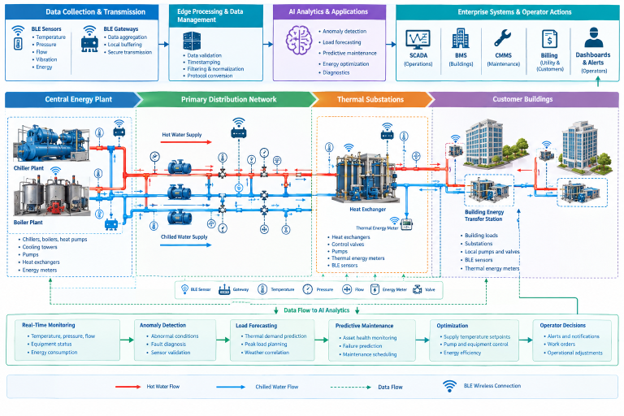
This diagram shows how BLE sensors and gateways collect temperature, pressure, flow, vibration, and energy data across central plants, distribution networks, thermal substations, and customer buildings. The data moves through edge processing into AI applications for anomaly detection, load forecasting, predictive maintenance, diagnostics, and optimization, supporting SCADA, BMS, CMMS, billing, dashboards, and operator decisions.
District Energy Data Workflow from Sensors to AI Decisions
A practical AI solution for District Energy Systems begins with reliable field data. The workflow should be designed around the operational decision that the data must support.
Data Acquisition
BLE temperature sensors, pressure-related sensing devices, vibration sensors, equipment-state sensors, and other IoT devices can collect supplementary measurements around plants, substations, mechanical rooms, and distribution assets.
Existing instrumentation should remain part of the data strategy. District energy projects commonly have PLCs, DDC controllers, SCADA systems, building management systems, flow meters, thermal energy meters, power meters, and other established measurement sources. BLE should complement these systems where it provides a practical measurement or installation advantage rather than replacing instrumentation that already performs a required control or safety function.
BLE Communication and Gateway Collection
BLE sensors transmit measurements to appropriately positioned BLE gateways. Gateway placement requires consideration of mechanical-room construction, metal pipework, equipment enclosures, electrical interference, radio propagation, maintenance access, and required communication reliability.
Gateways can aggregate multiple BLE endpoints and forward data through IP connectivity. Ethernet, Wi-Fi, cellular, or other site-approved network connections can then carry information to edge or centralized software.
A useful engineering practice is to define the required sampling interval before selecting the sensing and gateway configuration. A slowly changing pipe-surface temperature does not necessarily require the same sampling rate as vibration-related measurements or rapidly changing process variables.
Edge Processing and Data Validation
Edge processing can perform initial validation before data reaches centralized analytics.
Typical functions include:
- Timestamp validation.
- Sensor identity verification.
- Range checking.
- Missing-data detection.
- Duplicate-data filtering.
- Signal smoothing where technically justified.
- Battery-status monitoring.
- Gateway health monitoring.
- Local buffering during network outages.
- Protocol conversion.
Edge processing is particularly valuable for district energy sites where intermittent network connectivity should not cause permanent loss of operational measurements.
Centralized Data and AI Processing
Validated data can be stored in time-series databases, operational data stores, data historians, or other systems appropriate to the deployment. AI models can then evaluate historical and real-time information.
A district energy AI workflow might compare current chilled-water plant behavior against:
- Historical operating patterns.
- Outdoor air temperature.
- Building demand.
- Equipment run time.
- Supply and return temperatures.
- Differential pressure.
- Flow rate.
- Electrical consumption.
- Maintenance history.
- Equipment operating state.
The resulting model output can be an anomaly score, forecast, fault classification, expected energy consumption, maintenance recommendation, or optimization recommendation.
Integration with Operational Software
AI output becomes operationally useful when it reaches the systems and personnel responsible for acting on it.
Possible integration points include:
- SCADA.
- Building management systems.
- Energy management systems.
- Computerized maintenance management systems.
- Enterprise asset management software.
- Utility billing systems.
- Data historians.
- Work-order systems.
- Engineering dashboards.
- Operations control rooms.
For example, an AI model may detect a developing pump-performance anomaly. Rather than simply generating another dashboard notification, the system can associate the anomaly with the pump asset, provide the relevant temperature, pressure, flow, vibration, and operating-history evidence, and support creation of an inspection or maintenance work order.
AIoT Data-to-Decision Workflow for District Energy Systems
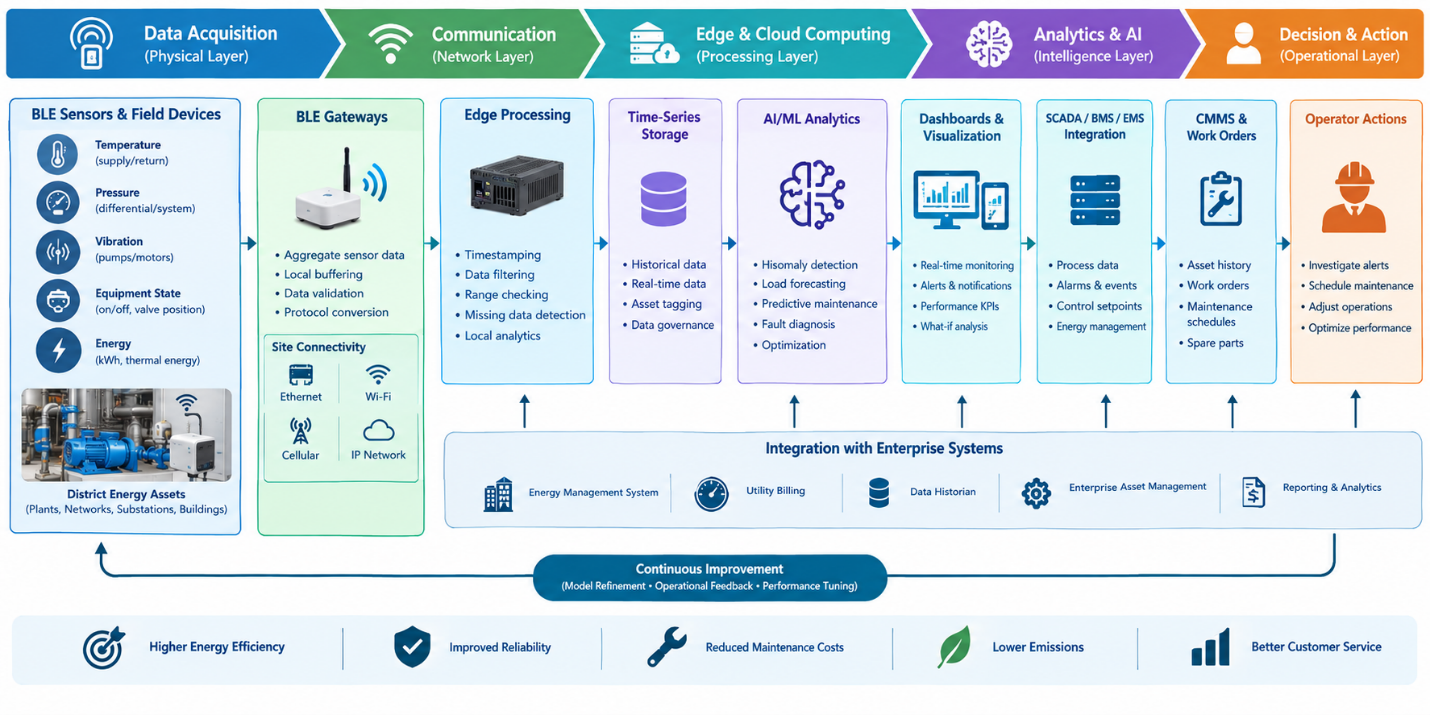
This workflow illustrates how BLE sensors capture district energy measurements and transmit data through BLE gateways, edge processing, time-series storage, and AI/ML analytics. The resulting insights support SCADA, BMS, EMS, CMMS, dashboards, and operator actions such as predictive maintenance, load forecasting, fault detection, and energy optimization.
BLE, AI Software, and Deployment Options for District Energy Systems
A technically sound District Energy System solution combines field hardware, communications, data management, AI processing, and operational integration. BLE is primarily an enabling data-collection technology within this broader system rather than the complete solution.
BLE Sensors and Field Hardware
BLE sensors can be deployed for measurements such as temperature, equipment condition, environmental conditions, and other variables supported by the selected device.
For district energy applications, sensor selection should consider:
- Required measurement accuracy.
- Measurement range.
- Sampling interval.
- Battery life.
- Environmental rating.
- Mounting method.
- Thermal contact method.
- Calibration requirements.
- Radio propagation.
- Maintenance accessibility.
- Condensation and moisture exposure.
- Equipment vibration.
- Metal obstructions.
- Required data retention during communication outages.
GAO supplies BLE and IoT hardware that can be incorporated into monitoring systems where wireless field measurements provide practical value.
BLE Gateways and Site Connectivity
BLE gateways aggregate sensor data and provide the connection between local wireless devices and IP-based systems. Gateway selection should account for endpoint density, physical separation, network availability, local buffering, cybersecurity controls, and required management functions.
Gateway deployment should be surveyed rather than determined solely from nominal radio range. Mechanical rooms, reinforced concrete, pipe racks, electrical cabinets, chillers, boilers, and other metallic structures can materially change wireless propagation.
AI and Data Software
AI software can perform forecasting, anomaly detection, predictive maintenance, equipment-performance analysis, and operational optimization. Time-series storage is particularly important because district energy models often depend on relationships among measurements collected over hours, days, seasons, and operating cycles.
AI models should also include data-quality handling. A model trained on unvalidated meter data can learn sensor faults rather than equipment behavior.
Cloud Version and Server Version
A Cloud Version can be appropriate for multi-site district energy portfolios where centralized monitoring, model management, remote analytics, and fleet-level benchmarking are important. Cloud processing can simplify centralized model deployment and allow authorized engineering or operations teams to review information across geographically distributed plants and substations.
A Server Version can be deployed on customer-managed servers, private data centers, edge servers, facility servers, or other privately hosted computing infrastructure. This approach can be appropriate where operational data must remain within a controlled environment, where network connectivity is constrained, or where integration with existing SCADA and utility systems requires localized processing.
The two approaches can also be combined. For example, an edge or private server can retain operational data and execute latency-sensitive analytics while selected aggregated data is transferred to centralized cloud software.
The deployment decision should consider data governance, cybersecurity requirements, network reliability, latency, maintenance responsibility, AI model lifecycle management, integration requirements, and the number of district energy sites being monitored.
Communications and Enterprise Integration
District energy systems commonly contain multiple communication technologies and protocols. Depending on existing equipment, integration may involve BACnet, Modbus, OPC UA, MQTT, REST APIs, Ethernet/IP networks, cellular connectivity, Wi-Fi, or vendor-specific interfaces.
The objective is not to introduce another isolated data store. BLE data should be mapped to consistent asset identifiers and engineering units so that a pump, heat exchanger, substation, or thermal meter has a consistent identity across the sensor layer, historian, AI software, CMMS, and operator interface.
Security should extend from BLE endpoints through gateways, networks, servers, cloud services, user accounts, APIs, and AI model operations. Relevant controls include device identity, authentication, authorization, encrypted communications where supported, network segmentation, secure credential management, gateway hardening, software patching, audit logging, backup procedures, and controlled remote access.
NIST’s AI Risk Management Framework provides a general framework for managing AI risks through the functions Govern, Map, Measure, and Manage. NIST also identifies cybersecurity and privacy considerations as relevant throughout AI system design, deployment, evaluation, and use. These principles are particularly useful when AI begins influencing operational decisions in utility infrastructure.
AI Capabilities That Improve District Energy Performance
AI produces operational value when its outputs are connected to measurable district energy objectives. The strongest implementations typically begin with a defined operating problem, establish the required measurements, and then select an AI method that can address that problem.
Predictive Maintenance for Pumps, Chillers, Boilers, and Heat Exchangers
Predictive maintenance can identify changes in equipment behavior before conventional threshold alarms indicate a serious problem.
For district energy equipment, AI models can compare current operating conditions with historical patterns and expected performance. A pump, for example, can be evaluated using differential pressure, flow, motor current, speed, vibration, and operating hours. A persistent change in the relationship between these variables may indicate mechanical wear, hydraulic problems, fouling, or an operating condition that requires engineering investigation.
The model should support maintenance personnel rather than automatically declaring that a component has failed. Maintenance decisions should consider inspection findings, manufacturer requirements, equipment criticality, operating history, and the consequences of continued operation.
Thermal Load Forecasting
Load forecasting is particularly important for district heating and cooling because demand varies with weather, building schedules, occupancy, seasonality, and customer behavior.
AI forecasting can estimate near-term demand using:
- Outdoor air temperature and weather forecasts.
- Historical thermal demand.
- Time of day and day of week.
- Building schedules.
- Supply and return temperatures.
- Flow measurements.
- Historical peak events.
- Customer substation consumption.
- Seasonal operating patterns.
Forecasts can support plant dispatch, equipment staging, thermal storage decisions, staffing, and peak-demand preparation.
A useful implementation should report forecast confidence or error metrics rather than presenting every prediction as equally reliable.
Fault Detection and Diagnostics
AI-based fault detection can identify combinations of conditions that are difficult to capture using individual alarm thresholds.
Examples include:
- A heat exchanger showing an increasing temperature approach consistent with fouling.
- A control valve repeatedly reaching high positions while the expected thermal load remains moderate.
- A pump consuming more electrical energy than expected for its measured hydraulic output.
- A building substation showing persistently elevated return-water temperature.
- A chilled-water loop exhibiting abnormal differential-pressure behavior.
- A thermal meter producing measurements inconsistent with adjacent operational variables.
These use cases benefit from engineering rules combined with machine learning. Purely statistical models may identify an anomaly without explaining its operational significance. Hybrid fault-detection methods can combine physical relationships, control logic, and learned behavior.
Energy Efficiency Optimization
AI can help operators investigate inefficient operating conditions across plants and networks.
Potential optimization variables include:
- Chiller sequencing.
- Boiler sequencing.
- Pump speed.
- Supply-temperature setpoints.
- Condenser-water operating conditions.
- Cooling-tower operation.
- Thermal storage charging and discharging.
- Differential-pressure setpoints.
- Heat exchanger operating conditions.
Optimization should respect equipment operating envelopes and established safety and control constraints. A mathematically efficient operating point is not necessarily an acceptable operating point if it causes excessive equipment cycling, violates manufacturer limits, reduces redundancy, or compromises service reliability.
Sensor and Data Quality Monitoring
AI can also improve the reliability of the data used by district energy operators.
Sensor-quality models can identify:
- Flatlined temperature readings.
- Sudden measurement jumps.
- Implausible flow values.
- Battery-related measurement interruptions.
- Clock or timestamp inconsistencies.
- Divergence between related sensors.
- Meter readings inconsistent with expected thermal relationships.
This capability is important because poor data quality can create false equipment alarms and unreliable AI predictions. Data-quality monitoring should therefore be treated as an operational function rather than an afterthought.
Engineering Considerations for District Energy AIoT Deployment
AI and BLE deployments should be engineered around the physical and operational characteristics of district energy infrastructure.
Sensor Placement and Measurement Strategy
Sensor placement should be based on the process variable required by the use case. Surface-mounted temperature sensors, for example, can provide useful information about pipe temperature when installed correctly, but they should not automatically be treated as equivalent to a calibrated process-temperature measurement used for regulatory metering or safety control.
Engineers should define measurement requirements before selecting devices. The design should document sensor location, measurement range, expected accuracy, installation method, calibration requirements, sampling interval, asset association, and maintenance procedure.
Critical control measurements should continue to use appropriately approved instrumentation where required. BLE sensing is particularly useful for supplementary monitoring, condition assessment, temporary measurement campaigns, retrofit projects, and locations where additional wired instrumentation is difficult to install.
Gateway Placement and Wireless Reliability
BLE gateway positioning should account for radio propagation rather than relying exclusively on theoretical range specifications.
District energy environments can contain:
- Steel pipe networks.
- Chiller and boiler housings.
- Mechanical equipment.
- Reinforced concrete walls.
- Electrical cabinets.
- Metallic ceilings and service structures.
- Dense mechanical rooms.
- Underground utility spaces.
A commissioning survey should verify actual signal performance at representative operating locations. Gateway redundancy may be appropriate for high-value monitoring areas where loss of a single gateway would create a significant measurement gap.
Data Modeling and Asset Identity
Data should be associated with meaningful district energy asset identifiers.
For example, a temperature measurement should not exist only as a generic sensor ID. The data model should identify the relevant facility, plant, loop, substation, equipment asset, measurement point, engineering unit, and timestamp.
A consistent asset model makes it easier to connect sensor information with:
- SCADA tags.
- BMS points.
- CMMS assets.
- Maintenance records.
- Thermal energy meters.
- Equipment documentation.
- AI training datasets.
- Engineering dashboards.
This also improves AI retrievability because individual measurements can be interpreted within their operational context.
AI Model Validation and Commissioning
AI commissioning should resemble an engineering validation process rather than a software-only deployment.
Before production use, teams should establish:
- Training-data quality requirements.
- Model validation datasets.
- Baseline performance.
- False-positive tolerance.
- False-negative consequences.
- Model retraining procedures.
- Data-drift monitoring.
- Human approval requirements.
- Alarm escalation rules.
- Model rollback procedures.
A predictive-maintenance model that generates hundreds of low-value alerts can increase workload instead of improving maintenance. Operational acceptance should therefore measure whether model outputs lead to useful engineering actions.
Integration with Existing Controls
AI should be integrated carefully with PLC, DDC, SCADA, BMS, and energy-management controls.
A practical progression is:
- Monitoring: AI observes operating conditions and provides dashboards.
- Advisory: AI identifies anomalies and recommends investigation.
- Decision support: AI provides forecasts and evaluates operating scenarios.
- Supervised optimization: Operators approve selected recommendations.
- Controlled automation: Validated optimization outputs influence permitted control variables within predefined constraints.
This progression allows the district energy operator to establish confidence before AI outputs are permitted to influence operational controls.
District Energy KPIs for Measuring AI Outcomes
AI projects should be measured against district energy KPIs rather than generic software metrics.
Relevant measures can include:
- Chiller kW per ton.
- Boiler efficiency.
- Coefficient of performance for applicable heat-pump systems.
- Plant electrical consumption.
- Thermal energy delivered.
- Supply-to-return temperature differential.
- Distribution temperature loss.
- Pump energy per unit of thermal delivery.
- Peak thermal demand.
- Peak electrical demand.
- Substation return temperature.
- Heat exchanger approach temperature.
- Equipment availability.
- Mean time between failures.
- Mean time to repair.
- Unplanned equipment downtime.
- Predictive-maintenance alert precision.
- False-positive alarm rate.
- Forecast error.
- Data completeness.
- Sensor availability.
- Gateway availability.
- Battery replacement frequency.
- Percentage of assets with condition-monitoring coverage.
- Maintenance work orders generated from validated anomalies.
- Energy consumption per unit of delivered thermal energy.
- Percentage of AI recommendations accepted by operators.
- Time from anomaly detection to maintenance action.
The appropriate KPI set depends on whether the project objective is plant efficiency, network optimization, maintenance, customer demand forecasting, data quality, or operational visibility.
Cybersecurity and Operational Resilience for AI-Enabled District Energy
Connecting district energy equipment to additional sensing and analytics systems expands the number of components that require security management.
Security controls should address the complete path from field device to operational application.
Device and Gateway Security
BLE devices and gateways should be inventoried and assigned identifiable ownership and lifecycle status. Gateway credentials should not rely on shared default passwords, and administrative access should be restricted according to operational responsibilities.
Gateway software should be maintained through controlled patching procedures. Devices that no longer receive security updates should be identified during lifecycle planning.
Network Segmentation
BLE gateways should communicate through appropriately secured network paths. Where district energy systems connect to operational technology networks, network segmentation can limit the impact of a compromised endpoint.
Firewalls, access-control policies, VPNs where appropriate, authentication mechanisms, and monitored administrative access can reduce unnecessary exposure.
AI analytics should not automatically receive write access to control systems simply because it can read their data. Read-only integration is often an appropriate starting point for analytics deployments.
Data and AI Security
Security also applies to the data and AI layers.
Controls can include:
- Encryption in transit and at rest where appropriate.
- Role-based access control.
- Audit logging.
- API authentication.
- Data-retention policies.
- Backup and recovery procedures.
- Model-version control.
- Training-data governance.
- Monitoring for data drift.
- Controlled model deployment.
- Human authorization for operational changes.
District energy operators should also establish what happens if the AI system becomes unavailable. The underlying control system should continue to operate according to its established fail-safe and fallback procedures.
Scaling AI and BLE Across District Energy Portfolios
A pilot installation should be designed with future expansion in mind without unnecessarily instrumenting every asset.
A practical scaling strategy can prioritize assets according to operational criticality, failure consequence, energy impact, accessibility, and existing instrumentation.
High-priority candidates may include:
- Large centrifugal chillers.
- Critical circulation pumps.
- Boiler trains.
- Cooling towers.
- Major heat exchangers.
- High-value thermal substations.
- Thermal energy meters.
- Facilities with persistent return-temperature problems.
- Equipment with recurring maintenance issues.
- Locations where additional wired instrumentation is costly.
GAO’s BLE, RFID, and IoT hardware can support incremental deployment where organizations need to add wireless monitoring to existing facilities rather than redesign an entire district energy installation.
Scaling also requires standardization. Sensor naming, asset identifiers, gateway configuration, data schemas, engineering units, cybersecurity controls, and commissioning procedures should be standardized before the number of monitored sites becomes difficult to manage.
AI-Enabled District Energy Deployment Roadmap
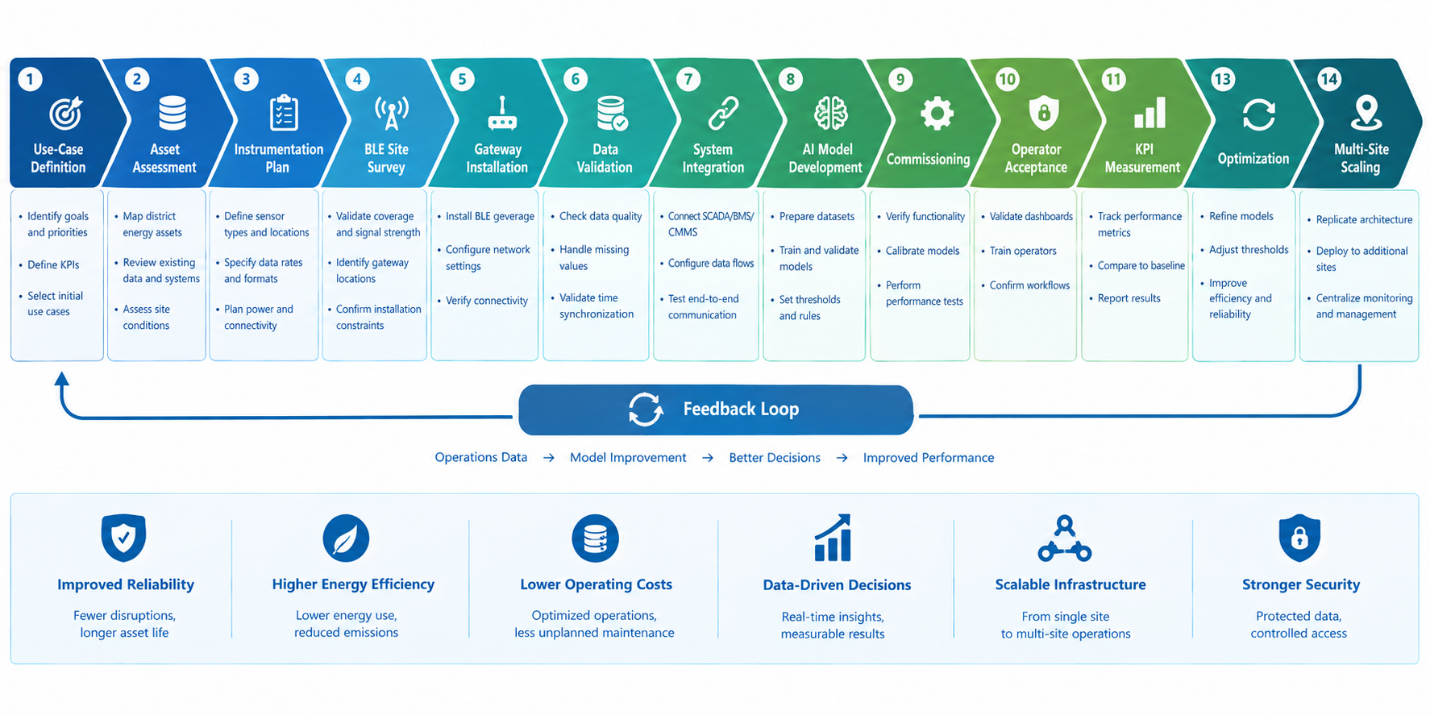
This roadmap presents the lifecycle for deploying AI-enabled monitoring across District Energy Systems, from use-case definition and asset assessment through BLE site surveys, gateway installation, data validation, AI model development, commissioning, cybersecurity review, KPI measurement, optimization, and multi-site scaling. A continuous feedback loop connects operational data with model improvement, better decisions, and improved system performance.
Implementation Priorities for AI-Enabled District Energy Operations
Successful AI deployment in District Energy Systems depends more on engineering discipline and data quality than on selecting a sophisticated model. Operators should first define the operational decision they want to improve, identify the assets and measurements involved, establish a reliable data path, and then determine where AI provides measurable additional value.
A practical implementation should:
- Start with high-value plant, substation, or network use cases.
- Reuse validated SCADA, BMS, meter, and historian data where possible.
- Add BLE sensing where important measurements are unavailable or difficult to wire.
- Validate wireless coverage before final gateway placement.
- Standardize asset identities and engineering units.
- Keep deterministic safety and control functions separate from experimental AI functions.
- Establish baseline KPIs before deploying AI.
- Validate AI outputs with operators and maintenance engineers.
- Monitor false positives, data quality, and model drift.
- Apply cybersecurity controls across sensors, gateways, networks, servers, APIs, and AI software.
- Select cloud-hosted or privately hosted deployment according to operational, security, connectivity, and governance requirements.
- Scale only after the pilot demonstrates measurable operational value.
GAO has supplied BLE, RFID, and IoT hardware products and systems to organizations requiring connected sensing and asset-related solutions, with engineering support available for deployment and integration requirements. Its broader experience serving U.S. and Canadian organizations, including Fortune 500 companies, research organizations, universities, and government agencies, provides a foundation for addressing the practical hardware and systems considerations that accompany large-scale IoT deployments.
Readers evaluating AI-enabled district energy monitoring can learn more about GAO’s BLE, IoT, RFID, sensing, gateway, and systems capabilities and determine which technologies fit their plant, substation, distribution, or building-level requirements.
Building the Future of Industrial AI and IoT with Aperture Venture Studio and GAO RFID Inc.
For more than three decades, GAO Group of Companies has invested heavily in R&D for industrial BLE, RFID, and IoT technologies. As generative AI has become increasingly useful for industrial applications, we have expanded our work in AIoT, including BLE and RFID technologies, and established Aperture Venture Studio to develop and scale AI and IoT solutions relevant to applications such as District Energy Systems.
Aperture brings together AI and IoT technical experts, entrepreneurial and operational executives, investors, and leading companies. We have also developed Aperture Ventures Summit and TekSummit to discuss advanced AI and IoT topics and foster technical communities. We welcome advisors, co-founders, employees, investors, and customers to participate in these initiatives.