
AI and BLE for Drinking Water Systems
AI-Driven Drinking Water Systems with BLE-Enabled Monitoring
Drinking water systems increasingly combine Industrial AI, IoT sensors, connected equipment, and operational data to improve treatment reliability, distribution performance, asset maintenance, and regulatory visibility. AI can analyze equipment condition, operating patterns, alarms, maintenance records, and environmental measurements to identify abnormal conditions and support faster operational decisions. BLE sensors and BLE beacons provide a practical wireless layer for collecting supplementary information around pumps, valves, chemical storage areas, treatment equipment, laboratories, reservoirs, and maintenance activities. BLE gateways can transfer this information to edge computers, servers, or cloud software where AI models and analytics can be applied. The resulting AIoT solution can complement existing SCADA, PLC, historian, CMMS, GIS, and water quality systems rather than replacing process-control instrumentation. For drinking water utilities, the value comes from connecting operational observations with asset context and actionable intelligence while maintaining cybersecurity, data integrity, and safe control practices.
AI-Enabled Drinking Water Treatment and Distribution System Overview with BLE, SCADA, and Predictive Analytics
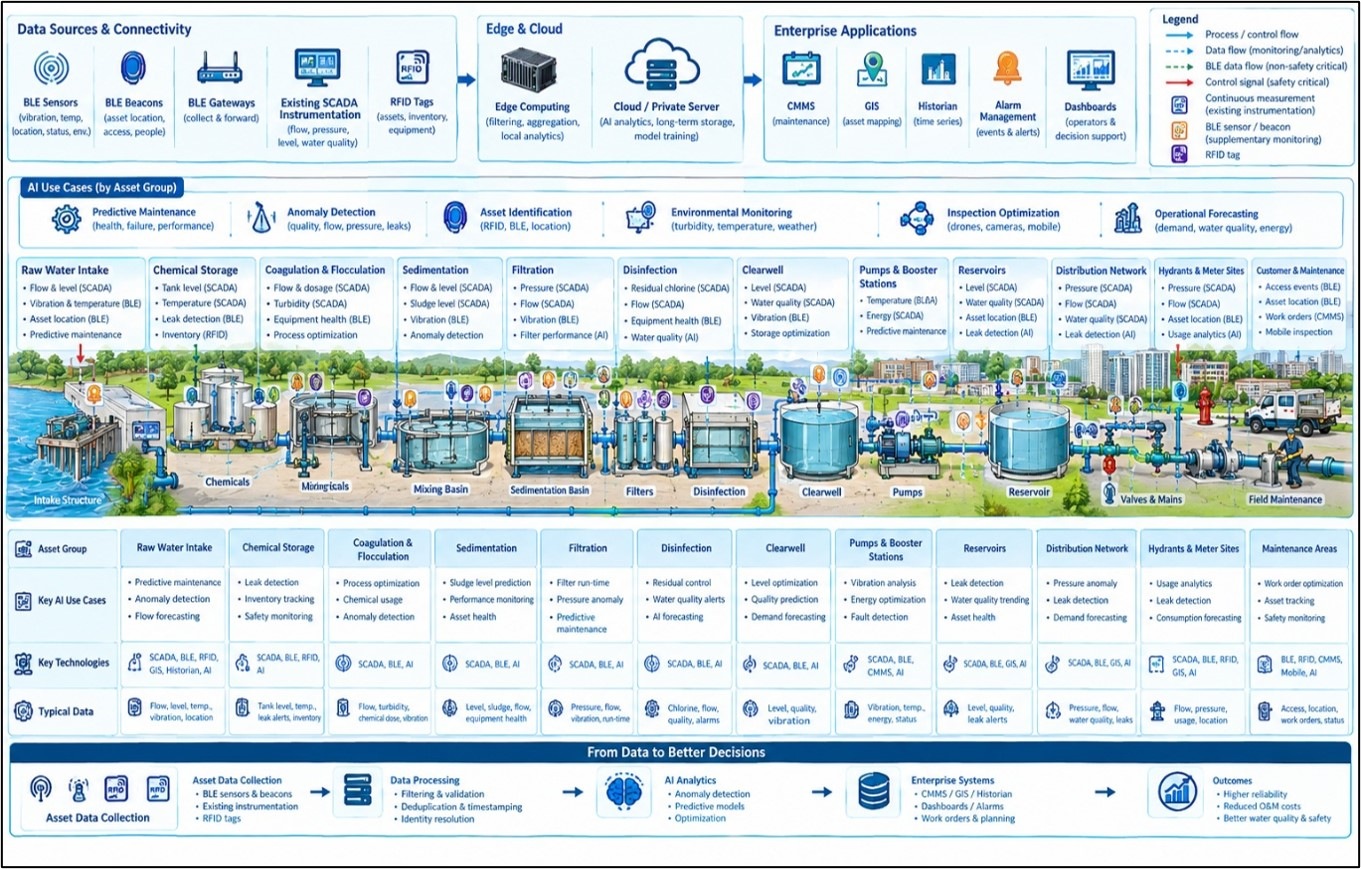
This enterprise engineering infographic illustrates how BLE sensors, BLE beacons, existing water-quality instrumentation, PLC/SCADA systems, and BLE gateways connect drinking water treatment and distribution operations with edge computing and cloud or private server AI analytics. It highlights data integration with CMMS, GIS, historian, alarm management, and operator dashboards for asset monitoring, predictive maintenance, water-quality visibility, and operational decision support. Safety-critical control signals remain distinguished from non-safety-critical monitoring and analytics.
How AI Transforms Drinking Water System Operations
AIoT in drinking water systems combines artificial intelligence with connected sensors, equipment, operational databases, and industrial systems. The AI layer can include machine learning, anomaly detection, time-series forecasting, computer vision, natural-language interfaces, and Edge AI where local processing is beneficial.
The important distinction is between process instrumentation and supplementary IoT monitoring. Drinking water treatment plants already depend on dedicated instruments for parameters such as flow, pressure, turbidity, pH, temperature, residual disinfectant, conductivity, and other water-quality measurements. These instruments normally connect to PLCs, RTUs, SCADA systems, or dedicated analyzers. BLE can complement this infrastructure by collecting information that is difficult or expensive to wire across a large facility.
Typical BLE-enabled information can include:
- Pump and motor vibration measurements for condition monitoring
- Ambient temperature and humidity around electrical and mechanical equipment
- Equipment cabinet environmental conditions
- Door, hatch, cabinet, and access-state information
- Portable equipment and maintenance-tool location
- BLE beacon-based identification of valves, pumps, tanks, meters, and other assets
- Battery-powered sensing at locations where permanent wiring is impractical
- Maintenance-worker or inspection-point presence where an approved tracking solution is required
- Environmental conditions around chemical storage and maintenance areas
- Temporary monitoring during commissioning, troubleshooting, or equipment investigation
AI becomes useful when these observations are combined with historical operating data. For example, a pump’s vibration pattern can be compared with operating hours, motor load, discharge pressure, maintenance history, and previous failure events. The objective is not simply to generate another alarm. The objective is to identify a meaningful change in equipment behavior and provide maintenance personnel with enough context to investigate it.
GAO can support such implementations with BLE sensors, beacons, gateways, RFID products, and related IoT hardware and systems that organizations can integrate with their existing operational software.
Drinking Water Applications for AI-Enabled Monitoring
AI Predictive Maintenance for Water Treatment Pumps
Raw-water pumps, high-service pumps, booster pumps, backwash pumps, chemical-feed pumps, and other rotating equipment are maintenance-critical assets. Unplanned failure can affect treatment throughput, pumping capacity, energy consumption, and service continuity.
BLE vibration and temperature sensors can provide additional condition data without requiring every monitoring point to be permanently wired. AI models can examine changes in vibration signatures, temperature trends, runtime, and operating conditions.
Practical outputs include:
- Abnormal vibration detection
- Bearing or motor-condition indicators
- Temperature trend analysis
- Maintenance-priority alerts
- Remaining-useful-life estimates where sufficient historical failure data exists
- Comparison of similar pumps operating under different loads
- Correlation between equipment condition and maintenance history
A key engineering consideration is sensor placement. A battery-powered BLE sensor mounted on a poorly selected surface can produce data that is technically available but operationally misleading. Mounting method, sensor orientation, measurement bandwidth, machinery speed, sampling interval, and environmental conditions should therefore be considered during commissioning.
AI Monitoring for Valves and Actuation Equipment
Treatment and distribution facilities contain isolation valves, control valves, check valves, actuators, and related mechanical equipment. Many are distributed across large physical areas and may not have continuous digital condition information.
BLE beacons can associate equipment with a unique digital identity, while appropriate sensors can provide supplementary information such as temperature, vibration, or operating-state observations. AI can then identify patterns such as repeated abnormal operating conditions or maintenance intervals that differ from expected behavior.
BLE should not be treated as a replacement for safety-critical valve position feedback where a hardwired or appropriately engineered industrial control connection is required. Instead, it can provide asset identification, supplementary condition monitoring, and maintenance visibility.
AI-Assisted Chemical Handling and Storage Monitoring
Drinking water treatment relies on chemicals such as chlorine or sodium hypochlorite, alum, ferric compounds, polymers, caustic chemicals, and other treatment chemicals depending on the treatment process.
Chemical concentration, dosing, leakage, ventilation, and process control should continue to use appropriately rated instrumentation and safety systems. BLE can support surrounding operational activities, including:
- Monitoring environmental conditions around storage areas
- Identifying chemical containers or mobile equipment
- Recording maintenance inspections
- Associating work activities with specific assets
- Monitoring access to designated equipment areas
- Supporting inventory identification when BLE or RFID tags are appropriate
RFID can also be useful for identifying chemical containers, replacement components, calibration equipment, or maintenance inventory when item-level identification is more important than continuous sensing.
AI for Reservoir, Tank, and Distribution Asset Monitoring
Clearwells, storage tanks, elevated reservoirs, pump stations, pressure-reducing stations, meter sites, and remote distribution facilities can be geographically dispersed.
AI can combine SCADA data, pressure and flow measurements, asset history, maintenance records, weather information, and supplementary IoT observations to identify abnormal operating conditions.
BLE is particularly useful for local asset identification and short-range monitoring around facilities. A BLE gateway can collect sensor information and forward it through a suitable backhaul connection such as Ethernet, cellular, Wi-Fi, or another approved communications network.
Drinking Water Asset Use-Case Map: AI, BLE, RFID, and SCADA for Water Treatment and Distribution
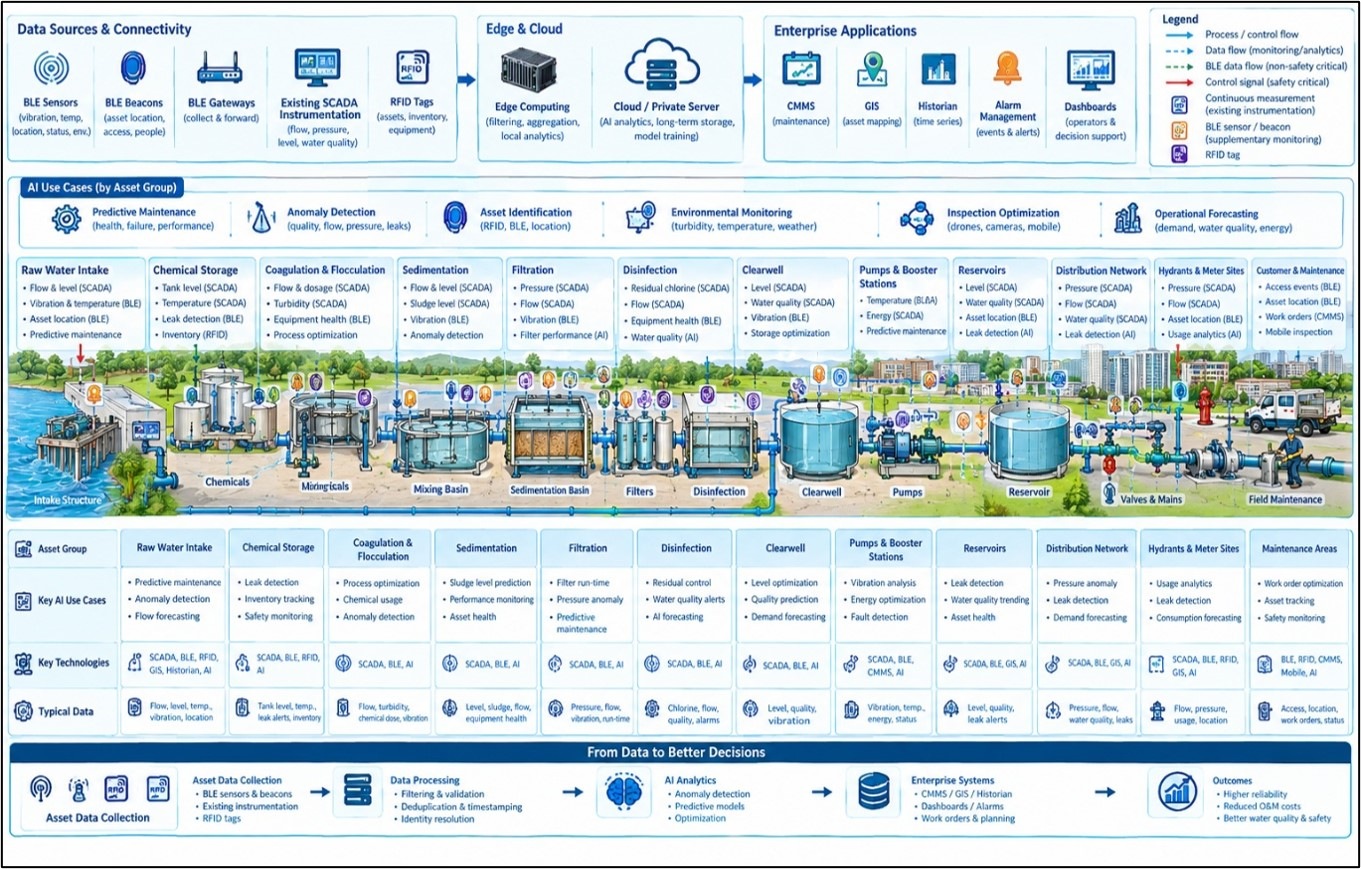
This technical utility engineering infographic maps AI applications across drinking water assets, including raw water intakes, chemical storage, filtration, pumps, reservoirs, distribution networks, and maintenance areas. It illustrates how BLE sensors, BLE beacons, RFID tags, existing SCADA instrumentation, and gateways connect to edge computing, AI analytics, GIS, CMMS, and historian systems. The visual highlights predictive maintenance, anomaly detection, environmental monitoring, inspection optimization, and operational forecasting to support data-driven water infrastructure management.
Drinking Water Operational Challenges AIoT Can Address
Drinking water utilities face a combination of process, mechanical, geographic, maintenance, and data-management challenges. AI and IoT technologies are most useful when they address a defined operational problem rather than being installed simply to collect more data.
Distributed and Difficult-to-Wire Assets
Water infrastructure frequently extends across treatment buildings, pump stations, reservoirs, wells, remote meter locations, and distribution corridors. Installing new cabling at every monitoring point can require electrical work, conduit, shutdown coordination, and significant installation effort.
Battery-powered BLE sensors can provide a lower-complexity option for selected supplementary measurements. The engineering decision should consider transmission distance, physical obstructions, battery life, gateway placement, electromagnetic conditions, maintenance access, and required measurement frequency.
Aging Mechanical Equipment
Many drinking water systems operate pumps, motors, valves, blowers, compressors, and other equipment for long service periods. Maintenance records may exist in a CMMS while equipment measurements remain in SCADA or local systems.
AI can create additional value by correlating these datasets. A maintenance engineer can investigate an abnormal pump trend while viewing operating hours, recent work orders, discharge pressure, vibration measurements, and historical events rather than evaluating each data source separately.
Alarm Overload and Data Fragmentation
SCADA systems can generate large numbers of alarms, especially during abnormal plant conditions. AI-based anomaly detection can provide another analytical layer that identifies persistent deviations or relationships among multiple variables.
The AI output should remain explainable enough for operators and maintenance teams to understand why an asset or process condition was flagged. Automatic control actions should be separated from advisory analytics unless the control function has undergone appropriate engineering validation and safety review.
Remote Maintenance and Inspection
Remote reservoirs, pump stations, and distribution facilities increase inspection travel and make asset context important. BLE beacons can provide local equipment identification, while sensors can provide supplementary condition information.
A technician arriving at a pump station could use an approved mobile application to identify the correct pump, retrieve its asset record, view recent measurements, and document an inspection. Integration with CMMS or work-order software can reduce manual transcription and improve maintenance traceability.
From Sensor Data to AI-Driven Water Operations
A practical AIoT deployment for drinking water systems normally follows a layered operational workflow. The exact implementation depends on whether the facility is a treatment plant, pump station, reservoir, well site, or distribution location.
Data Acquisition at Water Assets
The first layer contains existing process instruments and supplementary IoT devices.
Existing instrumentation can include:
- Flow meters
- Pressure transmitters
- Level instruments
- Turbidity analyzers
- pH analyzers
- Chlorine or disinfectant residual analyzers
- Conductivity instruments
- Temperature sensors
- Motor current and electrical measurements
- PLC and RTU status information
Supplementary BLE devices can add measurements such as vibration, temperature, humidity, access state, or asset identity.
This separation is important because drinking water operators should not assume that a consumer-grade wireless sensor provides the accuracy, environmental rating, calibration capability, or reliability expected from regulated process instrumentation.
BLE Gateway and Local Data Collection
BLE gateways collect nearby BLE sensor and beacon transmissions and convert them into data that can be transported to higher-level systems. Gateway selection should consider physical range, antenna characteristics, enclosure requirements, power availability, network connectivity, operating temperature, and cybersecurity requirements.
A treatment plant may use Ethernet-connected gateways where network infrastructure is available. A remote pump station may require cellular backhaul. A facility with restrictive network segmentation may place the gateway behind an industrial firewall and permit only specifically approved outbound communications.
Edge Processing and Data Validation
Edge computing can perform filtering, buffering, timestamp normalization, device health checks, and preliminary anomaly detection before information is transmitted to a cloud or private server.
This is useful when connectivity is intermittent or when the utility wants to minimize unnecessary data transmission.
Data validation should identify:
- Missing sensor readings
- Duplicate messages
- Abnormal timestamps
- Battery or device-health warnings
- Sensor drift
- Communication outages
- Implausible measurement values
- Gateway connectivity failures
AI models should not automatically interpret bad sensor data as a genuine equipment fault.
Cloud or Private Server Processing
Validated information can be transmitted to cloud-hosted software or a privately managed server. The software can combine BLE data with SCADA historians, CMMS records, GIS information, laboratory databases, asset registries, and other approved data sources.
AI processing can then support:
- Time-series anomaly detection
- Predictive maintenance
- Asset-condition classification
- Failure-pattern analysis
- Demand and operating-condition forecasting
- Maintenance prioritization
- Natural-language operational queries
- Automated report generation
- Inspection optimization
The final business action may be a maintenance work order, operator investigation, inspection request, asset replacement review, or engineering analysis.
Integration with SCADA, CMMS, GIS, and Utility Software
The AI system should fit into the drinking water utility’s existing information flow instead of creating another isolated database.
Common integration targets include:
- SCADA and HMI systems for operational context
- PLCs and RTUs for equipment and process status
- Historian databases for time-series analysis
- CMMS/EAM systems for work orders and maintenance history
- GIS for geographic asset relationships
- Laboratory information systems for water-quality records
- Asset management databases
- Identity and access management systems
- Notification and incident-management software
Open and established interfaces such as REST APIs, MQTT, OPC UA, database connectors, and vendor-supported integration interfaces may be appropriate depending on the system boundary. Protocol selection should follow the utility’s existing cybersecurity standards and network design rather than being determined solely by the IoT device.
BLE, AI Hardware, Software, and Deployment Models for Drinking Water Systems
A drinking water AIoT solution normally consists of several coordinated components rather than a single device. BLE provides short-range wireless connectivity for selected sensors and asset-identification devices, while AI provides the analytical capability.
BLE Sensors and Beacons
BLE sensors are appropriate where battery-powered monitoring, relatively low data volumes, and flexible installation are advantageous. BLE beacons primarily provide identification or location-related signals rather than high-frequency process measurement.
For drinking water facilities, engineers should evaluate:
- IP/NEMA enclosure requirements
- Battery chemistry and expected service life
- Temperature and humidity range
- Sensor calibration requirements
- Vibration measurement characteristics
- Radio range inside concrete and metal structures
- Interference from electrical equipment
- Maintenance accessibility
- Data transmission intervals
- Device authentication and provisioning
BLE Gateways
BLE gateways form the connection between local BLE devices and the utility’s IP network or communications infrastructure. A gateway may support Ethernet, Wi-Fi, cellular, or other network interfaces depending on the installation.
Gateway placement should be based on an actual RF site survey. Concrete structures, underground chambers, metal tanks, electrical rooms, pipe galleries, and equipment enclosures can significantly change wireless performance.
AI and Edge Computing
AI processing can occur at the edge, in a private server environment, or through cloud-hosted software.
Useful models include:
- Statistical anomaly detection for equipment measurements
- Supervised classification where labeled fault data exists
- Time-series forecasting for operational variables
- Clustering for identifying unusual equipment behavior
- Computer vision for selected inspection tasks
- Natural-language processing for querying operational documentation
- Predictive maintenance models using historical asset records
A common implementation mistake is selecting a sophisticated model before establishing adequate historical data. A simpler anomaly-detection method can be more practical when a utility has limited labeled failure events.
Cloud Version and Server Version
Cloud Version uses cloud-hosted software and managed cloud infrastructure. It can be suitable when a utility need centralized monitoring across multiple treatment plants, reservoirs, pump stations, or distribution facilities and its cybersecurity policies permit the required external connectivity.
Server Version runs software on customer-managed infrastructure, including an edge server, private data center, utility server room, or other privately hosted computing environment. This approach can be appropriate when operational data must remain within controlled infrastructure, connectivity to external cloud services is restricted, or integration with existing private systems is a priority.
GAO can provide hardware products and IoT systems that support these deployment choices, while the final implementation should follow the drinking water utility’s IT, OT, cybersecurity, regulatory, and operational requirements.
AI Capabilities for Drinking Water System Performance
AI delivers the greatest operational value when it converts large volumes of drinking water system data into condition indicators, predictions, prioritized actions, and decision support. The analytical layer should complement established process-control, water-quality, and safety procedures rather than bypass them.
Predictive Maintenance for Pumps, Motors, and Rotating Equipment
Predictive maintenance models can establish normal operating patterns for pumps and motors and identify deviations before conventional maintenance intervals indicate a problem.
A useful model can combine:
- Vibration amplitude and frequency characteristics
- Bearing and motor temperature
- Pump runtime and starts per hour
- Motor current and electrical load
- Suction and discharge pressure
- Flow rate
- Pump efficiency indicators
- Previous maintenance and failure records
- Operating mode and duty/standby status
The model can generate an equipment health indicator rather than simply issuing an alarm. Maintenance personnel can then inspect the asset and determine whether lubrication, alignment, bearing replacement, impeller inspection, seal replacement, or another intervention is warranted.
Historical data quality is critical. If a utility has very few documented failures, unsupervised anomaly detection or statistical condition monitoring may initially be more appropriate than a supervised failure-prediction model.
AI-Based Anomaly Detection for Water Treatment Processes
Treatment plants contain multiple variables that influence one another. A change in turbidity, flow, pressure, chemical dosing, filter differential pressure, or pump behavior can have different meanings depending on the current treatment stage.
AI can evaluate multiple time-series variables simultaneously and identify relationships that threshold-based monitoring may not capture.
Examples include:
- Detecting unusual filter differential-pressure behavior
- Identifying abnormal pump performance under comparable flow conditions
- Recognizing deviations in chemical dosing patterns
- Detecting unusual combinations of pressure and flow
- Identifying persistent equipment-temperature changes
- Flagging sensor behavior that differs from neighboring measurements
AI-generated observations should remain traceable to the underlying measurements. Operators need to know which variables contributed to an alert and whether the source data is reliable.
AI for Water Quality and Treatment Decision Support
Water-quality management requires particularly careful system design because process decisions can affect public health. AI can assist with forecasting, trend analysis, data-quality checks, and decision support, but critical treatment controls should remain governed by validated instrumentation, operating procedures, and applicable regulatory requirements.
Potential applications include:
- Forecasting water-quality trends
- Detecting unusual analyzer behavior
- Correlating process conditions with turbidity trends
- Identifying relationships between flow and disinfectant demand
- Supporting laboratory-data analysis
- Detecting inconsistent sensor measurements
- Generating operator reports from validated datasets
AI should not be treated as an independent authority for determining whether drinking water is safe. Its role is to help qualified personnel interpret information and identify conditions requiring investigation.
Computer Vision for Drinking Water Facilities
Computer vision can complement sensor-based monitoring in selected applications. Cameras may be used to inspect equipment, identify visible leakage, verify equipment states, monitor restricted areas, or detect visual anomalies.
Possible applications include:
- Visual inspection of pumps and mechanical equipment
- Detection of visible water leakage
- Inspection of gauges and indicator positions
- Identification of corrosion or physical deterioration
- Verification of equipment-area conditions
- Monitoring selected safety and access conditions
Lighting, camera positioning, condensation, dust, reflections, occlusion, and privacy requirements must be considered before deploying a vision model.
BLE and RFID Roles in Drinking Water Asset Management
BLE and RFID can serve different but complementary purposes within drinking water facilities. BLE is particularly useful for wireless sensing and local identification, while RFID is useful for identifying tagged physical items when continuous sensing is unnecessary.
Potential RFID applications include:
- Identification of pumps and maintenance components
- Tracking replacement parts
- Chemical-container identification where suitable tags are permitted
- Management of calibration instruments
- Tool and equipment tracking
- Maintenance inventory management
- Inspection-point identification
- Linking physical assets to digital maintenance records
BLE can provide dynamic measurements or proximity information, whereas RFID can provide low-maintenance identity information. A drinking water utility does not need to use both technologies everywhere. Selection should be based on the information requirement, reading distance, environmental conditions, battery requirements, data frequency, and existing asset-management processes.
Cybersecurity and Reliability for Drinking Water AIoT
Cybersecurity requires special attention because drinking water systems combine information technology with operational technology. A BLE monitoring deployment should therefore be designed so that compromise of a supplementary IoT device does not provide an uncontrolled path into safety-critical control systems.
Network Segmentation
BLE gateways should be placed within appropriately controlled network zones. Where possible, monitoring traffic should be separated from critical control traffic through network segmentation, firewalls, access-control policies, and carefully defined communication paths.
A sensible design can separate:
- BLE devices
- IoT gateways
- Edge computing
- SCADA and HMI systems
- PLC and RTU networks
- Historian databases
- CMMS and business applications
- Cloud services
- Administrative IT networks
The exact segmentation model should follow the utility’s cybersecurity program and applicable OT security requirements.
Device and Data Security
Security controls should address the complete lifecycle of BLE sensors and gateways.
Important controls include:
- Unique device identities
- Secure provisioning
- Authenticated gateway connections
- Encryption in transit
- Role-based access control
- Strong administrative authentication
- Credential rotation
- Secure firmware management
- Gateway hardening
- Network access restrictions
- Audit logging
- Device inventory management
- Backup and recovery procedures
- Monitoring for unexpected device behavior
BLE security should not be considered independently from gateway, network, cloud, server, and application security. A secure radio connection cannot compensate for an improperly protected gateway or poorly configured backend system.
Data Integrity and Fail-Safe Operation
A drinking water AIoT system should continue operating safely when wireless communications or analytics become unavailable.
Engineering provisions can include:
- Local buffering at gateways
- Timestamp synchronization
- Store-and-forward communication
- Sensor-health indicators
- Communication-loss alarms
- Redundant critical measurements
- Manual operating procedures
- Independent process controls
- Defined AI failure states
AI analytics should normally remain advisory unless a specific automated function has been validated, tested, approved, and engineered according to the utility’s control and safety requirements.
Drinking Water AIoT Implementation and Commissioning
Successful implementation depends more on engineering discipline than on the number of connected devices. A phased deployment reduces technical risk and provides measurable evidence before expansion.
Define the Operational Problem
Start with a measurable problem such as unexpected pump failures, excessive inspection travel, inadequate asset visibility, maintenance-data fragmentation, or difficulty identifying abnormal equipment behavior.
Useful questions include:
- Which asset creates the operational problem?
- What event should the solution detect?
- How frequently does the event occur?
- What data already exists?
- Which measurements are missing?
- What action will follow an AI alert?
- Which team owns that action?
- What measurable KPI should improve?
Survey the Drinking Water Facility
A site survey should document equipment locations, existing instruments, electrical infrastructure, network availability, radio obstructions, environmental conditions, maintenance access, and hazardous or restricted areas.
For BLE deployments, the survey should evaluate:
- Gateway coverage
- Concrete and metal obstructions
- Equipment-room attenuation
- Antenna positioning
- Expected sensor density
- Battery replacement access
- Cellular or Ethernet availability
- Network segmentation
- Potential RF interference
A small proof-of-concept can validate radio performance before a larger installation.
Select Sensors and Gateways
Sensor selection should follow the measurement requirement rather than choosing hardware first.
For example, a pump condition-monitoring application may require vibration characteristics that differ substantially from those needed for ambient temperature monitoring. Likewise, an outdoor reservoir may require environmental protection that is unnecessary inside a controlled electrical room.
GAO’s BLE sensors, beacons, gateways, RFID products, and related IoT hardware can be evaluated according to these application-specific requirements.
Install and Commission
Commissioning should verify both the physical installation and the data chain.
Recommended checks include:
- Sensor identity verification
- Asset-to-device mapping
- Correct sensor mounting
- BLE communication range
- Gateway connectivity
- Timestamp accuracy
- Data transmission intervals
- Battery status
- Measurement plausibility
- Data buffering
- Backend ingestion
- Alarm behavior
- User permissions
- CMMS or other system integration
Baseline measurements should be recorded before AI models are used for operational decisions.
Validate the AI Model
Model validation should use representative drinking water operating conditions. A model trained on normal pump operation may perform poorly when seasonal demand, pump configuration, maintenance activity, or treatment conditions change.
Validation should therefore consider:
- False positives
- False negatives
- Seasonal variation
- Duty-cycle changes
- Equipment replacement
- Sensor replacement
- Maintenance events
- Process changes
- Missing data
- Sensor drift
Maintenance personnel should participate in model validation because they understand the physical reasons behind equipment behavior.
KPIs for AI-Enabled Drinking Water Systems
A drinking water AIoT project should have measurable operational objectives. Device count alone is not an appropriate success measure.
Relevant KPIs can include:
| KPI | What It Measures | AIoT Relevance |
|---|---|---|
| Unplanned pump downtime | Equipment availability | Measures predictive-maintenance impact |
| Mean time between failures | Asset reliability | Indicates long-term condition improvement |
| Mean time to repair | Maintenance response | Measures usefulness of diagnostic information |
| Preventive-to-corrective maintenance ratio | Maintenance strategy | Shows movement toward condition-based maintenance |
| False alarm rate | Alert quality | Measures AI monitoring effectiveness |
| Detection lead time | Early warning capability | Measures how early abnormal behavior is identified |
| Sensor availability | Monitoring reliability | Identifies wireless-device performance |
| Gateway availability | Communications reliability | Measures data-collection continuity |
| Data completeness | Data quality | Determines whether AI inputs are trustworthy |
| Inspection travel time | Field efficiency | Useful for remote water assets |
| Work-order response time | Maintenance execution | Measures operational follow-through |
| Energy use per volume pumped | Pumping efficiency | Can be correlated with equipment condition |
| Filter performance indicators | Treatment operation | Supports process analysis |
| Water-quality excursion frequency | Process stability | Supports analytical monitoring |
| Asset identification accuracy | Asset-management quality | Measures BLE/RFID effectiveness |
Engineering Trade-Offs for Drinking Water BLE and AI Deployment
Wireless AIoT systems introduce practical trade-offs that should be evaluated during engineering design.
Wireless Flexibility Versus Measurement Requirements
BLE reduces cabling requirements for selected monitoring applications, but wireless devices have constraints involving range, battery life, radio propagation, and transmission intervals.
Critical process measurements may still require dedicated wired instrumentation or other industrial communications technologies.
Cloud Accessibility Versus Data-Control Requirements
Cloud deployment can simplify centralized analytics across geographically distributed facilities, while private server deployment can provide greater control over where operational information is processed.
The choice should consider cybersecurity policies, network connectivity, data governance, integration requirements, operating costs, maintenance responsibilities, and the utility’s IT capabilities.
AI Complexity Versus Data Availability
A complex machine-learning model does not automatically provide better operational results. Where historical failure data is limited, transparent statistical models or anomaly detection can be easier to validate and maintain.
Model complexity should increase only when the available data and operational requirement justify it.
Automation Versus Human Oversight
AI can recommend an inspection or maintenance action without directly controlling a pump or treatment process. This separation can reduce operational risk.
Any proposed automated control function requires a substantially higher level of validation, cybersecurity review, process engineering, fail-safe design, testing, and operational approval.
Regulations, Standards, and Compliance Considerations
Drinking water AIoT projects should be evaluated against the regulatory requirements applicable to the utility’s jurisdiction, treatment process, and operating environment.
Relevant areas may include:
- Safe drinking water and public-health requirements
- Water-quality monitoring and reporting
- Disinfection and treatment requirements
- Chemical handling and process safety
- Electrical and equipment safety
- Industrial cybersecurity
- Privacy requirements for worker or visitor location data
- Records retention and auditability
- Radio-frequency requirements
- Environmental and enclosure requirements
- Calibration and measurement management
For U.S. drinking water utilities, cybersecurity and operational requirements can involve federal, state, and local authorities as applicable. Canadian installations may involve federal, provincial, territorial, and municipal requirements. Applicable standards and utility-specific policies should be confirmed during project engineering rather than assumed from a generic IoT specification.
AI-generated recommendations should also remain auditable. Utilities should retain appropriate records of sensor data, model versions, configuration changes, alerts, operator decisions, and maintenance actions where required by their governance procedures.
Business Value of AI-Enabled Drinking Water Monitoring
Combining AI with appropriately selected IoT and BLE hardware can produce operational improvements that are directly connected to drinking water system performance.
Higher Equipment Availability
Earlier identification of abnormal pump or motor conditions can provide maintenance teams with additional time to investigate equipment before a failure affects pumping capacity.
More Targeted Maintenance
Condition information can help maintenance personnel prioritize assets according to observed behavior instead of relying exclusively on fixed maintenance intervals.
Better Visibility Across Remote Assets
BLE beacons and sensors can associate measurements with specific equipment while gateways transmit local observations into centralized software. This can be useful across distributed pump stations, reservoirs, and treatment facilities.
Better Data Quality
Automated validation can identify missing, implausible, duplicated, or stale data before those measurements are used by analytics.
Improved Asset Traceability
BLE and RFID identification can connect physical equipment with digital asset records, maintenance histories, inspection information, and work orders.
Scalable Monitoring
A standardized device and gateway approach can allow additional assets to be added progressively after the initial installation has demonstrated measurable value.
GAO has supplied BLE, RFID, and IoT hardware products and systems to organizations in the United States and Canada, including Fortune 500 companies, research organizations, universities, and government agencies. Its engineering and support capabilities can assist organizations evaluating device selection, integration, deployment, and technical support requirements.
Practical Recommendations for Drinking Water AIoT Projects
A technically sound implementation should begin with the utility’s operational requirement and then select the appropriate sensing, communications, analytics, and software components.
Recommended practices include:
- Prioritize high-criticality pumps, motors, valves, reservoirs, or remote assets where better information can produce a measurable operational benefit.
- Inventory existing SCADA, PLC, historian, CMMS, GIS, laboratory, and asset-management data before adding new sensors.
- Use BLE for suitable supplementary monitoring rather than forcing wireless technology into applications requiring specialized process instrumentation.
- Conduct an RF site survey before determining gateway locations.
- Establish sensor and gateway health monitoring from the beginning.
- Validate data quality before training or deploying AI models.
- Start with a measurable pilot and establish baseline KPIs.
- Involve operations, maintenance, IT, OT cybersecurity, engineering, and management in system design.
- Keep safety-critical treatment controls independent from unvalidated AI recommendations.
- Design cloud or private-server deployment according to cybersecurity, connectivity, integration, and governance requirements.
- Document device identities, asset relationships, firmware versions, model versions, and configuration changes.
- Test communication-loss and sensor-failure scenarios before production deployment.
- Establish a maintenance plan for battery-powered BLE devices and gateways.
- Review AI performance periodically as equipment, process conditions, and operating practices change.
- Scale the solution only after the pilot demonstrates measurable operational value.
AIoT-Enabled Drinking Water Infrastructure and Predictive Maintenance System
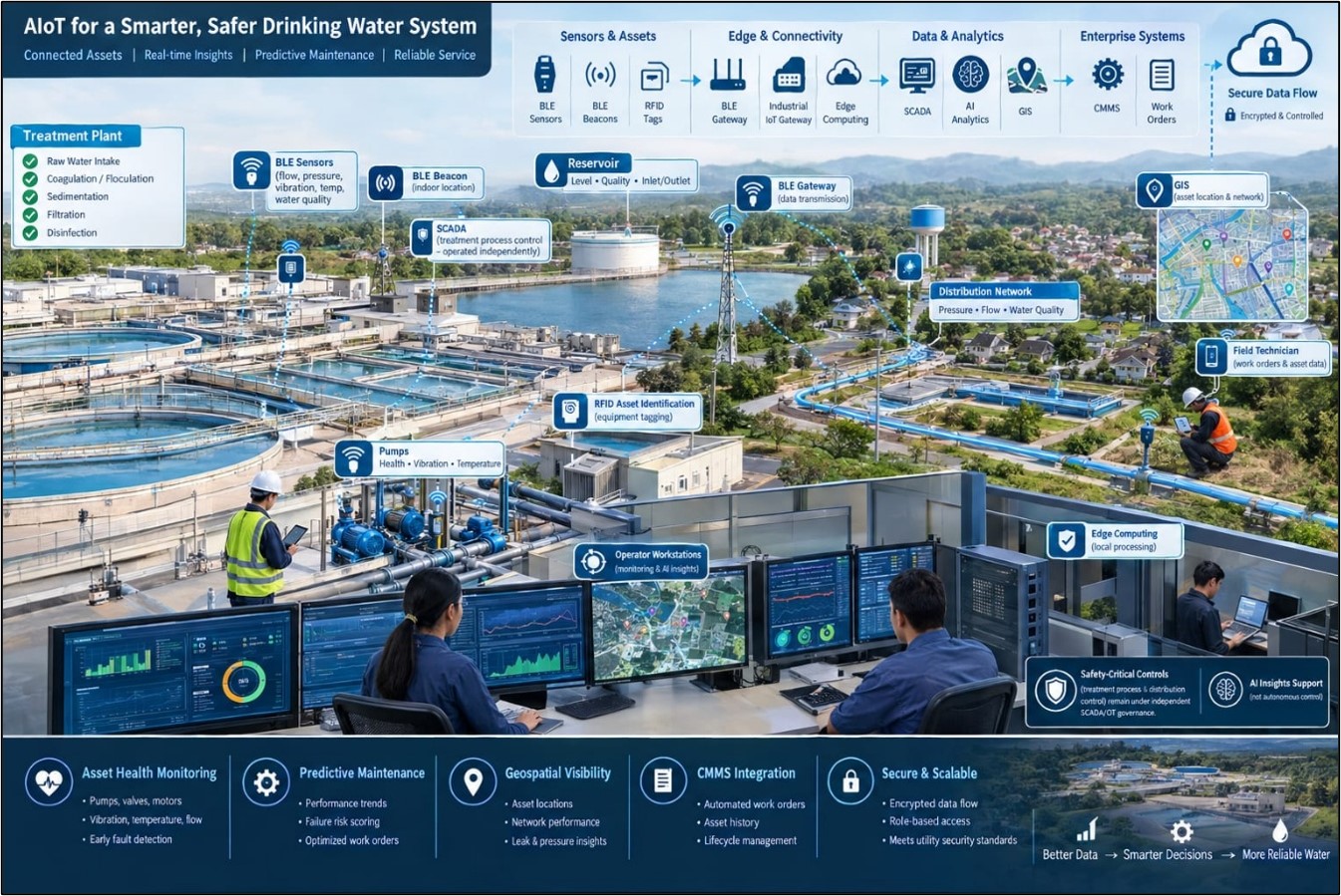
This industrial illustration shows how connected water infrastructure integrates BLE sensors, beacons, gateways, RFID asset identification, SCADA, edge computing, AI analytics, GIS, and CMMS. It highlights secure data flows from distributed assets to technicians and operator workstations, with AI supporting predictive maintenance while safety-critical treatment controls remain independently governed.
Alt Text:
AIoT drinking water system linking sensors, SCADA, AI analytics, GIS, CMMS, operators, and predictive maintenance
GAO Technology Support for Drinking Water System Applications
Drinking water organizations often need to combine new monitoring hardware with equipment and software already operating in treatment and distribution environments. GAO provides BLE sensors, BLE beacons, BLE gateways, RFID products, and other IoT hardware and systems that can be considered for applications such as equipment monitoring, asset identification, maintenance support, and distributed data collection.
GAO is headquartered in New York City and Toronto, Canada, and operates as part of GAO Group together with GAO Research Inc. and GAO Tek Inc. The companies serve customers across the United States and Canada, including major corporations, research organizations, universities, and government agencies. GAO’s product development has been supported by substantial R&D investment, quality-assurance processes, and technical support that can be delivered remotely or onsite.
For drinking water system projects, technical evaluation should focus on the actual treatment or distribution environment, required measurements, network conditions, cybersecurity requirements, existing software, and expected operational outcomes. Readers can explore GAO’s BLE, RFID, and IoT technologies and discuss application-specific requirements with its technical specialists.
Key Takeaways for AI and BLE in Drinking Water Systems
AI-enabled drinking water monitoring is most effective when it connects reliable operational data with a clearly defined maintenance, treatment, asset-management, or field-service requirement.
The principal implementation lessons are:
- AI should augment established drinking water process controls and qualified operator decisions.
- BLE is particularly useful for selected supplementary sensing, asset identification, and localized monitoring where cabling is difficult.
- BLE gateways provide the communications bridge between local wireless devices and higher-level software.
- Existing SCADA, historians, CMMS, GIS, and laboratory systems should remain important sources of operational context.
- Predictive maintenance requires reliable measurements, appropriate sensor placement, historical context, and continuous model validation.
- Cybersecurity must protect the complete path from wireless device to gateway, network, server, cloud software, and user.
- Cloud and privately hosted server deployments can both be appropriate depending on utility requirements.
- Pilot deployments should establish measurable baseline KPIs before broader rollout.
- Water-quality and safety-critical decisions require validated instrumentation, procedures, and qualified personnel rather than unvalidated AI outputs.
Organizations evaluating AIoT for drinking water treatment, pumping, storage, or distribution can use these principles to develop a technically controlled deployment roadmap. GAO can provide relevant BLE, RFID, and IoT hardware products and systems and technical support for organizations assessing their application requirements.
Building the Future of Industrial AI and IoT with Aperture Venture Studio and GAO RFID Inc.
For more than three decades, GAO Group of Companies has invested heavily in R&D for industrial BLE, RFID, and IoT. As generative AI has become increasingly useful in industrial applications, we have developed AI and IoT technologies that can support applications such as drinking water asset monitoring, predictive maintenance, and operational analytics. We have also founded Aperture Venture Studio to advance AI and IoT solutions relevant to industrial applications.
Aperture has attracted AI and IoT technical experts, operational executives, investors, and leading companies. We have also developed Aperture Ventures Summit and TekSummit to discuss advanced AI and IoT topics.
We welcome participation as:
- Advisors, co-founders, or employees
- Investors
- Customers