
AI and BLE for Electric Power Networks
AI-Driven Monitoring for Electric Power Networks
Artificial Intelligence of Things (AIoT) combines AI with connected sensors, equipment and industrial systems to turn field data into operational decisions. For electric power networks, AIoT can use BLE sensors, gateways and beacons to monitor substation equipment, distribution assets, maintenance conditions, worker locations and supporting infrastructure without requiring every monitoring point to be directly wired into a control system. AI models can analyze temperature, vibration, humidity, equipment presence, movement and other operational signals to identify abnormal conditions and prioritize maintenance activities. BLE provides a practical wireless layer for localized sensing and asset identification, while gateways transfer selected data into utility software for analytics and decision support. The resulting solution can support predictive maintenance, asset visibility, work-order prioritization, substation condition monitoring and field-service coordination. GAO supplies BLE and IoT hardware and systems that can be incorporated into such electric power network monitoring applications.
How AI Improves Electric Power Network Operations
Electric power networks combine generation interfaces, transmission facilities, substations, distribution feeders, transformers, switchgear, protection equipment, metering infrastructure and extensive field assets. Their operating conditions change continuously because of load variation, weather, switching activity, equipment aging, distributed energy resources and maintenance interventions.
AI becomes useful when utilities need to interpret large volumes of operational data rather than simply collect it. A temperature reading from a transformer enclosure, for example, has limited value by itself. Its operational significance increases when it is evaluated against historical readings, ambient temperature, load conditions, equipment age, maintenance history and other relevant signals.
AI-enabled electric power network solutions can therefore support:
- Transformer and switchgear condition monitoring
- Substation environmental monitoring
- Battery room temperature and humidity analysis
- Distribution cabinet and enclosure monitoring
- Asset identification and location verification
- Maintenance-tool and equipment tracking
- Field-worker location awareness in controlled areas
- Abnormal temperature and vibration detection
- Maintenance prioritization
- Spare-parts and field inventory visibility
- Inspection data correlation
- Equipment health scoring
- Work-order prioritization
- Anomaly detection across geographically distributed assets
The engineering objective is not to replace protection systems, SCADA, EMS, DMS or established utility control processes. Instead, AI can provide an additional analytical layer that helps operations and maintenance teams interpret information and identify conditions requiring investigation.
IEC 61850 remains particularly relevant to utility automation because the standard family defines communication requirements and information models for power utility automation systems and intelligent electronic devices. The current IEC 61850 series also addresses utility automation beyond traditional substation automation. (IEC Webstore)
Utility AIoT Operational Overview: BLE Sensing, Edge Analytics and Grid Systems
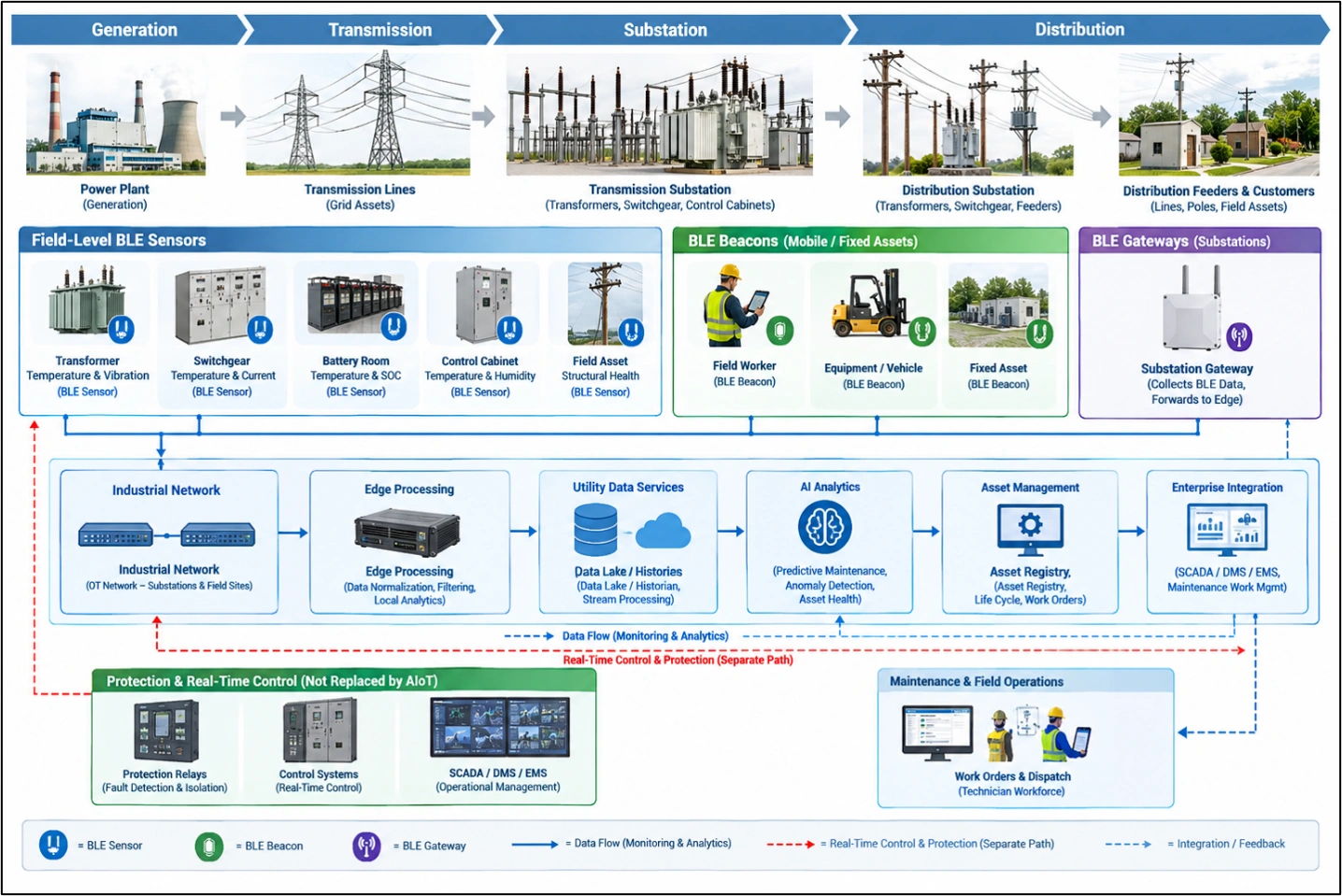
This architecture diagram illustrates how BLE sensors, beacons, and gateways collect field-level utility data and connect it to edge processing, AI analytics, asset management, and enterprise systems. It clearly distinguishes monitoring and analytics from protection and real-time control functions across transmission and distribution infrastructure.
Electric Power Network Use Cases for AIoT Monitoring
Transformer Condition and Thermal Monitoring
Power transformers are high-value assets where abnormal thermal conditions can indicate developing operational problems. BLE temperature sensors can collect localized measurements from suitable monitoring points such as enclosure areas, auxiliary equipment or supporting electrical rooms. AI models can compare sensor readings with historical patterns and environmental conditions to identify deviations.
The resulting analysis can help maintenance personnel distinguish a temporary temperature increase from a recurring abnormal pattern. A utility can combine this information with transformer loading, inspection records, oil analysis, equipment age and maintenance history when determining whether additional investigation is warranted.
BLE should not be treated as a substitute for dedicated transformer protection or certified electrical monitoring equipment where those systems are required. Its value is often in adding localized condition information that can complement existing instrumentation.
Substation Equipment Monitoring
Substations contain transformers, circuit breakers, disconnect switches, busbars, control cabinets, battery systems, HVAC equipment and communications infrastructure. Many supporting assets do not continuously produce the same depth of operational data as protection and control equipment.
BLE sensors can provide additional observations around:
- Control-room and relay-room temperature
- Battery-room environmental conditions
- Cabinet temperature and humidity
- Equipment enclosure conditions
- HVAC operating environments
- Auxiliary power equipment
- Selected mechanical equipment
- Maintenance-area environmental conditions
AI can correlate these readings with operating schedules, historical conditions and maintenance events to identify abnormal patterns.
GAO can support such deployments with BLE sensors, gateways and related IoT hardware selected according to the physical environment, sensing requirements and required communication range.
Asset Identification and Location Awareness
Electric utilities manage large numbers of transformers, portable test instruments, maintenance tools, inspection devices, replacement components and other physical assets. Loss of visibility can increase search time and complicate field-service coordination.
BLE beacons can provide identifiable wireless markers for fixed or mobile assets, while BLE gateways can capture nearby device information. Location data can then be associated with computerized maintenance management systems (CMMS), enterprise asset management (EAM) software or work-order systems.
AI can use historical movement patterns and asset utilization records to identify unusual movements, prolonged inactivity or potential equipment availability problems.
The practical value comes from connecting asset identity with operational context. Knowing that a testing instrument is somewhere within a substation is less useful than knowing which instrument is assigned to a work order, when it entered the facility, where it was last detected and whether it is available for the next maintenance task.
Distribution Network Field Asset Monitoring
Distribution networks contain extensive equipment spread across service territories. Depending on the utility and deployment objective, localized BLE sensing can complement existing telemetry around distribution cabinets, equipment rooms, service facilities and other accessible monitoring points.
AI can analyze environmental and asset-state information to identify unusual conditions and direct inspection resources toward assets requiring attention.
This approach is especially useful when the objective is supplementary condition monitoring rather than direct control of protection or switching functions.
Battery and Backup Power Monitoring
Substation battery systems provide critical backup power for protection, control and communications equipment. Temperature, humidity and other environmental conditions can affect battery performance and service life.
BLE sensors can collect localized environmental information within battery rooms or appropriate equipment areas. AI models can evaluate trends and identify conditions that deviate from established operating patterns.
The resulting alerts can be routed to maintenance teams rather than directly initiating protective actions. This distinction is important because AI-based recommendations should remain appropriately separated from deterministic protection functions.
Field-Service and Maintenance Intelligence
Utility maintenance involves crews, vehicles, test instruments, replacement components, permits, work orders and inspection records. AI can correlate asset data with maintenance history to help identify recurring service requirements.
BLE-based asset identification can provide additional context for maintenance workflows:
- Confirming that required equipment is present
- Recording arrival or departure events
- Associating tools with work areas
- Improving equipment utilization records
- Supporting inventory reconciliation
- Providing location context for maintenance activities
The objective is to reduce administrative uncertainty around field operations while giving maintenance personnel more reliable information.
AI-Based Substation Maintenance Workflow for BLE Monitoring and Predictive Maintenance
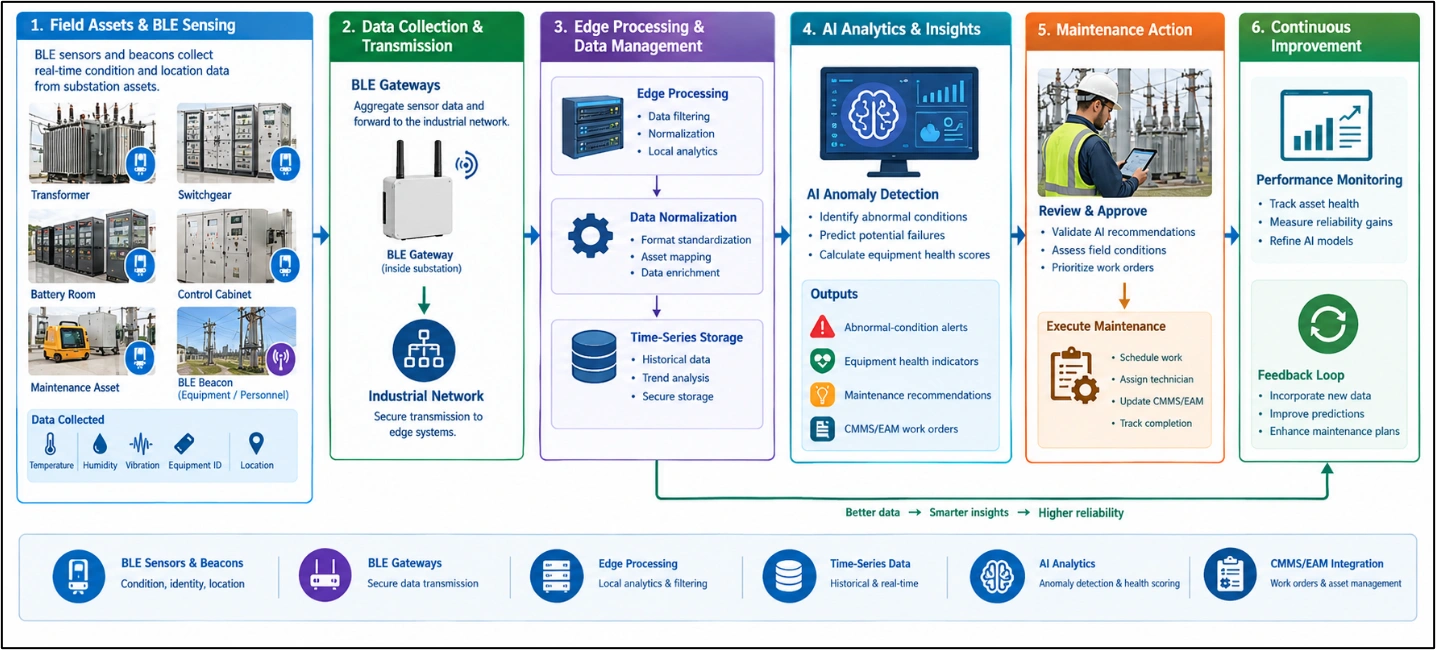
This workflow diagram illustrates how BLE sensors and beacons collect substation equipment data and transmit it through gateways, edge processing, and time-series storage. AI analytics identify anomalies and generate equipment health insights and maintenance recommendations, which are reviewed by maintenance engineers before CMMS/EAM work orders are executed.
Electric Power Network Data Flow from Sensor to Decision
A practical AIoT deployment begins with reliable data acquisition rather than the AI model itself. The sensing layer should be designed around the physical characteristics of the power network and the operational question being answered.
Field Data Acquisition
BLE sensors collect measurements appropriate to the use case. Typical data may include temperature, humidity, vibration, equipment state indicators or other sensor-specific measurements. BLE beacons can provide device identity and presence information.
Sensor placement requires careful consideration of:
- Equipment operating temperature
- Electromagnetic environment
- Metallic obstructions
- Enclosure construction
- Battery replacement requirements
- Sensor calibration
- Measurement frequency
- Physical access for maintenance
- Required wireless coverage
- Environmental protection requirements
A sensor should not be installed merely because the equipment can physically accommodate it. The measurement point needs to produce information that can support a defined maintenance or operational decision.
BLE Gateways and Local Communication
BLE gateways receive wireless data from nearby sensors and beacons and provide an interface to the utility’s wider communications infrastructure. Bluetooth LE supports several network configurations, including point-to-point, broadcast and mesh approaches. Bluetooth SIG documentation describes BLE mesh as suitable for many-to-many device communications and sensor networks. (Bluetooth® Technology Website)
For electric power networks, gateway placement should account for substation geometry, equipment enclosures, RF propagation, metal structures, interference, network availability and required redundancy.
A gateway can also perform local filtering and buffering so that the utility does not transmit every raw sensor event unnecessarily.
Edge Processing and Data Normalization
Edge processing is useful when a substation or field facility needs local analysis, temporary data storage or rapid event detection. The gateway or nearby edge server can normalize timestamps, validate measurements, remove malformed records and apply threshold checks before forwarding information.
This stage can also provide local buffering during temporary backhaul outages.
AI Analytics and Decision Support
Normalized data can be forwarded to AI services running on an edge server, private data center or cloud environment. Machine learning models can identify deviations from normal behavior, classify events, forecast maintenance requirements or calculate equipment condition indicators.
A utility should establish a clear relationship between an AI output and the operational decision it supports. For example, an anomaly score should lead to a defined inspection workflow rather than becoming an unexplained dashboard metric.
NIST’s AI Risk Management Framework provides a voluntary framework for managing AI risks throughout the AI lifecycle, with core functions organized around govern, map, measure and manage. NIST also released a 2026 concept note for an AI RMF profile focused specifically on trustworthy AI in critical infrastructure. (NIST)
Utility Software Integration
AIoT data becomes operationally useful when it connects to systems already used by utility personnel. Depending on the use case, integration targets can include:
- SCADA
- Distribution Management Systems (DMS)
- Energy Management Systems (EMS)
- Outage Management Systems (OMS)
- CMMS
- EAM
- Geographic Information Systems (GIS)
- Historian databases
- Laboratory and inspection systems
- Enterprise resource planning software
- Workforce management systems
- Maintenance work-order systems
The integration method depends on the existing utility environment. APIs, message brokers, database interfaces, OPC-based interfaces and other industrial communication methods may be appropriate depending on system ownership and cybersecurity requirements.
Electric Power Network AI Data Pipeline: BLE Sensing to Utility Decision Systems
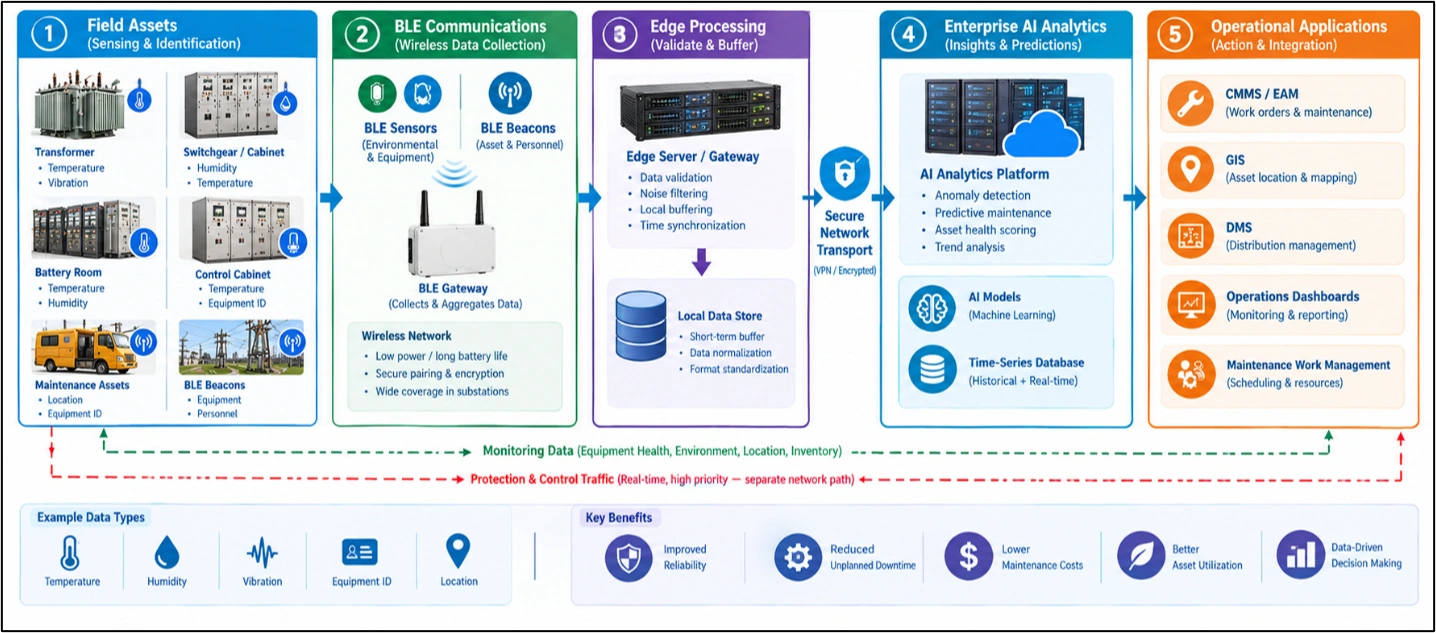
This flow diagram illustrates how operational data moves from utility field assets and BLE devices through edge processing and secure network transport to enterprise AI analytics. It shows how anomaly detection, predictive maintenance, asset health insights, and time-series data support CMMS, EAM, GIS, DMS, and maintenance dashboards while keeping protection and control traffic separate.
BLE Hardware and AI Software for Power Network Monitoring
BLE represents the field communication layer rather than the complete solution. A utility deployment normally combines BLE devices with gateways, networking, computing resources, data storage, AI software and existing operational systems.
BLE Sensors
BLE sensors should be selected according to the measurement, environmental and maintenance requirements of the target equipment. Temperature sensors may support transformer-adjacent monitoring, enclosure monitoring or battery-room environmental measurements. Vibration sensors can support selected mechanical-condition applications where the mounting location and sensor characteristics provide meaningful data.
Battery life is a major engineering consideration for remote sensors. Sampling frequency, transmission frequency, sensor type, temperature and wireless behavior all influence energy consumption.
BLE Beacons
BLE beacons primarily provide identity or presence information. In electric power network applications, they can be attached to portable test equipment, maintenance tools, mobile assets or selected fixed equipment.
Their usefulness increases when beacon identifiers are mapped to authoritative utility asset records rather than treated as anonymous wireless devices.
BLE Gateways
Gateways bridge the BLE field layer and the utility’s IP-connected environment. A gateway may provide local device management, protocol conversion, buffering, filtering and secure upstream communications.
Gateway hardware should be evaluated for:
- Operating temperature range
- Enclosure requirements
- Ethernet and wireless backhaul options
- Local storage
- Power availability
- Redundancy requirements
- Device capacity
- Remote administration
- Security controls
- Integration interfaces
GAO provides BLE gateways, beacons, sensors and related IoT hardware that can be evaluated for utility monitoring and asset-management requirements.
Cloud Version and Server Version
A Cloud Version places the application and analytics services in managed cloud infrastructure. This model can be appropriate when geographically distributed substations need centralized analytics, centralized device administration and scalable data processing.
A Server Version places the software on customer-managed infrastructure such as an edge server, private data center or other privately hosted enterprise environment. This approach can be appropriate where utilities require greater control over data residency, network isolation, integration boundaries or operational technology security.
The choice should be based on the utility’s cybersecurity policy, data classification, connectivity model, latency requirements, operational ownership and regulatory obligations rather than on deployment preference alone.
NIST’s smart-grid cybersecurity guidance emphasizes that utilities need security strategies tailored to their specific combinations of technologies, risks and vulnerabilities. (NIST)
Cybersecurity and Interoperability Considerations
Electric power networks require stronger separation between monitoring applications and systems responsible for protection or direct operational control. BLE devices should therefore be incorporated into an established utility cybersecurity program rather than deployed as isolated wireless devices.
Relevant controls can include:
- Device identity and authentication
- Encrypted wireless communications
- Secure gateway configuration
- Network segmentation
- Least-privilege access
- Credential lifecycle management
- Firmware and software update controls
- Gateway logging
- Centralized security monitoring
- Data integrity validation
- Backup and recovery procedures
- Controlled remote administration
- Asset inventory and configuration management
NERC CIP requirements apply to covered Bulk Electric System environments and include requirements addressing BES Cyber System categorization, system security management, configuration change management, vulnerability assessment and information protection. Applicability depends on the utility’s systems, assets and regulatory scope. (NERC)
IEC 61850 should also be considered where AIoT monitoring needs to exchange information with power utility automation systems. IEC describes the 61850 family as addressing communication between IEDs and related system requirements, with current work extending across utility automation applications. (IEC Webstore)
A BLE monitoring solution should therefore be engineered as a controlled extension of the utility’s information environment, with explicit boundaries around SCADA, protection, substation automation and maintenance systems.
Planning and Selecting AIoT Solutions for Electric Power Networks
A successful electric power network AIoT deployment begins with a clearly defined operational problem. Utilities should identify the equipment, condition, workflow or maintenance decision that needs better information before selecting BLE hardware or AI software. This prevents sensor deployments from generating large quantities of data without a corresponding operational purpose.
Define the Monitoring Objective
Each deployment should establish measurable objectives such as reducing inspection time, improving asset-location accuracy, detecting abnormal environmental conditions earlier, improving maintenance prioritization or increasing visibility of mobile equipment.
A useful requirements definition should identify:
- Asset classes being monitored
- Required measurements
- Measurement frequency
- Required detection latency
- Expected operating environment
- Required wireless coverage
- Data retention period
- Integration systems
- Personnel responsible for responding to alerts
- Cybersecurity requirements
- Maintenance and calibration requirements
- KPIs used to evaluate the deployment
Utility engineering teams should also distinguish between information that supports operational awareness and information that can legitimately influence protection or control decisions. BLE-based AIoT monitoring is generally most appropriate as a supplementary information source unless the complete solution has been engineered, tested and approved for a specific operational-control function.
BLE Hardware Selection
Hardware selection should consider the physical and electrical environment of the target facility. Substations contain metal structures, enclosed cabinets, concrete structures, electrical equipment and other objects that can affect radio propagation.
Battery-powered BLE sensors should be evaluated for expected battery life under the selected sampling and transmission configuration. Sensors installed in difficult-to-access locations may require substantially longer maintenance intervals than devices installed in accessible equipment rooms.
Gateway capacity should also be calculated from the number of sensors and beacons, expected event frequency, communication range, local processing requirements and network availability.
GAO can provide BLE sensors, beacons, gateways and related IoT hardware for evaluation against these utility-specific requirements.
Pilot Deployment and Site Survey
A pilot should normally cover a representative substation or maintenance facility rather than an artificially simple test environment. The pilot should examine RF coverage, gateway placement, sensor installation, battery performance, network connectivity, data quality and integration with utility software.
A practical site survey should document:
- Equipment locations
- Candidate sensor mounting points
- Gateway coverage zones
- RF obstructions
- Network connection points
- Available electrical power
- Environmental conditions
- Maintenance access
- Cybersecurity boundaries
- Existing communications infrastructure
The pilot should also deliberately include conditions that may challenge the system, such as temporary network loss, gateway restart, sensor battery depletion and missing or inconsistent readings.
BLE Substation Site Survey and Deployment Layout for Utility AIoT
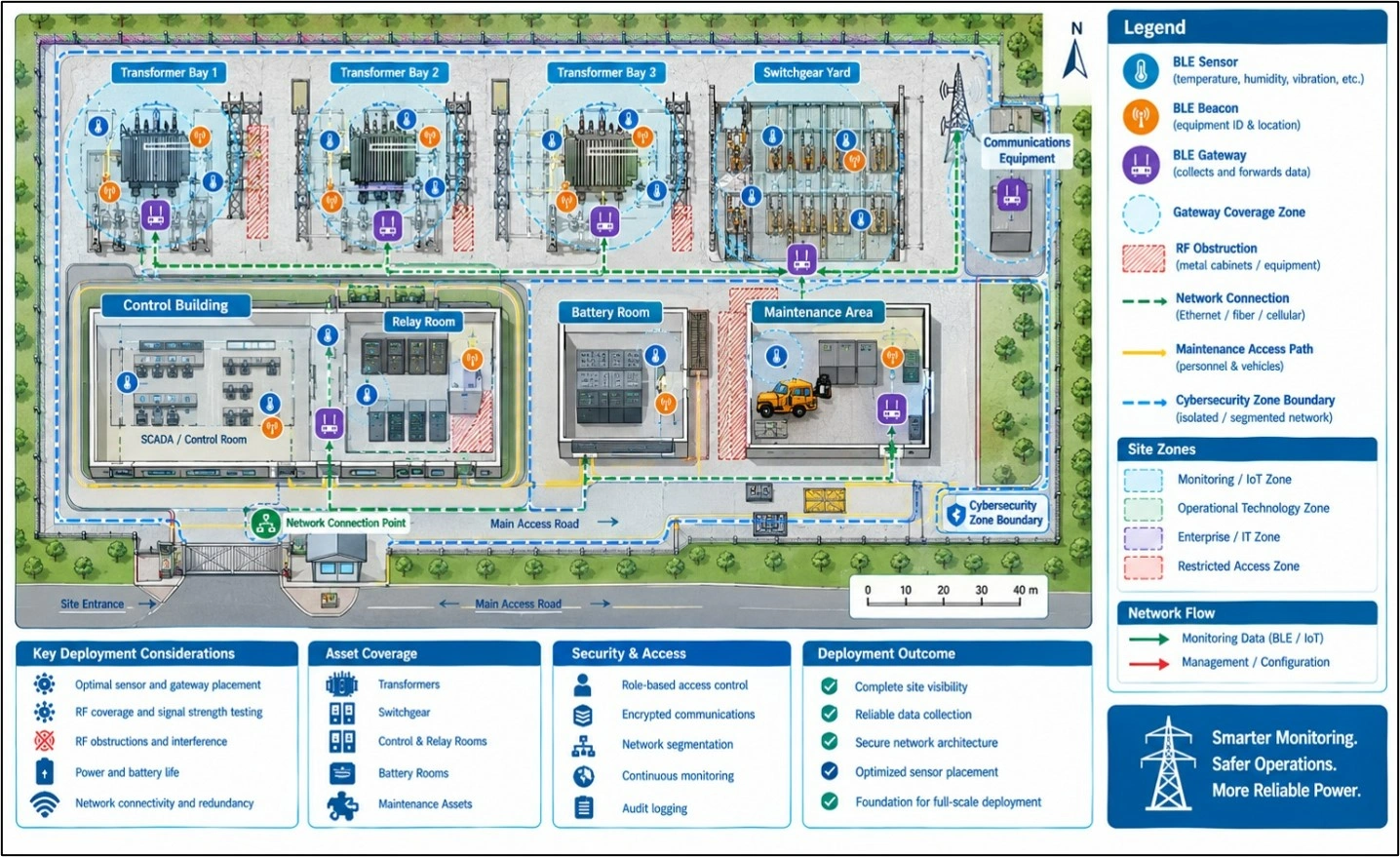
This site-plan illustration shows how engineers can position BLE sensors, beacons, and gateways across transformer bays, switchgear, control rooms, battery rooms, and maintenance areas. It highlights gateway coverage zones, RF obstructions, network connections, maintenance access paths, and cybersecurity boundaries to support reliable and secure AIoT deployment planning.
Commissioning and Integration of Utility AIoT Systems
Commissioning should verify the complete data path rather than simply confirming that individual BLE devices are powered and transmitting.
Device Commissioning
Each sensor and beacon should receive an authoritative device identity and be associated with the correct utility asset record. Installation records should include the device identifier, physical location, asset identifier, installation date and relevant configuration parameters.
Sensor readings should be validated against known reference conditions where applicable. Incorrect sensor association can be more damaging to maintenance analytics than a missing sensor because it may cause an AI system to associate abnormal measurements with the wrong asset.
Gateway and Network Commissioning
Gateway commissioning should verify BLE discovery, wireless communication, local buffering, upstream connectivity, authentication, logging and remote management.
Network testing should include normal operation and controlled failure scenarios. For example, a gateway should demonstrate what happens when the upstream network becomes unavailable. Data should either be buffered locally, transmitted through an approved alternative path or explicitly marked as unavailable according to the system design.
Enterprise Software Integration
The integration layer should map AIoT data to existing utility identifiers and workflows. A transformer temperature anomaly, for example, should be associated with the correct transformer asset rather than appearing as an isolated sensor event.
Integration may connect the AIoT solution with:
- EAM and CMMS software
- GIS asset records
- Maintenance work orders
- SCADA historians
- DMS and OMS information
- Inspection databases
- Inventory systems
- Workforce management software
- Utility dashboards
Data normalization is particularly important when different systems use different asset naming conventions, timestamps or equipment identifiers.
AI Model Development and Operational Validation
AI models for electric power networks should be developed around actual operating conditions rather than generic datasets. Utility equipment has distinct seasonal, geographical, loading and maintenance patterns.
Anomaly Detection
Anomaly detection can identify measurements that differ substantially from an established operating baseline. Suitable models may include statistical detection, clustering, isolation-based methods, time-series models or supervised machine learning where sufficient labeled historical data exists.
The model should account for legitimate operational changes. A transformer or equipment enclosure may show different temperatures during summer and winter, during different loading levels or during maintenance activities.
Predictive Maintenance
Predictive maintenance models can combine sensor data with asset age, inspection results, maintenance history, operating conditions and failure records.
Useful model outputs may include:
- Abnormal-condition probability
- Equipment health indicators
- Maintenance priority
- Remaining-useful-life estimates where sufficient data supports them
- Inspection recommendations
- Confidence levels
- Contributing sensor variables
A maintenance recommendation should be explainable enough for an engineer to understand why an asset has been flagged. AI output should support engineering judgment rather than hide the reasoning behind an unexplained score.
Model Validation
Before operational use, models should be tested against historical and controlled datasets. Validation should measure false positives, false negatives, detection latency, model stability and performance across different equipment types.
Model drift should also be monitored. Changes in equipment configuration, sensor replacement, network conditions, operating practices or seasonal patterns can change the statistical characteristics of the input data.
NIST’s AI Risk Management Framework emphasizes lifecycle-oriented AI risk management and provides a structured basis for governing, measuring and managing AI-related risks.
Testing, Optimization and Maintenance
Electric power network AIoT systems require continuing engineering attention after commissioning.
Functional Testing
Functional testing should verify the complete chain from sensor measurement through operational response.
Testing can cover:
- Sensor measurement accuracy
- BLE communication reliability
- Gateway discovery
- Data timestamp integrity
- Network failover
- Local buffering
- Data transmission
- AI anomaly detection
- Alert generation
- Asset identification
- CMMS/EAM integration
- User access controls
- Audit logging
- Recovery after gateway restart
Performance Optimization
Optimization should focus on useful information rather than maximum data volume. Increasing sensor transmission frequency can increase battery consumption, network traffic and storage requirements without necessarily improving maintenance decisions.
Sampling intervals should therefore reflect the physical behavior of the monitored equipment and the required response time.
Gateway placement can also be adjusted after deployment if field measurements show weak coverage. Sensor mounting locations may require modification when the initial location produces excessive measurement noise or does not represent the equipment condition accurately.
Preventive Maintenance
Maintenance activities should include sensor inspection, battery replacement, gateway health checks, firmware management, calibration where applicable and verification of device-to-asset mappings.
Utility teams should maintain an accurate inventory of deployed BLE devices. A sensor that remains visible in software after physical removal can generate misleading asset information and degrade AI model quality.
Scalability Across Electric Power Networks
A successful pilot should establish standards that can be reused across additional substations and field facilities.
Scalability depends on consistent device naming, asset identifiers, data models, gateway configurations, cybersecurity controls and installation procedures.
A utility expanding from one substation to many facilities should define reusable deployment standards for:
- Sensor identification
- Asset association
- Gateway configuration
- Network segmentation
- Data schemas
- AI model management
- Alert severity
- Maintenance workflows
- Device replacement
- Firmware updates
- Cybersecurity monitoring
- Data retention
Centralized device management can simplify large deployments, but geographically distributed substations may still require local processing and local data buffering.
GAO’s experience supplying BLE, RFID and IoT hardware and systems can support organizations evaluating standardized hardware configurations for distributed monitoring requirements.
Electric Power Network AIoT Deployment Lifecycle: From Planning to Network-Wide Scaling
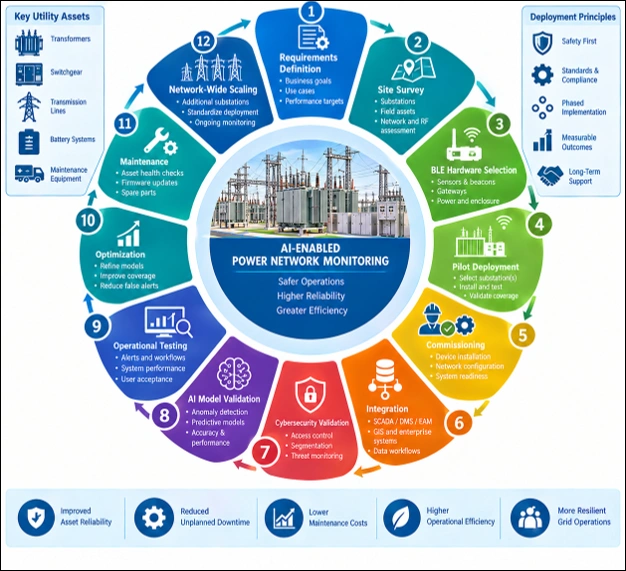
This lifecycle diagram illustrates the 12-stage engineering process for deploying AI-enabled monitoring across electric power networks, from requirements definition and site surveys to pilot deployment, validation, optimization, maintenance, and network-wide scaling. It highlights key utility assets and deployment principles that support a structured, secure, and measurable implementation approach.
Key Performance Indicators for AI-Enabled Power Network Monitoring
KPIs should measure operational improvement rather than simply counting connected devices.
Useful electric power network indicators include:
- Asset-location accuracy
- Sensor data availability
- BLE gateway uptime
- Sensor battery life
- Wireless communication success rate
- Anomaly detection precision
- False-alert rate
- Mean time to investigate an alert
- Mean time to acknowledge maintenance alerts
- Maintenance response time
- Inspection completion time
- Preventive-to-corrective maintenance ratio
- Equipment condition-monitoring coverage
- Asset inventory accuracy
- Work-order data completeness
- Gateway recovery time
- Data latency
- Data-quality exception rate
- AI model drift indicators
- Maintenance cost per monitored asset
The appropriate KPI set depends on the operational objective. A substation asset-location project should not be evaluated using the same primary metrics as a transformer condition-monitoring program.
Engineering Trade-Offs for Utility BLE Deployments
No wireless monitoring approach eliminates engineering trade-offs. BLE can be useful for localized sensing and asset identification, but it should be selected based on range, power consumption, environmental conditions, data volume and application requirements.
| Engineering Factor | Key Consideration for Electric Power Networks |
|---|---|
| Wireless range | Substation structures and metal equipment can reduce effective range |
| Battery life | Higher sampling and transmission frequency can increase energy consumption |
| Sensor placement | The measurement point must represent the physical condition being monitored |
| Gateway density | More gateways can improve coverage but increase installation and management requirements |
| Edge processing | Reduces upstream traffic and can maintain local functionality during connectivity loss |
| Cloud deployment | Supports centralized analytics across geographically distributed facilities |
| Private server deployment | Provides greater control over infrastructure and data processing boundaries |
| AI sensitivity | Higher sensitivity can detect more anomalies but may increase false alerts |
| Data volume | More data does not automatically produce better maintenance decisions |
| Integration | Asset identifiers and timestamps must remain consistent across utility systems |
| Cybersecurity | Monitoring networks must be separated and controlled according to utility security requirements |
| Maintenance | Sensors and gateways require lifecycle management just like other utility equipment |
These trade-offs should be resolved during engineering design rather than after deployment.
Practical Implementation Recommendations for Electric Power Networks
A technically sound AIoT program should begin with a limited number of high-value operational problems and expand after measurable results have been demonstrated.
Recommended practices include:
- Start with assets where additional condition information can influence a defined maintenance decision.
- Conduct an RF and physical site survey before fixing gateway locations.
- Establish authoritative asset identifiers before connecting AIoT data to utility software.
- Separate monitoring functions from protection and direct control functions.
- Use edge buffering where communications outages are possible.
- Validate sensor readings against appropriate reference measurements.
- Establish cybersecurity requirements before field installation.
- Select cloud or private server deployment according to utility governance and operational requirements.
- Use AI models that account for equipment operating context and seasonal variation.
- Require human review for maintenance recommendations where operational consequences are significant.
- Measure false positives and false negatives rather than evaluating AI solely by alert volume.
- Define firmware, battery, calibration and device-replacement procedures before scaling.
- Maintain documentation for device identity, physical location, software version and configuration.
- Test failure and recovery scenarios before production deployment.
- Review model performance periodically for drift and changing operating conditions.
GAO Support for AI and BLE Electric Power Network Solutions
GAO provides BLE, RFID and IoT hardware products and systems that can support organizations implementing connected monitoring and asset-management solutions. The company can supply BLE gateways, beacons, sensors and related technologies for evaluation against requirements such as wireless coverage, environmental conditions, asset identification and integration needs.
Headquartered in New York City and Toronto, Canada, GAO is among the top 10 leading B2B and B2G suppliers of BLE and RFID technologies globally, with additional activity across B2B2C and B2D markets. GAO and its sister companies, GAO Research and GAO Tek, operate within the same corporate group.
For more than three decades, GAO has served organizations across the United States and Canada, including Fortune 500 companies, R&D organizations, universities and government agencies. Its engineering approach combines product development, research investment, quality assurance and technical support delivered remotely or onsite.
Building More Observable Electric Power Networks
AI-enabled monitoring can give electric utilities additional visibility into equipment condition, environmental conditions, asset location and maintenance activity. BLE sensors and beacons provide localized data acquisition, while gateways connect field information to edge, private-server or cloud-based analytics. AI then helps convert those observations into anomaly detection, asset intelligence and maintenance priorities.
The strongest implementations begin with clearly defined utility problems, reliable sensor data, disciplined asset identification, appropriate cybersecurity boundaries and measurable operational outcomes. GAO can help organizations evaluate BLE and IoT hardware and systems for electric power network monitoring, asset management and related utility applications. Readers can learn more about GAO’s technology solutions, engineering capabilities and technical support when planning or expanding AIoT deployments.
Building the Future of Industrial AI and IoT with Aperture Venture Studio and GAO
For more than three decades, GAO has invested heavily in R&D for industrial BLE, RFID and IoT technologies and has expanded this work into AI-enabled industrial applications. We have founded Aperture Venture Studio to support the development and scaling of AI and IoT solutions relevant to areas such as electric power network monitoring, asset intelligence and industrial operations.
Aperture brings together AI and IoT technical specialists, operational leaders, investors and industry participants. We also organize technical events including Aperture Ventures Summit and TekSummit to discuss developments in AI and IoT.
We welcome participation as:
- Advisors, co-founders or employees
- Investors
- Customers