
AI and BLE for Industrial Mineral Mining
AI and BLE for Industrial Mineral Mining Operations
Industrial mineral mining operations depend on continuous movement of personnel, mobile equipment, extracted material, maintenance resources, and safety-critical assets across quarries, open-pit mines, processing areas, stockpiles, workshops, and remote field locations. AI-driven mining solutions can use location, condition, utilization, and operational data to improve how these resources are monitored and managed. BLE beacons, gateways, and sensors provide a practical data-acquisition layer for applications such as equipment tracking, worker-location awareness, maintenance monitoring, inventory control, and process optimization.
For industrial mineral producers, the value of AI comes from converting operational data into decisions. Machine-learning models can identify abnormal equipment behavior, predict maintenance requirements, analyze asset utilization, and detect process deviations. BLE helps supply the contextual data required by these models by identifying where tagged equipment and personnel are located and by capturing selected sensor measurements. GAO supplies BLE, RFID, and IoT hardware and systems that can support these mining use cases, with deployment choices determined by site conditions, connectivity, safety requirements, and existing mine-management systems.
Industrial Mineral Mining AI Operations Overview
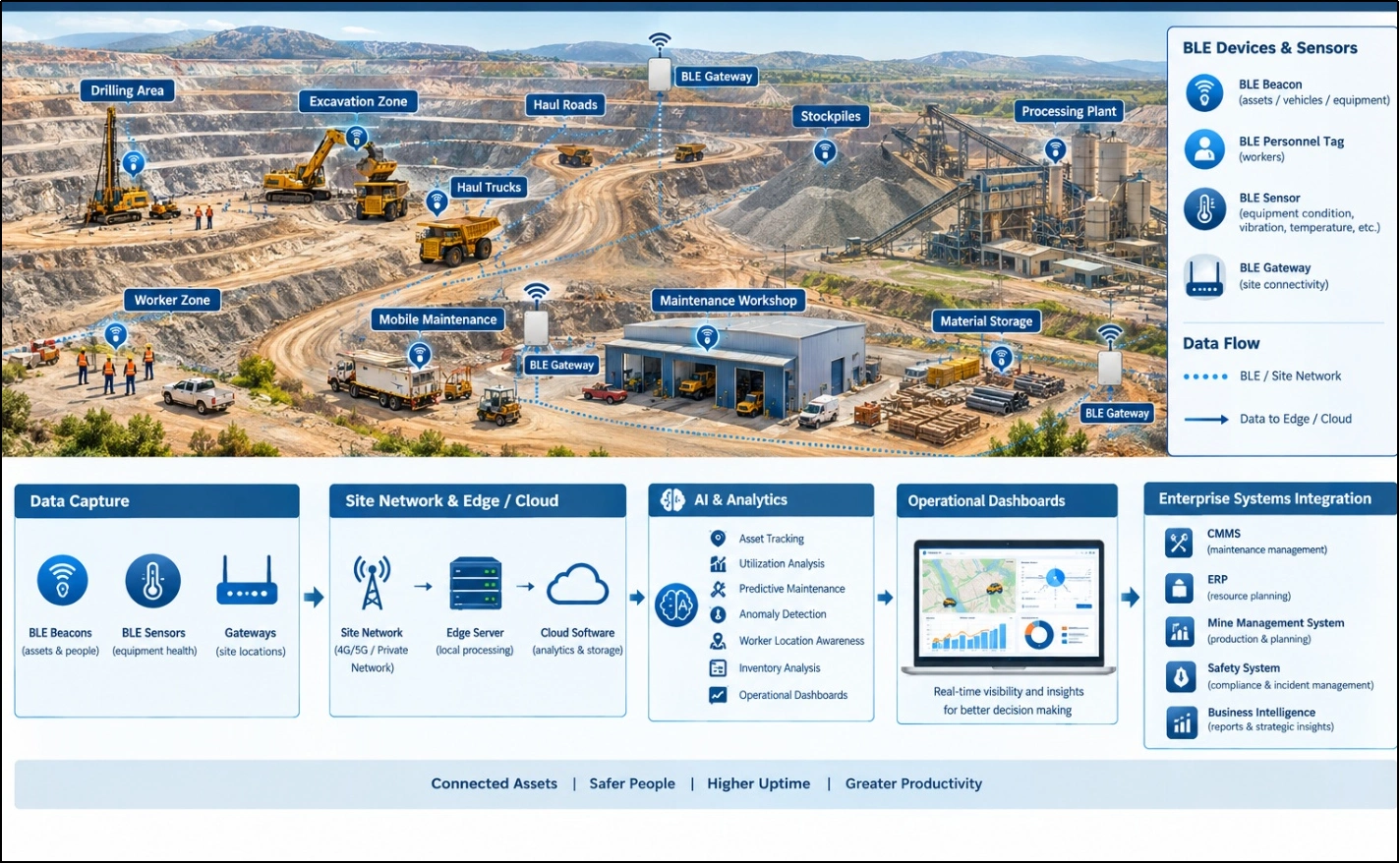
This enterprise mining operations diagram illustrates how AI, BLE-enabled asset tracking, equipment sensors, and site gateways connect physical mining activities with digital operational systems. It shows drilling, excavation, haulage, worker zones, stockpiles, processing, maintenance, and material storage, with BLE devices capturing asset, personnel, and equipment-condition data. Site networking transfers this information to edge servers or cloud software for asset tracking, utilization analysis, predictive maintenance, anomaly detection, worker-location awareness, inventory analysis, and operational dashboards. The diagram also highlights integration with CMMS, ERP, mine-management, safety, maintenance, and business-intelligence systems to support connected and data-driven mining operations.
How AI-Driven Mining Operations Use BLE Data
AI in industrial mineral mining is most useful when it addresses a defined operational decision rather than simply collecting more data. Quarry and mine operators can combine BLE location events and sensor readings with production records, maintenance history, equipment telemetry, work orders, shift information, and material-flow data.
A typical AI-driven mining system can analyze:
- Equipment location and movement between excavation, loading, hauling, processing, maintenance, and storage zones
- Utilization of loaders, haul trucks, mobile crushers, conveyors, pumps, compressors, generators, and other mobile or semi-mobile equipment
- Time spent by equipment in operating, idle, maintenance, staging, or unavailable states
- Movement of tools, spare parts, containers, samples, and other high-value operational assets
- Worker or contractor presence in designated operational areas where location monitoring is appropriate
- Temperature, vibration, occupancy, movement, or other sensor measurements available from BLE-enabled devices
- Maintenance work orders, inspection records, failure history, and equipment operating conditions
- Material-handling events associated with stockpiles, processing areas, warehouses, and dispatch operations
AI models can then identify patterns that would be difficult to recognize through manual monitoring. For example, repeated idle periods near a maintenance area may indicate an equipment reliability issue, while unusual movement or temperature patterns may warrant inspection. Historical maintenance and utilization data can also be combined to estimate when selected equipment requires preventive intervention.
BLE does not replace specialized mine telemetry, industrial control systems, or machine interfaces. Its role is complementary. BLE can provide relatively low-power identification, proximity, location, and sensor data for assets and personnel, while existing industrial systems continue to provide production, process, machine-control, and maintenance information.
Industrial Mineral Mining Applications for AI
Industrial mineral operations differ from many other resource-extraction environments because production may involve quarrying, crushing, screening, washing, drying, milling, blending, stockpiling, and dispatch. AI applications therefore need to account for both extraction activities and downstream mineral-processing workflows.
Mobile Equipment Tracking and Utilization
Mobile equipment frequently moves between extraction zones, loading areas, haul routes, workshops, fuel areas, and processing facilities. BLE tags can identify selected equipment while gateways installed at strategic locations collect proximity or location events.
AI software can use this information with equipment records to calculate utilization patterns, detect excessive idle time, identify recurring congestion around service areas, and support maintenance planning. Location history can also help maintenance teams determine where equipment was last observed before a service request.
Relevant equipment may include:
- Wheel loaders
- Haul trucks
- Excavators
- Drilling equipment
- Mobile crushers
- Water trucks
- Service vehicles
- Portable generators
- Compressors
- Pumps
- Maintenance carts
GAO BLE hardware can be incorporated into tracking systems where BLE-based identification and location data are suitable for the site’s coverage and accuracy requirements.
Predictive Maintenance for Mining Equipment
Predictive maintenance requires more than a list of equipment locations. Models need historical operating information, maintenance records, inspection results, and condition indicators.
BLE sensors can contribute selected measurements such as temperature, vibration, movement, or other supported parameters. These readings can be associated with individual assets through unique device identifiers.
An AI maintenance workflow can combine:
- BLE sensor observations
- Equipment identity
- Location and zone
- Operating duration
- Maintenance history
- Inspection records
- Failure events
- Work-order history
- Environmental observations
Machine-learning models can establish normal operating patterns and identify deviations that justify inspection. A detected anomaly should normally generate an operational review rather than an automatic assumption of equipment failure. Mining maintenance personnel can validate the condition and determine whether inspection, lubrication, adjustment, component replacement, or continued monitoring is appropriate.
Worker and Contractor Location Awareness
Mining sites contain restricted areas, heavy-equipment routes, workshops, processing zones, and other locations with different access requirements. BLE-enabled identification devices can provide location or proximity information where site conditions support the required accuracy.
A location-awareness system can help operations teams determine whether tagged personnel or contractors are present within defined zones. The information can support site accountability, operational coordination, and selected safety procedures.
Engineering design should account for radio propagation around steel structures, machinery, vehicles, rock faces, buildings, and other obstructions. Gateway placement and radio surveys are therefore important before deployment. BLE location information should also be treated according to its actual accuracy rather than represented as survey-grade positioning when the installed system cannot provide that precision.
Mining Inventory and Tool Tracking
Industrial mineral operations maintain inventories of maintenance tools, spare parts, mobile instruments, containers, samples, and other operational resources. Misplaced tools and delayed availability can increase maintenance time and complicate field work.
BLE tags can associate physical assets with unique digital identities. Gateway observations can establish where an asset was last detected or which operational zone it entered.
AI analytics can use historical movement and usage patterns to identify:
- Frequently moved maintenance assets
- Repeatedly misplaced equipment
- Underutilized resources
- High-demand spare-part categories
- Unusual movement patterns
- Assets requiring periodic inspection or maintenance
These insights can complement inventory records maintained in ERP, warehouse-management, or maintenance software.
AI Mining Asset Tracking and Predictive Maintenance Workflow
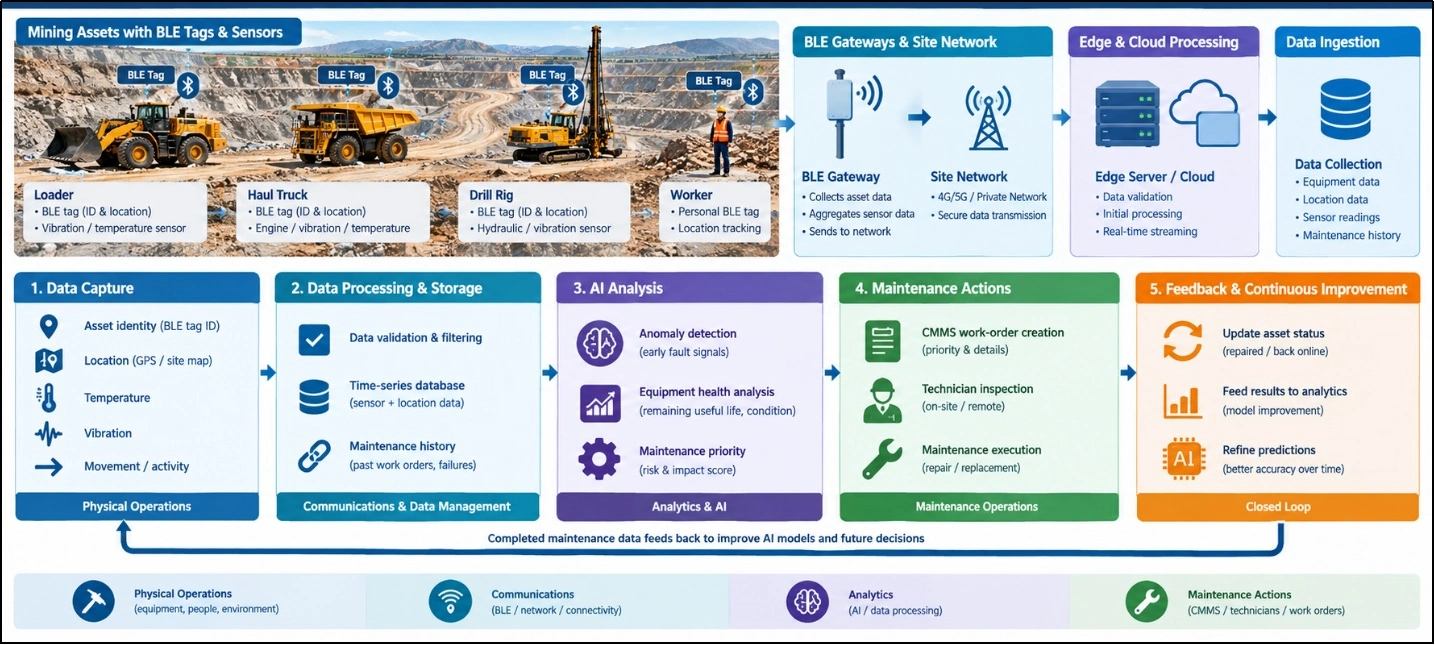
This industrial workflow diagram shows how BLE-enabled mining equipment and sensors support real-time asset tracking and predictive maintenance. It illustrates loaders, haul trucks, drill rigs, and personnel devices transmitting identity, location, temperature, vibration, and movement data through BLE gateways and site networks. Data is processed at the edge or cloud, validated, stored in time-series databases, and combined with maintenance history. AI models perform anomaly detection, equipment-health analysis, and maintenance prioritization. The workflow then connects insights to CMMS work-order creation, technician inspection, and maintenance execution. Completed maintenance results feed back into analytics to continuously improve equipment-health monitoring and future maintenance decisions.
AI-Enabled Material Handling and Mineral Processing Visibility
Material handling in industrial mineral mining extends from extraction through crushing, screening, processing, stockpiling, and dispatch. BLE is generally most useful for tracking supporting assets and operational resources rather than replacing process instrumentation used directly for mineral-quality or production-control measurements.
AI can correlate asset movements with production schedules, maintenance activities, stockpile operations, and processing events. For example, equipment-location information can help identify repeated delays between loading and processing zones. When combined with production records, these observations can support analysis of equipment utilization and material-flow bottlenecks.
BLE-enabled tracking can also help locate:
- Mobile sampling equipment
- Maintenance tools
- Portable instruments
- Material containers
- Spare-part transport equipment
- Selected processing-support assets
- Vehicles moving between designated operational zones
Where mineral processing requires precise measurement of flow rate, particle size, moisture, pressure, temperature, chemical composition, or other process variables, those measurements should generally continue to come from appropriate industrial instrumentation. AI can then combine these process measurements with location and operational context supplied by BLE systems.
Operational Challenges in Industrial Mineral Mining
BLE and AI deployments must be designed around actual mining conditions. A solution that performs adequately in an office, warehouse, or controlled factory environment may require substantial engineering changes when exposed to open-pit terrain, heavy machinery, dust, vibration, metal structures, weather, and intermittent network connectivity.
Important design considerations include:
- Radio propagation: Rock faces, steel equipment, buildings, conveyors, and vehicles can affect BLE signal behavior and gateway coverage.
- Site scale: Large quarries and mining areas may require carefully planned gateway placement and multiple communication zones.
- Power availability: Remote gateways may require industrial power, battery operation, solar-assisted power, or other suitable field arrangements.
- Environmental exposure: Hardware selection should account for dust, moisture, temperature variation, vibration, impact, and enclosure requirements.
- Network availability: Remote mining areas may have limited wired or wireless connectivity, making edge processing and store-and-forward mechanisms useful.
- Location accuracy: Required accuracy should be established from the business use case before selecting a BLE positioning method.
- Asset density: Large numbers of tags can create device-management and data-volume requirements that must be considered during system design.
- Maintenance access: Gateways and sensors installed in remote or elevated areas need practical inspection, battery replacement, and service procedures.
- Integration: Location and sensor events should be mapped to asset IDs used by CMMS, ERP, maintenance, inventory, safety, and business-intelligence systems.
- Cybersecurity: BLE devices, gateways, edge servers, application interfaces, credentials, and network connections require appropriate security controls.
Industrial Mineral Mining BLE Deployment Site Survey
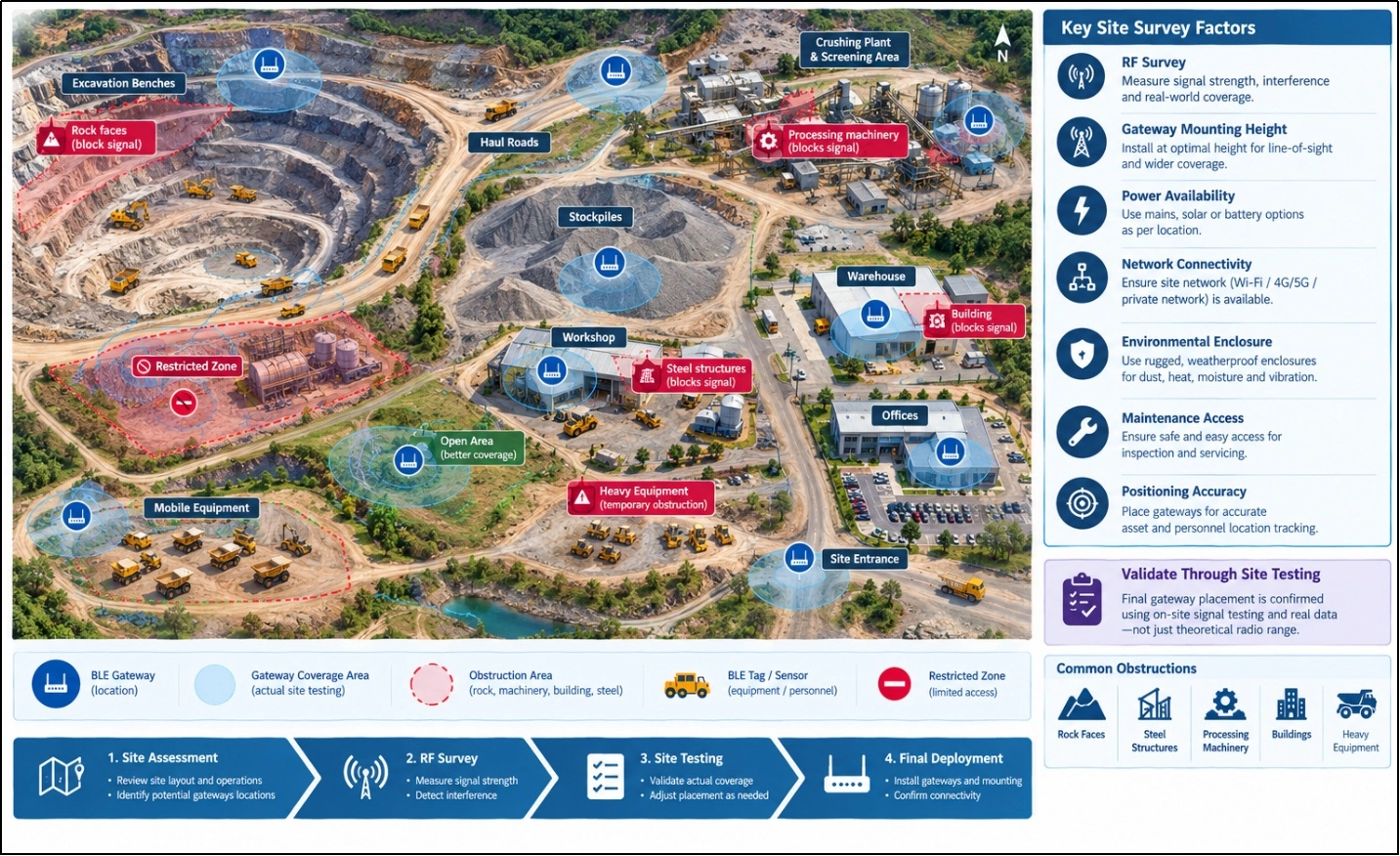
This engineering site-survey diagram illustrates the physical and technical factors that influence BLE gateway deployment across an industrial mineral mining site. It shows excavation benches, haul roads, crushing and screening areas, stockpiles, workshops, warehouses, offices, restricted zones, mobile equipment, and BLE gateway locations. Coverage areas and potential obstructions from rock faces, steel structures, processing machinery, buildings, and heavy equipment are highlighted. Key survey considerations include RF signal testing, gateway mounting height, power availability, network connectivity, environmental protection, maintenance access, and positioning accuracy. The workflow emphasizes validating gateway placement through on-site testing and measured signal performance rather than relying on theoretical radio-range assumptions.
AI, BLE Sensors, Gateways, and Mining Data Infrastructure
A practical industrial mineral mining solution typically separates field data acquisition from analytics and business applications. BLE beacons provide asset or personnel identification, while BLE sensors can provide selected condition or environmental measurements. BLE gateways receive these signals and forward relevant events through the site’s communication infrastructure.
Data can then pass through middleware responsible for device identification, event normalization, timestamping, validation, duplicate handling, and association with enterprise asset records. Edge computing can perform selected processing close to the mine when connectivity to a remote environment is intermittent or when operational decisions require low latency.
Cloud-hosted software can provide centralized storage, analytics, dashboards, device management, and cross-site reporting when connectivity, cybersecurity requirements, and organizational policies permit. A privately hosted server deployment can instead place the software on customer-managed servers, private data centers, edge servers, or other controlled infrastructure.
The appropriate deployment model depends on the mine’s connectivity, data-governance requirements, operational resilience objectives, integration constraints, and IT support model.
GAO provides BLE and RFID hardware and related IoT systems that can serve as components of these mining deployments. The engineering objective is not simply to install tags and gateways, but to establish reliable data relationships between physical mining assets and the software records used by maintenance, operations, inventory, safety, and management teams.
Cloud and Server Deployment Options for Mining Operations
Industrial mineral mining sites can use either cloud-hosted software or privately hosted server software depending on connectivity, data-management policies, integration requirements, and operational resilience objectives. Both approaches can support AI analytics, asset tracking, sensor monitoring, and mining operations when the underlying data acquisition and integration design is appropriate. The deployment choice should be made after evaluating the site’s network availability, IT resources, cybersecurity requirements, and required response times.
Cloud Version
A cloud-hosted deployment can centralize data from multiple quarries, processing plants, workshops, warehouses, and other operating locations. BLE gateways transmit validated events through available site connectivity to cloud software where data can be stored and analyzed.
Cloud deployment can be appropriate when mining organizations need:
- Centralized monitoring across geographically distributed mining and quarry operations
- Consolidated asset and equipment information
- Remote access for authorized operations, maintenance, and management personnel
- Centralized AI model management and analytics
- Cross-site comparison of equipment utilization and maintenance patterns
- Reduced requirement for maintaining application servers at every site
- Integration with cloud-based ERP, CMMS, BI, or data-management services
Connectivity remains a key engineering dependency. Remote extraction areas may experience intermittent communications, so gateways or edge servers can buffer events locally and forward them when connectivity is restored.
Server Version
A privately hosted server deployment places application software and databases on customer-managed infrastructure. The server can operate at a mine site, processing facility, private data center, edge location, or other controlled enterprise environment.
This approach can be appropriate when operations require:
- Greater control over application and data hosting
- Integration with privately hosted mining, maintenance, or ERP systems
- Local processing where external connectivity is limited
- Site-level operational continuity
- Customer-controlled network segmentation
- Internal data-retention and access policies
- Integration with existing industrial IT infrastructure
A hybrid arrangement can also be used. Edge servers can handle local data collection, buffering, and selected analytics while centralized cloud or private servers handle long-term storage, fleet-wide analytics, and management reporting.
The decision should be based on operational requirements rather than treating either deployment model as universally appropriate.
Mining Integration, AI Analytics, and Operational Decision-Making
AI applications become more useful when BLE-derived observations are connected to the systems that already manage mining operations. A BLE event identifying a haul truck, for example, has limited operational value by itself. Associating that event with the truck’s maintenance record, operating state, work order, assigned zone, and production schedule creates substantially more useful context.
Typical integration points include:
| Mining system | Relevant data relationship | Potential AI use |
|---|---|---|
| CMMS | Equipment identity, work orders, inspections, failures | Predictive maintenance and maintenance prioritization |
| ERP | Asset, purchasing, inventory, and cost records | Spare-parts and asset-cost analysis |
| Inventory or warehouse software | Tool and spare-part identity and movement | Inventory visibility and resource utilization |
| Mine-management software | Production, equipment, and operational records | Equipment utilization and workflow analysis |
| Safety software | Authorized personnel and incident records | Location-aware operational analysis |
| Business intelligence software | Historical operational and KPI data | Cross-site reporting and trend analysis |
| Industrial data systems | Process and machine measurements | Combined process and asset analysis |
Middleware should normalize incoming BLE events before they are passed into downstream applications. Device identifiers, asset IDs, timestamps, gateway IDs, zone identifiers, and sensor values should use consistent data structures.
AI processing can include anomaly detection, classification, forecasting, clustering, time-series analysis, and predictive models. Model selection depends on the available data and the operational decision being supported. A simple rules-based threshold can be more appropriate than machine learning when a process has a known engineering limit.
AI Capabilities That Improve Mining Operations
Combining AI analytics with location and sensor information can improve visibility across selected industrial mineral mining processes. The actual result depends on data quality, site coverage, equipment characteristics, model design, and how operational teams act on generated insights.
Anomaly Detection
AI models can establish normal patterns for selected assets and identify deviations in temperature, vibration, movement, utilization, or location behavior. An anomaly can trigger inspection or further analysis.
For mining equipment, this can help identify unusual behavior before a failure becomes an extended maintenance event. The model should provide sufficient context for technicians to validate the finding rather than treating every statistical deviation as a confirmed fault.
Predictive Maintenance
Predictive maintenance models can combine equipment history, sensor readings, operating duration, maintenance events, and environmental context. The output can support maintenance scheduling and inspection prioritization.
The most useful implementation connects AI predictions to existing maintenance workflows. A prediction that cannot be translated into a work order, inspection, or operational action has limited practical value.
Equipment Utilization Analysis
AI can analyze historical location and operational events to identify patterns such as excessive idle time, repeated staging, long periods near maintenance facilities, or unusual movement between operational zones.
Mining managers can use these insights alongside production records to investigate equipment availability and utilization.
Demand and Resource Forecasting
Historical equipment use, maintenance requirements, and inventory consumption can support forecasting of selected spare parts, tools, and maintenance resources. AI models can identify recurring demand patterns and help maintenance planners prepare resources before scheduled interventions.
Operational Pattern Analysis
Clustering and time-series techniques can identify recurring patterns across shifts, equipment classes, operating zones, and production periods. Such analysis can help teams investigate differences in equipment utilization, maintenance frequency, or asset movement.
Security and Reliability for BLE Mining Systems
Mining deployments should apply cybersecurity controls across the entire data path, not only at the BLE device. Relevant components include sensors, beacons, gateways, site networks, edge servers, application servers, databases, APIs, and user interfaces.
Important controls can include:
- Device identity and controlled provisioning
- Strong authentication for administrative access
- Role-based access control for operations, maintenance, IT, and management users
- Secure communication between gateways, servers, and applications
- Network segmentation between operational technology and enterprise IT where appropriate
- Credential rotation and controlled device lifecycle management
- Software and firmware update procedures
- Logging and monitoring of system events
- Backup and recovery procedures
- Data-retention policies appropriate to the application
- Physical protection of gateways and field equipment
- Fail-safe procedures for loss of network connectivity
BLE location information should not automatically be treated as a safety-critical source unless the complete system has been engineered, tested, validated, and approved for that safety function. Critical mine safety systems should continue to use appropriate dedicated controls where required.
Reliability also depends on environmental design. Gateway mounting, antenna placement, enclosure selection, power resilience, network redundancy, and maintenance access should be evaluated during commissioning.
Key KPIs for AI-Enabled Industrial Mineral Mining
Operational teams can use measurable KPIs to determine whether an AI and BLE deployment is producing useful information.
Relevant indicators include:
- Equipment utilization rate
- Equipment idle time
- Equipment availability
- Mean time between failures
- Mean time to repair
- Preventive-maintenance compliance
- Unplanned downtime
- Maintenance response time
- Asset location-data availability
- BLE gateway availability
- Sensor data completeness
- Data transmission success rate
- Asset identification accuracy
- Time spent locating tools or equipment
- Spare-parts availability
- Inventory discrepancy rate
- Maintenance backlog
- Production equipment cycle time
- Haul or material movement time
- Processing equipment availability
- Safety-zone occupancy events
- Unauthorized-zone events where applicable
- AI anomaly detection rate
- False-positive rate for alerts
- Maintenance prediction lead time
- Network availability
- System recovery time
These KPIs should be defined against a baseline established before deployment. Otherwise, an organization may measure increased data collection rather than a genuine operational improvement.
Practical Deployment Lifecycle for Industrial Mineral Mining
A successful deployment should move through planning, site assessment, hardware selection, installation, commissioning, integration, testing, operational rollout, and continuous optimization. Mining environments require particular attention to radio coverage, equipment movement, environmental conditions, network availability, and maintenance access.
Requirements and Operational Mapping
The first phase identifies the mining processes and decisions that require better visibility. Teams should define which assets need tracking, which equipment requires sensor monitoring, which zones require location awareness, and which operational systems need the resulting data.
RF Survey and Hardware Selection
A site survey should examine quarry geometry, rock faces, processing structures, equipment density, gateway mounting locations, power availability, network connectivity, and environmental conditions.
BLE beacon, sensor, gateway, antenna, enclosure, and power selections should follow the required use case rather than theoretical specifications alone.
Installation and Commissioning
Gateways should be installed at validated locations and configured with appropriate network and device-management settings. Tags and sensors should be associated with correct mining asset records.
Commissioning should verify device identity, signal reception, event generation, timestamps, gateway communication, sensor readings, and data transmission.
Integration and AI Configuration
Validated BLE data can then be connected to CMMS, ERP, inventory, mine-management, safety, and BI systems. AI models should be configured using representative operational data and appropriate historical records.
Testing and Operational Validation
Testing should cover normal equipment movement, gateway outages, intermittent connectivity, sensor failures, battery conditions, duplicate events, incorrect asset associations, and network interruptions.
Mining personnel should validate whether the generated information is operationally meaningful.
Optimization and Scale-Up
After initial deployment, gateway placement, sensor intervals, alert thresholds, data-processing rules, and AI models can be refined based on measured results. Successful configurations can then be extended to additional quarry zones, equipment groups, processing facilities, or mining locations.
AI and BLE Industrial Mineral Mining Deployment Lifecycle
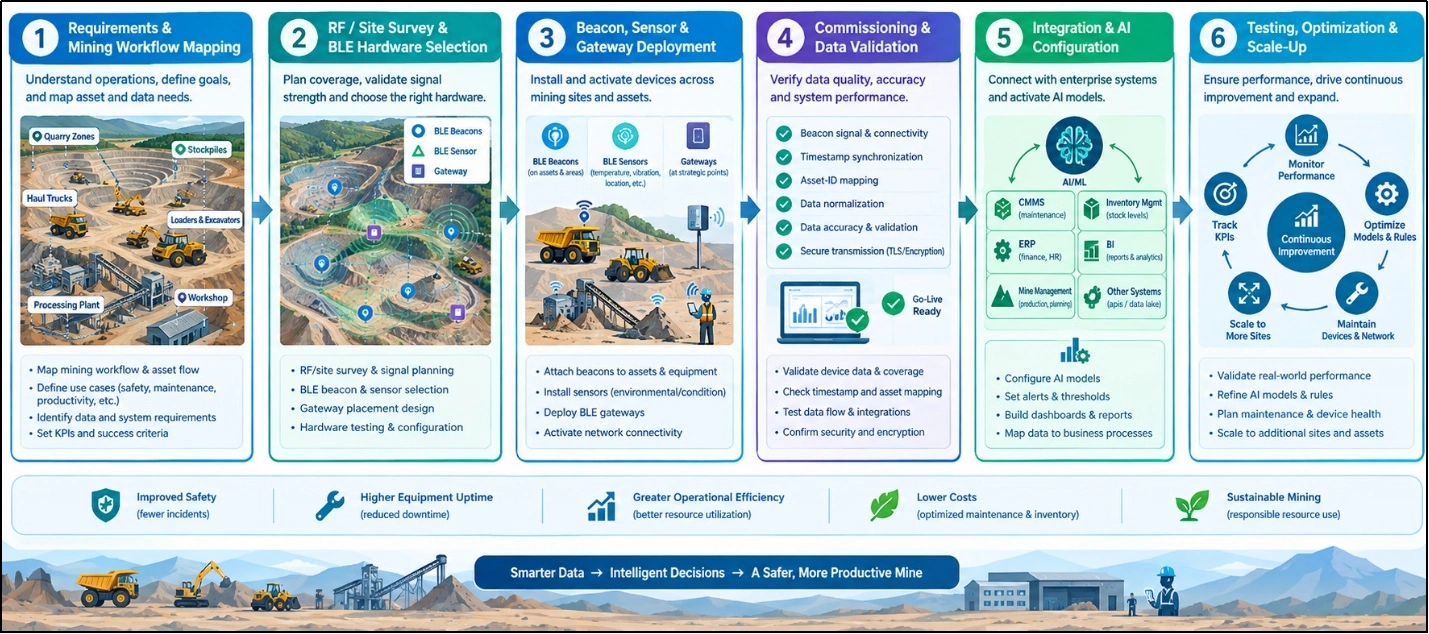
This six-stage lifecycle diagram presents a structured approach to deploying AI and BLE technologies across industrial mineral mining operations. It begins with requirements gathering and mining workflow mapping, followed by RF/site surveys and BLE hardware selection. The lifecycle then covers beacon, sensor, and gateway deployment, commissioning and data validation, and integration with CMMS, ERP, mine-management, inventory, and BI systems alongside AI configuration. The final stage focuses on testing, KPI monitoring, optimization, device maintenance, and scaling to additional sites and assets. Mining-specific visuals, including haul trucks, loaders, processing equipment, workshops, stockpiles, quarry zones, and maintenance teams, provide operational context.
Engineering Recommendations for AI and BLE Mining Deployments
Industrial mineral mining organizations should treat AI and BLE implementation as an operational engineering project rather than only a software installation.
Key recommendations include:
- Start with a measurable mining problem such as equipment utilization, maintenance visibility, tool tracking, or selected location-awareness requirements.
- Establish asset IDs and data ownership before installing large numbers of tags.
- Conduct an RF survey before finalizing gateway locations.
- Validate BLE performance around rock faces, processing equipment, metal structures, and moving machinery.
- Use edge buffering where remote areas have unreliable connectivity.
- Integrate BLE observations with existing maintenance and operational records.
- Establish data-quality checks before feeding events into AI models.
- Use appropriate engineering thresholds alongside machine-learning methods.
- Validate AI-generated anomalies with maintenance or operations personnel.
- Define cybersecurity controls during system design rather than after commissioning.
- Measure system performance against a documented baseline.
- Design battery replacement, gateway inspection, firmware updates, and device lifecycle procedures before deployment.
- Scale from a controlled operational area after the initial use case has been validated.
GAO has supplied BLE, RFID, and IoT hardware products and systems for organizations that require connected asset and operational data. For industrial mineral mining, the appropriate combination of beacons, sensors, gateways, software, and integration methods depends on site conditions and the specific operational problem being addressed.
Key Takeaways for Industrial Mineral Mining
AI can help industrial mineral mining organizations convert equipment, maintenance, location, sensor, and operational data into actionable analysis. BLE beacons, BLE sensors, and gateways can provide useful identification, proximity, location, and condition data for selected mining assets and resources.
The strongest deployments connect this information to existing CMMS, ERP, inventory, mine-management, safety, and business-intelligence systems. Site surveys, gateway placement, network resilience, environmental protection, cybersecurity, data quality, and AI validation are essential engineering considerations.
GAO’s experience supplying BLE, RFID, and IoT hardware and systems can support organizations evaluating these technologies for quarrying, extraction, processing, maintenance, and material-handling applications. Readers evaluating an implementation should define the operational objective first, establish measurable KPIs, validate the physical deployment, and then expand the system based on demonstrated requirements.
Building the Future of Industrial AI and IoT with Aperture Venture Studio and GAO RFID Inc.
For more than three decades, GAO has invested heavily in R&D for industrial BLE, RFID, and IoT technologies. As AI became increasingly applicable to industrial operations, we expanded our work across AI and IoT solutions and established Aperture Venture Studio to support the development of technologies addressing practical industrial challenges, including connected mining operations.
Aperture brings together AI and IoT technical expertise, entrepreneurial and operational experience, investors, and industry participants. GAO also supports technical communities through initiatives such as Aperture Ventures Summit and TekSummit, where advanced AI and IoT topics are discussed.