
AI and RFID for Courier Services
How AI-Powered RFID Is Transforming Modern Courier Services
Courier services increasingly depend on real-time parcel visibility, rapid sortation, accurate last-mile delivery, and operational efficiency across distribution hubs, cross-dock facilities, urban fulfillment centers, delivery stations, and transportation networks. AI-powered courier management solutions use RFID technologies to improve parcel tracking, optimize delivery operations, reduce exceptions, and enhance customer service.
Courier organizations manage millions of package movements daily. RFID-enabled parcel identification generates continuous operational data that AI systems analyze to improve route planning, predict delivery delays, optimize workforce allocation, detect shipment anomalies, and increase delivery success rates. As customer expectations for same-day, next-day, and time-definite delivery continue to rise, AI-supported RFID solutions are becoming critical tools for maintaining operational performance and service quality.
GAO has supported transportation and logistics organizations by supplying RFID readers, tags, antennas, and IoT hardware that enable improved visibility and operational intelligence throughout package delivery operations.
AI-Powered RFID Courier Operations Workflow: End-to-End Parcel Tracking, Delivery Intelligence, and Logistics Optimization
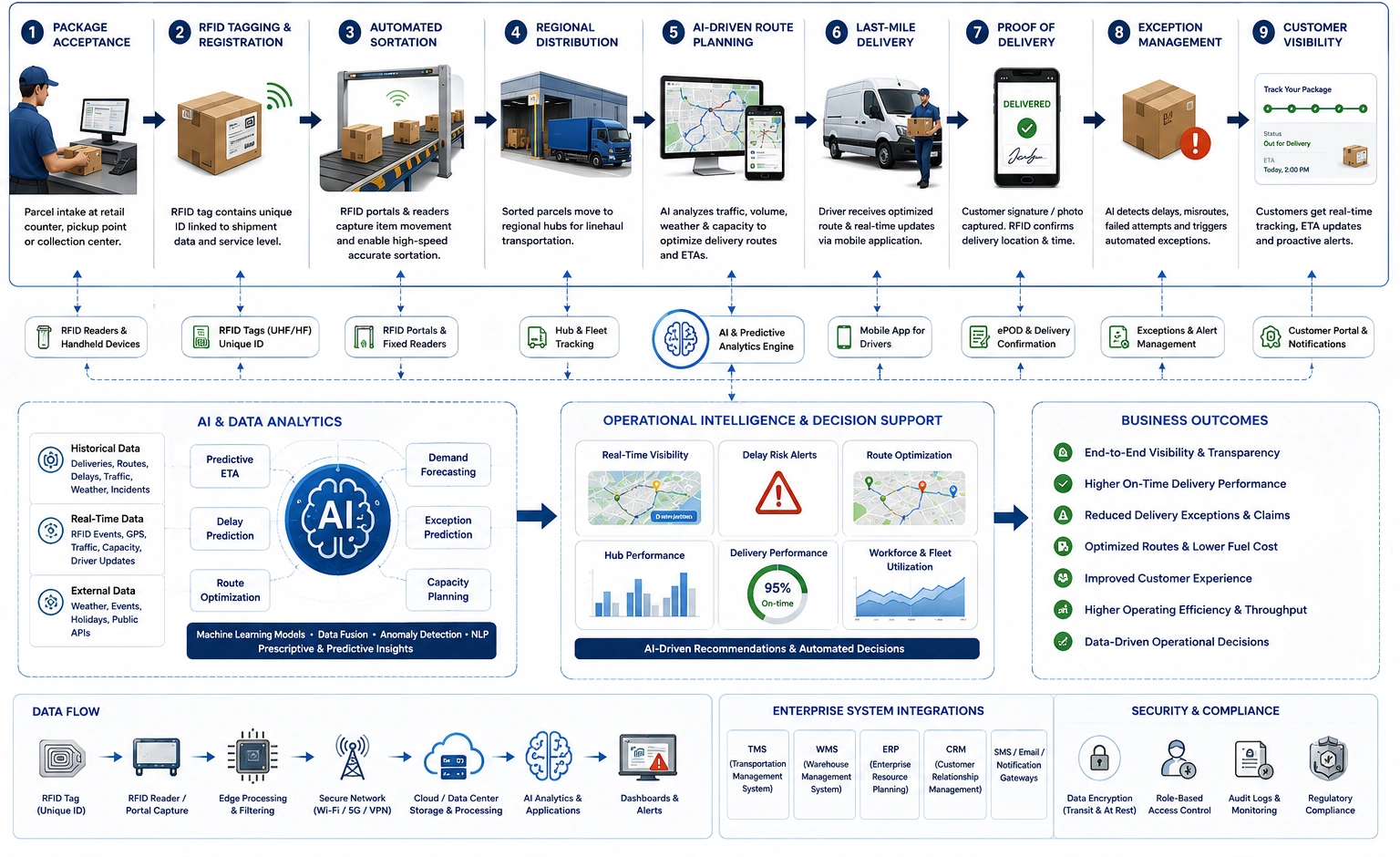
This infographic illustrates how RFID technology and AI analytics work together throughout the courier delivery lifecycle, from package acceptance and RFID registration to automated sortation, regional distribution, route optimization, last-mile delivery, proof of delivery, exception management, and customer visibility. The visual demonstrates how operational data flows through AI-powered analytics engines to generate predictive insights, delivery forecasts, automated alerts, and performance recommendations. The key takeaway is that AI-enabled RFID solutions provide real-time parcel visibility, improve delivery efficiency, reduce exceptions, and support data-driven courier operations.
Understanding AI-Driven RFID Solutions for Courier Operations
Courier companies operate highly dynamic delivery networks where shipment visibility, delivery accuracy, route efficiency, and parcel accountability directly affect customer satisfaction and profitability.
RFID technologies provide automated identification capabilities throughout courier workflows.
Common implementations include:
- UHF RFID for parcel and container tracking
- HF RFID for controlled operational environments
- LF RFID for specialized asset identification applications
AI enhances courier operations by transforming RFID-generated event data into actionable intelligence.
Rather than simply identifying parcel locations, AI systems help determine:
- Which deliveries are at risk of delay
- Which routes require optimization
- Which distribution centers face congestion
- Which delivery zones require additional resources
- Which parcels require exception handling
- Which operational processes generate recurring bottlenecks
The combination of RFID visibility and AI decision support allows courier organizations to improve operational responsiveness while reducing manual intervention.
Key Courier Service Applications Enabled by AI and RFID
Parcel Tracking and Shipment Visibility
Real-time parcel visibility remains one of the most important requirements within courier operations.
AI analyzes RFID-generated tracking events to:
- Predict estimated delivery times
- Detect misplaced parcels
- Identify delivery risks
- Improve customer notifications
- Support chain-of-custody verification
Benefits include:
- Reduced lost package incidents
- Improved delivery transparency
- Faster customer issue resolution
- Better service-level compliance
Automated Sortation Optimization
Large courier hubs process thousands of packages per hour.
AI-supported RFID systems help:
- Identify sortation bottlenecks
- Optimize conveyor utilization
- Balance processing workloads
- Improve package flow management
- Reduce manual handling requirements
Last-Mile Delivery Intelligence
Last-mile delivery represents one of the most expensive components of courier operations.
AI uses RFID and operational data to:
- Optimize delivery sequencing
- Predict delivery windows
- Improve driver productivity
- Reduce failed delivery attempts
- Support dynamic route adjustments
Delivery Fleet and Asset Tracking
Courier organizations manage extensive fleets of vehicles and operational assets.
AI-assisted RFID systems support:
- Vehicle utilization monitoring
- Delivery equipment tracking
- Container management
- Asset recovery
- Resource allocation optimization
Exception Management and Claims Reduction
Operational exceptions can significantly impact delivery performance.
AI identifies:
- Missing parcels
- Misrouted shipments
- Unauthorized package movements
- Delivery disruptions
- High-risk service areas
This enables earlier intervention and more efficient problem resolution.
AI-Powered RFID Courier Workflow Diagram: End-to-End Parcel Tracking, Route Optimization, and Delivery Intelligence
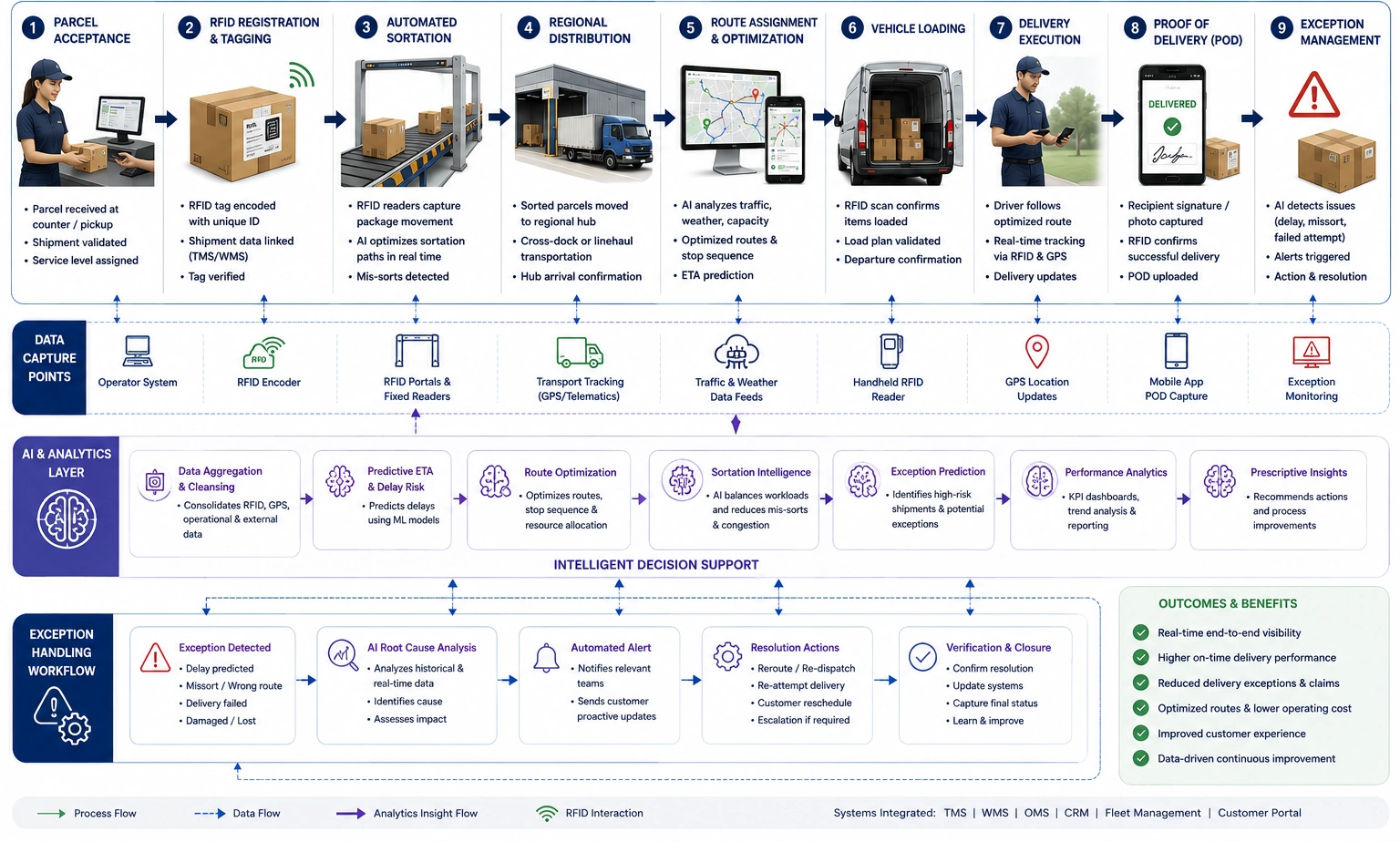
This workflow diagram illustrates the complete parcel journey through a modern courier network, from parcel acceptance and RFID registration to automated sortation, regional distribution, route optimization, vehicle loading, delivery execution, proof of delivery, and exception management. AI analytics are overlaid throughout the process to provide predictive ETAs, route optimization, delay risk detection, performance monitoring, and automated decision support. The key takeaway is that combining RFID visibility with AI-driven intelligence enables faster deliveries, improved operational efficiency, proactive exception handling, and enhanced customer satisfaction.
Operational Workflow of AI-Enabled Courier Intelligence
Package Identification and Data Capture
Courier workflows begin when parcels enter a collection point, retail counter, pickup location, fulfillment center, or distribution facility.
RFID tags are associated with:
- Tracking numbers
- Shipment records
- Delivery instructions
- Service levels
- Customer information
- Handling requirements
RFID readers capture package movement events across:
- Intake stations
- Sortation lines
- Distribution hubs
- Cross-dock facilities
- Delivery depots
- Vehicle loading areas
Communication Infrastructure
Captured RFID events are transmitted through:
- Ethernet networks
- Industrial Wi-Fi
- Cellular connectivity
- Private wireless networks
- Secure VPN environments
These communications systems enable real-time operational visibility across geographically distributed courier networks.
Edge Processing and Local Intelligence
Edge computing systems located within courier facilities perform:
- Event filtering
- Duplicate read elimination
- Operational alert generation
- Device monitoring
- Local exception processing
This reduces latency and improves responsiveness for time-sensitive operational decisions.
Enterprise Software Integration
Courier operations frequently integrate RFID and AI data with:
- Transportation Management Systems (TMS)
- Warehouse Management Systems (WMS)
- Parcel Management Systems
- Fleet Management Software
- Customer Service Systems
- Delivery Mobile Applications
- Enterprise Resource Planning (ERP) software
Effective integration ensures operational consistency and accurate decision-making.
AI Analytics and Operational Decision Support
Machine learning models evaluate courier operational data for:
- Delivery delay prediction
- Route optimization
- Capacity planning
- Workforce allocation
- Delivery success forecasting
- Service-level monitoring
Operational recommendations are delivered through dashboards, alerts, reports, and automated workflows.
National Courier Service Deployment Diagram: RFID, AI Analytics & Smart Delivery Network
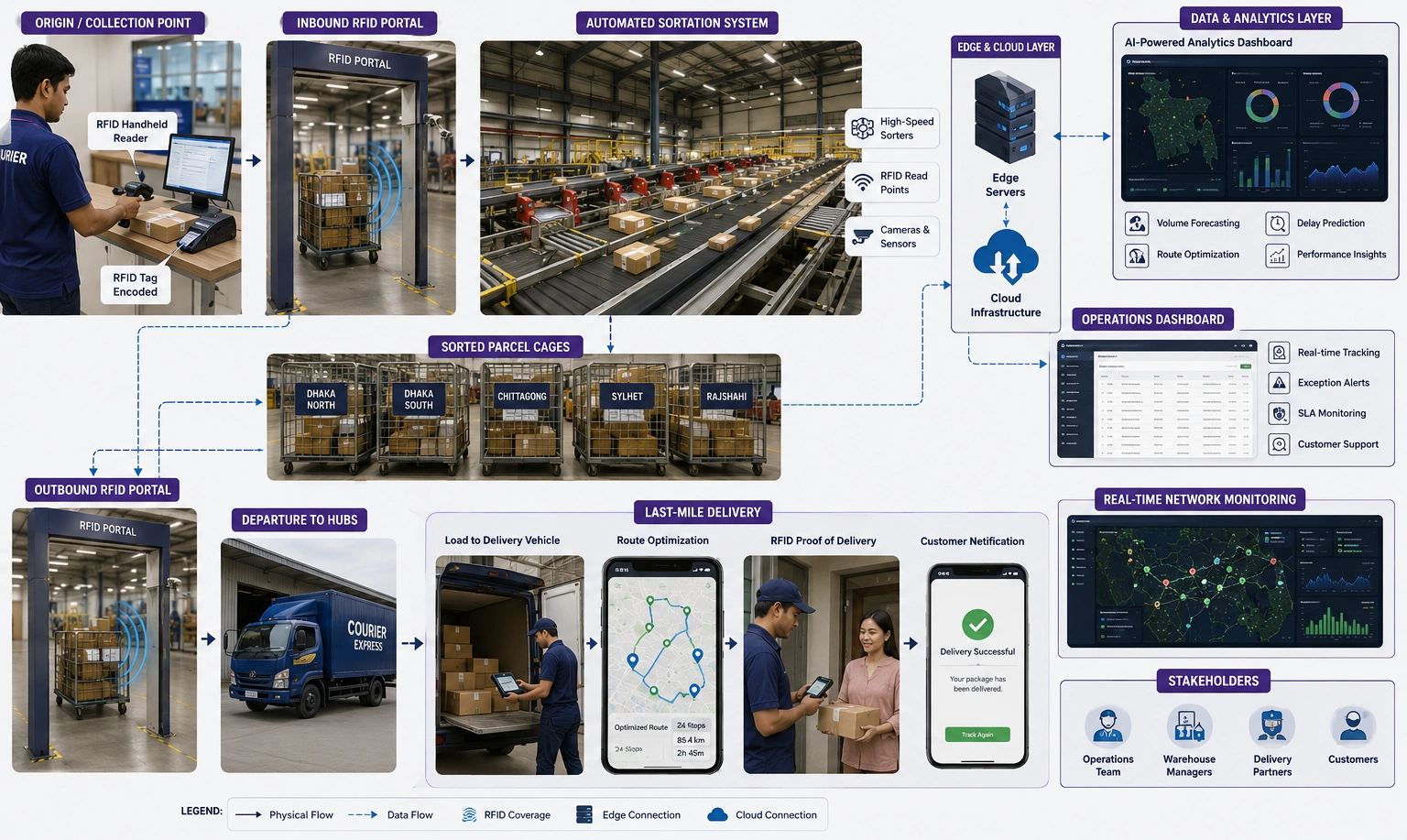
A realistic deployment diagram illustrating an end-to-end national courier network using RFID portals, automated sortation, edge servers, AI analytics, route optimization, operational dashboards, and last-mile delivery. The visual highlights how real-time data connects parcel handling, logistics operations, and delivery monitoring.
Technology Components Supporting AI-Powered Courier Operations
AI-enabled courier intelligence depends on coordinated hardware, software, communications, and cybersecurity systems.
RFID Hardware
Core RFID components include:
- Fixed RFID readers
- Handheld RFID readers
- RFID portals
- Parcel RFID tags
- Asset tracking tags
- Industrial antennas
- Mobile scanning devices
AI and Analytics Software
Key software capabilities include:
- Machine learning models
- Predictive analytics engines
- Route optimization algorithms
- Anomaly detection systems
- Forecasting tools
- Operational intelligence dashboards
Cloud Deployment Model
Cloud-hosted deployments are appropriate when courier organizations require:
- Multi-region visibility
- Rapid scalability
- Centralized reporting
- Cross-network coordination
- Simplified software maintenance
Server Deployment Model
Privately managed server environments are often preferred when organizations require:
- Data residency controls
- Low-latency processing
- Legacy system integration
- Internal security governance
- Customer-managed infrastructure
Security and Operational Protection
Courier deployments require protection against:
- Unauthorized device access
- Data tampering
- Network attacks
- Credential misuse
- Operational disruption
Security controls commonly include encryption, authentication, access management, network segmentation, audit logging, and continuous monitoring.
AI-Powered Courier Services Technology Stack: RFID, Edge Computing, Cloud & Logistics Systems
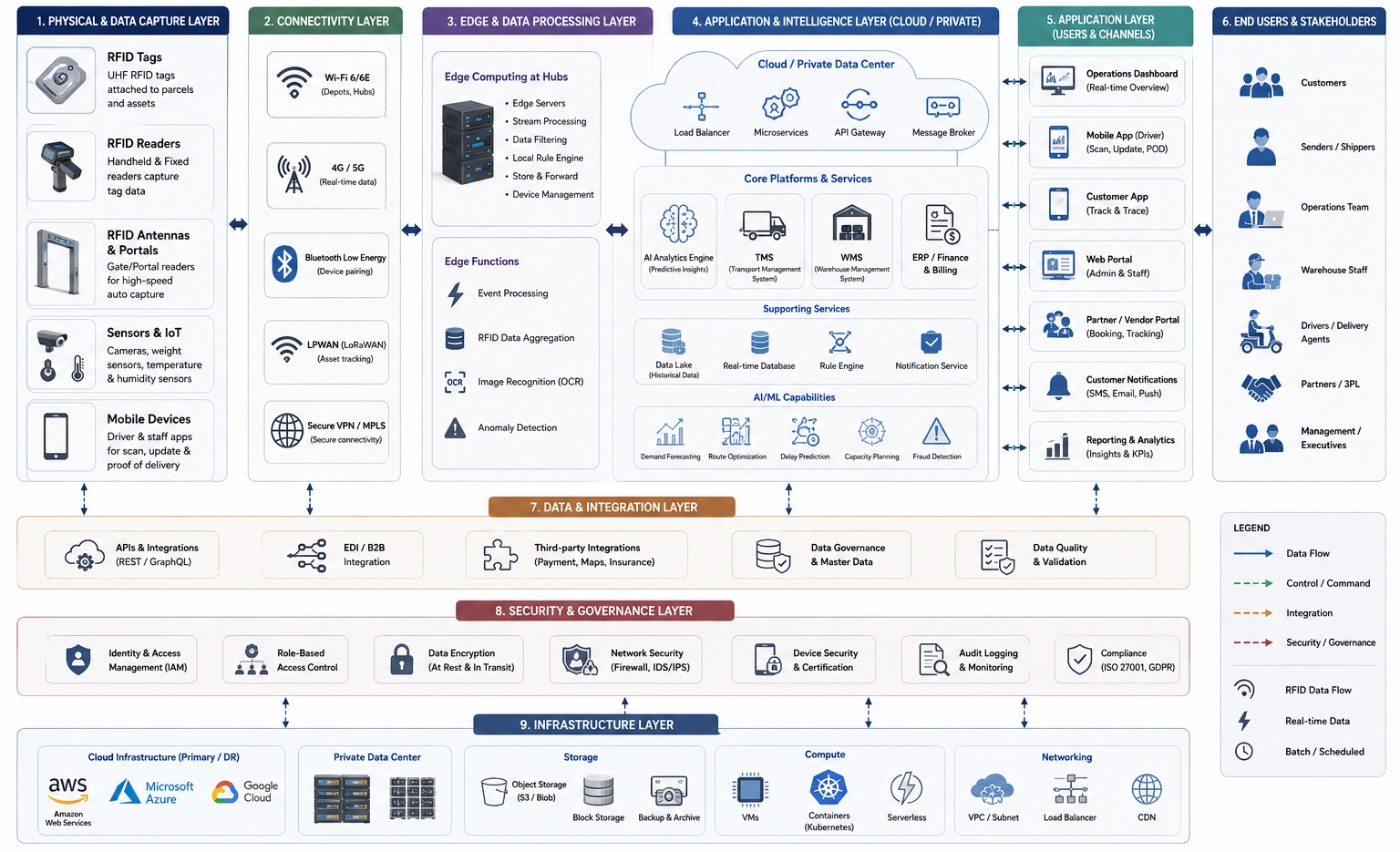
A detailed system diagram illustrating the technology stack behind AI-powered courier operations, from RFID tags, readers, sensors, and connectivity networks to edge servers, AI analytics, TMS, WMS, ERP, cloud infrastructure, applications, and dashboards. The visual highlights how these integrated layers enable real-time tracking, intelligent logistics, secure data management, and efficient delivery.
Technical Capabilities and Business Benefits of AI-Powered Courier Operations
AI-enabled courier operations supported by RFID technologies provide measurable improvements in package visibility, delivery performance, operational efficiency, customer satisfaction, and resource utilization. Courier organizations benefit because RFID continuously captures package movement events while AI converts those events into operational intelligence and automated decision support.
End-to-End Parcel Visibility
Modern courier networks require continuous visibility from pickup through final delivery.
AI-powered parcel visibility solutions use RFID-generated event data to provide:
- Real-time package status monitoring
- Automated chain-of-custody documentation
- Delivery milestone verification
- Exception detection
- Customer-facing tracking updates
Benefits include:
- Fewer lost shipments
- Improved customer confidence
- Faster issue resolution
- Reduced customer service inquiries
- Enhanced delivery transparency
Faster Parcel Processing and Sortation
High-volume courier hubs must process large parcel volumes with minimal delay.
AI analyzes RFID movement data to identify:
- Conveyor congestion
- Sortation bottlenecks
- Processing delays
- Labor imbalances
- Capacity constraints
Operational improvements frequently include:
- Increased package throughput
- Reduced parcel handling time
- Better dock utilization
- Improved hub productivity
- Lower operational costs
Delivery Route Optimization
Route efficiency directly affects courier profitability and service quality.
AI models evaluate:
- Traffic conditions
- Historical delivery performance
- Parcel density
- Driver workload
- Delivery windows
Combined with RFID-based package visibility, AI supports:
- Dynamic route planning
- Reduced mileage
- Improved stop sequencing
- Higher delivery success rates
- Lower fuel consumption
Workforce and Resource Optimization
Courier organizations must efficiently allocate drivers, sortation personnel, and operational resources.
AI-driven forecasting helps organizations:
- Predict delivery demand
- Anticipate peak periods
- Balance staffing levels
- Allocate vehicles efficiently
- Improve labor productivity
Improved Exception Management
Shipment exceptions can create significant operational disruption.
AI systems identify patterns associated with:
- Misrouted parcels
- Delivery failures
- Package damage risks
- Missing shipments
- High-risk delivery zones
Benefits include:
- Earlier intervention
- Reduced claims costs
- Improved service-level performance
- Better customer communication
Security and Asset Protection
Courier operations involve high-value packages, containers, mobile devices, and transportation assets.
AI-supported RFID monitoring helps:
- Detect unauthorized movements
- Track operational assets
- Monitor secure storage areas
- Support investigations
- Improve audit readiness
GAO has helped logistics organizations improve visibility and accountability by supplying RFID hardware and IoT solutions designed for demanding transportation environments.
Engineering Considerations for Courier Service Deployments
Successful deployment requires more than technology selection. Courier organizations must address operational, environmental, integration, and performance requirements.
RFID Read Zone Planning
Courier facilities contain dynamic operating environments with:
- Conveyor systems
- Parcel cages
- Delivery containers
- Loading docks
- Vehicle staging areas
- Dense package volumes
Read zones should be designed to maximize read accuracy while minimizing interference and missed reads.
Considerations include:
- Antenna placement
- Reader positioning
- Read range requirements
- Package density
- Facility layout
Data Quality and Event Accuracy
AI effectiveness depends on reliable operational data.
Organizations should establish processes for:
- Reader validation
- Event verification
- Duplicate event filtering
- Exception reconciliation
- Asset identification consistency
Accurate RFID data improves prediction quality and operational confidence.
Integration Strategy
Courier operations typically depend on multiple business systems.
Integration planning should address:
- Data synchronization
- Workflow automation
- Event mapping
- Reporting requirements
- Operational dependencies
Critical integrations commonly include TMS, WMS, customer service applications, route planning software, and delivery management systems.
Cybersecurity Requirements
Courier networks process sensitive operational and customer information.
Recommended security practices include:
- Multi-factor authentication
- Encrypted communications
- Device authentication
- Access management
- Network segmentation
- Security monitoring
Performance Measurement
Organizations should establish operational KPIs before deployment.
Common courier metrics include:
- On-time delivery rate
- Package visibility percentage
- First-attempt delivery success rate
- Parcel processing time
- Route efficiency
- Vehicle utilization
- Claims rate
- Customer satisfaction scores
Implementation Recommendations for Courier Organizations
Organizations pursuing AI-powered courier intelligence should adopt a phased implementation approach.
Recommended practices include:
- Define measurable operational objectives before deployment.
- Identify high-value use cases such as parcel visibility, route optimization, or sortation efficiency.
- Conduct facility assessments and operational workflow analysis.
- Establish data governance and quality management processes.
- Integrate RFID event streams with courier business systems.
- Deploy pilot projects within selected distribution centers.
- Measure outcomes using predefined KPIs.
- Expand deployment incrementally across regional operations.
- Continuously improve AI models using updated operational data.
- Maintain cybersecurity oversight throughout the solution lifecycle.
Organizations that align technology deployment with operational objectives generally achieve faster adoption, lower risk, and stronger long-term returns.
Why AI-Powered Courier Intelligence Is Becoming Essential
Courier services face increasing pressure to deliver faster, provide greater shipment transparency, reduce operating costs, and improve customer experiences. AI-powered operational intelligence supported by RFID technologies helps courier organizations transform package movement data into actionable insights that improve performance throughout the delivery lifecycle.
From automated sortation and route optimization to predictive delivery management and exception handling, AI-supported courier operations enable organizations to increase efficiency while improving service reliability. Real-time parcel visibility, operational forecasting, and intelligent decision support help courier companies meet evolving customer expectations while maintaining profitability.
Organizations seeking to improve parcel tracking, delivery performance, operational visibility, and logistics efficiency can benefit from carefully planned AI-driven courier solutions supported by RFID technologies. Through decades of experience supplying RFID and IoT technologies, GAO continues to assist transportation and logistics organizations in deploying solutions that improve operational performance and shipment visibility.
Building the Future of Industrial AI and IoT with Aperture Venture Studio and GAO
For more than three decades, GAO Group of Companies has invested heavily in research and development involving RFID, BLE, IoT, and intelligent operational technologies. As AI adoption continues to expand throughout courier services and transportation logistics, we founded Aperture Venture Studio to help accelerate the development and advancement of AI and IoT solutions that improve package visibility, delivery intelligence, logistics automation, and operational decision-making.
Aperture has attracted leading AI and IoT experts, investors, business leaders, and technology professionals. Through initiatives such as Aperture Ventures Summit and TekSummit, we continue to promote collaboration, innovation, and technical knowledge sharing across AI and IoT disciplines.
We welcome participation from:
- Advisors, co-founders, and employees
- Investors
- Customers seeking advanced AI and IoT solutions