
AI and BLE for Battery Energy Storage
Smarter Battery Energy Storage with AI and BLE
AI-powered battery energy storage monitoring combines machine learning, connected sensors, battery management data, and operational analytics to improve the safety, availability, efficiency, and service life of battery energy storage systems (BESS). BLE sensors, beacons, and gateways can support this intelligence by collecting localized condition, environmental, proximity, and asset-status data from battery rooms, containers, racks, auxiliary equipment, and maintenance workflows.
Battery energy storage operators can correlate BLE sensor observations with battery management system (BMS), power conversion system (PCS), energy management system (EMS), SCADA, fire detection, HVAC, and maintenance data. AI models can then identify abnormal thermal behavior, equipment degradation, cooling problems, operational anomalies, and maintenance risks before they develop into more serious failures. GAO supplies BLE and IoT hardware products and systems that can support connected monitoring and asset visibility for battery energy storage applications.
AI-Enabled Battery Energy Storage Facility with BLE Monitoring and Predictive Analytics
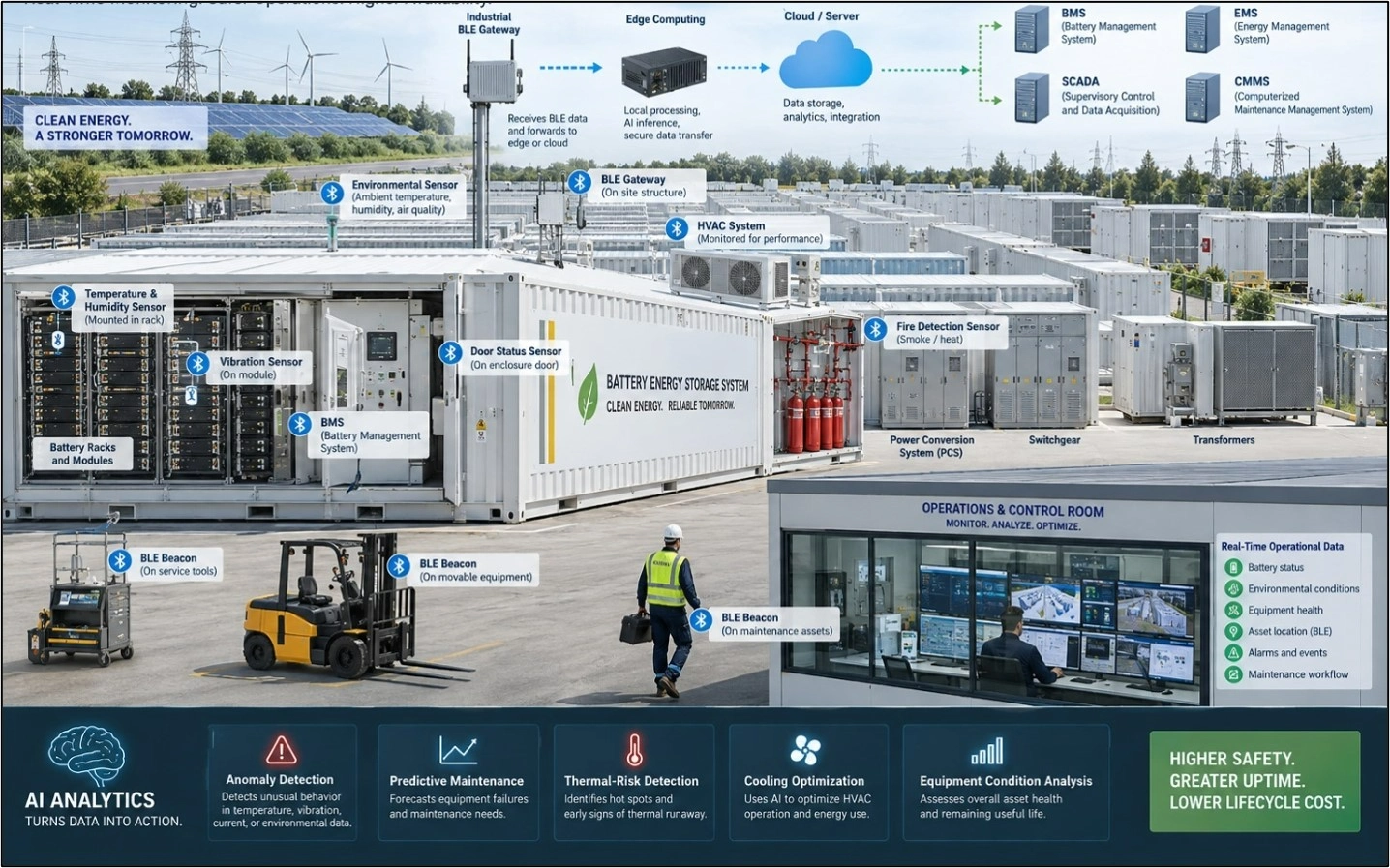
This visual illustrates a utility-scale battery energy storage facility using BLE sensors, beacons, gateways, edge computing, and AI analytics for real-time monitoring. It highlights integration with BMS, EMS, SCADA, and CMMS while supporting anomaly detection, predictive maintenance, thermal-risk detection, cooling optimization, and equipment-condition analysis.
Core Concepts of AI-Enabled Battery Energy Storage Monitoring
Battery energy storage facilities generate large volumes of operational data from cells, modules, racks, battery management systems, inverters, environmental controls, protective devices, and site-level energy management systems. Traditional threshold-based monitoring remains essential for protection, but AI can add another analytical layer by learning relationships and patterns across historical and real-time measurements.
Machine learning models can analyze cell voltage spread, current, temperature distribution, state of charge (SOC), state of health (SOH), charge-discharge cycles, impedance-related indicators, ambient conditions, PCS behavior, and auxiliary equipment condition. Time-series analysis and anomaly detection can identify deviations that fixed alarm thresholds may not reveal early enough. Predictive models can also support maintenance planning by estimating degradation trends and identifying equipment whose behavior is diverging from comparable assets.
BLE complements these existing operational systems where low-power wireless sensing or localized asset identification is practical. BLE temperature, humidity, vibration, contact, and environmental sensors can provide supplementary measurements around enclosures, HVAC equipment, electrical rooms, cabinets, auxiliary systems, and service areas. BLE beacons can support identification and location awareness for tools, portable diagnostic equipment, replacement components, and other service assets.
Industrial BLE gateways collect advertisements or sensor transmissions and bridge the wireless field layer to Ethernet, Wi-Fi, cellular, or other IP-based communications. Data can then be processed at an edge server or forwarded to privately hosted or cloud-based software for storage, analytics, visualization, and AI inference.
AIoT, or AI and IoT, therefore extends beyond individual wireless sensors. The complete battery energy storage solution can combine connected equipment, IoT sensors, Industrial AI, Edge AI, machine learning, operational software, and automated workflows. GAO’s BLE hardware products and IoT systems can serve as components within these connected monitoring environments when BLE is appropriate for the required range, power consumption, installation conditions, and data rate.
Why AI Matters for Battery Energy Storage Operations
Battery degradation is influenced by interacting variables rather than a single operating parameter. Temperature, depth of discharge, charge and discharge rate, SOC operating window, cell imbalance, calendar aging, cycling history, and environmental conditions can all affect long-term performance. AI models are useful because they can analyze multivariable relationships across large historical datasets while continuing to evaluate new operating data.
Practical applications include:
- AI battery health monitoring: Models analyze voltage, temperature, current, SOC, SOH, cycling history, and other condition indicators to identify abnormal degradation patterns.
- Predictive battery maintenance: Historical failures, alarms, environmental conditions, and equipment measurements can be used to prioritize inspection and maintenance activities.
- Thermal anomaly detection: AI evaluates temperature distributions and trends to identify unusual heating behavior requiring investigation.
- Battery degradation forecasting: Regression and time-series models can estimate capacity-loss trends and support lifecycle planning.
- Cooling-system monitoring: HVAC operating data, ambient conditions, rack temperatures, and supplementary BLE measurements can help detect insufficient cooling or abnormal environmental conditions.
- PCS condition monitoring: Electrical and equipment-condition data can support anomaly detection for inverters, converters, fans, and associated components.
- Battery asset tracking: BLE beacons can improve visibility of maintenance equipment, test instruments, spare components, and movable service assets.
- Operational optimization: AI can analyze historical demand, battery constraints, SOC, degradation considerations, and energy dispatch requirements to support more informed operating strategies.
Battery Energy Storage Applications and Deployment Scenarios
Battery energy storage systems operate in environments ranging from utility-scale grid installations to renewable energy facilities, commercial buildings, microgrids, industrial sites, and distributed energy resources. Each deployment has different operating profiles, communication requirements, environmental risks, cybersecurity controls, and maintenance practices.
Utility-Scale Battery Energy Storage Systems
Grid-scale BESS installations may contain hundreds or thousands of battery modules distributed across multiple racks and containerized enclosures. Operators must monitor battery condition, thermal behavior, auxiliary loads, HVAC performance, PCS status, alarms, enclosure conditions, and availability across a large physical site.
AI models can consolidate operational history from BMS, PCS, EMS, SCADA, environmental sensors, and maintenance records to detect patterns associated with degradation or equipment problems. BLE sensing can supplement wired instrumentation at selected points where low-power wireless installation offers an engineering advantage, particularly for retrofit condition sensing or monitoring noncritical auxiliary assets.
Gateway placement requires careful RF planning because metal battery enclosures, racks, cabinets, cable infrastructure, and equipment can attenuate or reflect 2.4 GHz signals. Site surveys should evaluate received signal strength, interference, enclosure construction, antenna placement, gateway redundancy, maintenance accessibility, and the consequences of temporary communication loss.
Renewable Energy and Battery Storage
Solar-plus-storage and wind-plus-storage facilities use batteries to shift renewable generation, reduce curtailment, support grid services, and improve dispatch flexibility. Battery operating conditions can change substantially with weather, generation output, electricity demand, and dispatch requirements.
AI can correlate renewable generation forecasts, battery SOC, historical cycling, thermal conditions, and equipment constraints to support battery scheduling and asset-health decisions. Condition monitoring is particularly valuable when battery containers are geographically distributed across large renewable sites.
BLE gateways can collect nearby wireless sensor and beacon data and transfer selected information into edge or central monitoring systems. Integration should maintain clear separation between supplementary IoT monitoring and safety-critical battery protection functions.
Commercial and Industrial Battery Energy Storage
Commercial facilities, data centers, manufacturing sites, warehouses, campuses, and other high-load locations can deploy battery storage for peak shaving, demand management, backup power support, renewable energy utilization, and resilience.
Facility teams may need visibility not only into battery performance but also into environmental conditions, electrical rooms, HVAC equipment, access points, maintenance assets, and supporting infrastructure. BLE sensors can extend condition visibility where additional wired sensors would be difficult or costly to retrofit.
AI can analyze energy consumption, demand peaks, battery cycling, ambient conditions, equipment health, and historical maintenance records. Results can support maintenance prioritization, operational planning, and improved utilization while respecting battery operating limits established by the BMS and equipment manufacturer.
Microgrids and Distributed Battery Storage
Microgrids integrate batteries with distributed generation, loads, control systems, and sometimes electric vehicle charging or backup generation. Local intelligence becomes important where connectivity to remote servers may be limited or where rapid operational analysis is required.
Edge AI can process selected sensor and equipment data near the battery installation. Local inference reduces dependence on continuous WAN connectivity and can provide timely anomaly notifications. Cloud or central server software can still aggregate longer-term data for fleet analysis, model training, reporting, and multi-site comparison.
GAO has supplied hardware products and systems to organizations requiring connected sensing and identification capabilities, supporting the integration of BLE and other IoT technologies into operational environments.
Battery Energy Storage AI Monitoring Application Map with BLE Sensors and Predictive Analytics
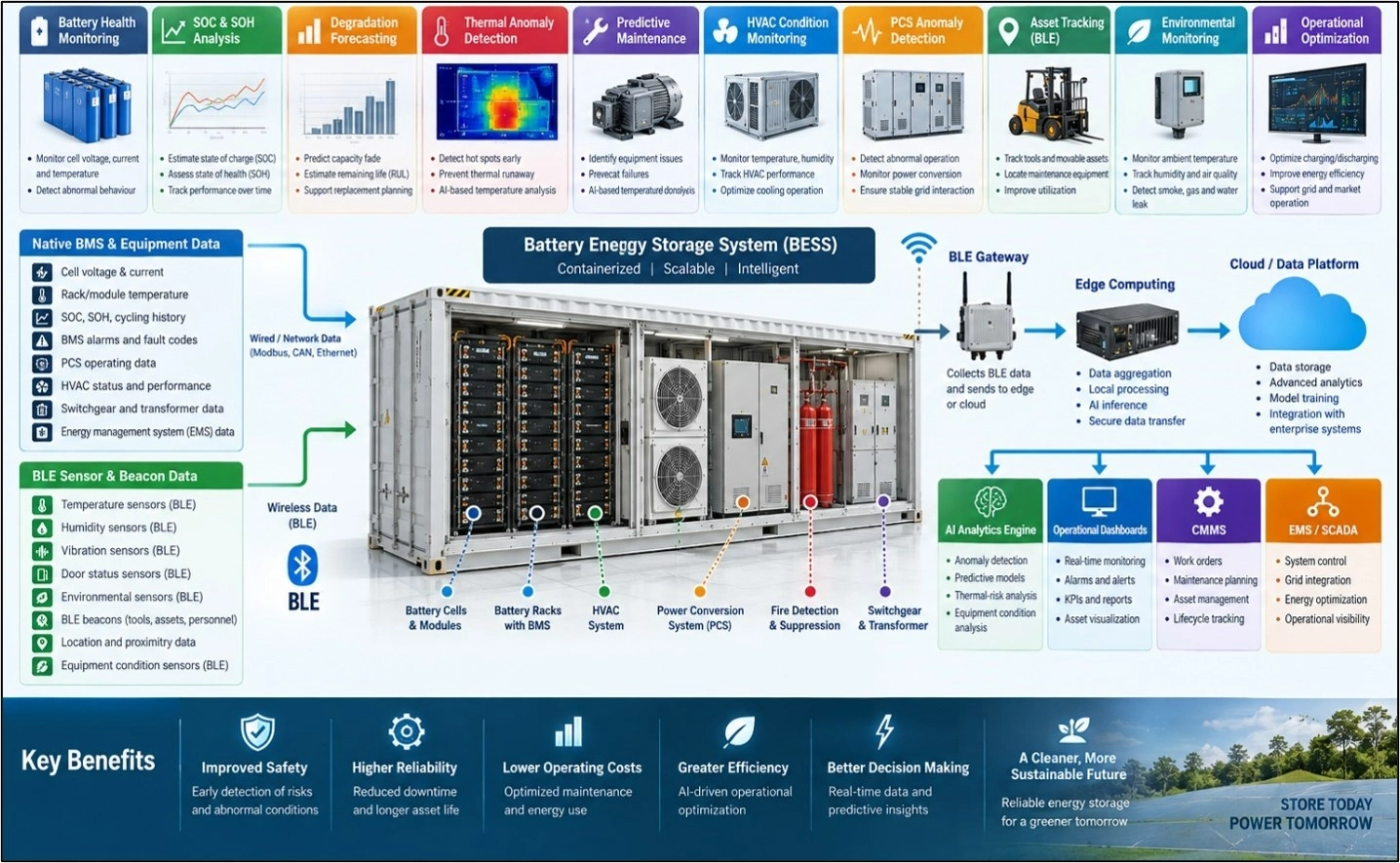
This infographic maps key AI monitoring applications across a battery energy storage system, including battery health, SOC and SOH analysis, thermal anomaly detection, predictive maintenance, HVAC and PCS monitoring, asset tracking, and operational optimization. It shows how native BMS data and BLE sensor data flow through gateways, edge computing, and cloud platforms to AI analytics, dashboards, CMMS, EMS, and SCADA.
Battery Energy Storage Data-to-Decision Workflow
A reliable AI battery monitoring solution begins with trustworthy operational data. The workflow should preserve data quality, timestamp consistency, asset identity, cybersecurity, and traceability from the battery equipment through the final maintenance or operational action.
Battery and Environmental Data Acquisition
Data acquisition begins at the cell, module, rack, container, PCS, and site levels. BMS measurements can provide cell voltage, pack voltage, current, temperatures, SOC, SOH estimates, balancing status, alarms, and protection states. PCS and EMS data add inverter status, active and reactive power, operating modes, dispatch commands, and site-level energy information.
Supporting measurements may include:
- Battery rack and enclosure temperature
- Ambient temperature and relative humidity
- HVAC operating condition
- Vibration from fans, pumps, or other rotating auxiliaries
- Door and cabinet status
- Smoke, gas, or other safety-system status where supported by approved dedicated equipment
- Equipment alarms and fault codes
- Maintenance and inspection history
- Charge-discharge cycles and depth-of-discharge history
- Battery asset and component identifiers
- Portable maintenance-tool location or presence
BLE sensors can contribute selected non-safety-critical environmental and condition data. Battery protection and life-safety functions should continue to rely on properly engineered, certified, and code-compliant protection systems rather than treating general-purpose BLE monitoring as a replacement.
Communication and Edge Processing
BLE gateways receive nearby beacon advertisements and sensor data. Gateway density and positioning should be determined through an RF site survey rather than nominal BLE range specifications alone. Battery containers contain extensive metal structures, electrical equipment, cabling, and enclosed spaces that can materially alter radio propagation.
The gateway or edge computing layer can perform filtering, normalization, timestamping, device authentication, buffering, protocol conversion, and preliminary analytics. Local processing can also remove duplicate messages, check sensor health, apply engineering limits, and execute selected AI models.
Store-and-forward capabilities are important when upstream connectivity is intermittent. The system should preserve measurement timestamps so temporarily buffered data remains meaningful after synchronization.
AI Analysis and Operational Decisions
Normalized information can be combined with BMS, EMS, PCS, SCADA, historian, CMMS, and environmental data. AI models then evaluate patterns according to the specific use case.
Anomaly detection can identify equipment behavior that deviates from established baselines. Time-series models can evaluate temperature or degradation trends. Classification models can categorize known operating or fault patterns when sufficient labeled data exists. Regression models can estimate continuous values such as degradation indicators or remaining performance trends.
AI results should include enough context for engineers to understand why an event requires attention. Useful outputs can include affected asset ID, timestamp, location, contributing variables, historical comparison, severity, confidence, and recommended inspection workflow.
Validated results can create dashboard alerts, maintenance notifications, inspection requests, or CMMS work orders. Human review remains important for high-impact decisions, particularly where model outputs affect battery availability, maintenance interventions, or operational limits.
BLE Hardware, AI Software, and Supporting Technologies for Battery Energy Storage
Battery energy storage monitoring requires coordinated sensing, communications, computing, analytics, and operational software. The technology stack should complement the BMS and other control and protection systems rather than create an independent source of conflicting operational information. GAO can supply BLE gateways, beacons, sensors, and related IoT hardware products for condition monitoring, asset visibility, and connected battery energy storage applications.
BLE Sensors, Beacons, and Gateways
BLE sensors can provide supplementary temperature, humidity, vibration, contact-state, and environmental measurements around battery enclosures, electrical cabinets, HVAC equipment, service areas, and auxiliary assets. Low power consumption makes battery-powered sensors useful where additional cabling is impractical, although battery life depends on sampling frequency, advertising intervals, transmit power, environmental conditions, and sensor workload.
BLE beacons can identify portable diagnostic instruments, maintenance tools, replacement components, movable equipment, and other service assets. Beacon identifiers can be associated with asset records to improve maintenance logistics and reduce time spent locating equipment.
BLE gateways receive wireless sensor and beacon transmissions and forward selected information through Ethernet, Wi-Fi, cellular, or other IP connections. Industrial deployments should consider RF coverage, gateway redundancy, environmental ratings, power availability, network segmentation, remote device management, and local buffering.
Edge Computing and AI Models
Edge computing can process battery energy storage data close to the equipment. Edge software may normalize measurements, remove duplicate BLE messages, calculate features, apply engineering rules, buffer data during network interruptions, and run selected machine learning models.
Relevant AI methods include anomaly detection for unusual operating patterns, regression for degradation estimation, classification for known equipment conditions, clustering for identifying behavioral groups, and time-series models for thermal or performance trends. Models should be validated using representative operating data before their outputs are incorporated into maintenance or operating workflows.
Feature engineering can combine variables such as cell voltage spread, temperature gradients, current, SOC, cycling history, ambient temperature, HVAC behavior, inverter operating state, alarm history, and supplementary BLE measurements. Model performance should be evaluated across different seasons, load profiles, battery ages, and operating modes because a model trained under one operating condition may not generalize reliably to another.
Battery Energy Storage Software Integration
AI monitoring should exchange information with existing operational systems where technically justified. Typical integrations can include BMS, EMS, SCADA, historians, computerized maintenance management systems (CMMS), asset management software, and engineering dashboards.
Protocols and interfaces vary by equipment vendor and deployment. Modbus TCP, OPC UA, MQTT, REST APIs, and vendor-specific interfaces may be used at different integration points. Protocol selection should consider interoperability, cybersecurity, data volume, latency, device capabilities, and the operational importance of each data stream.
GAO’s IoT hardware can serve as part of this data chain by connecting suitable BLE field devices with edge or server software while preserving the primary authority of certified battery control and protection systems.
Cloud Version and Server Version
A Cloud Version can centralize battery energy storage data within cloud-hosted software for multi-site analytics, fleet benchmarking, historical analysis, model management, reporting, and remote engineering access. This approach can be useful for operators managing geographically distributed BESS assets because data from multiple facilities can be analyzed using consistent models and dashboards.
A Server Version can run on an edge server, customer-managed server, private data center, site server, or other privately hosted infrastructure. Battery operators may select this model when they require tighter data control, restricted external connectivity, local AI inference, integration with private operational networks, or continued analytics during WAN interruptions.
Hybrid designs can combine both approaches. Time-sensitive processing and buffering can remain close to the battery site while approved historical information is synchronized to central software for fleet-level analysis. Deployment selection should therefore consider cybersecurity policy, connectivity, data residency, latency, IT and OT responsibilities, scalability, and disaster-recovery requirements rather than assuming that one hosting model fits every BESS installation.
Battery Energy Storage Cybersecurity
Cybersecurity should be incorporated during system design rather than added after commissioning. BLE monitoring introduces additional devices and communication paths that must be inventoried and managed.
Important controls include:
- Device authentication and controlled provisioning
- Encryption where supported and appropriate
- Secure gateway configuration
- Network segmentation between IoT, IT, and operational technology networks
- Role-based access control
- Strong administrator authentication
- Certificate and credential management
- Secure firmware and software update procedures
- Vulnerability and patch management
- Device inventory and configuration tracking
- Security logging and monitoring
- Firewall rules based on required communications
- Backup and recovery procedures
- Data integrity checks
- Decommissioning procedures for sensors, gateways, and credentials
BLE gateways should not provide unrestricted pathways into BMS, EMS, SCADA, or other operational networks. Security zones, controlled interfaces, firewalls, and least-privilege communication policies can reduce exposure if an IoT component becomes compromised.
Technical Capabilities and Operational Benefits
AI-supported battery monitoring creates value when analytical outputs lead to measurable improvements in reliability, maintenance, safety awareness, asset utilization, and operational decision-making. Benefits depend on data quality, model accuracy, system integration, and disciplined engineering implementation.
Earlier Detection of Battery and Equipment Anomalies
Conventional alarms usually respond when predefined conditions are reached. AI anomaly detection can complement these controls by identifying deviations from learned operating patterns.
For example, an abnormal temperature relationship between comparable battery racks may deserve investigation even when individual measurements remain below alarm thresholds. Combining thermal measurements with load, SOC, ambient conditions, cooling performance, and historical behavior can provide more context than evaluating a single sensor independently.
This analytical capability does not replace BMS protection, fire detection, or other safety functions. Its value is providing an additional condition-monitoring layer that may help engineering teams identify emerging problems earlier.
Predictive Maintenance for BESS Equipment
Battery storage maintenance involves more than battery cells. PCS equipment, cooling systems, fans, pumps, electrical cabinets, sensors, communications equipment, and other auxiliaries can affect overall system availability.
AI can analyze equipment measurements, fault history, operating hours, environmental conditions, work orders, inspections, and previous failures to identify assets that warrant closer attention. Maintenance teams can use these results to prioritize inspections rather than relying exclusively on fixed schedules.
BLE vibration and temperature sensors may provide supplementary condition measurements for suitable auxiliary equipment where permanent wired instrumentation is unavailable. The engineering value depends on sensor placement, sampling characteristics, equipment behavior, and the diagnostic requirements of the monitored asset.
Battery Thermal and Environmental Monitoring
Temperature uniformity is important for battery performance and degradation management. Persistent temperature differences between modules, racks, or enclosures can indicate airflow limitations, cooling-system problems, operating differences, or developing equipment conditions.
AI can analyze spatial and temporal temperature patterns together with ambient temperature, HVAC state, electrical loading, and battery operating conditions. Supplementary BLE environmental sensors can increase measurement coverage at selected locations without extensive new cabling.
The objective is not simply collecting more measurements. Engineers should select sensor locations based on thermal behavior, airflow, known risk areas, equipment layout, and the decisions that the resulting data will support.
Improved Battery Asset and Maintenance Visibility
Battery storage sites contain portable diagnostic equipment, service tools, replacement components, and other movable assets required during inspections and repairs. Missing or misplaced equipment can delay maintenance work.
BLE beacon-based identification can provide presence or approximate location information when sufficient gateway coverage exists. Asset records can associate beacon identifiers with equipment type, service status, assigned location, and maintenance information.
AI analytics can further identify unusual asset movement, repeated search patterns, or maintenance-resource bottlenecks when sufficient historical location data is available.
Data-Driven Battery Degradation Management
Battery degradation directly affects usable energy capacity and long-term project economics. AI models can evaluate historical cycling, SOC ranges, depth of discharge, temperature exposure, power levels, and battery health indicators to characterize degradation patterns.
Operators can compare similar racks, containers, or sites to identify assets whose performance is diverging from expected behavior. Such comparisons can support engineering investigations, warranty analysis, maintenance planning, and lifecycle forecasting.
Model outputs should remain traceable to source measurements and operating history. Battery chemistry, manufacturer specifications, operating strategy, commissioning date, and environmental conditions should also be considered when comparing assets.
Scalable Multi-Site Battery Monitoring
Standardized data models and device-management practices can make it easier to expand monitoring from a pilot installation to multiple battery containers or geographically distributed sites.
Scaling requires more than adding gateways. Device naming, asset hierarchy, sensor metadata, firmware versions, communication health, timestamps, cybersecurity configuration, model versions, and maintenance ownership should be standardized.
GAO, headquartered in New York City and Toronto, Canada, supplies BLE, RFID, and IoT technologies to organizations requiring connected sensing and identification systems. GAO and its sister companies have served customers in the U.S. and Canada for three decades, including Fortune 500 companies, R&D organizations, universities, and government agencies, while investing in product and system R&D, quality assurance, and technical support.
Engineering Considerations for AI and BLE BESS Deployment
Successful battery energy storage monitoring projects should begin with an operational problem rather than a technology selection. Engineers should define the failure mode, maintenance challenge, safety-related observation, asset-visibility problem, or performance KPI that requires improvement before selecting sensors or AI models.
Establish a Reliable BESS Data Baseline
Historical data should be evaluated before model development. Missing measurements, inconsistent timestamps, sensor replacements, calibration errors, communication outages, changing firmware, and undocumented maintenance activities can reduce model reliability.
Engineers should establish asset identifiers and map measurements to the correct battery module, rack, container, inverter, HVAC unit, or supporting asset. Without this contextual mapping, apparently sophisticated AI models can generate misleading correlations.
Perform a BLE RF Site Survey
Nominal BLE communication range should not be used as the sole basis for gateway placement. Battery containers contain conductive surfaces and densely installed equipment that can cause attenuation, reflection, and multipath effects.
Testing should be performed under realistic operating conditions. Engineers should evaluate RSSI distribution, packet reception, gateway placement, antenna orientation, enclosure boundaries, interference sources, and coverage redundancy.
Gateway locations should also consider power, network connectivity, environmental exposure, maintenance accessibility, and cybersecurity zoning.
Start with a Controlled Battery Storage Pilot
A pilot should target a defined operational problem and measurable KPI. Suitable examples include improving visibility of HVAC condition, monitoring selected environmental variables, tracking service equipment, or detecting anomalies in a defined group of assets.
Baseline performance should be measured before deployment so improvements can be evaluated objectively. The pilot should also test sensor reliability, BLE coverage, gateway availability, data completeness, AI accuracy, alert usefulness, maintenance response, and integration with existing systems.
Validate AI Before Operational Scaling
AI models should be tested against representative operating scenarios and known events. False positives can overwhelm operators, while false negatives can create misplaced confidence.
Validation should examine model precision, recall, false alarm frequency, detection latency, stability across operating modes, and performance as batteries age. Engineering teams should document model versions, training datasets, features, validation results, and deployment dates.
Human feedback should become part of the improvement cycle. Confirmed anomalies, inspection findings, component replacements, and maintenance outcomes provide valuable ground truth for future model refinement.
Measuring Battery Energy Storage Performance
AI and IoT investments should be connected to measurable battery storage outcomes rather than evaluated only by the volume of data collected.
Relevant KPIs can include:
- BESS availability
- Unplanned downtime
- Mean time between failures
- Mean time to repair
- Maintenance response time
- Preventive versus corrective maintenance ratio
- Battery capacity retention
- State-of-health trend
- Cell or module temperature spread
- Rack temperature deviation
- Cooling-system availability
- Auxiliary energy consumption
- Alarm frequency
- Repeat fault frequency
- Sensor data completeness
- Gateway communication availability
- AI anomaly detection precision and recall
- False alarm rate
- Inspection findings generated from AI alerts
- Asset search time
- Maintenance-tool availability
- Energy throughput
- Round-trip efficiency
- Cycle count and depth-of-discharge profile
KPI selection should match the original business and engineering objective. A BLE asset-tracking project, for example, should not be judged primarily by battery round-trip efficiency. Similarly, a predictive maintenance project should demonstrate improvements in fault detection, maintenance planning, downtime, or equipment availability.
AI and BLE Battery Energy Storage Implementation Roadmap for Scalable BESS Monitoring
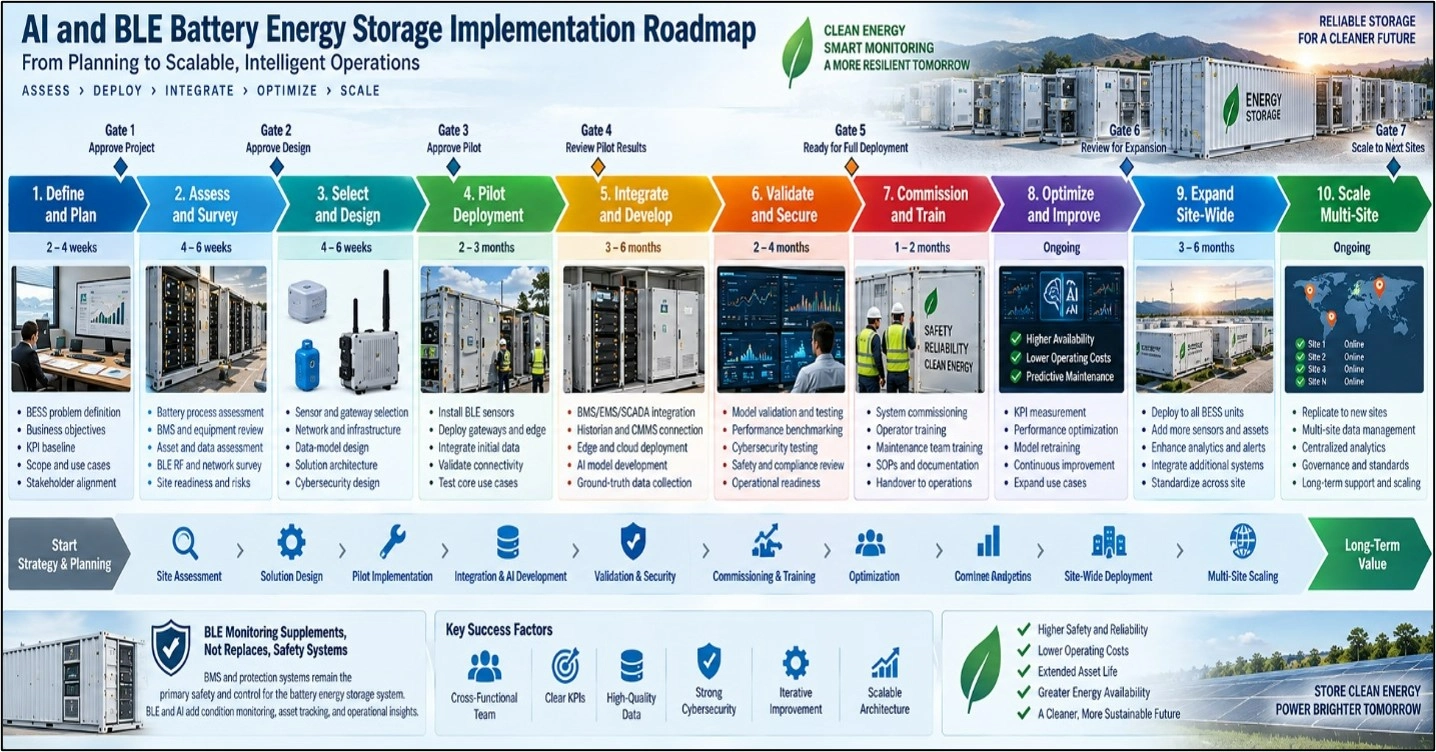
This roadmap illustrates the end-to-end deployment lifecycle for AI and BLE monitoring in battery energy storage systems, from initial planning and site assessment through pilot deployment, integration, validation, commissioning, optimization, and multi-site scaling. It emphasizes engineering decision gates, cybersecurity, continuous improvement, and the role of BLE monitoring as a supplement to core BMS and safety systems.
Implementing AI-Enabled BLE Monitoring for Battery Energy Storage
A practical implementation begins by identifying the battery storage problem and defining a measurable baseline. Engineers can then assess existing BMS, PCS, EMS, SCADA, historian, maintenance, environmental, and asset data before determining whether additional sensing is justified.
BLE should be selected where its characteristics match the application. Wireless sensing can reduce retrofit cabling for selected monitoring points, but radio coverage, battery replacement, sensor accuracy, communication reliability, and cybersecurity introduce their own engineering requirements.
Pilot deployments should verify RF performance and data quality before facility-wide expansion. AI development should proceed in parallel with ground-truth collection so model outputs can be compared with inspection findings and known equipment conditions.
Integration should also preserve operational responsibilities. The BMS and approved protection systems remain responsible for battery control and protective functions. AI and supplementary IoT monitoring should provide additional information for condition assessment, maintenance, and operational decision support rather than bypassing established safeguards.
Commissioning should verify device identity, measurement accuracy, communication reliability, timestamps, buffering, system integrations, cybersecurity configuration, alert routing, dashboard behavior, and maintenance procedures. Documentation should identify ownership for gateways, sensors, software, AI models, credentials, firmware, network configuration, and data quality.
GAO has invested heavily in R&D of BLE, RFID, and IoT products and systems and maintains quality assurance processes and technical support capabilities. These resources can support organizations evaluating connected sensing and identification technologies for battery energy storage monitoring.
Advancing Battery Energy Storage with AI and Connected Sensing
AI-enabled battery energy storage monitoring can turn BMS, equipment, environmental, maintenance, and supplementary IoT data into more actionable engineering information. Machine learning can support anomaly detection, degradation analysis, predictive maintenance, thermal monitoring, equipment-condition assessment, and operational optimization, while BLE sensors, beacons, and gateways can extend data collection and asset visibility where wireless connectivity is technically appropriate.
Effective implementation depends on accurate data, reliable RF engineering, secure integration, validated AI models, clear operational ownership, and measurable KPIs. GAO can provide BLE, RFID, and IoT hardware products, systems, engineering experience, and technical support for organizations developing connected battery energy storage monitoring solutions.
Building the Future of Industrial AI and IoT with Aperture Venture Studio and GAO RFID Inc.
For more than three decades, GAO Group of Companies has invested heavily in R&D of industrial BLE, RFID, and IoT. Since generative AI proved useful for industrial applications, we have been developing AI and IoT technologies, including BLE and RFID, and founded Aperture Venture Studio to advance AI and IoT solutions relevant to energy storage and other technical industries.
Aperture has attracted AI and IoT technical experts, operational executives, influential investors, and leading companies. Aperture Ventures Summit and TekSummit bring communities together to discuss advanced AI and IoT topics. These efforts have helped build diversified technical communities for AI and IoT.
We welcome you to join us as:
- Advisors, Co-founders or Employees
- Investors
- Customers