
AI and RFID for Specialty Chemicals
AI-Driven Asset Tracking and Operations for Specialty Chemicals
Specialty chemical manufacturers manage high-value raw materials, intermediates, finished products, containers, production equipment, and hazardous materials across tightly controlled processes. AI-driven asset tracking and inventory management can connect these physical assets with production, warehouse, quality, maintenance, and compliance information. RFID serves as an important data-capture technology by identifying tagged containers, drums, totes, pallets, tools, equipment, and other materials without requiring direct line-of-sight scanning. When RFID data is combined with machine learning, Industrial AI, enterprise software, and operational data, specialty chemical manufacturers can move from periodic inventory checks toward continuously updated material and asset intelligence. These capabilities can help identify material movement anomalies, improve batch traceability, support FEFO and FIFO practices, reduce search time, strengthen chain-of-custody controls, and provide earlier visibility into operational exceptions. GAO supplies RFID, BLE, and IoT hardware products and systems that can support these applications across specialty chemical manufacturing, storage, laboratories, and distribution environments.
AI-Driven Asset Tracking for Specialty Chemicals
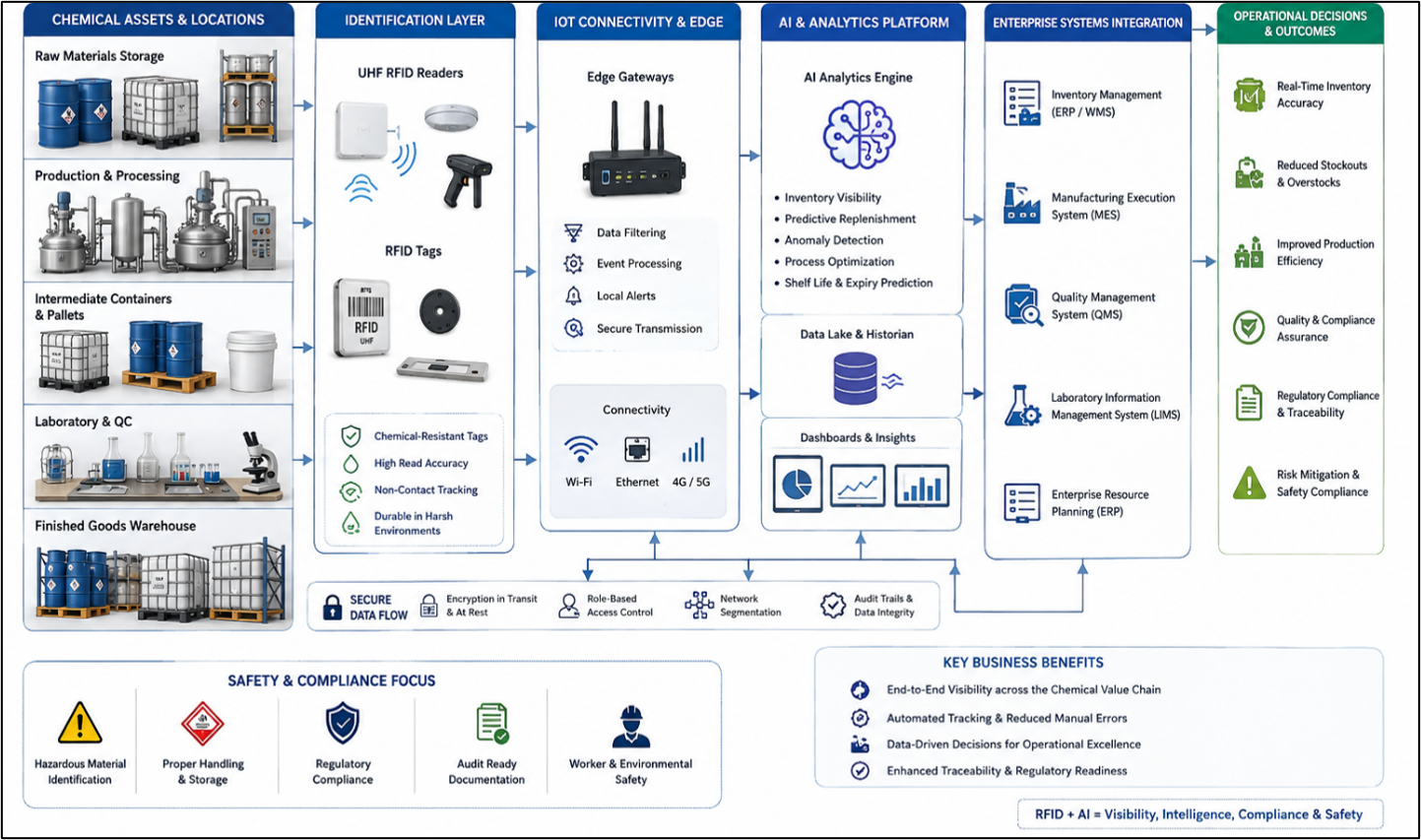
This infographic illustrates how RFID, IoT edge connectivity, and AI analytics provide end-to-end visibility across specialty chemical storage, production, laboratories, and warehouses. It connects physical assets with enterprise systems to support inventory accuracy, traceability, quality, compliance, safety, and operational decision-making.
How AI Improves Specialty Chemical Material and Asset Management
AI for specialty chemicals combines operational data with analytical models that can identify patterns across material movement, production, inventory, quality, maintenance, and logistics. The objective is not simply to identify where a container is located. The larger opportunity is to understand whether materials are in the correct location, whether their movement matches the expected production workflow, and whether an exception requires human intervention.
Specialty chemical operations frequently involve numerous raw materials with different storage conditions, lot numbers, grades, expiration dates, hazard classifications, and handling requirements. A single production campaign may involve staged raw materials, intermediate batches, laboratory samples, packaging materials, and finished products. AI can correlate these records with RFID observations and enterprise transactions to provide more useful operational intelligence.
Relevant AI applications include:
- AI inventory management for raw materials, intermediates, packaging materials, and finished specialty chemicals
- AI asset tracking for chemical containers, reusable totes, drums, pallets, tools, and mobile equipment
- AI batch traceability using material identity, location, lot, and movement history
- AI anomaly detection for unexpected material movement or unauthorized staging
- AI demand forecasting for frequently used specialty chemical inputs
- AI replenishment analysis based on production schedules, historical consumption, and inventory levels
- AI-assisted FEFO and FIFO management
- AI production-material reconciliation
- AI quality and genealogy analysis connecting materials with batches and process records
- AI maintenance analysis for pumps, motors, mixers, valves, and other production assets
- AI safety monitoring based on operational events and abnormal movement patterns
The value comes from connecting physical events with business context. An RFID observation that a tagged raw-material tote entered a staging area becomes more meaningful when software can compare the event with a production order, material requirement, batch schedule, approved location, and expected consumption window.
GAO’s RFID and IoT hardware can provide the physical identification layer required for these workflows, while software and AI systems can transform captured events into actionable information.
Specialty Chemical Workflows Where AI Creates Operational Value
Raw-Material Receiving and Verification
Receiving is a critical control point because incorrect material identity, quantity, lot information, or storage assignment can affect downstream production. RFID can automatically identify tagged containers as they move through receiving areas, while enterprise software can associate the observation with purchase orders, material records, supplier information, and lot data.
AI can analyze receiving patterns and identify exceptions such as unexpected quantities, repeated receiving discrepancies, unusual supplier-related delays, or materials remaining in receiving longer than expected.
Chemical Storage and Inventory Control
Specialty chemical warehouses may contain many similar-looking containers that differ by grade, formulation, lot, concentration, or expiration date. Manual searches and periodic counts can create operational delays and increase the possibility of inventory discrepancies.
RFID readers positioned at warehouse entrances, staging areas, or designated checkpoints can capture container movement. AI can use these events with inventory and production data to identify inventory anomalies, calculate dwell times, and support replenishment decisions.
Relevant operational metrics include:
- Inventory accuracy
- Material dwell time
- Stockout frequency
- Inventory turnover
- Expired or obsolete inventory
- Location accuracy
- Material search time
- Replenishment lead time
- FEFO compliance
- Lot traceability completeness
Production Staging and Batch Preparation
Production staging requires the correct materials to reach the correct production area at the correct time. This is particularly important when multiple formulations or specialty products are manufactured using different recipes and raw-material combinations.
An RFID-enabled staging workflow can identify materials as they enter designated production areas. AI software can compare observed material movement with production orders and planned batch requirements.
Potential exceptions include:
- A required material has not reached staging
- A material is staged for the wrong production order
- A container remains in staging beyond the expected time
- A material is moved into an unauthorized area
- A lot does not match the expected production requirement
- Material consumption differs substantially from historical production patterns
Batch Traceability and Material Genealogy
Specialty chemical manufacturers often need to maintain relationships between raw-material lots, production batches, intermediate materials, finished products, laboratory results, and shipping records.
AI can help analyze these relationships across large historical datasets. RFID contributes physical movement events that can supplement transaction records and improve confidence in where and when tagged materials moved.
This approach can support faster investigation when a quality issue occurs. Instead of relying only on manually reconstructed records, investigators can analyze material genealogy alongside RFID movement history, batch records, quality results, and production information.
Specialty Chemical Batch Genealogy & Traceability
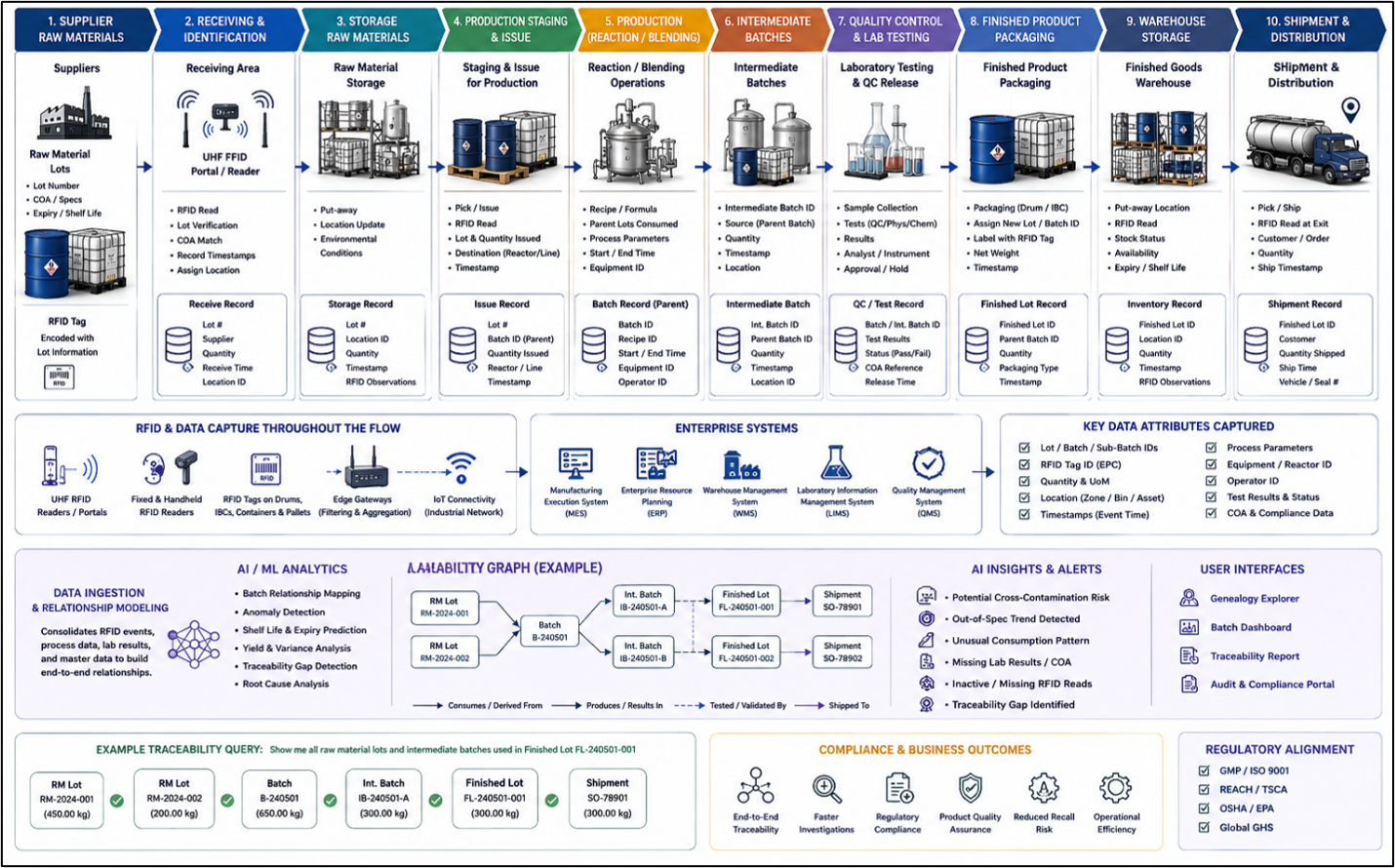
This diagram maps the complete genealogy of specialty chemical batches from supplier raw materials and RFID-tagged containers through production, laboratory testing, packaging, warehousing, and shipment. It shows how RFID events, batch records, timestamps, locations, and AI analytics create connected traceability and help identify anomalies, gaps, and compliance risks.
AI, RFID, and the Specialty Chemical Operating Data Flow
A practical specialty chemical solution begins with physical events and ends with a business or operational action. The data flow can be organized into several connected stages.
- Physical identification: RFID tags identify drums, totes, pallets, containers, reusable assets, tools, or other tracked items.
- RFID data capture: Fixed readers, portal readers, handheld readers, or integrated equipment capture tag observations.
- Communication: Ethernet, Wi-Fi, cellular, BLE, or other appropriate connectivity transports events to local processing or software.
- Edge processing: Local software can filter duplicate reads, normalize events, apply location logic, buffer data during network interruptions, and generate operational events.
- Middleware: RFID middleware converts raw reader observations into structured business events such as material arrival, departure, staging, or location change.
- Enterprise integration: APIs, databases, message brokers, or integration services connect tracking events with ERP, MES, WMS, LIMS, QMS, CMMS, and other systems.
- AI processing: Machine learning and Industrial AI models evaluate movement histories, inventory behavior, production requirements, and operational patterns.
- Decision support: Dashboards, alerts, reports, workflow systems, or automated actions present the resulting information to operators, supervisors, planners, quality personnel, and managers.
This workflow is particularly useful when RFID observations are treated as operational events rather than as isolated tag reads. For example, multiple RFID observations of the same container can be consolidated into a location transition, while an unexpected transition can become an exception for AI analysis.
RFID Hardware and AI Infrastructure for Specialty Chemical Operations
RFID selection should follow the physical characteristics of the specialty chemical environment rather than simply choosing the longest read range. Container material, liquid contents, metal surfaces, chemical packaging, reader placement, antenna orientation, required read distance, interference, and environmental conditions can all influence performance.
UHF RFID for Container and Material Tracking
UHF RFID is generally useful for applications requiring longer read ranges and rapid identification of multiple tagged items. Specialty chemical manufacturers can consider UHF RFID for warehouse portals, pallet movement, container staging, production material tracking, and controlled-area checkpoints.
HF RFID for Controlled Identification Points
HF RFID can be appropriate where shorter-range, more deliberate identification is desirable. Applications may include specific workstation interactions, laboratory processes, controlled material handoffs, or identification points where close-range interaction is preferable.
LF RFID for Specialized Identification Requirements
LF RFID can be considered for specific environments and asset-identification requirements where its operating characteristics provide an advantage. The appropriate RFID frequency depends on the material, read distance, environment, tag construction, and required workflow.
RFID tag engineering is especially important for specialty chemicals. Liquids and metals can influence RF performance, so tag placement and tag construction should be validated against the actual container type rather than selected only from catalog specifications.
Cloud and Server Deployment for Specialty Chemical AI Systems
The deployment model should reflect data governance, network availability, cybersecurity requirements, integration constraints, and the operational criticality of the application.
A Cloud Version can provide centralized software hosting, scalable compute resources, remote access, centralized analytics, and easier multi-site data aggregation. It can be suitable for organizations operating multiple specialty chemical facilities that need consolidated inventory, asset, and operational analytics.
A Server Version can run on customer-managed edge servers, factory servers, private data centers, or other privately hosted infrastructure. This approach can be appropriate when organizations require tighter control over data processing, local system integration, network independence, or site-specific security policies.
A hybrid approach can also be practical. RFID event processing and immediate operational workflows may run locally, while aggregated analytics and selected AI workloads can be processed in centralized infrastructure.
The system should account for network outages. Local buffering, event timestamps, store-and-forward mechanisms, and reconciliation procedures help prevent temporary connectivity failures from becoming permanent gaps in material history.
AI + RFID DEPLOYMENT IN A SPECIALTY CHEMICAL PLANT
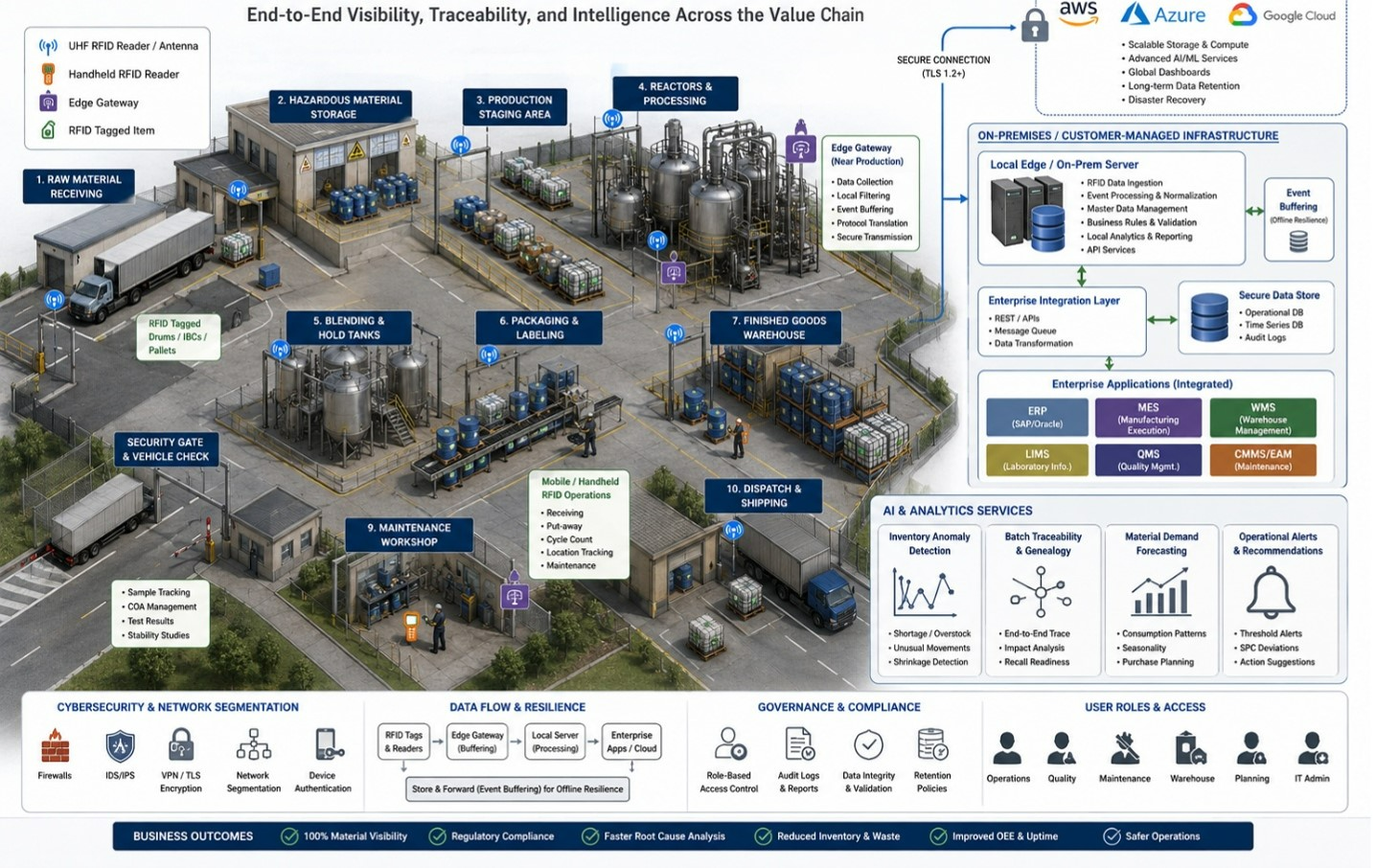
Real-world AI and RFID deployment architecture for a specialty chemical plant, showing RFID-enabled material tracking, edge processing, on-premises infrastructure, enterprise-system integration, AI analytics, cybersecurity, and operational outcomes.
Engineering Considerations for RFID Deployment
A successful deployment requires site-specific engineering before full-scale commissioning. Specialty chemical facilities can contain metal equipment, liquid-filled containers, enclosed storage areas, process piping, restricted zones, and hazardous environments that influence RFID deployment.
Important engineering considerations include:
- Container and packaging material
- Chemical composition and liquid volume
- Metal surfaces near RFID tags or antennas
- Reader and antenna mounting locations
- Read-zone geometry
- Required identification accuracy
- Tag orientation and placement
- Tag durability and chemical compatibility
- Environmental temperature and humidity
- Potential electromagnetic interference
- Network availability
- Hazardous-area requirements where applicable
- Integration with existing production and inventory systems
- Data retention requirements
- Cybersecurity and access control
- Maintenance and replacement procedures
A pilot should reproduce actual operating conditions. Testing only empty containers or laboratory conditions can produce misleading results because RF behavior can change substantially when tags are attached to filled chemical containers or positioned near metal process equipment.
GAO’s experience supplying RFID and IoT hardware and systems to organizations in the United States and Canada supports an engineering-oriented approach in which hardware selection, deployment conditions, system integration, and operational requirements are considered together. GAO is headquartered in New York City and Toronto, Canada, and is recognized among the leading B2B and B2G BLE and RFID suppliers.
RFID Deployment Lifecycle for Specialty Chemical Manufacturing
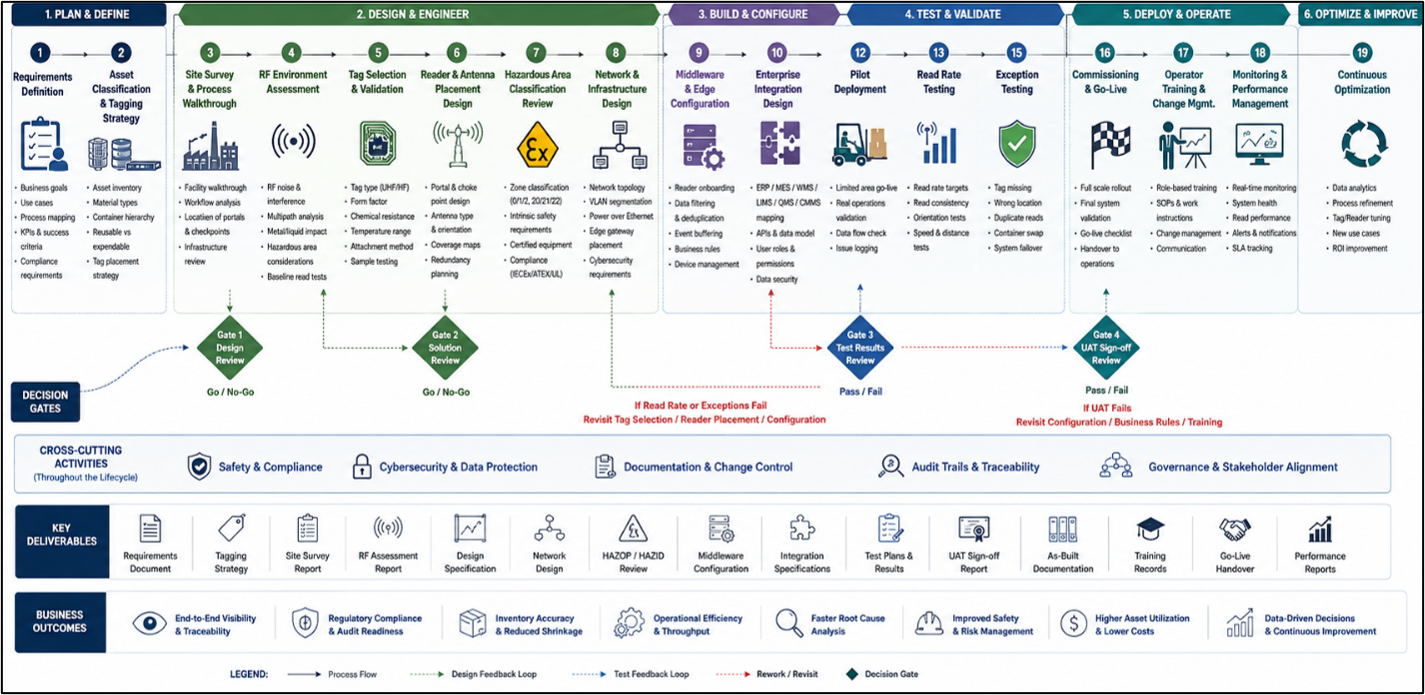
Engineering workflow covering RFID planning, site surveying, system design, integration, testing, commissioning, training, and continuous optimization.
Cybersecurity, Data Integrity, and Operational Reliability
AI-driven material tracking must preserve trustworthy event data. A false location event or incorrect association between a material and a production batch can be more damaging than a missing event because users may make decisions based on incorrect information.
Security controls should therefore address both the RFID infrastructure and the software handling operational data.
Relevant controls include:
- Role-based access control
- Strong authentication
- Network segmentation
- Secure API communication
- Device identity management
- Audit logging
- Data validation
- Time synchronization
- Event deduplication
- Local buffering during connectivity loss
- Backup and recovery procedures
- Software and firmware lifecycle management
- Monitoring of unusual system behavior
Data quality should also be measured. Read rates, duplicate events, missed events, location confidence, timestamp integrity, and integration failures should be monitored as operational KPIs rather than treated solely as IT metrics.
GAO Group, which includes GAO, GAO Research Inc., and GAO Tek Inc., has invested heavily in R&D and quality assurance for RFID, BLE, and IoT products and systems and provides technical support remotely or onsite.
AI Applications That Improve Specialty Chemical Operations
AI becomes most valuable when it converts tracking and production data into decisions that operators, planners, quality teams, and maintenance personnel can act on. For specialty chemical manufacturing, the strongest applications are closely connected to material genealogy, production planning, inventory control, quality, and asset reliability.
AI Inventory Forecasting and Replenishment
Specialty chemical manufacturers often manage materials with different consumption rates, supplier lead times, minimum order quantities, shelf-life requirements, and production dependencies. Historical consumption alone may not accurately predict future requirements because demand can change with customer orders, production campaigns, seasonal patterns, and formulation changes.
Machine learning models can combine:
- Historical material consumption
- Production schedules
- Open production orders
- Supplier lead times
- Inventory levels
- Safety-stock requirements
- Purchase-order history
- Material shelf life
- Batch requirements
RFID observations can provide an additional source of actual material movement. This helps distinguish nominal inventory from material that is physically available, staged, consumed, or temporarily located elsewhere.
AI-Based Inventory Anomaly Detection
Anomaly detection can identify unusual inventory behavior without requiring every exception to be manually defined.
Examples include:
- Unexpected movement of a high-value chemical container
- Repeated movement between storage and staging areas
- Inventory remaining in a production area longer than expected
- Material consumption that differs from historical batch behavior
- A container appearing in two operational zones within an impossible time interval
- A large difference between system inventory and physically observed inventory
The system can assign an anomaly score and route higher-risk exceptions to appropriate personnel instead of generating indiscriminate alerts.
AI-Assisted Quality and Batch Investigation
Quality investigations can require information from multiple systems. AI can help correlate batch records, raw-material lots, RFID movement history, laboratory results, process variables, equipment records, and operator-entered information.
The goal is not to replace quality personnel. Instead, AI can reduce the time required to identify potentially relevant relationships and focus an investigation on the most significant variables.
Predictive Maintenance for Production Assets
Specialty chemical plants depend on pumps, agitators, mixers, motors, valves, compressors, heat-transfer equipment, instrumentation, and other process assets. RFID can identify equipment, maintenance tools, spare parts, or mobile assets, while other IoT sensors provide condition data.
AI models can analyze vibration, temperature, current, operating hours, alarm history, maintenance records, and production context to identify developing equipment problems.
This can support:
- Predictive maintenance
- Failure-risk scoring
- Maintenance prioritization
- Spare-parts planning
- Maintenance compliance
- Mean time between failures analysis
- Mean time to repair analysis
- Equipment utilization analysis
RFID is therefore an enabling identification technology rather than the sole source of predictive-maintenance data.
Connecting AI Applications to Specialty Chemical KPIs
A technically successful deployment should produce measurable operational outcomes. Recommended KPIs should be established before implementation so that the organization can compare baseline performance with post-deployment results.
| Operational Area | Example KPI | AI and RFID Contribution |
|---|---|---|
| Inventory | Inventory accuracy | Reconciles physical movement with inventory records |
| Warehouse | Material search time | Provides recent location information |
| Production | Staging compliance | Compares material movement with production requirements |
| Traceability | Batch genealogy completeness | Connects material identity and movement events |
| Quality | Investigation time | Correlates batch, material, and operational data |
| Logistics | Shipment verification accuracy | Confirms identified materials before dispatch |
| Maintenance | Asset utilization | Provides identification and movement history |
| Maintenance | Unplanned downtime | AI analyzes equipment-condition and maintenance data |
| Planning | Stockout frequency | Forecasting combines consumption and production requirements |
| Compliance | Traceability record completeness | Preserves auditable movement and identification events |
| Operations | Exception response time | Automated alerts prioritize abnormal conditions |
The most useful measurement strategy combines technical KPIs with financial and operational outcomes. For example, a higher RFID read rate is useful, but its business significance becomes clearer when it reduces inventory reconciliation time or improves batch-traceability performance.
Integrating AI and RFID with Chemical Manufacturing Software
RFID should not become another isolated database. Its greatest operational value comes from integration with systems already used to manage production, inventory, quality, maintenance, and laboratory processes.
Potential integration points include:
- ERP: Purchase orders, material master data, inventory transactions, suppliers, production orders, and financial records
- MES: Production orders, batch execution, material consumption, work-in-process, and production status
- WMS: Storage locations, warehouse movements, picking, receiving, and shipping
- LIMS: Laboratory samples, test results, sample locations, and quality workflows
- QMS: Nonconformances, corrective actions, inspections, and quality investigations
- CMMS/EAM: Equipment records, maintenance work orders, spare parts, and asset history
- SCADA: Process conditions, alarms, equipment states, and production signals
- Historian: Time-series process data used for AI analysis
- Identity and access systems: User authentication and authorization
Integration design should establish which system is authoritative for each data object. For example, an ERP may remain authoritative for inventory ownership while the RFID system provides physical movement observations. A MES may control batch execution while RFID confirms that the expected material physically entered the production area.
This distinction helps prevent conflicting records and makes exception handling clearer.
AI-RFID Integration with ERP, MES, WMS, LIMS, QMS and CMMS
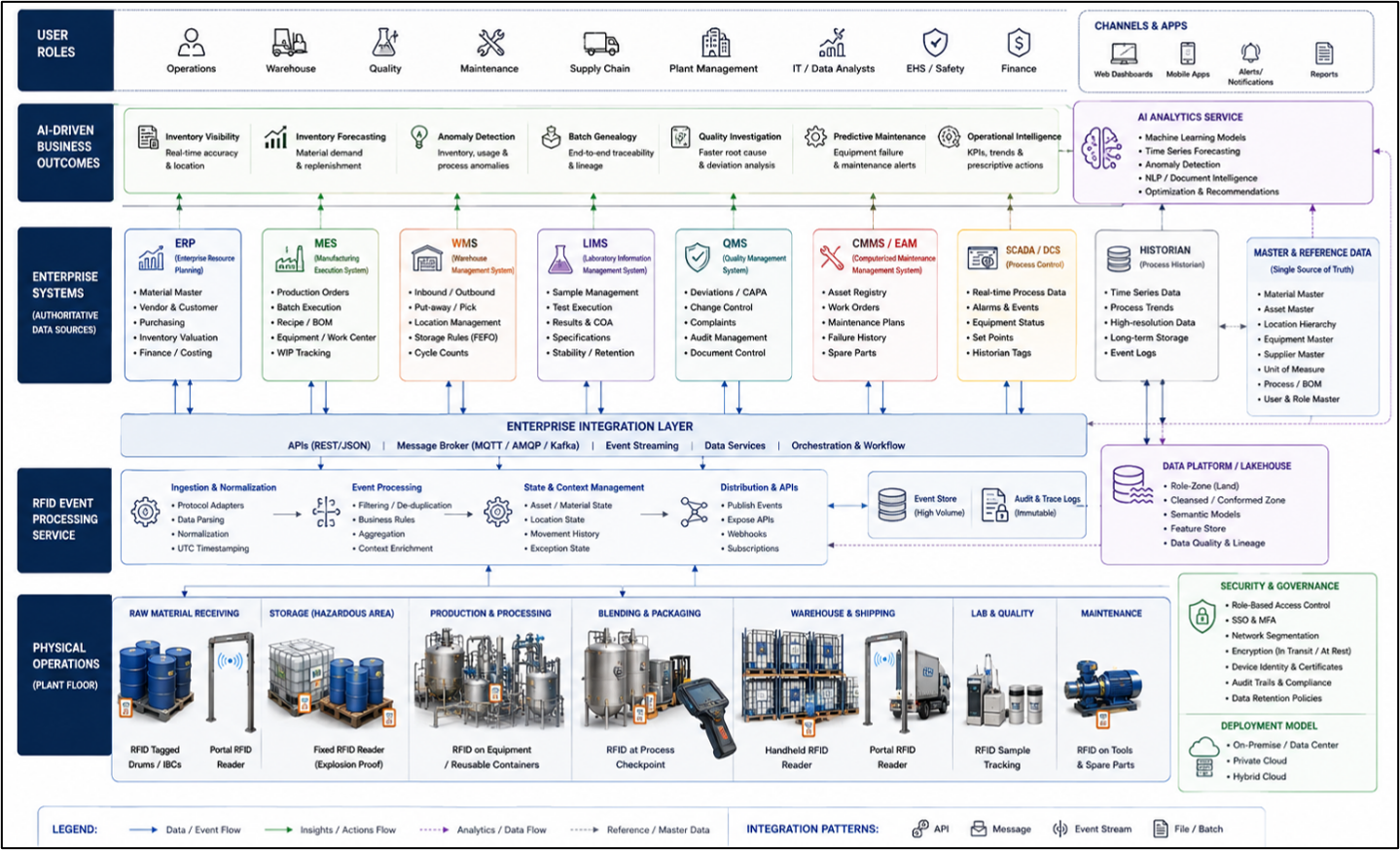
Systems integration architecture showing how RFID events flow through enterprise systems and AI analytics to deliver inventory, traceability, quality, maintenance, and operational intelligence.
Implementation Roadmap for Specialty Chemical Manufacturers
A phased implementation generally reduces technical and operational risk.
Requirements and Process Mapping
Start by identifying the business problem rather than selecting RFID hardware first. Document the material flows, container types, production steps, storage locations, handoff points, required traceability, and existing software systems.
Select a narrowly defined initial use case such as raw-material receiving, warehouse inventory accuracy, production staging, or reusable-container tracking.
Site Survey and RFID Engineering
Evaluate the actual facility and representative chemical containers. Test tag placement, antenna positions, reader power, read zones, network connectivity, and environmental conditions.
Where hazardous locations are involved, equipment selection and installation must follow the applicable site safety requirements and certifications.
Pilot Deployment
A pilot should use real operating workflows and representative materials. Performance should be measured during receiving, storage, staging, production, and other relevant activities.
Testing should include normal and abnormal conditions rather than only successful reads.
Software Integration
Connect validated RFID events with the required enterprise systems. Establish data ownership, event definitions, exception workflows, user permissions, audit requirements, and data-retention policies.
AI Model Development
AI should be introduced after sufficient operational data is available. Initial models can focus on descriptive analytics and anomaly detection before moving toward forecasting or predictive applications.
Model performance should be evaluated using operationally meaningful metrics rather than accuracy alone.
Production Rollout and Optimization
After successful acceptance testing, expand the solution to additional production areas, warehouses, materials, or facilities. Monitor read performance, integration reliability, user adoption, AI model performance, and operational outcomes.
GAO can support organizations with RFID, BLE, and IoT hardware products and systems as these deployments move from requirements definition through implementation and operational use.
Practical Design Lessons for AI-Enabled Specialty Chemical Tracking
Several engineering principles can improve the reliability of an implementation.
- Design around the workflow: RFID read points should correspond to meaningful material or asset transitions rather than being installed wherever convenient.
- Validate tags on real containers: Chemical liquids, metal surfaces, and packaging materials can significantly affect RF behavior.
- Separate identification from location logic: A tag identifies an object, while software determines what its observation means operationally.
- Use event filtering: Duplicate RFID observations should be consolidated into meaningful movement events.
- Keep local resilience: Edge processing and buffering can maintain operations during temporary network interruptions.
- Integrate before scaling: A large number of readers does not create business value if events cannot reliably reach inventory, production, quality, and maintenance workflows.
- Start AI with measurable problems: Inventory anomalies, material demand, batch genealogy, and maintenance risk are more actionable than generic AI experimentation.
- Preserve human oversight: High-impact decisions involving chemical production, quality release, safety, or compliance should retain appropriate human review.
- Monitor data quality: Missing reads, duplicate reads, incorrect timestamps, and integration failures should be treated as measurable system conditions.
- Design cybersecurity from the beginning: RFID readers, gateways, servers, APIs, user accounts, and cloud services should be included in the security model.
Business Value of AI-Driven Specialty Chemical Operations
Combining AI with reliable physical identification can create value across several parts of the specialty chemical lifecycle.
Improved material visibility comes from connecting physical movement with inventory and production records.
Faster traceability results from maintaining relationships between material identity, lot numbers, locations, production batches, and shipment events.
Lower inventory uncertainty can result when physical observations continuously supplement transactional records.
Better production staging is possible when AI compares expected material requirements with actual material movement.
More effective quality investigations can result from correlating material genealogy with laboratory, production, and movement information.
Reduced maintenance risk can result when equipment condition data is combined with asset identity, operating history, and maintenance records.
Improved operational scalability becomes possible when standardized RFID event models and software integrations can be reused across additional storage areas, production lines, and facilities.
These benefits should be evaluated against measurable baseline KPIs rather than assumed simply because RFID or AI has been installed.
Security, Compliance, and Responsible AI Considerations
Specialty chemical operations require careful treatment of operational and product data. AI systems should have clearly defined data sources, model objectives, access controls, retention rules, and human-review procedures.
Regulatory requirements vary according to chemical classification, facility location, process characteristics, transportation activities, and applicable national, state, provincial, and local requirements. Organizations should therefore validate the applicable requirements with their safety, environmental, quality, legal, and compliance teams rather than treating an RFID or AI system as a substitute for regulatory controls.
AI recommendations should also remain explainable enough for operational users to understand why an alert was generated. A material-movement anomaly, for example, should ideally provide supporting information such as the observed location, expected location, timestamp, production order, and relevant historical pattern.
Building a Scalable AI and RFID Program for Specialty Chemicals
A scalable deployment is more than adding additional RFID readers. It requires consistent data models, repeatable installation practices, reliable integrations, documented operating procedures, cybersecurity controls, and measurable performance standards.
A manufacturer beginning with one warehouse application can later expand into production staging, reusable-container tracking, batch genealogy, laboratory sample management, maintenance, and logistics. Each additional application should use consistent asset identifiers and event structures wherever practical.
GAO’s broader technology experience includes RFID, BLE, and IoT products and systems developed through significant R&D investment. GAO Group has served customers in the United States and Canada for three decades, including Fortune 500 companies, R&D organizations, universities, and government agencies.
Specialty Chemical AI + RFID Maturity Roadmap
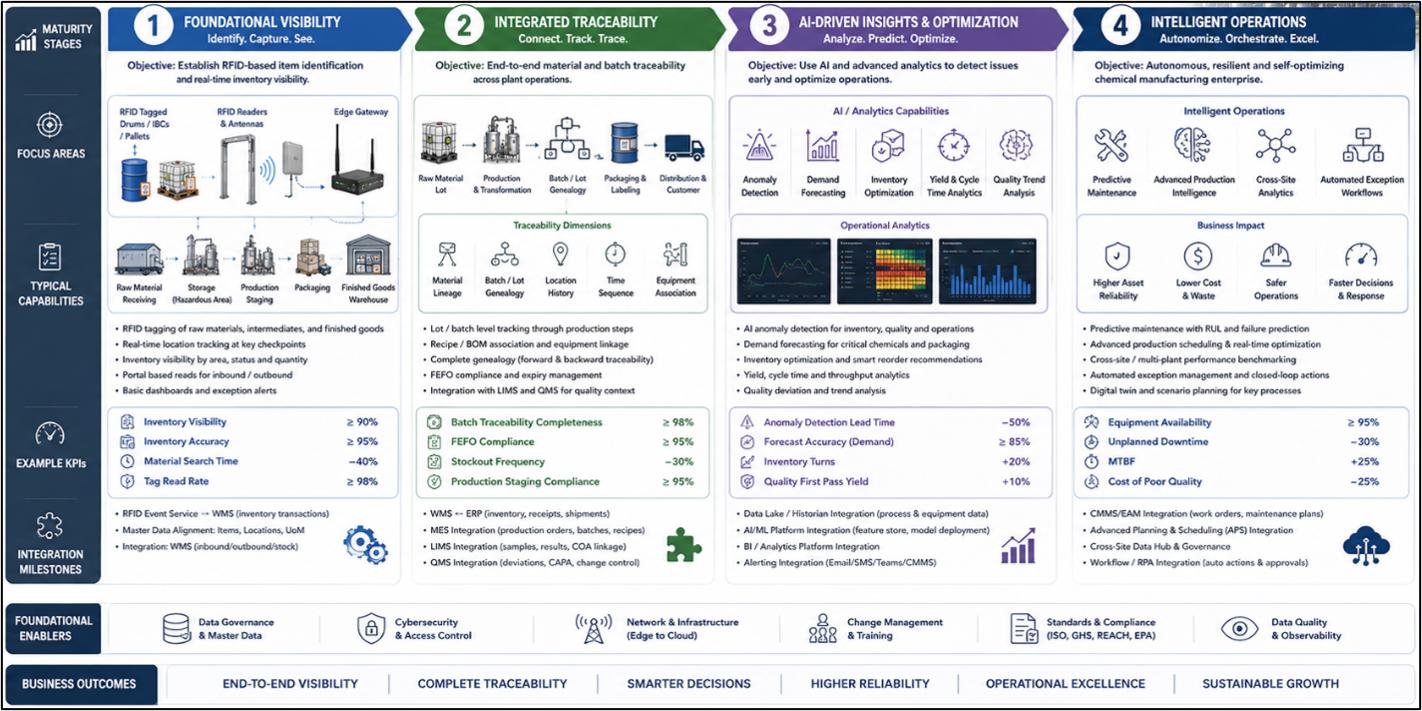
Four-stage roadmap showing the evolution from RFID-based visibility and traceability to AI-driven optimization, predictive maintenance, and intelligent operations.
Key Takeaways for AI-Driven Specialty Chemical Operations
AI-driven asset tracking for specialty chemicals is most effective when it connects physical material movement with production, inventory, quality, laboratory, maintenance, and logistics information. RFID provides an important identification mechanism for containers and assets, while AI turns accumulated operational data into forecasts, anomaly detection, traceability intelligence, and decision support.
Successful implementation depends on site-specific RFID engineering, appropriate tag selection, reliable connectivity, resilient edge processing, disciplined software integration, cybersecurity, and measurable KPIs. Organizations should begin with a clearly defined operational problem, validate the solution with real specialty chemical materials and workflows, and expand only after demonstrating measurable results.
GAO provides RFID, BLE, and IoT hardware products and systems that can support organizations developing these connected operational workflows. Readers interested in applying AI-driven tracking, RFID identification, or IoT monitoring to specialty chemical manufacturing can evaluate requirements with GAO’s technical resources and engineering support.
Building the Future of Industrial AI and IoT with Aperture Venture Studio and GAO RFID Inc.
For more than three decades, GAO Group of Companies has invested heavily in R&D for industrial RFID, BLE, and IoT technologies. As generative AI became increasingly useful for industrial applications, we expanded our work across AI and IoT, including RFID and BLE, and founded Aperture Venture Studio to support the development and scaling of AI and IoT solutions relevant to areas such as specialty chemical manufacturing, asset tracking, industrial operations, and connected production.
Aperture has attracted AI and IoT technical experts, entrepreneurial and operational executives, investors, and leading companies. We have also developed Aperture Ventures Summit and TekSummit to facilitate discussion of advanced AI and IoT topics.
We welcome you to join us as:
- Advisors, co-founders, or employees
- Investors
- Customers