
AI and RFID for Nutraceutical Manufacturing
AI and RFID for Nutraceutical Manufacturing
AI is transforming nutraceutical manufacturing by turning production, inventory, quality, and traceability data into actionable operational intelligence. When artificial intelligence is combined with connected identification technologies such as UHF RFID, HF RFID, and LF RFID, manufacturers can improve material tracking, batch genealogy, warehouse accuracy, equipment utilization, and production visibility. In nutraceutical facilities, these capabilities are particularly valuable because raw botanicals, vitamins, minerals, excipients, capsules, packaging materials, work-in-process batches, and finished products must be controlled through multiple processing and storage stages. AI can analyze identification events, production records, environmental readings, machine data, laboratory results, and enterprise software records to identify anomalies and support decisions. RFID provides automated identification and location information, while AI converts that information into predictions, alerts, optimization recommendations, and workflow decisions. GAO supplies RFID, BLE, and IoT hardware products and systems that can support these connected manufacturing applications.
AI-Enabled Nutraceutical Manufacturing Workflow
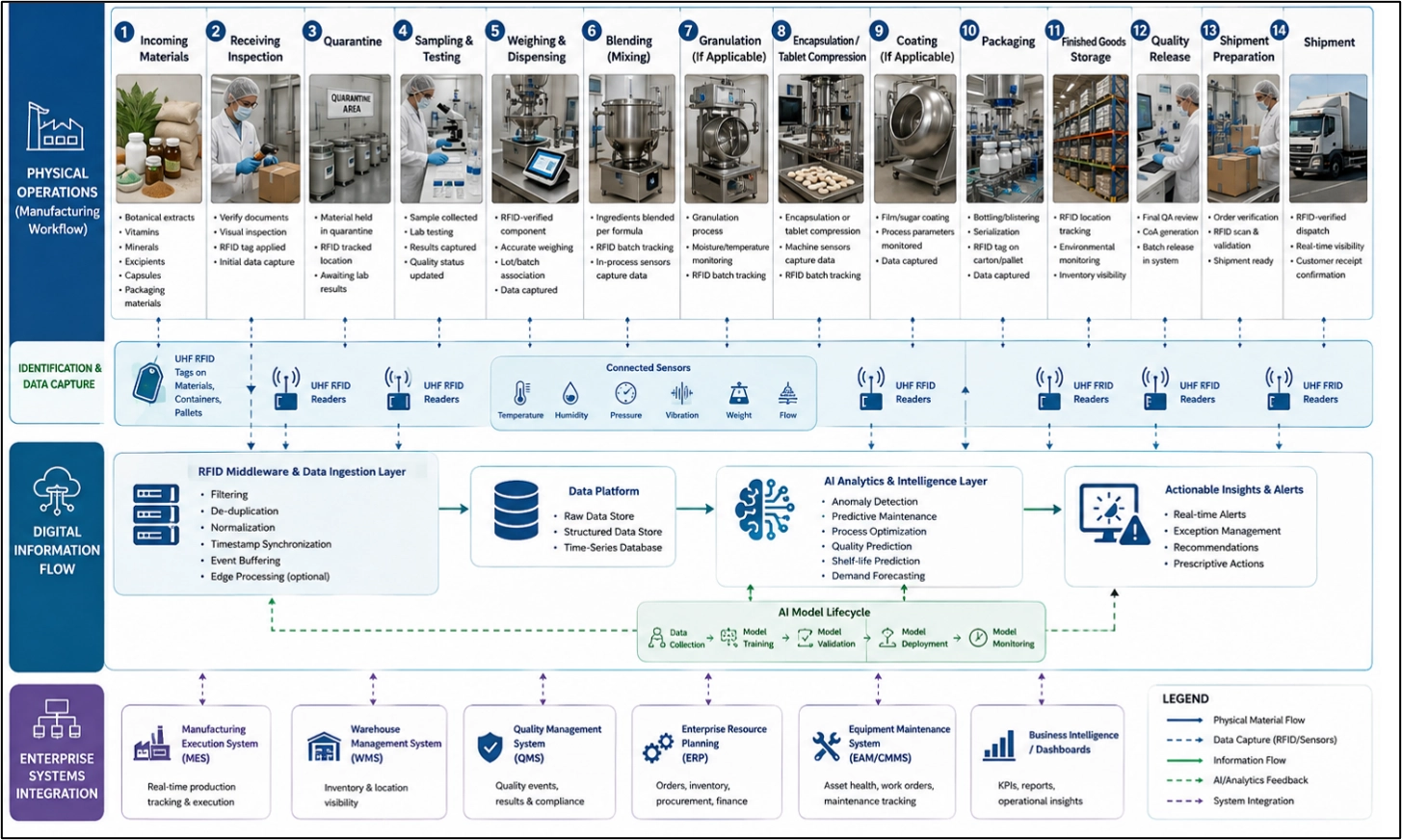
Shows the end-to-end nutraceutical manufacturing workflow from raw-material receiving to shipment. llustrates RFID tags, readers, and sensors capturing real-time production and material data.AI analytics identifies anomalies, predicts issues, and supports quality and process optimization. Connects manufacturing operations with MES, WMS, QMS, ERP, maintenance, and BI systems.
How AI Improves Nutraceutical Manufacturing Operations
Nutraceutical manufacturing combines formulation control, material handling, production scheduling, quality management, packaging, warehouse operations, and regulatory documentation. A production delay or material identification error can affect an entire batch because many operations are dependent on correct material identity, quantity, status, and location.
AI helps manufacturers move beyond simply recording production events. Machine learning models can analyze historical batch records, material movements, equipment conditions, environmental measurements, quality results, and production-cycle information to detect patterns that are difficult to identify through manual review.
Common AI applications include:
- AI-assisted batch traceability that identifies unusual material movements or missing process events.
- AI inventory management that predicts material requirements and identifies abnormal consumption.
- AI quality analytics that correlates process conditions with deviations, rejects, or out-of-specification trends.
- AI production scheduling that considers material availability, equipment capacity, changeover requirements, and batch priorities.
- AI predictive maintenance that analyzes equipment telemetry to identify conditions associated with impending failures.
- AI warehouse management that improves put-away, picking, replenishment, and finished-goods movement.
- AI anomaly detection that identifies unexpected movement of quarantined, rejected, released, or expired materials.
- AI-assisted recall analysis that rapidly identifies potentially affected batches, lots, materials, and shipment destinations.
RFID becomes an important data-acquisition mechanism within these applications. Rather than requiring operators to manually scan every movement, RFID readers can capture tag events as materials and containers pass through defined locations. The resulting event stream can be combined with manufacturing execution systems, warehouse management systems, laboratory information systems, enterprise resource planning software, and quality management software.
Why Material Identity Matters in Nutraceutical Production
Nutraceutical facilities handle materials with different specifications, suppliers, lot numbers, expiration dates, storage conditions, and quality statuses. Botanical ingredients can also introduce additional variability because their characteristics may depend on source, extraction process, concentration, moisture content, and other factors.
AI-supported traceability can use these variables to identify inconsistencies such as:
- A raw material entering production before quality release.
- A container appearing in a production area without the expected preceding transaction.
- An ingredient being associated with an unexpected batch.
- Material consumption deviating significantly from historical production patterns.
- A finished product being moved to an incorrect warehouse location.
- A quarantined or rejected material generating movement events inconsistent with its status.
These capabilities are most valuable when identification events are connected to the actual business rules governing nutraceutical production rather than treated as isolated RFID records.
Nutraceutical Manufacturing Applications for AI-Driven Traceability
AI-enabled traceability can support multiple operational areas across a nutraceutical facility.
Raw Material Receiving and Quarantine
Receiving is the first point where material identity, supplier information, lot information, quantity, and quality status enter the manufacturing data chain. RFID-tagged containers, pallets, totes, drums, or other suitable handling units can be associated with receiving records.
AI can analyze receiving patterns and identify discrepancies between expected and observed material quantities or movements. A system can also flag unusual supplier-related patterns, repeated receiving discrepancies, or material movements that do not correspond with the expected quality-release workflow.
UHF RFID is generally useful when facilities need longer read ranges and automated identification of tagged containers, pallets, or cases moving through receiving and warehouse areas. HF RFID can be appropriate for shorter-range controlled interactions, while LF RFID can be considered for specialized identification requirements where its physical characteristics provide an advantage.
Weighing, Dispensing, and Material Verification
Weighing and dispensing are critical control points because incorrect material identity or quantity can affect formulation quality. RFID identification can help associate containers with the intended production order and material record before dispensing.
AI can add a second layer of intelligence by comparing current dispensing activity with historical and expected process behavior. For example, an anomaly-detection model could flag an unusual consumption pattern, unexpected sequence of material additions, or discrepancy between the planned and observed material flow.
The objective is not to allow AI to bypass established quality controls. Instead, AI should provide additional evidence and alerts while validated manufacturing procedures remain the basis for controlled production decisions.
Blending, Granulation, Encapsulation, and Tablet Production
Production equipment generates information about operating conditions, cycle times, alarms, throughput, and equipment utilization. When this information is associated with batch and material identity, manufacturers can establish a more complete production history.
AI models can analyze relationships between process variables and production outcomes. Depending on the available data and validation requirements, applications may include process anomaly detection, cycle-time analysis, yield analysis, predictive maintenance, and identification of operating conditions associated with deviations.
RFID can maintain the identity of containers, intermediate materials, tooling, or other trackable production assets as they move between processing stages.
Packaging and Finished-Goods Traceability
Packaging introduces another set of traceability requirements involving components, packaging orders, production lots, cases, pallets, and finished products. RFID can provide automated identification at selected packaging and warehouse checkpoints.
AI can analyze movement patterns and packaging records to identify inconsistencies such as unexpected material consumption, abnormal production rates, unusual case movements, or discrepancies between production and warehouse transactions.
A properly designed solution can therefore connect material identity with production and logistics events instead of maintaining separate disconnected records.
AI and RFID Deployment in a Nutraceutical Manufacturing Facility
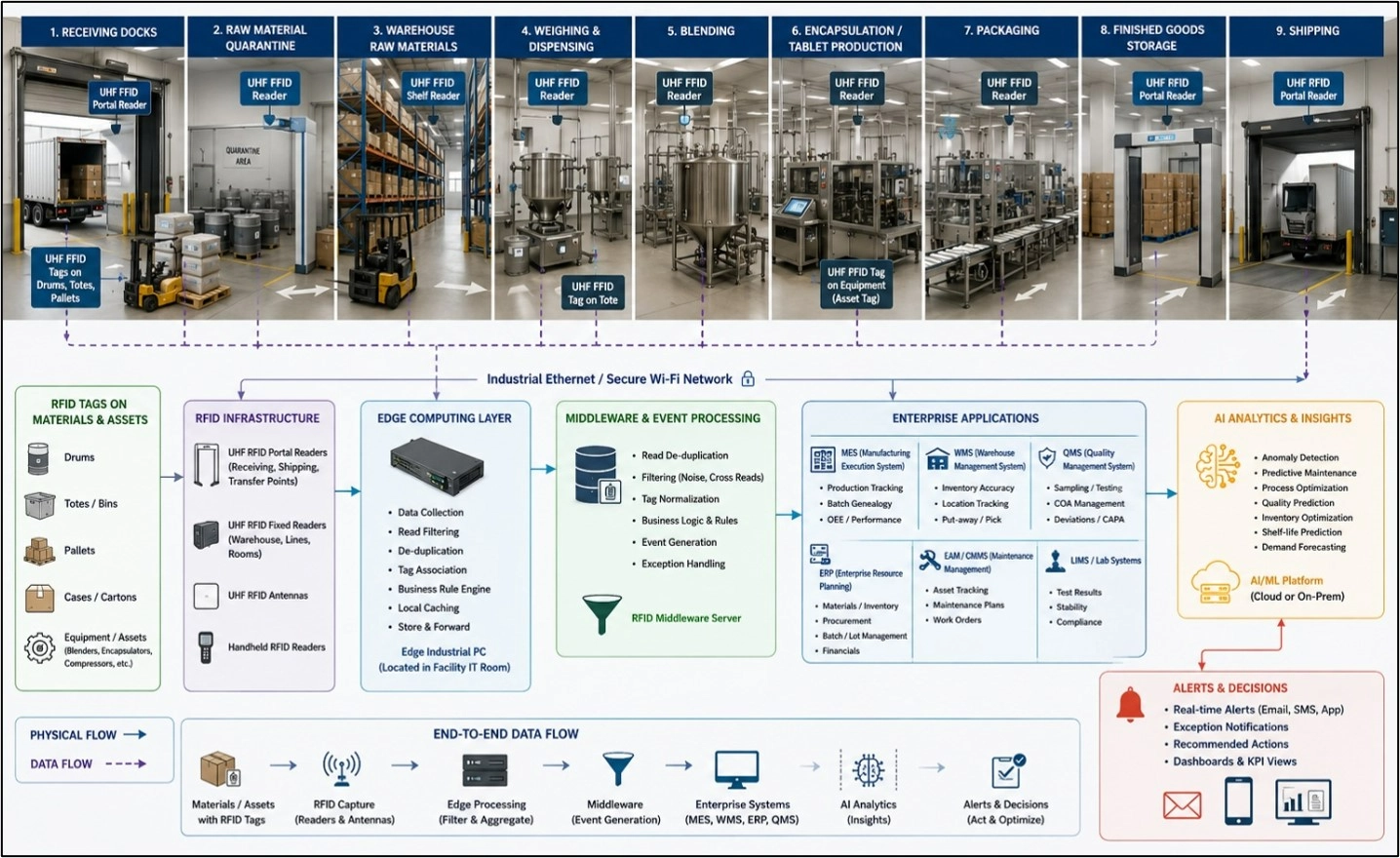
Shows RFID deployment across receiving, warehousing, production, packaging, storage, and shipping areas.RFID tags and readers capture real-time material, batch, and asset movements.
Edge computing and middleware filter RFID data and generate validated business events.
AI analytics connects with MES, WMS, ERP, QMS, and maintenance systems to support alerts and decisions.
From RFID Events to AI-Driven Manufacturing Decisions
A useful AI and RFID solution should be designed as a complete operational data flow rather than as an isolated reader installation.
The process typically begins with physical identification and data acquisition. RFID tags are attached to appropriate handling units, containers, cases, pallets, or assets. Fixed readers, antennas, handheld readers, or integrated RFID equipment capture identification events at defined points.
Raw reader events are not automatically equivalent to business transactions. A reader may detect the same tag multiple times, detect tags outside the intended process zone, or capture several tags simultaneously. Middleware and edge processing therefore perform important functions such as filtering, deduplication, event correlation, validation, buffering, and transformation.
The resulting events can then be associated with production and inventory records.
Data Acquisition
Relevant data may include:
- RFID tag identifier and associated material or asset identity.
- Reader location and antenna zone.
- Timestamp and read-event history.
- Batch, lot, work order, and production status.
- Material quantity and inventory status.
- Equipment operating conditions.
- Environmental measurements where relevant.
- Quality inspection and laboratory results.
- Warehouse transactions.
- Maintenance events and equipment alarms.
Edge Processing and Event Validation
Edge processing is particularly useful where manufacturing operations require low-latency event handling or continued operation during temporary network interruptions.
An edge computer can validate RFID reads against known locations and workflows, suppress repeated reads, buffer events, and forward normalized information to centralized software. This reduces unnecessary data transmission and helps prevent noisy RFID observations from directly entering business systems.
AI Analytics
Validated data can be analyzed using appropriate AI and machine learning methods.
Potential methods include:
- Classification for identifying known operational conditions.
- Anomaly detection for unusual material or equipment behavior.
- Time-series forecasting for inventory demand, production activity, or equipment conditions.
- Regression models for predicting measurable operational outcomes.
- Clustering for identifying recurring operational patterns.
- Computer vision where visual inspection can complement RFID and sensor information.
- Generative AI for controlled search, summarization, and operator assistance over approved manufacturing information.
The correct model depends on data quality, business objectives, validation requirements, explainability needs, and the consequences of incorrect predictions.
Business Actions
AI outputs should ultimately support an operational action. Examples include generating an investigation alert, recommending maintenance, identifying a material discrepancy, notifying warehouse personnel, prioritizing a quality review, or providing production-management insight.
A technically sophisticated model provides limited value if its output is not connected to an actionable workflow.
From RFID Events to AI Decisions in Nutraceutical Manufacturing
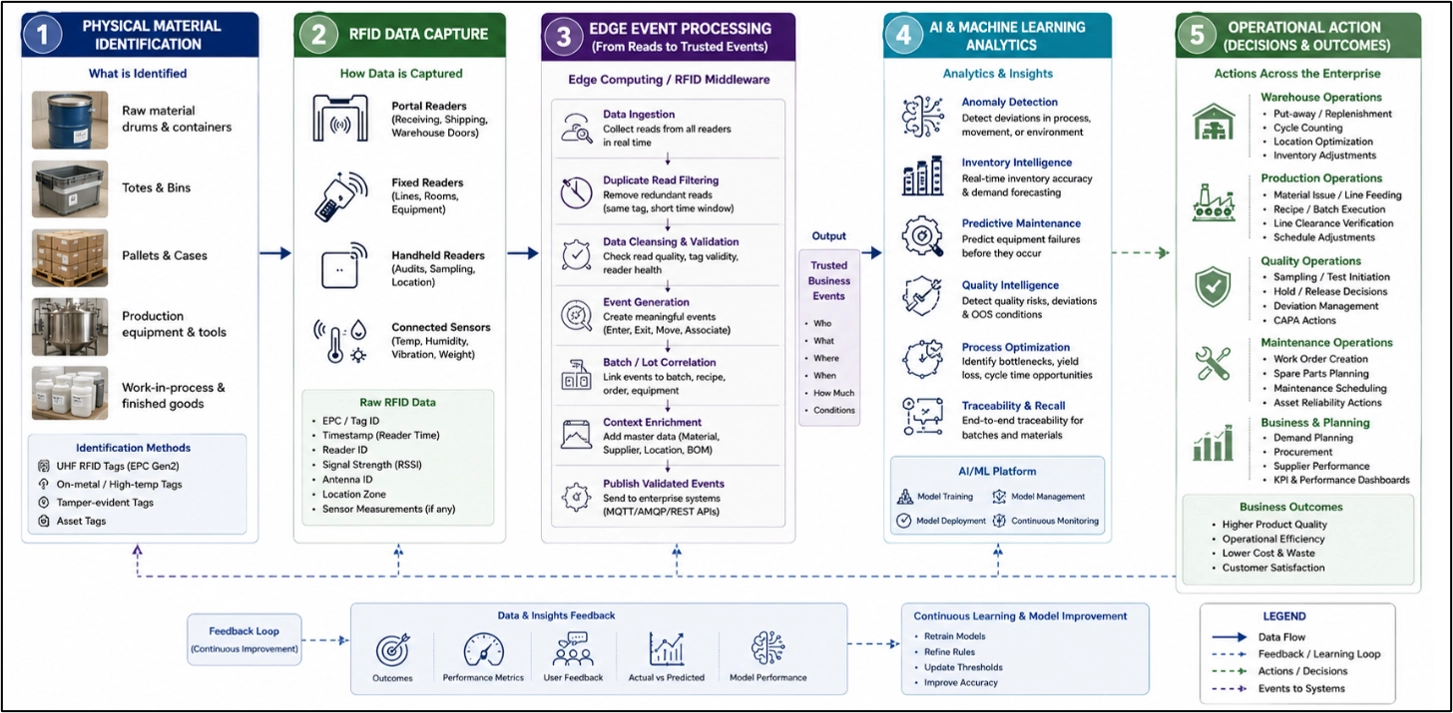
Shows how RFID data moves from physical materials to intelligent operational decisions.
RFID readers capture events, while edge processing filters, validates, and correlates the data.
AI analytics generates insights such as anomaly detection, forecasting, predictive maintenance, and quality alerts. Operational feedback continuously improves data analysis, models, and manufacturing decisions.
Connecting AI, RFID, and Manufacturing Software
The value of identification data increases when it can be correlated with existing software rather than creating another isolated database.
A nutraceutical manufacturing deployment may exchange information with:
- Enterprise resource planning systems for purchasing, inventory, production orders, and financial records.
- Manufacturing execution systems for batch execution, production status, work instructions, and electronic records.
- Warehouse management systems for receiving, put-away, picking, replenishment, and shipping.
- Laboratory information management systems for laboratory workflows and test results.
- Quality management systems for deviations, investigations, corrective actions, and approvals.
- Maintenance management systems for work orders, preventive maintenance, and equipment history.
- Building and environmental monitoring systems where storage or production conditions must be monitored.
- RFID middleware for device management, event processing, filtering, and integration.
- AI analytics software for forecasting, anomaly detection, optimization, and decision support.
Interoperability should be considered during solution design rather than after hardware installation. Standardized interfaces, controlled data models, clear ownership of master data, timestamp synchronization, and reliable event processing can substantially reduce integration problems.
GAO’s experience supplying RFID, BLE, and IoT hardware products and systems can support organizations that need connected identification and monitoring capabilities across manufacturing and logistics operations. GAO has served customers in the United States and Canada for decades, including Fortune 500 companies, research organizations, universities, and government agencies, with an emphasis on product R&D, quality assurance, and technical support.
RFID Hardware and AI Deployment Design for Nutraceutical Facilities
RFID selection should be based on the physical workflow rather than simply choosing the highest-performing reader or longest read range. Tag material, container composition, liquid content, metal surfaces, reader placement, antenna orientation, read-zone geometry, interference, and required read reliability all affect deployment performance.
UHF RFID is commonly considered for automated identification across receiving docks, warehouse portals, pallet movement, case tracking, and other longer-range applications. HF RFID can be appropriate for controlled near-field interactions, while LF RFID may be useful for specialized environments where low-frequency behavior is advantageous.
A deployment can combine RFID with BLE beacons, environmental sensors, industrial equipment data, barcode systems, cameras, and other IoT devices. AI then provides a mechanism for correlating these different data sources.
Cloud Version
A cloud-hosted deployment can centralize RFID event processing, AI analytics, dashboards, model management, and software integrations. This approach can be appropriate when multiple facilities need shared visibility, centralized analytics, remote administration, or scalable computing resources.
Cloud deployment also requires careful attention to network availability, data residency, identity management, encryption, API security, tenant isolation where applicable, and operational continuity.
Server Version
A server deployment can place software on customer-managed factory servers, private data centers, edge servers, or other privately hosted enterprise infrastructure. This approach may be preferable when manufacturing data must remain within controlled infrastructure, when connectivity to external cloud services is limited, or when local integration and low-latency processing are priorities.
The choice between cloud and server deployment should be driven by data governance, connectivity, cybersecurity requirements, operational latency, integration constraints, maintenance capabilities, and the organization’s IT strategy rather than by technology preference alone.
Security and Reliability Considerations
RFID and AI systems connected to production environments must be treated as part of the manufacturing information infrastructure.
Important controls include:
- Role-based access control for RFID middleware, dashboards, and AI applications.
- Strong authentication for users, devices, APIs, and service accounts.
- Encryption for sensitive data in transit and at rest.
- Network segmentation between RFID and IoT devices and critical manufacturing systems.
- Secure device configuration and controlled firmware updates.
- Audit logging for system access and important operational events.
- Data validation before AI models consume production information.
- Monitoring for abnormal device behavior and unauthorized system activity.
- Backup and recovery procedures for critical configuration and operational data.
- Fail-safe operating procedures when network connectivity or AI services are unavailable.
AI should support manufacturing personnel rather than silently replacing controlled quality decisions. Production and quality workflows should define which AI outputs are advisory, which can trigger automated actions, and which require human review.
Operational Benefits of AI-Enabled Nutraceutical Manufacturing
Combining AI-driven analytics with automated identification gives nutraceutical manufacturers a more complete view of materials, batches, equipment, and production activity. The value comes from connecting operational data to specific manufacturing decisions rather than simply increasing the amount of collected data.
Improved Batch Genealogy and Traceability
Batch genealogy can become more difficult when ingredients, intermediate materials, packaging components, and finished goods move through multiple rooms and storage locations.
RFID event data can provide time-stamped evidence of material movement, while AI can identify missing, unexpected, or abnormal transitions. This can help quality and operations teams investigate discrepancies more quickly.
A connected system can associate:
- Raw-material lots with receiving records.
- Released materials with production orders.
- Dispensed ingredients with specific batches.
- Intermediate containers with processing stages.
- Packaging components with production runs.
- Finished cases and pallets with finished-product lots.
- Shipment events with destination and inventory records.
The result is a more searchable and analyzable chain of custody across nutraceutical manufacturing operations.
Inventory Accuracy and Material Availability
Inventory discrepancies can interrupt production when materials appear available in an ERP or warehouse system but cannot be physically located.
Automated RFID identification can provide additional evidence of where tagged inventory was last observed. AI can analyze historical consumption, production schedules, lead times, inventory levels, and movement patterns to forecast requirements.
This can support:
- Raw-material replenishment.
- Safety-stock planning.
- Expiration-aware inventory management.
- Warehouse slotting decisions.
- Production material staging.
- Detection of unusual inventory consumption.
- Identification of potentially misplaced materials.
For nutraceutical ingredients with shelf-life constraints, inventory intelligence can also help operations teams prioritize materials according to expiration and production requirements.
Predictive Maintenance and Equipment Utilization
Production equipment such as blenders, mixers, encapsulation machines, tablet presses, coating systems, conveyors, packaging machinery, pumps, and HVAC-related equipment can generate operational data.
AI models can analyze vibration, temperature, current, runtime, alarm history, cycle time, maintenance records, and production conditions to identify patterns associated with equipment degradation.
RFID can complement this capability by identifying equipment, tooling, containers, or maintenance assets at specific locations. The combined information can help maintenance teams associate equipment conditions with actual production activity.
The practical objective is not simply predicting failure. A useful predictive-maintenance program should help answer:
- Which asset requires attention?
- What condition indicates a potential problem?
- How urgent is the issue?
- What production batches may be affected?
- Can maintenance be scheduled during a planned changeover?
- Which spare parts or technicians may be required?
Quality Management and AI-Assisted Anomaly Detection
Quality is central to nutraceutical manufacturing because product characteristics depend on raw-material attributes, formulation, processing conditions, environmental factors, equipment performance, and packaging controls.
AI can examine relationships between these variables and identify patterns that may deserve investigation.
For example, an anomaly-detection system could identify a batch whose production cycle time, ingredient consumption, equipment behavior, or environmental measurements differ substantially from historical batches of comparable products.
RFID contributes identification and movement context. It can establish which container, batch, or asset was present at a particular location and time. This context can make AI-generated anomalies more useful because the alert can be associated with an identifiable manufacturing event.
AI outputs should remain subject to appropriate quality procedures, validation requirements, and human review. An algorithmic anomaly should be treated as evidence for investigation, not automatically as proof of a quality failure.
Key KPIs for AI and RFID Programs
A successful implementation should be evaluated using measurable operational outcomes rather than reader counts or tag volumes alone.
Useful nutraceutical manufacturing KPIs include:
- Inventory record accuracy.
- Material location accuracy.
- Batch genealogy completeness.
- Material verification error rate.
- Production schedule adherence.
- Batch cycle time.
- Production yield.
- Equipment availability.
- Overall equipment effectiveness where applicable.
- Unplanned downtime.
- Mean time between failures.
- Mean time to repair.
- Maintenance compliance.
- Warehouse picking accuracy.
- Receiving transaction accuracy.
- Material staging accuracy.
- Quarantine-status accuracy.
- Expired-material incidents.
- Quality deviation rate.
- Rework rate.
- Scrap or reject rate.
- Production throughput.
- RFID read accuracy.
- RFID event processing latency.
- AI alert precision.
- AI false-alert rate.
- Predictive-alert lead time.
- User response time to operational alerts.
- System availability.
The KPI framework should be established before deployment so that baseline performance can be compared with post-deployment results.
Engineering Considerations for RFID Deployment
RFID performance depends strongly on physical conditions. Nutraceutical facilities can contain liquids, powders, metal equipment, foil packaging, dense storage racks, stainless-steel surfaces, and closely positioned containers. These factors can influence tag readability and antenna behavior.
A deployment should therefore begin with a site survey and controlled testing.
Tag Selection
Tag selection should consider:
- Container material.
- Presence of metal or liquid.
- Required read distance.
- Environmental exposure.
- Temperature and humidity.
- Attachment method.
- Required durability.
- Tag orientation.
- Labeling requirements.
- Cost at the required deployment volume.
A tag that performs well on a cardboard case may not provide equivalent performance when attached to a metal container or positioned near a liquid-filled vessel.
Reader and Antenna Placement
Reader placement should correspond to actual process boundaries.
Potential locations include:
- Receiving entrances.
- Warehouse portals.
- Quarantine areas.
- Material staging points.
- Dispensing-room entrances.
- Production transfer points.
- Packaging areas.
- Finished-goods warehouse portals.
- Shipping locations.
Read zones should be engineered so that the system captures intended transitions without generating excessive reads from adjacent areas.
Commissioning and Testing
A controlled commissioning process should include:
- Physical site assessment.
- Tag performance testing.
- Reader and antenna configuration.
- Read-zone validation.
- Network testing.
- Middleware configuration.
- ERP, MES, WMS, and quality-system integration testing.
- Exception and failure testing.
- User acceptance testing.
- Operational baseline measurement.
- Production pilot.
- Performance monitoring after deployment.
Testing should include difficult operating conditions rather than only ideal laboratory scenarios.
RFID Commissioning for Nutraceutical Manufacturing
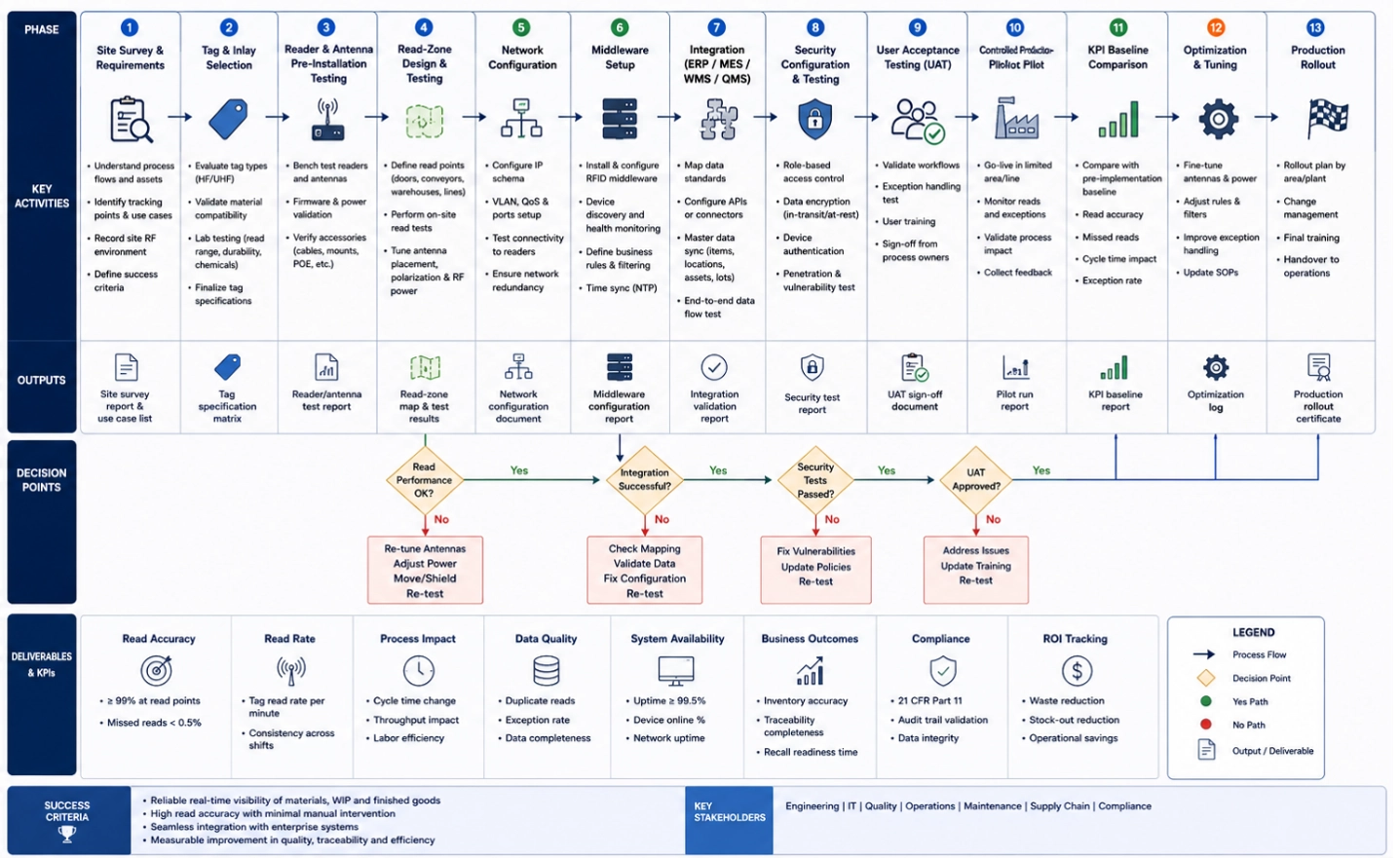
A technical end-to-end workflow showing RFID deployment from site survey, tag selection, reader and read-zone testing through network, middleware, ERP/MES/WMS integration, security validation, UAT, pilot production, KPI benchmarking, optimization, and final rollout. Decision gates provide corrective paths for read-performance, integration, security, and UAT failures.
AI Model Development and Data Quality
AI performance depends more heavily on data quality than on model complexity.
Nutraceutical manufacturers should establish clear data definitions for batch, lot, material, equipment, location, production order, quality status, and operational event. Timestamp consistency is particularly important when correlating RFID events with machine data and manufacturing transactions.
Data preparation may include:
- Removing duplicate identification events.
- Correcting invalid timestamps.
- Resolving inconsistent material identifiers.
- Associating RFID identifiers with master records.
- Handling missing sensor measurements.
- Separating normal production variation from genuine anomalies.
- Establishing reliable labels for supervised learning.
- Removing data generated during known equipment or system failures when it would distort training.
Models should also be monitored after deployment. Production conditions change, formulations change, equipment is replaced, suppliers change, and operational procedures evolve. These changes can create model drift.
A practical AI lifecycle therefore includes data monitoring, model performance evaluation, controlled retraining, version management, and documented approval procedures where applicable.
Cybersecurity for Connected Nutraceutical Manufacturing
Connecting RFID readers, edge computers, AI services, manufacturing systems, and enterprise applications increases the number of components that must be secured.
A defense-in-depth approach should include:
- Network segmentation for manufacturing and IoT devices.
- Device identity and authentication.
- Least-privilege access.
- Secure API authentication.
- Encryption for network communications.
- Controlled administrative access.
- Security logging and monitoring.
- Vulnerability management.
- Firmware and software update procedures.
- Backup and recovery testing.
- Incident-response procedures.
- Secure decommissioning of obsolete devices.
RFID itself should not be treated as the entire security boundary. The complete chain from physical reader to middleware, edge infrastructure, AI software, databases, APIs, and manufacturing applications must be considered.
Scaling from One Nutraceutical Facility to Multiple Sites
A pilot should be designed with future expansion in mind without attempting to automate every process immediately.
A practical rollout can prioritize high-value processes such as raw-material receiving, warehouse movement, batch staging, or finished-goods traceability.
Once performance is established, additional production areas can be connected.
Multi-site expansion introduces additional requirements for:
- Standardized tag and asset identifiers.
- Common material and location master data.
- Consistent RFID event definitions.
- Centralized analytics where appropriate.
- Site-specific configuration.
- Common cybersecurity policies.
- Centralized device monitoring.
- Model governance.
- Cross-site KPI comparison.
Cloud-hosted software can be useful for centralized visibility across facilities, while privately hosted servers and edge processing can remain appropriate where local data control or low-latency operation is important.
Practical Implementation Recommendations
Successful AI-enabled nutraceutical manufacturing projects generally begin with an operational problem rather than a technology purchase.
Recommended engineering practices include:
- Select a measurable manufacturing problem with a clear baseline.
- Map the physical movement of materials before installing RFID equipment.
- Identify which material, batch, asset, and location identities must be captured.
- Conduct RFID tag and read-zone testing under actual facility conditions.
- Establish master-data ownership before integration.
- Integrate RFID events with existing manufacturing and warehouse workflows.
- Use edge processing where local event filtering or low-latency operation is required.
- Start AI development with reliable historical data rather than selecting a complex model first.
- Establish human review procedures for AI-generated quality or production alerts.
- Define cybersecurity controls before connecting devices to manufacturing networks.
- Measure false alerts and operational response time as carefully as detection accuracy.
- Pilot one or two high-value workflows before expanding across the facility.
- Establish maintenance procedures for readers, antennas, tags, edge computers, and software.
- Document system behavior during network outages and equipment failures.
- Reassess AI models as manufacturing conditions and processes change.
GAO can support organizations requiring RFID, BLE, and IoT hardware products and systems for connected identification and monitoring applications. Its work across the United States and Canada, supported by R&D, quality processes, and technical assistance, provides a foundation for organizations evaluating connected manufacturing solutions.
AI and RFID Implementation Roadmap for Nutraceutical Manufacturing
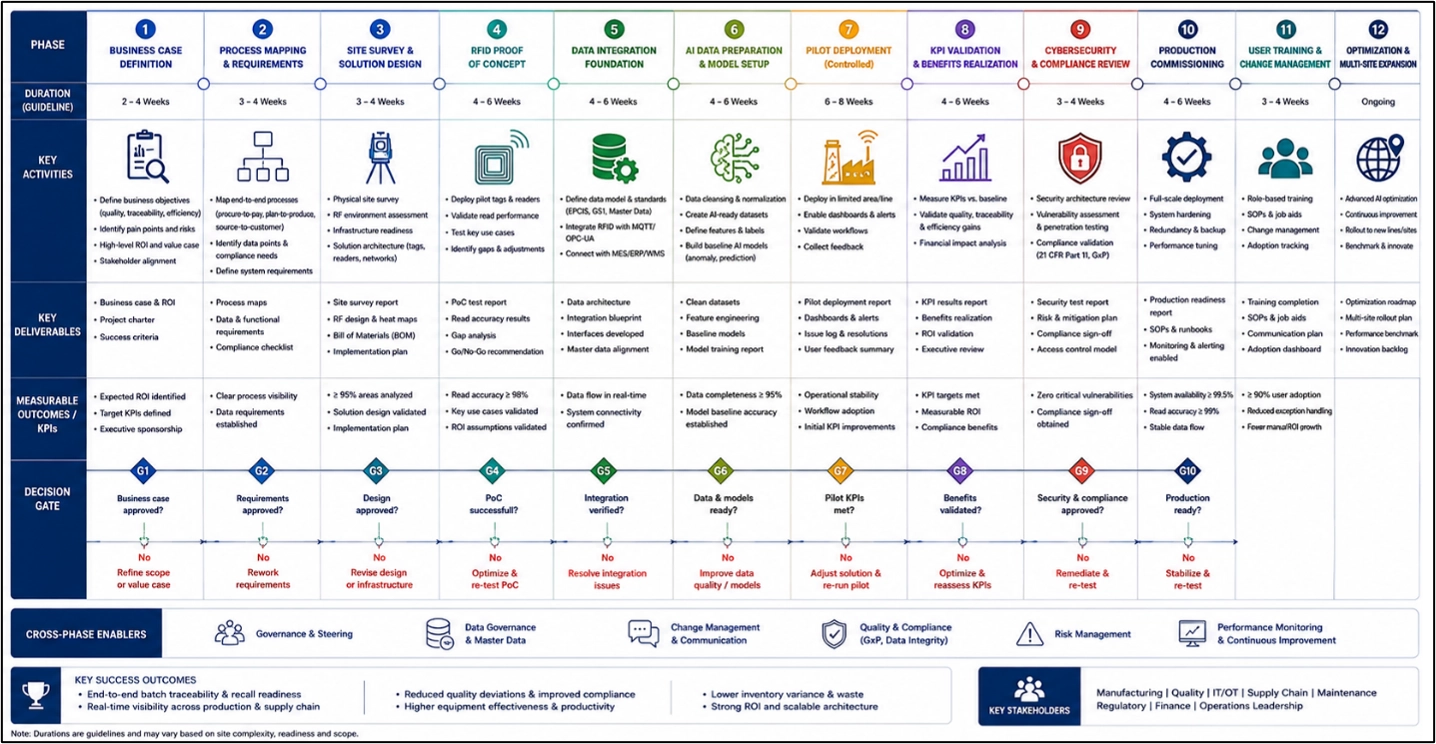
A phased implementation roadmap showing the progression from business-case definition and process mapping through RFID proof of concept, data integration, AI preparation, pilot deployment, KPI validation, cybersecurity review, production commissioning, training, and multi-site expansion. Decision gates and measurable outcomes provide a practical framework for managing implementation risk and demonstrating business value.
The Business Case for AI-Enabled Nutraceutical Manufacturing
AI and RFID should be evaluated according to their effect on measurable manufacturing outcomes.
The strongest business cases typically connect technical capabilities with operational costs and risks. For example, better material visibility can reduce time spent searching for inventory. Improved batch genealogy can reduce investigation effort. Predictive maintenance can reduce unexpected equipment downtime. AI-assisted inventory forecasting can reduce stockouts while helping control excess inventory.
The economic evaluation should consider:
- RFID tags and readers.
- Antennas and installation.
- Edge computing hardware.
- Network infrastructure.
- Middleware and integration development.
- AI software and computing resources.
- Cybersecurity controls.
- System validation and testing.
- Training and change management.
- Ongoing device and software maintenance.
Benefits should then be compared against measurable baseline values such as inventory discrepancies, labor spent on manual tracking, production delays, downtime, quality investigations, material waste, and warehouse errors.
Building a More Intelligent Nutraceutical Manufacturing Operation
AI-enabled nutraceutical manufacturing can connect material identity, batch genealogy, equipment data, warehouse activity, quality information, and production events into a more actionable operational information flow.
RFID provides automated identification and movement data, while AI can analyze that information alongside production, equipment, inventory, and quality data. The resulting capabilities can support batch traceability, inventory management, predictive maintenance, anomaly detection, production optimization, and quality investigations.
The most effective implementations are built around measurable manufacturing problems, validated data, carefully engineered read zones, secure integrations, and controlled AI workflows. Cloud, server, and edge processing can be combined according to operational and data-governance requirements.
GAO provides RFID, BLE, and IoT hardware products and systems that can help organizations develop these connected manufacturing capabilities. Technical evaluation, pilot testing, integration planning, and KPI measurement should guide the transition from proof of concept to production deployment.
Building the Future of Industrial AI and IoT with Aperture Venture Studio and GAO RFID Inc.
For more than three decades, GAO Group of Companies has invested heavily in R&D involving industrial RFID, BLE, and IoT technologies. As AI became increasingly useful for industrial applications, we expanded our work in AI and IoT technologies that can support connected manufacturing, traceability, asset monitoring, and operational intelligence.
We have also developed Aperture Venture Studio to support the development of AI and IoT solutions relevant to industrial applications such as nutraceutical manufacturing.
Aperture has attracted AI and IoT technical experts, operational executives, investors, and leading companies, while Aperture Ventures Summit and TekSummit provide forums for discussing advanced AI and IoT topics.
GAO Group’s companies, including GAO and its sister companies GAO Research Inc. and GAO Tek Inc., operate from New York City and Toronto, Canada. For three decades, the group has served organizations across the United States and Canada, including Fortune 500 companies, leading R&D organizations, universities, and government agencies. Its activities are supported by product R&D, quality-assurance processes, and technical support delivered remotely or onsite.
We welcome participation from:
- Advisors, co-founders, or employees.
- Investors.
- Customers.
GAO’s RFID, BLE, and IoT technologies can help organizations evaluate practical approaches to AI-enabled identification, traceability, monitoring, and manufacturing intelligence.