
AI and BLE for Open Pit Mining Operations
How AI Improves Asset Visibility, Safety, and Mining Productivity
AI for open pit mining combines artificial intelligence with connected equipment, industrial sensors, operational data, and location technologies to improve how mining companies monitor and manage extraction activities. BLE gateways, BLE beacons, and BLE sensors support selected asset-location, personnel-presence, environmental-monitoring, and equipment-condition applications, while AI converts operational data into predictions and actionable decisions. The solution can help mining operators locate mobile maintenance equipment, monitor high-value assets, identify unusual equipment conditions, improve dispatch coordination, and support safety-related alerts. Applications span mine pits, haul roads, maintenance shops, stockpiles, fuel facilities, and processing support areas. Integration with fleet management, maintenance, mine planning, safety, and enterprise software allows information to move beyond individual sensors into operational workflows. GAO supplies BLE and other IoT hardware products and systems that can support mining-specific data collection, integration, and deployment requirements.
AI and BLE for Open Pit Mining Operations: Connected Asset and Analytics Overview
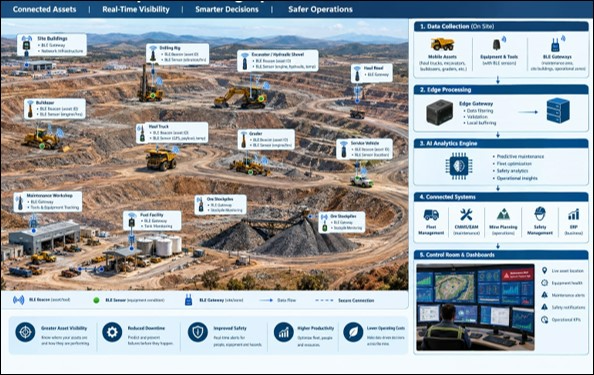
This enterprise engineering diagram illustrates how BLE beacons, equipment sensors, and gateways connect open-pit mining assets to edge processing and AI analytics. It shows integration with fleet management, CMMS/EAM, mine planning, safety management, ERP, and control-room dashboards to support asset visibility, maintenance, safety, and operational decision-making.
AI and BLE Fundamentals for Open Pit Mining
Open pit mining involves coordinated extraction, material movement, equipment utilization, grade control, maintenance, and site safety across a large and changing physical environment. Unlike fixed manufacturing workstations, mining operations frequently involve mobile assets, variable terrain, long travel distances, intermittent connectivity, dust, vibration, weather exposure, and restricted operating zones. These conditions influence the design of an AI-enabled tracking and monitoring solution.
What AI Contributes to Mining Operations
AIoT, also called AI and IoT, combines artificial intelligence with connected devices, sensors, equipment, and industrial systems. For open pit mining, AI can process operational data from equipment, location systems, machine controls, maintenance records, and environmental monitoring devices.
Relevant AI methods include:
- Machine learning: Identifies patterns in equipment utilization, maintenance history, operating conditions, and operational delays.
- Anomaly detection: Flags unusual equipment movement, unexpected asset dwell time, abnormal sensor readings, or deviations from established operating patterns.
- Predictive maintenance models: Estimate the likelihood of selected equipment faults using condition data, maintenance history, and operating context.
- Computer vision: Analyzes camera feeds for applications such as haul-road conditions, PPE compliance, restricted-area observation, and equipment interaction, subject to suitable camera placement and site conditions.
- Time-series forecasting: Supports estimates of maintenance workload, equipment demand, spare-parts requirements, and selected production-related variables.
- Optimization methods: Help evaluate dispatch, maintenance scheduling, equipment allocation, and operational resource decisions using defined constraints and reliable input data.
AI outputs should be treated as decision support unless a specific control function has been validated, authorized, and engineered for automated operation. A predicted equipment fault, for example, should trigger inspection or maintenance planning rather than automatically shutting down machinery without a validated control strategy.
The Role of BLE in Open Pit Mining
Bluetooth Low Energy is a wireless technology that can support short-range identification, presence detection, asset tracking, and sensor communication. BLE is particularly relevant to mining applications involving equipment and assets that require visibility within defined operational areas.
Common components include:
- BLE beacons: Small devices attached to mobile equipment, tools, containers, maintenance assets, or selected personnel safety devices to transmit identifiable signals.
- BLE gateways: Receiving devices that collect beacon or sensor transmissions and forward relevant information to edge or centralized software.
- BLE sensors: Devices that measure supported parameters such as temperature, motion, vibration, or other application-specific conditions.
- Edge processing: Local filtering, signal processing, buffering, and preliminary validation before data is transferred to centralized systems.
- AI software: Combines BLE-derived observations with other operational information to generate insights and exception alerts.
BLE should not be treated as a universal replacement for GNSS, industrial telemetry, or mine-wide communication networks. Open pit mining deployments often require a combination of technologies. GNSS may be more appropriate for broad outdoor vehicle positioning, while BLE can supplement visibility around workshops, storage zones, service facilities, or selected operational checkpoints. Actual accuracy depends on gateway placement, signal propagation, equipment obstruction, antenna characteristics, and environmental conditions.
Why AI-Enabled Visibility Matters for Open Pit Mining
Mining operators may have difficulty establishing the current location, availability, or utilization of mobile support assets across extensive sites. Maintenance teams may spend time searching for tools, service equipment, and components. Equipment inspections and maintenance scheduling can also be affected by incomplete asset histories, delayed status updates, or disconnected operational systems.
An AI-enabled BLE solution can address selected information gaps by combining asset identification and location observations with maintenance records, equipment utilization, work orders, and operational events. The value comes from correlating multiple data sources rather than treating a BLE signal as a complete description of an asset’s condition or operational status.
Open Pit Mining Applications for AI-Enabled Asset and Equipment Management
AI applications should be selected based on measurable operational problems, the available data, the mine’s physical environment, and the actions that personnel can take when an insight is generated.
Mobile Mining Asset Tracking and Location Visibility
Open pit mining uses mobile assets beyond primary production equipment. Maintenance teams may operate service trucks, portable generators, welding equipment, pumps, lubrication units, diagnostic tools, tool cabinets, and specialized maintenance kits.
AI-enabled asset tracking can help operations teams identify asset presence in defined areas and evaluate movement or dwell patterns.
Potential applications include:
- Tracking selected maintenance tools and service equipment between workshops, maintenance bays, and field service locations.
- Identifying prolonged asset dwell time in areas where equipment is expected to remain available for scheduled work.
- Supporting asset search by providing recent gateway observations and known location zones.
- Identifying unusual movement or unexpected presence of tagged equipment, subject to configured rules and validated location accuracy.
- Combining asset-location data with CMMS/EAM work orders to support maintenance preparation and equipment availability planning.
Engineering consideration: A BLE gateway observation is not necessarily a precise coordinate. Solutions should distinguish between zone-level presence, estimated proximity, and verified location. Mine operators should establish the accuracy required for each asset class before selecting gateway density and installation locations.
Predictive Maintenance for Mining Equipment
Primary production equipment such as hydraulic excavators, electric rope shovels, haul trucks, rotary blasthole drills, and crushers may already generate machine telemetry through onboard control systems and equipment monitoring systems. BLE sensors can complement this information for selected assets or parameters where existing instrumentation is unavailable or where supplementary observations are useful.
Potential AI applications include:
- Detecting unusual temperature or vibration patterns in selected auxiliary equipment.
- Prioritizing inspection of mobile service assets based on operating hours, sensor readings, and maintenance history.
- Identifying recurring maintenance delays associated with tool availability or asset location.
- Supporting spare-parts planning through maintenance history and forecasted service requirements.
- Correlating equipment downtime with maintenance response times, parts availability, and workshop congestion.
BLE sensor measurements should not be assumed to provide the same diagnostic coverage as manufacturer-installed condition-monitoring systems. Critical equipment decisions should use validated sensor specifications, appropriate sampling rates, calibrated measurements, and relevant equipment-specific engineering models.
Mining Worker Safety and Restricted-Zone Awareness
Open pit mines contain hazards associated with moving haul trucks, excavators, blasting activities, unstable ground, high-voltage equipment, vehicle interactions, and changing work zones. Location technologies can support selected safety procedures, but they do not replace site controls, training, communication protocols, or formal risk assessments.
BLE-based applications may include:
- Supporting presence detection around designated workshops, access points, and controlled areas.
- Providing proximity-related information for selected worker or contractor safety devices where the required detection performance has been demonstrated.
- Identifying potential unauthorized presence in configured restricted zones.
- Supporting muster or equipment-area visibility when combined with an approved site-specific safety procedure.
- Correlating location observations with operational events to assist post-incident investigation.
Safety-critical functions require a documented hazard analysis, defined detection performance, fail-safe behavior, reliable communications, and validation under actual mine conditions. A BLE signal alone should not be treated as proof that a person is safe, that a vehicle has detected a worker, or that a hazardous area is clear.
Haul Road and Field Service Coordination
Haulage operations depend on coordinated movement between loading points, haul roads, dumping locations, maintenance facilities, and other work areas. Production fleet systems commonly provide vehicle-related operational data, while BLE can support supplementary tracking of selected service assets and localized operational events.
AI can combine equipment availability, maintenance work orders, location observations, and operational schedules to support:
- Service vehicle allocation and field maintenance preparation.
- Identification of equipment waiting time associated with service resource availability.
- Maintenance team coordination around workshop and field locations.
- Analysis of recurring delays in support-asset movement.
- Improved visibility into the utilization of selected mobile tools and auxiliary equipment.
BLE is generally more useful for localized asset presence and proximity applications than for replacing mine-wide vehicle telemetry or GNSS fleet tracking. The integration strategy should reflect the capabilities and coverage of the existing mine fleet management system.
Stockpile, Spare Parts, and Maintenance Inventory Visibility
Open pit mining maintenance operations require spare parts, consumables, components, and specialized tools to be available when equipment requires service. Inventory operations may span central warehouses, satellite stores, maintenance shops, field service containers, and temporary storage areas.
AI and BLE can support selected inventory-related workflows by connecting item identification, storage-area observations, usage records, and maintenance demand.
Relevant use cases include:
- Tracking selected reusable maintenance containers and mobile tool assets.
- Supporting inventory-area presence checks for tagged items.
- Identifying potential storage congestion or prolonged dwell for selected assets.
- Combining maintenance forecasts with inventory records to identify items that require planning attention.
- Supporting reconciliation of asset movement across designated storage and maintenance zones.
BLE is not a complete substitute for barcode or RFID identification at the item level. Where exact item identity, bulk reading, or material transaction control is required, the solution may need barcode scanning, RFID, inventory transactions, or other appropriate identification methods.
Open Pit Mining Operational Challenges and Engineering Considerations
AI deployment in open pit mining must account for physical operating conditions, production priorities, equipment criticality, and the limitations of available data. A solution that performs adequately in a workshop may require a different design for a pit environment or field service area.
Environmental and Physical Conditions
Mining sites may expose electronic devices and wireless infrastructure to dust, vibration, temperature variation, moisture, mechanical impact, and electromagnetic interference. Equipment placement and device protection should be selected according to the actual operating environment.
Important considerations include:
- Enclosure protection appropriate to dust and water exposure.
- Temperature ratings for outdoor installations and enclosed equipment areas.
- Mechanical mounting that withstands vibration and routine maintenance activities.
- Battery life and replacement procedures for BLE beacons and sensors.
- Gateway placement that reduces signal obstruction from metal equipment, structures, and stored materials.
- Inspection and maintenance procedures for devices installed on mobile assets.
The appropriate environmental rating depends on the installation location and equipment specification. Mining operators should validate devices against actual exposure conditions rather than assume that a general industrial enclosure rating is sufficient for every mine location.
Connectivity and Data Availability
Open pit mining sites can contain areas with limited wireless coverage, changing terrain, moving equipment, and infrastructure that is difficult to access. BLE gateways may need to forward data through Wi-Fi, industrial Ethernet, cellular networks, or other supported communication methods.
A robust system should account for:
- Intermittent backhaul connectivity.
- Local buffering during network outages.
- Timestamp consistency across gateways and server systems.
- Duplicate observations caused by repeated beacon reception.
- Signal variation caused by moving equipment and metal obstructions.
- Gateway health monitoring and device battery status.
- Data validation before AI models use observations for operational decisions.
A location or sensor record should include appropriate identifiers, timestamps, signal or measurement information, and relevant quality indicators. Data filtering and deduplication should be performed according to the application’s requirements, without removing legitimate events or hiding communication problems.
Equipment Criticality and Safety Boundaries
Not every mining asset requires the same tracking precision, data frequency, or AI decision latency. A tool cabinet in a maintenance workshop and a mobile safety device near heavy equipment may have substantially different operational requirements.
Deployment planning should distinguish:
- Noncritical asset-location visibility.
- Maintenance planning support.
- Production-related decision support.
- Safety-related monitoring.
- Functions that could affect equipment operation or access control.
Criticality assessment helps determine appropriate redundancy, alert handling, validation, maintenance procedures, and cybersecurity controls. It also prevents unnecessary investment in high-frequency data collection for low-value use cases.
AI-Enabled Open Pit Mining Operational Workflow
A practical AI and BLE solution for open pit mining begins with a defined operational objective and proceeds through data collection, communications, processing, AI analysis, and operational action. The workflow should establish how observations are converted into reliable information and how personnel respond to the resulting insights.
Data Acquisition Across Mining Work Areas
Data acquisition may involve BLE beacons, BLE sensors, gateways, existing equipment telemetry, maintenance records, and operational software.
Examples of captured information include:
- BLE beacon identifiers and gateway reception timestamps.
- Asset association records linking a beacon to a tool, service vehicle, or maintenance asset.
- Sensor measurements such as temperature, vibration, or motion where supported by the device.
- Equipment operating hours, fault codes, and maintenance status from existing systems.
- Work-order information from CMMS/EAM.
- Location zones, workshop areas, and restricted-area definitions.
- Equipment and asset master data from mine operational software.
Each data source should have an established ownership, identifier structure, timestamp convention, and validation process.
BLE Gateway Communication and Edge Processing
BLE gateways receive wireless observations from nearby beacons and sensors. Depending on the deployment, gateways can forward data to edge servers or centralized software through available network infrastructure.
Edge processing can support:
- Duplicate filtering and event aggregation.
- Signal-quality checks and gateway health monitoring.
- Temporary data buffering during backhaul outages.
- Preliminary validation of asset identifiers and sensor readings.
- Local alert generation for selected use cases.
- Forwarding normalized records to AI and enterprise software.
Gateway coverage should be established through a site survey and validated with field tests. A mine maintenance workshop, fuel facility, and outdoor service area may have different gateway placement requirements because of equipment density, obstructions, and expected asset movement.
AI Analytics and Decision Support
The AI system combines validated data with operational context. A location observation becomes more useful when it is connected to asset identity, expected operating area, equipment status, and relevant maintenance or production information.
A typical processing sequence includes:
- Receive data from BLE gateways and other connected systems.
- Validate asset identifiers, timestamps, measurement ranges, and data quality.
- Associate observations with asset records and operational zones.
- Combine BLE observations with equipment telemetry, work orders, and historical records.
- Run appropriate AI models or analytical rules.
- Generate insights, predictions, or exceptions.
- Deliver relevant information to maintenance, operations, safety, or planning personnel.
- Record the operational response and subsequent outcome where available.
AI models should be evaluated using data representative of the mining site’s operating conditions. Training and validation data should account for seasonal changes, equipment replacement, gateway modifications, and shifts in maintenance practices.
Operational Actions and Feedback
The purpose of AI-enabled mining visibility is to support measurable operational decisions.
Examples include:
- A maintenance supervisor uses asset-location information to identify the last observed zone of a required service tool.
- A maintenance planner reviews equipment condition indicators and work-order history to prioritize inspection.
- A site operations team evaluates unusual dwell patterns to identify potential support-process delays.
- A safety team reviews a validated zone-presence event alongside existing site procedures and relevant operational records.
- An inventory coordinator checks the location and availability of selected reusable maintenance assets before scheduling field work.
The system should record whether an alert was acknowledged, investigated, confirmed, dismissed, or associated with a corrective action. This feedback can help improve rules, data quality, and model performance over time.
AI and BLE Data Flow for Open Pit Mining: From Field Data to Operational Decisions
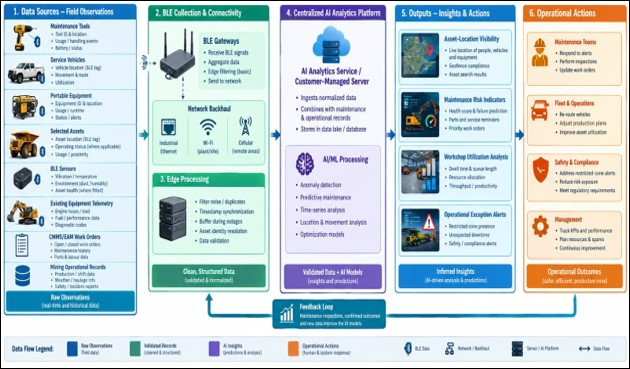
This end-to-end data-flow diagram shows how BLE beacons, sensors, equipment telemetry, CMMS/EAM records, and mining data move from field collection through gateways, network backhaul, edge processing, and centralized AI analytics. It illustrates how validated data becomes maintenance risk indicators, asset-location visibility, workshop insights, and operational alerts that support faster, safer, and more efficient mining decisions.
GAO’s Technical Role in Open Pit Mining IoT Solutions
GAO provides BLE, RFID, and other IoT hardware products and systems that can be incorporated into application-specific industrial monitoring and asset visibility solutions. For open pit mining, hardware selection should be aligned with the required coverage, environmental exposure, device mounting, battery maintenance, communications, and software integration requirements.
Headquartered in New York City and Toronto, Canada, GAO RFID Inc. is described by the company as among the top 10 leading B2B and B2G BLE and RFID suppliers globally. GAO RFID Inc., GAO Research Inc., and GAO Tek Inc. form GAO Group, with operations based in New York City and Toronto. The group has served organizations across the United States and Canada, including Fortune 500 companies, research and development organizations, universities, and government agencies.
For mining operators and system integrators, relevant engineering activities include evaluating device suitability, planning gateway installation, integrating asset identifiers, testing data quality, and establishing maintenance procedures for deployed hardware. GAO’s research and development investment, quality assurance processes, and remote or onsite technical support are relevant considerations when evaluating an IoT supplier for distributed operational environments.
Technical Components for AI-Enabled Open Pit Mining
AI-enabled open pit mining solutions combine field devices, communication infrastructure, data-processing software, AI models, and operational applications. The technical design should reflect the difference between localized BLE asset visibility and mine-wide equipment telemetry.
BLE Hardware and Supporting Infrastructure
BLE beacons, gateways, and sensors provide selected data inputs for mining workflows.
- BLE beacons: Identify tagged tools, service assets, containers, and selected mobile equipment. Beacon configuration should consider transmission intervals, battery life, mounting, and environmental exposure.
- BLE gateways: Receive beacon and sensor transmissions in defined coverage areas. Gateway placement should account for metal structures, mobile equipment, line-of-sight limitations, and backhaul availability.
- BLE sensors: Capture supported measurements for auxiliary equipment and selected environmental or operational monitoring applications. Sensor selection depends on measurement accuracy, sampling frequency, operating temperature, and enclosure requirements.
- Edge computing hardware: Provides local processing, buffering, and connectivity management. It can reduce dependence on continuous wide-area connectivity for selected workflows.
- Complementary positioning systems: GNSS, industrial telemetry, and other location technologies may provide broader outdoor coverage or more suitable positioning for production fleet applications.
BLE should be deployed where its technical characteristics match the operational requirement. Mine-wide haul-truck positioning, for example, may depend primarily on GNSS and fleet management systems, while BLE can provide supplementary visibility around maintenance facilities and localized work areas.
Communication Protocols and Data Integration
Communication infrastructure connects field observations to mining software. The choice depends on existing site connectivity, gateway capabilities, cybersecurity policies, and required data latency.
Relevant technologies include:
| Component | Application in open pit mining |
|---|---|
| BLE | Short-range beacon and sensor communications |
| Wi-Fi | Gateway backhaul in covered facilities and designated work areas |
| Industrial Ethernet | Reliable connections in workshops, control rooms, and fixed infrastructure |
| LTE/5G | Wireless backhaul or selected mobile operational applications where coverage is available |
| MQTT | Lightweight telemetry and event messaging where supported |
| HTTPS/TLS | Secure application and data exchange |
| OPC UA | Integration with compatible industrial equipment and control systems |
| REST APIs | Exchange of asset, maintenance, and analytical information between software systems |
MQTT and OPC UA should not be assumed to be supported by every BLE gateway or mining application. Integration requirements must be verified against the selected hardware and software interfaces.
AI Models and Mining Software
AI processing can combine BLE observations with equipment telemetry, maintenance records, and operational context.
Relevant software components include:
- Data ingestion and normalization services.
- Asset master data and identity resolution.
- Time-series data storage.
- AI model execution and monitoring.
- Maintenance and work-order integration.
- Operational dashboards and alert management.
- Data quality monitoring and audit records.
Mining software integration may involve fleet management systems, mine planning and dispatch software, CMMS/EAM, ERP, warehouse management, safety management, and environmental monitoring systems. Integration should preserve consistent asset IDs, equipment hierarchies, work-order references, timestamps, and access permissions.
Cloud Version vs. Server Version for Open Pit Mining
Cloud Version and Server Version deployments have different operational implications for mining companies. The selection should reflect connectivity, data governance, cybersecurity requirements, multi-site operations, and the ability to maintain software at remote mine locations.
Cloud Version
Cloud-hosted SaaS
Cloud-hosted software managed within cloud infrastructure. It can support centralized analytics, multi-site reporting, remote software administration, and integration across geographically distributed mining operations.
Server Version
Privately hosted
Software deployed on customer-managed edge servers, private data centers, or other privately hosted enterprise infrastructure. It can support local processing, selected operational continuity, and site-specific data governance requirements.
A hybrid deployment may combine local gateway processing and buffering with centralized cloud analytics. A private server deployment may use edge servers at a mine site and a central server at a customer-managed facility. Neither model automatically guarantees safety, availability, or cybersecurity. Those outcomes depend on engineering, operating procedures, redundancy, and validation.
Deployment Selection Considerations
- Cloud Version: Consider when multiple mine locations require centralized analytics, reliable network access is available, and organizational policies permit the required data flows.
- Server Version: Consider when local processing, private hosting, network isolation, or site-specific data governance is important.
- Hybrid processing: Consider when the mine needs local event handling or buffering while using centralized software for long-term analytics, reporting, and model management.
GAO hardware and system selection should be coordinated with the customer’s existing communications, IT/OT security policies, and maintenance capabilities.
AI Capabilities and Operational Benefits in Open Pit Mining
The value of AI in open pit mining depends on the quality of operational data and the ability to connect insights to practical decisions. BLE contributes selected location and sensor observations, while other systems provide production, maintenance, equipment, and safety context.
Improved Maintenance Productivity
AI can support maintenance planning by correlating equipment condition indicators, asset availability, operating hours, and historical work orders.
Potential benefits include:
- Reduced time spent searching for selected maintenance tools and service assets.
- Better preparation for field maintenance activities.
- Identification of recurring delays associated with equipment or tool availability.
- Improved visibility into maintenance support-asset utilization.
- More informed prioritization of inspections when condition and operational data are reliable.
The measurable outcome should be evaluated against a baseline such as maintenance response time, wrench time, work-order delay, or equipment downtime. Asset location alone does not establish that a tool is operational, available, or suitable for a particular repair.
Equipment Availability and Operational Coordination
Production availability is influenced by mechanical condition, maintenance scheduling, spare-parts availability, operator readiness, and other factors.
AI can support these processes by:
- Identifying patterns in equipment downtime and maintenance events.
- Forecasting selected maintenance workloads.
- Combining equipment status with service resource availability.
- Highlighting potential delays in maintenance preparation.
- Supporting planning decisions for selected equipment and support resources.
For critical production equipment, AI outputs should be evaluated alongside OEM monitoring systems, engineering inspections, and established maintenance practices.
Safety-Related Operational Awareness
AI and BLE may support specific safety procedures by providing information about tagged assets or presence in designated zones. The benefit depends on validated detection performance and clearly defined operational responses.
Potential improvements include:
- Faster awareness of selected zone-presence exceptions.
- Better records for reviewing operational events.
- Support for contractor and service-asset visibility in designated areas.
- Improved coordination of maintenance work in controlled locations.
Safety-related deployments should include hazard analysis, site testing, escalation procedures, and clearly defined limitations. BLE-based detection should not be presented as a standalone collision-avoidance or personnel-protection system unless the complete solution has been engineered and validated for that purpose.
Scalability and Data-Driven Mining Decisions
A scalable solution can extend from a limited workshop pilot to multiple maintenance areas, support facilities, or mine locations when the underlying identifiers, network design, data structures, and software interfaces are standardized.
Scalability considerations include:
- Consistent asset naming and master-data management.
- Gateway provisioning and device lifecycle management.
- Battery replacement and hardware maintenance procedures.
- Standardized event schemas and timestamp conventions.
- Centralized monitoring of device health and data quality.
- Controlled AI model deployment and version management.
- Integration with existing mine software without creating duplicate records.
GAO’s BLE and IoT hardware offerings can be assessed as part of a broader system design that includes installation, integration, testing, and ongoing technical support.
Mining KPIs for AI and BLE Performance Evaluation
A structured KPI program helps mining operators determine whether an AI-enabled solution improves an operational process. Measurements should be selected according to the use case and established before pilot deployment.
Operational and Maintenance KPIs
| KPI | Relevance to open pit mining |
|---|---|
| Asset search time | Time required to locate selected tools and service assets |
| Maintenance response time | Time from service request to maintenance response |
| Equipment availability | Proportion of scheduled time that equipment is available for operation |
| Mean time to repair (MTTR) | Average duration required to restore equipment after a failure |
| Mean time between failures (MTBF) | Average operating time between relevant equipment failures |
| Maintenance schedule compliance | Completed planned maintenance compared with scheduled work |
| Work-order completion delay | Difference between planned and actual completion times |
| Workshop asset utilization | Utilization of selected tools, service equipment, or work areas |
| Unplanned downtime | Time lost due to unplanned equipment interruptions |
| Spare-parts fulfillment time | Time required to provide needed parts for maintenance work |
These KPIs should be interpreted with appropriate operational context. For example, a reduction in maintenance response time may reflect improved asset visibility, but it can also be influenced by staffing, road access, weather, parts availability, or changes in maintenance procedures.
AI and Data Quality KPIs
- BLE observation completeness.
- Duplicate event rate.
- Asset identity association accuracy.
- Gateway availability.
- Sensor data completeness.
- Data timestamp consistency.
- AI alert precision and recall, where ground truth is available.
- False-positive and false-negative rates for applicable detection models.
- Prediction error for validated forecasting tasks.
- Alert acknowledgment and response time.
AI performance should be evaluated using a representative test dataset and a defined operational acceptance threshold. Model accuracy should not be reported without explaining the measurement method, validation data, and relevant limitations.
Cybersecurity and Interoperability for Open Pit Mining
Mining facilities often connect operational technology, information technology, industrial equipment, and enterprise applications. A connected asset-tracking or AI solution should be designed within the site’s cybersecurity and access-control framework.
Security Controls
Relevant security measures may include:
- Device identity management and controlled gateway enrollment.
- Encryption for supported wireless and backhaul communications.
- TLS-secured application connections where supported.
- Role-based access control for maintenance, operations, safety, and IT personnel.
- Network segmentation between field devices, operational systems, and enterprise applications.
- Secure software updates and controlled configuration changes.
- Centralized logging and security monitoring where appropriate.
- Backup and recovery procedures for critical software and data.
- Defined retention and access rules for personnel-related or operational records.
Security responsibilities should be allocated between the device supplier, software provider, mining operator, network team, and system integrator. BLE security features and gateway capabilities must be verified against the selected product specifications.
Interoperability With Mining Systems
A successful deployment should avoid creating an isolated data repository that cannot support existing maintenance or operational processes.
Integration targets may include:
- Fleet management and dispatch software.
- CMMS and EAM systems.
- ERP and procurement software.
- Warehouse and spare-parts inventory systems.
- Mine planning and production management applications.
- Safety management software.
- Environmental monitoring systems.
- Identity and access management services.
Data mappings should define asset identifiers, equipment hierarchies, event timestamps, location zones, work-order references, and ownership of master records. API integration, message-based exchange, or database integration should be selected according to system capabilities and security policies.
AI and BLE Deployment Lifecycle for Open Pit Mining
A phased implementation reduces the risk of deploying hardware and AI models before the mine has validated the operational requirements. The lifecycle should connect business objectives to engineering design, testing, commissioning, and continuous improvement.
Planning and Use-Case Selection
The initial stage defines the operational problem and the expected measurable result.
- Identify the mining workflow, such as maintenance tool tracking, workshop asset visibility, or selected condition-monitoring applications.
- Establish the affected equipment, locations, operational teams, and current process limitations.
- Assess asset criticality, safety implications, and required detection performance.
- Establish baseline KPIs and data availability.
- Identify existing software interfaces and cybersecurity requirements.
Site Survey and System Design
A site survey evaluates the physical and communications environment before hardware installation.
- Map workshop areas, maintenance bays, storage locations, field service facilities, and intended coverage zones.
- Assess gateway placement, signal obstructions, mounting options, and backhaul connectivity.
- Review temperature, dust, vibration, moisture, and mechanical exposure.
- Select beacon and sensor specifications according to the intended application.
- Define gateway power, network connectivity, and maintenance access.
- Determine cloud, server, or hybrid deployment requirements.
BLE radio behavior around large metal equipment and changing vehicle positions should be evaluated through field testing. Coverage assumptions based solely on nominal radio range may not represent actual mining conditions.
Pilot Installation and Commissioning
The pilot should test a limited number of assets and operational areas before wider deployment.
- Install and configure BLE beacons, sensors, and gateways.
- Verify asset associations and device identifiers.
- Test gateway reception and data transmission.
- Measure location-zone performance and observation completeness.
- Validate sensor readings against reference instruments where applicable.
- Test data buffering, duplicate handling, and timestamp synchronization.
- Confirm software integration and alert delivery.
- Document installation issues and corrective actions.
Commissioning acceptance criteria should be defined before testing. The pilot should not be considered successful solely because gateways receive signals or dashboards display asset records.
AI Validation and Operational Acceptance
AI models should be evaluated against relevant operational data and a defined ground-truth process.
- Establish training, validation, and test datasets.
- Assess data quality and missing-value patterns.
- Validate model outputs against confirmed maintenance records or operational observations.
- Measure false alerts and missed events where applicable.
- Conduct user acceptance testing with maintenance and operations personnel.
- Document model limitations, thresholds, and escalation procedures.
For predictive maintenance, a useful validation process requires confirmed fault or inspection outcomes rather than relying only on historical sensor correlations. A model may identify a statistical anomaly without accurately predicting an imminent equipment failure.
Scale-Up and Continuous Improvement
Following pilot acceptance, deployment can expand to additional work areas or mine sites.
- Review pilot KPI performance and user feedback.
- Refine gateway placement and device mounting.
- Standardize asset identifiers and installation procedures.
- Establish battery replacement and device inspection schedules.
- Monitor AI drift, data quality, and operational alert performance.
- Expand integrations through controlled interface changes.
- Review cybersecurity controls and system access regularly.
- Conduct periodic operational reassessments as mine layouts and equipment fleets change.
AI and BLE Deployment Lifecycle for Open Pit Mining: From Pilot to Continuous Improvement
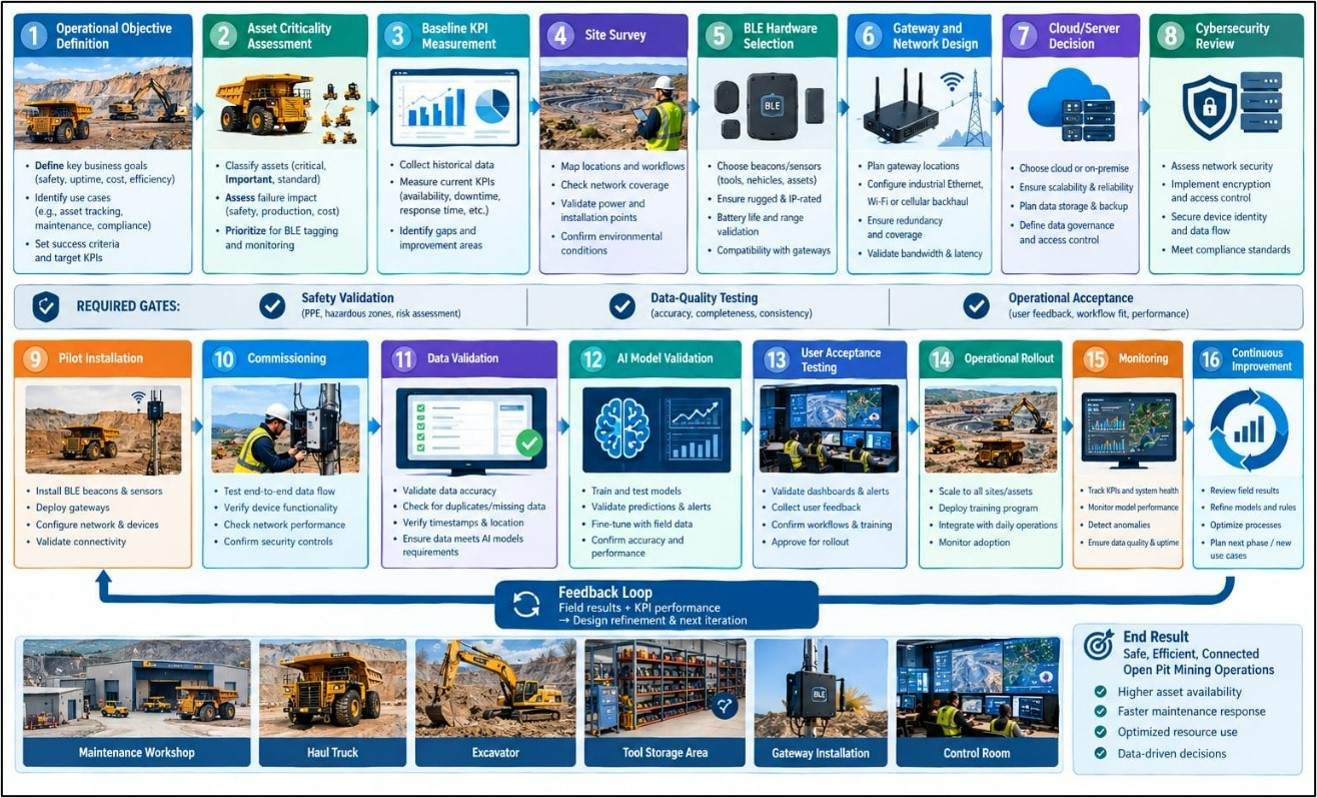
This engineering lifecycle diagram illustrates the complete deployment sequence for AI and BLE technology in open-pit mining, from operational objectives, asset assessment, site surveys, and infrastructure design through pilot installation, data validation, AI model testing, operational rollout, and monitoring. It highlights mandatory safety validation, data-quality testing, operational acceptance, and a feedback loop for continuous system improvement.
Implementation Recommendations for Mining Operators and System Integrators
Open pit mining AI projects should begin with a clearly defined operational need and a deployment design that respects the mine’s physical and digital environment.
Practical Engineering Recommendations
- Start with a bounded use case: Select a defined operational area, asset class, and measurable problem before attempting mine-wide deployment.
- Match technology to coverage needs: Use BLE for suitable localized applications and evaluate GNSS, industrial telemetry, or other technologies for broader outdoor positioning requirements.
- Design for environmental exposure: Validate enclosures, temperature ratings, mounting, and battery maintenance against actual installation conditions.
- Separate observations from predictions: Store raw and validated records separately from inferred AI results, enabling auditability and troubleshooting.
- Establish data ownership: Define who maintains asset master data, work-order associations, device configurations, and operational zone definitions.
- Validate before automating: Confirm AI performance and operational responses before allowing any automated function to affect production or safety-critical processes.
- Include mine personnel in testing: Maintenance supervisors, technicians, operations teams, and site IT personnel should participate in acceptance testing and workflow design.
- Plan lifecycle maintenance: Include gateway health monitoring, battery replacement, software updates, cybersecurity reviews, and equipment changes in the operating model.
GAO Support for AI and IoT Mining Deployments
GAO can be considered as a supplier of BLE, RFID, and other IoT hardware products and systems for organizations evaluating industrial tracking and monitoring requirements. Its broader technology offering can support conversations around device selection, system integration, and application-specific deployment planning.
The GAO Group’s three-decade investment in research and development, quality assurance processes, and remote or onsite technical support provides relevant background for organizations assessing technology suppliers. The suitability of any particular product for open pit mining should be confirmed through technical specifications, environmental requirements, field testing, and project acceptance criteria.
Key Takeaways for AI-Enabled Open Pit Mining
AI for open pit mining can improve selected maintenance, asset visibility, and operational coordination processes by combining equipment data, BLE observations, and analytical software. The practical value depends on the quality of captured data, appropriate technology selection, validated AI performance, and integration with existing mining workflows.
Mining operators and system integrators should prioritize measurable use cases, site-specific radio testing, environmental suitability, cybersecurity, and lifecycle maintenance. GAO’s BLE and IoT hardware products and systems can be evaluated as part of these engineering requirements.
Learn more about GAO’s industrial IoT technologies, hardware products, and technical support to assess solutions for your open pit mining applications.
Building the Future of Industrial AI and IoT with Aperture Venture Studio and GAO RFID Inc.
For more than three decades, GAO Group of Companies has invested heavily in R&D of industrial BLE, RFID, and IoT. As industrial AI advances, we have founded Aperture Venture Studio to build, launch, and scale next-generation AI and IoT companies, including solutions relevant to mining operations, asset visibility, and industrial automation.
Aperture brings together technical experts, executives, investors, and leading companies. Through the Aperture Ventures Summit and TekSummit, we discuss advanced AI and IoT topics and foster technical communities. We welcome advisors, co-founders, employees, investors, and customers to join us.