
AI-Enabled Smart Utility Infrastructure Using BLE Systems
How AI Improves Smart Utility Infrastructure Operations
AI-enabled smart utility infrastructure combines artificial intelligence with connected field assets, utility equipment, operational data, and BLE-based sensing to improve how water, electric, gas, and other utility infrastructure is monitored and managed. BLE gateways, beacons, and sensors provide localized asset identity, condition, location, and environmental data, while AI analyzes those data streams to identify abnormal conditions, forecast maintenance requirements, improve workforce coordination, and support operational decisions.
For utility operators, the value is not simply connecting more equipment. The objective is to turn dispersed infrastructure data into actionable information for substations, pump stations, treatment facilities, distribution sites, service depots, field vehicles, meters, valves, transformers, generators, and maintenance inventories. AI can correlate BLE observations with computerized maintenance management systems (CMMS), geographic information systems (GIS), outage records, work orders, supervisory control and data acquisition (SCADA) data, and enterprise asset management (EAM) records. GAO provides BLE hardware and IoT systems that can support these utility infrastructure applications.
BLE-Enabled Smart Utility Infrastructure AIoT Architecture for Asset Monitoring and Operations
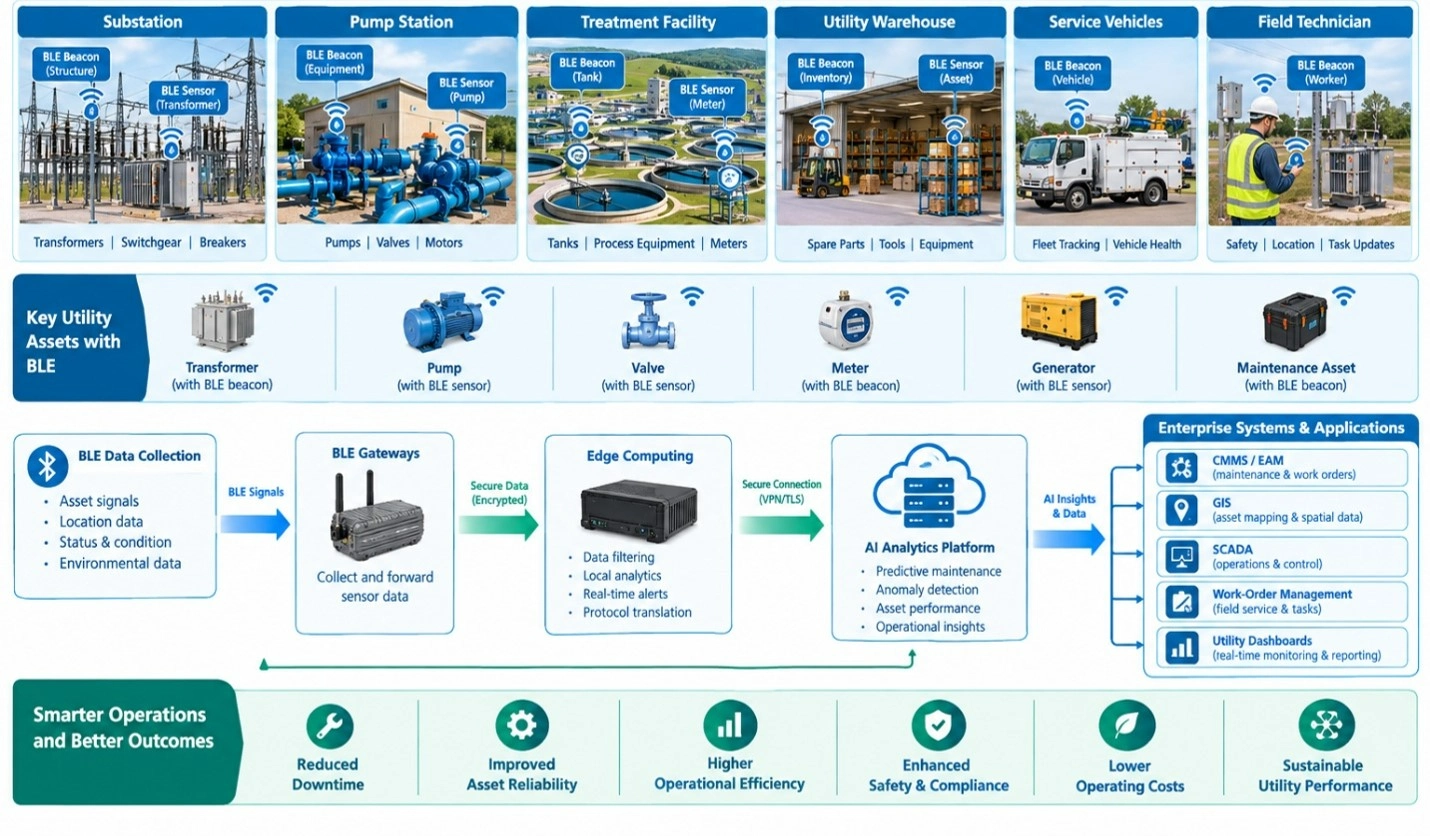
This diagram illustrates how BLE beacons and sensors attached to utility assets—such as transformers, pumps, valves, meters, generators, vehicles, and maintenance equipment—generate field data across substations, treatment facilities, warehouses, and service operations. BLE gateways and edge computing securely process this information before sending it to AI analytics platforms and enterprise systems including CMMS/EAM, GIS, SCADA, work-order management, and operational dashboards. The visual highlights how connected utility infrastructure improves asset reliability, maintenance efficiency, safety, and overall operational performance.
What AI-Enabled BLE Means for Utility Infrastructure
AIoT, or Artificial Intelligence of Things, combines artificial intelligence with IoT devices, sensors, connected equipment, and industrial systems. Within smart utility infrastructure, AIoT can combine BLE sensing with machine learning, Edge AI, computer vision, predictive analytics, and automated decision support.
BLE is particularly useful where utility assets operate across buildings, equipment rooms, maintenance depots, substations, treatment plants, pumping facilities, and controlled field locations. BLE beacons can provide persistent asset identities or location references. BLE sensors can capture temperature, humidity, vibration, motion, contact state, or other measurable conditions. BLE gateways collect nearby transmissions and forward normalized data to utility software.
The resulting information can support applications such as:
- Utility asset tracking for transformers, pumps, generators, test instruments, tools, spare parts, and mobile equipment.
- AI-assisted predictive maintenance based on condition trends and historical work orders.
- Utility inventory management using asset identity and consumption patterns.
- Field workforce coordination based on equipment availability and work-order requirements.
- Monitoring of environmental conditions in electrical rooms, control rooms, pump stations, and equipment storage areas.
- Detection of unusual movement or unauthorized access involving high-value maintenance equipment.
- Tracking of portable diagnostic equipment and calibration instruments between service locations.
- AI-assisted analysis of equipment utilization, maintenance history, and operational conditions.
The important engineering relationship is that BLE supplies localized observations, while AI provides interpretation. A temperature reading from a sensor has limited operational meaning by itself. When combined with equipment type, operating history, maintenance records, ambient conditions, and known failure patterns, the same observation can become a useful maintenance signal.
Utility Infrastructure Applications for AI and BLE
AI Asset Tracking for Utility Equipment
Utility organizations maintain large numbers of distributed assets that move between central warehouses, substations, pump stations, treatment plants, service centers, and field locations. Missing or incorrectly recorded equipment can delay maintenance and create unnecessary procurement activity.
BLE asset tracking can associate equipment with unique identifiers and location observations. AI can then analyze movement histories and asset utilization to identify unusual patterns, equipment bottlenecks, or recurring availability problems.
Relevant assets include:
- Portable generators and battery systems
- Pumps and pump components
- Transformers and electrical maintenance equipment
- Valve actuators and service tools
- Flow meters and pressure instruments
- Calibration equipment
- Safety equipment and specialized tools
- Spare motors, bearings, seals, and electrical components
- Mobile maintenance carts
- Utility vehicles and field-service equipment
A utility warehouse can use BLE-enabled identification to record when an asset enters or leaves a controlled area. AI can correlate those movements with inventory records and work orders, helping maintenance planners determine whether equipment is available for a scheduled intervention.
AI Predictive Maintenance for Utility Equipment
Predictive maintenance requires reliable historical and real-time condition information. BLE sensors can supplement SCADA and dedicated industrial sensors by providing condition data for assets that may not already have continuous instrumentation.
A pump station, for example, may contain motors, pumps, bearings, control cabinets, valves, and auxiliary equipment. BLE sensors can capture selected condition variables such as vibration or temperature. AI models can compare current measurements with historical operating patterns and maintenance records.
The resulting system can help maintenance teams identify:
- Gradual temperature increases
- Abnormal vibration patterns
- Repeated equipment overheating
- Changes following maintenance activities
- Unusual equipment operating intervals
- Conditions associated with previous failures
AI should generally support, rather than blindly replace, engineering judgment. A maintenance alert should be traceable to the underlying measurements, model threshold, historical comparison, or rule that generated it.
AI Utility Inventory Management
Utility infrastructure depends on the availability of replacement components. A delayed repair can occur because a relatively inexpensive seal, bearing, fuse, valve component, connector, sensor, or electrical component cannot be located when required.
BLE-enabled identification can improve visibility across utility warehouses and maintenance stores. AI can use historical consumption, work-order schedules, seasonal demand, failure patterns, and inventory movements to generate replenishment recommendations.
Useful data relationships include:
- Part identity and storage location
- Current quantity
- Historical consumption
- Work-order demand
- Asset failure frequency
- Supplier lead time
- Minimum stock levels
- Emergency usage
- Returned components
GAO can supply BLE hardware and IoT systems that form part of these asset and inventory workflows, with system design depending on the physical environment, required coverage, integration requirements, and operating conditions.
Utility Asset and Inventory AI Workflow for BLE-Enabled Maintenance Management
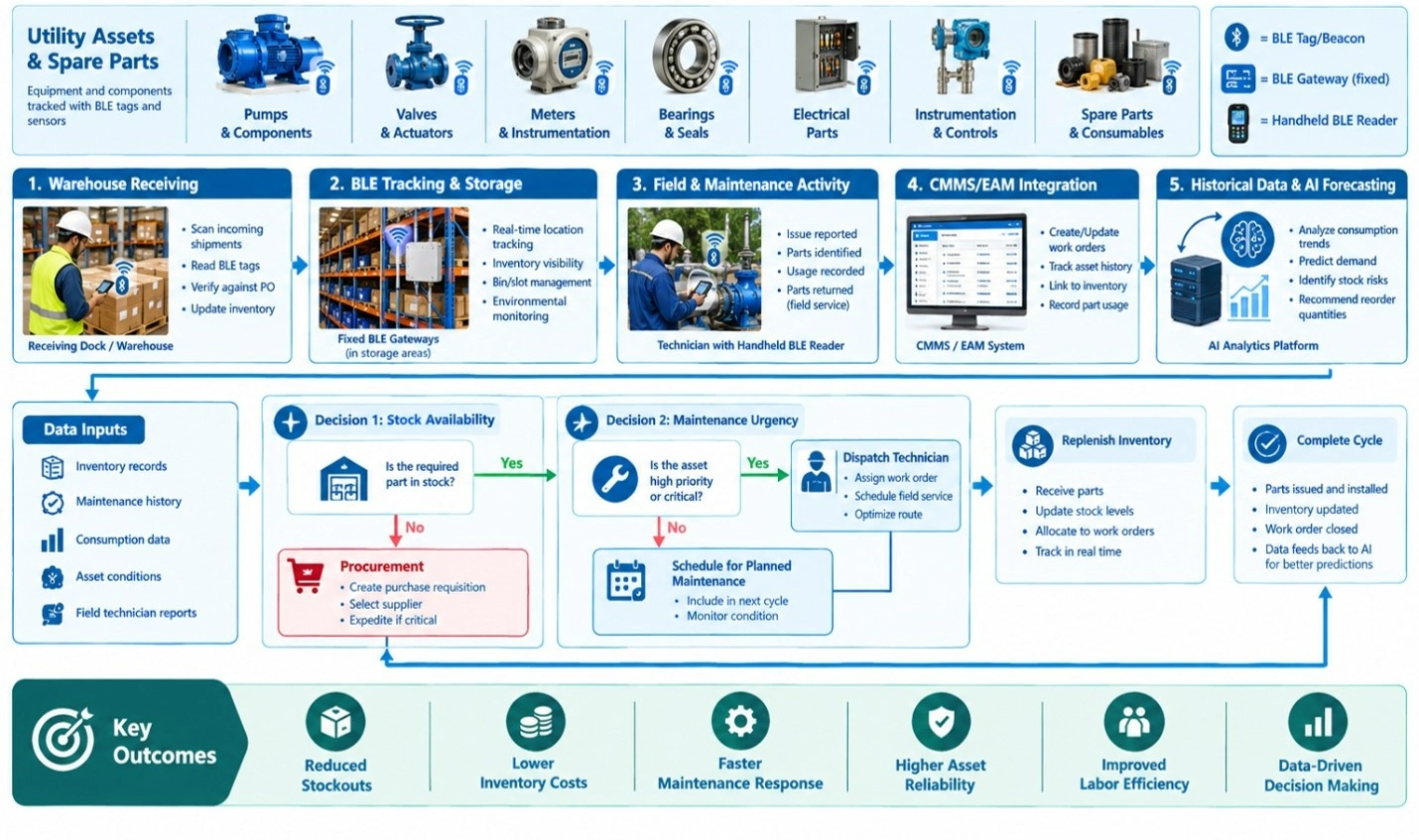
This workflow illustrates how BLE-tagged utility assets and spare parts move through warehouse receiving, storage tracking, field maintenance, and CMMS/EAM systems. Historical consumption and maintenance data feed AI forecasting to support stock availability decisions, procurement, technician dispatch, and inventory replenishment. The visual highlights a connected approach to reducing stockouts and improving maintenance response and asset reliability.
Utility Operational Challenges Addressed by AI
Smart utility infrastructure has operational characteristics that make data quality and asset visibility particularly important. Equipment can be geographically dispersed, maintenance activities can be irregular, and infrastructure may operate continuously for years.
Common challenges include:
- Limited visibility into portable equipment across service locations.
- Incomplete asset-location records.
- Reactive maintenance caused by insufficient condition history.
- Manual inventory reconciliation.
- Difficulty correlating maintenance records with actual equipment movement.
- Environmental exposure affecting electrical and mechanical equipment.
- Poor connectivity in underground, enclosed, or remote utility locations.
- Duplicate or inconsistent asset identifiers across operational systems.
- Aging infrastructure with incomplete historical data.
- High consequences associated with equipment availability during outages or emergency repairs.
AI can address these challenges only when the underlying data is reliable. Sensor placement, gateway coverage, timestamp accuracy, asset identity, calibration, network availability, and integration quality therefore become as important as model selection.
From Utility Data Capture to AI-Driven Decisions
A practical smart utility infrastructure workflow begins with physical assets and ends with a maintenance, inventory, field-service, or operational decision.
Data Acquisition
BLE sensors capture condition measurements while BLE beacons provide asset identity or location references. Existing utility systems can contribute SCADA values, meter readings, GIS information, equipment specifications, maintenance history, and outage records.
BLE Communication and Edge Collection
BLE gateways collect nearby transmissions and forward them to an edge computer, local server, or cloud-connected service. Gateway placement requires attention to building materials, electrical interference, equipment-room layouts, metal enclosures, concrete structures, and expected transmission distances.
Data Normalization and Middleware
Middleware converts heterogeneous sensor observations into records that utility applications can consume. A normalized record may include asset ID, timestamp, gateway ID, location, sensor value, measurement unit, signal information, and data-quality status.
AI Analytics
AI models can identify anomalies, classify operating conditions, forecast demand, estimate maintenance requirements, and identify patterns across asset histories. Depending on the application, methods can include time-series anomaly detection, regression, classification, clustering, forecasting, and rules combined with machine learning.
Utility Software Integration
AI outputs become more useful when integrated with CMMS, EAM, GIS, SCADA, laboratory information systems, inventory software, work-order management, and utility dashboards. Integration can occur through APIs, message brokers, database interfaces, industrial protocols, or other approved enterprise interfaces.
Operational Action
The final output should support a concrete utility action. Examples include creating a maintenance work order, locating a required component, recommending inventory replenishment, escalating an abnormal equipment condition, assigning a technician, or reviewing an asset before returning it to service.
End-to-End Utility AI Data Flow from BLE Assets to Intelligent Operations
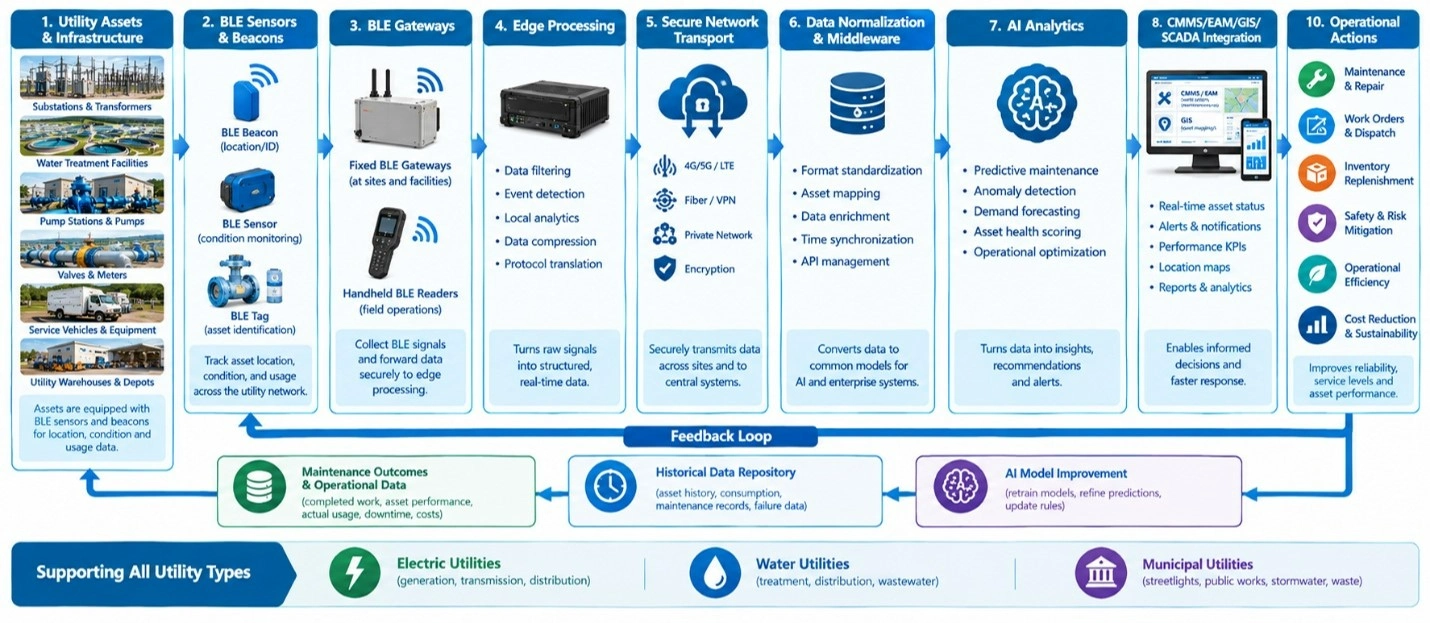
This diagram illustrates the complete flow of utility data from BLE-enabled assets and sensors through gateways, edge processing, secure network transport, data normalization, and AI analytics. It shows how AI insights integrate with CMMS/EAM, GIS, and SCADA to support maintenance, work orders, inventory, safety, and operational decisions. A feedback loop connects maintenance outcomes and historical data to ongoing AI model improvement.
BLE Hardware and AI Software for Smart Utility Infrastructure
A utility deployment normally combines BLE field hardware with networking, computing, data-management, and operational software. The appropriate configuration depends on whether the objective is asset identification, condition monitoring, indoor location, inventory control, or a combination of these applications.
BLE beacons can provide persistent identifiers for equipment such as portable generators, pumps, instruments, tools, and maintenance components. BLE sensors add measurable operating or environmental conditions. BLE gateways aggregate transmissions from multiple nearby devices and provide the connection to higher-level software.
Gateway selection should account for transmission range, enclosure requirements, power availability, antenna characteristics, network connectivity, installation location, temperature range, and maintenance access. Utility environments can contain metal cabinets, reinforced concrete, high-voltage equipment, pumps, motors, and other sources of radio-frequency complexity, so theoretical range should not be treated as actual site coverage.
AI software can operate at different processing locations. Edge processing is useful when a utility needs rapid local decisions, reduced backhaul traffic, or continued operation during temporary WAN interruptions. Cloud processing is useful when multiple facilities need centralized analytics, shared historical data, and centralized model management.
Supporting technologies may include Ethernet, Wi-Fi, cellular connectivity, MQTT, REST APIs, databases, time-series storage, message brokers, identity management, encryption, role-based access control, and secure remote administration.
Cloud Version and Server Version for Utility Deployments
A Cloud Version can host utility asset data, AI analytics, dashboards, device management, and centralized application services within cloud infrastructure. This approach can be appropriate for utilities managing geographically distributed facilities that need centralized visibility without maintaining all application servers themselves.
A Server Version can run on customer-managed servers, private data centers, utility control facilities, edge servers, or other privately hosted infrastructure. This model may be appropriate where operational data must remain within controlled infrastructure, connectivity is constrained, integration with existing utility systems is tightly managed, or organizational policies require private deployment.
A hybrid arrangement can also place latency-sensitive processing near utility equipment while sending selected data to centralized infrastructure for long-term analytics. Security teams should define network segmentation, certificate management, authentication, access privileges, logging, patching, backup, and incident-response procedures before commissioning.
GAO’s experience supplying BLE, RFID, and IoT hardware and systems can support utility deployments where field sensing must connect with existing operational processes rather than operate as an isolated application.
AI-Driven Capabilities for Smart Utility Infrastructure
AI becomes operationally valuable when it converts utility infrastructure data into decisions that maintenance, engineering, inventory, and field-service teams can act on. BLE provides an additional source of structured asset and condition data that can be correlated with existing utility records.
Predictive Maintenance and Condition Assessment
Machine learning can establish normal operating patterns for pumps, motors, generators, electrical equipment, and other monitored assets. Deviations in temperature, vibration, operating duration, or environmental conditions can trigger investigation before a conventional calendar-based maintenance interval is reached.
The engineering objective is not to generate the greatest number of alerts. It is to produce alerts with sufficient context for a technician or reliability engineer to determine whether an inspection or intervention is warranted.
GAO BLE sensors can contribute localized condition observations where existing instrumentation does not provide sufficient coverage. Combining those measurements with CMMS history, failure records, equipment age, and maintenance activities can improve the context available to predictive-maintenance models.
AI-Assisted Field Service
Utility field technicians frequently travel between substations, pump stations, treatment facilities, meter locations, and maintenance depots. AI can analyze work orders, technician requirements, equipment availability, asset location, and historical service information to support work planning.
BLE asset identification can help confirm that the required test instrument, replacement component, or maintenance tool is present at the expected location. This reduces reliance on manually maintained equipment lists.
Useful operational outputs include:
- Required equipment for a scheduled work order
- Known location of portable maintenance equipment
- Previous maintenance performed on an asset
- Components previously replaced
- Equipment condition observations
- Recommended inspection priorities
- Confirmation that required tools or parts are available
AI Utility Inventory Forecasting
Inventory forecasting becomes more useful when consumption is connected to actual maintenance activity. AI can identify relationships between spare-part usage, equipment failures, scheduled maintenance, seasonal operating conditions, and emergency repairs.
For example, repeated pump failures may produce increased demand for bearings, seals, couplings, or motor components. A forecasting model can identify the trend earlier than a simple minimum-stock rule.
BLE-enabled asset identification adds another data layer by improving the traceability of components and mobile equipment as they move through warehouses and service locations.
Smart Utility Infrastructure Performance and KPIs
A successful deployment should be measured through operational outcomes rather than the number of BLE devices installed or AI models deployed.
Relevant utility infrastructure KPIs include:
| KPI | Utility Infrastructure Relevance |
|---|---|
| Asset-location accuracy | Measures whether equipment records correspond with physical locations |
| Maintenance response time | Tracks time from condition alert to maintenance action |
| Mean time to repair | Measures restoration efficiency after equipment failure |
| Unplanned equipment downtime | Indicates reliability improvement |
| Preventive maintenance compliance | Shows whether scheduled interventions are completed |
| Predictive alert precision | Measures how often AI alerts correspond to meaningful conditions |
| False-alert rate | Identifies unnecessary maintenance investigations |
| Spare-part stockout rate | Measures availability of critical components |
| Inventory accuracy | Compares recorded and physically available stock |
| Technician equipment availability | Measures whether required tools and instruments are accessible |
| Asset utilization | Shows how effectively portable equipment is being used |
| Gateway data availability | Measures reliability of BLE data collection |
| Sensor data completeness | Identifies missing condition measurements |
| Work-order closure time | Measures maintenance workflow efficiency |
| Emergency procurement frequency | Indicates weaknesses in spare-part planning |
These KPIs should have defined baselines before deployment. A utility operator should compare performance before and after implementation while accounting for seasonal demand, major infrastructure projects, outages, and changes in maintenance policy.
Engineering Design and Deployment Considerations
BLE Coverage Planning
BLE gateway placement should be based on an actual radio survey rather than nominal manufacturer range. Utility facilities often contain reinforced concrete, steel structures, electrical cabinets, pipes, tanks, motors, and other obstructions.
A deployment survey should evaluate:
- Gateway mounting positions
- Asset density
- Expected BLE transmission paths
- Metal equipment and enclosures
- Radio interference
- Required location accuracy
- Gateway backhaul availability
- Power availability
- Environmental exposure
- Maintenance access
High-value assets may require overlapping gateway coverage so that a single gateway failure does not eliminate visibility.
Sensor Placement and Data Quality
Sensor placement directly affects AI model quality. A temperature sensor mounted too far from a heat-generating component may produce an apparently stable measurement even when the component is experiencing abnormal conditions.
Condition-monitoring installations should therefore consider the physical mechanism being measured. Vibration sensors require appropriate mechanical coupling. Temperature sensors should be positioned where the measured temperature has operational meaning. Environmental sensors should represent the conditions relevant to the equipment being protected.
Data-quality checks should identify missing values, implausible measurements, duplicate records, timestamp inconsistencies, low battery conditions, and communication gaps before those data enter predictive models.
Utility System Integration
BLE data should complement, rather than unnecessarily replace, existing utility information systems. A mature implementation may integrate:
- CMMS and EAM software
- GIS and asset registries
- SCADA systems
- Meter data management systems
- Inventory and warehouse management software
- Work-order management
- Laboratory information systems
- Procurement systems
- Identity and access management
- Operational dashboards
- Data historians and time-series databases
Asset identifiers should be standardized across systems. A pump identified as one asset in the BLE system and another asset in the CMMS can create duplicate maintenance records and undermine AI analysis.
Cybersecurity for AI-Enabled Utility Infrastructure
Utility infrastructure requires security controls that account for both information technology and operational technology environments. BLE devices should not be treated as isolated sensors simply because their radio range is relatively short.
A secure implementation should address:
- Unique device identities
- Strong authentication
- Encrypted communications where supported
- Certificate and credential management
- Network segmentation
- Least-privilege access
- Secure gateway configuration
- Firmware update procedures
- Centralized logging
- Vulnerability management
- Backup and recovery
- Remote-access controls
- Monitoring of unusual device behavior
BLE gateways connecting to utility networks should be placed according to the organization’s OT and IT security policies. A gateway should not provide an uncontrolled path between field devices and critical control networks.
AI security also requires protection of training and operational data. Model inputs should be traceable, access should be controlled, and changes to model versions should be documented. Human approval may remain necessary for maintenance decisions that could affect safety, service continuity, or regulated operations.
GAO can provide hardware and IoT systems for utility applications, while the final cybersecurity configuration should be developed jointly with the utility’s IT, OT, engineering, and cybersecurity teams.
Interoperability and Data Governance
Interoperability becomes increasingly important as smart utility infrastructure expands across facilities and asset classes. BLE systems should expose information in formats that can be consumed by approved utility software rather than creating another isolated database.
A practical data model can associate:
Asset ID → Equipment Type → Physical Location → BLE Device → Condition Data → Work Order → Maintenance History → Inventory Relationship
This relationship allows AI systems to analyze an asset using both current observations and historical operational context.
Data governance should establish ownership for asset records, sensor data, AI outputs, and maintenance decisions. Engineering teams should also define retention periods, data-quality thresholds, timestamp requirements, and procedures for correcting erroneous asset associations.
Utility Asset Data Relationship Model for BLE, CMMS/EAM, GIS, and AI Analytics
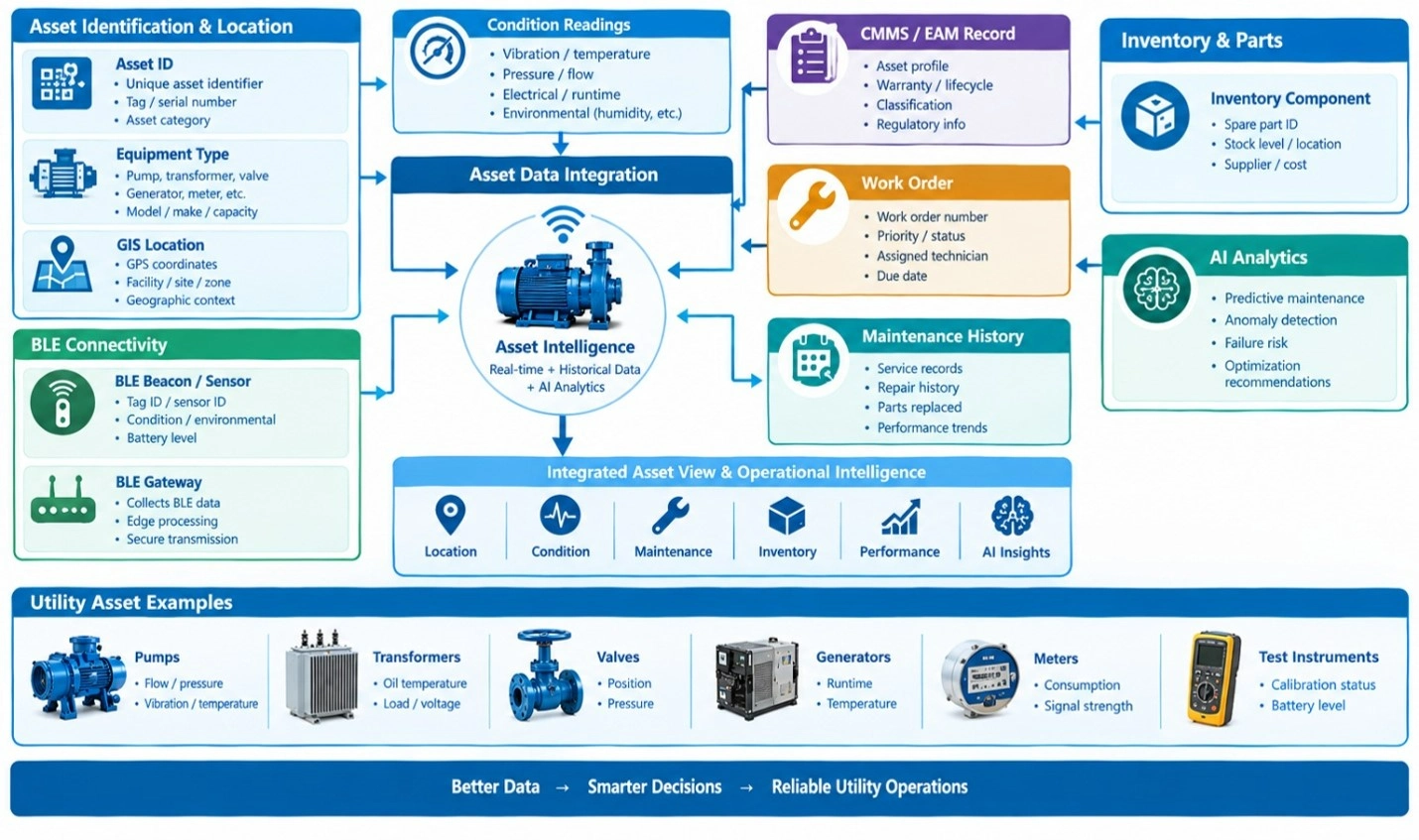
This diagram illustrates how asset IDs, equipment types, GIS locations, BLE observations, condition readings, maintenance records, work orders, and inventory data connect within a unified utility asset model. AI analytics combines real-time and historical information to support predictive maintenance, anomaly detection, asset performance analysis, and operational recommendations. The model applies to utility assets including pumps, transformers, valves, generators, meters, and portable test instruments.
Commissioning, Testing, and Optimization
Commissioning should verify the complete operational chain rather than simply confirming that BLE devices transmit.
Testing should cover:
- BLE device identification
- Gateway reception
- Signal consistency
- Timestamp accuracy
- Sensor measurement validity
- Network transmission
- Middleware processing
- Database storage
- CMMS/EAM integration
- AI alert generation
- Dashboard presentation
- Work-order creation
- Failure and recovery behavior
A controlled pilot can begin with a defined equipment group, such as pump motors at one facility or portable maintenance equipment within one utility depot. The pilot should establish baseline KPIs and document failure modes before broader deployment.
AI models should be validated against actual utility maintenance outcomes. Historical data may contain survivorship bias, missing maintenance records, inconsistent asset identifiers, or periods when equipment was offline. Those issues should be addressed before model performance is treated as evidence of operational reliability.
Optimization can then focus on gateway placement, sensor sampling intervals, battery life, alert thresholds, model parameters, integration latency, and technician workflows.
Scaling AI and BLE Across Utility Facilities
Scaling should occur through repeatable engineering standards rather than simply installing identical equipment at every location. A pumping station, electrical substation, water treatment facility, warehouse, and service depot have different physical and operational requirements.
A scalable utility deployment should define:
- Standard asset identification conventions
- Approved BLE device classes
- Gateway installation guidelines
- Sensor mounting practices
- Network and cybersecurity requirements
- Data schemas
- API integration standards
- AI model validation procedures
- Maintenance responsibilities
- Device replacement procedures
- Battery-management policies
- Firmware-management processes
- KPI reporting standards
Facilities can then be added while preserving consistent data structures and operational procedures.
Practical Implementation Lessons for Smart Utility Infrastructure
Several engineering lessons are particularly important when combining AI with BLE in utility environments.
- Start with a measurable utility problem such as asset-location accuracy, spare-part availability, or predictive maintenance rather than deploying sensors without a defined operational purpose.
- Establish asset identity before building AI models. Incorrect equipment associations can contaminate historical datasets.
- Use BLE coverage surveys to validate gateway placement under real utility conditions.
- Treat sensor calibration and mounting as part of AI data quality.
- Integrate with existing CMMS, EAM, GIS, and SCADA workflows where appropriate.
- Keep safety-critical control decisions under approved utility engineering controls.
- Measure false alerts as carefully as successful detections.
- Design for gateway, network, sensor, and power failures.
- Separate operational technology networks from general-purpose application networks according to utility cybersecurity requirements.
- Pilot with a controlled equipment population before expanding across multiple facilities.
- Document model assumptions and retraining procedures.
- Make AI recommendations explainable enough for maintenance and reliability personnel to investigate.
Building a More Observable Utility Infrastructure
AI-enabled utility infrastructure is most effective when sensing, asset identity, operational history, and maintenance processes are treated as one connected workflow. BLE beacons and sensors can improve visibility of equipment and conditions, while gateways provide the data path into utility software. AI then adds value by finding patterns that are difficult to identify through manual review.
The resulting system can support predictive maintenance, utility asset tracking, inventory forecasting, field-service coordination, environmental monitoring, and operational analytics. The strongest implementations begin with a defined utility problem, establish measurable KPIs, validate data quality, integrate with existing systems, and expand only after the operational workflow has been proven.
GAO has supplied BLE, RFID, and IoT hardware products and systems to organizations across utility-related and other technical environments. Headquartered in New York City and Toronto, Canada, GAO is among the top 10 leading B2B and B2G BLE and RFID suppliers globally. Its technical work includes applications where asset identification, sensing, data collection, and enterprise software integration must operate reliably together.
Why Work with GAO for Smart Utility Infrastructure
GAO, together with GAO Research Inc. and GAO Tek Inc., forms the GAO Group, with operations based in New York City and Toronto, Canada. For three decades, the companies have served customers across the United States and Canada, including Fortune 500 companies, leading R&D organizations, universities, and U.S. and Canadian government agencies.
Our work emphasizes practical hardware and system requirements rather than technology selection in isolation. GAO has invested substantially in R&D and maintains stringent quality assurance processes for its products and systems. Remote and onsite technical support can also help organizations address installation, integration, troubleshooting, and deployment requirements.
For utility engineering and IT teams evaluating AI-enabled asset tracking, condition monitoring, inventory visibility, or field-service applications, the next step is to define the assets, facilities, operational data, integration points, and measurable outcomes required for the deployment. GAO’s BLE, RFID, and IoT solutions can then be evaluated against those requirements.
Building the Future of Industrial AI and IoT with Aperture Venture Studio and GAO
For more than three decades, GAO Group of Companies has invested heavily in R&D involving industrial BLE, RFID, and IoT. As AI became increasingly useful for industrial applications, we expanded work combining AI with connected utility assets, sensors, and operational systems. We also founded Aperture Venture Studio to build, launch, and scale AI and IoT companies addressing practical industrial applications, including smart utility infrastructure.
Aperture brings together AI and IoT technical experts, entrepreneurial and operational executives, investors, and leading companies. Its Aperture Ventures Summit and TekSummit provide forums for discussing advanced AI and IoT topics. We welcome advisors, employees, investors, and customers interested in advancing practical AI and IoT applications.