
AI and BLE for Solar Energy Facilities
AI-Driven Solar Facility Operations with BLE
Artificial Intelligence of Things (AIoT) combines AI with connected sensors, equipment, and industrial systems to turn field data into operational decisions. For solar energy facilities, AIoT can combine BLE sensors, BLE beacons, BLE gateways, plant monitoring data, weather information, maintenance records, and equipment telemetry to improve asset visibility and maintenance decisions. AI models can identify abnormal equipment conditions, correlate environmental and operational variables, prioritize field inspections, and support predictive maintenance for photovoltaic (PV) plants. BLE is particularly useful where maintenance teams need localized monitoring of mobile tools, critical spares, battery-powered devices, environmental conditions, or equipment in areas where wiring additional sensors is impractical. GAO supplies BLE gateways, beacons, sensors, RFID and IoT systems that can be integrated into these workflows. The resulting system can connect field-level observations with SCADA, computerized maintenance management systems (CMMS), enterprise databases, and analytics software, supporting more data-driven solar facility operations. (GAO RFID)
AI-Enabled BLE Monitoring System for Solar Energy Facilities
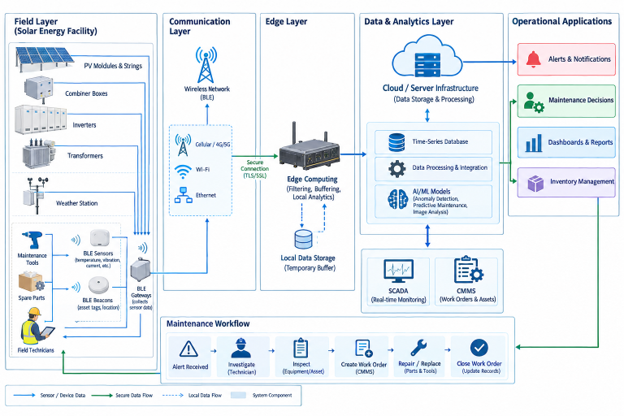
This enterprise engineering diagram illustrates how PV modules, inverters, transformers, maintenance assets, BLE sensors, BLE beacons, and BLE gateways connect through edge computing to SCADA, CMMS, cloud/server analytics, and AI/ML models. It shows the complete data flow from field sensing through AI-generated alerts and maintenance decisions.
What AI-Enabled BLE Monitoring Means for Solar Energy Facilities
Solar energy facilities generate operational data from many interconnected assets. A utility-scale PV plant can contain thousands of modules, DC strings, combiner boxes, inverters, medium-voltage transformers, switchgear, trackers, weather instruments, communications equipment, fire and safety equipment, maintenance tools, and replacement components.
Traditional plant monitoring generally concentrates on electrical generation and equipment telemetry through SCADA and inverter monitoring systems. That information is essential, but it does not necessarily provide continuous visibility into every physical asset, maintenance activity, or localized environmental condition.
AI-enabled BLE monitoring fills selected gaps by adding low-power wireless observations close to the equipment or assets being managed. BLE sensors can capture parameters such as temperature, humidity, vibration, battery condition, or other application-specific measurements. BLE beacons can provide identity and location signals for mobile assets, tools, spare parts, inspection equipment, or tagged maintenance resources. BLE gateways collect these wireless signals and forward relevant data to edge or server software.
AI then adds analytical capability. Instead of simply displaying individual sensor readings, an AI system can correlate measurements with equipment status, weather conditions, historical maintenance records, alarm events, inspection findings, and production information. This can help maintenance teams distinguish normal environmental variation from conditions that warrant investigation.
For solar facilities, the value therefore comes from the complete information chain:
- Field sensing: Capture physical and operational observations close to solar assets and maintenance resources.
- BLE connectivity: Collect low-power wireless telemetry and identification data.
- Edge processing: Filter, normalize, timestamp, and temporarily store data near the facility.
- AI analytics: Detect anomalies, identify patterns, classify events, and estimate maintenance priorities.
- Operational software: Connect findings with SCADA, CMMS, computerized maintenance workflows, inventory systems, or reporting databases.
- Human action: Dispatch technicians, inspect equipment, verify faults, replace components, or adjust maintenance priorities.
The engineering objective should not be to replace established PV monitoring systems. Instead, AI and BLE should provide additional observations where they improve operational visibility or reduce the cost of collecting field information.
Solar Facility Applications for AI-Driven Monitoring
Predictive Maintenance for PV Plant Equipment
Predictive maintenance can combine equipment telemetry, environmental conditions, historical failure records, inspection results, and maintenance events to identify deviations from expected operating behavior.
For example, an AI model could correlate abnormal temperature observations around selected electrical assets with inverter alarms, ambient temperature, loading conditions, and previous maintenance events. The model could then assign an anomaly score for engineering review rather than automatically declaring a component defective.
This distinction is important. Solar equipment operates under changing irradiance, ambient temperature, wind, dust, humidity, and loading conditions. A useful AI model therefore needs contextual data rather than relying on a single threshold.
Potential applications include:
- Inverter enclosure temperature monitoring
- Transformer and electrical-room environmental monitoring
- Vibration monitoring for tracker drive equipment
- Battery-backed equipment monitoring
- Communications cabinet temperature and humidity monitoring
- Abnormal environmental condition detection
- Maintenance-event correlation
- Failure precursor identification
- Work-order prioritization
AI-Assisted Solar Asset Tracking
Large solar facilities can contain extensive inventories of test instruments, portable electrical equipment, replacement components, PPE, maintenance tools, temporary equipment, and critical spares.
BLE beacons can provide a digital identity for selected mobile assets, while BLE gateways positioned around buildings, maintenance areas, warehouses, substations, and other relevant locations can collect proximity or location information.
AI can then analyze asset movement patterns and maintenance records to identify operational issues such as frequently misplaced equipment, unusual movement patterns, underutilized tools, or delays between equipment checkout and field deployment.
This is particularly useful when asset location affects maintenance response time.
GAO provides BLE gateways and beacons that can serve as the field connectivity layer for asset tracking and monitoring systems. Its experience supplying BLE and RFID hardware and systems to organizations across multiple industries supports integration-oriented deployments rather than treating wireless hardware as an isolated installation. (GAO RFID)
AI for Solar Maintenance Logistics
Maintenance performance depends not only on diagnosing equipment but also on having the correct people, tools, replacement components, and inspection equipment available at the right location.
An AI-enabled maintenance system can combine:
- Equipment condition data
- Open CMMS work orders
- Spare-parts inventory
- Technician availability
- Asset location
- Historical repair duration
- Site access constraints
- Weather information
- Equipment criticality
BLE tracking can provide additional information about the location of mobile tools and selected inventory. AI can use that information to improve work-order prioritization and maintenance coordination.
For example, if an inverter-related work order requires a specific diagnostic instrument, the maintenance system can determine whether the instrument is already available near the relevant inverter block or whether it must be retrieved from another maintenance area.
Solar Site Environmental Monitoring
Environmental conditions can materially influence solar facility operations. Depending on the location and plant design, relevant parameters can include temperature, humidity, dust exposure, enclosure conditions, and localized environmental variation.
BLE sensors can supplement fixed weather stations when localized measurements are useful. The data can then be correlated with equipment alarms, inspection records, and energy production.
AI-based anomaly detection can help identify relationships that are difficult to observe manually. For example, a recurring equipment alarm may appear more frequently under a specific combination of temperature and humidity conditions.
Such findings should be treated as engineering evidence for investigation rather than automatically interpreted as proof of causation.
Utility-Scale Solar PV Facility Infrastructure and Smart Operations Architecture.
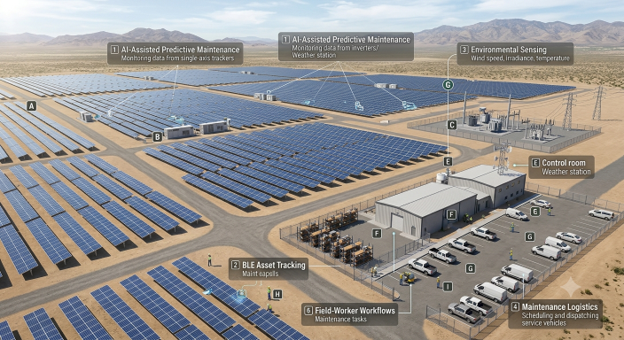
An elevated vector-style engineering diagram illustrating a utility-scale solar photovoltaic plant set in a desert environment. The scene outlines physical infrastructure—including tracker-mounted PV module arrays, inverter skid stations, high-voltage substations, administrative buildings, maintenance warehouses, spare-part yards, weather stations, and field technicians—overlaid with subtle semi-transparent HUD callouts detailing smart O&M capabilities like AI predictive maintenance, BLE asset tracking, and environmental sensing.
Solar Facility Operational Workflow from Sensing to Action
A successful AIoT deployment should be designed around the solar facility’s existing operational workflow rather than around individual sensors.
Field Data Acquisition
The process begins with data acquisition from multiple sources.
BLE sensors can collect localized measurements, while BLE beacons can identify or provide proximity information for selected assets. Existing plant systems can provide inverter status, production information, alarms, weather measurements, and other operational data.
The solution should establish a clear data dictionary before deployment. Each measurement should have an identifiable asset, timestamp, unit, quality status, and source.
BLE Communication and Gateway Collection
BLE gateways receive wireless advertisements or connected-device data from sensors and beacons within their coverage areas. Gateway placement should account for solar-panel rows, metal structures, inverter enclosures, electrical rooms, maintenance buildings, substations, and other physical obstructions.
Radio planning should be performed on the actual site because theoretical range figures rarely represent the final installation environment.
Gateway redundancy may be appropriate for critical areas where communication loss would otherwise create unacceptable blind spots.
Bluetooth technology also provides standardized capabilities relevant to asset tracking. Bluetooth’s Asset Tracking Profile, for example, supports direction-finding workflows based on Angle of Arrival (AoA), allowing suitable systems to derive location information from BLE signals. (Bluetooth® Technology Website)
Edge Processing and Data Normalization
A solar facility may continue operating even when its external network connection is unavailable. For that reason, an edge computing layer can be useful for local buffering, filtering, timestamping, protocol conversion, and basic event processing.
The edge software can:
- Remove duplicate sensor messages
- Validate sensor readings
- Apply data-quality rules
- Buffer data during network outages
- Normalize timestamps and measurement units
- Forward selected events to central software
- Maintain local operational records
This reduces unnecessary data transmission and improves resilience.
AI Analytics and Decision Support
After normalization, AI and machine learning models can process historical and real-time data.
Relevant analytical methods include:
- Time-series anomaly detection
- Predictive maintenance models
- Classification models
- Clustering
- Regression
- Remaining-useful-life estimation where sufficient failure data exists
- Pattern recognition
- Context-aware alert prioritization
- Natural-language interfaces for operational records
A practical deployment should establish model validation procedures before allowing AI-generated findings to influence maintenance decisions.
Solar plant operators should also maintain explainability and traceability. A maintenance engineer should be able to determine which measurements, events, or historical observations contributed to an AI-generated alert.
Integration with Solar Operations Software
The AI system should connect with existing software instead of creating another isolated data store.
Potential integration points include:
- SCADA
- Energy management systems
- Inverter monitoring software
- CMMS
- Enterprise asset management systems
- Inventory management software
- Weather databases
- Maintenance work-order systems
- Data historians
- SQL databases
- REST APIs
- MQTT-based IoT messaging systems
- OPC UA environments where appropriate
The precise integration method should depend on the interfaces already supported by the solar facility.
Operational Decision and Feedback
The final stage is the human or automated operational response.
A high-temperature anomaly, for example, may trigger an engineering review. The technician can inspect the equipment, compare the physical condition with the AI alert, record the finding in the CMMS, and close or escalate the work order.
That feedback becomes valuable training information. Over time, verified maintenance outcomes can improve the AI model’s ability to distinguish genuine equipment abnormalities from environmental variation.
BLE, AI Software and Deployment Models for Solar Facilities
The technology layer should be selected according to the physical characteristics and operational requirements of the solar facility.
BLE Sensors, Beacons and Gateways
BLE sensors are appropriate when a solar operator needs localized measurements without installing extensive wired infrastructure. Depending on the sensor design, applications may include temperature, humidity, vibration, battery status, or other monitored parameters.
BLE beacons are useful for assigning wireless identities to mobile assets and selected equipment. A beacon can periodically transmit identification information that nearby gateways receive.
BLE gateways provide the connection between field-level BLE devices and the facility’s computing or communications environment. Gateway selection should consider radio coverage, antenna configuration, enclosure requirements, power availability, network interfaces, environmental rating, and local processing capability.
The physical installation matters as much as the radio specification. Large metallic structures, equipment enclosures, electrical interference, module rows, and changing equipment positions can affect signal behavior.
Edge Computing and Solar Site Networking
An edge server or industrial computer can provide local processing close to the PV plant. This approach is particularly relevant when network connectivity to a central cloud environment is intermittent or when operational data should remain available locally.
A typical edge implementation can include:
- BLE gateway management
- Local message brokers
- Device health monitoring
- Data buffering
- Protocol conversion
- Local analytics
- Secure API communication
- Time synchronization
- Event forwarding
Network segmentation should separate IoT devices from sensitive control networks wherever practical. The exact design should follow the facility’s cybersecurity policies and applicable operational technology requirements.
Cloud Version
A cloud-hosted SaaS deployment can centralize data from multiple solar facilities. This is useful for operators managing geographically distributed PV plants because centralized software can provide consistent dashboards, asset records, AI models, reporting, and fleet-level analytics.
Cloud deployment is particularly useful when:
- Multiple solar sites need consolidated reporting
- Central engineering teams monitor geographically distributed facilities
- AI models require substantial computing resources
- Long-term historical data needs centralized storage
- Software updates must be managed consistently
- Corporate maintenance systems already use cloud infrastructure
Cloud connectivity should not be assumed to be continuously available. Critical local workflows may still require edge buffering or local operation.
Server Version
A server deployment places the software on customer-managed infrastructure, such as an edge server at the solar facility, a private data center, a corporate server environment, or another privately hosted enterprise computing environment.
This approach can be appropriate where operators require greater control over data location, network connectivity, software integration, or operational technology boundaries.
A server deployment can also reduce dependence on external connectivity for local monitoring. However, the customer assumes greater responsibility for server maintenance, backup, patching, cybersecurity controls, redundancy, and disaster recovery.
GAO can support deployments involving BLE gateways, BLE beacons, RFID hardware, and IoT systems, allowing the wireless layer to be selected according to the customer’s operational requirements rather than forcing every solar facility into one deployment model. (GAO RFID)
Security and Interoperability Considerations
Security should be addressed from device commissioning through data storage and software integration.
Important controls include:
- Unique device identities
- Secure gateway configuration
- Role-based access control
- Encrypted communications where supported
- Network segmentation
- Credential lifecycle management
- Firmware and software update procedures
- Audit logging
- Data integrity checks
- Backup and recovery procedures
- Monitoring for unauthorized device behavior
Interoperability is equally important. A BLE system should expose useful data through documented interfaces so that information can be consumed by existing solar monitoring, maintenance, inventory, and analytics software.
Solar PV Standards and Engineering Context
AI and BLE systems should complement, rather than replace, established photovoltaic engineering practices.
IEC 62446-1 specifies documentation, commissioning tests, inspection criteria, and information expected for grid-connected PV systems. Its scope was expanded to address larger and more complex PV installations. (IEC Webstore)
PV performance evaluation also relies on standardized measurement concepts. NREL documentation references IEC 61724 series methods for photovoltaic system performance, including capacity and energy evaluation, while IEC 62446-related guidance covers PV documentation, inspection, commissioning, and maintenance activities. (NREL)
Consequently, an AI-enabled BLE system should preserve links between wireless observations and established engineering records.
A temperature anomaly should remain traceable to the monitored asset, measurement timestamp, environmental context, inspection result, and resulting maintenance action. Similarly, an asset-tracking event should be connected to the relevant work order or inventory transaction when that information is operationally important.
This traceability creates a more useful foundation for AI because the model receives structured operational context rather than isolated sensor readings.
AI-Enabled BLE Solution Lifecycle for Solar PV Facilities
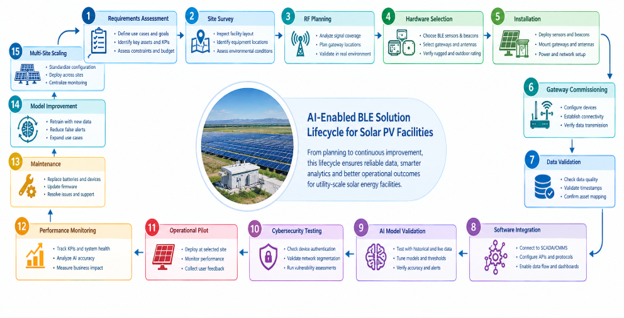
This lifecycle diagram presents the engineering process for deploying an AI-enabled BLE solution in utility-scale solar PV facilities, from requirements assessment and RF planning through installation, commissioning, software integration, cybersecurity testing, operational validation, maintenance, model improvement, and multi-site scaling.
Engineering Considerations for AI-Enabled Solar Facility Monitoring
Deploying AI-enabled BLE monitoring across a solar energy facility requires more than installing wireless devices. The system should be designed around asset criticality, physical site conditions, existing electrical and communications infrastructure, maintenance procedures, cybersecurity requirements, and the quality of data available for AI analysis.
Site Survey and RF Planning
A site survey should identify where BLE devices will operate and where gateways can be installed safely and effectively.
Important considerations include:
- Distance between BLE devices and gateways
- Metal structures and equipment enclosures that may affect radio propagation
- PV module rows and tracker movement
- Inverter stations and electrical rooms
- Maintenance buildings and warehouses
- Gateway mounting height and antenna orientation
- Available electrical power
- Ethernet, Wi-Fi, cellular, or other backhaul connectivity
- Outdoor temperature, moisture, dust, and enclosure requirements
- Areas where technicians routinely move tagged tools and equipment
Solar facilities are geographically distributed, so a single gateway location should not be assumed to provide adequate coverage across an entire plant. A practical deployment normally begins with a representative area, measures actual signal behavior, and then adjusts gateway locations before full-scale installation.
Sensor Selection and Asset Criticality
Not every PV asset requires a BLE sensor. Monitoring should be justified by the operational value of the information.
A useful prioritization method considers:
- Asset criticality
- Failure consequence
- Failure frequency
- Existing SCADA visibility
- Cost of manual inspection
- Availability of historical data
- Ease of sensor installation
- Required measurement frequency
- Environmental exposure
- Maintenance response requirements
For example, adding BLE temperature sensors to an area that is already comprehensively instrumented may provide little additional value. The same technology can be more useful for localized conditions that existing plant instrumentation does not measure.
Data Quality Before AI Model Development
AI performance depends heavily on data quality. A solar facility should therefore establish data-quality controls before developing predictive models.
Sensor records should ideally include:
- Asset identifier
- Sensor identifier
- Timestamp
- Measurement value
- Unit of measurement
- Signal or device status
- Data-quality indicator
- Gateway identifier
- Physical location
- Calibration or maintenance information where applicable
Missing values, duplicated messages, incorrect timestamps, sensor drift, gateway outages, and battery failures can create false patterns. AI models trained on poor-quality historical data may produce unreliable alerts even when the algorithm itself is technically sound.
A practical implementation should therefore monitor sensor health separately from asset health.
AI Models for Solar Plant Operations
AI methods should be selected according to the decision that the solar operator needs to make.
Anomaly Detection
Anomaly detection is useful when the facility has substantial normal operating data but relatively few confirmed failure events.
The model learns expected relationships between variables and identifies observations that differ materially from those patterns.
For example, a model could examine:
- Equipment temperature
- Ambient temperature
- Equipment loading
- Irradiance
- Historical alarm states
- Time of day
- Maintenance history
An anomaly does not necessarily mean equipment failure. It indicates that the observation deserves investigation.
Predictive Maintenance
Supervised machine learning can be considered when the solar operator has sufficient historical examples of failures, maintenance events, component replacements, and associated measurements.
Potential outputs include:
- Failure-risk estimates
- Maintenance priority
- Expected degradation trends
- Recommended inspection intervals
- Remaining-useful-life estimates where sufficient historical evidence exists
The model should be evaluated using operationally meaningful metrics rather than model accuracy alone. False positives can consume technician time, while false negatives can allow important equipment problems to remain undetected.
Computer Vision and Multimodal AI
AI for solar facilities does not need to depend exclusively on BLE data. Computer vision can analyze thermal or visual inspection imagery from drones, robotic systems, handheld cameras, or other inspection equipment.
Examples include identifying:
- PV module abnormalities
- Hotspots
- Soiling patterns
- Physical damage
- Vegetation encroachment
- Tracker abnormalities
- Equipment enclosure conditions
BLE-based asset identification can complement these workflows by associating inspection equipment, locations, or maintenance resources with specific operational records.
The most useful AI solution may therefore combine several data sources rather than attempting to make BLE responsible for every monitoring requirement.
KPIs for AI and BLE Solar Facility Solutions
A deployment should be measured against operational outcomes rather than the number of BLE devices installed.
Relevant performance indicators can include:
| KPI | Solar Facility Relevance |
|---|---|
| Asset-location accuracy | Measures whether tagged tools and equipment can be located reliably |
| BLE gateway availability | Indicates continuity of wireless data collection |
| Sensor data completeness | Measures missing or unavailable observations |
| Alert precision | Indicates how many AI-generated alerts require genuine investigation |
| Mean time to detect | Measures how quickly abnormal conditions are identified |
| Mean time to respond | Measures maintenance response after an actionable alert |
| Mean time to repair | Measures the duration of corrective maintenance |
| Unplanned downtime | Tracks equipment availability impact |
| Preventive-to-corrective maintenance ratio | Indicates the shift toward planned intervention |
| Work-order response time | Measures maintenance workflow efficiency |
| Critical spare availability | Indicates readiness for equipment repair |
| Tool retrieval time | Measures efficiency of field maintenance logistics |
| Gateway communication uptime | Measures wireless connectivity reliability |
| Sensor battery life | Indicates field-device maintenance requirements |
| Energy availability | Helps assess operational impact at plant level |
| Specific yield | Provides a production-level performance reference |
| Capacity factor | Supports broader plant-performance analysis |
| False-alert rate | Measures AI alert quality |
| Model drift | Identifies changes in AI performance over time |
KPIs should be established during the requirements stage so that the pilot has measurable acceptance criteria.
Commissioning, Testing and Validation
Commissioning should verify both the wireless system and the complete information flow.
Device and Gateway Testing
Each BLE device should be registered against the correct asset or location. Gateway testing should verify:
- Device discovery
- Signal reception
- Data transmission
- Correct timestamps
- Battery status reporting where available
- Gateway connectivity
- Local buffering
- Recovery following communications interruption
End-to-End Data Testing
A field-generated event should be traceable through the complete system.
For example:
BLE sensor → BLE gateway → edge software → secure network → server/cloud → analytics → alert → maintenance workflow
Testing should verify that the correct asset receives the correct measurement and that data is not duplicated, lost, incorrectly mapped, or assigned to another equipment record.
AI Validation
AI outputs should be tested against known operational events and expert-reviewed scenarios.
A controlled pilot can compare:
- AI-generated alerts
- Existing SCADA alarms
- Technician observations
- Inspection findings
- CMMS work orders
- Actual component failures or maintenance outcomes
This provides a basis for determining whether the AI is producing useful operational information.
AI recommendations should remain subject to appropriate engineering review, particularly where an incorrect decision could affect electrical safety, equipment protection, or plant availability.
Cybersecurity for Solar AIoT Deployments
Solar facilities increasingly depend on connected operational technology, making cybersecurity a design requirement rather than a later software feature.
The BLE layer should be isolated appropriately from critical control systems. Gateway and edge devices should use controlled credentials, secure configuration, and only the network access necessary for their functions.
A security program should address:
- Device identity management
- Gateway authentication
- Credential rotation
- Network segmentation
- Least-privilege access
- Secure API authentication
- Encryption for applicable communications
- Software and firmware patching
- Vulnerability management
- Audit logs
- Backup and recovery
- Incident response
- Remote-access controls
The distinction between monitoring systems and control systems is especially important. A BLE monitoring deployment should not inadvertently create an unnecessary path into sensitive PV plant control networks.
Organizations can also use established industrial cybersecurity practices and applicable organizational controls to define security requirements for IoT gateways, servers, and integrations.
Scaling AI and BLE Across Multiple Solar Sites
A successful pilot at one PV facility does not automatically mean that the same configuration should be copied unchanged to every site.
Solar plants differ in:
- Plant capacity
- Module technology
- Tracker configuration
- Terrain
- Climate
- Equipment suppliers
- Communications infrastructure
- Maintenance practices
- Network design
- Asset naming conventions
- Existing SCADA and CMMS software
A scalable implementation should standardize data models and software interfaces while allowing field hardware configurations to reflect each site’s physical conditions.
GAO’s BLE, RFID, and IoT hardware can be incorporated into site-specific deployments where wireless asset identification, environmental sensing, or equipment monitoring adds operational value. GAO has supplied technology products and systems to customers including Fortune 500 companies, R&D organizations, universities, and government agencies in the United States and Canada, supported by R&D investment, quality processes, and remote or onsite technical support.
Implementation Recommendations for Solar Energy Facilities
A practical deployment should progress from a defined operational problem to measurable results.
Start with High-Value Operational Gaps
Potential starting points include difficult-to-track maintenance equipment, localized environmental monitoring, maintenance logistics, or equipment where existing plant systems provide insufficient condition information.
Avoid deploying sensors simply because the technology is available.
Build the Data Model Before Scaling
Define how the solution identifies:
- Solar site
- Plant block
- Equipment
- Asset
- Sensor
- Gateway
- Location
- Measurement
- Alarm
- Work order
- Maintenance event
Consistent naming and asset relationships make later AI analysis substantially easier.
Use Edge Processing Where Resilience Matters
Local buffering is particularly valuable at remote solar facilities where network connectivity can be affected by terrain, weather, telecommunications availability, or infrastructure outages.
Critical monitoring data should not disappear simply because a cloud connection temporarily fails.
Keep AI Human-Verified During Early Deployment
Early AI outputs should be treated as decision support. Maintenance engineers and technicians can validate whether an alert corresponds to a genuine operational issue.
Those verified outcomes create valuable training data for future model improvement.
Design for Maintenance of the Monitoring System
The monitoring system itself becomes an operational asset. Solar operators should plan for:
- Sensor battery replacement
- Gateway maintenance
- Firmware updates
- Calibration where applicable
- Device replacement
- Network troubleshooting
- Cybersecurity patching
- AI model monitoring
- Data-quality audits
A system that detects equipment problems but has unreliable sensors or unavailable gateways will eventually lose operational value.
Business and Technical Value of AI-Enabled Solar Monitoring
Combining AI with BLE-enabled field data can provide several practical improvements when the deployment is properly engineered.
- Improved asset visibility: BLE identification can reduce uncertainty about the location of maintenance tools, portable equipment, and selected assets.
- Earlier anomaly identification: AI can identify relationships and deviations that are difficult to detect from isolated readings.
- More targeted inspections: Maintenance teams can prioritize assets and locations based on measured evidence rather than relying exclusively on fixed inspection schedules.
- Improved maintenance logistics: Asset-location information can reduce time spent searching for tools and equipment.
- Better data utilization: AI can combine wireless measurements with SCADA, weather, inspection, and maintenance records.
- Scalable monitoring: Standardized gateways, data structures, and interfaces can support deployment across multiple PV facilities.
- Operational resilience: Edge processing can retain and process selected information during temporary network interruptions.
- Traceable decisions: Properly designed systems can connect sensor observations, AI findings, technician inspections, and maintenance outcomes.
- Better cybersecurity control: Segmentation and controlled interfaces can reduce unnecessary connectivity between wireless monitoring systems and critical operational networks.
The actual financial and operational outcome depends on the facility’s baseline conditions, equipment criticality, sensor placement, network reliability, data quality, and maintenance practices. A technically sound business case should therefore use site-specific measurements rather than generic percentage improvements.
GAO Technology Support for Solar Facility IoT Deployments
GAO provides BLE gateways, BLE beacons, BLE sensors, RFID products, and other IoT hardware and systems that can support applications such as asset identification, localized monitoring, and connected maintenance workflows.
Headquartered in New York City and Toronto, Canada, GAO serves B2B and B2G customers with BLE and RFID technologies. GAO, GAO Research Inc., and GAO Tek Inc. operate as the GAO Group, with operations based in New York City and Toronto. Over three decades, the group has invested in R&D across BLE, RFID, and IoT products and systems and has served customers in the United States and Canada.
For solar operators, the relevant engineering question is not simply which wireless device to purchase. It is how sensing, connectivity, AI analytics, existing PV monitoring, maintenance software, cybersecurity, and field procedures should work together.
GAO can support this process through hardware products, technical systems, engineering knowledge, quality assurance processes, and remote or onsite technical support.
Key Takeaways for AI and BLE in Solar Energy Facilities
AI-enabled BLE monitoring is most valuable when it solves a clearly defined operational problem in a solar facility. BLE sensors and beacons provide low-power field-level data and asset identification, while gateways connect those observations to edge or centralized software. AI can then correlate wireless data with SCADA telemetry, weather information, inspection results, inventory records, and CMMS history to identify anomalies and support maintenance decisions.
Successful implementation depends on accurate asset mapping, RF planning, data quality, cybersecurity, interoperability, commissioning, and continuous model validation. Solar operators should begin with measurable use cases, validate the solution at a representative site, and expand only after operational performance has been demonstrated.
GAO’s BLE, RFID, and IoT products and systems can provide the hardware and connectivity components needed for these deployments. Organizations evaluating AI-enabled solar facility monitoring can learn more about GAO’s technology solutions, engineering capabilities, products, and technical support through GAO.
Building the Future of Industrial AI and IoT with Aperture Venture Studio and GAO RFID Inc.
For solar energy facilities, the combination of AI, BLE, RFID, and IoT creates opportunities to improve how physical assets, maintenance information, and operational data are connected. For more than three decades, GAO Group of Companies has invested heavily in R&D of industrial BLE, RFID, and IoT. As generative AI has become useful in industrial applications, we have developed AI and IoT technologies relevant to applications such as solar asset monitoring, predictive maintenance, and connected field operations. We have also founded Aperture Venture Studio to advance AI and IoT solutions addressing these and other industrial applications. Aperture has attracted technical experts, executives, investors, and leading companies. Through Aperture Ventures Summit and TekSummit, we discuss advanced AI and IoT topics and foster technical communities. We welcome you to join us as Advisors, Co-founders or Employees, Investors, or Customers.