
AI and RFID for Trucking
AI-Driven Trucking Operations with RFID-Based Identification
AI and RFID for trucking combines artificial intelligence with vehicle, trailer, freight, driver, maintenance, and yard data to improve operational visibility and decision-making. RFID provides reliable identification and event capture for physical assets, while AI analyzes those events alongside telematics, transportation management, maintenance, and operational data. The result is a trucking intelligence system that can identify exceptions, predict operational constraints, prioritize work, and improve asset utilization.
For trucking companies, the value is not simply knowing where a truck or trailer is located. AI-assisted operations can help determine whether a trailer is assigned correctly, whether freight dwell time is increasing, whether equipment utilization is falling, or whether maintenance activity is likely to disrupt dispatch schedules.
GAO supplies RFID hardware and related technology systems that organizations can integrate into fleet identification, yard visibility, asset management, and AI-driven transportation workflows. RFID data becomes especially valuable when it is connected to dispatch records, vehicle telematics, maintenance systems, proof-of-delivery events, and operational KPIs.
Connected Trucking & Logistics AI Operations Diagram
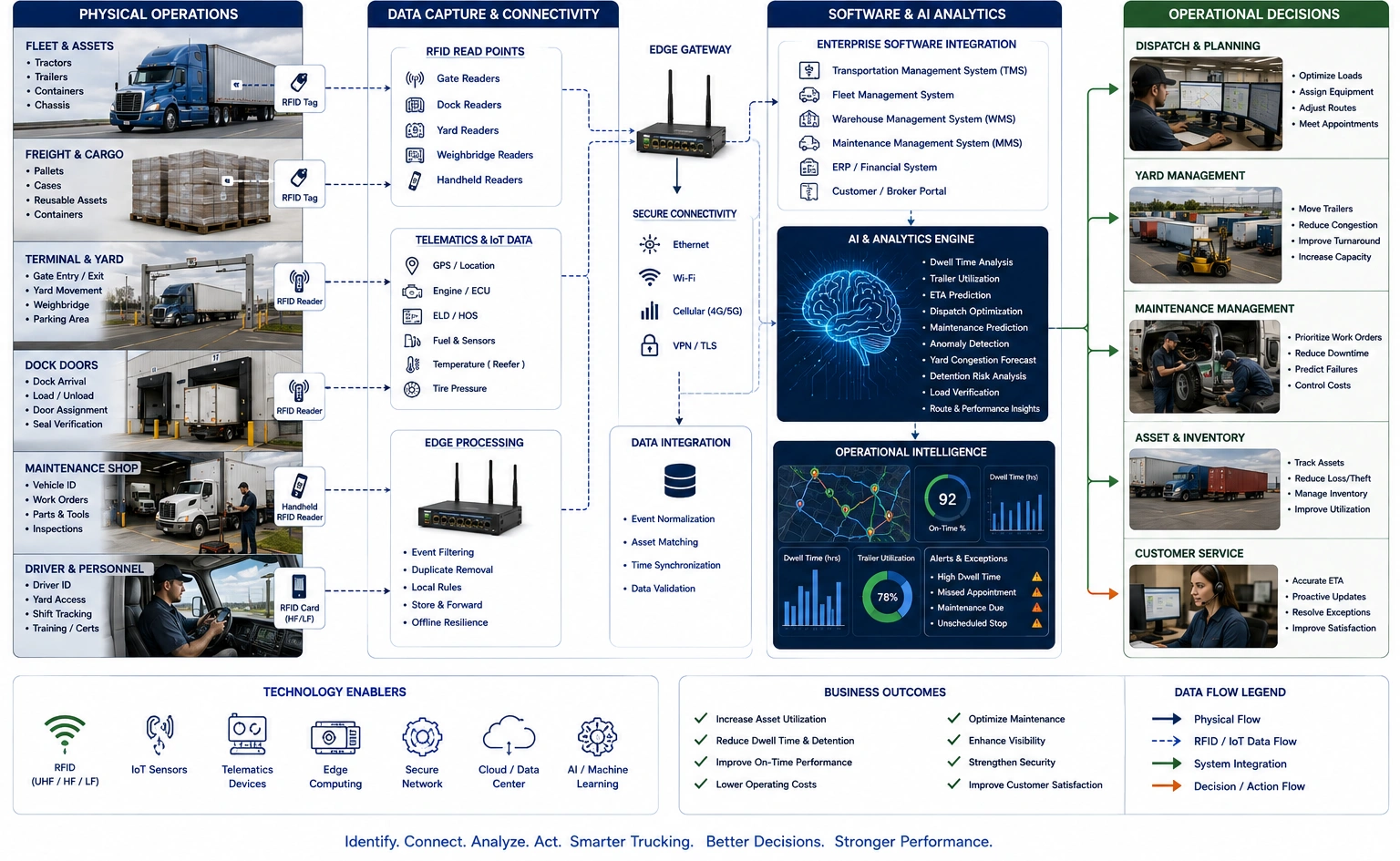
This operational overview illustrates how RFID identification, telematics, IoT sensors, edge processing, and AI analytics connect physical trucking operations with dispatch, yard management, maintenance, asset tracking, and customer service decisions. It shows the end-to-end flow of operational data from trucks, trailers, freight, docks, and personnel into transportation software and AI-driven intelligence that improves utilization, visibility, on-time performance, and operational decision-making.
What AI and RFID Mean for Modern Trucking
Trucking operations generate continuous operational events across dispatch, pickup, loading, linehaul, fueling, maintenance, yard movement, delivery, and asset return. Traditional systems often record many of these events separately, creating gaps between physical activity and digital records. AI helps interpret these connected operational signals, while RFID can provide a dependable physical identification layer at critical locations.
A typical AI-driven trucking solution combines several categories of information:
- Truck and trailer identity
- Trailer arrival and departure events
- Freight and pallet movement
- Dock-door activity
- Yard entry and exit records
- Vehicle telematics
- GPS location data
- Electronic logging device data where applicable
- Maintenance and inspection records
- Fuel consumption
- Driver assignment information
- Transportation management system records
- Route and dispatch schedules
- Customer pickup and delivery commitments
- RFID read events from gates, docks, maintenance bays, and warehouses
Artificial intelligence can use this data to detect patterns that are difficult to identify through manual reporting. For example, an AI model may identify recurring trailer dwell at a specific customer location, repeated asset mismatches between dispatch records and physical RFID events, or maintenance-related delays affecting a particular vehicle class.
RFID should not be viewed as a replacement for GPS or telematics. Each technology captures different operational information. GPS is useful for geographic location and route movement, while RFID can establish highly specific identity and presence events at known physical locations such as terminal gates, fueling areas, dock doors, maintenance shops, and secure yards.
This distinction is important when designing AI applications for trucking. A GPS position may indicate that a trailer is near a terminal, whereas an RFID event can confirm that a specific tagged trailer passed through a designated gate or entered a particular maintenance bay.
GAO has supported organizations by supplying RFID readers, tags, and related hardware that can be incorporated into physical asset identification and automated data-capture systems. For trucking deployments, engineering decisions should be based on asset type, read distance, mounting location, environmental exposure, vehicle speed, metal interference, tag durability, and the operational event that must be captured.
High-Value AI Applications for Trucking Operations
AI Fleet Asset Tracking and Trailer Utilization
Trailer availability is a persistent operational issue in trucking. Dispatch teams need to know which trailers are loaded, empty, assigned, awaiting maintenance, parked, or located at customer facilities.
RFID events can strengthen trailer identification at terminals and controlled facilities. AI can combine these events with dispatch schedules and telematics data to identify utilization problems such as:
- Extended trailer dwell
- Underutilized equipment
- Unassigned trailers
- Repeated location mismatches
- Delayed trailer returns
- Assets remaining outside expected operational cycles
- Excessive idle inventory at specific terminals
AI-based utilization analysis can help fleet managers distinguish between a genuine equipment shortage and inefficient circulation of available trailers.
AI Yard Management and Gate Automation
Truck yards often experience congestion because physical vehicle movement changes faster than manual records. Gate personnel, yard jockeys, dispatchers, and dock supervisors may work from different views of current asset status.
Fixed UHF RFID readers can capture identification events when appropriately tagged trucks, trailers, containers, or other assets pass designated checkpoints. AI can then analyze arrival patterns, queue length, dock availability, appointment schedules, and historical turnaround performance.
Potential operational improvements include:
- Automated arrival and departure confirmation
- Faster yard inventory reconciliation
- Reduced manual asset searches
- Dock assignment recommendations
- Detection of abnormal dwell times
- Yard congestion forecasting
- Prioritized movement of high-priority freight
A practical engineering lesson is that gate automation requires careful reader placement. A reader positioned too broadly may capture nearby assets that are not actually passing through the intended checkpoint. Antenna orientation, lane geometry, vehicle speed, shielding, read zones, and event-filtering rules must therefore be validated during commissioning.
AI Freight and Load Visibility
RFID can also support freight identification where tagged pallets, reusable transport items, containers, or high-value shipment assets move through controlled facilities.
AI applications can compare physical movement events against transportation and warehouse records to identify potential exceptions such as:
- Freight loaded onto an unexpected trailer
- Assets remaining at a dock longer than expected
- Missing scan or identification events
- Shipment sequencing inconsistencies
- Reusable asset accumulation
- Unexpected freight movement patterns
The AI model should not automatically assume that a missing RFID event represents a lost shipment. Read reliability, tag orientation, material interference, and operational exceptions must be considered before generating an actionable alert.
Predictive Fleet Maintenance
Truck maintenance systems contain work orders, inspection records, repair histories, diagnostic codes, component replacements, and service schedules. AI can analyze this information alongside mileage, engine hours, operating conditions, and asset utilization.
RFID can support physical workflow verification in maintenance facilities by identifying vehicles, trailers, tools, service assets, or tagged components at designated work areas.
AI-assisted maintenance systems can help:
- Prioritize assets requiring inspection
- Identify recurring component failure patterns
- Forecast maintenance capacity requirements
- Detect unusual repair frequency
- Reduce missed service events
- Improve maintenance-bay utilization
Maintenance recommendations should remain subject to qualified technician review. AI predictions can prioritize inspection and planning, but they should not replace required safety procedures or manufacturer maintenance guidance.
Driver, Equipment, and Operational Resource Coordination
Trucking operations depend on coordinated availability of drivers, tractors, trailers, freight, docks, and maintenance resources. AI can evaluate constraints across these resources to identify operational conflicts before they become dispatch failures.
Relevant applications include:
- Equipment assignment prioritization
- Driver and tractor availability analysis
- Delay prediction
- Dispatch exception prioritization
- Terminal workload forecasting
- Maintenance conflict detection
- Empty-mile reduction analysis
The business value comes from improving the timing and quality of operational decisions rather than simply increasing the amount of collected data.
AI & RFID Trucking Use Cases & Decision Matrix
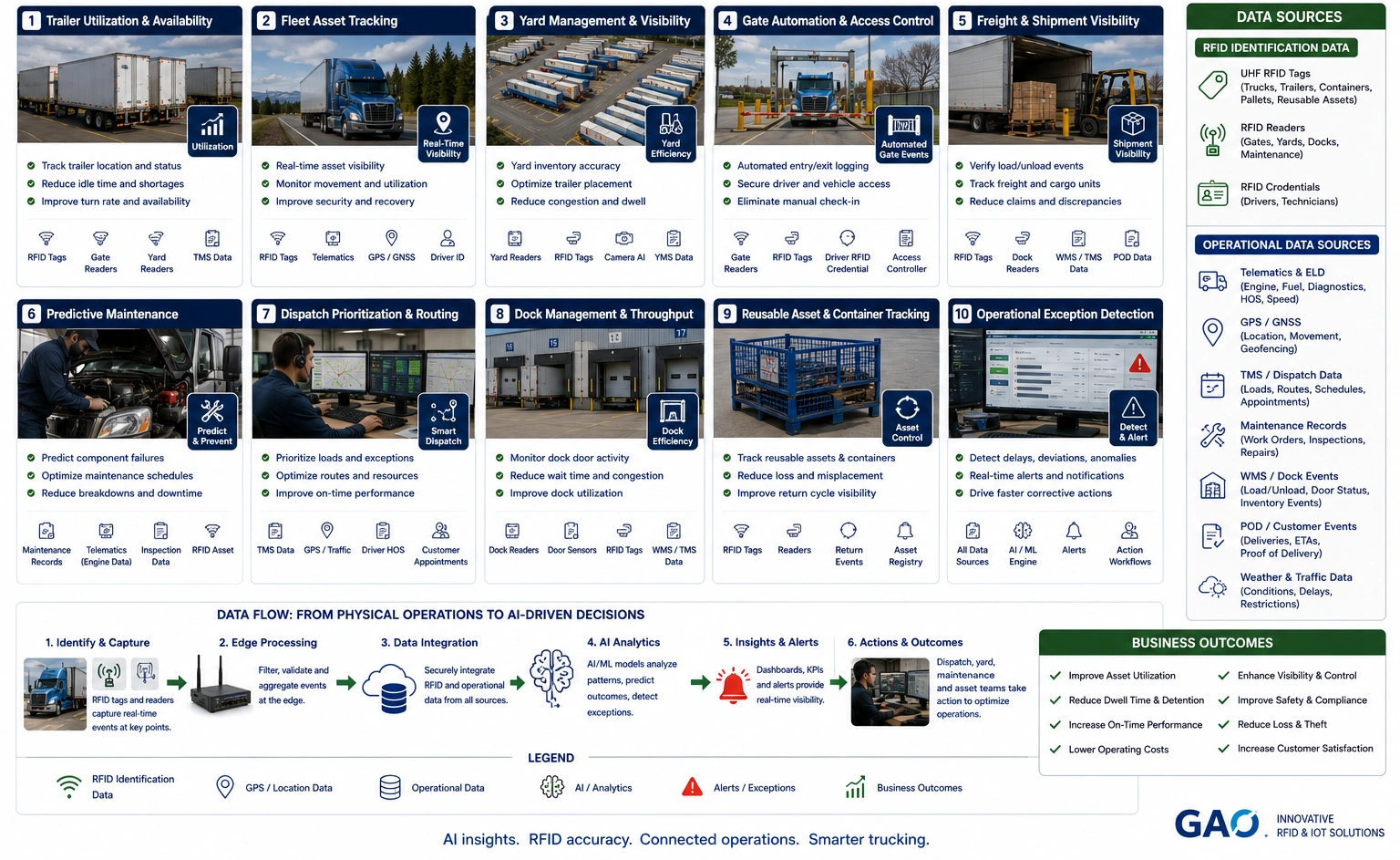
This infographic maps key AI and RFID use cases across trucking operations, including trailer utilization, fleet asset tracking, yard management, gate automation, freight visibility, predictive maintenance, dispatch prioritization, dock management, reusable asset tracking, and operational exception detection. It shows how RFID identification data combines with telematics, GPS, transportation management software, maintenance records, and operational events to support AI-driven insights, alerts, and faster transportation decisions.
Trucking Workflow from RFID Event Capture to AI Decision-Making
A useful AI and RFID trucking system should follow the operational flow of the fleet rather than forcing dispatch personnel to adapt to disconnected technology.
Physical Identification and Data Acquisition
The process begins with identifying the physical objects that need to be associated with operational events. Depending on the use case, these may include:
- Tractors
- Dry vans
- Refrigerated trailers
- Flatbeds
- Tank trailers
- Containers
- Chassis
- Freight pallets
- Returnable transport assets
- Maintenance tools
- Yard equipment
The selected RFID technology should match the use case. UHF RFID is generally appropriate where longer read ranges and automated checkpoint identification are required. HF or LF RFID may be more suitable for short-range identification scenarios where controlled proximity is required.
Tag selection for trucking requires environmental analysis. Tags may be exposed to vibration, road debris, moisture, temperature changes, UV exposure, chemicals, pressure washing, and metal surfaces.
RFID Event Capture and Local Processing
RFID readers capture identification events at operational points such as:
- Terminal entry gates
- Exit gates
- Dock doors
- Maintenance bays
- Fueling locations
- Trailer storage areas
- Inspection stations
Raw reads usually require filtering before they become operational events. A vehicle may remain within a read zone long enough to generate repeated reads. Edge software can aggregate duplicate reads and apply rules that determine whether the event represents arrival, departure, presence, or movement through a checkpoint.
This processing reduces unnecessary data transmission and prevents AI systems from treating every radio read as an independent business event.
Communication and System Integration
Processed events can be transmitted through secure IP networks, cellular connectivity, Wi-Fi, or Ethernet depending on the terminal environment and deployment design.
Middleware can associate RFID identifiers with records from systems such as:
- Transportation management systems
- Fleet management software
- Yard management systems
- Maintenance management software
- Warehouse management systems
- ERP software
- Telematics systems
- Dispatch applications
Data normalization is essential. A trailer identifier stored in RFID middleware must be consistently mapped to the trailer ID used by dispatch and maintenance systems. Without a reliable asset master record, AI analysis can generate incorrect conclusions because the same physical asset may appear under different identifiers.
AI Analytics and Operational Actions
Once RFID events and operational records are correlated, AI models can identify patterns, forecast outcomes, and prioritize exceptions.
Examples include:
- Predicting trailer shortages at a terminal
- Detecting assets exceeding expected dwell time
- Prioritizing maintenance work based on operational impact
- Forecasting yard congestion
- Identifying inconsistent asset movement
- Recommending investigation of unplanned freight or trailer events
The final step is operational action. Dispatchers may reassign equipment, maintenance teams may inspect a vehicle, yard personnel may move a trailer, or managers may investigate a recurring process bottleneck.
The most effective trucking AI systems keep human accountability in the workflow. AI should provide evidence, confidence indicators, and recommended actions rather than functioning as an unexplained automated decision source.
RFID, AI, Software, and Deployment Components for Trucking
A trucking AI solution requires more than RFID readers and an analytics application. The deployment must connect physical operations with software records while accounting for terminal conditions, vehicle movement, network reliability, cybersecurity, and integration requirements.
RFID Hardware and Physical Infrastructure
Relevant hardware may include UHF RFID readers, fixed antennas, rugged RFID tags, handheld readers, vehicle-mounted readers, edge gateways, industrial network equipment, and protected enclosures.
For trucking terminals, engineering teams should evaluate:
- Read-zone width
- Vehicle speed
- Reader-to-tag orientation
- Metal and multipath interference
- Tag mounting surfaces
- Weather exposure
- Power availability
- Network backhaul
- Maintenance accessibility
GAO provides RFID hardware products and systems that can support these physical identification requirements. Hardware selection should be validated through a pilot because a reader configuration that performs well in a controlled test may behave differently around metal trailers, moving vehicles, and dense terminal infrastructure.
AI Models for Trucking Operations
AI methods may include time-series forecasting, anomaly detection, classification, regression, optimization, computer vision, and machine learning models.
For example, anomaly detection can identify unexpected trailer dwell patterns, while forecasting models can estimate terminal congestion. Optimization algorithms can support equipment assignment and dispatch prioritization.
The quality of these models depends heavily on data consistency. RFID event accuracy, telematics quality, timestamp synchronization, asset master data, and operational definitions should be validated before production AI models are deployed.
Cloud Version, Server Version, and Hybrid Deployment
A Cloud Version is suitable for trucking organizations requiring centralized access across multiple terminals, fleets, and geographic regions. Cloud-hosted software can support centralized reporting, multi-terminal analytics, centralized model management, and remote access.
A Server Version may be appropriate when a trucking company requires privately managed data processing, integration with existing data centers, strict data-control requirements, or local processing at major terminals.
A Hybrid Version is often practical when terminals need local RFID event processing but fleet-wide AI analytics require centralized data aggregation.
The selection depends on connectivity reliability, latency requirements, data governance, terminal scale, cybersecurity policies, integration complexity, and operational continuity requirements.
From RFID Events to AI-Driven Trucking Decisions
AI and RFID for trucking becomes operationally valuable when identification events are connected to dispatch, fleet, freight, maintenance, and yard decisions. A truck RFID system should not be treated simply as an automated replacement for manual scanning. Its primary value comes from establishing reliable operational events that AI software can combine with telematics, GPS, electronic logging data, maintenance records, shipment schedules, and transportation management data.
A typical trucking workflow begins when a tractor, trailer, driver credential, cargo unit, or returnable asset passes an RFID read point. Fixed readers installed at fleet terminals, maintenance facilities, customer sites, distribution centers, gates, fuel stations, loading docks, or weighbridges capture identification events.
The complete decision workflow can include:
- Vehicle, trailer, or asset identification through UHF, HF, or LF RFID
- Timestamping of gate entry, exit, dock arrival, loading, unloading, and maintenance events
- Validation of the vehicle and driver against scheduled transportation assignments
- Event transmission to local middleware or edge software
- Filtering of duplicate, incomplete, or unexpected RFID reads
- Association of the event with vehicle, trailer, driver, shipment, route, or maintenance records
- Integration with transportation management systems, fleet management software, warehouse systems, ERP software, and maintenance systems
- AI analysis of dwell time, utilization, exceptions, turnaround patterns, and operational risk
- Generation of alerts, recommendations, or automated workflow actions
- Dispatch, maintenance, yard, or fleet-management decisions based on prioritized operational information
GAO has helped organizations deploy RFID hardware products and systems that support this type of automated identification workflow, particularly where manual gate logs, paper records, vehicle searches, and inconsistent asset identification create operational delays.
RFID Hardware and AI Software for Trucking Operations
An effective trucking deployment requires hardware selection based on the physical movement of vehicles and assets rather than selecting RFID equipment solely by nominal read range.
UHF RFID is generally suited to high-throughput vehicle, trailer, yard, dock, cargo, and asset identification because passive tags can be read without requiring direct line-of-sight scanning. Windshield tags, rugged vehicle tags, trailer tags, pallet tags, container tags, reusable hard tags, and specialized asset tags may be selected according to mounting surface, environmental exposure, vibration, washing, metal interference, and expected service life.
HF RFID can support closer-range identification where intentional presentation of a card or credential is desirable, such as driver authentication, controlled access, maintenance authorization, or inspection workflows. LF RFID can remain relevant for specialized short-range identification requirements where environmental conditions and legacy equipment influence technology selection.
A trucking RFID solution may include:
- Fixed UHF RFID readers at fleet gates and vehicle lanes
- Directional or circularly polarized antennas positioned for vehicle movement
- Windshield, vehicle, trailer, cargo, pallet, and reusable asset tags
- Handheld RFID readers for maintenance yards and exception searches
- HF or LF RFID readers for controlled driver and technician identification
- Industrial controllers for barrier, traffic-light, and gate automation
- Edge computers for local event processing
- Network switches, secure gateways, and power-over-Ethernet infrastructure
- Middleware for event filtering, device monitoring, and software integration
AI software then converts these identification events into operational intelligence. Machine learning models can identify recurring dwell-time patterns, predict congestion periods, detect abnormal asset movement, estimate trailer demand, prioritize dispatch exceptions, and identify maintenance workflows associated with repeated delays.
Computer vision may supplement RFID at gates and yards through vehicle classification, license plate recognition, damage inspection, or occupancy analysis. RFID remains valuable because visual identification alone does not provide a durable digital identity for every trailer, cargo unit, or reusable transport asset.
AI Applications That Improve Trucking Performance
AI Yard Management and Trailer Utilization
Truck terminals frequently lose productive time when dispatch personnel cannot immediately determine which trailers are available, loaded, empty, under maintenance, awaiting a driver, or approaching a detention threshold.
RFID checkpoints establish dependable movement events at gates, staging areas, maintenance entrances, and loading zones. AI models can then analyze historical and current movement patterns to identify congestion, predict trailer shortages, prioritize trailer moves, and recommend staging actions.
Useful AI outputs can include:
- Predicted trailer dwell time
- Detention-risk prioritization
- Yard congestion forecasts
- Trailer availability estimates
- Recommended staging sequences
- Dock assignment priorities
- Exception alerts for unexpected asset movement
AI Dispatch Exception Management
Dispatchers manage numerous variables, including driver availability, equipment status, shipment priority, customer appointment times, route restrictions, hours-of-service constraints, and trailer availability.
RFID events can confirm whether a tractor or trailer has entered or exited a terminal, arrived at a dock, entered a maintenance area, or remained stationary longer than expected. AI can combine those events with dispatch schedules and telematics data to identify exceptions requiring human attention.
This approach is particularly useful when dispatch teams need prioritization rather than additional raw data.
Predictive Fleet and Trailer Maintenance
Maintenance planning benefits from accurate asset identification. RFID can associate maintenance work orders, inspections, tires, components, trailers, and vehicles with their operational history.
AI models can evaluate maintenance records, repair frequency, vehicle usage, downtime patterns, and sensor data to identify assets requiring earlier inspection or preventive action. The objective is not to replace technicians but to help maintenance teams prioritize inspections and work orders according to operational risk.
Cargo and Shipment Verification
RFID can support automated verification of tagged pallets, containers, reusable packaging, and selected freight units during loading and unloading. AI can identify repeated loading discrepancies, route-specific handling exceptions, abnormal dwell periods, or recurring shipment errors.
GAO can provide RFID readers, tags, antennas, and supporting hardware that system integrators can incorporate into these trucking workflows.
AI Use Cases Powered by RFID in Trucking Operations
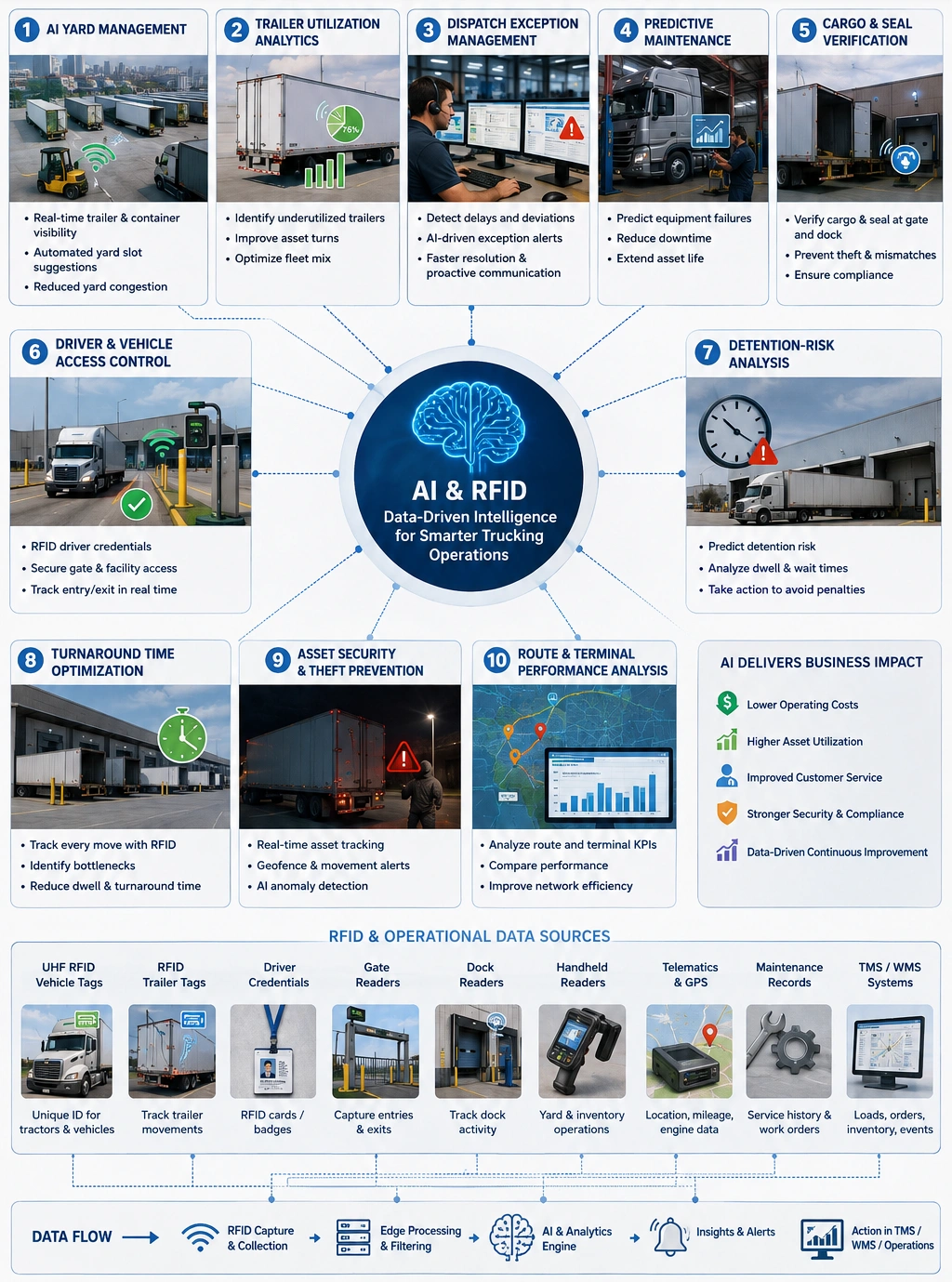
A professional infographic showing how AI and RFID technologies improve trucking operations through real-time visibility, smarter automation, asset tracking, predictive maintenance, security, and data-driven decision-making.
Engineering Considerations for Trucking RFID Deployment
RFID performance in trucking environments depends heavily on physical installation quality. A reader that performs well in a controlled demonstration can produce inconsistent results if antennas are incorrectly positioned around metal trailers, reflective surfaces, multiple vehicle lanes, or uncontrolled read zones.
Engineering teams should evaluate:
- Vehicle speed at each read point
- Lane width and vehicle approach path
- Tag orientation and mounting position
- Metal and liquid interference
- Antenna polarization
- Reader transmit-power configuration
- Unwanted reads from adjacent lanes
- Weather exposure and enclosure ratings
- Vibration and mechanical mounting
- Power and network redundancy
- Cellular or wired backhaul availability
- Required read confidence for automated actions
Pilot testing should use actual tractors, trailers, cargo units, and driver workflows rather than relying exclusively on laboratory tag tests.
A common implementation error is attempting to create highly precise continuous truck location tracking using a limited number of fixed RFID checkpoints. RFID is highly effective for identification and event detection at known locations. Continuous outdoor location tracking generally requires complementary technologies such as GPS, GNSS, telematics, BLE, or other positioning methods depending on the operational requirement.
Cybersecurity and Data Integrity
Truck RFID systems can affect physical gates, fleet records, shipment verification, and operational decisions. Security therefore extends beyond protecting dashboards.
Recommended controls include:
- Device authentication for readers and gateways
- Encrypted communications where supported
- Network segmentation for RFID infrastructure
- Role-based access to operational software
- Audit logs for tag association and configuration changes
- Controlled tag issuance and replacement procedures
- Validation of abnormal or duplicate read events
- Secure API authentication for TMS, ERP, and fleet software integrations
- Backup and recovery procedures for local event databases
- Edge processing rules that define safe behavior during network outages
AI recommendations should also remain explainable to operational users. A dispatcher should understand whether an alert was triggered by excessive dwell time, an unexpected trailer movement, a schedule mismatch, or a predicted capacity constraint.
RFID Deployment in Truck Terminal
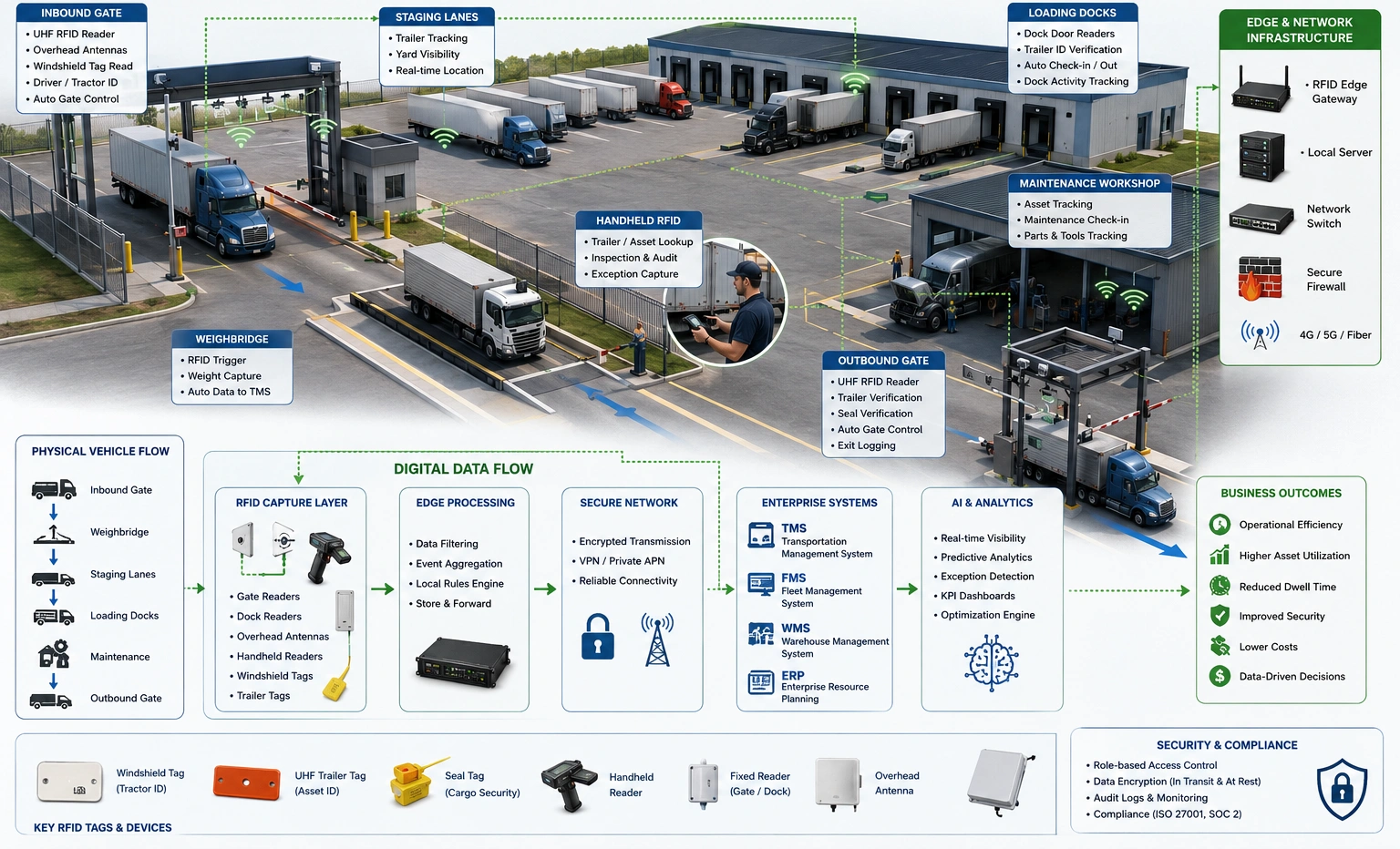
A realistic technical diagram showing how RFID technology supports truck terminal operations by connecting vehicles, trailers, gates, docks, maintenance areas, and handheld readers with secure edge computing, enterprise software, and AI analytics for real-time visibility and smarter decision-making.
Implementation Recommendations for Trucking Companies
The most effective AI and RFID trucking projects generally begin with a clearly measurable operational problem.
Suitable starting points include:
- Reducing terminal gate congestion
- Improving trailer identification and availability
- Automating yard movement records
- Reducing manual vehicle and trailer searches
- Improving dock verification
- Managing detention-risk events
- Strengthening maintenance asset traceability
- Improving cargo loading verification
A practical implementation sequence should include operational assessment, RFID site surveying, tag selection, reader testing, integration design, pilot deployment, data validation, KPI baseline collection, operator training, commissioning, and gradual scale-up.
GAO can support technical teams by supplying RFID hardware products and systems appropriate for vehicle, trailer, driver, cargo, and terminal identification requirements. Hardware selection should remain aligned with the actual trucking environment, including read distance, tag durability, mounting surface, traffic speed, environmental exposure, and software integration requirements.
Key Technical Takeaways for AI and RFID in Trucking
AI and RFID can help trucking companies convert physical movement into reliable digital operational events. RFID provides durable identification at gates, terminals, docks, maintenance facilities, and other defined checkpoints. AI adds value by analyzing those events alongside transportation schedules, telematics, maintenance records, and operational KPIs.
The strongest deployments avoid treating RFID as a standalone tracking tool. Instead, they connect identification events to specific trucking decisions involving dispatch, trailer utilization, yard movement, maintenance, cargo verification, security, and fleet performance.
GAO provides RFID hardware and technical support for organizations evaluating these solutions. Trucking companies and system integrators can work with our technical teams to evaluate tags, readers, antennas, handheld devices, and supporting RFID systems for specific vehicle, trailer, terminal, and transportation workflows.
Building the Future of Industrial AI and IoT with Aperture Venture Studio and GAO RFID Inc.
For more than three decades, GAO has invested heavily in research and development involving industrial RFID, BLE, and IoT technologies. As generative AI and industrial AI became increasingly useful for operational applications such as trucking, fleet management, and transportation automation, we expanded our work across AI, connected systems, RFID, and intelligent asset identification. We have also founded Aperture Venture Studio to support the advancement and scaling of AI and IoT technologies across multiple application areas.
Aperture brings together technical experts, operational leaders, investors, and established companies interested in advanced AI and IoT applications. Through Aperture Ventures Summit and TekSummit, we continue discussions around emerging technologies and practical industrial implementation.
We welcome participation from:
- Advisors, co-founders, and employees
- Investors
- Customers