
AI and RFID for Fulfillment Centers
AI and RFID for Fulfillment Centers
AI is changing how fulfillment centers receive, store, pick, pack, stage, and ship inventory by converting high-volume operational data into actionable decisions. AI-driven inventory management can combine RFID identification, warehouse management system (WMS) transactions, conveyor and sortation data, order history, labor signals, and computer vision to improve inventory accuracy, slotting, order prioritization, exception handling, and fulfillment throughput. RFID provides machine-readable identity and movement events, while AI interprets those events in relation to orders, locations, inventory status, and operating conditions. The result is a more continuously informed fulfillment operation rather than one dependent on periodic manual counts and barcode scans. For fulfillment centers handling thousands or millions of SKUs, this combination can support faster receiving, more reliable put-away, improved pick verification, reduced inventory discrepancies, and earlier detection of operational exceptions.
AI and RFID Deployment in a Modern Fulfillment Center
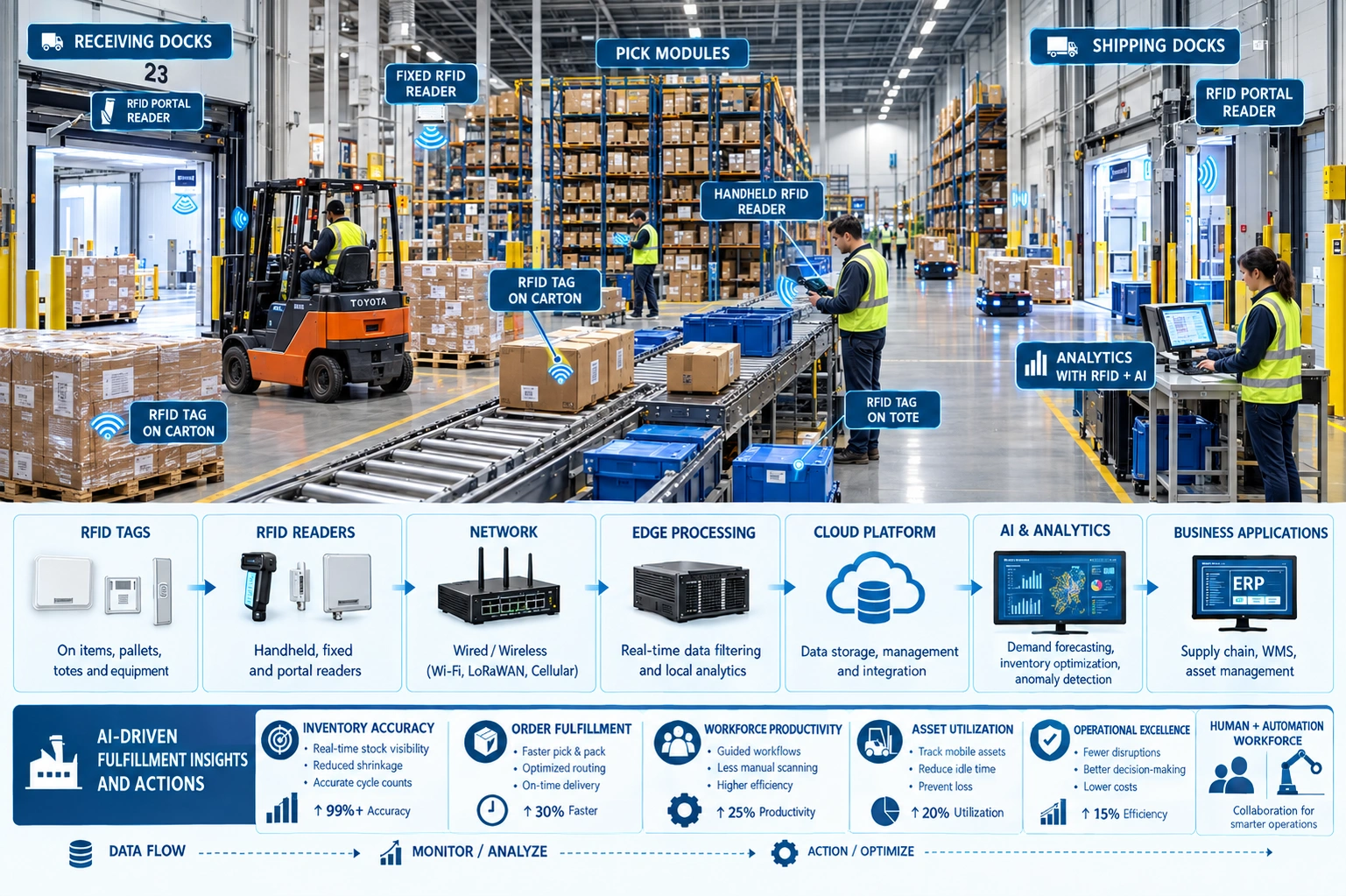
This visual illustrates a realistic fulfillment center deployment where UHF RFID portals, fixed readers, handheld readers, and tagged pallets, cartons, and totes feed operational data through an industrial network, edge server, RFID middleware, WMS, order management, and AI analytics. It highlights practical AI applications including inventory discrepancy detection, replenishment prediction, order prioritization, and exception management.
What AI-Driven Fulfillment Operations Mean for Modern Fulfillment Centers
Fulfillment centers are fundamentally data-intensive environments. Every inbound pallet, carton, tote, inventory item, pick task, replenishment movement, packing event, exception, and outbound shipment can generate operational data. The engineering challenge is not simply collecting more data. It is converting those events into reliable operational context quickly enough to influence decisions.
AIoT, or Artificial Intelligence of Things, combines AI with connected devices, sensors, readers, equipment, and industrial systems. Within a fulfillment center, this can include RFID readers, barcode scanners, machine vision cameras, conveyor sensors, weight scales, dimensioners, PLC-connected equipment, handheld computers, mobile robots, environmental sensors, and warehouse software.
AI methods can then analyze these signals for applications such as:
- AI inventory management that identifies probable inventory discrepancies before they become customer-facing stockouts.
- AI warehouse slotting that evaluates SKU velocity, order affinity, cube utilization, travel distance, and replenishment frequency.
- AI order fulfillment optimization that prioritizes work according to promised ship time, carrier cutoff, inventory availability, labor capacity, and congestion.
- AI anomaly detection that identifies unusual movement patterns, duplicate reads, missing inventory events, unexpected dwell time, or inconsistent WMS transactions.
- AI demand forecasting that uses historical orders, seasonality, promotions, lead times, and inventory positions to improve replenishment planning.
- AI computer vision for package verification, carton dimension validation, label inspection, and damage detection.
- Predictive analytics for conveyors, sorters, automated storage and retrieval systems, and other material-handling equipment.
- AI-assisted labor planning based on workload, order profiles, shift schedules, productivity trends, and expected peaks.
RFID becomes particularly valuable when the fulfillment workflow requires rapid identification of multiple tagged objects without requiring individual line-of-sight scans. GS1’s EPC UHF Gen2 standard defines the air interface for passive UHF RFID, while EPCIS provides a standardized method for representing visibility events such as what happened, where, when, and why. Current GS1 standards include Gen2 version 3 and EPCIS 2.0, making standards-based event modeling an important consideration for interoperable fulfillment systems.
Fulfillment Center Applications for AI-Driven Inventory and Order Execution
AI Inventory Accuracy and Reconciliation
Inventory accuracy is one of the most important foundations of fulfillment performance. A WMS may show inventory as available while the physical item has been misplaced, incorrectly received, moved without a transaction, allocated to another order, or physically located in the wrong storage position.
AI can compare RFID movement events with WMS inventory records, expected process sequences, historical movement patterns, and location information. A system can flag situations such as:
- A pallet received at a dock but never associated with a put-away transaction.
- A carton physically detected in a storage zone where the WMS expects it elsewhere.
- A serialized item appearing in two operational zones within an impossible time interval.
- A replenishment task created in the WMS without a corresponding physical movement.
- Inventory remaining stationary beyond the normal dwell time for that process.
- A shipping carton passing through a dock portal without a matching outbound order.
The important engineering principle is that AI should not automatically overwrite authoritative WMS records merely because an RFID event differs from a transaction. The AI layer should distinguish observations, inferred states, and confirmed business transactions.
AI Receiving and Put-Away Optimization
Receiving is a high-leverage point for fulfillment center automation because errors introduced at the inbound dock can propagate throughout the facility.
RFID-enabled receiving can identify multiple tagged cartons or pallets as they pass through a portal or controlled read zone. AI can then compare the observed identities against advance shipping notices, purchase orders, expected quantities, supplier records, and receiving tolerances.
The resulting system can prioritize exceptions rather than requiring associates to manually investigate every shipment.
AI-assisted put-away can further consider:
- SKU velocity
- Storage location availability
- Cube and weight constraints
- Pick-path distance
- Temperature or environmental requirements
- Hazardous-material restrictions where applicable
- Inventory affinity
- Replenishment frequency
- Current congestion
- Labor availability
- Equipment availability
GAO supplies RFID readers, tags, antennas, handheld devices, and RFID-based inventory systems that can support warehouse data capture. Its published warehouse products include UHF equipment supporting ISO 18000-6C and multi-tag identification for inventory operations.
AI Picking, Verification, and Exception Management
Picking combines inventory availability, worker movement, order priority, storage locations, and fulfillment deadlines. AI can use historical pick data and real-time warehouse conditions to identify inefficient travel paths, congested zones, likely replenishment interruptions, and orders at risk of missing their service-level targets.
RFID can support pick verification where tagged products, totes, cartons, or containers need automated identity confirmation. The system can compare the physical identity against the active pick task before the item advances to packing.
A practical deployment should also provide a clear exception workflow. When AI identifies a discrepancy, the system should create a manageable task for the appropriate warehouse role rather than generating an alert that operators cannot act upon.
The Fulfillment Center Operational Data Flow
A production AI and RFID solution should be designed around the actual movement of inventory and information through the fulfillment center.
Data Acquisition at the Physical Process Layer
Data begins at operational points where inventory or equipment changes state:
- Receiving dock doors
- Trailer unloading areas
- Pallet staging zones
- Put-away aisles
- Pick faces
- Replenishment routes
- Conveyor transfer points
- Packing stations
- Sortation equipment
- Shipping dock doors
- Returns processing areas
- High-value inventory cages
- Cycle-count locations
UHF RFID is generally the primary RFID choice for high-volume fulfillment workflows where longer read ranges and multi-tag identification are useful. HF or NFC can be more appropriate for shorter-range controlled interactions, while LF RFID can serve specialized identification requirements. Technology selection should be based on tag material, item density, read-zone geometry, required range, interference, packaging, metal or liquid content, and process speed rather than assuming one RFID frequency fits every location.
Edge Processing and RFID Middleware
Raw RFID reads should not normally be forwarded directly into business applications without filtering and contextualization.
RFID middleware or an edge processing service can perform:
- Duplicate-read suppression
- Reader health monitoring
- Antenna-zone association
- Tag filtering
- Read confidence evaluation
- Event aggregation
- Reader configuration management
- Device heartbeat monitoring
- Local buffering during network interruptions
- Conversion of raw reads into business events
This layer is especially important in fulfillment centers because a single pallet can produce many RF observations while moving through a reader field. The business application normally needs a meaningful event such as “pallet entered receiving lane” rather than thousands of individual antenna observations.
GS1 EPCIS is relevant where a fulfillment organization needs standardized visibility events and interoperability between operational applications and trading partners. EPCIS 2.0 also supports REST APIs, JSON/JSON-LD, sensor data, and event information describing physical business processes.
AI Processing and Decision Layer
The AI layer consumes normalized operational data rather than treating every raw sensor event as an independent decision.
Potential inputs include:
- RFID events
- WMS inventory records
- Warehouse task history
- Order queues
- Pick rates
- Shipment deadlines
- Carrier cutoff times
- Conveyor status
- Labor availability
- Storage locations
- Historical demand
- Returns patterns
- Computer vision results
- Equipment telemetry
Machine learning models can identify patterns and predict outcomes, while rules engines can enforce deterministic operational constraints. A robust fulfillment solution generally needs both. AI should not replace hard operational rules such as inventory ownership, hazardous-material restrictions, authorization controls, or shipping cutoffs.
Fulfillment Center AI and RFID Data Flow Diagram
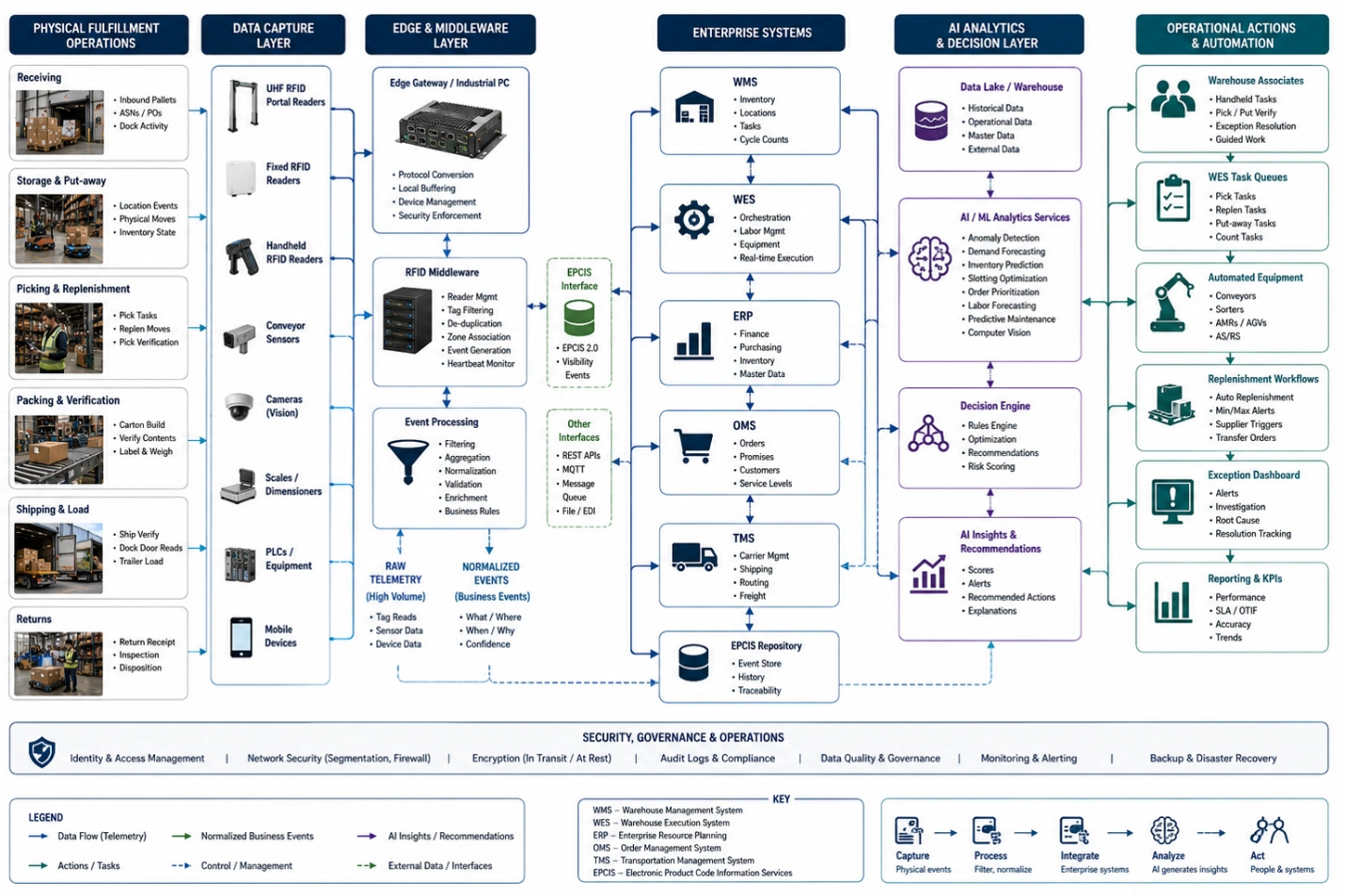
This end-to-end diagram shows how RFID, sensors, cameras, scales, dimensioners, PLCs, and mobile devices generate raw telemetry that is filtered and normalized through edge computing and RFID middleware. The resulting business events flow into WMS, WES, ERP, OMS, TMS, and EPCIS, where AI analytics generate recommendations for inventory, fulfillment, maintenance, replenishment, exception handling, and automated operations.
Integrating AI, RFID, WMS, WES, ERP, and Warehouse Equipment
AI-driven fulfillment does not operate independently from existing warehouse software. The practical objective is to improve decisions while preserving the transactional integrity of established systems.
A typical integration path can include:
RFID readers and sensors → edge gateway → RFID middleware → event processing → WMS/WES → AI analytics → operational recommendation → warehouse task or human decision
The WMS normally remains responsible for inventory and warehouse transactions. A Warehouse Execution System (WES), where deployed, can coordinate real-time work between WMS orders and material-handling resources. ERP systems provide broader procurement, financial, supplier, and inventory context. Order Management Systems contribute customer-order information, while Transportation Management Systems can provide carrier and shipment constraints.
API-based integration is generally preferable to tightly coupling AI logic directly into reader firmware or individual warehouse applications. MQTT can be useful for IoT telemetry, while REST APIs, message queues, database interfaces, and event-driven integration can connect operational systems depending on existing IT standards.
RFID Hardware and AI Infrastructure for Fulfillment Centers
RFID hardware selection should begin with the physical process rather than the reader specification sheet. Dock-door portals, conveyor tunnels, shelving zones, pick stations, and handheld inventory operations impose different RF requirements.
GAO’s RFID portfolio includes fixed readers, industrial readers, handheld and wearable readers, antennas, tags, and software-oriented systems. Its published UHF equipment includes models supporting multi-tag reading, Ethernet or serial connectivity, adjustable RF output, and integration options appropriate to warehouse environments.
A fulfillment center deployment may combine:
- UHF RFID fixed readers for dock doors, conveyor transitions, and controlled read zones.
- Handheld or wearable UHF RFID readers for cycle counting, exception investigation, and location verification.
- RFID tags for cartons, totes, pallets, serialized products, returnable containers, and selected high-value inventory.
- Directional or optimized antennas designed around the physical read zone.
- Edge gateways for local processing and network connectivity.
- Industrial Ethernet, Wi-Fi, PoE, or other suitable communications infrastructure.
- WMS and WES interfaces for operational transactions.
- AI compute resources for inference, analytics, and model services.
- Centralized databases or data stores for historical operational analysis.
The correct RF design also requires site testing. Reader power, antenna placement, polarization, tag orientation, conveyor speed, metal structures, liquids, adjacent reader interference, and read-zone containment can materially affect performance.
Cloud and Server Deployment for Fulfillment Centers
Cloud Version
A cloud-hosted implementation can centralize AI analytics, dashboards, historical data, multi-site reporting, model management, and cross-facility inventory analysis. This approach is useful for organizations operating multiple fulfillment centers that need standardized analytics and centralized visibility.
Cloud deployment should not automatically imply that every operational decision must depend on an internet connection. Time-sensitive functions such as reader control, local event buffering, and critical exception detection can remain close to the warehouse floor.
GAO publishes cloud-based inventory and location systems designed to integrate RFID or other wireless identification technologies with WMS and ERP environments, illustrating how cloud processing can support distributed warehouse operations.
Server Version
A server deployment places application services on customer-managed servers, private data centers, edge servers, or other privately hosted infrastructure. This model can be appropriate where fulfillment centers require local operational autonomy, strict data-control policies, low-latency processing, or integration with systems that cannot be exposed directly to external cloud services.
A hybrid design is often practical: local RFID event processing and operational services remain available inside the facility, while approved historical data and AI workloads are synchronized with centralized infrastructure.
The choice should be driven by latency, availability, data governance, cybersecurity requirements, IT operating capabilities, network reliability, integration constraints, and the number of fulfillment sites rather than by a simple cloud-versus-server preference.
AI-Driven Fulfillment Performance and Operational Improvements
Combining AI with RFID-generated operational data can improve fulfillment center performance because the system gains both physical visibility and decision intelligence. RFID identifies tagged inventory and assets as they move through defined read zones, while AI evaluates those events against orders, locations, historical activity, warehouse capacity, and process expectations.
The most useful results occur when AI recommendations are connected directly to warehouse processes rather than presented only as dashboards.
Faster Inventory Reconciliation
AI can continuously compare observed RFID events with WMS records and identify inventory states that require investigation. This changes inventory control from periodic cycle counting toward exception-driven verification.
Potential improvements include:
- Detecting inventory that appears in an unexpected storage zone.
- Prioritizing cycle counts for SKUs with high discrepancy probability.
- Identifying unexplained inventory movement.
- Detecting cartons or totes that have remained stationary unusually long.
- Comparing inbound RFID events with expected advance shipping notices.
- Identifying outbound shipments where physical identification does not match the expected order contents.
The AI model should provide confidence scores or explanations where practical. Warehouse supervisors can then distinguish between a probable discrepancy and a confirmed inventory transaction.
More Efficient Picking and Replenishment
Pick productivity is influenced by SKU velocity, storage location, order composition, congestion, replenishment frequency, and worker travel distance. AI can analyze these variables together rather than optimizing each one independently.
For example, an AI slotting model can recommend moving frequently ordered SKUs closer to high-volume pick paths. A replenishment model can predict when a forward pick location is likely to reach its minimum level and generate a task before the shortage interrupts picking.
RFID observations add physical evidence to these decisions. The system can determine whether inventory actually reached the intended location instead of relying exclusively on a completed WMS transaction.
Better Exception Management
Exception management is particularly important in high-throughput fulfillment centers because small process failures can propagate rapidly.
AI can classify exceptions according to operational impact:
- Inventory mismatch
- Missing carton
- Unexpected RFID read
- Duplicate identity
- Failed put-away
- Wrong pick location
- Shipment discrepancy
- Excessive dwell time
- Conveyor or sortation anomaly
- Unusual return pattern
Instead of producing thousands of raw alerts, the system can prioritize exceptions according to order urgency, financial impact, operational risk, and probability of causing downstream disruption.
Key AI and RFID Use Cases Across the Fulfillment Workflow
Receiving and Inbound Verification
Inbound operations benefit from identifying cartons and pallets before they enter storage. RFID readers positioned at controlled dock-door or receiving-zone locations can provide automated identity events.
AI can use these events to compare:
- Purchase orders
- Advance shipping notices
- Expected SKU quantities
- Supplier shipment patterns
- Receiving tolerances
- Historical discrepancy rates
- Dock congestion
- Put-away capacity
A supplier with recurring quantity or labeling discrepancies can therefore be identified through operational data rather than discovered only after inventory reaches the pick area.
Storage, Location Tracking, and Cycle Counting
AI inventory systems can combine RFID location events with WMS data to estimate where inventory should be and identify locations requiring verification.
This is particularly useful for:
- High-value serialized products
- Fast-moving SKUs
- Returnable transport items
- Totes and containers
- Exception inventory
- Quarantine inventory
- Returns
- Inventory awaiting inspection
Cycle-counting resources can be directed toward locations with the greatest expected value rather than distributed uniformly throughout the facility.
Packing and Shipping Verification
Packing errors can create direct customer-service costs through wrong-item shipments, missing products, returns, reshipments, and carrier-related complications.
RFID identification can support physical verification at packing or shipping points, while AI can compare the observed item set against order requirements.
A practical system can distinguish between:
Expected: Order contains items A, B, and C
Observed: RFID identifies A, B, and D
AI result: Shipment discrepancy requiring verification
The business application should then determine whether the carton is held, reopened, re-picked, or escalated.
Returns Processing
Returns introduce a different operational problem because the physical condition and commercial status of an item may be uncertain.
AI can help classify returned inventory using order history, RFID identity, inspection results, images, and disposition rules. Potential outcomes include:
- Return to stock
- Quality inspection
- Refurbishment
- Quarantine
- Vendor return
- Liquidation
- Disposal
RFID can preserve product or container identity throughout this workflow, reducing manual identification work where tagging is appropriate.
Engineering Considerations for RFID Deployment
RF performance inside fulfillment centers should be validated experimentally. A reader that performs well in an open test area may behave differently near metal shelving, conveyors, dock structures, dense cartons, liquids, or RF-reflective equipment.
Read-Zone Engineering
Each RFID read zone should have a defined operational purpose and physical boundary.
For a dock-door portal, engineers should determine:
- Maximum pallet or carton dimensions
- Expected tag orientations
- Vehicle or pallet movement speed
- Required read probability
- Reader and antenna placement
- Adjacent portal interference
- False-read containment
- Direction-of-travel detection
- Environmental conditions
The objective is not simply maximum RF range. Excessive range can create reads from neighboring lanes and produce incorrect inventory events.
Tag Selection
Tag selection should consider the material being tagged rather than treating tags as interchangeable consumables.
Metal products, liquid-filled containers, corrugated cartons, plastic totes, apparel, electronics, and mixed pallets can require different tag constructions or mounting positions.
A fulfillment center should validate:
- Required read distance
- Tag orientation
- Attachment method
- Surface material
- Temperature exposure
- Packaging configuration
- Expected tag reuse
- Printing and encoding requirements
- EPC or serialization strategy
RF Testing and Commissioning
Before production operation, commissioning should include representative test loads rather than empty pallets or idealized samples.
A useful test program includes:
- Empty and full pallets
- Mixed-SKU cartons
- Different tag orientations
- Maximum expected conveyor speed
- Multiple simultaneous tags
- Metal-containing products
- Liquid-containing products
- Adjacent read zones
- Reader failure scenarios
- Network interruption
- Duplicate-read conditions
The resulting measurements should establish realistic read-rate, false-read, latency, and event-completeness expectations.
AI Model Engineering and Data Quality
AI performance depends heavily on the quality and historical consistency of fulfillment center data. A machine-learning model cannot reliably infer operational states from inconsistent timestamps, incorrect location identifiers, duplicated events, or incomplete WMS transactions.
Data Preparation
A production data pipeline should distinguish between:
- Raw RFID observations
- Filtered RFID reads
- Normalized location events
- WMS transactions
- AI-derived predictions
- Confirmed business outcomes
This separation makes troubleshooting substantially easier.
For example, an engineer investigating an inventory discrepancy should be able to determine whether the problem originated from:
RFID read failure → event filtering → location mapping → middleware → WMS integration → AI inference
rather than seeing only a final “inventory mismatch” message.
Appropriate AI Methods
Different fulfillment problems require different AI approaches.
- Forecasting models: Demand, order volume, SKU velocity, replenishment requirements.
- Classification models: Exception categorization, shipment risk, inventory discrepancy probability.
- Anomaly detection: Unusual movement, unexpected dwell time, abnormal equipment behavior.
- Optimization algorithms: Slotting, task allocation, routing, labor allocation.
- Computer vision models: Package verification, damage detection, label inspection, dimension and presentation checks.
- Time-series models: Conveyor telemetry, sorter behavior, equipment condition.
- Generative AI: Natural-language operational summaries, investigation assistance, procedure retrieval, and controlled interaction with warehouse data.
- Edge AI: Low-latency inference for selected computer vision or sensor-processing tasks near the fulfillment operation.
Generative AI should generally operate within controlled access boundaries and should not independently execute high-impact warehouse transactions without appropriate authorization and validation.
Cybersecurity and Operational Resilience
Connecting RFID readers, warehouse equipment, AI services, WMS software, and enterprise networks increases the number of systems that require security controls.
A fulfillment center should consider:
- Network segmentation between operational equipment and corporate systems.
- Role-based access control for RFID and warehouse applications.
- Strong authentication for administrative functions.
- Encryption for data transmitted between systems.
- Secure API authentication.
- Audit logs for configuration and inventory actions.
- Firmware and software patch management.
- Reader configuration backups.
- Device inventory and asset identification.
- Monitoring for unauthorized devices.
- Local buffering when upstream systems become unavailable.
- Recovery procedures for AI or middleware failures.
Operational resilience is particularly important. If a cloud service becomes temporarily unavailable, the fulfillment center should have a defined degraded operating mode. Critical receiving, picking, packing, and shipping processes should not necessarily stop because a non-critical analytics service is unavailable.
Deployment Lifecycle for AI-Enabled Fulfillment Centers
Successful implementation is usually incremental rather than facility-wide from the first day.
Planning and Site Assessment
Start with the operational bottleneck rather than the technology.
A site assessment should document:
- Facility layout
- Dock-door configuration
- Storage systems
- Conveyor paths
- Pick modules
- WMS/WES environment
- Existing barcode processes
- SKU characteristics
- Tagging requirements
- Network availability
- Existing automation
- Security requirements
- Current KPIs
A controlled pilot can then target one high-value process such as receiving verification, cycle counting, or shipping validation.
Proof of Concept and RF Validation
The proof of concept should use real inventory, actual warehouse processes, production-like network conditions, and representative operators.
Success criteria should be measurable:
- Required read probability
- False-read tolerance
- Event latency
- Inventory reconciliation accuracy
- WMS transaction consistency
- Associate handling time
- Exception rate
- System availability
Integration and User Acceptance Testing
Integration testing should verify the entire chain rather than testing individual components independently.
For example:
Tag → Reader → Middleware → Event → WMS/WES → AI decision → Warehouse task → Operator action → Confirmed transaction
User acceptance testing should involve receiving associates, inventory control teams, pickers, packers, supervisors, IT administrators, and operations leadership where their workflows are affected.
Production Rollout and Optimization
After commissioning, collect operational data and tune the system.
Common optimization areas include:
- Antenna placement
- Reader power
- Read-zone containment
- Event filtering
- Location mapping
- AI thresholds
- Exception prioritization
- Dashboard design
- WMS transaction timing
- Operator workflows
A deployment should also include maintenance procedures for RFID readers, antennas, tags, edge infrastructure, network components, and software.
Why GAO’s Fulfillment Center Experience Matters
GAO has supplied RFID, BLE, and IoT hardware products and systems to organizations requiring automated identification, asset visibility, sensing, and operational data collection. Its broader experience includes applications involving inventory, location tracking, industrial monitoring, and connected equipment.
GAO is headquartered in New York City and Toronto, Canada, and is ranked among the top 10 leading B2B and B2G RFID and BLE suppliers globally. Its sister companies, GAO Research and GAO Tek, operate as part of GAO Group, with operations based in New York City and Toronto.
For more than three decades, GAO Group has served customers across the United States and Canada, including Fortune 500 companies, major R&D organizations, universities, and government agencies. Its approach includes substantial product and systems R&D, quality assurance processes, and technical support available remotely or onsite.
For fulfillment center deployments, this background is relevant because successful RFID implementation requires more than selecting a reader. It requires matching hardware to physical conditions, integrating event data with warehouse software, validating performance, and supporting the system after commissioning.
Building a Practical AI and RFID Roadmap for Fulfillment Centers
The strongest business case for AI-enabled fulfillment operations usually starts with a clearly measurable operational problem.
A practical roadmap can prioritize:
- Inventory accuracy where discrepancies create substantial downstream costs.
- Receiving automation where manual identification slows dock throughput.
- Cycle counting where labor requirements are high.
- Pick verification where order errors generate returns and reshipments.
- Shipping verification where outbound mistakes directly affect customers.
- Exception management where supervisors currently spend substantial time investigating disconnected data.
- Replenishment prediction where stockouts interrupt high-volume picking.
- Predictive maintenance where material-handling equipment failures disrupt throughput.
The technology should then be engineered around the selected workflow. RFID hardware, AI models, WMS integration, network infrastructure, security controls, and operator interfaces should all support the same operational objective.
GAO can support organizations evaluating RFID readers, antennas, tags, handheld devices, IoT equipment, and RFID-based systems for fulfillment center applications. Organizations can explore GAO’s technical solutions and work with its engineering and technical-support resources to determine appropriate hardware and system configurations.
Key Takeaways for AI-Enabled Fulfillment Centers
AI can make fulfillment center operations more predictive, responsive, and measurable when it is supplied with reliable physical-world data. RFID is one important source of that data, particularly for identifying tagged inventory, containers, pallets, and assets as they move through controlled warehouse processes.
The most effective implementations connect physical events to WMS/WES workflows, apply AI to meaningful operational questions, maintain clear human approval points, and measure results against pre-deployment KPIs. Engineering validation remains essential because RF behavior, tag performance, network reliability, data quality, and warehouse process design directly affect the quality of AI decisions.
For organizations planning AI inventory management, intelligent receiving, automated fulfillment verification, or RFID-enabled warehouse visibility, GAO provides RFID, BLE, IoT hardware products, systems, and technical support that can form part of a broader fulfillment center solution.
Building the Future of Industrial AI and IoT with Aperture Venture Studio and GAO RFID Inc.
For more than three decades, GAO Group of Companies has invested heavily in R&D for industrial RFID, BLE, and IoT technologies. As generative AI became increasingly useful for industrial applications, we expanded our work on AIoT solutions that connect AI with RFID, BLE, sensors, and connected equipment. We have also established Aperture Venture Studio to advance AI and IoT solutions relevant to fulfillment centers and other industrial applications.
Aperture brings together AI and IoT technical experts, experienced operational leaders, investors, and technology companies. Through Aperture Ventures Summit and TekSummit, we also discuss advanced AI and IoT topics and cultivate technical communities.
We welcome you to join us as:
- Advisors, co-founders, or employees
- Investors
- Customers