
AI and RFID for Access Control Integrators
AI-Driven Access Control with RFID for Security Integrators
AI-enabled access control systems use artificial intelligence to interpret identity, credential, occupancy, event, and operational data collected across physical security environments. For access control integrators, RFID provides a practical identification layer for credentials, personnel, assets, visitors, and controlled equipment, while AI helps turn those events into risk-aware decisions and operational actions. UHF, HF, and LF RFID can be selected according to read range, credential form factor, installation environment, and security requirements.
AI can correlate RFID access events with door-controller logs, schedules, visitor records, video events, alarm conditions, HR systems, and security policies. This allows integrators to support applications such as anomalous access detection, credential misuse analysis, visitor monitoring, access-rights review, and security incident investigation. GAO supplies RFID and IoT hardware and systems that can be incorporated into access control deployments, giving integrators options for RFID readers, tags, gateways, and supporting identification infrastructure.
AI-Enabled RFID Access Control Solution Architecture
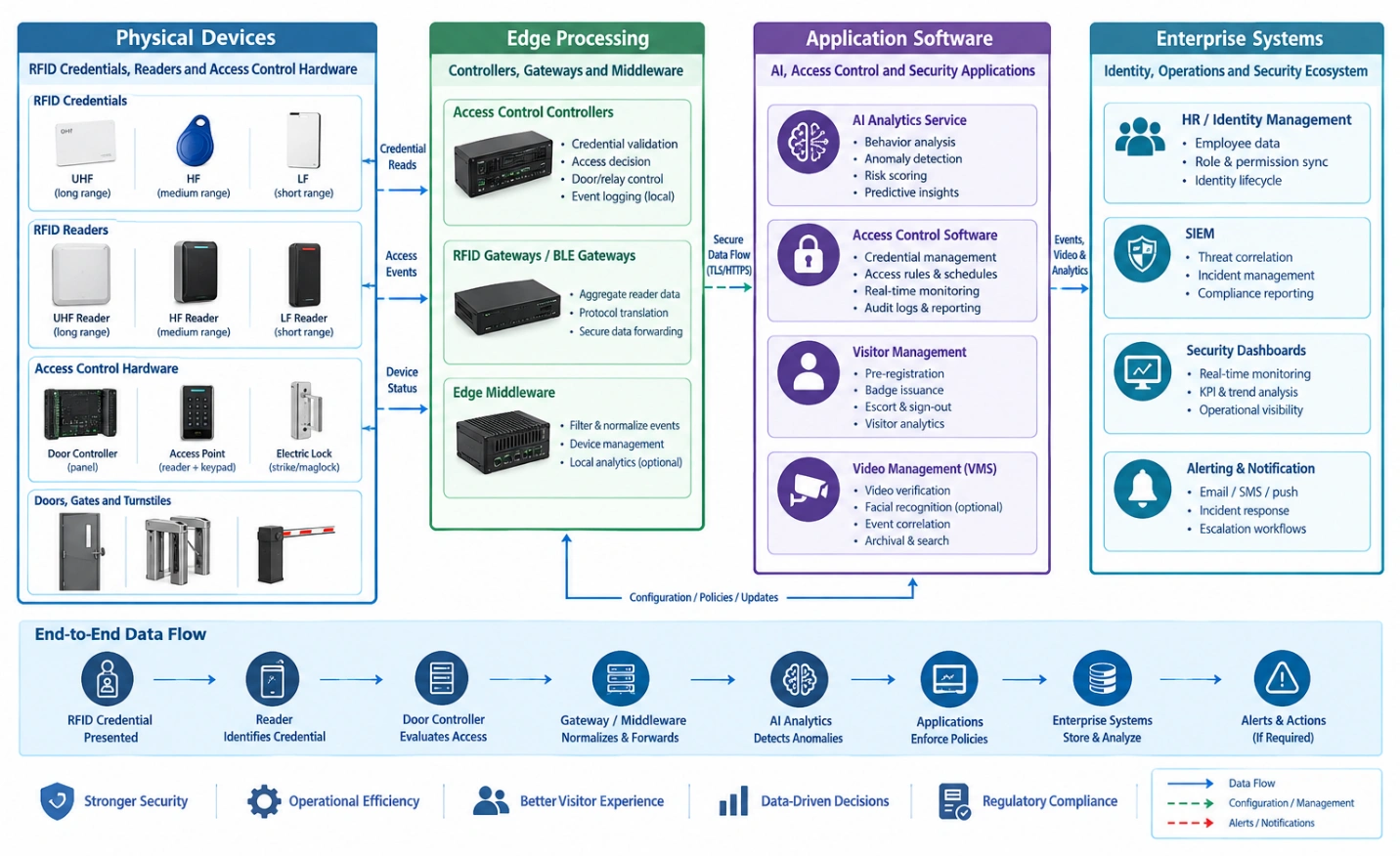
This enterprise architecture diagram illustrates how UHF, HF, and LF RFID credentials and readers connect with access-control hardware, edge gateways, middleware, AI analytics, and security applications. It highlights the end-to-end flow from credential identification and access decisions through enterprise systems, monitoring, anomaly detection, and security alerts.
What AI-Enabled RFID Access Control Means for Integrators
Access control integrators traditionally combine readers, credentials, door controllers, locks, request-to-exit devices, sensors, alarm inputs, management software, and network infrastructure into a functioning physical security system. AI adds a decision-support layer that can evaluate patterns across these components rather than treating every credential transaction as an isolated event.
An RFID access event may contain information such as credential identifier, reader location, timestamp, door identifier, access result, and transaction type. AI models can combine this information with authorized schedules, employee status, visitor appointments, facility zones, historical behavior, and related security events.
The result is not simply automated door access. A properly engineered solution can identify situations that deserve investigation, such as:
- A credential being used repeatedly at geographically separated entry points within an impossible travel interval.
- An employee credential being presented outside an approved shift or access schedule.
- A visitor credential being used after the scheduled visit has expired.
- A temporary credential appearing at a restricted door where it has no authorized access.
- A large increase in denied access events at a particular door or reader.
- A credential exhibiting behavior that differs significantly from its historical usage pattern.
- RFID-tagged security equipment or controlled assets appearing in an access-restricted area without an associated work order or authorization.
For integrators, AI therefore complements rather than replaces the physical access-control decision path. Safety-critical and security-critical door functions should continue to operate according to deterministic access policies, controller configuration, life-safety requirements, and approved fail-safe or fail-secure behavior. AI can provide risk scoring, anomaly detection, recommendations, prioritization, and investigation support without becoming an uncontrolled dependency for basic door operation.
Access Control Workflows Where AI Creates Practical Value
Credential Issuance and Lifecycle Management
Credential management is a major source of administrative workload for access control integrators and their customers. Employees, contractors, visitors, temporary workers, security personnel, and service technicians may receive credentials with different access privileges and expiration periods.
AI can help identify unusual credential lifecycle patterns by analyzing issuance, activation, modification, suspension, and revocation records. For example, a model can flag credentials that remain active after an employment or contractor relationship should have ended, or identify access groups that contain unusually large numbers of temporary users.
RFID credentials can provide the physical identity token while access-control software maintains authorization. The AI layer can analyze lifecycle data and generate recommendations for security administrators.
Visitor and Contractor Access
Visitor management frequently requires coordination among reception personnel, security officers, host employees, access-control administrators, and facilities teams. RFID badges can provide temporary identification for approved visitors and contractors.
AI can compare scheduled visits with actual entry and exit activity, identify expired temporary credentials still being used, and highlight abnormal visitor movement through controlled areas. Contractor access can also be correlated with work orders, project schedules, escort requirements, or approved working hours.
This is particularly useful for integrators supporting multi-building facilities where visitor access must be synchronized across several access-control zones.
Restricted-Zone Access
Security environments often contain areas requiring stricter controls than ordinary employee entrances. Examples include security operations centers, server rooms, evidence storage, communications rooms, control rooms, laboratories, executive areas, and restricted equipment rooms.
RFID readers can identify authorized credentials at designated entry points, while AI evaluates the surrounding event context. A suspicious transaction may become more significant when it occurs outside normal operating hours, follows a sequence of unusual door events, or conflicts with a user’s normal access profile.
Integrators can therefore configure AI alerts around risk conditions instead of generating the same level of notification for every denied transaction.
Credential Misuse and Anomaly Detection
Credential sharing is difficult to identify using conventional access logs alone. A valid RFID credential can technically pass authentication even when it is being used by another person.
AI can examine transaction frequency, reader sequence, time-of-day behavior, access-zone patterns, and other available signals to identify deviations. When video management software is integrated, suspicious RFID transactions can also be associated with corresponding video events for human investigation.
The objective is not to assume that an anomaly represents a security incident. AI-generated findings should be treated as investigation priorities that security personnel can validate.
AI-Assisted RFID Credential Anomaly Workflow
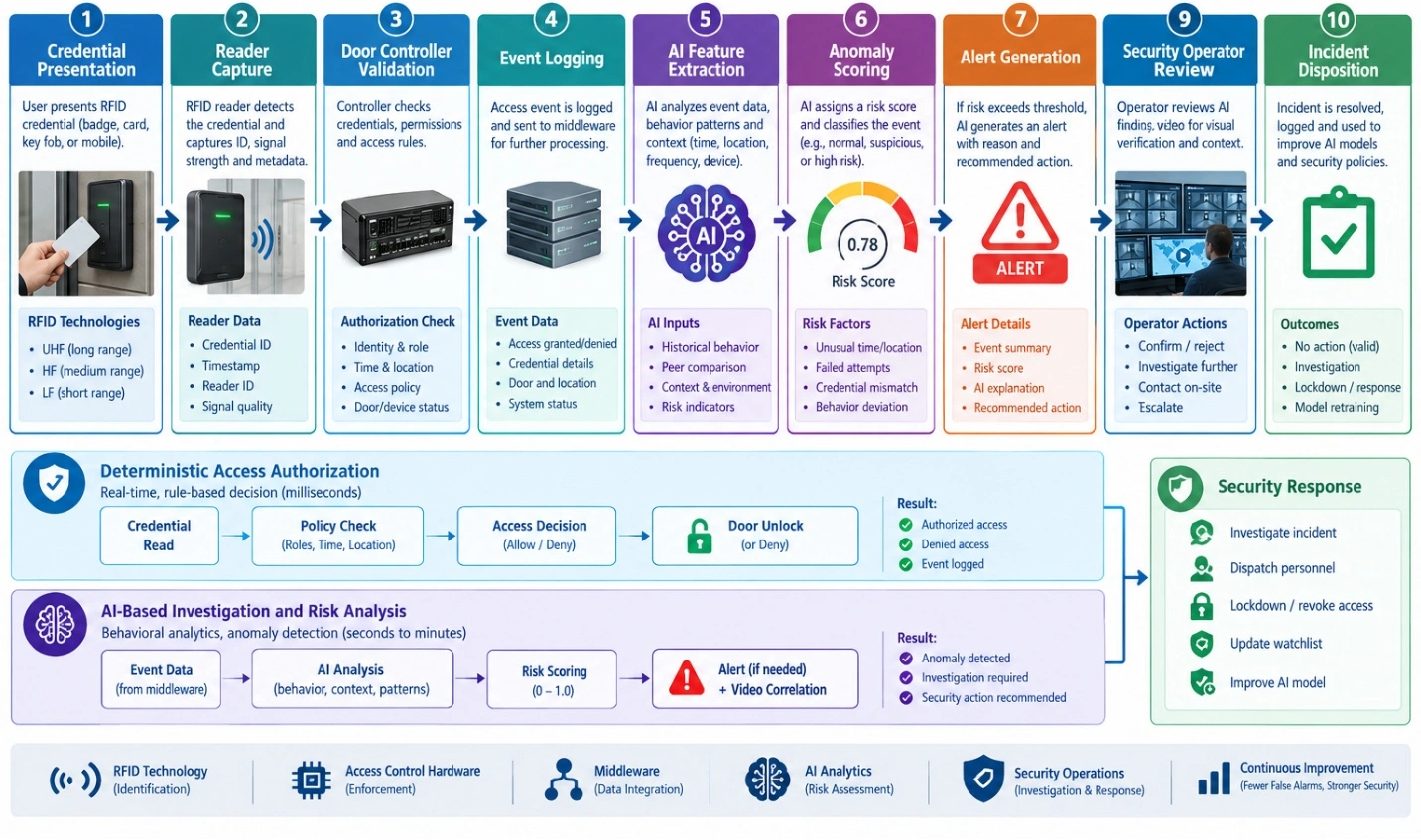
This workflow shows how an RFID credential event moves from credential presentation and deterministic access authorization through event logging, AI feature extraction, anomaly scoring, and alert generation. It also illustrates optional video correlation, security-operator review, incident disposition, and the distinction between real-time access enforcement and AI-assisted investigation.
RFID Applications for Access Control Integrators
RFID selection should follow the physical and security requirements of the access-control project rather than assuming that one RFID frequency is appropriate for every application.
HF RFID for Controlled Credential Identification
HF RFID at 13.56 MHz is commonly suited to short-range credential identification, including cards, badges, key fobs, and related identification media. For access-control integrators, HF can be appropriate where the credential is intentionally presented close to the reader.
The controlled read distance can help reduce unintended credential detection around an access point. Depending on the credential technology and system design, integrators may also need to consider encryption, secure authentication, credential cloning resistance, key management, and compatibility with the selected access-control system.
LF RFID for Legacy and Specialized Identification
LF RFID, commonly operating around 125 kHz or 134.2 kHz depending on the application, remains relevant in certain legacy access-control installations and specialized identification environments.
Integrators working with existing facilities may encounter LF credentials that must coexist with newer identification technologies. Migration planning should therefore consider credential replacement, reader compatibility, enrollment processes, controller configuration, and the customer’s security requirements rather than treating frequency migration as a simple hardware swap.
UHF RFID for Longer-Range Identification
UHF RFID is generally better suited to longer-range identification than conventional short-range access credentials. For access control integrators, this can be useful when the objective extends beyond a person presenting a card at a door.
Potential applications include vehicle identification at controlled gates, identification of tagged equipment entering restricted areas, monitoring of security equipment movement, and controlled-area inventory associated with security operations.
UHF deployments require careful attention to antenna placement, reader power, tag orientation, metal surfaces, interference, read zones, and unintended reads. The integrator must define the physical read zone so that identification events correspond to the intended security boundary.
AI, RFID and the Access Control Data Flow
A practical deployment begins with reliable event capture. RFID readers collect credential or tag observations and send them to access-control controllers, gateways, or other local processing equipment. The resulting transaction is passed through the appropriate communication network to access-control software or middleware.
Depending on the installation, communication may use Ethernet, TCP/IP, RS-485, OSDP, Wiegand, Wi-Fi, cellular connectivity, or vendor-specific interfaces. Modern integrators should generally favor secure, supervised communication methods where supported rather than relying on legacy interfaces simply because they are familiar.
The access-control software maintains authorization rules and transaction history. Middleware can normalize information from multiple reader and controller types before forwarding selected data to AI services, visitor management systems, identity systems, video management software, SIEM systems, or operational dashboards.
AI processing can occur at different points in this flow. Edge processing is useful where rapid analysis, local operation, bandwidth reduction, or data-residency requirements matter. Server-side processing is appropriate when models require greater computing resources or need to correlate information from many access-control sites. Cloud processing can support geographically distributed deployments where the customer permits relevant security data to be processed through cloud infrastructure.
A sound implementation keeps the operational roles distinct:
- RFID provides identification observations.
- Readers and controllers enforce configured access-control transactions.
- Access-control software manages credentials, permissions, doors, schedules, and events.
- Middleware handles data exchange and normalization between systems.
- AI analyzes patterns, anomalies, and contextual relationships.
- Security personnel validate alerts and determine operational response.
- Enterprise systems provide identity, personnel, visitor, video, incident, and audit context.
This separation improves reliability because an AI model can be updated or temporarily unavailable without necessarily disabling the fundamental door-control function.
AI Methods Supporting RFID Access Control
AI techniques should be selected according to the operational problem rather than added simply because the system contains large amounts of data.
Anomaly detection is particularly relevant to access-control integrators because suspicious behavior is often defined by deviation from normal activity. Unsupervised or semi-supervised models can identify unusual transaction patterns where labeled security incidents are relatively scarce.
Classification models can help categorize access events according to predefined risk or operational conditions when suitable historical data is available. Time-series methods can analyze transaction volumes and identify unusual spikes in denied access attempts, after-hours activity, or other temporal patterns.
Natural language processing can also be useful where security teams need to search incident notes, access-control records, maintenance records, or investigation reports. Computer vision may complement RFID access events when video systems are integrated, although visual analytics should be deployed according to the customer’s privacy, security, and legal requirements.
AI recommendations should remain explainable enough for security operators to understand why an event was prioritized. Useful explanations may include unusual time, unusual location, abnormal access sequence, expired credential status, or a conflict between the credential event and another enterprise record.
Real-World RFID Access Control Deployment
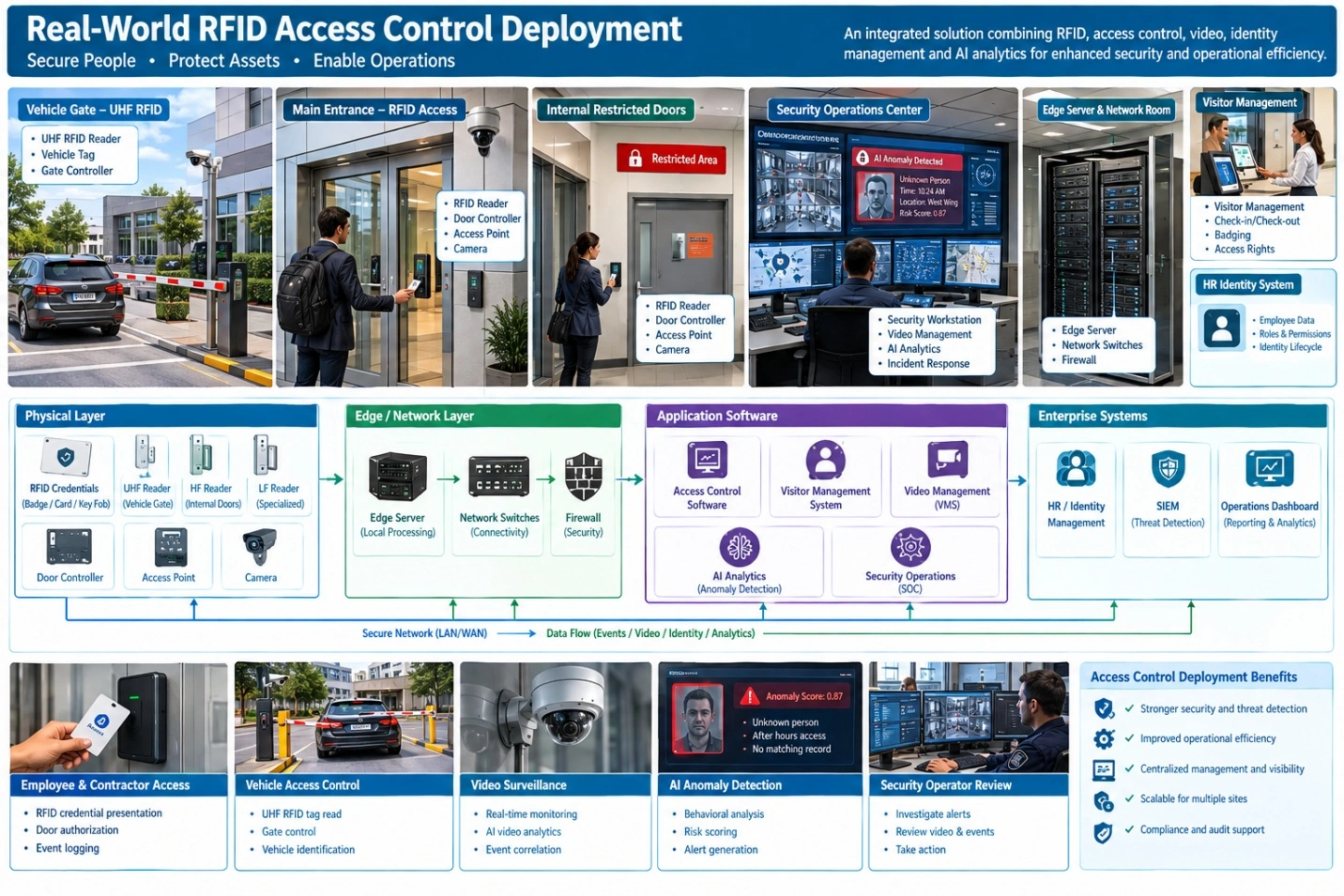
This deployment illustration shows how an access-control integrator combines RFID credentials and readers, door controllers, vehicle-gate identification, cameras, edge infrastructure, visitor management, HR identity systems, AI anomaly detection, and security operations. It emphasizes the integration of physical security devices with network, application, and enterprise layers for centralized monitoring and response.
Access Control Systems and Enterprise Integration
AI-enabled RFID access control becomes more useful when event data can be correlated with systems already used by the security organization.
Common integration points include:
- Physical access control systems for credential, door, schedule, and transaction data.
- Identity and access management systems for user identity and authorization relationships.
- HR information systems for employee status and organizational records.
- Visitor management systems for temporary credentials and scheduled visits.
- Video management systems for visual verification and incident investigation.
- Security information and event management systems for centralized security monitoring.
- Facility management and computerized maintenance management systems for door, reader, controller, and security-equipment maintenance.
- Incident management systems for investigation workflows and evidence tracking.
- Directory services for user and group synchronization.
- Enterprise databases and APIs for controlled exchange of access-control records.
GAO’s RFID and IoT hardware can support the identification layer within such deployments, while system integrators determine how readers, controllers, software, networks, and customer systems should be combined for the specific facility.
Interoperability requires more than confirming that two products have an API. Integrators should verify event schemas, authentication methods, timestamp handling, duplicate-event behavior, failure recovery, retry mechanisms, audit trails, and version compatibility. The system should also define what happens when a downstream AI or enterprise service becomes unavailable.
Cloud Version and Server Version for Access Control Integrators
A Cloud Version uses cloud-hosted software and computing resources to process and manage applicable access-control analytics. This approach can be useful for organizations operating multiple facilities where centralized administration, distributed analytics, and remote system management are priorities.
Cloud deployment requires careful evaluation of identity management, encryption, tenant separation, network dependencies, data retention, privacy obligations, vendor access, backup procedures, and the customer’s security policies. Access-control event data can contain sensitive information, so cloud adoption should follow an explicit data-governance assessment.
A Server Version places software on edge servers, customer-managed servers, private data centers, security operations servers, or other privately hosted enterprise infrastructure. This model is often appropriate when customers require tighter control over security data, local processing, integration with existing server environments, or operation with limited external connectivity.
A hybrid arrangement may be appropriate when access-control controllers and essential functions remain local while selected analytics, reporting, or centralized management services operate in cloud infrastructure.
Engineering Priorities Before Deployment
Successful AI-enabled RFID access control begins with requirements engineering rather than hardware selection. Integrators should establish the security objectives, protected zones, credential population, expected transaction volume, integration requirements, environmental conditions, and operational response procedures before selecting readers and software.
Key design questions include:
- Which doors require short-range credential presentation and which areas require longer-range RFID identification?
- Which users receive permanent, temporary, contractor, visitor, or vehicle credentials?
- Which access events require immediate alerting?
- Which systems contain authoritative identity and employment information?
- Which security events should be correlated with video?
- What happens when the network connection is interrupted?
- Which functions must continue locally during server or cloud outages?
- How long should access events and AI findings be retained?
- Which personnel are authorized to investigate or override security decisions?
- How will false positives be measured and reduced after deployment?
- How will credential revocation propagate across all connected systems?
- Which interfaces should use secure protocols such as OSDP with appropriate security configuration?
- How will reader placement and RFID read zones prevent unintended credential or tag detection?
GAO has served organizations across the United States and Canada for three decades, including Fortune 500 companies, R&D organizations, universities, and government agencies. Its work across RFID, BLE, and IoT hardware and systems provides a foundation for supporting integrators that need to evaluate identification hardware against real deployment requirements rather than treating RFID as an isolated reader technology.
RFID Access Control Integration with Enterprise Security Systems
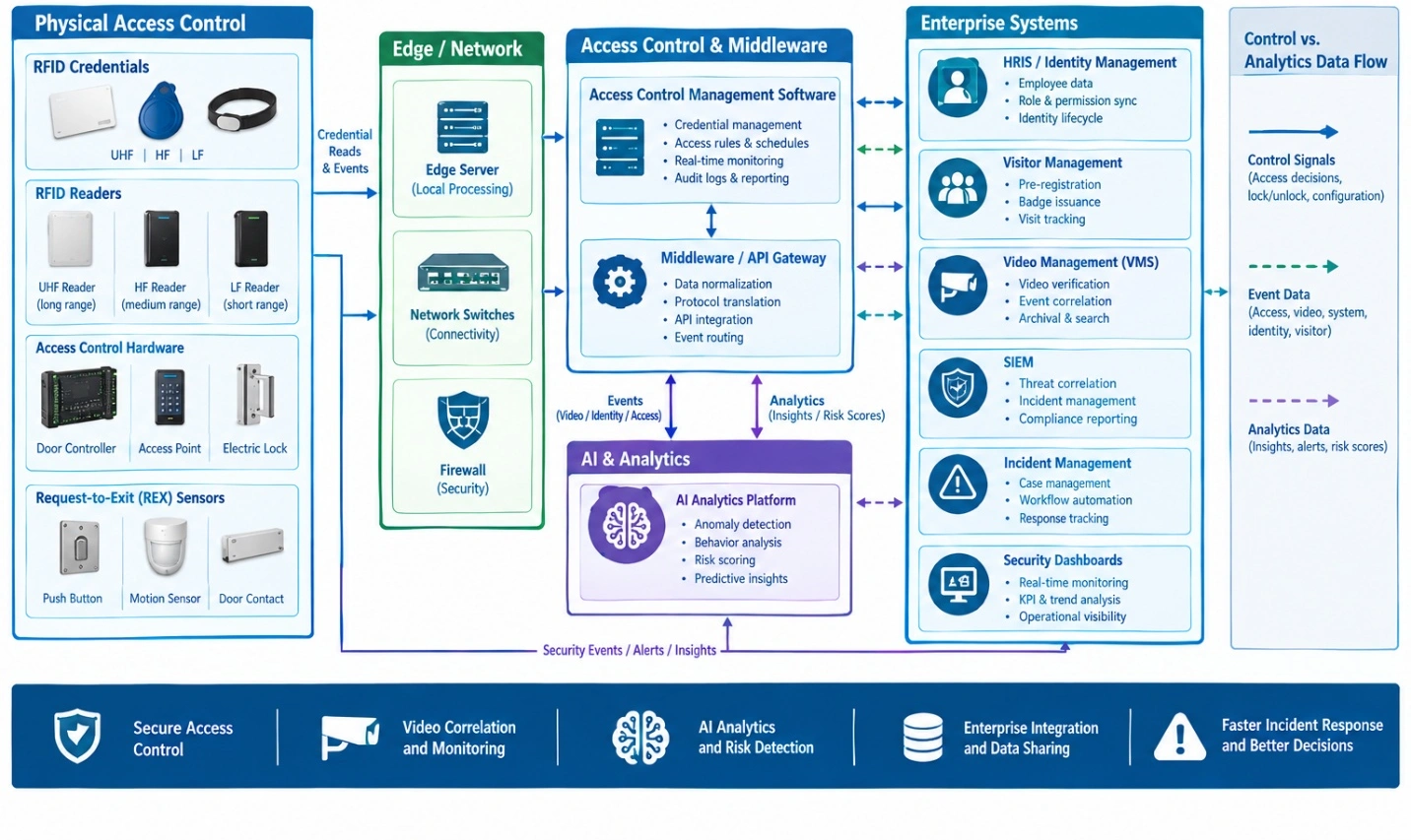
This technical block diagram shows how RFID credentials, readers, controllers, locks, and request-to-exit sensors connect through edge networking, access-control software, middleware, and AI analytics. It illustrates bidirectional integration with HR identity systems, visitor management, video management, SIEM, incident management, and security dashboards while distinguishing control signals from analytics data.
Deploying AI-Enabled RFID Access Control Systems
Deployment should begin with a site survey covering doors, gates, credential types, reader locations, controller cabinets, network paths, power availability, protected zones, and existing security equipment. Access control integrators should document which entry points require HF or LF credential presentation and which applications justify UHF identification.
Reader placement deserves particular attention. Metal doors, elevator structures, electrical equipment, reinforced walls, and nearby RFID readers can affect performance. UHF installations require additional control of antenna orientation and read zones because unwanted reads can create misleading access or asset-location events.
The commissioning plan should define acceptance criteria before installation. These criteria can include credential read reliability, transaction latency, controller response, event delivery, synchronization accuracy, alarm generation, AI alert behavior, and operation during network interruptions.
Installation and Commissioning
Commissioning should verify each physical and software component independently before evaluating the complete system. Reader addressing, controller configuration, door inputs, locking hardware, request-to-exit devices, door-position switches, and emergency interfaces should be tested systematically.
RFID testing should use representative credentials rather than only laboratory samples. Integrators should test different credential orientations, distances, user behavior, mounting conditions, and environmental conditions expected during normal operation.
AI commissioning requires a different approach. The model should first operate in a controlled observation or advisory mode where practical. Security personnel can compare AI findings against known access patterns and determine whether alerts are useful before allowing automated downstream actions.
Integration Testing
Integration testing should verify the complete transaction path from credential presentation to final event availability. A successful door opening does not necessarily mean the entire information flow is working correctly.
Testing should cover:
- RFID reader to controller communication.
- Controller to access-control software communication.
- Access-control software to middleware or API interfaces.
- Identity and credential synchronization.
- Visitor credential creation and expiration.
- HR status changes and credential revocation.
- Video event correlation.
- AI event ingestion and anomaly scoring.
- Alert delivery to security personnel.
- Audit-log creation and retention.
- Network and server failure recovery.
- Duplicate or delayed event handling.
- Clock synchronization across controllers, servers, and analytics systems.
Time synchronization is particularly important. An AI model analyzing access sequences can produce incorrect conclusions when readers, controllers, servers, cameras, and enterprise applications use inconsistent timestamps. Network Time Protocol should therefore be configured and monitored throughout the deployment.
Validating AI Performance in Access Control
AI performance should be evaluated using operational security metrics rather than model accuracy alone. A model that identifies many anomalies but generates excessive false positives can increase the workload of security officers rather than improve security.
Useful evaluation measures include precision of high-risk alerts, false-positive rate, detection latency, alert acknowledgment time, investigation completion time, and the percentage of AI findings that lead to confirmed operational actions.
Access-control integrators should establish a baseline before deploying automated analytics. Historical access transactions can help characterize normal patterns for employees, contractors, visitors, facilities, and security personnel.
Model drift should also be considered. Changes in working hours, shift patterns, facility expansion, new access groups, seasonal contractor populations, or changes to security policy can alter what constitutes normal behavior.
AI outputs should therefore be periodically reviewed by authorized security personnel. Thresholds can be adjusted as operational conditions change, while model changes should follow controlled testing and change-management procedures.
Cybersecurity for RFID Access Control Integrations
Physical access-control systems are security infrastructure and should be treated accordingly. Adding AI and network connectivity increases the number of interfaces that must be protected.
Integrators should establish separate security controls for credentials, readers, controllers, servers, APIs, databases, networks, and AI services. Administrative privileges should follow least-privilege principles, and service accounts should have only the permissions required for their assigned functions.
Where supported by the equipment, secure reader communication should be preferred. OSDP with appropriate security configuration can provide stronger protection and supervision than legacy one-way reader interfaces. Network segmentation can further restrict communication between access-control controllers and unrelated corporate systems.
Other cybersecurity considerations include:
- Encryption of sensitive data during transmission and storage.
- Strong administrator authentication and role-based access control.
- Credential key-management procedures.
- Secure API authentication.
- Certificate lifecycle management where certificates are used.
- Firmware and software patch management.
- Controller and server backup procedures.
- Centralized security logging.
- Monitoring for unauthorized configuration changes.
- Controlled remote maintenance access.
- Protection of AI models and analytical data.
- Defined data-retention and deletion policies.
- Incident-response procedures covering both cyber and physical security events.
AI should not be allowed to bypass established access-control security controls merely because it identifies a potentially suspicious event. A risk score can inform an operator or trigger an approved workflow, but the fundamental authorization logic should remain governed by explicit security policy.
Privacy and Responsible Security Analytics
Access-control data can reveal employee movements, contractor activity, visitor behavior, and facility usage patterns. AI analytics can make those datasets even more informative, so privacy considerations should be incorporated into system design.
Security teams should determine what information is actually required for each analytical use case. Retaining every available field indefinitely can increase privacy exposure without necessarily improving anomaly detection.
Integrators should also clarify who can view detailed access histories, who can investigate AI-generated findings, and how long records are retained. Where video analytics or biometric systems are introduced alongside RFID, additional legal, organizational, and privacy requirements may apply.
The engineering objective is to collect sufficient data for the defined security purpose while limiting unnecessary exposure and access.
Interoperability and Migration Strategies
Many access control integrators work with facilities that contain equipment from different generations and manufacturers. A new AI-enabled RFID solution therefore needs to coexist with legacy readers, controllers, credentials, databases, and management software.
Migration can be staged rather than performed as a single replacement project. Existing controllers can remain operational while new readers or analytics services are introduced in selected areas. Historical access data can then be incorporated into the new analytical workflow after data quality has been assessed.
API-based integration is useful where supported, but integrators should also examine event formats and operational semantics. Two systems may both report an “access denied” event while using different identifiers, timestamps, reason codes, or retry behavior.
A robust integration specification should define:
- Credential identifier format.
- Door and reader naming conventions.
- Event timestamps and time zones.
- Access-grant and access-denial reason codes.
- User and visitor identifiers.
- Temporary credential expiration behavior.
- Event acknowledgment and retry behavior.
- API authentication and authorization.
- Error handling.
- Data retention.
- Audit requirements.
- Version-control procedures.
GAO’s experience supplying RFID and IoT hardware to organizations across the U.S. and Canada can be relevant when integrators need identification equipment that must operate within broader access-control and enterprise systems. The final system design, however, should always be validated against the customer’s existing controllers, software, credentials, and security requirements.
Operational KPIs for AI-Enabled Access Control
A successful deployment should be measured through security and operational outcomes rather than reader counts alone.
| KPI | What It Measures | Why It Matters |
|---|---|---|
| Valid credential read rate | Successful RFID identification | Indicates reader and credential reliability |
| Access transaction latency | Time from credential presentation to decision | Helps identify user-facing delays |
| False-positive alert rate | AI alerts not confirmed as meaningful | Measures analyst workload |
| High-risk detection precision | Proportion of prioritized alerts that are relevant | Indicates practical AI value |
| Alert acknowledgment time | Time before security staff review an alert | Measures response efficiency |
| Credential revocation latency | Time required to disable access after authorization changes | Reduces exposure from inactive users |
| Denied-access trend | Changes in rejected transactions | Helps identify misuse or configuration problems |
| Visitor credential expiration compliance | Expired visitor credentials still appearing in events | Supports temporary-access governance |
| Controller availability | Operational availability of access controllers | Protects continuous access-control operation |
| Integration event delivery rate | Percentage of events successfully transferred between systems | Measures system interoperability |
| AI detection latency | Time from event capture to analytical finding | Important for time-sensitive investigations |
| Investigation closure time | Time from alert to disposition | Measures security-team efficiency |
Scaling Across Buildings and Multiple Access Zones
Scaling an AI-enabled RFID access-control solution requires consistent naming, credential policies, event schemas, network design, and operational procedures.
A multi-building deployment should distinguish facilities, floors, security zones, doors, readers, and controlled areas using a standardized identifier structure. Without consistent naming, AI correlation becomes more difficult and security operators can misinterpret alerts.
Centralized analytics can provide cross-site visibility, but local controllers should retain essential access-control functions. A network outage between a building and a central server should not automatically disable ordinary authorized entry unless the customer’s security policy explicitly requires such behavior.
Large deployments should also consider transaction volume. Reader count alone does not determine processing requirements. Event frequency, video correlation, historical retention, AI model complexity, number of simultaneous investigations, and reporting requirements can all influence server and database capacity.
Maintenance, Optimization and Lifecycle Management
AI-enabled RFID access control requires continuous maintenance rather than a one-time installation.
Preventive maintenance should cover reader condition, antenna alignment where applicable, controller health, door-position sensors, request-to-exit devices, locking hardware, power supplies, network connections, and backup systems.
RFID performance should be reviewed when doors, walls, furniture, electrical equipment, or nearby RFID systems change. UHF read zones can change after physical modifications, so a previously validated installation may require another site test.
Software maintenance should include security patches, interface compatibility, database maintenance, backup validation, and controlled AI model updates. Any model modification should be tested against representative access-control data before production deployment.
Operational teams should periodically review:
- AI alert thresholds.
- False-positive patterns.
- Unused access groups.
- Expired credentials.
- Temporary contractor accounts.
- Reader and controller fault trends.
- Network communication failures.
- Integration errors.
- Unusual access patterns.
- Data-retention compliance.
- Security incident outcomes.
Practical Implementation Recommendations for Access Control Integrators
AI should solve a defined access-control problem rather than become an additional feature with no operational owner. A focused deployment such as credential anomaly detection, visitor access monitoring, or restricted-zone analysis is often easier to validate than attempting to automate every security decision simultaneously.
RFID selection should follow the required identification behavior. HF or LF can be appropriate for deliberate close-range credential presentation, while UHF may be useful for longer-range vehicle, equipment, or controlled-zone identification.
The AI layer should be separated from deterministic door authorization wherever possible. This approach allows security teams to gain analytical value without making normal door operation dependent on model availability.
Integration specifications should be written before installation. Data fields, identifiers, event timing, APIs, failure handling, cybersecurity controls, and audit requirements should be agreed upon with the customer and relevant system vendors.
Pilot deployments should use representative doors and users. A laboratory test cannot reproduce all the conditions that affect access-control performance, including credential orientation, user behavior, metal structures, network interruptions, shift changes, and unusual visitor activity.
Security operators should participate in acceptance testing. A technically functioning AI model is not sufficient if the resulting alerts are difficult to understand, impossible to investigate, or too frequent to be operationally useful.
Key Takeaways for AI and RFID Access Control Integration
AI-enabled RFID access control combines reliable identification with contextual analytics. RFID captures credential and tagged-object events, while AI can identify patterns that are difficult to detect through conventional access logs.
For access control integrators, the strongest applications include credential anomaly detection, visitor and contractor monitoring, restricted-zone analysis, access-rights review, security-event correlation, and investigation prioritization.
The most important engineering considerations are reliable reader deployment, deterministic access-control operation, accurate timestamps, secure communications, system interoperability, appropriate AI validation, cybersecurity, privacy, and clearly defined operator workflows.
GAO provides RFID, BLE, and IoT hardware products and systems that can support these deployments. GAO and its sister companies, GAO Research Inc. and GAO Tek Inc., operate as part of GAO Group, with operations based in New York City and Toronto, Canada. The organization has invested substantially in research and development and maintains stringent quality-assurance processes with technical support available remotely or onsite.
Building the Future of Industrial AI and IoT with Aperture Venture Studio and GAO
For more than three decades, GAO Group of Companies has invested heavily in R&D for industrial RFID, BLE, and IoT. As generative AI became useful for industrial applications, we expanded our work in AI and IoT technologies, including RFID and BLE, and founded Aperture Venture Studio to develop AI and IoT solutions relevant to areas such as intelligent access control and security operations.
Aperture brings together AI and IoT technical experts, operational executives, investors, and leading companies. Through initiatives such as Aperture Ventures Summit and TekSummit, advanced AI and IoT topics are explored with technical communities and industry participants.
We welcome you to join us as:
- Advisors, Co-founders or Employees
- Investors
- Customers