
AI and RFID for Airlines
AI-Driven Airline Operations with RFID
Artificial intelligence is helping airlines improve baggage handling, aircraft maintenance, inventory control, ground operations, and asset visibility by turning operational data into timely decisions. AI systems can analyze flight schedules, baggage events, aircraft maintenance records, turnaround activities, inventory movements, and equipment data to identify disruptions, predict operational risks, and optimize resource allocation. RFID provides a practical identification and data-capture layer for baggage, aircraft components, ground support equipment, tools, consumables, catering assets, and other airline-controlled items. Together, these technologies support applications such as AI baggage tracking, intelligent aircraft asset management, predictive maintenance, inventory optimization, and turnaround monitoring. For airlines operating under strict departure schedules, safety requirements, maintenance controls, and complex airport interfaces, accurate real-time information is critical. GAO provides RFID, BLE, IoT, and related hardware products and systems that can supply physical identification data for airline software, analytics, and AI-enabled operational workflows.
AI-Powered RFID Airline Operations Workflow
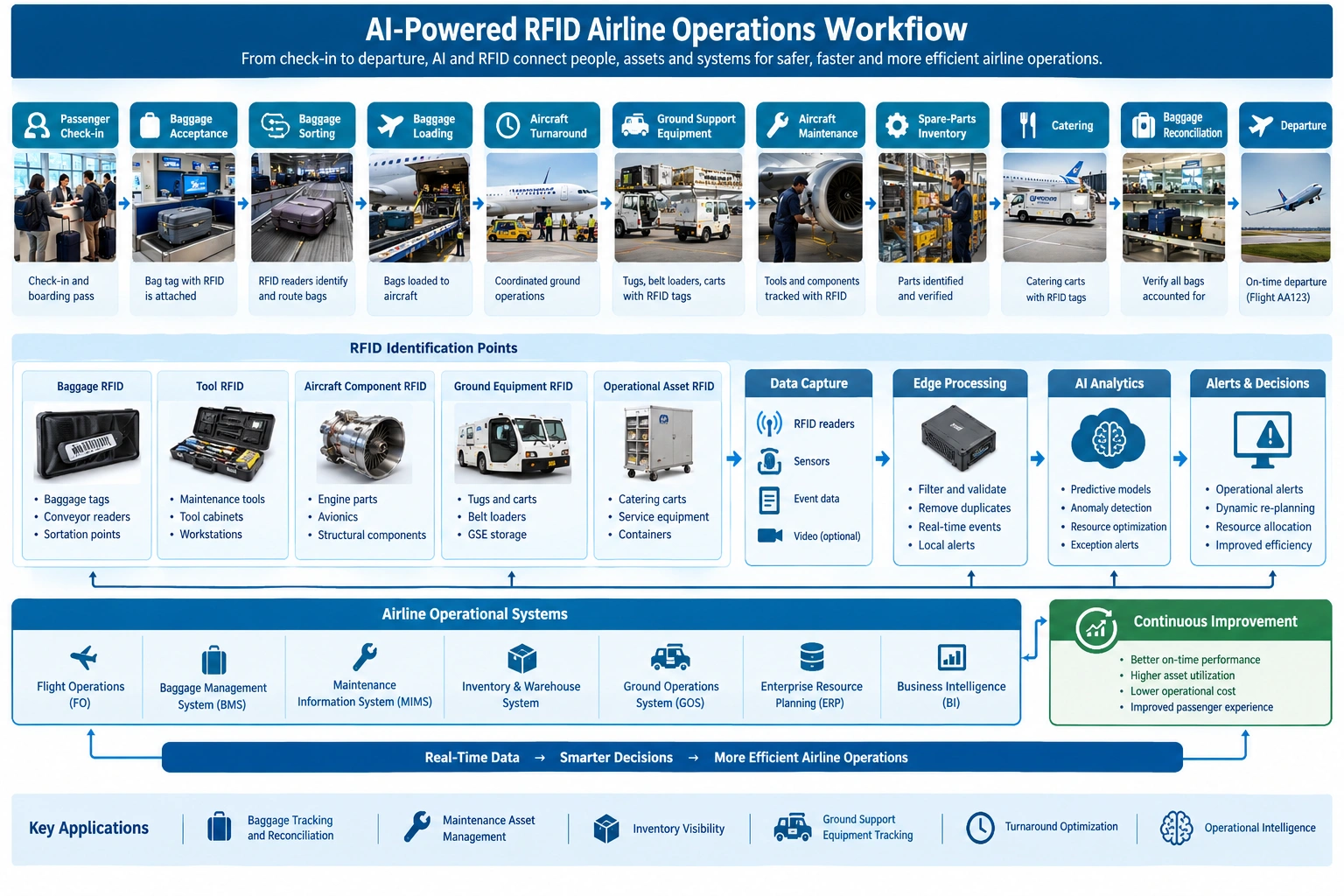
This infographic shows how AI and RFID connect passenger check-in, baggage handling, aircraft turnaround, maintenance, inventory, ground support, catering, baggage reconciliation, and departure. It traces RFID data through edge processing, AI analytics, airline operational systems, alerts, and continuous improvement.
Alt Text: AI and RFID workflow connecting airline baggage, maintenance, inventory, ground support, analytics, and departure.
What AI Means for Airline Operations
AI for airlines uses machine learning, predictive analytics, computer vision, optimization algorithms, anomaly detection, and related Industrial AI methods to support decisions across passenger service, baggage operations, aircraft turnaround, maintenance, logistics, and asset management.
The business value comes from connecting operational data that is normally distributed across multiple airline systems. Flight operations may maintain schedules and aircraft status, maintenance teams use maintenance information systems, baggage operations manage handling events, and supply-chain teams maintain parts and inventory records. AI can correlate these data sources to identify relationships that are difficult to recognize through isolated systems.
Airline applications can include:
- AI baggage tracking and exception detection
- Predictive aircraft maintenance
- Intelligent spare-parts inventory management
- Ground support equipment tracking
- Aircraft tool tracking
- Turnaround-time prediction
- Flight disruption analysis
- Maintenance resource planning
- Catering and service-equipment tracking
- Airport logistics optimization
- Computer vision for baggage and ramp operations
- Anomaly detection across operational events
RFID acts as an enabling data-capture technology rather than the primary business objective. A tagged baggage item, tool, component, or ground asset can generate an identification event at a defined location. AI software can combine that event with flight schedules, maintenance records, baggage information, inventory data, and other operational information.
This relationship is especially useful when an airline needs to know not merely that an item exists, but whether it is at the correct location, associated with the correct flight or aircraft, available for a required task, or progressing through the expected workflow.
Airline Applications for AI-Enabled RFID
Airlines have several operational areas where AI can benefit from reliable identification and location data. The strongest applications are those where a physical item or operational event directly affects aircraft readiness, passenger service, maintenance compliance, or departure performance.
AI Baggage Tracking and Reconciliation
Baggage handling is one of the most data-intensive airline processes. A passenger bag can pass through check-in, security screening, sorting, transfer handling, loading, aircraft unloading, and baggage reclaim.
RFID can provide automated identification at selected baggage handling points. AI software can combine these events with flight schedules, passenger connections, baggage reconciliation records, and airport handling information.
This can help identify:
- Bags that have not reached an expected handling point
- Transfer baggage at risk of missing a connecting flight
- Unexpected baggage routing
- Baggage handling bottlenecks
- Exceptions requiring ground-handling intervention
- Mismatches between planned and observed baggage movement
AI can prioritize exceptions according to flight departure time and operational impact rather than treating every missing event equally.
Aircraft Maintenance and Tool Tracking
Aircraft maintenance organizations manage large numbers of tools, inspection devices, components, consumables, and maintenance assets. Tool accountability is particularly important because an unaccounted tool can create an operational and safety concern.
RFID can identify tagged maintenance tools at tool cribs, maintenance areas, storage locations, and controlled access points. AI analytics can examine usage patterns, movement history, maintenance schedules, and tool availability.
Potential applications include:
- Tool location and accountability
- Maintenance-kit verification
- Aircraft component traceability
- Maintenance inventory visibility
- Detection of unusual tool movement
- Identification of frequently unavailable maintenance assets
- Prediction of tool or component demand based on maintenance schedules
The AI layer can help maintenance planners anticipate resource requirements rather than discovering shortages when an aircraft is already scheduled for maintenance.
Predictive Maintenance Support
Predictive maintenance uses historical maintenance records, aircraft health data, sensor readings, component history, operating conditions, and other variables to estimate potential failures or maintenance requirements.
RFID can contribute identity and lifecycle information for tagged components, maintenance assets, or service items. The technology does not replace aircraft-certified sensing or approved maintenance procedures. Instead, it can provide additional traceability data around physical assets and maintenance workflows.
For example, AI software could correlate component identity with installation history, maintenance events, inventory movements, and inspection records. Maintenance teams can then use the resulting analysis as decision support within approved airline maintenance processes.
Ground Support Equipment Management
Airlines and ground-handling organizations use baggage tractors, belt loaders, ground power units, tow bars, service carts, maintenance equipment, and other ground support equipment.
Locating the correct equipment at the right gate or aircraft stand can influence turnaround performance. RFID can provide identification at controlled points, while other IoT technologies may provide continuous location or condition information when required.
AI can analyze equipment utilization, movement patterns, turnaround schedules, and availability to identify:
- Equipment shortages at scheduled gates
- Underutilized equipment
- Abnormal utilization patterns
- Equipment allocation conflicts
- Delays associated with unavailable ground equipment
GAO’s RFID and IoT hardware can support these physical identification requirements, while airline software and analytics determine how the resulting events are used operationally.
AI for Airline Turnaround and Departure Readiness
Aircraft turnaround involves a tightly coordinated sequence of activities between arrival and departure. Baggage unloading and loading, passenger boarding, catering, cabin servicing, fueling, potable-water servicing, waste servicing, cleaning, maintenance inspections, and ground support activities may occur within the same operational window.
AI can analyze historical turnaround durations and current events to estimate whether an aircraft is likely to depart on schedule. Reliable identification data improves the model’s understanding of physical progress.
For example, an AI system can evaluate whether required ground equipment has arrived, whether baggage handling events are progressing as expected, whether a maintenance task remains open, and whether other turnaround milestones have been completed.
This supports a shift from simply recording completed activities toward predicting departure risk before the delay becomes unavoidable.
Airline Inventory and Spare-Parts Intelligence
Aircraft maintenance depends on the availability of approved parts, consumables, tools, and maintenance materials at the required location and time. A shortage can affect maintenance schedules and aircraft availability, while excessive inventory can increase carrying costs and storage complexity.
AI-enabled inventory management can analyze:
- Historical parts consumption
- Scheduled maintenance events
- Aircraft fleet composition
- Component replacement patterns
- Current stock levels
- Supplier lead times
- Aircraft location
- Maintenance requirements
- Seasonal operational patterns
RFID can strengthen physical inventory visibility by automatically identifying tagged parts, containers, kits, and other suitable inventory units as they enter or leave controlled locations.
This can help maintenance logistics teams distinguish between a part that exists in the inventory database and a part that has actually been identified at the expected physical location.
Component and Maintenance-Kit Traceability
Airline maintenance requires controlled handling and documentation of components. A tagged item can be associated with its part number, serial number, batch information, maintenance status, storage location, and applicable records in the maintenance system.
AI can use this information to identify inconsistencies, such as an expected maintenance kit that has not reached the aircraft maintenance location or an item whose physical movement does not match its recorded workflow.
RFID should be implemented according to the component’s material, environmental conditions, attachment requirements, and applicable aviation procedures. Metal aircraft components and other RF-sensitive items may require specialized tag selection and placement testing.
Airline Operational Workflow from Data Capture to AI Decisions
An AIoT solution for airlines can connect physical asset identification with operational software through several processing stages.
Data acquisition begins with RFID readers and tags, barcode systems, industrial cameras, aircraft and ground-equipment sensors, access-control devices, and existing airport or airline equipment. RFID can be deployed at baggage handling points, maintenance stores, tool rooms, equipment staging areas, and other controlled locations where automatic identification is beneficial.
Communication infrastructure transfers events from readers and connected equipment to local processing systems. Depending on the airport environment, this may involve Ethernet, Wi-Fi, cellular connectivity, airport networks, secure IP connections, APIs, or other supported interfaces.
Edge processing can filter repeated RFID reads, validate events, apply local business rules, and buffer information when external connectivity is interrupted. This is particularly important for airport operations where immediate local processing can reduce unnecessary network traffic and improve response time.
Middleware converts device-level observations into business events. Rather than sending thousands of repeated tag reads into airline applications, middleware can produce meaningful events such as “baggage detected at loading point,” “maintenance tool returned,” “component received,” or “ground equipment detected at gate.”
Airline software integration connects those events with systems such as airline operational databases, baggage management systems, maintenance information systems, fleet management applications, inventory systems, flight operations systems, airport operational databases, ERP software, and workforce-management applications.
AI analytics can then correlate physical events with schedules, historical data, maintenance requirements, passenger connections, and other operational variables. Models can perform anomaly detection, forecasting, classification, optimization, or risk scoring.
Operational action is the final stage. A system may notify a baggage supervisor about a transfer bag, alert maintenance logistics about a missing component, identify insufficient ground equipment at a gate, or flag a turnaround that is trending toward delay.
AI-Powered RFID Data Flow for Airlines
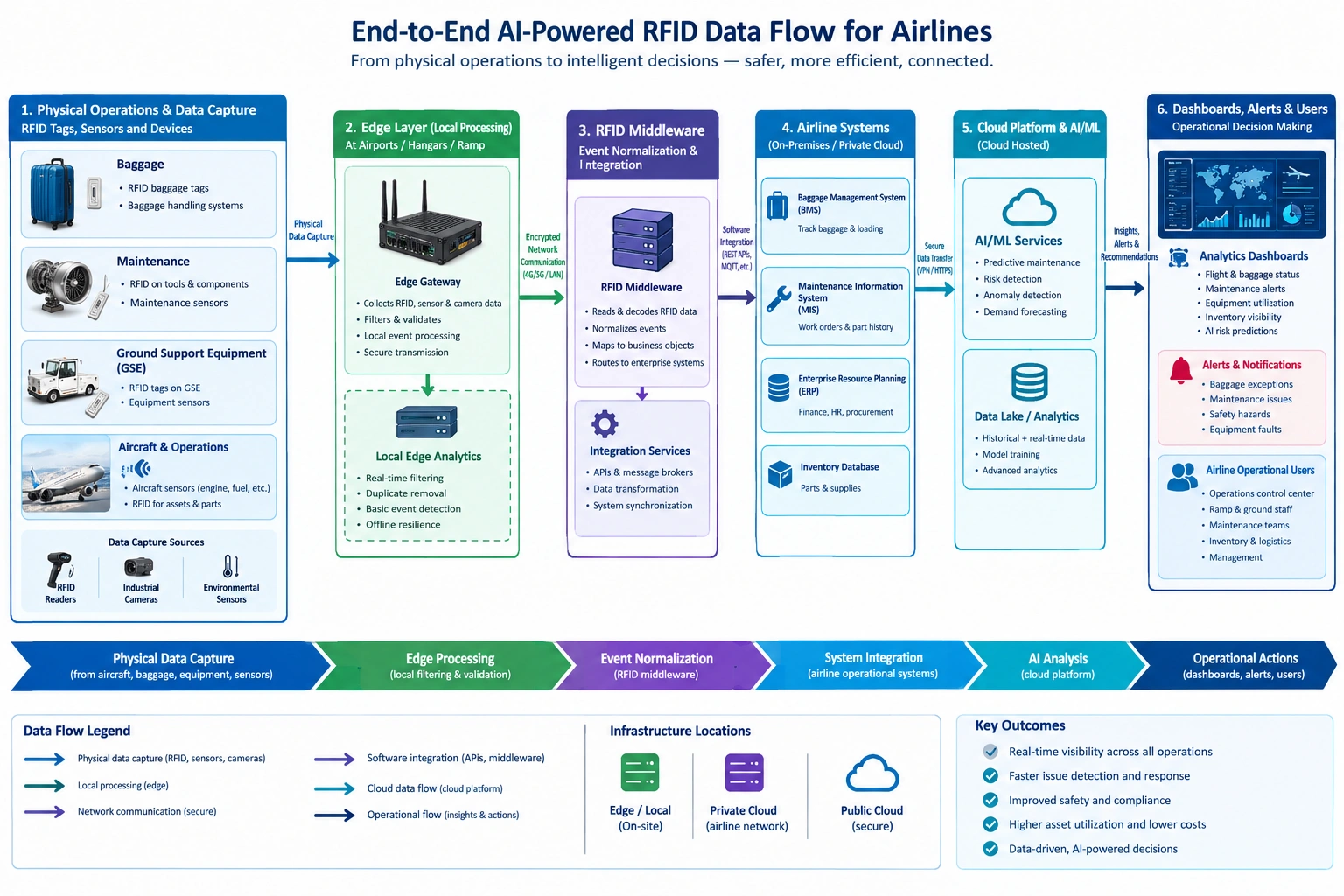
End-to-end diagram showing how RFID tags, sensors, and cameras feed airline systems through edge processing and RFID middleware, enabling AI-driven analytics, real-time alerts, predictive insights, operational visibility, improved asset tracking, and faster data-driven decisions.
Alt Text: AI-powered RFID airline data flow from sensors and edge gateways to AI analytics, alerts, and users.
RFID, AI Hardware and Software for Airlines
Airline deployments should be engineered around operational requirements rather than treating RFID as a standalone installation. Airports contain metal structures, aircraft surfaces, moving equipment, dense baggage flows, restricted areas, and radio-frequency considerations that can affect identification performance.
RFID Hardware for Airline Operations
UHF RFID can be appropriate for applications requiring longer-range identification of baggage, ground assets, maintenance equipment, pallets, containers, and other suitable items. Reader selection should consider required read distance, tag density, item orientation, movement speed, environmental conditions, and interference.
HF RFID can support shorter-range controlled identification where an item can be presented near a reader. This can be useful for controlled maintenance, access, inventory, or identification points where longer read range is unnecessary.
LF RFID has specialized applications where its operating characteristics match the physical environment and identification requirement.
Airline deployments may use:
- Fixed RFID readers at controlled baggage or asset checkpoints
- Handheld RFID readers for maintenance inventory and asset verification
- Antennas positioned around defined read zones
- Tags selected for baggage, plastic, paper, metal, or other relevant surfaces
- Edge gateways for local event processing
- Industrial computers or servers for local applications
- Network infrastructure connecting RFID devices with airline software
AI and Supporting Software
AI software can use machine learning for forecasting, anomaly detection, classification, resource optimization, and operational risk analysis. Computer vision can complement RFID where visual confirmation is useful for baggage handling, ramp operations, equipment inspection, or facility monitoring.
The broader software environment may include:
- RFID device-management software
- Event middleware
- Airline operational databases
- Baggage handling systems
- Maintenance information systems
- Fleet management software
- Inventory and supply-chain systems
- ERP applications
- AI inference and analytics services
- Dashboards and alerting software
GAO can supply RFID, BLE, and IoT hardware products and systems that form part of these connected airline workflows, with deployment decisions based on the physical environment and integration requirements.
Cloud Version and Server Version
A Cloud Version can host AI analytics, dashboards, data processing, and selected application services within cloud infrastructure. This can be useful for airlines that need centralized visibility across multiple airports, maintenance bases, or operational locations. Cloud deployment can simplify centralized software management and support large-scale analytics, subject to the airline’s cybersecurity, privacy, connectivity, and data-governance requirements.
A Server Version can operate on customer-managed edge servers, private data centers, airport servers, airline facilities, or other privately hosted infrastructure. This approach can be appropriate where operational data requires local control, where connectivity to airline or airport systems must remain local, or where low-latency processing is important.
A hybrid model can place RFID event processing and time-sensitive operational functions locally while sending selected data to centralized AI services. Local buffering can also help preserve events during temporary connectivity interruptions.
Key Capabilities of AI-Enabled Airline Operations
Combining AI with reliable identification data can help airlines move from retrospective reporting toward proactive operational management. The greatest value comes when AI predictions are connected to specific airline workflows and measurable actions.
Real-Time Baggage Visibility
AI can evaluate baggage identification events against flight schedules, connection times, loading milestones, and routing information. This allows airline and ground-handling teams to prioritize exceptions according to operational urgency.
Potential outcomes include:
- Earlier identification of transfer baggage at risk of missing a connection
- Faster investigation of bags missing from expected handling stages
- Better visibility into baggage loading and unloading progress
- Improved coordination between baggage handlers and flight operations
- More accurate analysis of baggage-handling bottlenecks
RFID provides the physical identification events, while AI determines which events require attention and why.
Intelligent Aircraft Asset Management
Aircraft maintenance organizations handle large numbers of tools, components, maintenance kits, ground equipment, and consumables. AI can analyze historical movement, utilization, maintenance schedules, and availability to identify resource constraints.
For example, if a scheduled maintenance event requires a particular tool kit and RFID data indicates that the kit has not arrived at the maintenance location, the system can generate an exception before the maintenance task begins.
This can reduce time spent searching for equipment and help maintenance planners coordinate resources more effectively.
Predictive Turnaround Management
Aircraft turnaround performance depends on multiple activities occurring within a limited time window. AI can evaluate current milestone completion against historical turnaround patterns to estimate departure risk.
Relevant inputs can include:
- Baggage loading progress
- Ground support equipment availability
- Aircraft servicing milestones
- Maintenance status
- Boarding progress
- Catering and cabin-service status
- Historical turnaround duration
- Gate and stand information
- Flight schedule constraints
AI can convert these inputs into a risk score or predicted completion time, allowing airline operations personnel to intervene earlier.
Intelligent Inventory Management
AI-supported inventory management can forecast demand for maintenance parts, tools, consumables, and other airline materials by analyzing fleet schedules, maintenance plans, historical consumption, and current inventory.
RFID can provide additional evidence about the physical location and movement of suitable tagged inventory.
The combined approach can help distinguish between:
- Stock recorded in software but not physically located
- Materials physically available but not correctly recorded
- Items allocated to the wrong maintenance location
- Frequently requested items approaching shortage
- Inventory that is rarely used
- Components or kits awaiting movement
The result is more informed inventory planning without depending entirely on manual stock checks.
Engineering Considerations for Airline RFID Deployment
RFID performance at airports and maintenance facilities depends heavily on physical conditions. Aircraft structures, metal containers, baggage carts, machinery, dense baggage flows, and other RF-reflective materials can affect read performance.
Tag Selection
Tag selection should be based on the actual airline asset rather than simply choosing a tag based on nominal read range.
Testing should consider:
- Baggage construction and tag attachment
- Metal aircraft components
- Maintenance tools and tool cabinets
- Plastic or metal containers
- Ground support equipment
- Required read distance
- Item orientation
- Read-zone density
- Movement speed
- Environmental exposure
- Attachment durability
Specialized on-metal RFID tags may be appropriate for certain aircraft maintenance assets, while conventional tags may be suitable for other materials.
Controlled Read Zones
Airline RFID installations should create defined identification points rather than attempting to read every tagged object throughout an airport.
For example, a reader at a maintenance-store doorway can detect tools or components passing through that location. A reader positioned near a baggage process can capture a defined handling event.
A carefully engineered read zone reduces unintended reads from nearby baggage, equipment, or inventory and makes the resulting data more useful for AI analysis.
RFID Event Processing
A reader may detect the same tag repeatedly while an item remains within its RF field. Software should therefore convert raw observations into meaningful airline events.
Examples include:
- Baggage entered a loading area
- Maintenance tool returned to the tool room
- Component entered a maintenance store
- Ground support asset arrived at a gate
- Maintenance kit was issued
- Asset departed from a controlled location
This distinction between RFID reads and business events is an important engineering consideration. AI models should generally operate on validated events rather than raw reader output.
Integrating AI and RFID with Airline Systems
AI and RFID deployments should complement existing airline software rather than create isolated operational databases.
Common integration targets include:
- Airline operational databases
- Baggage management systems
- Departure control systems
- Maintenance information systems
- Fleet management systems
- Inventory and warehouse systems
- Enterprise resource planning software
- Ground operations systems
- Airport operational databases
- Workforce-management software
- Business intelligence systems
A common integration model associates physical RFID identifiers with business identifiers such as a baggage identifier, aircraft registration, part number, serial number, tool ID, equipment ID, or maintenance work order.
For example, an RFID event indicating that a maintenance component has entered a controlled storage location can be linked to its part and serial information. AI software can then evaluate whether the component is required for an upcoming maintenance event.
GAO’s RFID and IoT hardware can provide the physical identification layer while software integration connects those events to the airline’s existing operational environment.
Cybersecurity and Operational Resilience
Airline technology deployments require cybersecurity controls appropriate to systems that interact with operational environments. RFID readers, edge gateways, servers, databases, APIs, and AI services should be incorporated into established airline security practices.
Important controls include:
- Network segmentation between operational technology and general-purpose networks
- Role-based access control
- Strong authentication for administrative functions
- Encryption for supported data communications
- Secure API authentication
- Device inventory and configuration management
- Security logging and monitoring
- Controlled software and firmware updates
- Backup and recovery procedures
- Incident-response procedures
Operational resilience is equally important. A temporary loss of cloud connectivity should not necessarily prevent local baggage, maintenance, or asset-identification processes from continuing.
Local edge processing can buffer RFID events and synchronize them with centralized systems when connectivity is restored. This approach can be particularly useful at airports where multiple systems and network boundaries must operate reliably.
Implementation, Testing and Commissioning
A successful airline AI and RFID project should progress through controlled engineering stages.
Define the Operational Problem
Start with a measurable airline requirement such as baggage exception management, maintenance-tool accountability, spare-parts visibility, ground equipment utilization, or turnaround monitoring.
The project team should identify:
- Which physical item requires identification
- Which event needs to be captured
- Where that event occurs
- Which airline system currently records related information
- What decision depends on the event
- What operational action follows an exception
Conduct a Site Survey
Airport and maintenance environments should be assessed before hardware selection is finalized.
The survey should examine RF conditions, metal structures, reader mounting positions, network availability, environmental conditions, security restrictions, equipment movement, and the expected density of tagged items.
Representative baggage, tools, components, and ground equipment should be tested where possible.
Pilot the RFID Workflow
A pilot should use actual airline workflows rather than artificial laboratory conditions. For baggage applications, representative bags and normal handling processes should be included. For maintenance applications, actual tools, kits, and storage processes provide more meaningful results.
Useful measurements include:
- Read accuracy
- Missed-read rate
- Unintended-read rate
- Event latency
- Tag durability
- Network availability
- Middleware processing reliability
- User acceptance
- AI prediction accuracy
Validate AI Outputs
AI predictions should be evaluated against known operational outcomes. A model predicting turnaround delays, baggage exceptions, or inventory demand should be tested using historical and live operational data.
Human operational teams should remain involved in validating alerts, especially where decisions affect maintenance, safety, baggage handling, or flight operations.
Scale by Operational Priority
After a successful pilot, airlines can expand from one controlled workflow to additional airports, maintenance locations, baggage processes, or asset categories.
Scaling should preserve consistent identifiers, data models, security controls, and event definitions so that information remains interoperable across locations.
KPIs for AI-Powered Airline Operations
Technology performance should be measured alongside airline operational outcomes. Suitable KPIs depend on the selected application.
Relevant measures include:
- Baggage identification accuracy
- Baggage exception detection rate
- Mishandled baggage rate
- Transfer-baggage processing time
- Aircraft turnaround time
- On-time departure performance
- Maintenance-tool search time
- Tool accountability rate
- Maintenance material availability
- Inventory accuracy
- Spare-parts fulfillment time
- Ground support equipment utilization
- Equipment response time
- RFID read accuracy
- RFID event latency
- AI alert precision
- False-alert rate
- Predicted versus actual turnaround time
- Maintenance-resource forecast accuracy
- System availability
A useful KPI framework should connect each technology measurement to a business outcome. For example, RFID read accuracy matters because missed identification can produce incorrect baggage or maintenance records. AI alert precision matters because excessive false alerts can reduce operational confidence.
Business and Operational Value for Airlines
AI-supported RFID systems can create value across airline operations by connecting physical assets and events with the information used for operational decisions.
The principal advantages include:
- Improved baggage visibility: Automated identification provides more frequent evidence of baggage movement across defined handling points.
- Better turnaround coordination: AI can combine operational milestones to identify potential departure risks earlier.
- Improved maintenance readiness: Tool, component, and kit visibility can help maintenance teams prepare resources before scheduled work begins.
- Higher inventory accuracy: Physical identification can strengthen the connection between inventory records and actual item locations.
- Faster exception management: AI can prioritize operational events according to timing, flight impact, and historical patterns.
- Improved asset utilization: Movement and usage data can reveal underutilized or poorly allocated ground and maintenance assets.
- Scalable operational intelligence: A consistent identification and event model can support additional airports, maintenance bases, and asset categories.
- Better traceability: Time-stamped physical events provide additional evidence for operational investigations and process analysis.
The technology should not be viewed as a substitute for airline safety procedures, approved maintenance processes, or established operational controls. Its role is to provide better information and decision support within those processes.
GAO Expertise for AI and RFID Airline Solutions
GAO provides RFID, BLE, IoT, and related hardware products and systems that can support airline applications including baggage identification, maintenance asset tracking, inventory visibility, ground support equipment management, and connected operational workflows.
Our experience supplying technology to organizations across the U.S. and Canada supports an engineering approach that considers the physical environment, tag characteristics, reader placement, software integration, cybersecurity, and long-term support together. GAO Group companies have served Fortune 500 companies, leading R&D organizations, prestigious universities, and U.S. and Canadian government agencies for three decades.
GAO has invested substantially in product and system R&D and maintains stringent quality assurance processes, with expert technical support available remotely or onsite. For airline organizations evaluating AI-enabled baggage management, maintenance traceability, asset tracking, or operational intelligence, these capabilities can support the progression from technical requirements and pilot testing to production deployment.
Key Takeaways for Airline AI and RFID Deployment
AI can help airlines predict operational risks, optimize resources, identify exceptions, and improve decision-making across baggage handling, aircraft maintenance, ground operations, inventory, and turnaround management.
RFID is most effective when it supplies reliable physical identification events to those AI applications. Successful implementation therefore depends on more than reader installation. Airlines should validate tags against real assets, engineer controlled read zones, integrate events with existing airline systems, protect connected infrastructure, establish meaningful KPIs, and test AI outputs against actual operational results.
GAO can help organizations evaluate RFID hardware and connected IoT systems for airline applications while considering deployment, integration, testing, and technical support requirements. Organizations planning AI-enabled baggage tracking, maintenance asset visibility, or intelligent airline operations can learn more about GAO’s technology products and engineering capabilities to determine an appropriate implementation path.
Building the Future of Industrial AI and IoT with Aperture Venture Studio and GAO
For more than three decades, GAO Group of Companies has invested heavily in R&D for industrial RFID, BLE, and IoT. As generative AI became useful for industrial applications, we expanded our work in AI and IoT technologies and founded Aperture Venture Studio to advance AI and IoT solutions for applications such as airline asset tracking, baggage intelligence, maintenance operations, and connected aviation workflows.
Aperture brings together AI and IoT technical experts, operational executives, investors, and leading companies. We also developed Aperture Ventures Summit and TekSummit to discuss advanced AI and IoT topics and strengthen technical communities.
We welcome you to join us as:
- Advisors, co-founders, or employees
- Investors
- Customers