
AI and RFID for Commercial Printing
AI-Driven Commercial Printing Operations with RFID
Artificial intelligence is helping commercial printers turn production, inventory, quality, and fulfillment data into actionable operational decisions. AI systems can analyze job status, press and finishing data, substrate consumption, production schedules, material movements, and quality observations to identify delays, predict workflow problems, and improve resource utilization. RFID provides a practical identification and data-capture layer for paper stock, rolls, pallets, reusable containers, job components, and other trackable assets. Together, AI and RFID support applications such as AI job tracking, intelligent inventory management, production traceability, automated work-in-process monitoring, and predictive quality analysis. For commercial printing operations handling short production runs, variable media, multiple finishing stages, and demanding delivery schedules, timely identification of materials and job components is particularly important. GAO provides RFID, BLE, IoT, and related hardware products and systems that can supply the physical data required by software and AI applications for more connected commercial printing workflows.
AI-Driven Commercial Printing Workflow with RFID
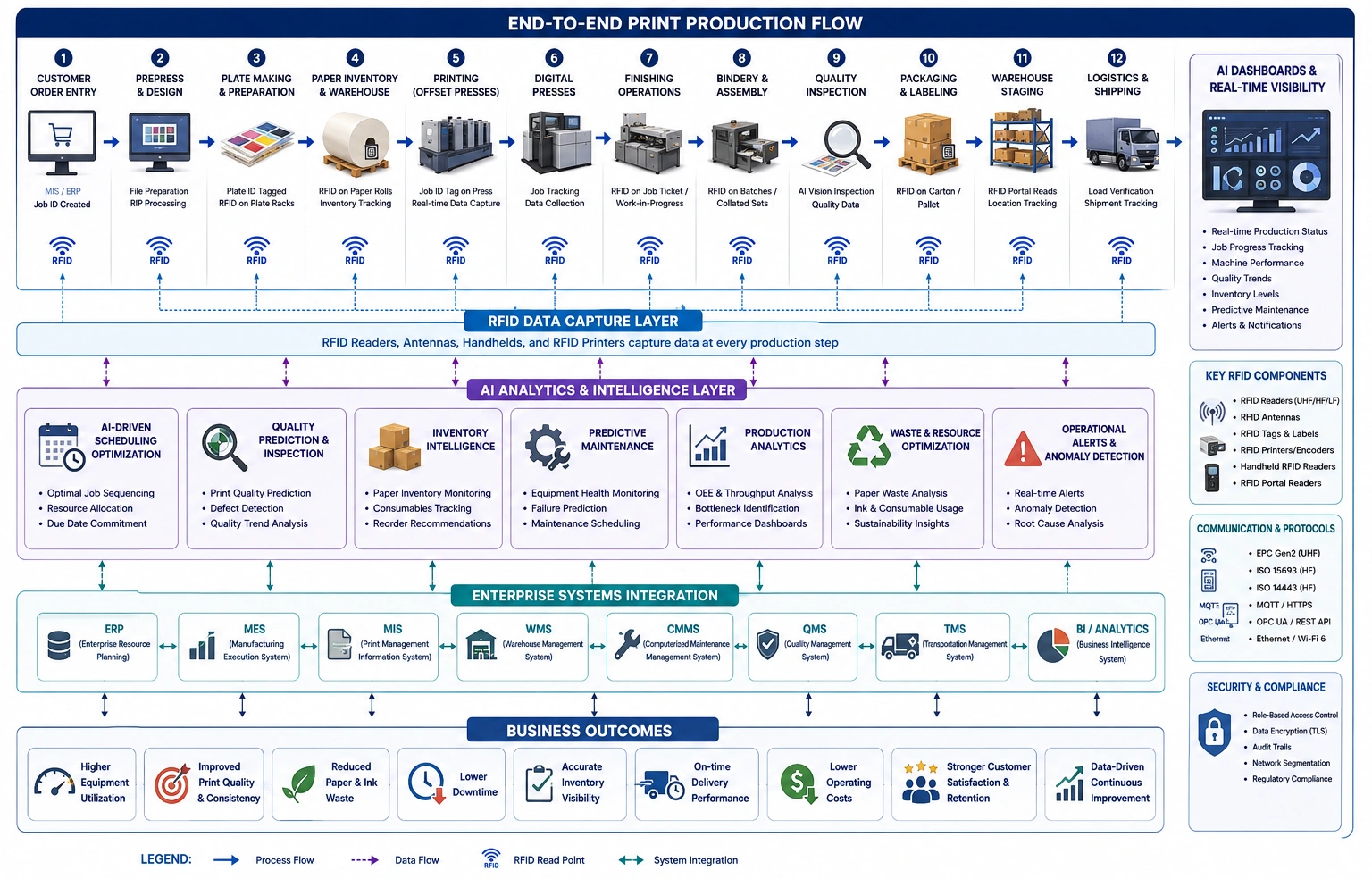
This workflow illustrates how AI and RFID connect commercial printing activities from job planning and material identification through production, quality control, finishing, and shipping. It highlights how RFID data feeds edge computing, production software, and AI analytics to support operational decisions.
What AI Means for Commercial Printing
AI for commercial printing refers to the use of machine learning, computer vision, predictive analytics, optimization algorithms, and related Industrial AI methods to improve decisions across the print production lifecycle. The objective is not simply to collect more production data. The objective is to convert operational data into decisions that reduce waste, improve schedule adherence, identify quality deviations, and provide better visibility into jobs and materials.
Commercial printers operate under conditions that make timely information particularly valuable. A single order can move through prepress, substrate preparation, printing, inspection, drying or curing, cutting, folding, binding, laminating, packaging, and shipment. Different jobs may use different substrates, inks, coatings, finishing specifications, and delivery requirements. Job changes and short production runs can also create frequent material movements and machine adjustments.
AI can evaluate these variables to support decisions such as:
- Which jobs are approaching schedule risk based on current production progress
- Whether required paper, board, film, labels, or other substrates are available for an upcoming job
- Which work-in-process items are waiting too long between printing and finishing
- Whether production conditions indicate an increased probability of quality defects
- How jobs should be prioritized when presses, finishing equipment, operators, or materials are constrained
- Whether actual material consumption is deviating from expected consumption
- Which production events require intervention by a supervisor or production planner
RFID supports these applications by providing machine-readable identity and movement data. A tagged roll, pallet, container, job component, or reusable production asset can be associated with a job record and detected at defined points in the printing workflow. AI software can then combine these observations with information from print management, MIS, ERP, quality systems, machine controllers, and production databases.
Commercial Printing Applications for AI and RFID
Commercial printing organizations can apply AI-supported identification and tracking to several operational areas. The highest-value applications are generally those where physical material movement and production status directly influence scheduling, quality, cost, or customer commitments.
AI Job Tracking and Work-in-Process Visibility
Commercial print jobs frequently pass through several departments before completion. Manual status updates can become inaccurate when operators are busy, jobs are moved between staging areas, or several orders use similar substrates and finishing processes.
RFID readers can automatically record the presence of tagged job materials or production units at defined checkpoints. The resulting events can be associated with job numbers in the printing MIS or production database.
AI software can use this information to identify workflow exceptions, such as:
- A printed job that has not reached finishing within an expected time window
- A job that appears at an unexpected production location
- A work order that has been processed through one stage without a corresponding downstream event
- A job approaching its promised completion time without sufficient production progress
- A production queue accumulating around a constrained finishing operation
This approach changes job tracking from periodic manual status entry toward continuous operational visibility.
AI Inventory Management for Printing Materials
Paper, board, film, specialty media, labels, packaging substrates, inks, coatings, and other consumables represent significant operating costs for commercial printers. Inventory accuracy becomes more difficult when materials are distributed among warehouses, press-side storage, staging areas, and production departments.
RFID can identify tagged material units as they move through receiving, storage, picking, staging, and production. Fixed readers can monitor designated movement points, while handheld RFID readers can support cycle counting and exception investigation.
AI can combine identification events with consumption history, production schedules, purchasing information, and inventory records to improve decisions about:
- Material availability for scheduled print jobs
- Replenishment timing
- Substrate allocation
- Excess or slow-moving inventory
- Expected material consumption
- Production jobs at risk because of missing materials
The practical value comes from connecting physical inventory status with actual commercial printing requirements rather than treating inventory as an isolated database record.
Predictive Quality and Process Monitoring
Commercial printing quality can be affected by substrate characteristics, press settings, ink or toner behavior, registration, color consistency, temperature, humidity, machine condition, and finishing parameters. Computer vision can inspect printed output, while machine data and production history can provide additional variables for AI models.
RFID can contribute job and material identity to this process. For example, a tagged substrate batch or production unit can provide traceability between a physical print run and the digital production record.
AI models can then associate quality observations with:
- Specific print jobs
- Substrate batches
- Presses and finishing machines
- Production settings
- Environmental conditions
- Operator or shift information
- Historical defect patterns
This supports earlier detection of recurring problems and can help quality teams investigate root causes using production evidence instead of relying solely on manual records.
Intelligent Production Scheduling
Production scheduling in commercial printing must account for machine availability, substrate requirements, finishing capacity, job priorities, changeover requirements, delivery deadlines, and operator resources.
AI-based scheduling can evaluate historical production times and current shop-floor conditions to identify scheduling conflicts and estimate completion times. RFID event data can improve the accuracy of these estimates by showing whether physical job materials have actually reached the expected production stage.
For example, if an MIS shows that a job is scheduled for finishing but RFID data indicates that its printed components have not arrived at the finishing department, scheduling software can flag the discrepancy. This gives production planners an opportunity to reassign capacity or investigate the delay before the customer delivery commitment is affected.
Commercial Printing Workflow from Data Capture to AI Decision
A practical AIoT implementation begins with physical production events and progressively converts them into usable operational information.
Data acquisition starts with RFID tags, readers, antennas, barcode systems, machine sensors, industrial cameras, and existing production equipment. RFID may operate at different frequencies depending on the application. UHF RFID is generally useful for longer-range identification of tagged materials and assets, while HF RFID can be appropriate for shorter-range controlled identification. LF RFID has a more specialized role where its characteristics fit a particular identification requirement.
Communication infrastructure transports identification events and machine data to local software. Depending on the facility, this can include Ethernet, Wi-Fi, industrial networks, serial interfaces, APIs, and other communication methods supported by connected equipment.
Edge processing can filter duplicate RFID reads, validate events, normalize machine data, and perform time-sensitive processing before information reaches centralized software. This is particularly useful where high volumes of reader events would otherwise create unnecessary data traffic.
Middleware connects RFID readers and other data sources with the commercial printer’s software environment. It can associate an RFID identifier with a job number, material record, pallet ID, production batch, or reusable asset ID.
Production and business systems may include a print MIS, ERP software, warehouse management software, quality management software, maintenance systems, scheduling applications, and customer-order systems. Integration through APIs, databases, message brokers, or other supported interfaces allows physical production events to become part of operational records.
AI analytics can then analyze historical and real-time information. Machine learning models can detect anomalies, forecast delays, estimate production performance, identify unusual material consumption, or prioritize operational exceptions.
Business actions occur when the system converts those predictions into practical decisions. A supervisor may receive an alert, a planner may adjust a job sequence, a warehouse operator may locate material, or a quality team may inspect a specific production batch.
End-to-End AIoT Data Flow for Commercial Printing
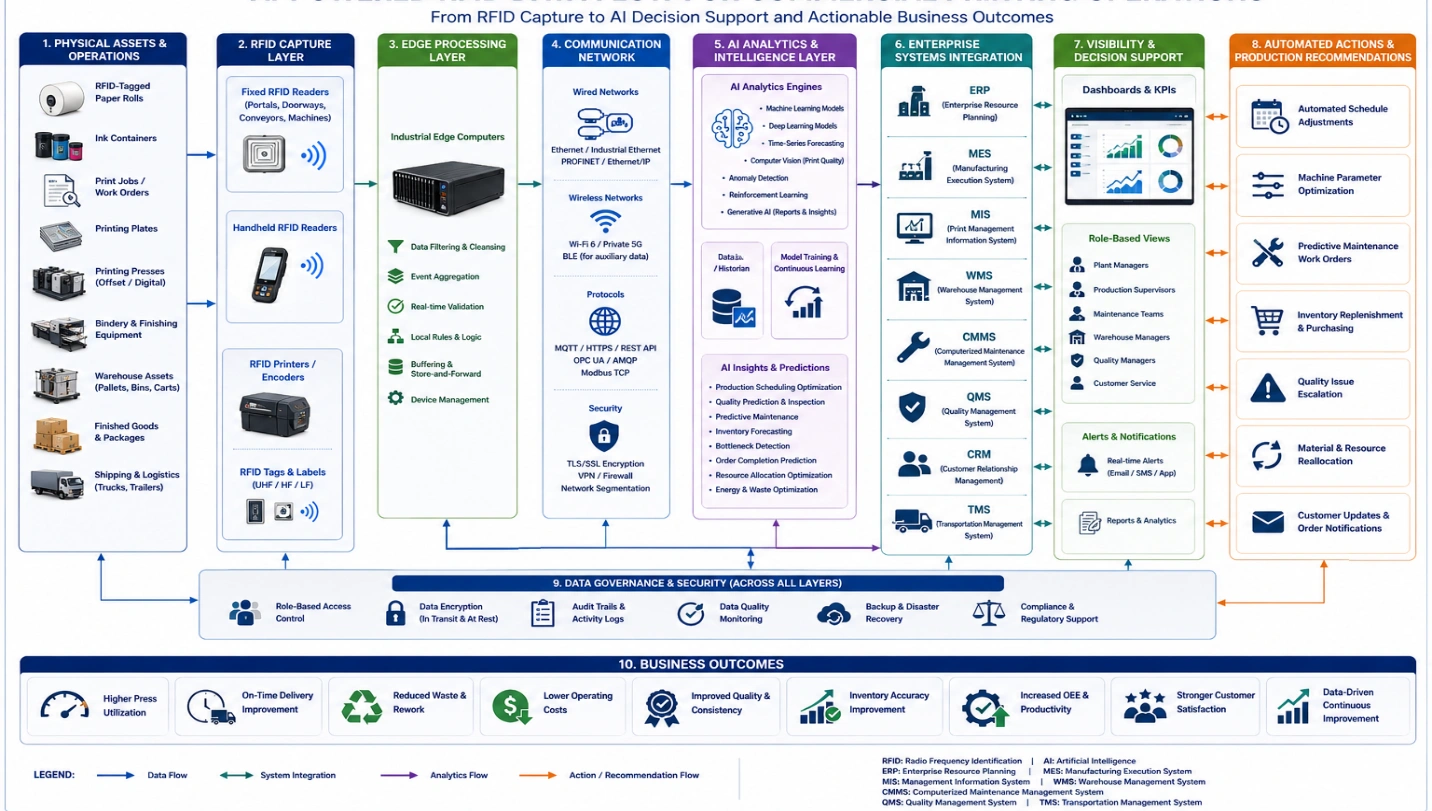
This diagram illustrates how RFID tags, readers, industrial cameras, printing equipment, environmental sensors, and edge gateways feed data into middleware, MIS, ERP, and AI/ML services. It shows how processed production data supports analytics, alerts, and operational decisions across commercial printing workflows.
RFID, AI Hardware and Software for Commercial Printing
A commercial printing solution should be designed around the physical workflow rather than selecting RFID hardware in isolation. Tag selection, reader placement, antenna orientation, read-zone design, substrate composition, operating environment, and integration requirements can materially affect system performance.
RFID Hardware
UHF RFID can be useful for identifying tagged pallets, material rolls, containers, job components, and other items as they pass through controlled read zones. Reader selection should account for required read distance, tag density, throughput, interference, mounting conditions, and the physical characteristics of printing materials.
HF RFID can support shorter-range identification where a controlled presentation point is preferable. LF RFID may be considered for specialized identification scenarios where its operating characteristics provide an appropriate engineering fit.
Commercial printing deployments may also use:
- Fixed RFID readers at receiving, storage, production, and shipping checkpoints
- Handheld RFID readers for inventory verification and exception handling
- RFID antennas positioned around defined movement zones
- RFID tags selected according to substrate, attachment method, read range, and environmental conditions
- Industrial gateways for connecting RFID equipment with local software
- Edge computers for event processing and local analytics
AI and Supporting Software
The AI layer can include machine learning models for anomaly detection, forecasting, classification, optimization, and predictive analysis. Computer vision systems can complement RFID by examining printed output and identifying visual quality conditions.
The software stack may include RFID device management, event middleware, production databases, analytics software, AI inference services, dashboards, alerting systems, and connectors to the printer’s existing MIS or ERP.
The most effective deployments avoid forcing every production activity into a new software environment. Instead, RFID and AI capabilities should exchange data with existing commercial printing systems where practical.
Cloud Version and Server Version
A Cloud Version can host AI analytics, dashboards, data processing, and selected application services in cloud infrastructure. This model can be useful for commercial printing organizations operating multiple facilities or requiring centralized visibility across geographically distributed production sites. Cloud deployment can also simplify centralized software maintenance and enable aggregated analysis across production locations, subject to the organization’s security and data-governance requirements.
A Server Version can run software on customer-managed edge servers, private data centers, factory servers, or other privately hosted infrastructure. This approach can be preferable when production data must remain within controlled facilities, when low-latency local processing is important, or when integration with existing plant systems requires direct local connectivity.
A hybrid deployment can also separate time-sensitive RFID event processing and production controls from centralized analytics. For example, local software can continue collecting and validating RFID events during a temporary external-network interruption while selected historical data is synchronized with centralized AI services when connectivity is restored.
Key Capabilities of AI-Enabled Commercial Printing
Combining AI with RFID-based identification allows commercial printing operations to connect physical production activity with digital job records and analytical models. The resulting capability is most valuable when it addresses a measurable production problem rather than simply increasing the amount of collected data.
Real-Time Job and Material Traceability
RFID events can establish where tagged materials or job components were last detected. AI software can interpret these events alongside planned production sequences to identify missing transitions, unexpected movement, or stalled work.
For commercial printers, this can improve traceability from substrate receiving through printing, inspection, finishing, packaging, and shipment. Production supervisors can investigate exceptions using a time-stamped record rather than relying entirely on manual status reports.
Automated Inventory and Material Reconciliation
AI can compare planned material requirements with actual RFID-confirmed inventory and production consumption. This can help identify discrepancies between the inventory database and physical stock.
Useful outputs include:
- Material availability warnings before production begins
- Identification of stock that has remained unused beyond expected periods
- Detection of inventory records that do not correspond with physical observations
- Improved substrate allocation between scheduled jobs
- More accurate production-consumption analysis
- Reduced time spent searching for tagged rolls, pallets, containers, or job materials
The engineering objective is not to eliminate manual inventory controls completely. Instead, automated identification should reduce repetitive counting and provide stronger evidence for exceptions requiring human investigation.
Predictive Production Management
Historical production records can be used to estimate actual processing times for different job types, presses, substrates, finishing methods, and production conditions. AI models can compare these patterns with current RFID and machine events.
A system may identify that a job is progressing more slowly than comparable historical jobs even before the contractual delivery deadline becomes critical. Production planners can then review machine availability, material status, finishing capacity, or quality issues.
This creates a more proactive production-management process in which schedule risks are addressed before they become urgent.
Computer Vision for Print Quality
Computer vision can inspect printed sheets, labels, packaging graphics, color areas, registration, text regions, and other visual characteristics depending on the application. AI models can classify detected deviations and support quality teams in separating normal variation from potentially significant defects.
RFID can provide the identity context needed to associate an inspection result with the correct job, material batch, press, or production unit. This is particularly useful where several print jobs are processed in parallel.
Production Asset and Reusable Container Tracking
Commercial printing facilities may use reusable pallets, carts, bins, roll-handling equipment, tooling, fixtures, and other production assets. Lost or misplaced reusable assets create unnecessary searching and replacement costs.
RFID can provide automatic identification at designated locations, while AI analytics can identify unusual movement patterns or assets that remain outside their expected operating area for extended periods.
The same approach can support maintenance planning when asset identity is connected with inspection and service records.
Engineering Considerations for Commercial Printing RFID
RFID performance depends heavily on the physical environment. Commercial printing materials can contain paper, board, films, inks, coatings, laminates, metallic components, and other materials that may affect tag selection or RF behavior.
A reliable deployment should therefore begin with a site survey and representative testing.
Tag Selection and Placement
Tag performance should be evaluated against the actual item being identified. A tag that performs well on a cardboard carton may not provide equivalent results when attached to a roll, laminated material, metallic object, or densely stacked pallet.
Testing should consider:
- Substrate material and dimensions
- Tag attachment method
- Required read distance
- Orientation of tagged items
- Number of tags in the read zone
- Stacking density
- Movement speed
- Nearby metal structures
- Reader and antenna mounting position
- Environmental conditions around presses and finishing equipment
Commercial printers should validate tags using representative production materials rather than relying only on laboratory specifications.
Reader and Antenna Placement
A fixed reader should normally monitor a defined operational zone rather than simply maximizing RF output. Excessive read coverage can create unwanted reads from adjacent inventory or production areas.
For example, a reader positioned near a substrate staging lane should distinguish material entering that lane from material stored nearby. Physical barriers, antenna orientation, reader power configuration, shielding where appropriate, and software filtering can all contribute to read-zone control.
Event Filtering and Data Quality
Raw RFID reads are not equivalent to business events. A reader may detect the same tag repeatedly while an item remains inside the read zone.
Middleware should therefore transform raw observations into meaningful events such as:
- Material entered production staging
- Job component arrived at finishing
- Pallet entered shipping
- Reusable container returned
- Inventory item detected during cycle counting
This event-processing layer is essential because AI models produce better operational results when they receive validated business events rather than uncontrolled reader data.
Integrating AI, RFID and Commercial Printing Software
Commercial printing environments commonly contain multiple software systems with different data models. A print MIS may manage job specifications and scheduling, while an ERP handles purchasing and financial information. Quality software may store inspection results, and maintenance software may contain equipment-service records.
A successful implementation establishes consistent identifiers across these systems.
For example, a job identifier can be associated with:
- Customer order
- Print specification
- Substrate requirement
- Material batch
- Press assignment
- Finishing instructions
- Quality inspection records
- Packaging unit
- Shipping record
RFID identifiers can then connect physical items to those digital records.
GAO’s RFID and IoT hardware can provide the identification layer required at physical checkpoints, while software integration determines how those events are converted into useful commercial printing information. The integration method should be selected according to the customer’s existing systems and interfaces rather than forcing a single software model onto every facility.
Cybersecurity and Data Protection
Connected commercial printing equipment introduces additional considerations for network security and operational resilience. RFID readers, edge computers, gateways, databases, AI services, and production applications should be incorporated into the organization’s cybersecurity controls.
Practical controls can include:
- Network segmentation between production equipment and general-purpose corporate networks
- Role-based access to RFID management and production applications
- Strong authentication for administrative accounts
- Encryption for data transmitted between supported systems
- Secure API authentication for software integration
- Device inventory and configuration management
- Logging of administrative and operational events
- Controlled firmware and software updates
- Backup and recovery procedures
- Monitoring for abnormal device or network behavior
Security requirements should also account for the operational consequences of an unavailable system. Production should not necessarily stop because an analytics service is temporarily unreachable. Where appropriate, local event capture and buffering can allow production data to be retained until centralized services become available.
Deployment, Commissioning and Optimization
AI and RFID projects in commercial printing should progress through controlled engineering stages rather than deploying readers throughout a facility without validating the workflow.
Planning and Site Assessment
The first stage identifies the production problems that the system must solve. Relevant locations can include material receiving, substrate storage, press staging, work-in-process transfer points, finishing departments, packaging, and shipping.
Process mapping should document:
- What physical item needs identification
- Which production event should be detected
- Where the event occurs
- Which system currently records the event
- What decision depends on that information
- What happens when the expected event does not occur
Pilot Deployment
A pilot should use representative commercial printing jobs, materials, equipment, and operating conditions. Testing only during an empty facility or with idealized samples can produce misleading results.
Pilot measurements may include read accuracy, false reads, missed reads, event latency, tag durability, operator usability, integration reliability, and system availability.
Integration Testing
Integration testing should verify that a physical RFID event produces the correct digital result. For example, a material movement should update the intended inventory or job record without creating duplicate transactions.
AI outputs should also be evaluated against known production outcomes. Forecasting and anomaly-detection models require appropriate historical data and should not be treated as reliable merely because the software produces a prediction.
Production Optimization
Once the system is operational, data can be used to refine reader locations, tag placement, event rules, AI thresholds, alert priorities, and workflow procedures.
False-positive alerts should receive particular attention. An alerting system that generates too many low-value notifications can cause supervisors to ignore genuinely important exceptions.
KPIs for AI-Enabled Commercial Printing
Measurement should connect technology performance with printing operations.
Relevant KPIs can include:
- Print job schedule adherence
- Work-in-process dwell time
- Material inventory accuracy
- Substrate search time
- Material consumption variance
- Production changeover time
- First-pass quality rate
- Defect detection rate
- Rework rate
- Scrap percentage
- Order-to-shipment cycle time
- Equipment utilization
- Finishing queue time
- RFID read accuracy
- RFID event-processing latency
- AI alert precision
- Predicted versus actual production completion time
- Asset recovery or location time
The appropriate KPI set depends on the original business problem. A commercial printer focused on substrate control may prioritize inventory accuracy and material search time, while a high-volume print operation may place greater emphasis on schedule adherence, throughput, changeovers, and quality.
Why AI and RFID Matter for Commercial Printing
AI creates value when it improves decisions, while RFID can provide reliable physical identification data needed to make those decisions. Their combination is particularly useful in commercial printing because production involves physical materials moving through multiple interconnected processes.
The strongest applications typically share several characteristics:
- A clearly defined operational event can be captured
- Physical materials or assets have stable identities
- Existing software contains useful job and production data
- Historical data is available for AI analysis
- The resulting prediction or alert leads to a specific operational action
- Performance can be measured through production KPIs
Commercial printers should therefore begin with a measurable workflow problem rather than selecting AI or RFID hardware first. The technology should follow the operational requirement.
GAO Solutions for Commercial Printing
GAO supplies RFID, BLE, IoT, and related hardware products and systems that can support commercial printing applications such as material identification, asset tracking, inventory visibility, work-in-process monitoring, and connected production workflows. Our experience supplying technology to organizations across the U.S. and Canada supports an engineering-oriented approach in which hardware selection, deployment conditions, integration requirements, and operational support are considered together.
GAO is headquartered in New York City and Toronto, Canada, and is ranked among the top 10 leading B2B and B2G suppliers of BLE and RFID technologies worldwide. GAO Group companies have served Fortune 500 organizations, R&D firms, universities, and government agencies in the U.S. and Canada for three decades, supported by substantial R&D investment, stringent quality assurance, and remote or onsite technical support.
Commercial printing organizations evaluating AI-enabled job tracking, intelligent inventory management, production traceability, or RFID-enabled workflow automation can use these principles to define requirements, select suitable hardware, validate performance, and integrate physical production data with existing software.
Building the Future of Industrial AI and IoT with Aperture Venture Studio and GAO RFID Inc.
For more than three decades, GAO Group of Companies has invested heavily in R&D for industrial RFID, BLE, and IoT. As generative AI became increasingly useful for industrial applications, we expanded our work in AI and IoT, including RFID and BLE, and founded Aperture Venture Studio to build, launch, and scale next-generation AI and IoT solutions for applications such as commercial printing, production intelligence, and connected asset management.
Aperture has attracted AI and IoT technical experts, entrepreneurial and operational executives, influential investors, and leading companies. We have also developed Aperture Ventures Summit and TekSummit to discuss advanced AI and IoT topics and build strong technical communities.
We welcome you to join us as:
- Advisors, Co-founders, or Employees
- Investors
- Customers