
AI and RFID for Clinics
AI-Driven Asset Tracking for Modern Clinics
Clinics are increasingly using artificial intelligence to improve asset tracking, inventory management, equipment utilization, patient-flow coordination, and operational decision-making. AI becomes substantially more useful when it can work with reliable real-world data from connected clinical equipment and tagged assets. RFID provides that identification layer by automatically capturing the presence, movement, and status of selected assets without requiring staff to manually scan every item.
AI-driven asset tracking for clinics can combine RFID reader events with electronic health record systems, inventory software, computerized maintenance management systems, nurse-call systems, scheduling software, and operational databases. Machine learning can then identify utilization patterns, detect unusual movement, forecast equipment demand, and support decisions about equipment allocation.
For a clinic, the practical value is not simply knowing where an infusion pump, wheelchair, diagnostic device, or mobile workstation is located. The objective is to understand how clinical assets are being used, whether equipment is available when needed, whether inventory levels are appropriate, and where workflow delays or losses occur. GAO supplies RFID, BLE, and IoT hardware products and systems that can support these connected clinical workflows.
AI-Enabled RFID Asset Tracking in a Modern Clinic
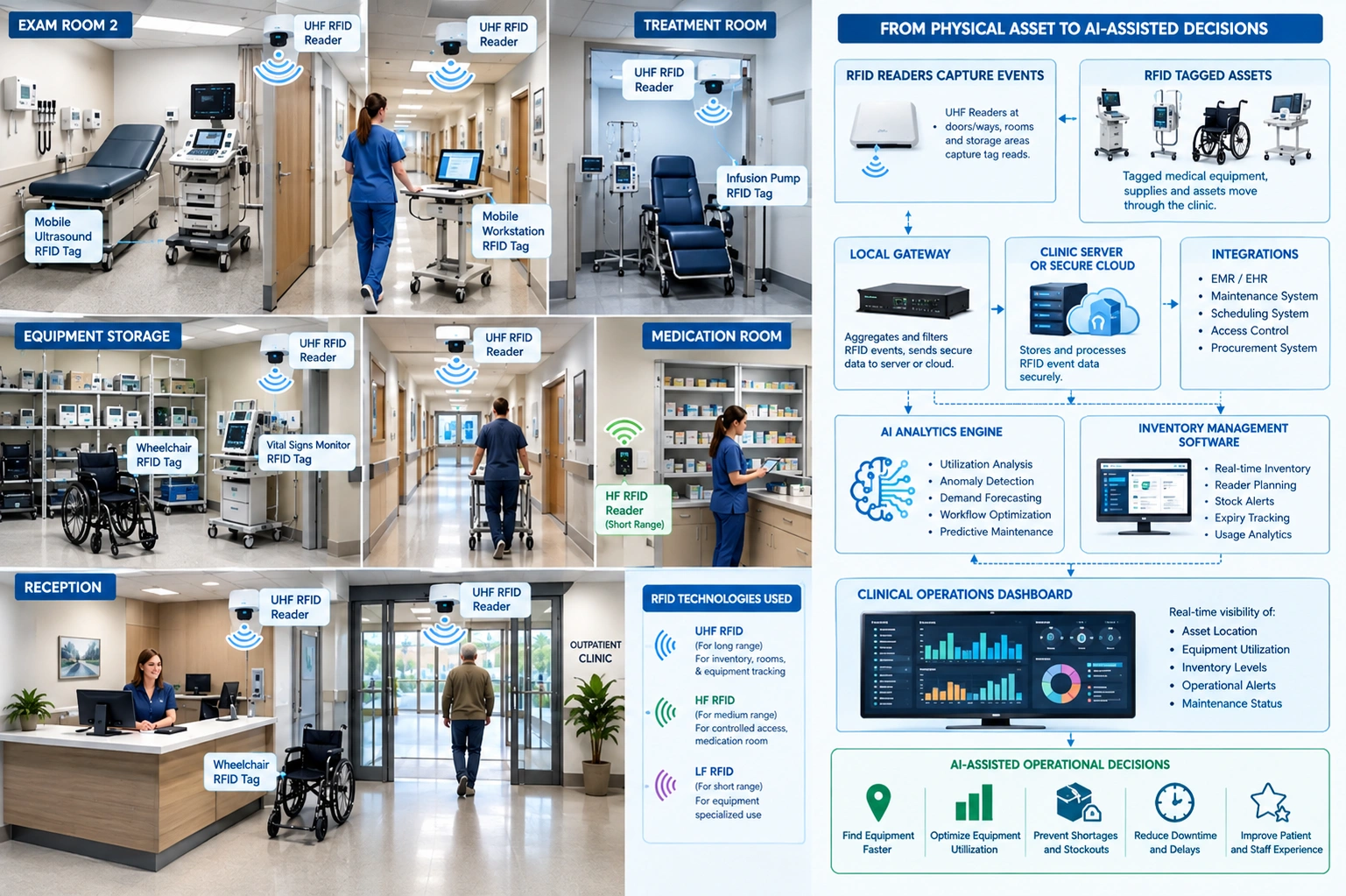
This visual illustrates a realistic outpatient clinic where RFID-tagged medical equipment is monitored through UHF and short-range RFID readers. RFID events are processed through a local gateway and secure server or cloud software, then analyzed by AI to support equipment utilization, inventory management, anomaly detection, maintenance, and clinical operations.
What AI and RFID Enable in Clinic Operations
RFID and AI address different parts of the clinic asset-management problem. RFID is primarily responsible for automatic identification and event capture, while AI converts accumulated operational data into predictions, classifications, anomaly detection, and decision support.
UHF RFID is particularly useful for tracking tagged equipment and inventory across larger areas because readers can detect multiple compatible tags without requiring direct line-of-sight scanning. HF RFID is better suited to controlled short-range interactions, such as identification at specific points or applications where near-field communication characteristics are useful. LF RFID can support specialized short-range identification requirements where its operating characteristics are appropriate.
The most effective deployment depends on the physical environment, asset type, read-zone requirements, tag construction, workflow, and interference conditions. A clinic should not automatically use one RFID frequency for every asset. Metal equipment, liquid-rich environments, small instruments, disposable supplies, and doorway monitoring can require different tag and reader configurations.
AI adds another layer of operational intelligence. A clinic can use machine learning to analyze historical RFID events and determine:
- Which clinical assets are frequently underutilized or overused
- Which equipment categories experience recurring shortages
- Which locations have abnormal asset movement
- When equipment demand is likely to increase
- Whether equipment is remaining outside its designated area
- Which operational workflows create unnecessary equipment searching
- When maintenance or inspection workflows may need attention
- How equipment utilization changes by clinic department, shift, or appointment volume
Clinic Applications for AI-Based Asset Tracking
Medical Equipment Location and Utilization
Mobile clinical equipment frequently moves between examination rooms, treatment areas, storage rooms, and service locations. Manual searches consume staff time and can delay clinical work.
RFID event data can provide a continuous record of equipment movement through monitored areas. AI can analyze these events to identify utilization patterns, recurring bottlenecks, and unusual movement. A clinic can use these insights to improve equipment allocation rather than purchasing additional equipment solely because existing equipment is difficult to locate.
Inventory and Medical Supply Management
Clinics manage consumables such as examination supplies, sterile products, diagnostic materials, protective equipment, and other inventory items. RFID can provide automated identification at storage and replenishment points where suitable tagging is economically and technically justified.
AI can use inventory movement data to estimate consumption rates and identify unusual changes in demand. This can support replenishment planning and reduce the risk of stockouts for frequently used clinical supplies.
Asset Movement and Loss Prevention
Unauthorized or unexplained movement of clinical equipment can create operational and financial problems. RFID readers installed at controlled transitions can generate events when tagged assets pass through defined areas.
AI-based anomaly detection can compare current movement patterns with normal behavior. An unusual transfer of a high-value device, for example, can generate an operational alert for staff review. AI should support the decision process rather than automatically treating every unexpected movement as theft because legitimate clinical transfers also occur.
Equipment Maintenance Coordination
Clinical equipment requires inspection, calibration, preventive maintenance, cleaning, and repair according to applicable procedures. RFID identification can associate an asset with its maintenance records when integrated with maintenance software.
AI can analyze equipment utilization and service histories to help identify maintenance scheduling patterns. Combining asset identity, location, utilization, and maintenance information can give facilities personnel a more complete view of equipment condition and availability.
Patient and Staff Workflow Support
RFID can also contribute to controlled workflow identification when privacy, consent, system design, and applicable healthcare requirements are properly addressed. However, clinics should distinguish between tracking physical assets and tracking people.
For asset-focused deployments, RFID can help identify whether required equipment is available near a treatment area. AI can use equipment-location data alongside scheduling or operational information to identify potential resource conflicts without requiring unnecessary manual searches.
Clinic RFID Data to AI-Assisted Decisions
A practical AI-enabled clinic solution begins with physical events. RFID tags identify selected assets, readers capture tag observations, and edge gateways or networked reader systems transmit those events to software.
A typical workflow can include:
- RFID tag attachment to appropriate clinical assets
- RFID reader deployment at storage areas, controlled doors, corridors, or work zones
- Reader middleware filtering duplicate or low-confidence events
- Local gateway processing for connectivity and event normalization
- Secure transmission to a clinic server or cloud-hosted software
- Association of RFID identifiers with asset records
- Integration with inventory, maintenance, scheduling, or clinical operations systems
- AI processing of historical and real-time operational data
- Dashboard presentation and alert generation
- Staff action based on the resulting operational information
The quality of AI output depends heavily on the quality of captured events. Poor reader placement, inappropriate tag selection, uncontrolled read zones, duplicate observations, missing events, and inaccurate asset master data can produce misleading analytics.
For this reason, RFID commissioning should include controlled read-range testing, tag orientation testing, environmental testing, event deduplication, and verification against actual asset movements. AI should be introduced after the underlying data pipeline is sufficiently reliable.
RFID-to-AI Workflow for Clinics
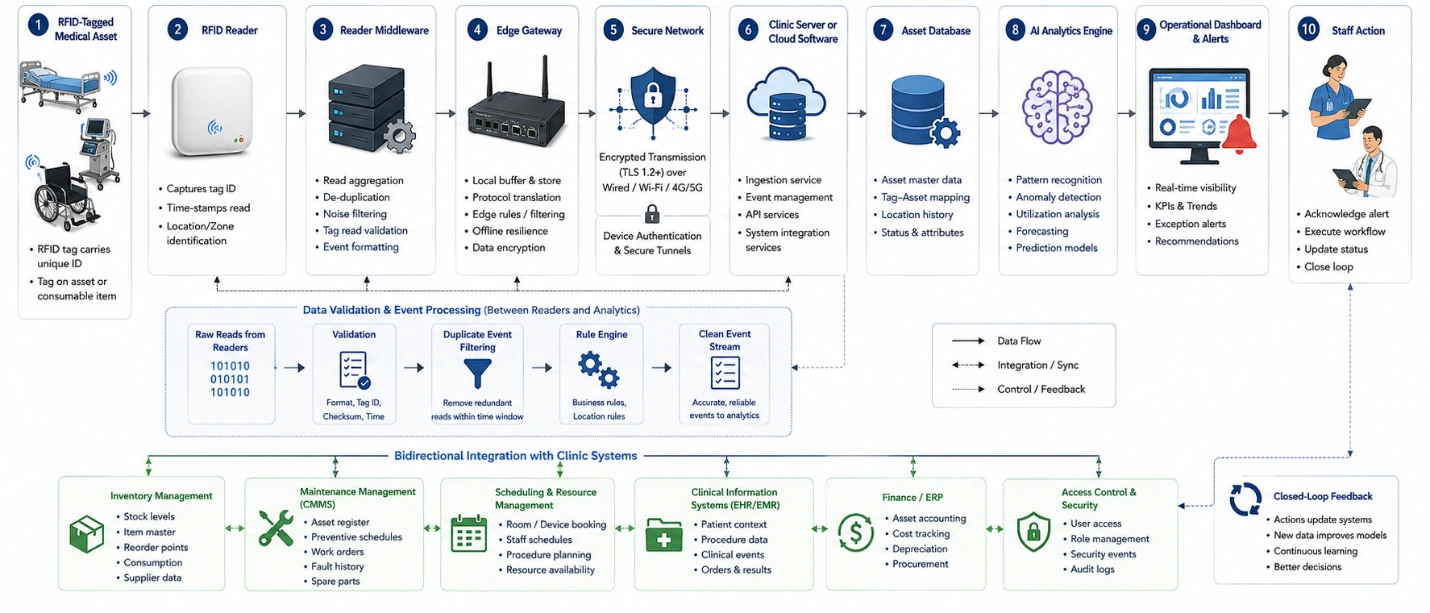
This workflow diagram illustrates how RFID-tagged medical assets move from physical identification through readers, middleware, edge processing, secure networks, clinic servers or cloud systems, asset databases, and AI analytics. It also shows data validation, duplicate-event filtering, bidirectional integration with inventory, maintenance, scheduling, clinical information, finance, and security systems, culminating in AI-driven dashboards, alerts, and staff actions.
Technology Components for AI-Enabled Clinic Asset Tracking
RFID Tags and Readers
RFID tags provide the identity associated with physical clinical assets. Tag selection should consider the asset material, surface geometry, expected read distance, cleaning processes, temperature exposure, and whether the asset contains metal or other materials that can affect RF performance.
Reader selection should follow the workflow rather than the other way around. Fixed UHF readers can be suitable for monitored transitions and larger clinical areas when read-zone control is achievable. HF or LF readers may be more appropriate for shorter-range identification scenarios.
GAO can provide RFID hardware and systems that can be selected according to the identification and operational requirements of a clinic.
Middleware and Event Processing
Reader middleware is responsible for converting raw RFID observations into useful business events. This can include filtering repeated reads, associating observations with locations, applying time windows, and forwarding normalized events to downstream software.
This layer is important because AI models should generally not consume uncontrolled raw reader observations directly. Clean event data produces more reliable asset histories and improves the quality of utilization and anomaly analysis.
AI and Machine Learning
Different clinic applications require different AI methods. Time-series models can analyze equipment utilization over time. Classification models can categorize operational conditions. Anomaly-detection algorithms can identify movement patterns that differ from historical behavior. Forecasting models can estimate future equipment or supply requirements.
AI selection should be driven by the operational decision being improved rather than by the popularity of a particular model. Simple statistical methods may be sufficient for some inventory forecasts, while more sophisticated machine learning can be justified when the clinic has adequate historical data and a clearly defined decision problem.
Cloud and Server Deployment
A cloud-hosted deployment can be appropriate for clinics that need centralized software management, remote access, scalable analytics, and integration across multiple locations. A privately hosted server can be preferable where local control, network independence, or specific organizational data requirements are important.
Edge processing can also be used when the clinic needs rapid local event handling or wants to reduce the amount of raw RFID data sent to a remote environment. A hybrid design can process immediate reader events locally while transferring validated operational data to centralized software for broader analytics.
Security and Integration
RFID identifiers should not be treated as a substitute for healthcare identity management or access control. A clinic solution should use authentication, authorization, encryption, secure APIs, audit logging, network segmentation, and controlled access to operational data.
Integration should also preserve clear ownership of master data. Asset identifiers, equipment descriptions, department assignments, maintenance records, and location definitions need consistent mappings between RFID software and existing clinic systems.
Engineering Considerations Before Deployment
A successful clinic deployment requires more than installing readers and attaching tags. Site surveys should identify doorways, corridors, storage areas, treatment rooms, equipment parking locations, RF-sensitive environments, and areas where unintended reads could occur.
Tag selection should be validated against the actual equipment rather than tested only on sample cards. Metal medical equipment, liquids, dense equipment storage, and room construction can affect RFID performance. Reader placement should therefore be validated through physical testing.
Clinics should also define the operational events they actually need. Examples include asset entering a department, asset leaving a controlled area, asset remaining in storage beyond a defined period, or equipment becoming available for reassignment.
GAO’s experience supplying RFID and IoT hardware systems can support organizations in evaluating these physical and software integration requirements before deployment.
Technical and Operational Benefits of AI-Enabled Clinic Asset Tracking
Combining RFID-generated asset data with AI can improve clinic operations when the underlying identification data is reliable and connected to existing workflows. The primary value comes from turning individual location and movement events into useful operational information.
Faster Equipment Retrieval
Staff can spend significant time searching for mobile equipment when asset locations are not visible. RFID can automatically record the movement of tagged equipment through monitored areas, while AI can analyze historical movement patterns to help identify where equipment is likely to be located.
This can reduce unnecessary searching and help clinical staff locate required equipment more efficiently. The KPI can be measured through average equipment retrieval time, search duration per shift, and percentage of requests fulfilled within a target time.
Improved Equipment Utilization
A clinic may have equipment that is heavily used in one department while similar equipment remains idle elsewhere. RFID event histories provide a basis for calculating utilization patterns.
AI can identify recurring demand differences between departments, appointment periods, and operating shifts. Managers can use these insights to rebalance equipment before purchasing additional units.
Useful KPIs include equipment utilization rate, idle time, equipment availability, and utilization variance between departments.
More Accurate Inventory Planning
Manual inventory counts can introduce delays and data inconsistencies. RFID-supported inventory events can provide more frequent observations of tagged supplies and equipment.
AI forecasting can analyze historical consumption, seasonal patterns, appointment volumes, and other relevant operational variables. The resulting forecasts can help inventory teams establish more appropriate replenishment thresholds.
The objective is not simply to increase inventory accuracy. The larger operational goal is to maintain appropriate stock levels while reducing emergency replenishment, expired stock, and unnecessary inventory carrying costs.
Anomaly Detection and Operational Alerts
AI can identify RFID event patterns that differ significantly from normal clinic operations. Examples include equipment repeatedly leaving an assigned department, unusually long periods outside expected locations, or unexpected movement through controlled transitions.
Anomaly detection should be configured around actual clinic workflows. A system that generates excessive false alerts can cause alert fatigue and reduce staff confidence. Thresholds should therefore be tested using historical and live operational data.
Maintenance and Equipment Availability
Combining RFID location data with maintenance records can help facilities teams understand where equipment is located and whether it is available for clinical use.
AI can identify relationships between equipment usage, movement frequency, maintenance events, and downtime. These insights can help maintenance teams prioritize work and improve equipment availability.
Scalability Across Clinic Locations
A standardized RFID identification approach can support expansion from one department to additional areas or multiple clinic sites. Centralized software can aggregate operational information while local readers and gateways capture events at each location.
Scalability should be planned around consistent asset identifiers, location naming, integration interfaces, reader configurations, cybersecurity controls, and operational policies.
Clinic KPIs for Measuring AI and RFID Performance
A deployment should be evaluated against measurable operational outcomes rather than the number of RFID readers installed or tags attached.
Recommended KPIs include:
- Average time required to locate mobile clinical equipment
- Percentage of tagged assets successfully identified within monitored zones
- Equipment utilization rate
- Equipment idle time
- Asset availability rate
- Number of unresolved asset-location exceptions
- Inventory stockout frequency
- Inventory counting time
- Inventory record accuracy
- Emergency replenishment frequency
- Equipment maintenance turnaround time
- Equipment downtime
- Percentage of assets with current location records
- RFID event accuracy after filtering and validation
- False-positive alert rate
- AI anomaly detection precision
- Forecast accuracy for selected clinical supplies
- Average response time to operational alerts
KPI definitions should be agreed upon before deployment so that baseline performance can be compared with post-deployment results.
AI Models and Analytics for Clinic Asset Management
AI model selection should reflect the available data and the operational question.
Time-Series Forecasting
Time-series models can analyze historical equipment demand or supply consumption. For example, a clinic may analyze usage patterns by day, week, department, appointment volume, or operating hours.
Forecasting can support inventory replenishment and equipment allocation decisions when sufficient historical data is available.
Anomaly Detection
Anomaly-detection models can identify unusual asset movements without requiring every possible abnormal condition to be manually labeled.
This approach can be useful when a clinic has large quantities of historical RFID events but limited examples of confirmed abnormal events. The system can learn normal movement patterns and flag observations that significantly deviate from them.
Classification
Classification models can categorize operational events into predefined categories, such as normal movement, delayed return, unexpected department transfer, or potential process exception.
The categories should be defined by operational teams so that AI outputs correspond to decisions that staff can actually take.
Predictive Analytics
Predictive models can estimate future equipment requirements, likely inventory shortages, or potential operational bottlenecks. The quality of these predictions depends on historical data quality, feature selection, model validation, and changes in clinic workflows.
AI predictions should therefore be monitored after deployment and periodically recalibrated when operating conditions change.
Integration with Clinic Software
AI-based RFID asset tracking becomes more useful when it operates with the software already used by clinic personnel.
Potential integration points include:
- Inventory management software
- Computerized maintenance management systems
- Enterprise asset management software
- Scheduling systems
- Procurement systems
- Building and facility management systems
- Clinical operations databases
- Business intelligence and analytics software
- Identity and access management systems
- Secure API gateways
- Centralized data warehouses
Integration should use controlled interfaces and consistent asset identifiers. The RFID system should not create a separate, disconnected inventory record that conflicts with the clinic’s existing master data.
For example, an RFID identifier can be associated with an equipment asset number in the asset-management database. Reader observations can then update the equipment’s latest known location while maintenance software remains responsible for maintenance status.
GAO can supply RFID and IoT hardware systems that form the physical identification layer for these software integrations.
Cybersecurity and Data Governance
RFID asset tracking introduces connected devices and data flows that need appropriate cybersecurity controls. The security design should address RFID readers, gateways, servers, cloud services, APIs, databases, user accounts, and network connections.
Recommended controls include:
- Strong authentication for administrative users
- Role-based access control
- Encryption for data transmission
- Encryption for sensitive stored information
- Network segmentation for connected devices
- Secure device configuration
- Controlled firmware and software updates
- Centralized logging and audit trails
- API authentication and authorization
- Monitoring of unusual system activity
- Regular vulnerability assessment
- Backup and recovery procedures
- Defined data retention policies
Clinics should also minimize unnecessary collection of personally identifiable information. Asset tracking should remain focused on physical equipment and operational requirements unless a specific workflow requires an authorized connection to other data.
Healthcare organizations should evaluate applicable legal, regulatory, contractual, and organizational requirements before deployment. The exact compliance obligations depend on the jurisdiction, organization, system configuration, and type of information processed.
Implementation Lifecycle for Clinic RFID and AI
Planning and Requirements Definition
The first stage is to define the operational problem. A clinic should identify which assets need tracking, which workflows create delays, where equipment is frequently misplaced, and which decisions could benefit from better operational data.
Requirements should define target KPIs, asset categories, monitored areas, read-zone requirements, software integrations, security controls, and expected data retention.
Site Survey and Hardware Selection
The physical environment should be assessed before selecting readers and tags. Testing should consider room layouts, equipment materials, doors, walls, storage density, RF characteristics, cleaning procedures, and potential unintended read zones.
UHF, HF, and LF RFID should be evaluated according to the actual use case rather than assuming that one frequency is appropriate for every clinic application.
Pilot Deployment
A limited pilot can validate tag performance, reader positioning, middleware filtering, event accuracy, software integration, and staff workflows.
The pilot should include representative clinical equipment and real operating conditions. Success criteria should be measured against the baseline established before deployment.
Commissioning and Testing
Commissioning should verify:
- Tag readability
- Reader coverage
- Read-zone boundaries
- Event filtering
- Location accuracy
- Network connectivity
- Data synchronization
- API integration
- Alert behavior
- User permissions
- System logging
- Failure and recovery behavior
Testing should include both normal and abnormal operating conditions.
AI Model Validation
AI models should be evaluated using appropriate training, validation, and test procedures. Metrics should match the intended use case.
For anomaly detection, false-positive and false-negative behavior can be more operationally important than a single overall accuracy value. For forecasting, error metrics should be evaluated against meaningful business baselines.
AI outputs should remain explainable enough for operational users to understand why an alert or recommendation was generated, particularly when the output affects equipment allocation or clinical workflows.
Production Deployment and Optimization
After successful pilot validation, the system can be expanded to additional departments or locations.
Operational performance should continue to be monitored after deployment. Changes in room layouts, equipment inventories, reader configurations, workflows, or software integrations can affect data quality and model performance.
Maintenance and Continuous Improvement
RFID systems require ongoing hardware inspection, tag replacement where necessary, software updates, security maintenance, and periodic performance testing.
AI models also require monitoring. Data distributions can change as equipment inventories, clinical workflows, appointment volumes, and operating practices change.
Clinic RFID and AI Implementation Lifecycle
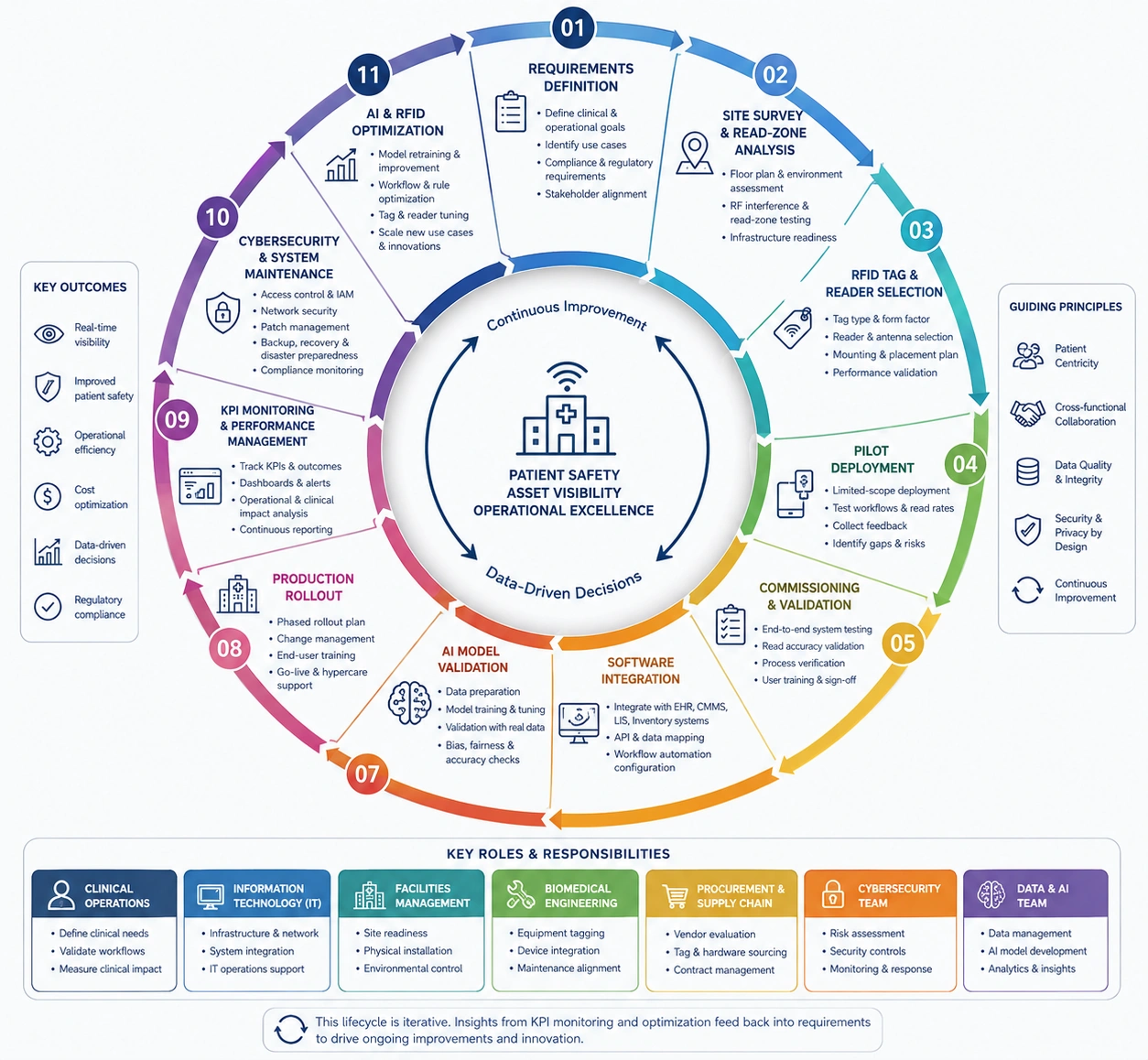
A circular healthcare technology lifecycle illustrating the complete journey from requirements definition and site surveying through RFID deployment, software integration, AI validation, production rollout, KPI monitoring, cybersecurity maintenance, and continuous optimization. It also highlights the responsibilities of clinical, IT, facilities, biomedical, procurement, cybersecurity, and data/AI teams.
Practical Recommendations for Clinic Deployment
Clinics should begin with a clearly defined operational problem instead of deploying RFID everywhere. Asset categories should be prioritized according to value, mobility, search frequency, operational impact, and tagging feasibility.
A practical deployment strategy should consider:
- Start with high-value or frequently searched mobile equipment
- Establish baseline equipment retrieval and utilization metrics
- Conduct a physical RFID site survey
- Test tags on actual equipment materials
- Define controlled read zones
- Filter duplicate RFID observations before analytics
- Establish a reliable asset master database
- Integrate with existing maintenance and inventory software
- Introduce AI only after sufficient operational data is available
- Validate AI predictions against operational baselines
- Design cybersecurity controls before production deployment
- Train clinical and facilities personnel on operational workflows
- Monitor false alerts and adjust thresholds
- Expand incrementally after pilot KPIs are achieved
A phased approach also makes it easier to determine whether improvements result from the RFID deployment, AI analytics, process changes, or a combination of these factors.
Building Measurable Value from AI-Enabled Clinic Operations
AI and RFID should be treated as complementary technologies within a broader operational improvement program. RFID provides reliable identification events from physical assets, while AI can transform those events into forecasts, anomaly detection, utilization insights, and decision support.
The strongest use cases are those where a clinic has a recurring operational problem, sufficient data can be captured, and staff can act on the resulting information. Asset tracking is particularly valuable when equipment is mobile, shared between departments, expensive to replace, or frequently difficult to locate.
GAO’s RFID, BLE, and IoT products and systems can support the physical data-capture requirements of these applications, while deployment decisions should be based on the clinic’s equipment, workflows, facility conditions, software environment, and operational objectives.
Advancing Smarter Asset Tracking for Clinics
AI-driven asset tracking can help clinics move from manual equipment searches and periodic inventory checks toward more continuous operational visibility. RFID provides automated identification and movement data, while AI can identify patterns, forecast requirements, detect anomalies, and support resource-allocation decisions.
Successful implementation depends on more than technology selection. Tag performance, reader placement, event processing, integration, cybersecurity, data quality, AI validation, and staff workflows all influence the final outcome.
Clinics should begin with measurable operational requirements, validate RFID performance through a pilot, establish reliable data pipelines, and introduce AI where it produces a clear operational benefit. GAO provides RFID, BLE, and IoT hardware products and systems that can support organizations developing these connected clinic solutions.
Building the Future of Industrial AI and IoT with Aperture Venture Studio and GAO RFID Inc.
For more than three decades, GAO Group of Companies has invested heavily in R&D for industrial RFID, BLE, and IoT technologies. As AI has become increasingly useful for connected operations, we have expanded our work across AI and IoT applications, including intelligent asset tracking and clinical operational systems. We have also established Aperture Venture Studio to support the development and scaling of AI and IoT solutions relevant to industries such as healthcare.
Aperture has attracted AI and IoT technical experts, experienced executives, investors, and leading companies. We have also developed the Aperture Ventures Summit and TekSummit to facilitate discussion of advanced AI and IoT topics.
GAO welcomes participation from:
- Advisors, co-founders, or employees
- Investors
- Customers