
AI and RFID for Home Improvement Stores
How AI Improves Inventory and Store Operations in Home Improvement Retail
Home improvement stores manage a complex mix of products that range from high-value power tools and appliances to lumber, building materials, plumbing components, electrical supplies, hardware, paint, outdoor equipment, and small accessories. AI-driven inventory management can help retailers interpret item-level movement data, identify inventory discrepancies, predict demand, improve shelf availability, and prioritize operational tasks. UHF RFID provides a practical identification layer for many products, particularly packaged merchandise, tools, equipment, and other items that can be tagged and read without line-of-sight.
The combination becomes valuable when RFID event data is connected with inventory management, point-of-sale (POS), order management, warehouse management, and analytics software. Rather than relying only on periodic manual counts, store teams can use item-level information to investigate unexpected movements, locate products, support pickup orders, and prioritize replenishment. AI can further evaluate patterns across stores, departments, SKUs, locations, sales history, and item movements to identify conditions that require attention.
For home improvement retailers, the objective is not simply to identify products. The larger opportunity is to connect physical inventory conditions with decisions involving replenishment, fulfillment, cycle counting, exception management, and loss prevention. GAO provides RFID, BLE, and IoT hardware products and systems that can support these operational requirements across retail environments.
AI-Driven RFID Inventory Workflow for Home Improvement Stores
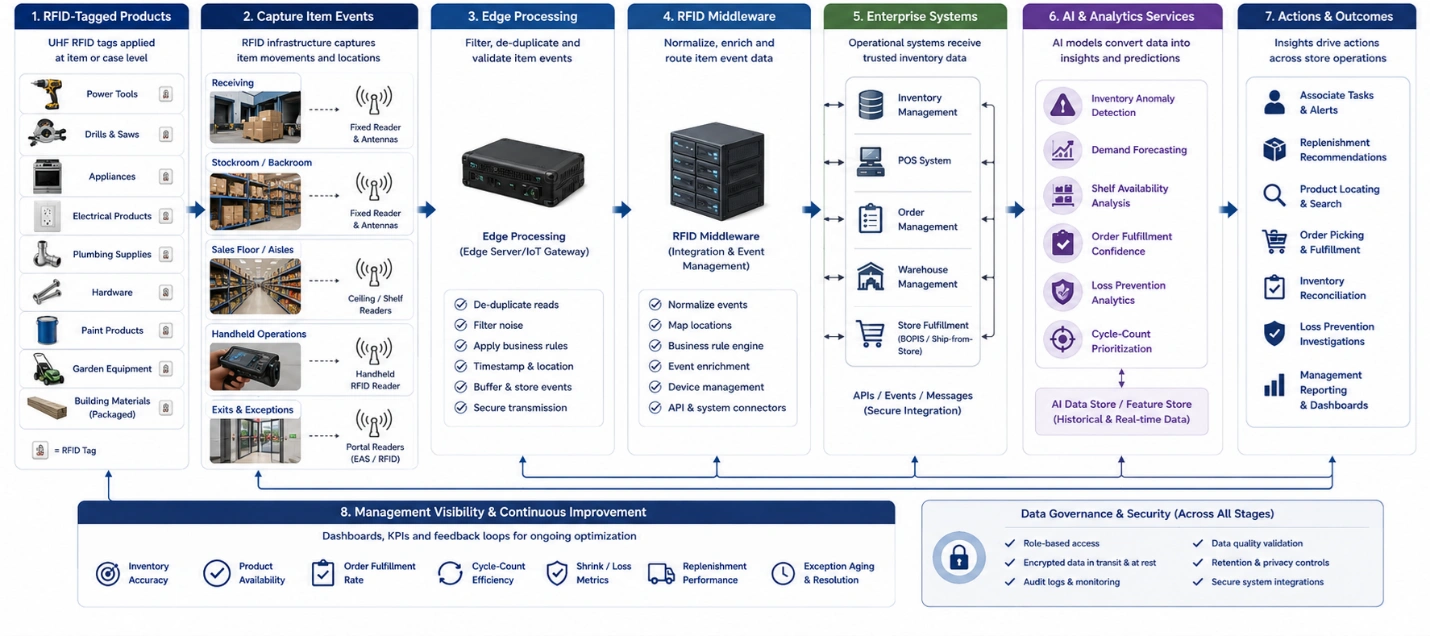
This workflow diagram shows how RFID-tagged home improvement products move from physical item identification through RFID readers, edge processing, middleware, retail systems, and AI analytics. It connects inventory data to AI-driven capabilities such as anomaly detection, demand forecasting, shelf availability analysis, fulfillment confidence, loss prevention, and cycle-count prioritization, ending with store actions and KPI management.
What AI-Enabled RFID Means for Home Improvement Stores
AI-enabled RFID for home improvement stores combines automated item identification with software that can analyze inventory and operational events. RFID is the enabling identification technology, while AI provides analytical capabilities that can turn large volumes of item, location, transaction, and movement data into prioritized decisions.
UHF RFID is generally the most relevant RFID technology for broad item-level inventory applications because it can support reading multiple tagged items without requiring direct visual contact. HF RFID can be appropriate for shorter-range identification scenarios where proximity is intentional, while LF RFID is typically associated with specialized short-range identification requirements. Technology selection should be based on product materials, tag placement, required read distance, environment, and the operating process rather than on RFID frequency alone.
Home improvement environments introduce several engineering considerations. Metal shelving, appliances, power tools, liquids, dense packaged merchandise, concrete structures, and closely packed inventory can affect RFID performance. Tag selection and placement therefore need to be validated against representative products and store fixtures before a large deployment.
AI becomes useful after reliable event data is available. Examples include identifying an item that appears to have moved unexpectedly, estimating whether a shelf or storage location is likely to have an availability problem, forecasting demand for seasonal products, and determining which inventory discrepancies deserve physical investigation first.
The system should also distinguish between an RFID observation and a business transaction. A reader event indicates that a tag was detected at a particular location and time. Inventory software must apply business rules to determine whether that observation represents receiving, movement, stocking, picking, return processing, or another operational event.
Why Item-Level Visibility Matters in Home Improvement Retail
Home improvement inventory is distributed across receiving areas, backrooms, overhead storage, sales-floor aisles, secured displays, service counters, pickup areas, and sometimes outdoor yards. A product can therefore be physically present but difficult for an associate or customer to locate.
AI-supported item visibility can help address several operational questions:
- Where was a specific product last observed?
- Is inventory recorded in the correct department or storage location?
- Which high-value products show unusual movement patterns?
- Which SKUs have a discrepancy between system inventory and observed inventory?
- Which products should be counted first?
- Which orders have sufficient inventory confidence for fulfillment?
- Which products are likely to require replenishment?
- Which inventory exceptions warrant associate investigation?
These questions are particularly important for products such as cordless power tools, generators, premium hand tools, smart-home equipment, appliances, cameras, outdoor power equipment, and other higher-value merchandise.
Home Improvement Store Applications for AI and RFID
AI-driven RFID applications should be designed around actual store workflows rather than deployed as an isolated tracking system. The highest-value use cases generally occur where inaccurate inventory, difficult product locating, delayed replenishment, fulfillment errors, or unexplained item movement creates measurable operational friction.
AI Inventory Management and Accuracy
Inventory anomaly detection can compare RFID observations with inventory records, receiving activity, sales transactions, returns, transfers, and expected item locations. The objective is to identify discrepancies that require investigation rather than simply generating a large volume of alerts.
For example, if a high-value power tool is recorded as being in a backroom location but repeated RFID observations indicate movement into a different area, the system can flag the discrepancy for an associate. Similar logic can be applied to products that appear to be missing after receiving or that remain in an unexpected location after a customer order has been processed.
GAO’s RFID hardware and systems can provide the underlying item-event data required for these workflows, while the retailer’s existing business systems remain important sources of transactional context.
Shelf Availability and Product Locating
Shelf availability is particularly important in home improvement because customers frequently visit stores looking for a specific SKU, size, model, tool, fitting, or component. A system that knows an item exists somewhere in the store is not necessarily sufficient. The operational question is whether the product can be located and made available to the customer.
AI can combine RFID observations, inventory records, sales activity, product-location information, and replenishment rules to identify likely shelf gaps or misplaced merchandise. Associates can then receive prioritized tasks instead of manually searching every aisle or storage location.
This approach can be especially useful for fast-moving hardware, electrical components, plumbing fittings, consumable supplies, seasonal merchandise, and frequently purchased tools.
Order Fulfillment and Buy-Online-Pickup-In-Store
Home improvement retailers increasingly support pickup and other omnichannel fulfillment processes. An order may require an associate to locate multiple SKUs across different store locations, departments, or storage areas.
RFID can provide additional evidence about item presence and recent location. AI can use that evidence alongside inventory and order data to estimate fulfillment confidence and prioritize orders that are most likely to be completed successfully.
The result is not simply faster picking. Better inventory confidence can also help reduce substitutions, delayed pickup orders, canceled orders, and unnecessary associate search time.
Loss Prevention and High-Value Merchandise
Loss prevention can use RFID event patterns as one source of evidence when investigating unusual product movement. AI can identify deviations from expected movement patterns across controlled areas, receiving processes, stockrooms, sales floors, and exits.
This does not mean every unusual RFID event represents theft. Store layouts, legitimate customer activity, returns, transfers, damaged goods, and associate handling can all create unusual patterns. Effective systems therefore combine RFID observations with transaction data, access controls, video systems where appropriate, and documented operational processes.
Automated Cycle-Count Prioritization
Manual cycle counting can consume substantial associate time, particularly when stores contain thousands of SKUs distributed across large selling areas and storage locations. AI can prioritize counts based on factors such as inventory variance, product value, sales velocity, previous discrepancies, recent movement anomalies, and operational importance.
Rather than treating every SKU equally, the system can direct associates toward locations and products where a physical count is most likely to resolve an important inventory problem.
AI Use Cases Powered by RFID for Home Improvement Retail
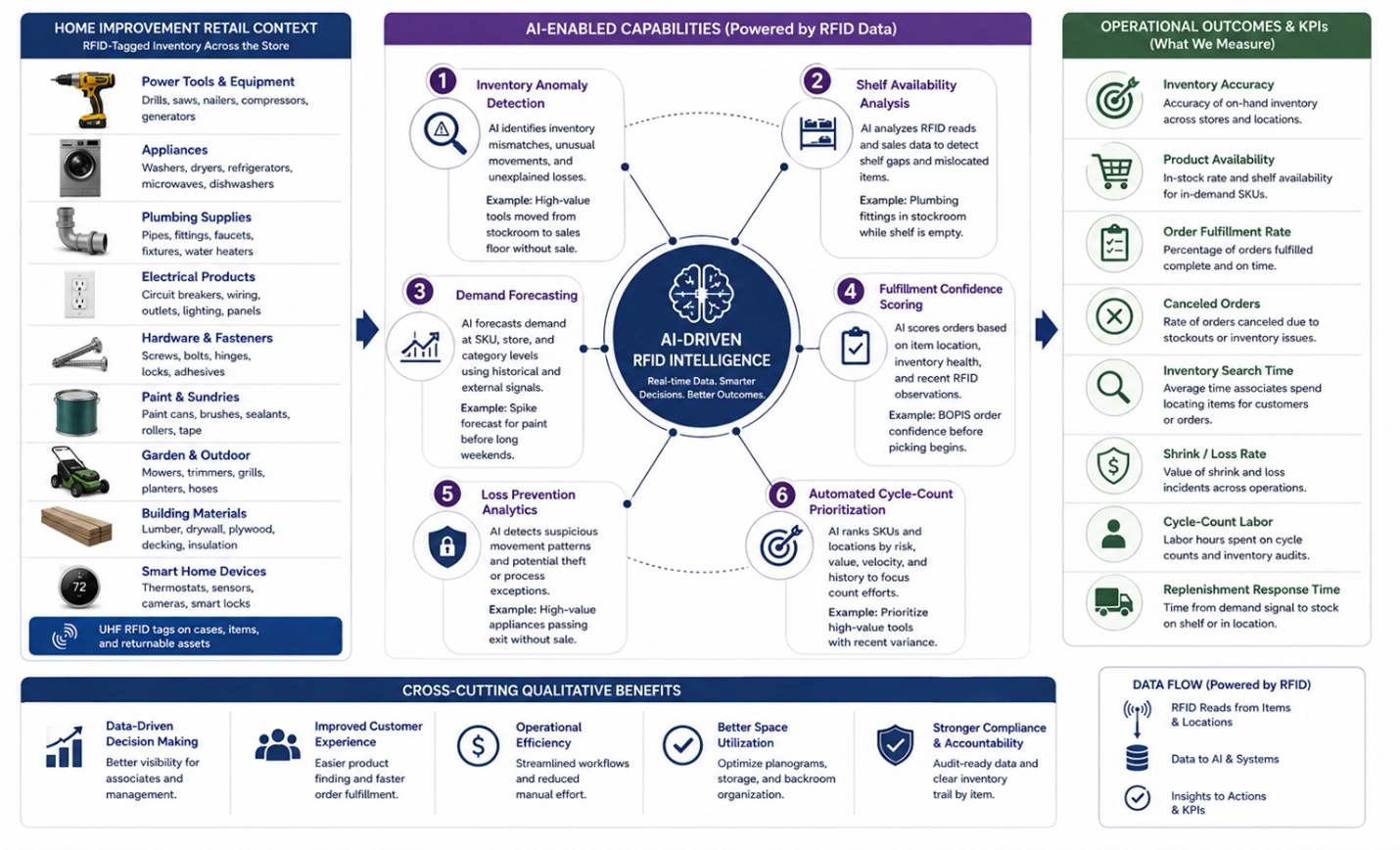
This infographic maps six RFID-enabled AI capabilities to practical home improvement retail outcomes. It shows how inventory anomaly detection, shelf availability analysis, demand forecasting, fulfillment confidence, loss prevention analytics, and cycle-count prioritization support measurable KPIs such as inventory accuracy, product availability, fulfillment rate, search time, shrink, labor, and replenishment response.
Operational Workflow from RFID Events to AI Decisions
A practical AI and RFID solution for home improvement stores operates as a sequence of physical identification, data processing, enterprise integration, analysis, and operational action.
RFID Data Capture at Store Operations
The process begins with tagged merchandise and RFID readers positioned around workflows where item identification provides operational value. Receiving docks can capture inbound merchandise, while stockrooms and sales-floor areas can use fixed or handheld readers for inventory verification and product locating.
Reader events can include the tag identifier, reader identifier, antenna or read point, timestamp, signal characteristics, and location context. Handheld readers can provide an additional mechanism for associates to search for products or verify inventory in a specific area.
Edge Processing and RFID Middleware
Raw RFID observations should normally be filtered before they become business events. Edge processing can remove duplicate reads, apply local filtering, and reduce unnecessary network traffic. RFID middleware can then normalize events and apply device, location, and business rules.
For example, repeated observations of the same tag in one read zone should not automatically create hundreds of separate inventory transactions. Middleware can help transform low-level observations into meaningful events such as “item observed in receiving” or “item detected in stockroom zone.”
Enterprise Software Integration
Normalized item events can be exchanged with inventory management, POS, order management, warehouse management, merchandising, and other store systems. Integration may use APIs, message queues, database interfaces, event streams, or other supported mechanisms depending on the retailer’s existing software environment.
The integration design should define system ownership for critical data. Product master data, SKU identifiers, store locations, inventory status, order information, and RFID identifiers need consistent relationships. Poor master-data quality can undermine AI analysis even when RFID hardware is performing correctly.
AI Analytics and Decision Support
AI services can evaluate historical and real-time information to identify patterns that are difficult to manage manually. Demand forecasting can incorporate sales history, seasonality, promotions, store-level demand, and other available variables. Anomaly detection can compare observed item behavior with expected patterns. Availability models can combine location evidence with inventory and sales information.
The output should be actionable. A useful system does not merely state that an anomaly exists. It can identify the affected SKU or item, relevant location, supporting evidence, priority, and recommended operational response.
Store Associate and Management Actions
AI recommendations ultimately need to become store activity. Depending on the use case, an action may involve locating an item, replenishing a shelf, completing a cycle count, investigating an exception, picking an order, reconciling inventory, or reviewing a loss-prevention event.
Management dashboards can aggregate these events across departments and stores, providing visibility into inventory accuracy, availability, fulfillment performance, exception volumes, and other operational indicators.
RFID Hardware, Software, and AI Components for Home Improvement Stores
The technology stack should be selected around store workflows, product characteristics, integration requirements, and operating conditions.
RFID Tags and Product Identification
RFID tags need to be selected according to the physical characteristics of the merchandise. Metal products, liquids, dense packaging, and products containing electronic components can require specialized tag designs or placement strategies.
A tagging standard should define where tags are attached, how they are encoded, which product categories require specialized tags, and how tags are handled during receiving, returns, repackaging, and product disposal.
Fixed and Handheld RFID Readers
Fixed readers are appropriate for controlled read zones and repeatable workflows such as receiving, selected stockroom areas, or controlled exits. Handheld readers provide mobility for cycle counts, product searches, shelf verification, and exception investigation.
Reader placement should be validated through site surveys and RF testing. Antenna orientation, mounting height, read-zone boundaries, interference, shelving, product density, and nearby materials can materially affect performance.
Edge Processing and Connectivity
Local edge computing can process RFID events close to the store operation. This can reduce unnecessary transmission of raw reads and allow selected functions to continue when connectivity to a centralized service is interrupted.
Store networks should provide appropriate segmentation, access controls, monitoring, and secure communication between RFID equipment, edge systems, and enterprise software.
Cloud and Privately Hosted Server Deployment
Cloud-hosted deployment can centralize software, analytics, inventory intelligence, and management across multiple home improvement stores. It can be appropriate when retailers want centralized administration, scalable computing resources, and consolidated visibility across geographically distributed locations. Secure connectivity between stores and the cloud service remains an important design requirement.
A privately hosted server deployment places the relevant software on customer-managed edge servers, enterprise servers, or private data-center infrastructure. This model can be appropriate when data-control requirements, existing IT standards, connectivity limitations, or integration constraints favor privately managed infrastructure.
A hybrid arrangement can combine local RFID processing and store-level data handling with centralized analytics. This can provide local operational resilience while allowing broader analysis across stores.
The appropriate deployment model depends on connectivity, data governance, IT capabilities, integration requirements, latency requirements, security controls, and the retailer’s preferred operating model.
Connectivity, Security, and Supporting Technologies
Home improvement stores often operate across large physical areas with demanding RF conditions, distributed network infrastructure, and a mixture of fixed and mobile devices. The connectivity design therefore needs to support reliable RFID event collection while keeping store operations protected from unnecessary network exposure.
Communication and Network Infrastructure
RFID readers typically communicate with edge computers or store systems through Ethernet or other supported network connections. Wireless connectivity can also support handheld devices and selected mobile workflows. Network design should account for reader density, bandwidth, segmentation, availability, device management, and secure communication with centralized software.
Common supporting technologies include:
- Ethernet and TCP/IP networking for fixed reader and edge connectivity
- Wi-Fi for handheld RFID readers and mobile associate applications
- VPN or other encrypted connections for communication between stores and centralized services
- TLS for protecting application and data exchanges
- APIs and event-based interfaces for exchanging information with retail software
- Database and message-processing technologies for storing and distributing item events
- BLE or other IoT technologies where complementary location, sensing, or mobile-device capabilities are required
The network should not be treated as a substitute for RFID engineering. A high-bandwidth network cannot correct poor antenna placement, unsuitable tags, excessive RF reflections, or inadequate read-zone design.
Cybersecurity for RFID and AI Systems
Cybersecurity should extend from RFID readers through edge computing, middleware, integrations, databases, AI services, and management interfaces. The objective is to protect item data and retail operations while maintaining the availability required for store workflows.
Important controls include:
- Device authentication and controlled provisioning
- Role-based access to RFID and inventory applications
- Network segmentation between RFID equipment and unrelated store devices
- Encryption for data transmitted between stores and centralized systems
- Secure software updates and configuration management
- Logging of reader, application, integration, and administrative activity
- Monitoring for unusual device behavior or unauthorized access
- Backup and recovery procedures for critical inventory and configuration data
- Protection of APIs and service credentials
- Security testing before operational commissioning
AI systems introduce additional considerations. Models should be evaluated against representative store data, monitored for changes in accuracy, and prevented from making uncontrolled operational changes without appropriate business rules and human oversight.
Deployment Considerations for Home Improvement Retail
The physical characteristics of a home improvement store can significantly influence RFID performance. A deployment that performs well in a controlled test area may behave differently when exposed to dense merchandise, metal shelving, appliances, liquids, construction materials, and customer traffic.
Product and Tag Testing
Tag selection should begin with the merchandise categories that matter most to the intended use case. A single tag type may not provide optimal performance across every product category.
Testing should consider:
- Metal tools and equipment
- Appliances and metal-bodied products
- Liquids and paint containers
- Packaged hardware
- Electrical products and cables
- Plumbing components
- Outdoor and garden equipment
- Smart-home devices
- Products with dense packaging
- High-value merchandise requiring controlled handling
Tag placement should also be standardized. Poor placement can produce inconsistent reads even when the reader and antenna configuration is appropriate.
Store RF Survey and Read-Zone Design
A site assessment should document store layout, shelving, receiving flows, stockroom configuration, electrical infrastructure, network availability, potential RF interference, and the physical locations where RFID events are needed.
Receiving areas may require different read-zone characteristics from sales-floor inventory locations. A controlled exit requires a highly defined detection area, while a stockroom may benefit more from handheld inventory verification than from continuous fixed reading.
The design should therefore be driven by operational requirements rather than by installing readers uniformly throughout the store.
Integration With Existing Retail Software
AI-driven RFID should complement existing retail software instead of creating a parallel source of truth. Inventory management remains central to SKU quantities and availability, while POS provides transaction context and order management provides fulfillment requirements.
Integration should establish clear relationships among:
- SKU and product identifiers
- RFID tag identifiers
- Store and department locations
- Inventory status
- Purchase and sales transactions
- Receiving and transfer events
- Customer orders
- Returns and adjustments
- Associate tasks
- AI-generated recommendations
A strong integration design also defines what happens when RFID observations conflict with transactional records. Exceptions should be routed for investigation rather than automatically changing inventory records without appropriate validation.
AI Capabilities and Business Benefits
The value of AI-driven RFID comes from connecting physical inventory observations with decisions that matter to home improvement store operations.
More Reliable Inventory Information
AI can compare RFID observations with inventory records, sales, receiving, transfers, returns, and expected locations to identify discrepancies. This provides a more targeted approach to inventory reconciliation than relying exclusively on periodic manual counts.
The resulting improvement is not simply a larger quantity of inventory data. It is better visibility into which discrepancies are important and where associates should investigate.
Improved Product Availability
Product availability depends on more than having inventory somewhere in the store. A product may be recorded as available while sitting in an overhead location, stockroom, incorrect department, or another area where it is difficult to access.
AI can combine recent RFID observations with sales and location information to identify likely availability problems and prioritize replenishment or product-location tasks.
More Efficient Order Fulfillment
For buy-online-pickup-in-store and other store fulfillment workflows, inventory confidence is important before an associate begins picking an order.
RFID observations can provide recent evidence of item presence and location. AI can combine that evidence with order requirements and inventory records to help determine fulfillment confidence and prioritize orders requiring additional verification.
Better Loss Prevention Investigation
RFID can create a history of item movement through receiving, stockrooms, sales areas, and controlled locations. AI can analyze deviations from expected movement patterns and identify exceptions for investigation.
The system should support loss-prevention personnel rather than automatically labeling an event as theft. Combining RFID data with transaction records, access information, video evidence where appropriate, and documented procedures provides stronger investigative context.
Lower Cycle-Count Effort
AI can prioritize cycle counts according to business risk and operational value. High-value tools, fast-moving merchandise, products with repeated discrepancies, and locations with unusual movement can receive greater attention than low-risk inventory.
This approach can allow store teams to spend less time performing indiscriminate counts and more time resolving inventory conditions that are likely to affect availability or fulfillment.
Scalable Multi-Store Visibility
A centralized system can compare inventory events and operational patterns across multiple home improvement locations. This can help management identify recurring discrepancies, differences in store performance, unusual inventory behavior, and opportunities for process improvement.
The value increases when store-level data uses consistent product identifiers, location definitions, event rules, and KPI definitions.
AI and RFID Benefits-to-KPI Map for Home Improvement Retail
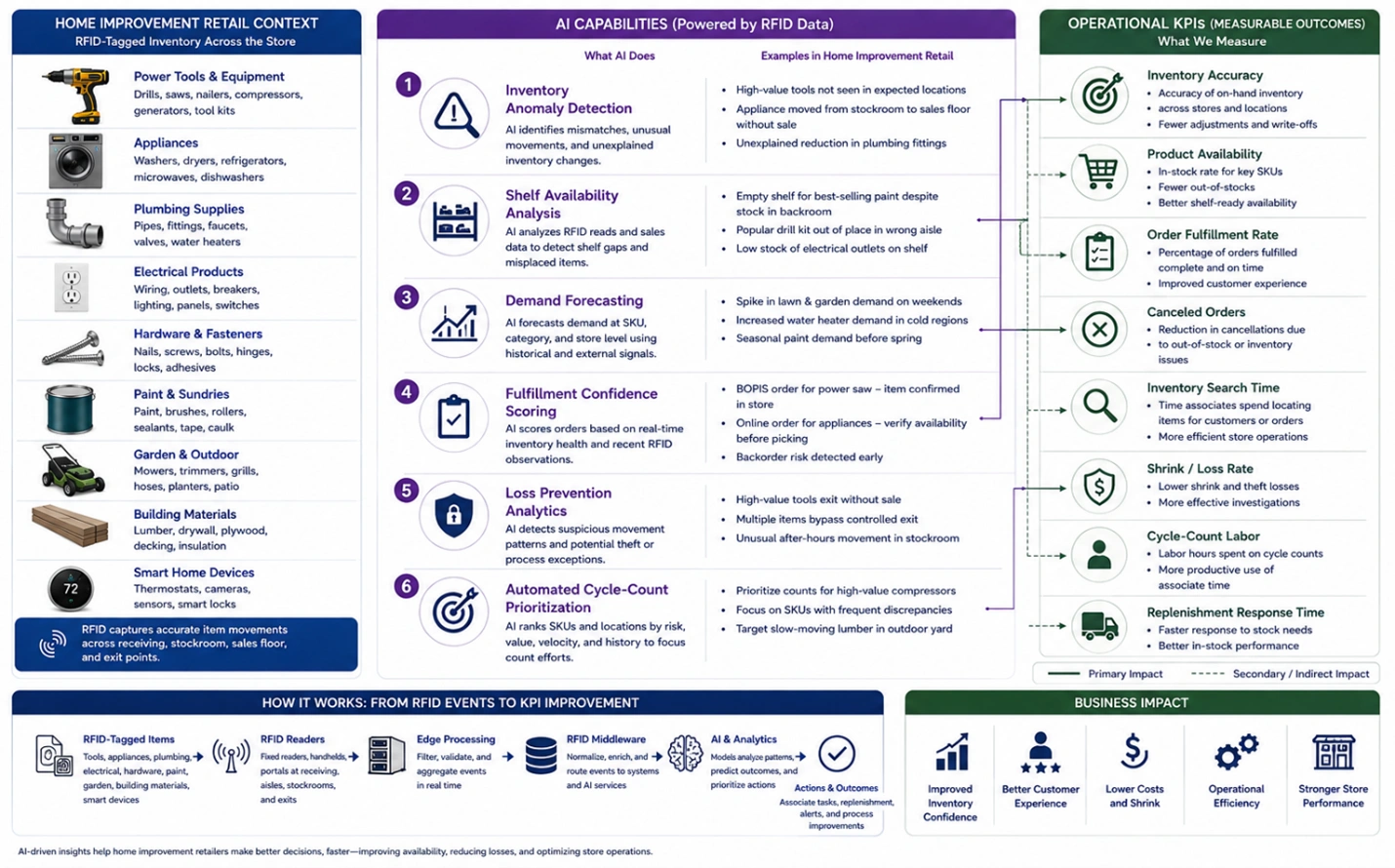
This infographic maps six AI-enabled RFID capabilities to measurable home improvement retail outcomes. It connects inventory anomaly detection, shelf availability analysis, demand forecasting, fulfillment confidence, loss prevention analytics, and cycle-count prioritization with KPIs such as inventory accuracy, product availability, fulfillment rate, canceled orders, search time, shrink, cycle-count labor, and replenishment response time.
Measuring AI-Driven RFID Performance
A successful deployment needs measurable objectives that connect technology performance with store operations. Technical reader performance alone is insufficient because the business value depends on whether the system improves inventory and fulfillment processes.
Relevant KPIs can include:
- Inventory accuracy by store, department, or product category
- Product availability
- Order fulfillment rate
- Canceled or unfulfilled orders
- Inventory search time
- Replenishment response time
- Cycle-count labor
- Inventory adjustment frequency
- Shrink and loss-prevention exceptions
- Time required to reconcile discrepancies
- RFID read reliability within defined operating zones
- Percentage of inventory events successfully integrated with retail systems
- AI alert precision and investigation outcomes
- Exception resolution time
KPI definitions should be established before a pilot begins. Baseline measurements are particularly important because improvements cannot be evaluated reliably when the original process has not been documented.
AI model performance should also be monitored independently from business KPIs. A demand model, anomaly detector, or fulfillment-confidence model may require recalibration when product assortments, promotions, store layouts, customer behavior, or operating procedures change.
Practical Implementation Recommendations
A phased deployment reduces technical and operational risk. The first step should be to identify the store processes where better item visibility can solve a clearly defined business problem.
Start With High-Value Use Cases
Initial use cases can focus on areas such as high-value power tools, controlled merchandise, inventory reconciliation, order picking, or difficult-to-locate products. These scenarios can provide a clear basis for measuring RFID and AI performance.
Validate Products Before Scaling
Representative product samples should be tested before selecting final tag types and reader configurations. Testing should include actual merchandise, packaging, shelving, and operating conditions.
Pilot the Complete Workflow
A pilot should test more than RFID reads. It should validate the entire path from product identification through edge processing, middleware, retail-system integration, AI analysis, associate action, and KPI measurement.
This approach exposes integration and process issues that may not appear during isolated hardware testing.
Establish Data and Integration Governance
Product master data, location data, RFID identifiers, inventory transactions, and AI outputs need consistent definitions. Ownership and error-handling procedures should be established before large-scale rollout.
Design for Store Operations
Associates should receive concise, prioritized tasks rather than raw RFID events. A useful recommendation should explain what needs attention, where the item or exception is located, and what action is expected.
Training should also explain the relationship between RFID observations and inventory records so employees understand when physical verification is required.
Scale After Validation
Multi-store expansion should use documented configurations, tagging standards, integration specifications, cybersecurity controls, testing procedures, and support processes. Standardization makes it easier to identify whether a problem originates from the RFID installation, store process, software integration, or business data.
Key Takeaways for Home Improvement Retailers
AI-driven RFID can help home improvement stores move from periodic inventory verification toward more continuous item-level operational visibility. The strongest applications connect RFID observations with inventory management, POS, order fulfillment, replenishment, cycle counting, and loss-prevention processes rather than treating item identification as an isolated technology project.
Effective implementation depends on product and tag testing, RF site surveys, appropriate reader placement, reliable edge processing, disciplined middleware rules, secure connectivity, clean master data, and well-defined software integrations. AI should then be applied to specific decisions such as anomaly detection, demand forecasting, availability analysis, fulfillment confidence, and cycle-count prioritization.
GAO supplies RFID, BLE, and IoT hardware products and systems that can support these requirements, with remote and onsite technical support available for organizations implementing connected retail solutions. GAO’s experience also includes serving customers across the U.S. and Canada, including Fortune 500 companies, R&D organizations, universities, and government agencies, supported by substantial product and system R&D and quality-assurance processes.
For retailers evaluating AI-driven inventory management, RFID deployment, or store-level IoT integration, the next step is to define the highest-value operational use cases, assess representative products and store conditions, and develop a deployment plan that connects physical item data to measurable business outcomes.
Building the Future of Industrial AI and IoT with Aperture Venture Studio and GAO RFID Inc.
For more than three decades, GAO has invested heavily in R&D for industrial RFID, BLE, and IoT technologies. As generative AI has become useful for practical industrial and retail applications, we have continued developing AI and IoT solutions, including technologies that connect RFID and BLE data with intelligent software. We founded Aperture Venture Studio to build, launch, and scale next-generation AI and IoT companies and initiatives relevant to industries such as department-store operations.
Aperture has attracted AI and IoT technical experts, experienced executives, investors, and leading companies. We have also developed the Aperture Ventures Summit and TekSummit to facilitate discussion of advanced AI and IoT topics.
GAO welcomes participation from:
- Advisors, co-founders, or employees
- Investors
- Customers