
AI and RFID for Long-Term Care – GAO
AI-Driven Asset Tracking for Long-Term Care
Long-term care facilities manage a continuous flow of residents, medical equipment, medications, supplies, staff activities, and clinical documentation. AI-driven asset tracking helps nursing homes, assisted living facilities, skilled nursing facilities, rehabilitation centers, and other long-term care environments turn location and utilization data into actionable operational intelligence. RFID serves as an enabling identification technology, allowing tagged equipment and supplies to be automatically detected at defined locations without requiring manual barcode scanning. AI software can then analyze movement patterns, utilization records, inventory levels, and operational events to identify shortages, misplaced equipment, unusual movement, and workflow bottlenecks. GAO provides RFID, BLE, and other IoT hardware products and systems that can support these connected workflows. The result is better visibility into mobile assets, more efficient staff workflows, improved inventory control, and data-driven operational decisions.
AI-Enabled RFID Asset Tracking in Long-Term Care Facilities
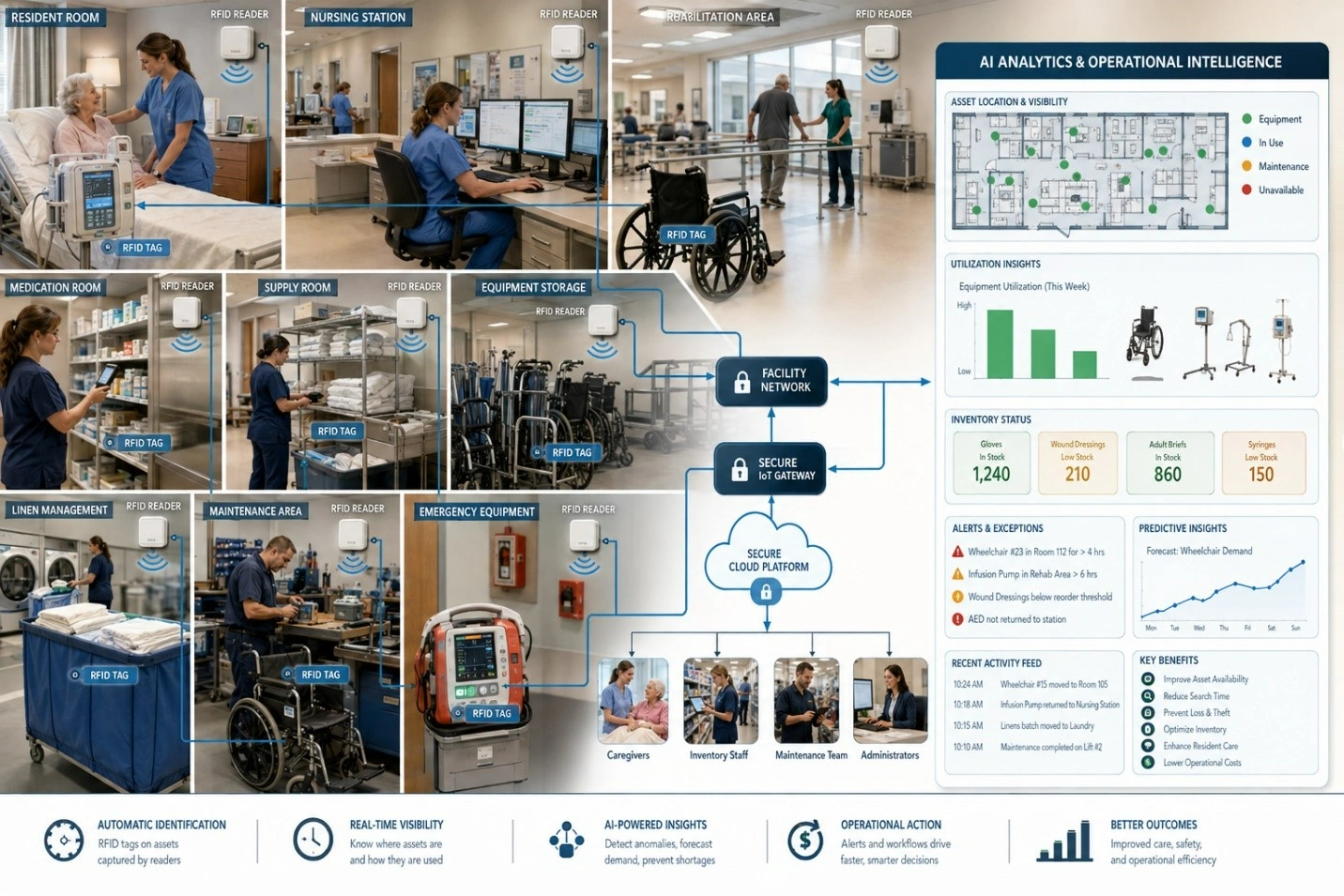
This visual illustrates how RFID-tagged medical equipment, supplies, linen, and emergency assets are identified across a long-term care facility. RFID readers transmit asset events through a secure facility network and IoT gateway to AI analytics, which provides location visibility, utilization insights, inventory monitoring, alerts, and predictive information for caregivers, inventory teams, maintenance staff, and administrators.
What AI-Enabled RFID Means for Long-Term Care
AI-enabled asset tracking combines machine learning and other AI techniques with connected identification infrastructure to understand where critical resources are, how they are being used, and where operational problems are emerging. RFID is particularly useful when long-term care staff need automatic identification of tagged objects as they move through rooms, corridors, storage areas, treatment spaces, and designated checkpoints.
The three principal RFID frequency categories provide different operating characteristics:
- UHF RFID can support longer-range identification and is useful for tracking mobile medical equipment, supply containers, linen, and other tagged assets across selected facility zones.
- HF RFID provides shorter-range identification and can be appropriate for controlled reading points, identification stations, and applications where proximity-based detection is desirable.
- LF RFID operates at lower frequencies and can be useful in specialized identification scenarios where its propagation characteristics and established tag formats are appropriate.
The identification technology alone does not determine whether a long-term care workflow becomes intelligent. Value comes from connecting identification events with facility software, asset records, inventory information, maintenance records, staff workflows, and AI analytics.
AI can transform raw RFID events into operational information. For example, repeated movement of a wheelchair between resident rooms and a rehabilitation area can establish utilization patterns. A medical device that remains outside its designated storage area for an unusual period can generate an exception for staff review. Inventory consumption patterns can help estimate future supply requirements. These functions allow long-term care operators to move from simply locating an object to understanding how resources are being used.
GAO’s RFID and IoT hardware can form part of this identification layer, while facility software and AI services process the resulting data according to operational requirements.
Long-Term Care Applications for AI Asset Tracking
Long-term care facilities contain many assets that are shared among residents, departments, care teams, and support functions. Manual searches consume staff time and can make it difficult to establish an accurate picture of equipment availability.
Medical Equipment Location and Utilization
Mobile equipment such as wheelchairs, walkers, patient lifts, infusion equipment, vital-sign devices, beds, and rehabilitation equipment can move frequently between rooms and departments. RFID-based identification can provide location events when tagged equipment passes through appropriately configured reading zones.
AI can analyze these events to identify:
- Equipment frequently requested but difficult to locate
- Underutilized equipment that could be reassigned
- Equipment remaining in unintended areas
- Repeated movement patterns between departments
- Abnormal utilization or movement behavior
- Potential demand for additional equipment
This information can support equipment allocation and reduce unnecessary searches by nursing and support staff.
Supply and Inventory Management
Long-term care operations depend on recurring supplies such as gloves, dressings, continence products, hygiene materials, wound-care supplies, cleaning products, and other consumables. RFID identification can improve visibility into inventory movement when tags and readers are selected appropriately for the specific item and environment.
AI can analyze historical consumption and replenishment information to identify changing demand patterns. This can help inventory personnel establish more appropriate reorder thresholds and identify unusual consumption.
The system should distinguish between high-value reusable assets and low-cost consumables because RFID economics, tag selection, read-point design, and return-on-investment calculations differ substantially between the two categories.
Linen and Reusable Resource Tracking
Linen movement can create recurring operational losses when items are misplaced, sent to the wrong area, or removed from the intended circulation process. RFID can provide identification events at laundry, storage, distribution, and collection points where technically appropriate.
AI analytics can examine circulation patterns and identify unusual loss rates, recurring bottlenecks, or locations where inventory repeatedly accumulates.
Equipment Maintenance and Availability
Asset location data becomes more useful when combined with maintenance information. A tagged device can be associated with its equipment record, maintenance status, service history, and operational availability.
AI can help maintenance teams prioritize work by considering utilization, movement history, service intervals, reported faults, and other available operational data. The resulting workflow can help distinguish equipment that is simply unavailable from equipment that is unavailable because it requires inspection or repair.
Resident-Care Workflow Support
RFID-based identification should not be interpreted as a replacement for clinical judgment or resident care decisions. Its strongest role is often supporting operational workflows around care delivery.
For example, identification events can help establish whether designated equipment or supplies are available in a care area before a scheduled procedure. Combined with appropriate software rules, these events can trigger notifications or workflow actions for authorized personnel.
Any application involving resident identification, location, or care information requires careful privacy, access-control, data-retention, and security design.
RFID Deployment in a Long-Term Care Facility
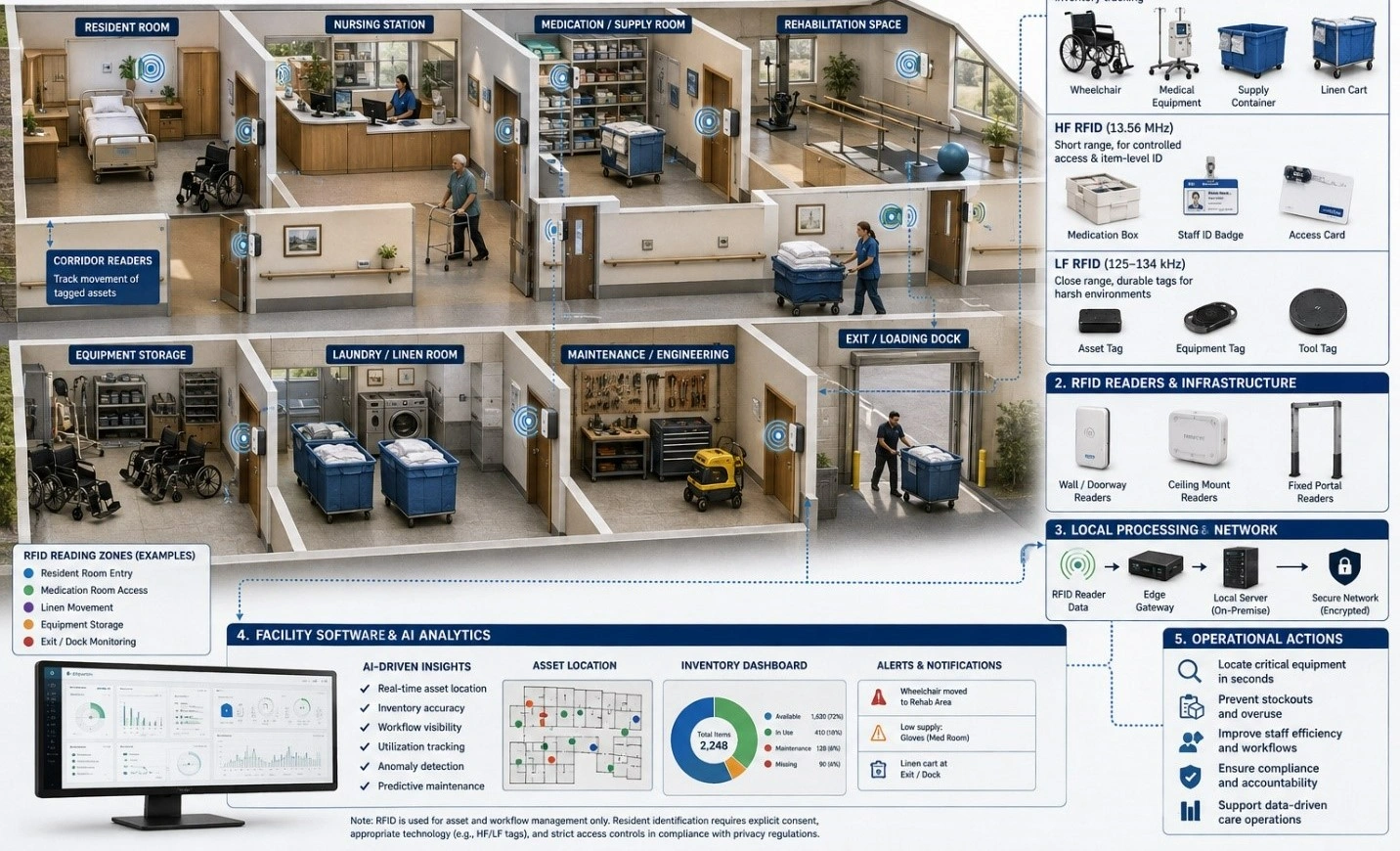
A detailed cutaway illustration showing RFID readers, tagged medical assets, reading zones, secure network infrastructure, and AI analytics across key areas of a long-term care facility.
Long-Term Care Operational Workflow from RFID Events to AI Decisions
A practical AI-enabled asset tracking system begins with physical events and ends with an operational action. The workflow should be designed around the specific movement patterns, facility layout, asset categories, and responsibilities of long-term care personnel.
Data Acquisition
RFID tags are attached to selected reusable assets, inventory items, containers, or other objects according to the application’s technical and economic requirements. Fixed readers, antennas, handheld readers, or controlled reading stations capture identification events.
Reader placement is important. A facility should not attempt to cover every square foot with RFID infrastructure. Instead, engineering teams should identify meaningful transition points and operational zones where a read event provides useful information.
Communication and Local Processing
Reader events are transmitted through the facility’s network to appropriate processing services. Ethernet, Wi-Fi, or other supported communication methods can connect readers to local software or centralized services.
Edge processing can be useful when the facility needs rapid event filtering, local decision-making, reduced network traffic, or continued operation during temporary connectivity interruptions. Local processing can also normalize duplicate reads before information is forwarded to higher-level software.
Middleware and Event Processing
RFID middleware converts raw reader observations into meaningful events. A single asset may be detected repeatedly while passing through a reader zone, so software should filter duplicate observations and apply business rules.
For long-term care, useful event structures can include:
- Asset entered a designated equipment room
- Asset left a nursing unit
- Supply container reached a replenishment area
- Linen batch entered or exited a processing zone
- Equipment remained outside its expected location
- Asset movement indicates a potential exception
The resulting events can then be associated with asset records, location records, maintenance information, and authorized workflows.
AI Analytics and Decision Support
AI models operate on structured operational data rather than treating every RFID observation as an independent prediction. Depending on the problem, techniques can include anomaly detection, time-series analysis, demand forecasting, classification, clustering, and optimization.
A long-term care facility might use historical equipment movement to forecast demand for specific asset categories. Anomaly detection can identify movement patterns that differ significantly from normal facility operations. Forecasting can support inventory planning when sufficient historical data is available.
AI outputs should remain explainable enough for operational teams to understand why an alert or recommendation was generated. Automated recommendations should also be validated against actual facility workflows before being used for consequential decisions.
Business Action
The final stage converts information into an operational response. A notification may be sent to an inventory coordinator when supplies reach a defined threshold. Maintenance staff may receive an exception when equipment remains in an unexpected area. A supervisor may review utilization data before deciding whether additional equipment is required.
This closes the loop between physical asset movement and facility management.
RFID-to-AI Workflow for Long-Term Care Asset Tracking
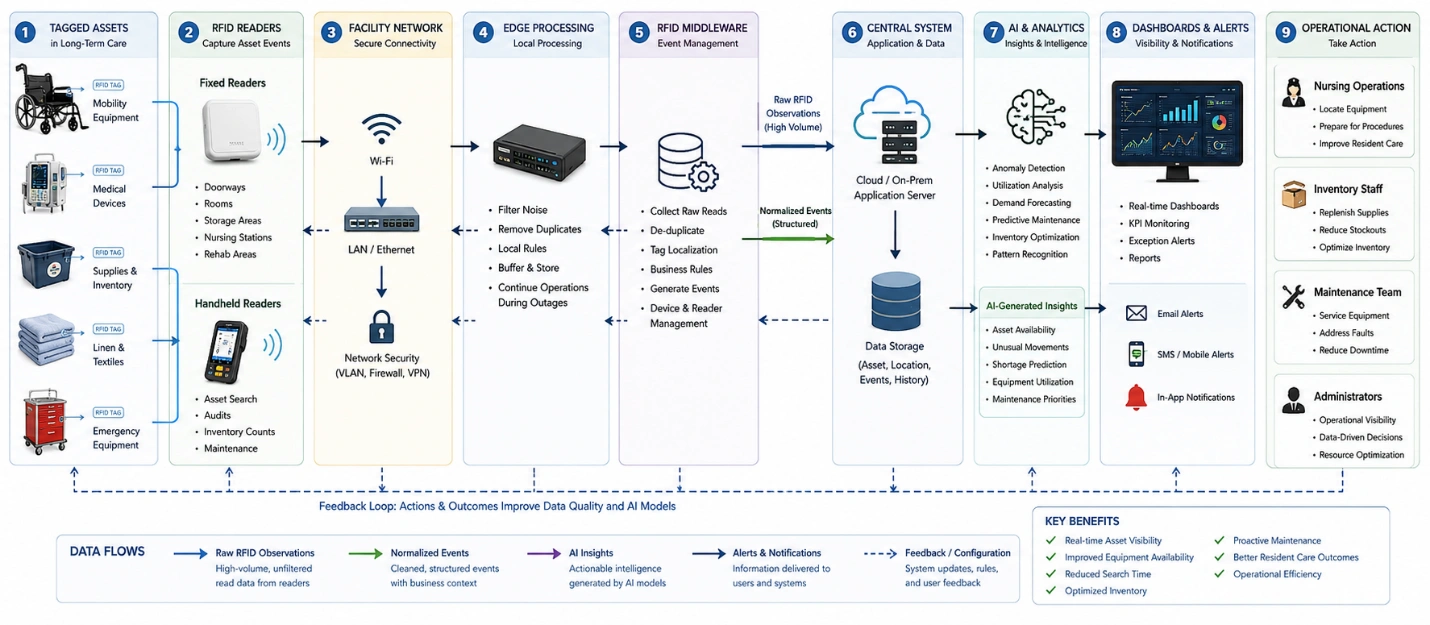
This workflow diagram shows how RFID-tagged medical equipment, supplies, linen, and emergency assets generate identification events that move through readers, the facility network, edge processing, RFID middleware, centralized software, and AI analytics. The resulting insights support dashboards, alerts, inventory management, maintenance, nursing operations, and administrative decisions.
Cloud and Server Deployment Options for Long-Term Care
Long-term care organizations can select cloud-hosted software or privately hosted server deployment depending on operational requirements, data governance, IT resources, connectivity, and integration constraints.
Cloud-Hosted Deployment
A cloud deployment places application services and analytics within managed cloud infrastructure. This model can simplify centralized software management across multiple facilities and can make it easier to scale computing resources as the number of tracked assets and locations increases.
Cloud deployment may be appropriate when:
- Multiple facilities need centralized visibility
- IT teams prefer managed infrastructure
- AI processing requirements vary over time
- Remote monitoring and centralized administration are important
- Existing software integrations can securely communicate with cloud services
Network availability becomes an important engineering consideration. Local buffering or edge processing can help prevent temporary connectivity problems from causing unacceptable gaps in operational event data.
Privately Hosted Server Deployment
A server deployment places software on customer-managed servers, private data centers, facility servers, or other privately hosted infrastructure. This model can provide greater control over infrastructure configuration and data processing.
It may be appropriate when:
- Internal IT teams require direct infrastructure control
- Existing facility systems are hosted privately
- Network isolation is required for particular workflows
- Local processing is important
- Organizational policies favor privately hosted systems
A hybrid design can combine local event processing with centralized analytics. This approach can reduce dependence on continuous external connectivity while retaining centralized reporting and AI capabilities.
The appropriate deployment model should be selected after reviewing facility networking, integration requirements, cybersecurity controls, data governance, AI processing needs, maintenance responsibilities, and the organization’s ability to operate the selected infrastructure.
AI Capabilities That Improve Long-Term Care Operations
AI adds value when RFID-generated operational data is combined with facility context, historical records, and clearly defined business rules. Rather than treating every RFID read as an isolated event, AI can identify patterns across equipment movement, inventory consumption, maintenance activity, and facility workflows.
Predictive Asset Demand
Historical movement and utilization data can help estimate future demand for shared equipment. A model can consider variables such as time of day, unit, equipment category, utilization frequency, and historical demand.
For example, if a rehabilitation unit consistently experiences higher wheelchair demand during specific periods, forecasting can help staff prepare appropriate resources before demand peaks.
Predictions should be continuously evaluated against actual utilization. Poor-quality historical data, changes in facility operations, or changes in resident populations can reduce model accuracy.
Anomaly Detection
AI-based anomaly detection can identify asset behavior that differs from established operational patterns.
Potential examples include:
- A high-value device remaining outside its assigned area for an unusually long period
- Unexpected movement between facility zones
- An unusual concentration of equipment in one department
- Supply consumption significantly above historical patterns
- Repeated equipment movements that indicate workflow inefficiency
An anomaly should normally generate an investigation rather than an automatic conclusion. Facility personnel should be able to review the underlying event history before taking action.
Inventory Forecasting
AI can analyze historical consumption, replenishment frequency, seasonal changes, and operational demand to improve inventory planning.
The objective is not simply to maintain more inventory. Excess stock increases storage requirements and can create expiration or obsolescence concerns, while insufficient stock can disrupt care operations. Forecasting can therefore support more balanced inventory policies.
Asset Utilization Analytics
Asset utilization analysis helps managers understand whether equipment is appropriately distributed across units.
A dashboard could show:
- Equipment availability by care unit
- Utilization frequency
- Average time between uses
- Equipment idle periods
- High-demand equipment categories
- Equipment frequently moved between units
- Assets requiring redistribution or replacement review
These insights can support purchasing decisions based on actual usage rather than assumptions.
AI-Assisted Maintenance Prioritization
Maintenance teams can combine equipment movement, utilization, service history, inspection records, and fault information to prioritize maintenance activities.
An AI model can identify patterns associated with increasing service requirements, but maintenance personnel should remain responsible for technical inspection, repair decisions, and safety verification.
Security, Privacy, and Data Governance
Long-term care environments require careful handling of information because asset-tracking systems may operate alongside resident-care workflows and facility information systems. RFID identification data should therefore be treated according to its actual sensitivity and relationship to other records.
A secure implementation should consider:
- Role-based access control for administrators, nurses, inventory personnel, maintenance staff, and other authorized users
- Strong authentication for management applications
- Encryption for data transmitted between readers, servers, cloud services, and connected applications
- Network segmentation between RFID infrastructure and other facility systems where appropriate
- Audit logging for important administrative and data-access activities
- Secure device configuration and credential management
- Controlled software and firmware updates
- Data retention policies based on operational and regulatory requirements
- Protection of resident-related information when RFID events are associated with identifiable individuals
- Monitoring for unauthorized devices or unusual network activity
RFID does not inherently make a system secure or insecure. Security depends on the complete implementation, including readers, networks, middleware, databases, APIs, cloud services, user accounts, and operational procedures.
Privacy design is particularly important when tracking can be associated with residents or individual staff members. Organizations should clearly define what is being tracked, why it is required, who can access the information, how long records are retained, and how the information is used.
GAO can provide RFID and IoT hardware that forms part of a larger deployment, while the facility and its technology partners remain responsible for configuring the complete system according to applicable privacy, cybersecurity, and organizational requirements.
Long-Term Care RFID Security and Data Governance
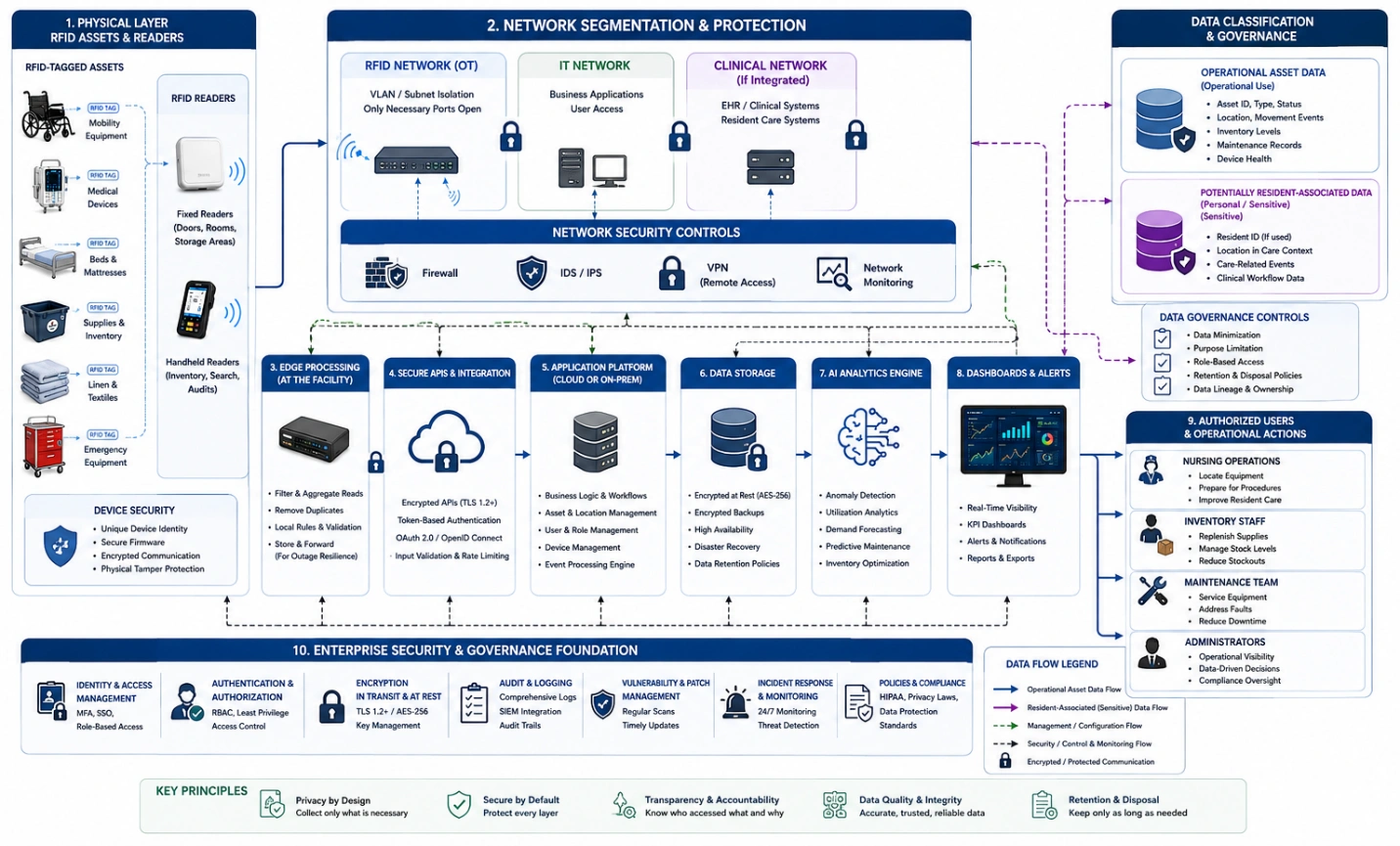
This diagram shows how RFID data in a long-term care facility can be protected from physical readers through segmented networks, edge processing, secure APIs, cloud or private servers, data storage, AI analytics, and dashboards. It highlights encryption, authentication, access control, audit logging, data classification, retention policies, and authorized operational access.
RFID Integration with Long-Term Care Software
RFID systems become substantially more useful when identification events are integrated with existing facility software instead of creating another isolated information source.
Potential integration points include:
- Inventory management software
- Computerized maintenance management systems
- Asset management databases
- Procurement systems
- Facility management software
- Electronic health record systems where an approved use case requires integration
- Workforce and operational management systems
- Business intelligence and reporting tools
- Notification and workflow systems
Integration should be designed around the minimum information necessary for each workflow. For example, an equipment-tracking system may only need an asset identifier, location, timestamp, status, and maintenance reference. A resident-care application may require substantially stronger privacy controls.
APIs can provide structured communication between RFID middleware and facility software. Event-driven integration can also allow specific events to trigger notifications or workflows without continuously transferring unnecessary raw reader observations.
Data normalization is critical. Asset identifiers, location names, department codes, timestamps, and equipment status values should use consistent formats. Otherwise, AI models may learn from inconsistent records and produce unreliable results.
Interoperability Considerations
A deployment should document:
- RFID tag identifiers
- Asset identifiers
- Reader identifiers
- Location identifiers
- Timestamp format and synchronization
- Event types
- Equipment status values
- API interfaces
- Authentication mechanisms
- Data ownership
- Error-handling procedures
- Data retention requirements
Time synchronization across readers and servers is particularly important for reconstructing movement sequences and analyzing asset utilization.
Implementation and Engineering Considerations
A long-term care RFID deployment should begin with operational requirements rather than hardware procurement. The first question should be which workflow has a measurable problem that automatic identification and AI analytics can realistically improve.
Start with a Defined Use Case
A pilot may focus on high-value mobile equipment, because these assets can generate measurable savings from improved availability and reduced search time.
The facility should define baseline measurements before deployment, such as:
- Average time required to locate equipment
- Equipment search frequency
- Equipment utilization
- Lost or misplaced asset incidents
- Inventory stockouts
- Emergency equipment availability
- Maintenance turnaround time
These measurements provide a basis for evaluating whether the deployment produces operational improvement.
Perform a Facility Site Survey
RFID performance depends on physical conditions. Engineering teams should examine:
- Building construction
- Metal surfaces
- Medical equipment density
- Storage configurations
- Doorways and corridors
- Reader mounting locations
- Antenna orientation
- Electrical infrastructure
- Network connectivity
- Areas requiring controlled read zones
A site survey should include physical testing with representative tags and assets rather than relying exclusively on theoretical RF specifications.
Select Tags According to the Asset
One RFID tag design should not automatically be applied to every asset.
Metal equipment may require tags designed for metal mounting. Items containing liquids can have different RF behavior from dry materials. Small disposable items may require a different economic model than expensive reusable equipment.
Tag selection should consider:
- Material composition
- Mounting surface
- Required read distance
- Environmental exposure
- Cleaning procedures
- Temperature
- Asset lifecycle
- Required durability
- Tag cost
- Required identification reliability
Validate the AI Model
AI should be introduced after sufficient operational data is available or through an appropriately designed training dataset. Model performance should be evaluated using metrics relevant to the specific application.
For anomaly detection, false-alert frequency may be as important as detection capability. Excessive alerts can cause staff to ignore notifications. For forecasting, organizations should compare predicted demand with actual demand over time.
Human review remains important, especially when AI recommendations influence equipment allocation, inventory decisions, maintenance prioritization, or resident-related workflows.
Scaling from a Pilot to Multiple Long-Term Care Units
Scaling should occur only after the pilot demonstrates reliable identification, useful operational workflows, acceptable staff adoption, and measurable business results.
A practical expansion can progress from one equipment category or care unit to additional operational areas. For example, a facility may initially track mobile medical equipment and later expand to rehabilitation equipment, linen, inventory, and maintenance workflows.
Multi-facility deployments require additional considerations:
- Standardized asset identification
- Consistent location naming
- Centralized reporting
- Facility-specific configuration
- Network and cybersecurity standards
- User-access policies
- Software version management
- Hardware maintenance
- AI model monitoring
- Data governance
- Integration standards
AI models should also be monitored after deployment. Operational patterns can change as facilities modify layouts, acquire new equipment, change staffing models, or introduce new workflows. A model that performs well during an initial deployment may require recalibration as conditions change.
GAO’s experience supplying RFID, BLE, and IoT hardware and systems can support organizations as they evaluate hardware requirements and expand connected identification capabilities across appropriate long-term care workflows.
Practical Recommendations for Long-Term Care Organizations
Organizations evaluating AI-enabled RFID asset tracking should prioritize measurable operational problems rather than attempting to track every possible object.
- Select a high-value workflow with a clear operational problem.
- Establish baseline KPIs before installing RFID infrastructure.
- Perform a physical RF site survey using representative assets.
- Select UHF, HF, or LF RFID according to the specific application rather than treating the frequencies as interchangeable.
- Test tags against actual equipment materials and cleaning conditions.
- Use middleware to filter duplicate reads and convert raw observations into meaningful events.
- Keep AI models focused on actionable problems such as forecasting, utilization analysis, and anomaly detection.
- Integrate with existing inventory, maintenance, and operational software where justified.
- Apply role-based access and appropriate cybersecurity controls.
- Separate resident-related information from general asset information unless integration is explicitly required.
- Pilot the system before expanding across multiple units or facilities.
- Measure operational outcomes rather than RFID installation volume.
- Establish procedures for reader maintenance, tag replacement, software updates, and AI model monitoring.
- Involve nursing, inventory, maintenance, IT, compliance, and facility management personnel during requirements and testing.
Building Smarter Long-Term Care Operations with AI and RFID
AI-enabled asset tracking can help long-term care organizations improve visibility into mobile equipment, supplies, maintenance activity, and operational workflows. RFID provides automatic identification data, while AI transforms accumulated operational information into forecasts, anomaly detection, utilization insights, and decision support.
The strongest implementations begin with a specific facility problem, validate RFID performance in the physical environment, integrate reliable event data with existing software, and establish measurable KPIs. Cloud, private server, and hybrid deployment models can all be appropriate depending on infrastructure, governance, connectivity, and IT requirements.
GAO supplies RFID, BLE, and IoT hardware products and systems that can support these connected workflows. Organizations can use this technology as part of a broader engineering strategy focused on asset availability, inventory control, maintenance efficiency, and operational visibility. Exploring GAO’s RFID and IoT solutions can help technical teams identify appropriate hardware and deployment approaches for their long-term care requirements.
Building the Future of Industrial AI and IoT with Aperture Venture Studio and GAO RFID Inc.
For more than three decades, GAO has invested heavily in R&D for industrial RFID, BLE, and IoT technologies. As generative AI has become useful for practical industrial and retail applications, we have continued developing AI and IoT solutions, including technologies that connect RFID and BLE data with intelligent software. We founded Aperture Venture Studio to build, launch, and scale next-generation AI and IoT companies and initiatives relevant to industries such as department-store operations.
Aperture has attracted AI and IoT technical experts, experienced executives, investors, and leading companies. We have also developed the Aperture Ventures Summit and TekSummit to facilitate discussion of advanced AI and IoT topics.
GAO welcomes participation from:
- Advisors, co-founders, or employees
- Investors
- Customers