
AI and RFID for Spare Parts Warehouses
AI-Powered Inventory and Asset Management for Spare Parts Warehouses
Spare parts warehouses support maintenance operations where inventory availability, part identification, storage accuracy, and rapid order fulfillment directly affect equipment uptime. AI-powered warehouse management can combine inventory data, historical consumption, maintenance requirements, and RFID-based identification to improve how spare parts are received, stored, located, picked, replenished, and audited. UHF RFID is particularly useful for automated identification of boxed, packaged, and palletized components, while HF and LF RFID can address more specialized identification requirements. AI can then turn captured warehouse data into demand forecasts, stock-risk alerts, anomaly detection, replenishment recommendations, and operational decisions. The resulting system connects RFID readers, tags, handheld devices, warehouse software, maintenance systems, and analytics. For spare parts operations, the value is not simply faster identification. The objective is a more accurate and responsive inventory process that reduces stockouts, excess inventory, search time, manual transactions, and maintenance delays.
RFID and AI Warehouse Inventory Management System

A detailed operational overview of a modern warehouse integrated with RFID technology and AI analytics. It tracks stock movement from receiving and cycle counting to dispatch, mapping RFID tags on parts and cartons to edge computing, WMS, and maintenance software dashboards.
How AI Improves Spare Parts Warehouse Inventory Management
AI for spare parts warehouses applies machine learning, statistical forecasting, anomaly detection, optimization, and increasingly computer vision to warehouse and maintenance data. The most useful applications are connected to specific operational decisions rather than deployed simply for automation.
Spare parts demand is often irregular. A warehouse may hold thousands of SKUs with different criticality levels, lead times, suppliers, failure patterns, and consumption frequencies. Conventional min-max rules can struggle with intermittent demand, emergency withdrawals, obsolete components, and changes in maintenance schedules.
AI can analyze historical issues, work orders, equipment maintenance records, lead times, supplier performance, inventory movements, and current stock levels to identify patterns that are difficult to capture with fixed reorder rules. The resulting recommendations can support planners without removing human approval from critical inventory decisions.
Key applications include:
- AI inventory forecasting: Estimate future spare parts requirements using historical consumption, maintenance schedules, equipment populations, seasonality, and lead-time information.
- Critical spare identification: Prioritize components whose absence could create significant equipment downtime or maintenance delays.
- Stockout prediction: Detect inventory conditions likely to result in an unavailable part when a maintenance requirement occurs.
- Excess and obsolete inventory analysis: Identify slow-moving, duplicate, aging, or potentially obsolete spare parts.
- AI-assisted replenishment: Recommend reorder quantities and timing using demand, supplier lead time, safety stock, and inventory risk.
- Inventory anomaly detection: Flag unusual receipts, withdrawals, duplicate transactions, unexpected location changes, and unexplained quantity differences.
- Search and retrieval optimization: Use real-time identification data to help technicians and warehouse personnel locate parts more quickly.
- Maintenance inventory coordination: Connect spare parts availability with maintenance work orders and planned equipment servicing.
GAO supplies RFID and IoT hardware products and systems that can provide the identification and sensing data required by these applications. The AI layer becomes more useful when its models receive reliable operational events instead of relying entirely on manually maintained spreadsheets.
Spare Parts Warehouse Workflows That Benefit from AI and RFID
Spare parts operations contain several points where inaccurate inventory records or delayed identification can create downstream problems. The most valuable deployments focus on these transaction points.
Receiving and Put-Away
Receiving personnel can use RFID handhelds or fixed readers to identify incoming cartons and tagged components. The warehouse management system can compare captured identifiers against purchase orders, expected quantities, and item master records.
AI can identify receiving anomalies such as unexpected quantities, repeated receiving patterns, supplier-related discrepancies, or parts that do not match expected inventory behavior.
Put-away recommendations can consider storage location, part dimensions, environmental requirements, movement frequency, criticality, and proximity to maintenance staging areas.
Inventory Location and Cycle Counting
A spare part can become operationally unavailable even when the warehouse system shows a positive quantity if the physical item is in the wrong bin or cannot be located quickly.
RFID-assisted cycle counting can reduce dependence on manual item-by-item scanning. A handheld reader can capture multiple tagged items during a controlled inventory sweep, while fixed readers can monitor selected locations continuously.
AI-based anomaly detection can then compare expected and observed inventory states to identify discrepancies requiring investigation.
Picking and Maintenance Staging
Maintenance teams frequently require specific parts against work orders, shutdown schedules, or corrective maintenance requests. Picking errors can delay technicians and create additional warehouse transactions.
An integrated system can associate RFID-tagged parts with picking requests and staging locations. AI can assist with prioritizing urgent requests, predicting demand around planned maintenance events, and identifying parts that should be staged before scheduled work begins.
Returns, Repairs, and Reusable Components
Some spare parts are returned after maintenance, sent for repair, refurbished, or transferred between storage locations.
Tracking the identity and movement history of reusable components can improve accountability. AI can analyze repeated repair cycles, abnormal return patterns, component utilization, and movement history to support maintenance and inventory decisions.
Spare Parts Warehouse End-to-End AI Workflow Infographic
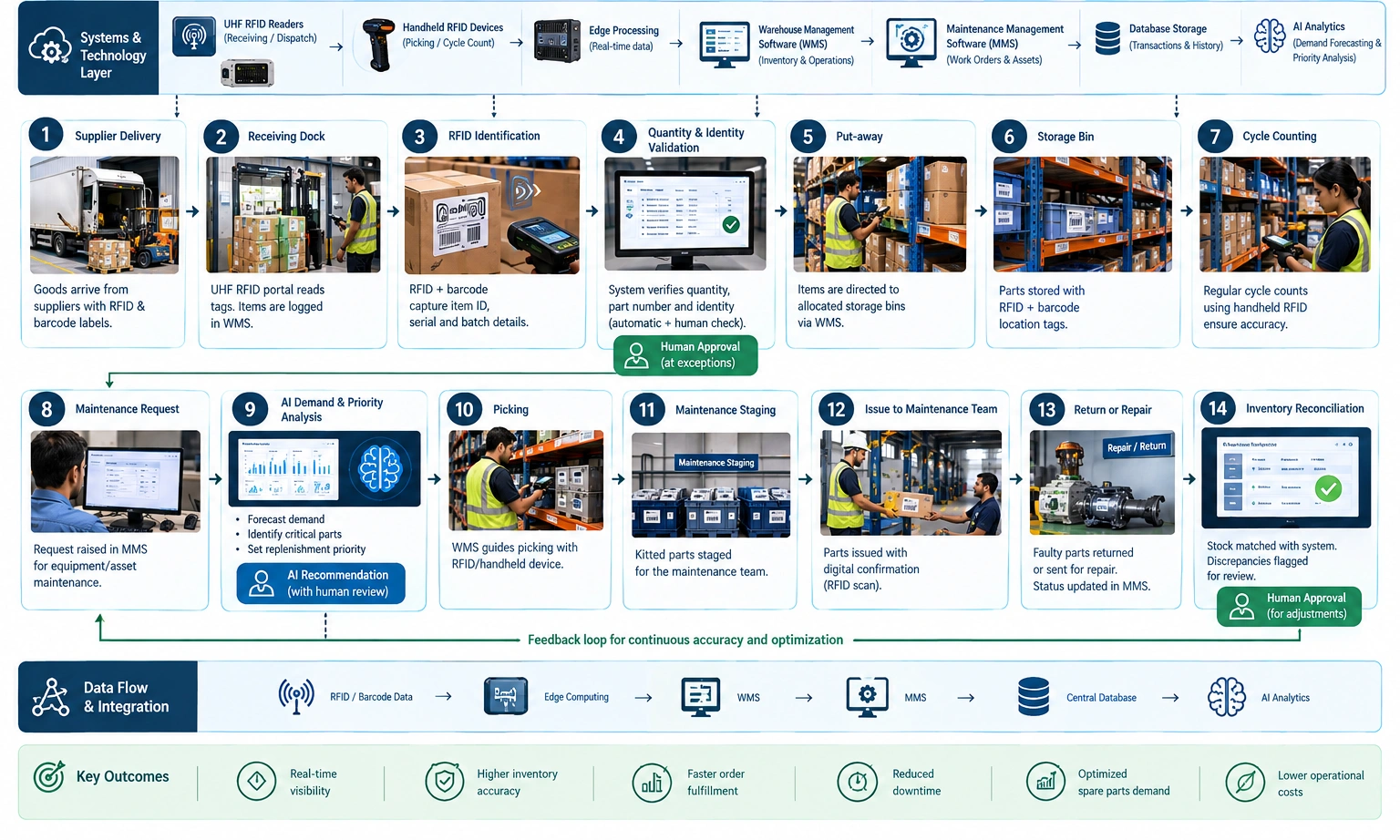
A comprehensive 14-step diagram mapping the lifecycle of spare parts management in a warehouse. It details the journey from supplier delivery and RFID identification to AI demand forecasting, maintenance staging, repair/return, and inventory reconciliation.
AI and RFID Data Flow in a Spare Parts Warehouse
A practical deployment begins with physical inventory events and progressively converts those events into business information.
Data Acquisition
RFID tags provide electronic identification for tagged spare parts, cartons, containers, bins, or pallets. UHF RFID is generally appropriate when longer read ranges and multi-item identification are required. HF RFID can be useful for shorter-range controlled interactions, while LF RFID can support specialized applications where its propagation characteristics and tag formats are appropriate.
Other data sources may include barcode scans, handheld terminals, warehouse sensors, environmental sensors, equipment maintenance records, purchase orders, inventory transactions, and supplier information.
Communication and Edge Processing
RFID readers transmit identification events through wired Ethernet, Wi-Fi, or other supported communication infrastructure. Edge processing can filter duplicate reads, validate reader events, associate reads with zones or transactions, and reduce unnecessary traffic before information reaches centralized software.
For a spare parts warehouse, event filtering is important because a reader may detect the same tag multiple times while an item passes through a portal. Business software generally needs a meaningful event such as “part received” or “part moved through dispatch,” rather than hundreds of raw reader observations.
Middleware and Data Normalization
RFID middleware can convert reader-specific data into standardized inventory events. It can also apply rules for reader zones, antenna locations, read confidence, duplicate suppression, tag association, and exception handling.
The middleware layer should preserve traceability between the original RFID event and the business transaction. This becomes particularly important when investigating inventory discrepancies.
AI Analytics and Decision Support
Normalized inventory events can be combined with historical transactions, maintenance work orders, supplier lead times, equipment information, and demand history.
AI models can then produce outputs such as:
- Predicted spare parts demand
- Stockout risk
- Excess inventory risk
- Abnormal inventory movement
- Replenishment recommendations
- Maintenance-related demand alerts
- Inventory discrepancy alerts
- Suggested cycle-count priorities
The warehouse planner or maintenance inventory manager can review these recommendations before high-impact actions are executed.
RFID Events to AI Decision Support System Diagram
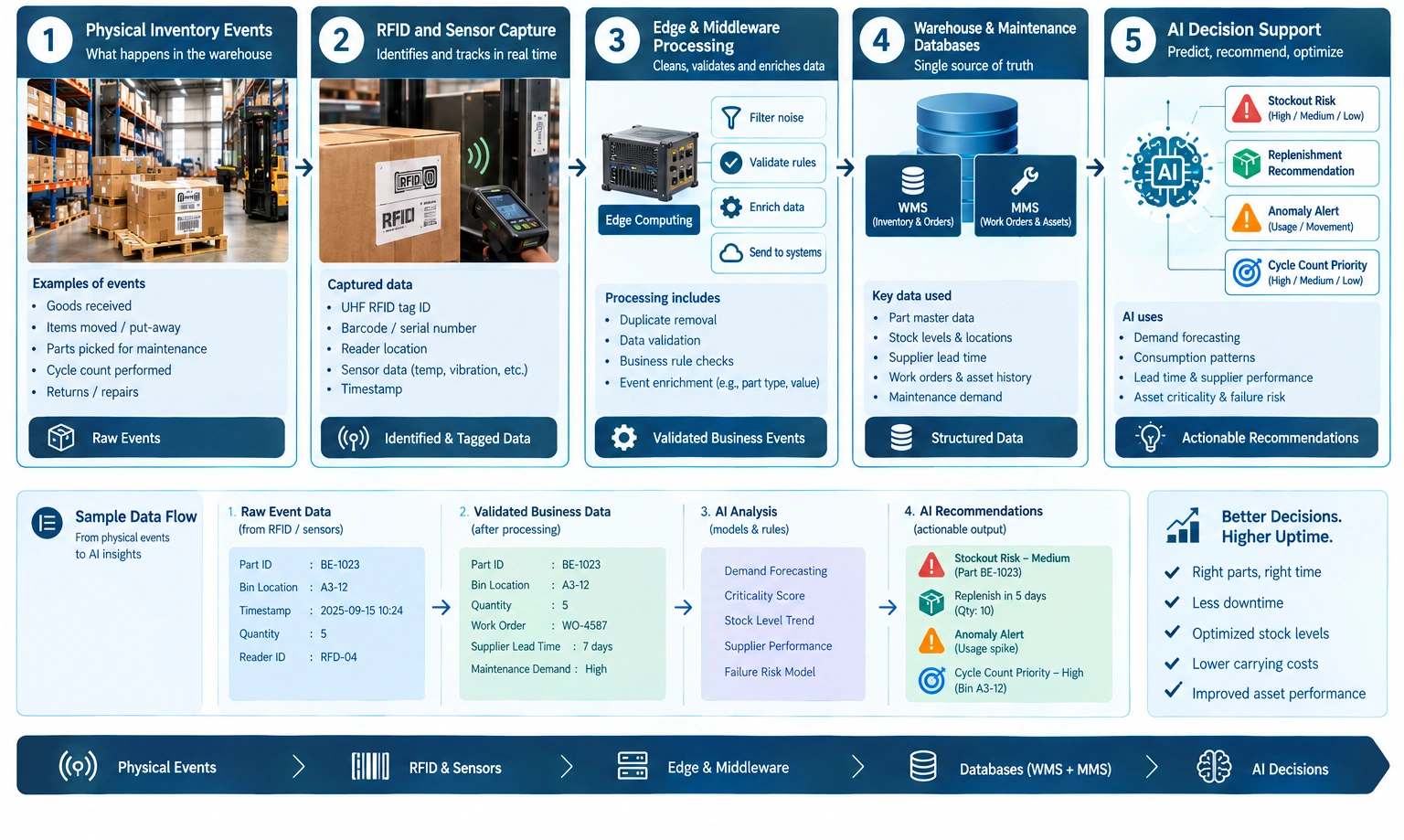
A 5-stage architecture diagram illustrating how warehouse RFID events convert into actionable AI insights. It outlines data movement from physical events and sensor capture through edge processing and database validation to predictive AI decision outputs like stockout risk and replenishment recommendations.
RFID, AI Hardware, Software, and Deployment Components
A spare parts warehouse solution normally combines identification hardware, computing infrastructure, enterprise software, and AI services. Component selection should follow the warehouse process rather than beginning with a particular RFID reader or AI model.
RFID Tags and Identification Hardware
Tag selection depends on the material, dimensions, mounting surface, required read distance, operating environment, and value of the spare part.
UHF RFID is generally suited to warehouse operations involving cartons, bins, pallets, and multiple tagged items within a read zone. Specialized UHF tags can be selected for metal-mounted components where ordinary labels may perform poorly.
HF RFID can be considered for controlled short-range identification, such as specific workstation interactions or near-field item verification. LF RFID is typically associated with short-range identification and specialized applications where its characteristics are appropriate.
Fixed readers, antennas, RFID portals, and handheld readers can be combined according to the process:
- Fixed readers can monitor receiving or dispatch portals.
- Handheld readers can support cycle counts, search operations, and exception investigation.
- Antenna placement determines the physical read zone and affects read reliability.
- RFID tags provide the item or container identity used to associate physical objects with inventory records.
Warehouse and Maintenance Software
The RFID system should connect with existing business software rather than creating a separate inventory record that warehouse personnel must maintain independently.
Common integration targets include:
- Warehouse management systems
- Enterprise resource planning systems
- Enterprise asset management systems
- Computerized maintenance management systems
- Inventory management software
- Procurement systems
- Supplier management software
- Databases and data warehouses
- Business intelligence software
- AI and machine learning services
APIs, message queues, web services, database interfaces, or integration middleware can be used depending on the customer’s existing software environment.
AI Models for Spare Parts Operations
AI model selection depends on the decision being supported.
Demand forecasting can use time-series methods and machine learning models. Classification models can categorize inventory risk. Anomaly detection can identify unusual movement or consumption behavior. Optimization models can support replenishment and stocking decisions.
The model should not be treated as an independent decision-maker. Inventory planners need visibility into the data used by the model, confidence or uncertainty where appropriate, and business rules that prevent recommendations from violating stocking policies.
Cloud Version and Server Version
A Cloud Version can host AI analytics, databases, dashboards, integration services, and application software within managed cloud infrastructure. This approach can simplify centralized access for organizations operating multiple spare parts warehouses and can make it easier to scale computing resources as data volumes increase.
A Server Version can deploy the required software on customer-managed edge servers, private data centers, factory servers, or other privately hosted enterprise infrastructure. This model can be appropriate when warehouse data must remain within controlled infrastructure, when network connectivity is limited, or when the organization has established internal requirements for system administration and data governance.
A hybrid deployment can also be appropriate. RFID event filtering and transaction-critical processing can occur close to the warehouse, while longer-term analytics and model training can use centralized infrastructure.
GAO’s experience supplying RFID, BLE, and IoT hardware and systems allows deployment decisions to be considered alongside physical identification requirements, reader placement, connectivity, and software integration rather than treating these elements as independent projects.
Cybersecurity and Data Integrity
Cybersecurity should cover both the RFID infrastructure and the systems consuming RFID events.
Relevant controls include:
- Role-based access control for warehouse and inventory users
- Authentication for connected devices and APIs
- Network segmentation between warehouse equipment and business systems
- Encryption for data transmitted across networks
- Secure device configuration and credential management
- Audit logging for inventory transactions
- Software patch and firmware management
- Backup and recovery procedures
- Monitoring for abnormal system activity
- Validation of AI inputs and model outputs
Data integrity is equally important. An incorrect tag-to-part association can be more damaging than a missing RFID read because the system may confidently associate the wrong physical item with an inventory record. Commissioning should therefore include tag encoding validation, reader-zone testing, antenna tuning, transaction testing, and reconciliation against known physical inventory.
Engineering Considerations for Spare Parts RFID Deployment
RFID performance depends heavily on the physical environment. Metal cabinets, electrical equipment, dense storage, liquids, shielding materials, tag orientation, reader power, antenna positioning, and warehouse traffic can all influence read behavior.
A deployment should therefore begin with a site survey and process analysis. Engineers should identify receiving doors, storage aisles, secure cages, high-value inventory areas, picking stations, maintenance staging areas, and dispatch points before determining reader locations.
Pilot testing should use actual spare parts and representative packaging rather than relying only on laboratory specifications. The objective is to verify read performance under realistic operating conditions, including the presence of metal components, stacked cartons, moving personnel, forklifts, and normal warehouse transactions.
Technical and Operational Benefits of AI-Enabled Spare Parts Management
Combining AI-driven decision support with automated identification gives spare parts warehouses a more complete view of inventory condition, movement, availability, and future requirements. The greatest benefits occur when RFID events are connected to warehouse, procurement, maintenance, and asset data.
Higher Inventory Accuracy
AI can compare expected inventory records against physical identification events and historical transaction patterns. RFID-assisted counts provide additional physical evidence for these comparisons.
This can help identify:
- Missing spare parts
- Misplaced components
- Duplicate inventory records
- Unexpected stock movements
- Incorrect quantities
- Parts recorded in the wrong storage location
- Unusual consumption patterns
Inventory accuracy should be measured against physically verified stock rather than RFID read counts alone.
Reduced Maintenance-Related Stockouts
A maintenance organization may require a particular bearing, seal, motor, valve, control module, sensor, or other component at short notice. A stockout can extend equipment downtime when an equivalent part is unavailable.
AI can combine maintenance schedules, equipment populations, historical failure patterns, current inventory, open purchase orders, supplier lead times, and consumption trends to identify potential shortages before the maintenance requirement occurs.
RFID contributes by improving confidence in the physical availability and location of the part.
Faster Spare Parts Retrieval
Search time becomes significant when warehouses contain thousands of low-frequency components distributed across bins, cabinets, racks, and controlled storage areas.
RFID handheld devices can assist personnel in locating tagged inventory without requiring every item to be visually identified. The warehouse system can provide the expected location while the handheld reader helps confirm the physical presence of the item.
This is particularly valuable for emergency maintenance requests where technicians need to find a specific component quickly.
Better Replenishment Decisions
Traditional reorder points often depend on static minimum and maximum quantities. AI-based replenishment can incorporate more variables, including:
- Intermittent demand
- Equipment maintenance schedules
- Supplier lead times
- Supplier reliability
- Criticality of the supported equipment
- Current on-hand quantity
- Open purchase orders
- Historical consumption
- Seasonal requirements
- Substitution options
- Obsolescence risk
The result can be a more context-sensitive replenishment recommendation.
Lower Excess and Obsolete Inventory
Spare parts warehouses often retain components for long periods because their value is associated with equipment availability rather than frequent sales.
AI can identify parts with declining demand, prolonged inactivity, duplicate stocking locations, superseded part numbers, or unusually low utilization. Procurement and maintenance teams can then determine whether inventory should be retained, transferred, returned, refurbished, consolidated, or retired.
AI should support this decision rather than automatically disposing of parts because low usage does not necessarily mean low operational importance.
Implementing AI-Powered Spare Parts Warehouse Management
Successful implementation requires more than installing RFID readers and connecting an AI service. The physical process, item master, warehouse transactions, network, integration interfaces, and operational policies must work together.
Process and Data Assessment
The first stage should document how spare parts move through the facility.
The assessment should identify:
- Receiving procedures
- Put-away processes
- Storage locations
- High-value and critical spare areas
- Picking procedures
- Maintenance staging
- Returns and repair flows
- Inter-warehouse transfers
- Cycle-count procedures
- Existing barcode processes
- ERP and WMS transactions
- CMMS or EAM integration
- Existing inventory discrepancies
The quality of the item master is particularly important. Part numbers, descriptions, units of measure, locations, manufacturer information, serial numbers, and supersession relationships should be reviewed before AI models are trained.
RFID Hardware Selection and Site Validation
RFID hardware should be selected according to the physical characteristics of the spare parts and the warehouse workflow.
Engineers should evaluate:
- UHF, HF, or LF suitability
- Tag material compatibility
- Metal-mounted components
- Required read distance
- Antenna positioning
- Reader coverage
- Forklift and personnel movement
- Portal geometry
- Electrical interference
- Network connectivity
- Environmental conditions
- Tag durability
- Required handheld mobility
A controlled pilot should use representative inventory rather than a small collection of easy-to-read items.
System Integration
Integration should establish a reliable relationship between RFID identification and the warehouse transaction.
For example:
RFID observation → validated event → inventory transaction → warehouse record → maintenance availability → AI analysis → recommended action
APIs or integration middleware can connect RFID software with WMS, ERP, CMMS, EAM, procurement, and analytics systems.
The integration design should prevent duplicate transactions. A tag passing a reader should not automatically generate a second inventory receipt if the original transaction has already been confirmed.
AI Model Development and Validation
AI development should begin with clearly defined decisions.
A project might initially target:
- Which spare parts are likely to stock out?
- Which parts should be reordered?
- Which inventory records appear anomalous?
- Which parts require priority cycle counting?
- Which planned maintenance events require pre-staging?
- Which inventory items show potential obsolescence?
Historical data should be cleaned and evaluated before model development. Missing transactions, changes in part numbers, equipment replacements, abnormal shutdowns, and one-time projects can distort demand patterns.
Model outputs should be validated against warehouse and maintenance personnel knowledge.
Commissioning and Acceptance Testing
Testing should include both technical and operational acceptance criteria.
Typical tests include:
- Tag encoding verification
- Reader connectivity
- Antenna coverage
- Read-zone accuracy
- Duplicate-read filtering
- Item-to-tag association
- Receiving transaction validation
- Put-away transaction validation
- Picking verification
- Cycle-count reconciliation
- Network failover
- Software integration
- API error handling
- User authentication
- Audit logging
- AI recommendation validation
- Recovery after communication interruption
A warehouse should not move directly from laboratory testing to full production deployment. Controlled commissioning helps identify problems before they affect maintenance inventory.
Scaling AI and RFID Across Spare Parts Warehouses
Multi-site organizations can extend the solution from one warehouse to regional distribution centers, maintenance stores, manufacturing support warehouses, or field-service inventory locations.
Standardization becomes important during expansion. The organization should define common rules for tag identification, part master data, event formats, user roles, inventory states, and integration interfaces while allowing individual warehouses to retain necessary process differences.
A centralized AI service can analyze data from multiple facilities and identify patterns such as:
- Regional demand differences
- Duplicate stocking across facilities
- Opportunities for inventory transfers
- Supplier performance differences
- Critical-part availability by location
- Unusual consumption at individual sites
- Opportunities to consolidate slow-moving inventory
RFID data can provide the physical movement evidence needed to make these comparisons more reliable.
Multi-Warehouse Scaling Architecture Diagram
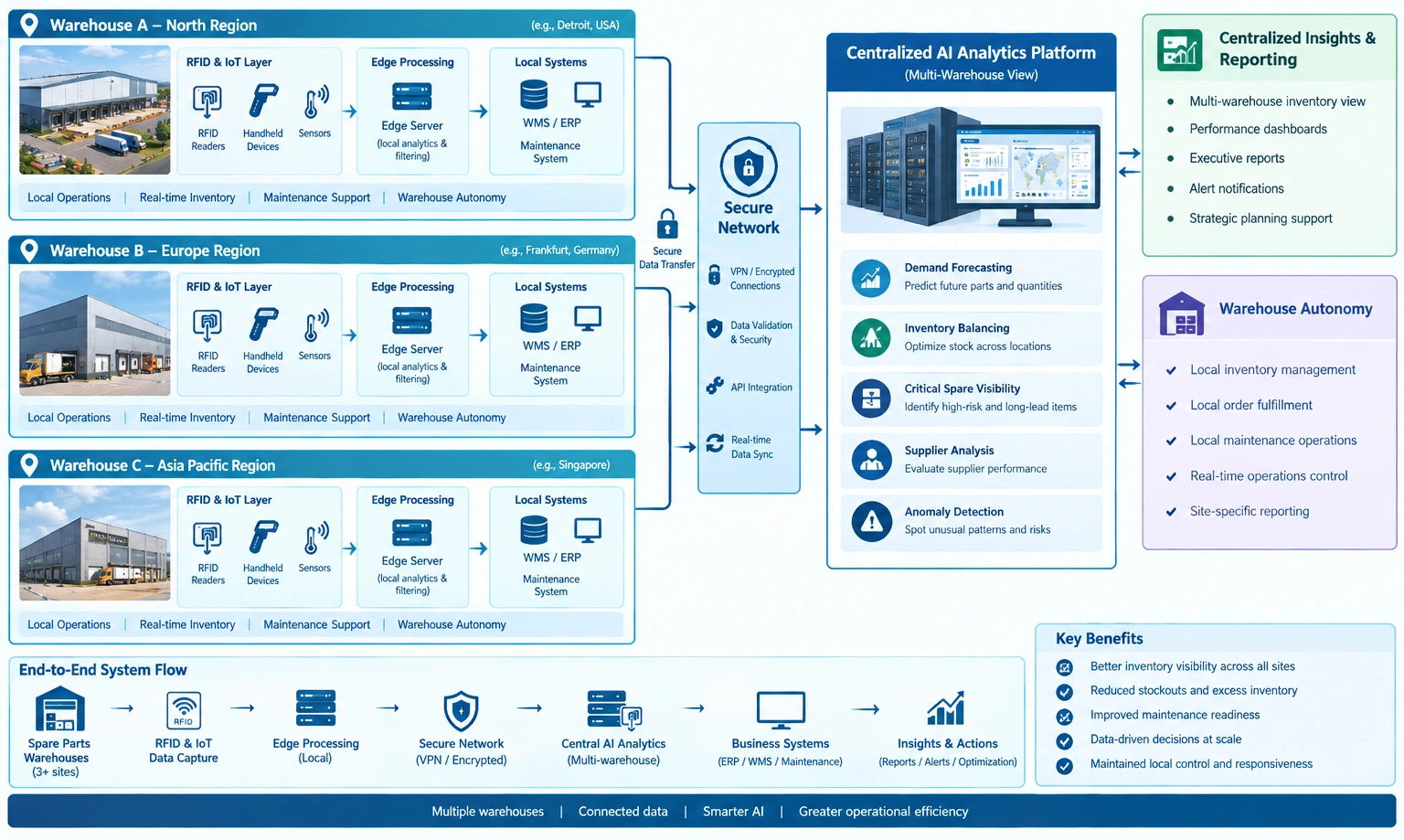
An architectural infographic showing how regional warehouses (North America, Europe, Asia Pacific) connect local RFID and edge processing systems to a centralized AI analytics platform over a secure network, driving multi-site inventory balancing, forecasting, and executive reporting while maintaining local operational autonomy.
Cybersecurity, Reliability, and Data Governance
Connected warehouse systems create additional security considerations because RFID readers, handheld terminals, edge computers, APIs, databases, and AI services exchange operational information.
A practical security program should include:
- Unique user accounts and role-based permissions
- Device authentication
- Secure API credentials
- Network segmentation
- Encrypted communication
- Security logging
- Firmware and software patch management
- Backup and disaster recovery procedures
- Controlled administrative access
- Inventory transaction audit trails
- Monitoring for abnormal device activity
AI data governance should define which information can be used for model training, how long operational data is retained, who can access model outputs, and how changes to models are approved.
Human oversight is especially important when AI recommendations can influence critical-spare purchasing. A model should not independently override established maintenance policies without appropriate controls.
Practical Design Trade-Offs for Spare Parts Warehouses
Every deployment involves engineering trade-offs.
A warehouse with dense metal inventory may require specialized RFID tags and careful antenna positioning. Increasing reader coverage can improve detection but may also increase unwanted reads from adjacent areas.
Automating every transaction may appear attractive, but some processes still benefit from human verification. For example, a high-value serialized component may require physical inspection in addition to electronic identification.
Cloud deployment can simplify centralized analytics, while privately hosted server deployment may better fit organizations with specific data-control or connectivity requirements.
AI can improve prediction, but poor source data will reduce model reliability. A sophisticated model cannot compensate for incorrect part numbers, missing historical transactions, inconsistent units of measure, or inaccurate inventory locations.
These trade-offs should be evaluated during pilot deployment rather than after full-scale installation.
Recommended AI and RFID Roadmap for Spare Parts Inventory
A phased approach reduces operational risk and allows measurable results to guide expansion.
- Define the business problem: Select a measurable issue such as stockouts, inventory discrepancies, search time, or emergency purchasing.
- Map the physical workflow: Document receiving, storage, picking, staging, returns, and cycle counting.
- Clean the inventory data: Validate part numbers, locations, quantities, serial numbers, criticality, and historical transactions.
- Select representative RFID use cases: Begin with processes where automated identification can produce clear operational value.
- Conduct a site survey: Evaluate shelving, metal components, portal locations, antenna placement, network connectivity, and reader coverage.
- Run a controlled pilot: Use representative spare parts and real warehouse processes.
- Integrate with business software: Connect RFID events to WMS, ERP, CMMS, EAM, and procurement workflows where required.
- Introduce AI decision support: Begin with forecasting, anomaly detection, stockout prediction, or replenishment recommendations.
- Measure operational KPIs: Establish baseline values before deployment and compare them after implementation.
- Validate security and reliability: Test authentication, network interruptions, data recovery, audit trails, and system failure conditions.
- Expand by process or site: Scale only after the initial deployment demonstrates reliable performance.
- Continuously optimize: Review tag performance, reader placement, data quality, AI model accuracy, and user adoption.
GAO can support organizations evaluating RFID, BLE, and IoT hardware and systems for these types of connected warehouse applications. Our work with customers has included supplying technology products and systems designed around specific operational requirements, with remote or onsite technical support where appropriate.
Key Takeaways for AI-Enabled Spare Parts Warehouses
AI-powered spare parts management is most effective when it connects accurate physical inventory information with maintenance demand, procurement data, warehouse transactions, and human decision-making.
RFID can provide automated identification and location-related events, while AI can transform those events and historical business data into forecasts, anomaly alerts, inventory-risk assessments, and replenishment recommendations.
The strongest implementation strategy is process-driven. Organizations should first identify the warehouse decisions that need improvement, then select RFID hardware, integration methods, AI techniques, and deployment models that support those decisions.
GAO’s experience in RFID, BLE, and IoT products and systems can help technical teams evaluate identification hardware, connectivity, software integration, and deployment requirements for spare parts warehouse applications. Organizations can explore GAO’s technology solutions and technical support when planning a pilot, upgrading an existing inventory process, or developing a larger connected warehouse system.
Building the Future of Industrial AI and IoT with Aperture Venture Studio and GAO RFID Inc.
For more than three decades, GAO Group of Companies has invested heavily in R&D for industrial RFID, BLE, and IoT. As generative AI became increasingly useful for industrial applications, we expanded our work across AI and IoT technologies and founded Aperture Venture Studio to support the development and scaling of AI and IoT solutions for practical applications such as intelligent spare parts inventory, asset tracking, and connected warehouse operations.
Aperture has attracted AI and IoT technical experts, entrepreneurial and operational executives, investors, and leading companies. We have also developed Aperture Ventures Summit and TekSummit to discuss advanced AI and IoT topics.
These activities have helped develop technical communities around AI and IoT. We welcome participation as:
- Advisors, co-founders, or employees
- Investors
- Customers