
AI and BLE for Omni-channel Fulfillment
AI-Powered Omni-channel Fulfillment with BLE-Enabled Real-Time Visibility
Modern omni-channel fulfillment operations depend on accurate inventory visibility, rapid order orchestration, efficient picking workflows, and synchronized execution across distribution centers, micro-fulfillment facilities, retail stores, dark stores, and transportation networks. AI-powered fulfillment systems supported by BLE beacons, BLE gateways, and BLE sensors help organizations improve inventory accuracy, reduce order delays, optimize labor utilization, and enhance customer service performance.
As order volumes increase across e-commerce, click-and-collect, curbside pickup, ship-from-store, same-day delivery, and marketplace fulfillment models, fulfillment teams face growing challenges related to inventory synchronization, asset visibility, labor productivity, and operational bottlenecks. AI analyzes operational data collected throughout fulfillment workflows and transforms it into actionable insights that improve decision-making, forecasting, exception management, and process optimization.
Organizations deploying AI-driven fulfillment solutions supported by BLE technologies can achieve greater visibility into inventory movements, material handling assets, order processing activities, and warehouse operations while improving fulfillment speed, inventory accuracy, and operational efficiency.
Understanding AI-Driven Omni-channel Fulfillment and the Role of BLE
Omni-channel fulfillment refers to the coordinated execution of customer orders across multiple sales channels, inventory locations, distribution centers, stores, and delivery networks. The objective is to provide customers with a consistent purchasing experience regardless of where the order originates or how it is fulfilled.
AI improves omni-channel fulfillment by continuously analyzing inventory levels, order demand, labor activity, asset movement, storage utilization, picking performance, replenishment requirements, and transportation status. Instead of relying solely on historical reporting, fulfillment teams gain predictive and prescriptive insights that support operational decisions.
BLE technologies contribute by providing location awareness and movement visibility for fulfillment assets such as:
- Inventory pallets
- Picking carts
- Rolling containers
- Returnable transport items
- Mobile warehouse equipment
- Material handling assets
- High-value inventory
- Dock staging assets
- Cross-docking containers
- Order consolidation carts
BLE-based visibility provides operational data that AI systems can use to identify inefficiencies, predict bottlenecks, optimize workflows, and support inventory reconciliation processes.
GAO has helped organizations deploy BLE and IoT hardware solutions that improve operational visibility and support data-driven fulfillment initiatives across complex supply chain environments.
Key AI Applications in Omni-channel Fulfillment Operations
AI Inventory Visibility and Inventory Accuracy
Inventory discrepancies create significant challenges for omni-channel fulfillment operations. Inventory records may indicate stock availability while physical inventory is misplaced, reserved, damaged, or located elsewhere.
AI systems analyze:
- Warehouse management system data
- Inventory transactions
- Picking activity
- Receiving records
- Replenishment history
- BLE location information
- Inventory movement patterns
AI can identify unusual inventory behavior, predict inventory shortages, and prioritize inventory investigations before customer orders are affected.
AI Order Orchestration and Fulfillment Optimization
Order orchestration determines the optimal fulfillment location for each customer order.
AI evaluates:
- Inventory availability
- Store inventory levels
- Distribution center capacity
- Shipping costs
- Delivery commitments
- Labor availability
- Transportation constraints
The result is improved fulfillment efficiency, lower transportation costs, and better customer service performance.
AI Picking and Labor Optimization
Order picking represents one of the most labor-intensive activities within fulfillment operations.
AI analyzes:
- Pick paths
- Travel distances
- Congestion zones
- Order characteristics
- Labor productivity
- Equipment utilization
Using these insights, fulfillment managers can optimize picking strategies, improve workforce allocation, and reduce travel time throughout facilities.
AI-Powered Slotting Optimization
Product slotting directly affects picking efficiency and warehouse throughput.
AI continuously evaluates:
- SKU velocity
- Seasonal demand patterns
- Order frequency
- Product affinity
- Storage utilization
Recommendations can be generated for relocating inventory to improve accessibility and reduce picking travel distances.
AI Returns Processing Optimization
Returns management is increasingly important in omni-channel fulfillment environments.
AI supports:
- Return classification
- Damage assessment
- Disposition recommendations
- Fraud detection
- Restocking prioritization
Improved returns processing reduces operational costs and accelerates inventory recovery.
AI-Powered Omni-channel Fulfillment Workflow with BLE Asset Tracking and Enterprise System Integration
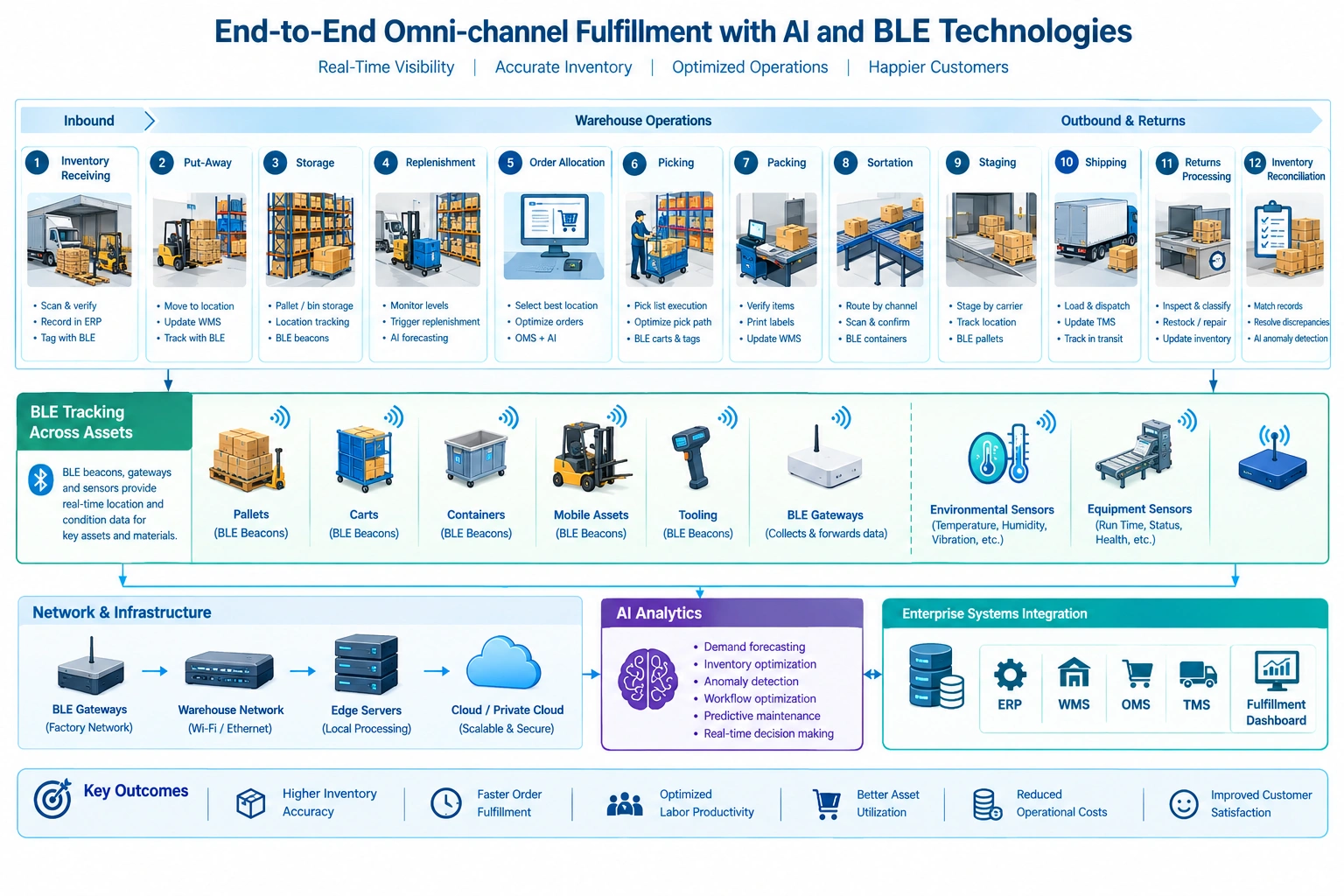
This visual illustrates the complete omni-channel fulfillment process from inventory receiving through shipping, returns processing, and inventory reconciliation. It demonstrates how BLE beacons, gateways, sensors, AI analytics, and integrated enterprise systems such as ERP, WMS, OMS, and TMS work together to improve inventory visibility, order fulfillment efficiency, asset utilization, and operational performance.
Operational Challenges in Omni-channel Fulfillment
Inventory Synchronization Across Multiple Fulfillment Locations
Omni-channel environments often manage inventory across:
- Regional distribution centers
- Retail stores
- Micro-fulfillment centers
- Third-party logistics facilities
- Cross-docking hubs
Inventory synchronization delays can create stock inaccuracies and fulfillment disruptions. AI continuously monitors inventory events and identifies synchronization anomalies that require investigation.
Fulfillment Bottlenecks and Throughput Constraints
Fulfillment operations frequently encounter bottlenecks involving:
- Receiving docks
- Put-away activities
- Replenishment workflows
- Picking operations
- Packing stations
- Sortation systems
- Shipping docks
AI identifies operational bottlenecks by analyzing workflow patterns, queue lengths, labor allocation, and equipment utilization metrics.
Asset Visibility Challenges
Many fulfillment facilities struggle to locate:
- Picking carts
- Rolling racks
- Mobile workstations
- Returnable containers
- Staging assets
- Material handling equipment
BLE tracking improves visibility into asset locations and movement history while providing data that AI systems can use to optimize utilization and reduce search time.
Labor Productivity Variability
Labor productivity can vary significantly between shifts, facilities, workflows, and operational periods.
AI helps identify:
- Performance trends
- Workflow inefficiencies
- Congestion points
- Travel inefficiencies
- Resource allocation opportunities
These insights support continuous operational improvement initiatives.
End-to-End AI Workflow for Omni-channel Fulfillment
AI-driven fulfillment solutions operate through a structured data lifecycle beginning with operational data acquisition and ending with business actions that improve fulfillment performance.
Data Acquisition Layer
Operational data is collected from multiple sources including:
- BLE beacons
- BLE sensors
- Warehouse management systems
- Order management systems
- Transportation management systems
- Enterprise resource planning systems
- Inventory control systems
- Labor management systems
- Mobile fulfillment devices
Communication and Data Collection Layer
BLE gateways collect information from tagged assets and connected devices throughout fulfillment facilities. Data is transferred through warehouse networks to edge computing systems, cloud software, or privately managed servers for further processing.
Data Processing and Integration Layer
Operational data is normalized, filtered, validated, and integrated with business systems such as:
- ERP
- WMS
- OMS
- TMS
- Labor management software
- Business intelligence systems
BLE Hardware, AI Software, Communication Infrastructure, and Deployment Models
Successful omni-channel fulfillment solutions require coordinated operation of tracking hardware, communication networks, analytics software, and enterprise business systems.
BLE Beacons
BLE beacons are commonly attached to:
- Inventory pallets
- Order carts
- Rolling containers
- Reusable transport assets
- Mobile fulfillment equipment
- High-value inventory
- Cross-docking assets
These devices transmit identifiers that help fulfillment teams monitor asset location, movement history, dwell time, and utilization patterns.
BLE Gateways
BLE gateways collect information from beacons and sensors distributed throughout fulfillment facilities.
Common gateway deployment locations include:
- Receiving docks
- Storage zones
- Picking areas
- Packing stations
- Sortation systems
- Shipping docks
- Staging areas
- Returns processing zones
Gateway placement directly affects location accuracy and system performance.
BLE Sensors
BLE sensors provide environmental and operational monitoring data such as:
- Temperature
- Humidity
- Vibration
- Equipment status
- Storage conditions
These measurements help organizations monitor fulfillment conditions and support quality assurance objectives.
AI Models Used in Omni-channel Fulfillment
AI solutions frequently utilize:
- Machine learning
- Predictive analytics
- Demand forecasting
- Optimization algorithms
- Anomaly detection
- Computer vision
- Workforce analytics
- Inventory forecasting
These models transform operational data into recommendations and automated business actions.
Communication Protocols and Data Flow
Data commonly moves through:
- BLE communications
- Wi-Fi networks
- Ethernet infrastructure
- Secure API integrations
- Cloud messaging services
- Edge computing environments
Information collected from fulfillment assets is integrated with enterprise software systems to provide a unified operational view.
Cloud Software Deployment
Cloud-hosted deployments are often selected when organizations require:
- Multi-site visibility
- Rapid scalability
- Centralized analytics
- Simplified software maintenance
- Remote operational access
Cloud deployments are commonly used by retailers and fulfillment organizations operating multiple distribution centers and store fulfillment locations.
Server-Based Deployment
Privately hosted server deployments may be preferred when organizations require:
- Enhanced control over operational data
- Internal compliance requirements
- Custom integrations
- Dedicated infrastructure management
- Private fulfillment environments
Server-based solutions may operate within private data centers, customer-managed facilities, or dedicated enterprise hosting environments.
GAO supplies BLE and IoT hardware solutions that support both cloud and privately hosted deployment strategies across fulfillment operations.
AI Solution Matrix for Omni-channel Fulfillment Using BLE Tracking and Predictive Analytics
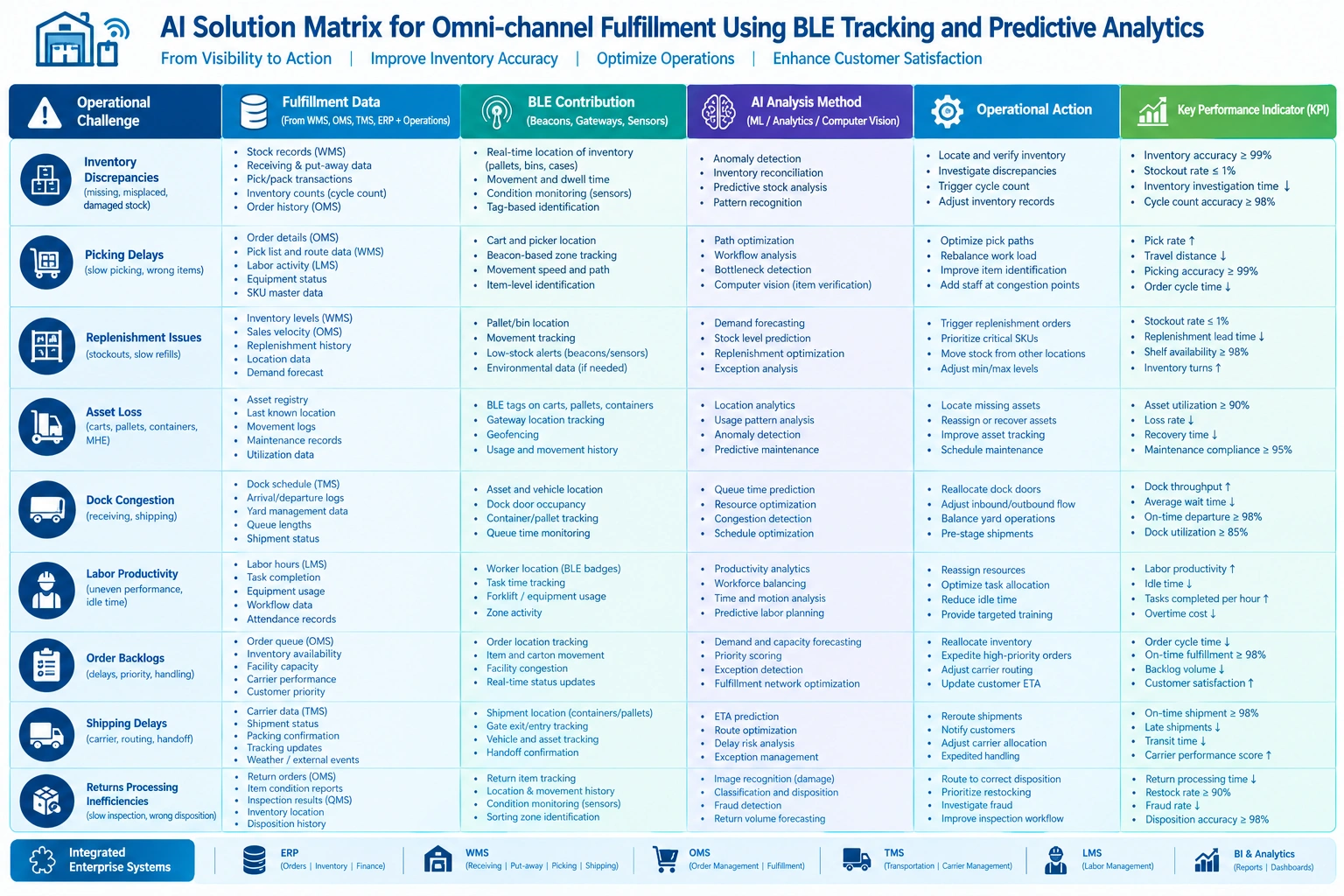
This visual presents a comprehensive solution matrix that maps common omni-channel fulfillment challenges to BLE-enabled data collection, AI analysis techniques, operational responses, and measurable performance indicators. It demonstrates how fulfillment organizations can use BLE tracking data alongside ERP, WMS, OMS, and TMS information to improve inventory accuracy, labor productivity, order fulfillment speed, asset visibility, and operational efficiency.
Technical Capabilities and Operational Benefits
Real-Time Inventory Visibility
AI-driven inventory management supported by BLE tracking helps organizations improve visibility into inventory movement across multiple fulfillment locations.
Benefits include:
- Improved inventory accuracy
- Reduced inventory search time
- Faster cycle counting
- Better replenishment planning
- Improved stock availability
Faster Order Fulfillment
AI continuously evaluates fulfillment priorities and operational capacity.
Benefits include:
- Reduced order cycle times
- Improved order throughput
- Better resource allocation
- Reduced fulfillment delays
- Higher customer satisfaction
Improved Labor Productivity
AI identifies opportunities to improve workforce performance by analyzing operational patterns.
Benefits include:
- Reduced travel distance
- Improved task allocation
- Better workload balancing
- Enhanced productivity measurement
- Improved workforce planning
Asset Utilization Optimization
BLE tracking improves visibility into mobile fulfillment assets.
Benefits include:
- Reduced asset loss
- Better utilization rates
- Reduced replacement costs
- Faster asset recovery
- Improved operational efficiency
Enhanced Inventory Accuracy
Inventory accuracy directly affects customer satisfaction and fulfillment performance.
Benefits include:
- Reduced stock discrepancies
- Improved order fulfillment rates
- Better replenishment execution
- Improved inventory confidence
- Reduced inventory investigations
Reduced Operational Costs
AI supports continuous operational optimization.
Benefits include:
- Reduced labor costs
- Lower transportation costs
- Reduced inventory carrying costs
- Reduced operational waste
- Improved facility utilization
Better Customer Service Performance
Improved visibility and operational control help organizations meet customer expectations.
Benefits include:
- Improved on-time fulfillment
- Better order accuracy
- Reduced backorders
- Faster delivery execution
- Improved service consistency
Engineering Considerations and Deployment Best Practices
Successful deployments require careful planning and operational alignment.
Asset Selection Strategy
Organizations should identify:
- Critical fulfillment assets
- High-value inventory
- Mobile operational equipment
- Frequently misplaced assets
- Operational bottlenecks
Tracking every asset is not always necessary. High-impact assets often deliver the greatest return on investment.
Gateway Coverage Planning
Gateway placement should support:
- Receiving visibility
- Storage visibility
- Picking visibility
- Shipping visibility
- Returns visibility
Coverage testing is essential before large-scale deployment.
Data Quality Management
AI effectiveness depends on accurate operational data.
Recommended practices include:
- Data validation
- Asset registration controls
- Location verification
- System integration testing
- Ongoing performance monitoring
Enterprise System Integration
Successful solutions commonly integrate with:
- ERP
- WMS
- OMS
- TMS
- LMS
- Business intelligence software
Integration ensures that physical operations and business processes remain synchronized.
Cybersecurity and Access Control
Security measures should include:
- Role-based access controls
- Data encryption
- Secure APIs
- Network segmentation
- Audit logging
These controls help protect fulfillment operations and operational data.
Implementation Recommendations for Omni-channel Fulfillment Organizations
Organizations pursuing AI-driven fulfillment initiatives should focus on measurable operational objectives before deployment.
Recommended priorities include:
- Improving inventory accuracy
- Increasing fulfillment throughput
- Reducing order cycle times
- Enhancing labor productivity
- Improving asset visibility
- Reducing operational bottlenecks
- Strengthening inventory synchronization
- Improving customer service performance
A phased deployment strategy typically reduces implementation risk while allowing operational teams to validate performance improvements before expanding deployment scope.
Many organizations begin with inventory visibility and asset tracking initiatives before expanding into predictive analytics, labor optimization, and advanced fulfillment automation.
AI-Powered Omni-channel Fulfillment: Key Takeaways
AI-powered omni-channel fulfillment combines operational intelligence, inventory visibility, workforce optimization, and predictive analytics to improve fulfillment performance across distribution centers, stores, and logistics networks. BLE-enabled visibility provides valuable operational data that helps AI systems identify inefficiencies, predict disruptions, optimize workflows, and support more accurate decision-making.
Organizations that successfully integrate AI analytics with fulfillment operations can improve inventory accuracy, fulfillment speed, workforce productivity, and customer service outcomes while reducing operational costs and fulfillment risks. GAO continues to support organizations by supplying BLE, RFID, and IoT hardware products and systems that enable reliable data collection and operational visibility throughout fulfillment environments.
Building the Future of Industrial AI and IoT with Aperture Venture Studio and GAO RFID Inc.
For more than three decades, GAO Group of Companies has invested heavily in research and development of BLE, RFID, IoT, and industrial connectivity technologies. As AI adoption continues to expand across omni-channel fulfillment operations, we have advanced AIoT solutions that combine artificial intelligence with connected devices, sensors, and operational systems to improve fulfillment visibility and decision-making.
Aperture Venture Studio was established to help accelerate the development and growth of AI and IoT solutions that address real operational challenges across fulfillment, logistics, supply chain, and other sectors. Together with leading technical experts, business leaders, investors, and industry participants, we continue to advance practical AI and IoT innovation through collaborative initiatives such as Aperture Ventures Summit and TekSummit.
We welcome you to join us as:
- Advisors, Co-founders or Employees
- Investors
- Customers