
AI and BLE for E-commerce Fulfillment
Transforming E-commerce Fulfillment with AI-Driven Inventory Visibility and Operational Intelligence
E-commerce fulfillment operations must process large order volumes while maintaining inventory accuracy, rapid order execution, efficient warehouse workflows, and consistent customer service. AI-powered fulfillment solutions supported by BLE beacons, BLE gateways, and BLE sensors help fulfillment organizations gain real-time visibility into inventory, material handling assets, order movement, labor activity, and warehouse operations.
Modern e-commerce fulfillment centers support same-day delivery, next-day delivery, click-and-collect services, marketplace fulfillment, direct-to-consumer distribution, returns processing, and multi-channel inventory management. These operations generate large volumes of operational data that can be analyzed using AI to identify inefficiencies, predict bottlenecks, optimize labor allocation, improve inventory accuracy, and accelerate order fulfillment.
AI-driven fulfillment systems supported by BLE technologies enable organizations to improve order processing speed, reduce inventory discrepancies, enhance warehouse productivity, and strengthen operational decision-making. By combining operational visibility with predictive analytics, fulfillment teams can respond more effectively to changing demand patterns and customer expectations.
GAO has helped organizations improve fulfillment visibility and warehouse operations by supplying BLE, RFID, and IoT hardware products and systems that support inventory tracking, asset monitoring, and operational data collection.
Understanding AI-Powered E-commerce Fulfillment and BLE-Enabled Visibility
E-commerce fulfillment includes all activities required to receive, store, manage, pick, pack, ship, and return products purchased through online sales channels. Successful fulfillment operations depend on accurate inventory records, efficient warehouse workflows, reliable order execution, and synchronized movement of products throughout distribution facilities.
AI improves e-commerce fulfillment by analyzing operational data from warehouse management systems, order management systems, transportation systems, inventory records, labor management applications, and connected devices. These insights help fulfillment managers improve operational performance and proactively address issues before they affect customer orders.
BLE technologies contribute by providing visibility into the location and movement of fulfillment assets such as:
- Inventory pallets
- Inventory totes
- Picking carts
- Mobile workstations
- Returnable containers
- Material handling equipment
- Order consolidation carts
- Dock staging assets
- High-value inventory
- Replenishment carts
BLE-generated operational data allows AI systems to identify workflow inefficiencies, monitor asset utilization, detect inventory anomalies, and support more accurate fulfillment decisions.
Key AI Applications in E-commerce Fulfillment Operations
AI Inventory Management and Inventory Accuracy
Inventory accuracy directly affects order fulfillment performance. Inventory records that do not accurately reflect physical inventory can result in stockouts, order cancellations, delayed shipments, and customer dissatisfaction.
AI analyzes:
- Inventory transactions
- SKU movement patterns
- Cycle count records
- Receiving activities
- Replenishment activity
- Warehouse location data
- BLE asset tracking information
AI models can identify inventory discrepancies, predict stock shortages, and recommend corrective actions before fulfillment operations are impacted.
AI Order Allocation and Order Routing
Order allocation determines the most effective location from which customer orders should be fulfilled.
AI evaluates:
- Available inventory
- Distribution center capacity
- Warehouse workload
- Shipping costs
- Delivery commitments
- Carrier performance
- Labor availability
These insights help organizations improve fulfillment speed while reducing operational costs.
AI Picking Optimization
Order picking is one of the most labor-intensive processes within e-commerce fulfillment centers.
AI analyzes:
- Picking routes
- Travel distances
- Congestion zones
- Picker productivity
- Order characteristics
- Equipment utilization
Optimized picking workflows reduce travel time, improve throughput, and increase labor productivity.
AI Replenishment Optimization
Inventory replenishment ensures products remain available in forward-picking locations.
AI evaluates:
- SKU demand patterns
- Order volume trends
- Replenishment history
- Storage utilization
- Inventory turnover
This enables fulfillment teams to reduce stock shortages and improve picking efficiency.
AI Returns Processing
Returns management plays a critical role in e-commerce fulfillment operations.
AI supports:
- Return classification
- Product disposition decisions
- Damage assessment
- Fraud detection
- Inventory recovery prioritization
These capabilities help organizations reduce processing costs while accelerating inventory recovery.
AI-Powered E-commerce Fulfillment Workflow with BLE Asset Tracking and Enterprise Systems Integration
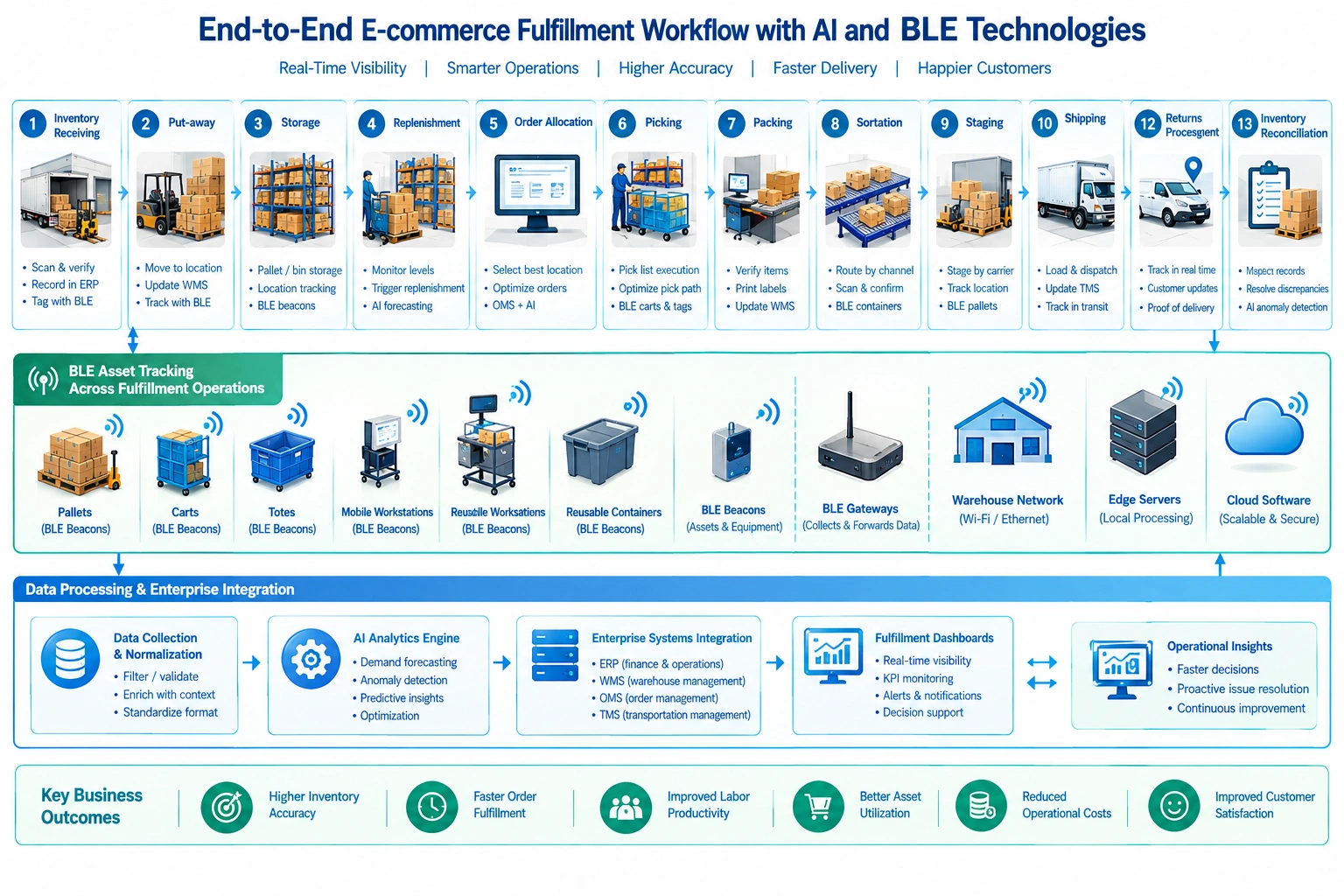
This visual illustrates the complete e-commerce fulfillment lifecycle from inventory receiving and storage through picking, packing, shipping, returns processing, and inventory reconciliation. It demonstrates how BLE beacons, BLE gateways, warehouse networks, AI analytics, and integrated ERP, WMS, OMS, and TMS systems work together to improve inventory visibility, fulfillment efficiency, asset utilization, and operational decision-making.
Operational Challenges in E-commerce Fulfillment
Inventory Visibility Challenges
Large fulfillment facilities often struggle to maintain real-time inventory visibility across receiving zones, storage locations, picking areas, packing stations, and shipping docks.
Common challenges include:
- Misplaced inventory
- Inventory discrepancies
- Inaccurate stock records
- Delayed inventory updates
- Inventory search time
AI combined with BLE tracking helps improve inventory visibility throughout fulfillment operations.
Order Processing Bottlenecks
Order fulfillment workflows may experience delays during:
- Receiving
- Put-away
- Replenishment
- Picking
- Packing
- Sortation
- Shipping
AI identifies workflow bottlenecks and helps managers allocate resources more effectively.
Asset Tracking Difficulties
Fulfillment facilities rely on numerous mobile assets.
Commonly tracked assets include:
- Picking carts
- Pallet jacks
- Rolling racks
- Reusable containers
- Mobile workstations
- Staging equipment
BLE tracking improves asset visibility and reduces time spent searching for equipment.
Labor Productivity Variability
Labor performance can vary significantly between facilities, shifts, and operational periods.
AI identifies:
- Travel inefficiencies
- Congestion points
- Resource allocation issues
- Process bottlenecks
- Workforce utilization opportunities
These insights support continuous operational improvement.
AI-Powered E-commerce Fulfillment Solution Matrix
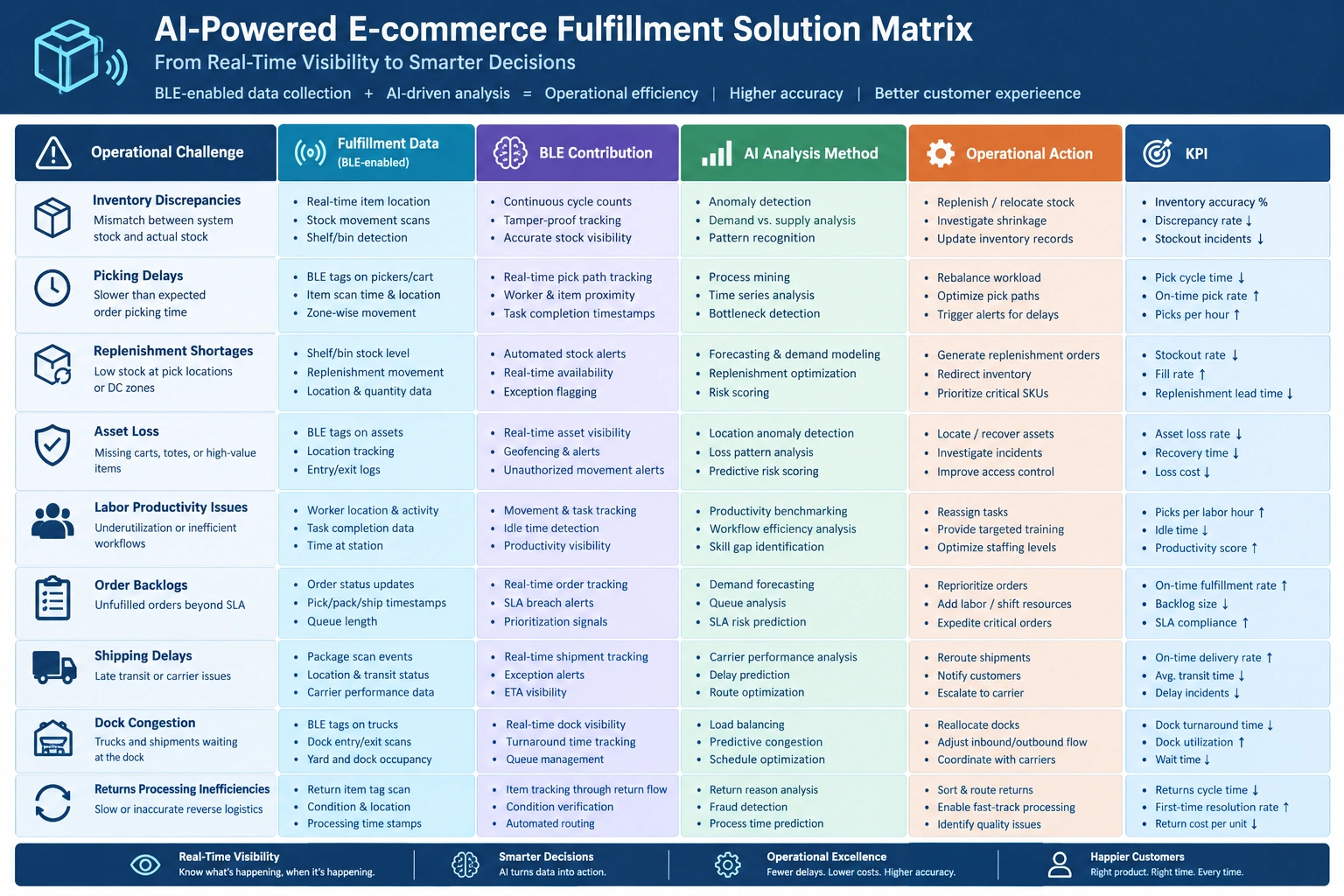
A solution matrix showing how BLE-enabled data collection and AI analysis address key e-commerce fulfillment challenges, from inventory discrepancies and picking delays to shipping, dock congestion, and returns.
End-to-End AI Workflow for E-commerce Fulfillment
Data Acquisition Layer
Operational data is continuously collected from multiple sources throughout fulfillment operations.
Data sources include:
- BLE beacons
- BLE sensors
- Warehouse management systems
- Order management systems
- Transportation management systems
- Inventory control systems
- Labor management software
- Mobile warehouse devices
- Barcode scanning systems
Communication and Data Collection Layer
BLE gateways collect information from tracked assets and connected devices throughout the fulfillment facility.
Data is transmitted through:
- BLE communications
- Warehouse Wi-Fi
- Ethernet infrastructure
- Edge computing systems
- Cloud-hosted environments
- Private enterprise servers
The communication layer ensures reliable transfer of operational data for further analysis.
Data Processing and Enterprise Integration Layer
Collected operational information is validated, normalized, and integrated with business software systems including:
- ERP software
- WMS software
- OMS software
- TMS software
- Labor management systems
- Business intelligence software
BLE Hardware, AI Software, Communication Infrastructure, and Deployment Models for E-commerce Fulfillment
Modern e-commerce fulfillment operations require reliable visibility into inventory, assets, workflows, labor activity, and order movement. AI-powered fulfillment solutions depend on coordinated operation between BLE hardware, communication networks, analytics software, and fulfillment management systems.
BLE Beacons
BLE beacons are commonly attached to:
- Inventory totes
- Inventory pallets
- Picking carts
- Rolling containers
- Replenishment carts
- Mobile workstations
- Returnable transport items
- High-value inventory
- Dock staging assets
These devices continuously provide location and movement data that helps fulfillment teams monitor operational activity throughout the warehouse.
BLE Gateways
BLE gateways collect data transmitted from beacons and sensors deployed throughout fulfillment facilities.
Typical deployment locations include:
- Receiving docks
- Storage aisles
- Forward picking zones
- Packing stations
- Sortation areas
- Shipping docks
- Returns processing areas
- Staging locations
Proper gateway placement improves visibility accuracy and operational coverage.
BLE Sensors
BLE sensors support monitoring of:
- Temperature
- Humidity
- Equipment condition
- Environmental conditions
- Storage areas
- Sensitive inventory locations
Sensor data helps maintain operational quality standards and improve warehouse performance.
AI Models Used in E-commerce Fulfillment
Common AI methods include:
- Machine learning
- Predictive analytics
- Demand forecasting
- Workforce optimization
- Inventory forecasting
- Anomaly detection
- Computer vision
- Route optimization
- Operational intelligence
These AI models transform operational data into actionable recommendations and automated business decisions.
Communication Infrastructure
Data typically moves through:
- BLE communications
- Wi-Fi networks
- Ethernet infrastructure
- Secure APIs
- Edge computing systems
- Cloud-hosted software
This communication framework enables continuous visibility throughout fulfillment operations.
Cloud Deployment Model
Cloud-hosted software is commonly selected when organizations require:
- Multi-site visibility
- Centralized analytics
- Rapid deployment
- Flexible scalability
- Remote management
Cloud deployments are frequently used by organizations operating multiple fulfillment centers and distribution facilities.
Server Deployment Model
Privately managed server deployments may be preferred when organizations require:
- Internal data governance
- Custom integrations
- Dedicated infrastructure control
- Private hosting environments
- Compliance-specific requirements
Server-based solutions can operate on customer-managed servers, private data centers, or dedicated hosting environments.
GAO supplies BLE, RFID, and IoT hardware products and systems that support both cloud and server-based deployment models for fulfillment operations.
Technical Capabilities and Business Benefits
Real-Time Inventory Visibility
AI-powered inventory visibility supported by BLE tracking improves awareness of inventory movement throughout fulfillment facilities.
Benefits include:
- Improved inventory accuracy
- Faster inventory searches
- Better stock availability
- Reduced inventory discrepancies
- Improved replenishment planning
Improved Order Fulfillment Performance
AI continuously analyzes order flow and warehouse activity to optimize fulfillment operations.
Benefits include:
- Faster order processing
- Reduced order cycle times
- Improved order accuracy
- Higher throughput
- Better customer service levels
Labor Productivity Optimization
AI helps fulfillment organizations improve workforce performance.
Benefits include:
- Reduced travel distances
- Improved task allocation
- Better workforce utilization
- Increased picking productivity
- Improved shift performance
Asset Utilization Improvement
BLE tracking improves visibility into operational assets.
Benefits include:
- Reduced asset loss
- Faster asset recovery
- Improved utilization rates
- Lower replacement costs
- Improved operational efficiency
Inventory Accuracy Enhancement
Inventory accuracy is critical for successful e-commerce fulfillment.
Benefits include:
- Reduced stock discrepancies
- Improved inventory confidence
- Improved fulfillment reliability
- Better inventory reconciliation
- Reduced inventory investigations
Operational Cost Reduction
AI-driven operational improvements help reduce fulfillment costs.
Benefits include:
- Reduced labor costs
- Lower inventory carrying costs
- Reduced operational waste
- Better facility utilization
- Improved process efficiency
Improved Customer Experience
Fulfillment performance directly affects customer satisfaction.
Benefits include:
- Improved delivery performance
- Better order accuracy
- Reduced order delays
- Improved inventory availability
- Consistent fulfillment execution
Engineering Considerations and Deployment Best Practices
Successful deployment requires careful planning and operational alignment.
Asset Selection Strategy
Organizations should prioritize tracking:
- High-value inventory
- Mobile assets
- Picking equipment
- Replenishment equipment
- Frequently misplaced assets
- Operational bottlenecks
Tracking the most operationally important assets often delivers the highest business value.
Gateway Coverage Planning
Gateway deployment should support visibility across:
- Receiving operations
- Storage locations
- Picking zones
- Packing stations
- Shipping docks
- Returns processing areas
Coverage testing should be performed before full deployment.
Data Quality Management
AI performance depends on accurate operational data.
Recommended practices include:
- Data validation
- Asset registration controls
- Location verification
- Integration testing
- Ongoing monitoring
Enterprise Software Integration
Successful deployments commonly integrate with:
- ERP software
- WMS software
- OMS software
- TMS software
- Labor management software
- Business intelligence applications
Integration ensures operational data and business transactions remain synchronized.
Security and Access Control
Recommended security measures include:
- Role-based access controls
- Data encryption
- Secure APIs
- Network segmentation
- Audit logging
These controls help protect fulfillment operations and operational data.
Implementation Recommendations for E-commerce Fulfillment Operations
Organizations pursuing AI-driven fulfillment initiatives should focus on measurable operational objectives before deployment.
Recommended priorities include:
- Improving inventory accuracy
- Increasing fulfillment throughput
- Reducing order cycle times
- Improving labor productivity
- Enhancing asset visibility
- Reducing operational bottlenecks
- Improving inventory synchronization
- Strengthening customer service performance
A phased implementation strategy often reduces deployment risk while allowing fulfillment teams to validate performance improvements before expanding deployment across additional facilities.
Many organizations begin with inventory visibility and asset tracking initiatives before expanding into predictive analytics, workforce optimization, and advanced fulfillment intelligence capabilities.
AI-Powered E-commerce Fulfillment: Key Takeaways
AI-powered e-commerce fulfillment combines inventory visibility, operational intelligence, workforce optimization, and predictive analytics to improve warehouse performance and customer service outcomes. BLE-enabled visibility provides operational data that helps AI systems identify inefficiencies, optimize workflows, improve inventory accuracy, and support faster fulfillment decisions.
Organizations that successfully integrate AI analytics with fulfillment operations can improve order accuracy, increase throughput, strengthen inventory visibility, reduce operational costs, and enhance customer satisfaction. GAO continues to support fulfillment organizations by supplying BLE, RFID, and IoT hardware products and systems that enable reliable operational visibility and data collection throughout warehouse environments.
Building the Future of Industrial AI and IoT with Aperture Venture Studio and GAO RFID Inc.
For more than three decades, GAO Group of Companies has invested heavily in research and development of BLE, RFID, and IoT technologies. As AI adoption expands across e-commerce fulfillment and warehouse operations, we continue developing AIoT solutions that combine artificial intelligence with connected devices, sensors, and operational systems to improve visibility, efficiency, and decision-making.
Aperture Venture Studio was established to support the advancement of AI and IoT solutions addressing fulfillment, logistics, inventory management, and supply chain challenges. Together with technical experts, operational leaders, investors, and industry participants, we continue fostering innovation through initiatives such as Aperture Ventures Summit and TekSummit.
We welcome you to join us as:
- Advisors, Co-founders or Employees
- Investors
- Customers