
AI and RFID for Tunnel Construction in Passenger Vehicle Manufacturing.
AI-Driven Tunnel Construction for Passenger Vehicle Manufacturing Facilities
Tunnel construction supporting passenger vehicle manufacturing facilities requires continuous control of excavation, materials, equipment, personnel, utilities, and changing underground conditions. AI can help construction teams turn data from connected equipment, inspection systems, project records, and identification technologies into earlier warnings and better operational decisions. RFID provides one practical data-capture method for identifying tagged construction assets, tools, materials, components, and equipment as they move through tunnel work areas.
For passenger vehicle manufacturing, this is particularly relevant when tunnels support plant logistics, utilities, conveyor routes, pedestrian access, ventilation, water management, or connections between production buildings. AI can correlate RFID observations with schedules, equipment telemetry, inspection information, and maintenance records to identify delays, abnormal asset movements, resource bottlenecks, and potential operational risks. GAO provides RFID, BLE, and IoT hardware products and systems that can support these connected construction and industrial applications.
Why AI Matters in Tunnel Construction for Vehicle Manufacturing Plants
Tunnel construction inside or around a passenger vehicle manufacturing environment is different from a conventional isolated civil construction project. Excavation and underground work may take place while nearby manufacturing operations continue. Construction teams therefore need visibility into materials, mobile equipment, temporary infrastructure, access points, work crews, and interfaces between construction and plant operations.
AI can support this environment by analyzing large quantities of operational data and identifying relationships that are difficult to monitor manually. Machine learning can detect patterns associated with equipment utilization, material movement, schedule deviation, or recurring maintenance conditions. Computer vision can support inspection and progress monitoring where cameras can safely operate. Edge AI can process selected data close to the tunnel work area when response time, connectivity, or data-volume requirements make centralized processing unsuitable.
RFID becomes an enabling identification layer rather than the objective of the solution. Tagged assets can provide identity and location-event information that AI software uses alongside other data sources. UHF RFID is particularly useful when longer read ranges are required for tagged equipment, tools, materials, or logistics movements. HF RFID can be appropriate for shorter-range identification and controlled interactions, while LF RFID can support specific proximity-based identification requirements.
AI-Driven Tunnel Construction Architecture for Passenger Vehicle Manufacturing
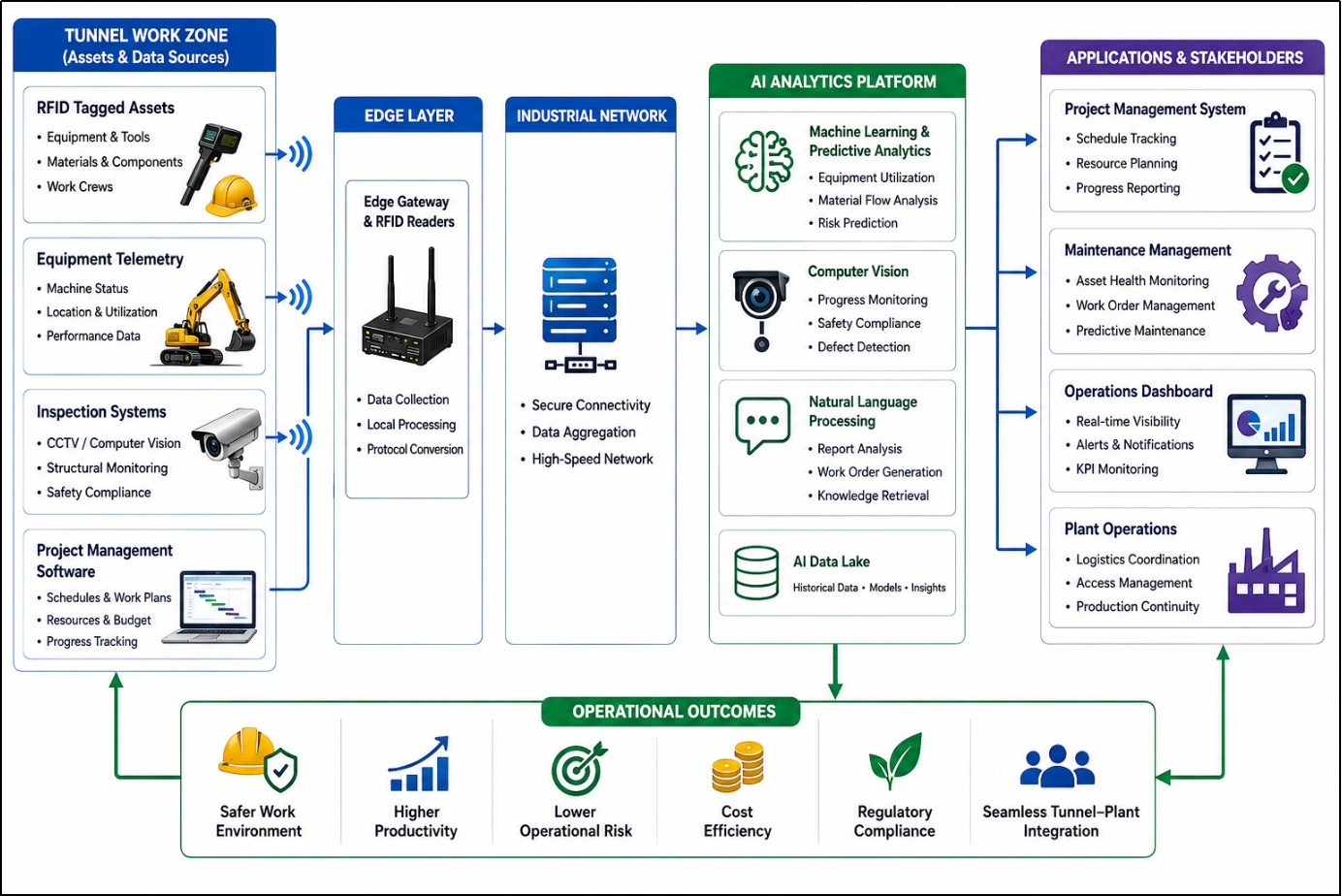
This technical architecture diagram illustrates how RFID-tagged construction assets, equipment telemetry, inspection systems, and project data flow through edge processing and secure industrial networks into a centralized AI and analytics platform. It shows how AI insights connect with project management, maintenance, inventory, safety, and plant systems to support real-time monitoring, predictive analysis, operational decisions, and improved tunnel-to-plant integration.
Tunnel Construction Applications Across Passenger Vehicle Manufacturing
AI-enabled tunnel construction solutions can address several operational requirements within passenger vehicle manufacturing projects:
- Construction asset tracking: RFID identification can provide movement events for tools, temporary equipment, construction materials, electrical components, ventilation equipment, pumps, and other tagged assets. AI can analyze these events against expected movement patterns and project schedules.
- Material flow monitoring: Tagged materials can be associated with work packages and delivery stages. AI can identify unusual delays between receiving, staging, transport, and installation.
- Equipment utilization: RFID observations can supplement equipment telemetry and operator records to determine whether critical construction equipment is available, underused, or repeatedly moved between work areas.
- Tunnel logistics: AI can combine asset-location events with schedules and work-zone information to identify congestion, resource conflicts, or inefficient movement patterns.
- Inspection and progress monitoring: Computer vision, digital inspection records, and RFID-based identification can help associate observed work with specific equipment, materials, zones, or work packages.
- Maintenance coordination: Tagged pumps, ventilation units, temporary electrical equipment, and construction machinery can be associated with inspection and maintenance records so teams can identify assets requiring attention.
- Plant interface management: When tunnel construction connects with active passenger vehicle manufacturing facilities, AI can help correlate construction activities with plant access requirements, logistics routes, utility interfaces, and planned shutdowns.
From RFID Data Capture to AI-Driven Construction Decisions
A practical AI and RFID solution begins with physical data acquisition. RFID readers installed at controlled access points, material staging areas, tunnel entrances, equipment zones, or other suitable locations detect tagged objects. Depending on the application, handheld RFID readers can also be used for inspections, inventories, commissioning activities, and field verification.
Reader events are transmitted through wired or wireless industrial communication infrastructure to an edge gateway, local server, or cloud-connected service. Middleware filters duplicate reads, associates tag identifiers with asset records, applies business rules, and forwards usable events to operational software.
AI models can then combine RFID events with additional information such as equipment telemetry, construction schedules, inspection results, maintenance records, environmental measurements, and project progress data. The resulting analysis can support decisions such as reallocating equipment, investigating missing materials, prioritizing inspections, adjusting logistics activities, or escalating a developing schedule deviation.
The important engineering consideration is that an RFID read is not automatically a precise real-time location. Read range, antenna orientation, metal structures, tunnel geometry, electromagnetic interference, tag placement, reader configuration, and multipath effects can influence detection. A reliable deployment therefore requires site testing and a carefully defined interpretation of RFID events before AI models are trained on the resulting data.
RFID-to-AI Workflow for Tunnel Construction in Passenger Vehicle Manufacturing
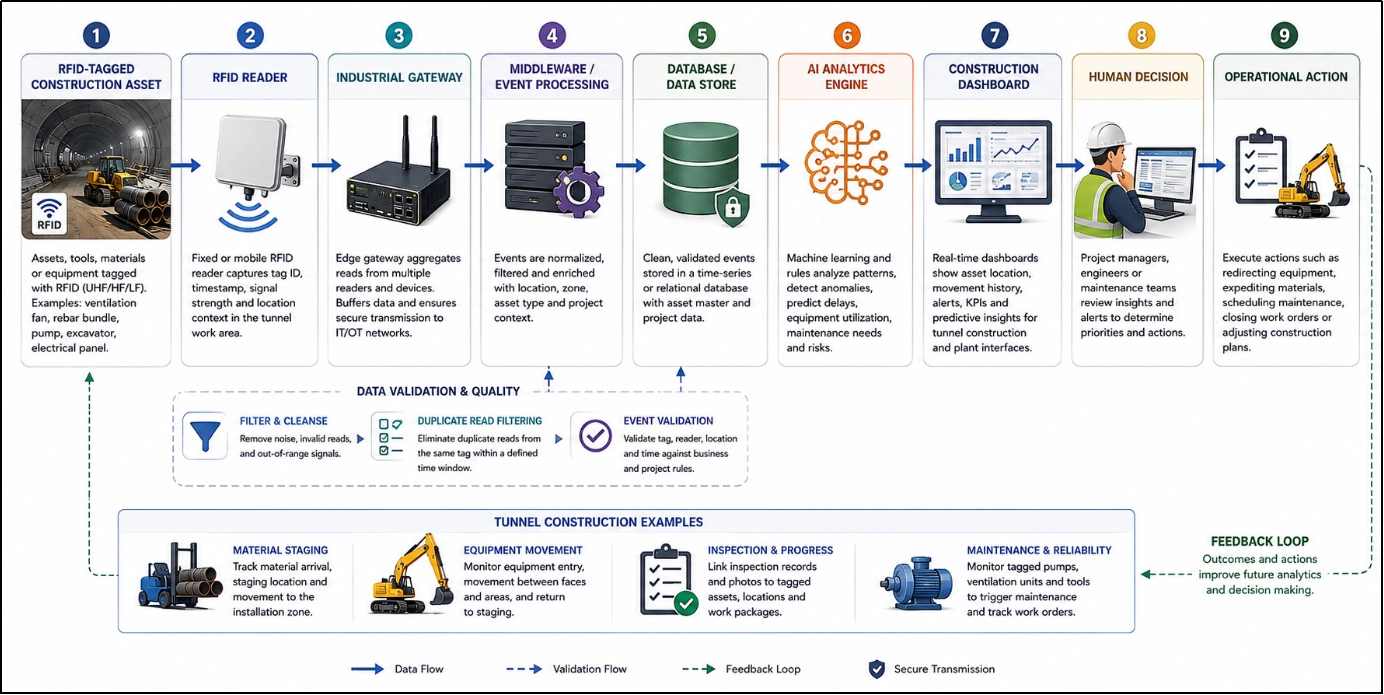
This workflow diagram shows how data moves from RFID-tagged construction assets through RFID readers, industrial gateways, middleware, databases, and AI analytics to construction dashboards and human decisions. It highlights data validation, duplicate-read filtering, and practical applications including material staging, equipment movement, inspection, progress monitoring, and maintenance.
Engineering Considerations for Deployment
Successful deployment depends on the physical characteristics of the tunnel and the construction activities taking place within it. Reinforced concrete, steel structures, machinery, electrical equipment, temporary barriers, and narrow passages can affect RFID performance. Tag selection should therefore consider mounting surface, material composition, environmental exposure, temperature, moisture, vibration, impact, and required read distance.
The data model is equally important. Asset identifiers should connect RFID events to meaningful records such as equipment type, work package, responsible contractor, maintenance status, tunnel zone, or material category. Without this contextual layer, AI receives identification events but has limited operational meaning.
For passenger vehicle manufacturing facilities, integration should also consider existing maintenance management, enterprise resource planning, construction management, industrial IoT, access control, and plant logistics software. GAO’s RFID and IoT hardware can form part of this data-capture layer where the deployment requires physical identification and connected asset monitoring.
RFID Deployment in Tunnel Construction for Passenger Vehicle Manufacturing
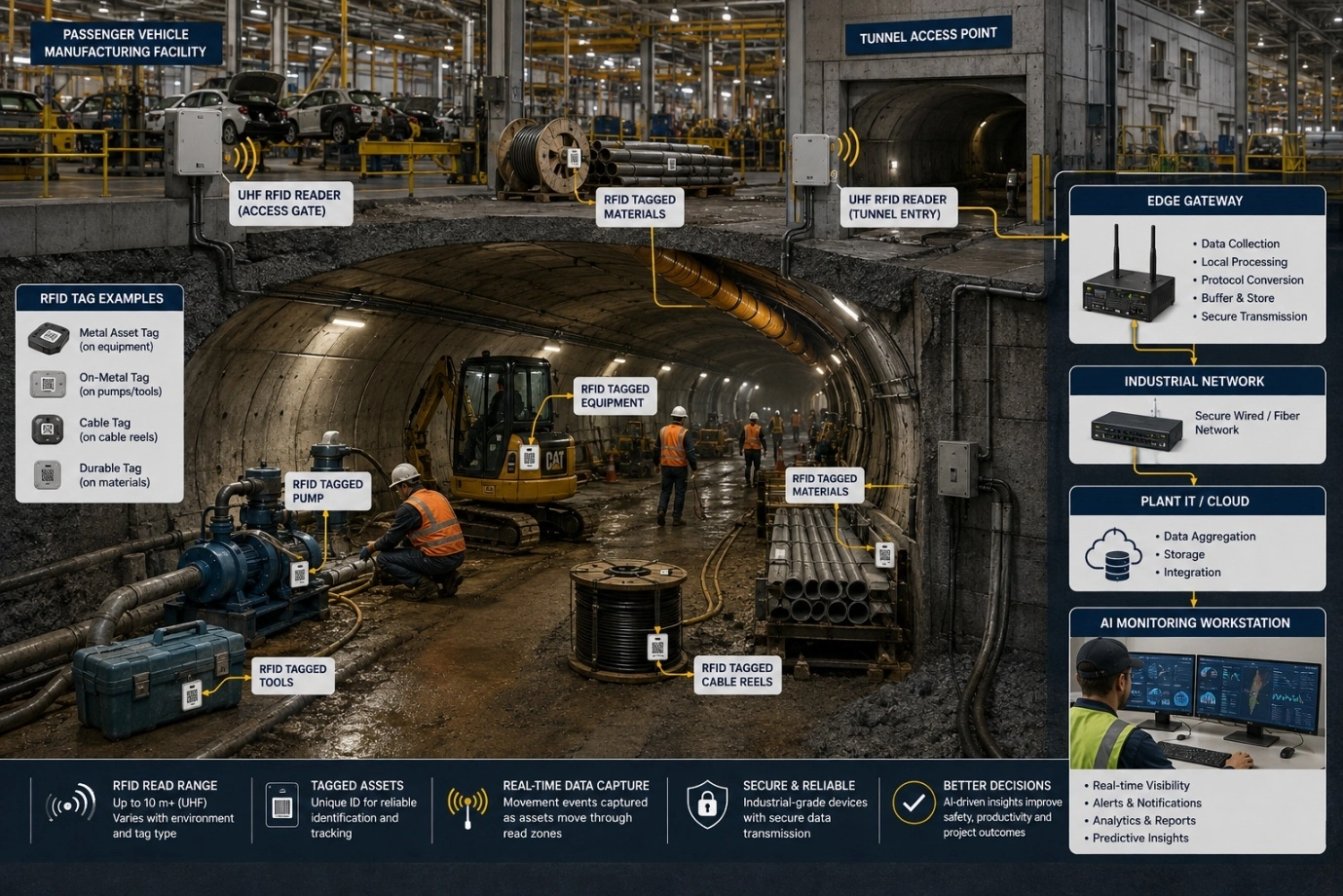
This realistic cutaway illustration shows how UHF RFID readers and tagged construction assets operate within an underground tunnel beneath a passenger vehicle manufacturing facility. It traces asset data from tagged pumps, tools, materials, cable reels, and equipment through RFID readers and an edge gateway to the industrial network, plant IT/cloud systems, and an AI monitoring workstation.
Practical Deployment Principle
The strongest results come from treating AI, RFID, and other IoT technologies as components of a defined construction-control process rather than deploying sensors without an operational objective. Passenger vehicle manufacturing projects should first identify the decisions that need better data, then determine which assets and events must be captured, where identification points should be installed, how the information will reach AI software, and which operational action should follow an AI-generated alert or recommendation.
RFID, AI Software, and Deployment Models for Tunnel Construction
A production-ready solution for tunnel construction supporting passenger vehicle manufacturing combines physical identification hardware, communication infrastructure, data-processing software, AI analytics, and existing construction or plant systems. The exact combination depends on tunnel geometry, construction phase, connectivity, asset density, and the degree of integration required with manufacturing operations.
UHF RFID readers and tags are useful for longer-range identification of tagged equipment, tools, materials, and temporary infrastructure. HF RFID supports shorter-range identification where controlled proximity is preferable, while LF RFID can be considered for specialized close-range identification requirements. Handheld RFID readers can complement fixed readers when construction supervisors need to verify assets during inspections, inventory activities, commissioning, or material reconciliation.
RFID readers normally connect to edge gateways or local computing equipment through Ethernet, serial interfaces, or suitable wireless communication. The gateway can perform event filtering, buffering, protocol conversion, and local processing before sending relevant information to centralized software. MQTT, HTTPS, REST APIs, TCP/IP, and industrial networking technologies can be used where supported by the specific equipment and integration requirements.
AI software can operate on centralized servers or cloud infrastructure. Machine learning models can analyze asset movement, utilization, project progress, maintenance patterns, and other operational data. Computer vision can support visual inspection and progress monitoring, while anomaly-detection models can identify behavior that differs from established operating patterns.
Cloud Version
A cloud-hosted deployment can be appropriate when construction teams need centralized access across multiple tunnel work zones, contractors, engineering offices, and manufacturing locations. RFID event data and other approved operational information can be transmitted to cloud services for storage, analytics, dashboards, model management, and reporting.
Cloud deployment can simplify centralized software maintenance and support scalability when several construction projects or facilities need to share common services. It also requires careful consideration of network availability, data governance, authentication, encryption, bandwidth, and the handling of operational data that should not leave a controlled environment.
Server Version
A server deployment places the software on customer-managed infrastructure such as an edge server, factory server, private data center, or other privately hosted enterprise computing environment. This model can be useful when tunnel connectivity is intermittent, low-latency processing is important, or project and plant requirements favor local control of operational data.
A hybrid arrangement is also possible. Edge servers can process time-sensitive RFID events locally while selected data is synchronized with centralized cloud or corporate systems. This approach can reduce unnecessary network traffic and allow basic monitoring to continue during temporary connectivity disruptions.
Cloud vs. Server Deployment Models for AI-Enabled RFID Tunnel Construction
| Comparison Factor | Cloud-Hosted Software | Privately Hosted Server Software |
|---|---|---|
| Data Location | Hosted in vendor-managed cloud data centers and accessed through secure network connections. | Hosted on customer-managed infrastructure such as edge servers, plant servers, private data centers, or other privately hosted infrastructure. |
| Connectivity Dependency | Requires reliable Internet connectivity for optimal access and centralized processing. | Can operate primarily through the local network and is better suited to intermittent or limited connectivity. |
| Latency | Depends on network bandwidth, Internet conditions, and distance to the selected cloud region. | Supports low-latency local processing within the tunnel site or passenger vehicle manufacturing plant network. |
| Scalability | Highly scalable and suitable for expanding across multiple tunnel projects, facilities, or construction sites. | Scalability depends on available local computing and storage capacity and may require additional infrastructure as deployment grows. |
| Maintenance Responsibility | Cloud infrastructure, updates, patches, and many backup responsibilities are generally managed by the cloud service provider. | Customer is responsible for server hardware, operating systems, software updates, patches, backups, and disaster recovery according to its IT policies. |
| Cybersecurity Controls | Can use cloud-provider security controls, encryption, identity and access management, monitoring, and compliance capabilities. | Allows the organization to implement its own security policies, network segmentation, firewalls, identity management, and locally controlled security measures. |
| Integration with Plant Systems | Can integrate with ERP, CMMS, construction management, planning, and IoT software through APIs and secure connectors. Particularly useful for multi-site integration. | Can provide close integration with local IT/OT systems and plant infrastructure through local networks and supported industrial interfaces. |
| Offline Operation | Functionality may be limited during Internet outages, although local buffering and later synchronization can be implemented. | Better suited to local operation during Internet outages because processing and data can remain within privately hosted infrastructure. |
| Suitability for Active Passenger Vehicle Manufacturing Facilities | Suitable when centralized visibility across multiple tunnels, contractors, and facilities is required and reliable connectivity is available. | Suitable when local data control, low latency, strict data-residency requirements, or connectivity-constrained tunnel environments are priorities. |
| Best When… | Centralized access, rapid scaling, multi-site projects, remote collaboration, and reduced infrastructure management are priorities. | Local control, data residency, low latency, intermittent connectivity, and close integration with plant IT/OT systems are priorities. |
Communication, Middleware, and Enterprise Integration
RFID data becomes operationally useful only when identification events are transformed into reliable business information. Middleware should validate incoming reader events, remove duplicate observations where necessary, associate tag IDs with asset records, apply timestamps and location context, and expose normalized data to downstream applications.
For tunnel construction, integration can connect RFID information with construction management software, enterprise resource planning systems, computerized maintenance management systems, inventory databases, project scheduling applications, access-control software, industrial IoT systems, and manufacturing plant systems where appropriate.
An asset record might connect a tag identifier with a construction pump, cable reel, ventilation unit, generator, tool, material batch, or temporary electrical component. The software can then associate the object’s identity with its current status, assigned work package, responsible team, inspection history, maintenance information, and expected location.
This contextualization is essential for AI. A machine-learning model does not gain much operational value from knowing only that a tag was detected. It becomes substantially more useful when the event can be interpreted as, for example, a critical pump entering a tunnel zone before a scheduled dewatering activity or a required material remaining in a staging area beyond its planned installation window.
AI Methods Supporting Tunnel Construction Decisions
Different AI methods address different construction problems. The appropriate model should be selected according to the decision being supported rather than simply because a particular AI technique is available.
- Anomaly detection can identify unusual equipment movement, unexpected asset inactivity, abnormal utilization, or deviations from established RFID event patterns.
- Predictive analytics can estimate equipment demand, maintenance requirements, material requirements, or potential schedule deviations using historical and current operational data.
- Classification models can categorize asset conditions, movement patterns, inspection observations, or operational events.
- Computer vision can analyze images or video for selected inspection, progress-monitoring, or site-observation applications where suitable cameras and controlled operating conditions are available.
- Time-series models can analyze sequential equipment, environmental, or RFID-derived activity data to identify trends and changes.
- Optimization models can help evaluate equipment allocation, material movement, work sequencing, or resource utilization under defined constraints.
- Generative AI can assist with searching project documentation, summarizing inspection records, interpreting maintenance information, or providing natural-language access to approved construction data. Human review remains important for safety-critical engineering decisions.
Cybersecurity and Data Integrity for AI-Enabled Tunnel Construction
Connected tunnel construction equipment and identification systems create additional cybersecurity considerations. RFID tags themselves generally provide identification rather than comprehensive cybersecurity protection, so security must be designed across readers, gateways, networks, middleware, servers, cloud services, APIs, and user interfaces.
Role-based access control can restrict project information according to responsibilities. Encryption should be considered for data in transit and at rest according to the organization’s security requirements. Device authentication, secure credentials, network segmentation, software patching, logging, backup procedures, and monitoring can reduce the risk of unauthorized access or manipulation.
Data integrity is equally important. Incorrect tag-to-asset associations can produce misleading AI outputs even when the AI model itself is functioning correctly. Asset master data, reader configuration, timestamp synchronization, location definitions, and middleware validation should therefore be included in commissioning and ongoing quality assurance.
GAO’s experience supplying RFID, BLE, and IoT hardware products and systems can support organizations that require physical identification and connected sensing components as part of broader industrial data solutions. GAO also maintains stringent quality assurance processes and provides technical support remotely or onsite for customers in its served markets.
Layered Cybersecurity Protection for AI-Enabled Tunnel Construction and RFID Systems
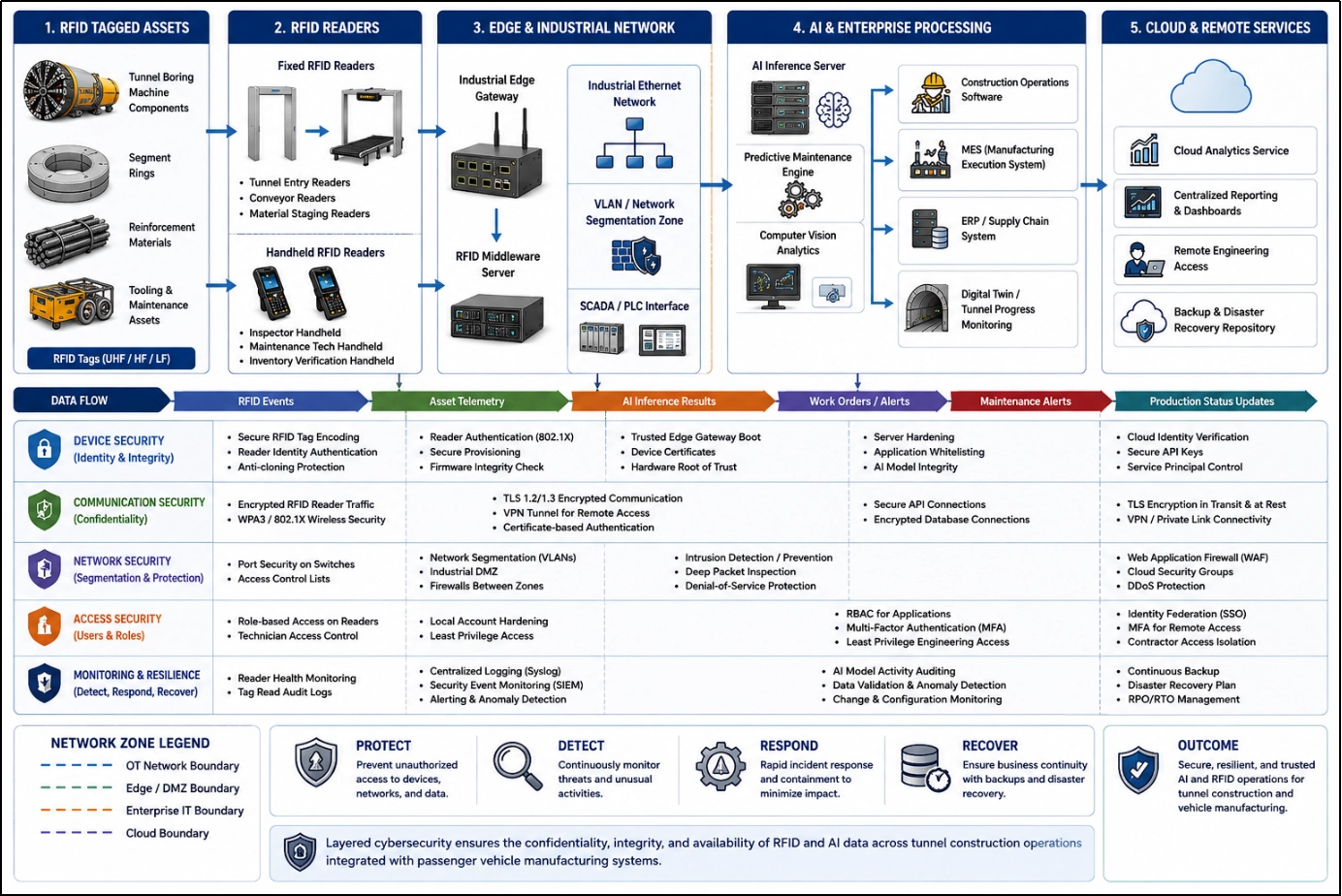
This enterprise cybersecurity diagram illustrates how layered security controls protect the complete AI-enabled RFID data path across tunnel construction operations integrated with passenger vehicle manufacturing systems. The visual shows RFID tags, fixed and handheld readers, edge gateways, industrial networks, middleware, AI servers, plant systems, and cloud services with overlays for device authentication, encrypted communication, network segmentation, role-based access control, logging, monitoring, backup, and data validation.
Deployment and Commissioning Priorities
Deployment should begin with a defined operational use case rather than a technology-first installation. Project teams should determine which tunnel assets require identification, which events need to be captured, and which decisions will be improved by the resulting information.
Site surveys should assess tunnel geometry, construction materials, equipment density, reader mounting locations, electromagnetic conditions, network availability, environmental exposure, and worker access. RFID tag selection should be validated against the surfaces and conditions where tags will actually be installed.
A pilot deployment can then test read performance, event reliability, middleware logic, integration behavior, and AI data quality before wider installation. This is particularly valuable in reinforced concrete tunnel environments containing metal machinery, temporary utilities, cable runs, ventilation equipment, and moving construction vehicles.
Commissioning should include functional testing of readers, tag identification, network communication, event processing, asset-master synchronization, dashboard behavior, alert handling, and integration with connected software. AI models should also be evaluated against representative project data rather than relying only on laboratory or synthetic datasets.
How GAO Supports Connected Construction Data Capture
GAO provides RFID, BLE, and IoT hardware products and systems that can be incorporated into asset identification, monitoring, and connected industrial applications. Headquartered in New York City and Toronto, Canada, GAO serves organizations across the United States and Canada, including Fortune 500 companies, R&D organizations, universities, and government agencies.
For tunnel construction supporting passenger vehicle manufacturing, this type of hardware can provide the physical data-capture layer required by larger AI and IoT solutions. The practical objective is not simply to identify an asset, but to establish reliable operational data that can be connected to construction workflows, maintenance processes, project controls, and AI-supported decision-making.
Operational and Business Value of AI-Enabled Tunnel Construction
Combining AI with RFID-supported data capture can improve visibility across tunnel construction activities associated with passenger vehicle manufacturing facilities. The greatest value comes from connecting physical events to project decisions rather than treating asset identification as an isolated tracking function.
- Improved material visibility: RFID events can show when tagged construction materials enter, leave, or remain within defined staging areas. AI can compare these events with planned work packages and identify material-flow patterns that may contribute to delays.
- Better equipment utilization: Equipment movement and identification data can supplement operating-hour information to reveal how frequently construction equipment is used, where it is deployed, and when equipment remains idle. This can support more informed allocation decisions.
- Reduced search time: Construction personnel can use RFID-based identification records to determine the last known detection point of tagged tools, equipment, or materials rather than relying entirely on manual searches.
- Earlier schedule-risk detection: AI can analyze relationships among material availability, equipment activity, work-package progress, and historical project patterns to identify conditions associated with schedule deviation.
- Improved maintenance coordination: Connecting tagged equipment with maintenance records can make it easier to associate inspections, service intervals, faults, and equipment movements with specific physical assets.
- More controlled tunnel logistics: AI can evaluate movement patterns and planned activities to identify resource conflicts or inefficient movement between tunnel zones, staging areas, and manufacturing plant interfaces.
- Improved project reporting: Automatically collected identification events can reduce dependence on manually compiled asset and movement records, giving project managers a more consistent operational data source.
- Better construction-to-operations handover: Asset identities and associated records can remain useful after construction when temporary or permanent equipment becomes part of plant infrastructure, maintenance, utilities, or facility operations.
Performance Improvements and Engineering Trade-Offs
The performance improvement achieved by AI and RFID depends heavily on data quality and deployment design. A system that produces a large quantity of unreliable RFID events can create more work rather than reducing it. Engineers should therefore optimize for useful information rather than maximum tag-read volume.
RFID read accuracy can be affected by metal surfaces, liquids, reinforced concrete, equipment orientation, reader placement, antenna configuration, and the movement of workers or vehicles. Tunnel construction introduces additional variables because work zones change throughout the project. Reader positions that are effective during excavation may become unsuitable after structural work, utility installation, or equipment relocation.
AI introduces a different set of trade-offs. A predictive model trained on one project may not perform equally well on another project with different construction methods, equipment fleets, schedules, tunnel dimensions, or operational constraints. Model performance should therefore be monitored throughout deployment, with appropriate retraining or recalibration when conditions materially change.
Edge processing can reduce latency and dependence on continuous connectivity, but local computing resources require maintenance and cybersecurity controls. Cloud processing can simplify centralized access and scaling, but network availability and data-governance requirements become more significant.
These trade-offs make staged deployment important. A pilot can establish realistic RFID performance, data quality, network behavior, integration requirements, and AI feasibility before the solution is expanded to additional tunnel zones.
Engineering Decision Tree for AI and RFID Technology Selection in Tunnel Construction
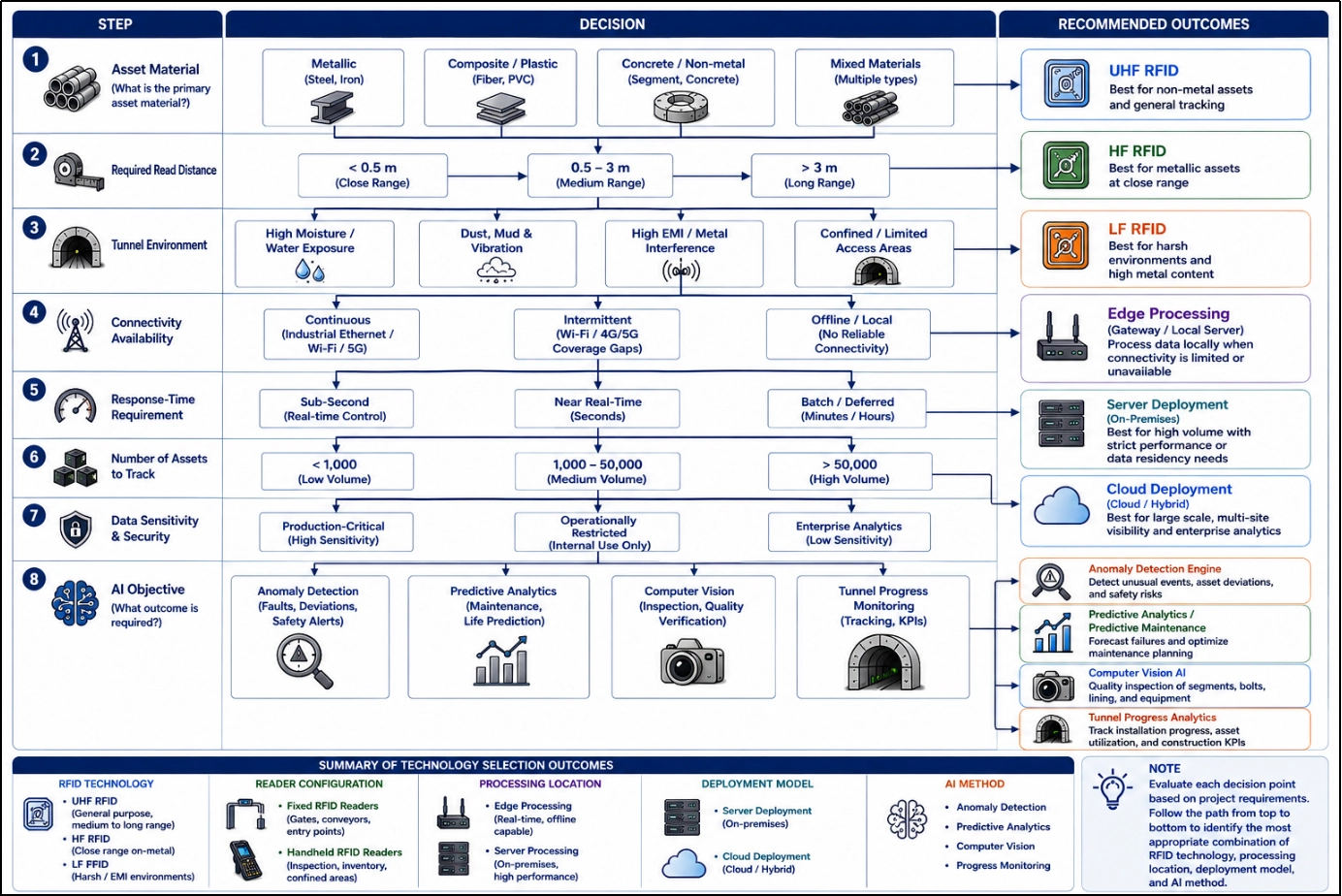
This decision tree helps tunnel construction and passenger vehicle manufacturing engineers choose appropriate RFID technologies, reader configurations, processing locations, deployment models, and AI methods based on operational conditions. It evaluates asset material, read distance, tunnel environment, connectivity, response-time requirements, asset volume, data sensitivity, and analytics objectives to produce technically realistic deployment recommendations.
KPIs for AI and RFID-Enabled Tunnel Construction
The effectiveness of an AI-enabled construction solution should be measured through operational KPIs rather than technology metrics alone. Passenger vehicle manufacturing projects can evaluate whether the solution is producing measurable improvements in construction control and resource utilization.
Relevant KPIs include:
- RFID asset identification accuracy
- Asset-location event reliability
- Material staging dwell time
- Equipment utilization rate
- Equipment idle time
- Average asset search time
- Material availability rate
- Material-related work stoppages
- Equipment-related work stoppages
- Maintenance response time
- Preventive maintenance compliance
- Inspection completion rate
- Work-package completion variance
- Construction schedule variance
- Tunnel-zone resource conflicts
- Average material movement time
- Asset reconciliation accuracy
- Number of unidentified or incorrectly associated assets
- AI alert precision
- AI false-alert rate
- AI prediction accuracy
- Mean time to respond to operational alerts
- Network availability
- Edge-processing latency
- RFID reader availability
- Data synchronization success rate
- System integration error rate
- Cybersecurity incident count
- User adoption among construction personnel
- Cost associated with asset loss or misplacement
The most meaningful measurement approach establishes a baseline before deployment. For example, a project can record average equipment search time and material reconciliation effort before introducing RFID-supported processes, then compare those measurements after commissioning.
Scaling from a Tunnel Pilot to Multiple Construction Zones
A pilot should establish technical feasibility and operational value before expansion. Once RFID read behavior, data models, integration methods, and AI performance have been validated, the same principles can be extended to additional tunnel zones and related construction activities.
Scalability requires standardized asset identifiers, consistent tag-management procedures, reusable middleware rules, documented reader configurations, common location definitions, and controlled integration interfaces. Construction contractors and plant personnel should also share clear procedures for tagging newly introduced equipment and materials.
Passenger vehicle manufacturing projects may contain multiple tunnels, underground utility corridors, logistics routes, service passages, and infrastructure connections. Scaling should therefore avoid simply multiplying hardware installations. Each additional zone should have a defined operational purpose and measurable KPI.
Software should also distinguish between temporary construction assets and permanent plant assets. Temporary equipment may leave the site after commissioning, whereas installed pumps, electrical infrastructure, ventilation systems, fire-protection equipment, or other facility assets may require long-term identification and maintenance records.
AI-Enabled Use Cases Across the Tunnel Construction Lifecycle
The value of AI can change as a tunnel project progresses from excavation to commissioning. RFID and other IoT data sources should therefore be configured around the requirements of each project stage.
Excavation and Ground-Support Activities
During excavation, the focus may be on construction equipment, tools, temporary infrastructure, material movement, and work-zone coordination. AI can analyze equipment activity and asset movements to support resource planning and identify unusual utilization patterns.
Structural Construction and Installation
As structural work progresses, tagged materials, components, equipment, and installation tools can be associated with work packages and tunnel zones. AI can help compare expected material availability with observed movement and project progress.
Mechanical, Electrical, and Utility Installation
Mechanical and electrical activities can involve large quantities of cables, electrical components, pumps, ventilation equipment, control equipment, and temporary utilities. Identification records can improve traceability, while AI can help identify material-flow or maintenance patterns that affect installation activities.
Testing and Commissioning
Commissioning requires confirmation that equipment and infrastructure are installed, inspected, tested, and associated with the correct documentation. RFID identification can support physical asset verification, while AI can assist with exception detection across inspection and commissioning records.
Handover to Manufacturing Operations
The transition from construction to plant operation requires reliable asset records and documentation. Tagged assets can be reconciled against project records and maintenance databases, reducing the risk of incomplete handover information.
AI, RFID, and IoT Lifecycle Timeline for Tunnel Construction and Manufacturing Handover
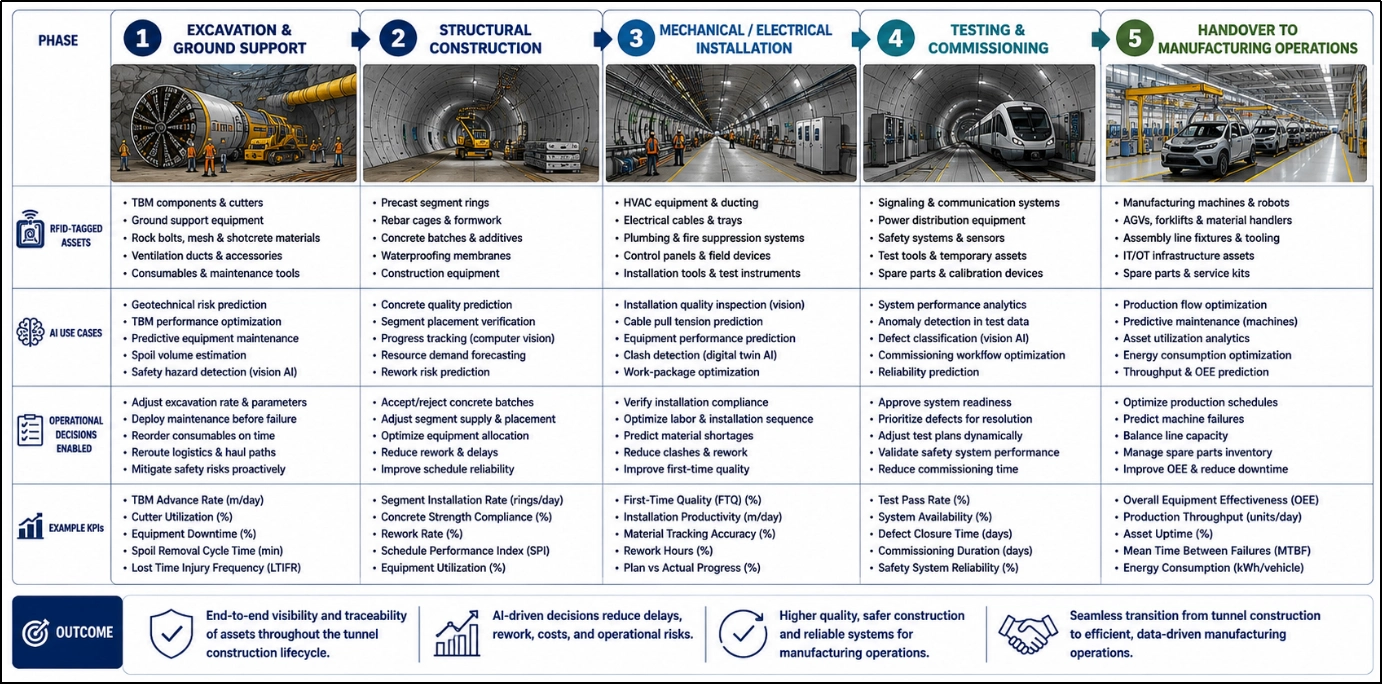
This lifecycle timeline illustrates how RFID-tagged assets, AI analytics, and IoT-enabled operational decisions evolve across five tunnel construction phases, from excavation and ground support through structural construction, mechanical and electrical installation, testing and commissioning, and final handover to passenger vehicle manufacturing operations. It also highlights representative KPIs that project engineers can use to measure productivity, quality, reliability, and manufacturing readiness at each stage.
Implementation Recommendations for Construction and Plant Teams
A technically sound implementation should combine construction engineering, IT, operational technology, project management, cybersecurity, and plant operations expertise. RFID deployment decisions should not be made independently from the construction workflow.
Recommended practices include:
- Define the business decision each AI use case is intended to improve before selecting sensors or software.
- Build an accurate asset master containing identifiers, asset types, responsible teams, work packages, locations, and relevant maintenance information.
- Perform an RFID site survey before finalizing reader locations and tag specifications.
- Test tags on the actual materials and equipment that will be used in the tunnel.
- Use fixed RFID readers where automated detection provides a clear operational advantage and handheld readers where mobile verification is more practical.
- Establish rules for handling duplicate reads, missed reads, unknown tags, damaged tags, and reassigned assets.
- Validate network availability and edge-processing requirements before relying on continuous connectivity.
- Integrate RFID events with existing project and maintenance software instead of creating isolated records.
- Establish cybersecurity controls before connecting readers, gateways, servers, or cloud services to production networks.
- Start AI models with measurable use cases such as anomaly detection, asset utilization analysis, or schedule-risk indicators.
- Keep human review in the decision loop for safety-critical construction, engineering, and plant-operational decisions.
- Establish baseline KPIs and review them regularly after deployment.
Practical Value for Passenger Vehicle Manufacturing Projects
The strongest business case is created when improved construction visibility contributes to measurable project outcomes. Better identification of materials can support work continuity. Better equipment visibility can improve resource utilization. Better maintenance information can reduce avoidable downtime. Better data integration can improve project reporting and handover quality.
AI adds another layer by transforming accumulated operational data into patterns, predictions, exceptions, and recommendations. The result is not simply more information. Properly engineered systems help project teams decide what requires attention and why.
GAO’s RFID, BLE, and IoT products and systems can provide components for these connected workflows. Its work across the United States and Canada, including support for major companies, R&D organizations, universities, and government agencies, provides experience relevant to deployments where hardware quality, integration, and technical support are important considerations.
Building a Reliable AI and RFID Program for Tunnel Construction
AI-enabled tunnel construction should be implemented as an operational improvement program rather than as a standalone technology installation. Passenger vehicle manufacturing projects should begin with the highest-value construction and plant-interface problems, establish measurable baselines, and then introduce identification, sensing, integration, and AI capabilities in stages.
A practical implementation sequence starts with asset and workflow mapping. Construction teams identify critical equipment, materials, work zones, access points, inspection activities, and handover requirements. The project then determines where RFID can provide reliable identification and where other technologies such as BLE, machine telemetry, computer vision, or conventional databases are more appropriate.
The next stage is controlled deployment. Reader locations, tag types, communication links, middleware rules, and software integrations should be tested under actual tunnel conditions. AI models should initially support clearly defined decisions, with performance measured against operational KPIs.
Long-term operation requires continued monitoring. RFID infrastructure may need adjustment as construction zones change. Tags may be damaged or reassigned. Asset records may change as equipment moves between contractors and plant operations. AI models may also require recalibration as the project enters new construction phases.
This lifecycle approach reduces technology risk while allowing the project to expand successful use cases based on demonstrated operational value.
Key Technical Takeaways for Tunnel Construction
AI and RFID can provide a practical foundation for improving construction visibility within passenger vehicle manufacturing facilities, particularly where underground infrastructure introduces complex material, equipment, and logistics requirements.
The main technical lessons are:
- RFID should be selected according to the physical environment, required read behavior, tag mounting surface, and operational objective.
- AI should address a defined construction or plant-interface decision rather than being deployed simply to generate analytics.
- RFID events should be validated and contextualized through middleware before being used by AI models.
- Asset master data is critical because AI recommendations depend on accurate relationships between tag identifiers, physical assets, work packages, locations, and operational status.
- Edge processing can provide resilience and low-latency processing where tunnel connectivity is constrained.
- Cloud deployment can support centralized analytics and multi-location access where connectivity and data-governance requirements permit it.
- Server deployments can provide greater local control where project or plant requirements favor privately hosted infrastructure.
- Cybersecurity should cover readers, gateways, networks, middleware, APIs, servers, cloud services, and user access rather than focusing only on the RFID devices.
- AI outputs should remain subject to appropriate engineering and human review, especially for safety-critical construction and manufacturing decisions.
- Pilot deployments should establish measurable improvements before large-scale installation.
Connecting Tunnel Construction Data with Long-Term Plant Operations
The value of connected tunnel construction can extend beyond the construction project itself. Passenger vehicle manufacturing facilities depend on infrastructure that must remain operational for many years after commissioning. Accurate information captured during construction can therefore contribute to future facility maintenance and asset management.
Permanent equipment can retain unique identifiers that connect physical assets with maintenance histories, inspection records, technical documentation, and replacement information. This can reduce the information gap that sometimes occurs when responsibility moves from construction contractors to plant engineering and maintenance teams.
AI can subsequently use accumulated operational information to identify maintenance patterns, prioritize inspections, and support infrastructure planning. The original construction data therefore becomes part of a longer operational information lifecycle rather than being discarded after project completion.
This approach is particularly valuable for tunnel infrastructure that is difficult to access, contains critical utilities, or supports manufacturing operations where unexpected infrastructure downtime can affect production.
Construction to Operational Handover – Landscape Information Flow
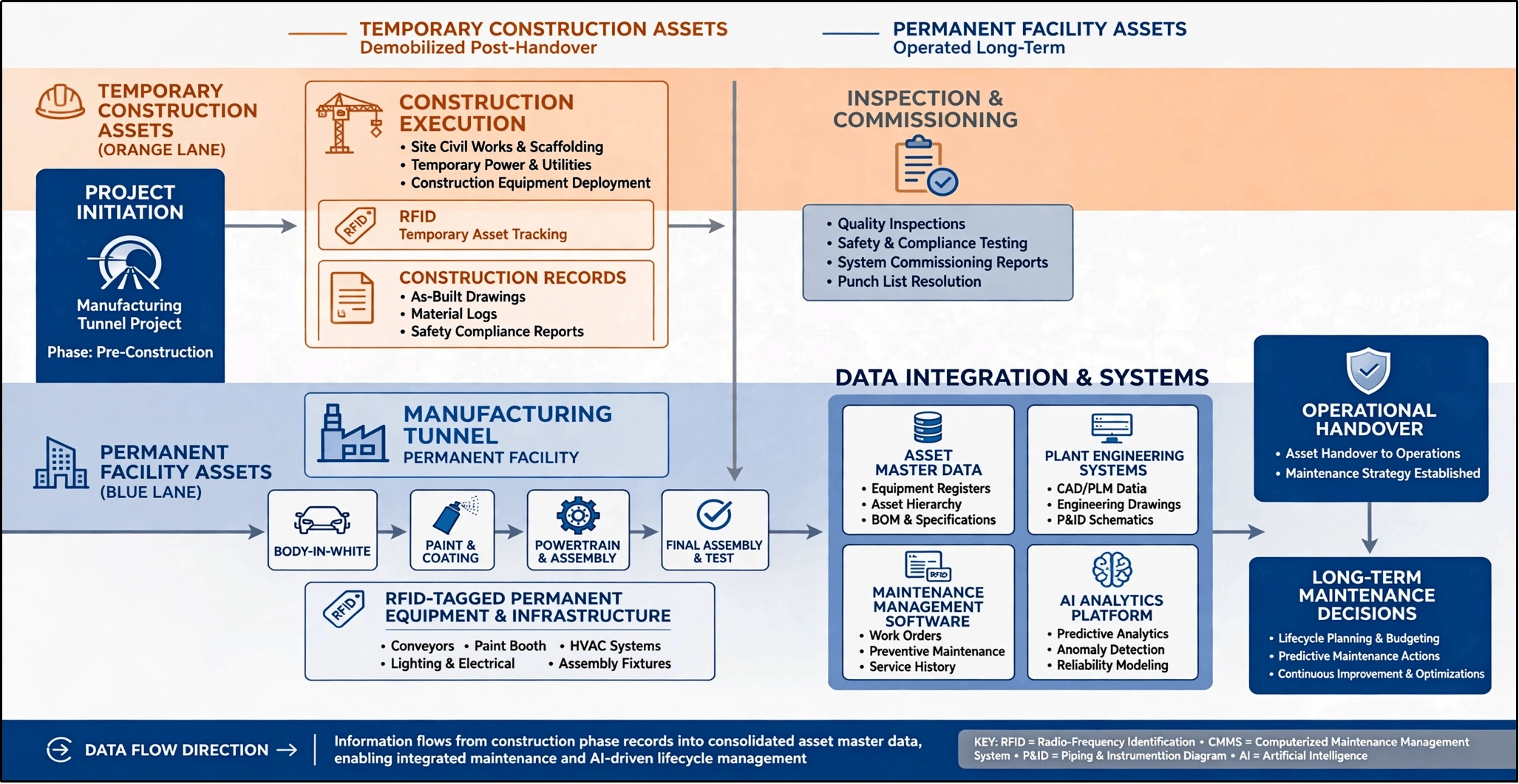
Landscape information-flow diagram without header text showing flow from Project Initiation through Construction Execution with RFID temporary tracking and Construction Records, into Inspection & Commissioning, then into Manufacturing Tunnel Permanent Facility steps Body-in-White through Final Assembly with RFID-tagged conveyors and HVAC, feeding Data Integration & Systems: Asset Master Data, Plant Engineering Systems, Maintenance Management Software, and AI Analytics Platform, ending in Operational Handover and Long-Term Maintenance Decisions.
Why GAO Is Relevant to Connected Tunnel Construction
GAO’s role in this type of solution is centered on supplying the physical RFID, BLE, and IoT technologies that organizations can incorporate into broader monitoring, identification, and data-driven systems. The hardware layer is particularly important because AI performance depends on the quality and reliability of the operational data entering the software.
GAO is headquartered in New York City and Toronto, Canada, and is ranked among the top 10 leading B2B and B2G, with a lesser degree of B2B2C and B2D, BLE and RFID suppliers in the world. GAO, together with GAO Research Inc. and GAO Tek Inc., forms GAO Group, with operations based in New York City and Toronto.
For more than three decades, GAO Group has served customers in the United States and Canada, including Fortune 500 companies, leading R&D organizations, prestigious universities, and government agencies. Its substantial investment in R&D, quality assurance processes, and technical support capabilities provides a foundation for organizations evaluating RFID and IoT hardware for demanding applications.
Learn More About AI-Enabled RFID Solutions for Tunnel Construction
Organizations planning tunnel construction associated with passenger vehicle manufacturing can evaluate AI and RFID use cases according to their specific asset, material, equipment, logistics, inspection, and infrastructure requirements. The appropriate solution depends on physical conditions, project workflows, existing software, connectivity, cybersecurity requirements, and the decisions that need better operational data.
GAO can support organizations evaluating RFID, BLE, and IoT hardware products and systems for these requirements, including technical considerations related to identification, monitoring, and connected data capture. Readers, engineers, system integrators, construction technology teams, and plant decision-makers can work with GAO to identify appropriate technology options and deployment approaches for their operational environment.
The objective is practical: establish reliable physical data capture, connect that information to the software already used by the organization, and apply AI where analysis can produce a measurable improvement in tunnel construction and plant infrastructure management.
Building the Future of Industrial AI and IoT with Aperture Venture Studio and GAO RFID Inc.
For more than three decades, GAO Group of Companies has invested heavily in R&D of industrial RFID, BLE, and IoT. As generative AI became increasingly useful for industrial applications, we expanded our work across AI and IoT, including RFID and BLE, and founded Aperture Venture Studio to build, launch, and scale next-generation AI and IoT companies and solutions relevant to industrial applications such as connected tunnel construction and passenger vehicle manufacturing.
Aperture has attracted AI and IoT technical experts, entrepreneurial and operational executives, influential investors, and leading companies. We have also developed the Aperture Ventures Summit and TekSummit to discuss advanced AI and IoT topics.
These activities have helped develop diversified technical communities around AI and IoT.
We welcome you to join us as:
- Advisors, Co-founders, or Employees
- Investors
- Customers