
AI-Powered Copper Mining with RFID: Intelligent Asset Tracking, Ore Traceability, Equipment Visibility, and Operational Optimization
AI-Powered Copper Mining Using RFID Solutions
Copper mining is becoming increasingly data-driven as mining companies seek higher productivity, safer operations, improved ore traceability, and lower operating costs. Artificial Intelligence integrated with Industrial IoT technologies, particularly RFID, enables mining organizations to collect accurate operational data from equipment, materials, personnel, and production processes while transforming that information into real-time operational intelligence.
Unlike traditional mining monitoring systems that rely heavily on manual inspections and isolated machine data, AI-powered RFID solutions connect physical mining assets with intelligent analytics. RFID provides reliable identification and location data, while AI continuously analyzes operational conditions, predicts production bottlenecks, detects abnormal equipment behavior, improves ore movement visibility, and supports faster operational decision-making.
For copper mining operations, this combination supports continuous improvement across exploration logistics, drilling operations, blasting preparation, ore hauling, crushing, flotation, concentrate storage, maintenance planning, inventory management, and worker safety. Supported by decades of industrial RFID and IoT expertise, GAO provides RFID hardware and intelligent identification solutions that help mining organizations build reliable AI-driven operational systems designed for demanding mining environments.
How AI is Transforming Copper Mining with RFID-Enabled Operational Intelligence
Copper mining involves thousands of moving assets operating simultaneously across open-pit mines, underground tunnels, concentrators, maintenance workshops, warehouses, tailings facilities, and logistics terminals. Heavy mobile equipment, drilling systems, explosives inventories, replacement components, haul trucks, conveyor systems, and ore batches continuously move through complex operational workflows.
Traditional identification methods often struggle with:
- Limited real-time visibility
- Manual asset tracking
- Delayed maintenance reporting
- Lost equipment
- Inaccurate inventory counts
- Incomplete production records
- Limited traceability between mine and concentrator
AIoT addresses these challenges by combining Artificial Intelligence with connected sensing technologies. Within copper mining, RFID serves as a reliable identification layer that automatically captures operational events, while AI interprets those events to optimize production planning, maintenance scheduling, workforce allocation, material flow, and operational safety.
Instead of replacing existing mining software, AI-powered RFID solutions complement systems such as:
- Mine Planning Software
- Fleet Management Systems
- Computerized Maintenance Management Systems (CMMS)
- Enterprise Asset Management (EAM)
- Enterprise Resource Planning (ERP)
- Manufacturing Execution Systems for mineral processing
- Geological Information Systems
- SCADA systems
- Distributed Control Systems (DCS)
- Digital Twin solutions
This integrated approach enables mining organizations to transition from reactive operations toward predictive, data-driven decision making.
AI-Powered RFID Across the Copper Mining Value Chain: Intelligent Asset Tracking, Ore Traceability, and Operational Optimization
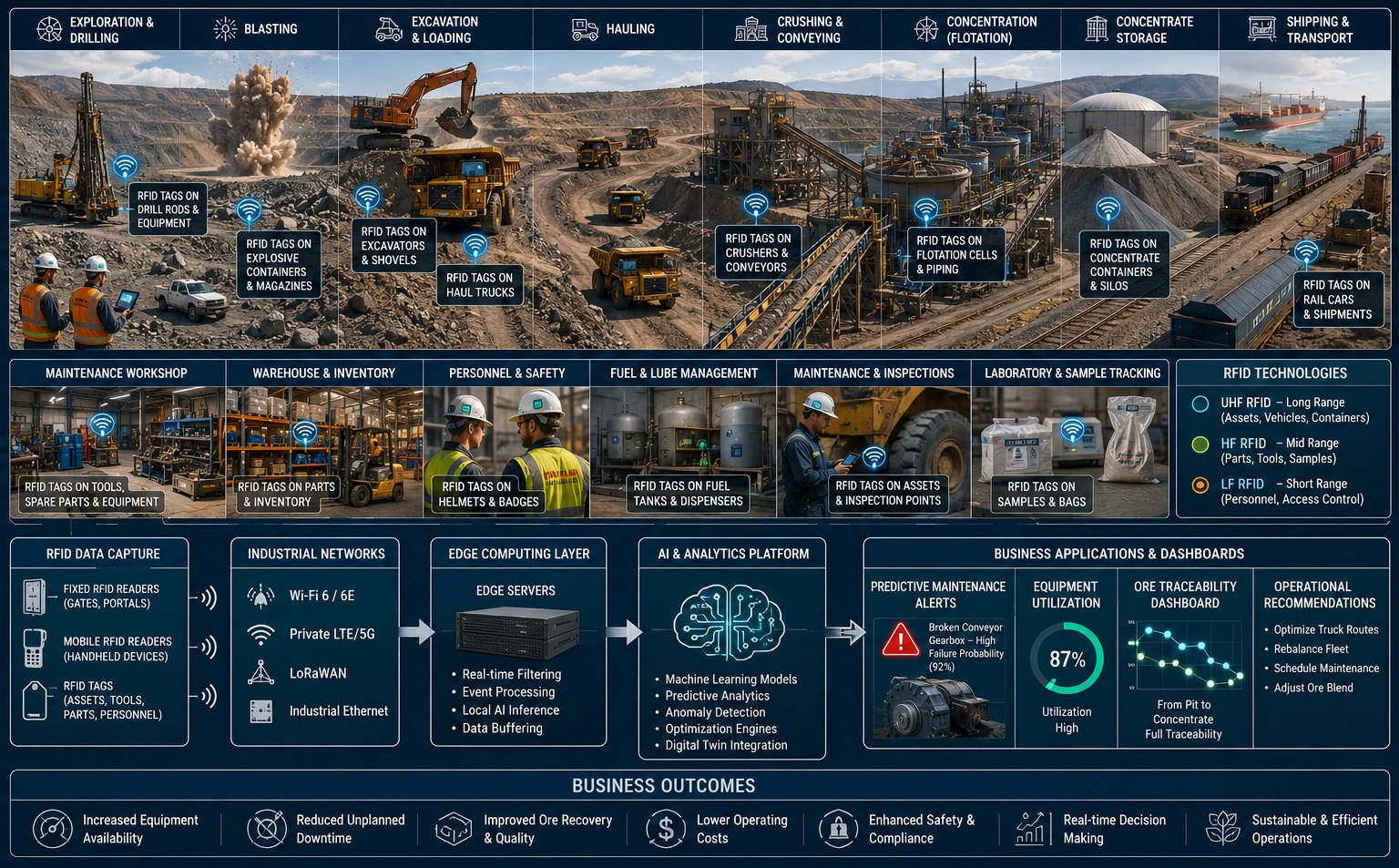
This infographic illustrates how RFID technology enables AI-driven intelligence across the complete copper mining value chain, from exploration and drilling to concentrate shipping. It demonstrates how RFID-tagged assets, industrial communication networks, edge computing, and AI analytics work together to improve equipment utilization, predictive maintenance, ore traceability, workforce safety, inventory management, and operational decision-making. The visual highlights how integrated AIoT solutions enhance productivity, reduce downtime, and support more efficient copper mining operations.
Why AI-Driven RFID Systems Matter in Modern Copper Mining
Copper mining operations generate enormous volumes of operational information every minute.
Examples include:
- Loader utilization
- Haul truck cycle times
- Blast scheduling
- Ore grade movement
- Conveyor loading
- Fuel consumption
- Maintenance work orders
- Tire replacements
- Spare component usage
- Workforce access records
- Underground personnel locations
- Drill utilization
- Stockpile movements
Without automated identification, much of this information must be manually entered or reconciled after production shifts.
RFID enables automatic identification of mining assets whenever tagged objects pass readers installed at critical operational locations.
Examples include:
- Mine portals
- Maintenance bays
- Conveyor transfer stations
- Crusher feed points
- Warehouse entrances
- Explosive storage facilities
- Vehicle checkpoints
- Concentrator receiving areas
- Fuel stations
- Loading facilities
AI continuously analyzes these RFID events alongside sensor data collected from industrial equipment.
Common AI techniques include:
- Machine learning for predictive maintenance
- Computer vision for conveyor inspection
- Time-series forecasting for production planning
- Anomaly detection for equipment failures
- Reinforcement learning for haul route optimization
- Optimization algorithms for maintenance scheduling
- Natural language processing for maintenance reports
- Graph analytics for supply chain visibility
Together these technologies create operational intelligence that continuously improves mining performance.
GAO has supported organizations across North America by supplying industrial RFID hardware, readers, antennas, tags, and IoT solutions that integrate with larger digital transformation initiatives requiring dependable identification under demanding operating conditions.
AI Applications Across Copper Mining Operations
Although every mine has unique geological conditions and production objectives, several operational areas consistently benefit from AI supported by RFID identification.
Intelligent Fleet Management
Open-pit copper mines often operate hundreds of mobile assets simultaneously.
These include:
- Electric rope shovels
- Hydraulic excavators
- Rigid haul trucks
- Water trucks
- Fuel trucks
- Motor graders
- Wheel loaders
- Service vehicles
- Light utility vehicles
RFID automatically identifies each vehicle as it enters maintenance facilities, fueling stations, dispatch zones, and restricted operational areas.
AI analyzes:
- Equipment utilization
- Queue times
- Idle duration
- Maintenance history
- Fuel efficiency
- Operator productivity
- Route optimization
- Asset availability
Mining dispatch teams can therefore improve fleet productivity while reducing unnecessary downtime.
Ore Tracking and Material Traceability
Copper ore passes through numerous production stages before becoming concentrate.
These stages include:
- Blast blocks
- Loading zones
- Haul trucks
- Primary crushers
- Secondary crushing
- Stockpiles
- Grinding circuits
- Flotation
- Thickening
- Filtration
- Concentrate storage
- Rail or port shipment
RFID-enabled containers, transport bins, processing pallets, and mobile equipment provide traceability events throughout these production stages.
AI correlates these events with:
- Ore grades
- Geological models
- Recovery rates
- Processing throughput
- Concentrate quality
- Moisture measurements
- Laboratory assays
This improves production planning while reducing uncertainty throughout mineral processing.
Predictive Maintenance for Mining Equipment
Maintenance represents one of the largest operating expenses within copper mining.
Critical assets include:
- Ball mills
- SAG mills
- Crushers
- Conveyors
- Pumps
- Flotation cells
- Ventilation fans
- Compressors
- Diesel generators
- Conveyor drives
- Bucket wheel reclaimers
RFID automatically records:
- Spare component installation
- Tool usage
- Maintenance technician assignments
- Equipment movement
- Service completion
- Replacement history
AI combines RFID records with:
- Vibration monitoring
- Thermal imaging
- Lubrication analysis
- Oil condition monitoring
- Motor current analysis
- Bearing temperatures
- Acoustic monitoring
Maintenance engineers can predict failures before catastrophic breakdowns occur, improving equipment availability while extending asset life.
Mining Warehouse and Spare Parts Management
Large copper mines may manage tens of thousands of maintenance components.
Examples include:
- Bearings
- Conveyor rollers
- Hydraulic hoses
- Electric motors
- Gearboxes
- Pump seals
- Tires
- Explosive accessories
- Valves
- Instrumentation
- PPE
- Welding supplies
RFID automates inventory movement throughout warehouses.
AI predicts:
- Inventory demand
- Spare consumption
- Seasonal purchasing requirements
- Critical stock shortages
- Overstock situations
- Procurement priorities
Warehouse managers gain significantly improved inventory accuracy while reducing emergency purchasing.
Workforce Safety and Access Control
Worker safety remains one of the highest priorities in copper mining.
RFID-enabled identification badges and helmet tags support:
- Authorized access
- Underground entry records
- Muster management
- Emergency evacuation accounting
- Contractor management
- Equipment authorization
- Restricted area enforcement
AI enhances safety by analyzing:
- Personnel movement patterns
- Shift fatigue indicators
- High-risk operational zones
- Near-miss trends
- Equipment proximity events
- Emergency response readiness
These insights help safety managers proactively reduce operational risk rather than responding only after incidents occur.
AI-Enabled RFID Deployment in Copper Mining: Real-Time Asset Tracking, Equipment Visibility, and Intelligent Mine Operations
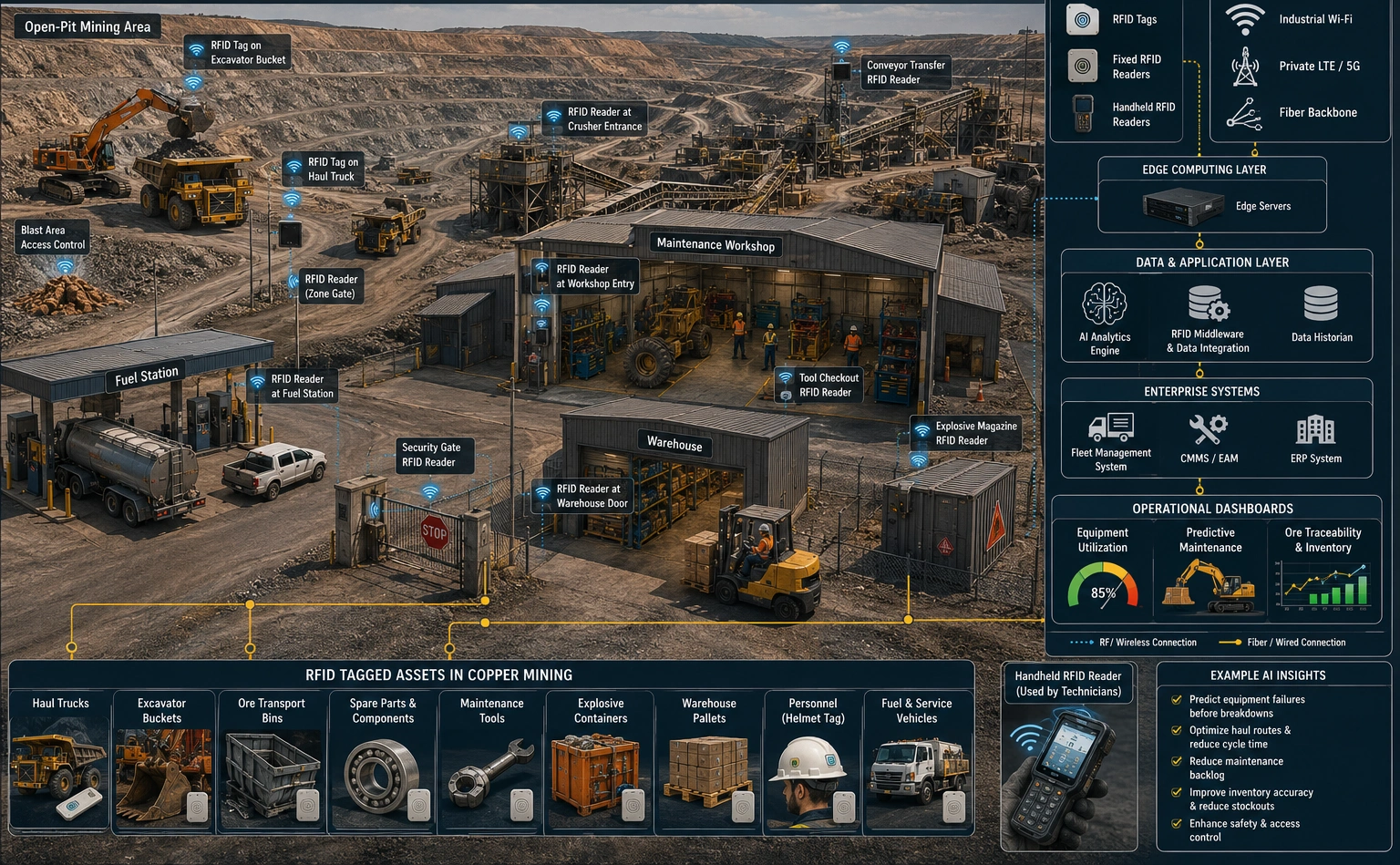
This deployment diagram illustrates how RFID technology is integrated throughout an operational open-pit copper mine to identify and monitor haul trucks, excavators, warehouses, maintenance facilities, explosive storage, fuel stations, and personnel. It demonstrates how RFID readers, industrial communication networks, edge computing, AI analytics, and mining software work together to deliver predictive maintenance, asset visibility, ore traceability, inventory management, and real-time operational decision support.
Copper Mining Operational Workflow Using AI-Driven RFID Intelligence
Copper mining requires continuous coordination between geological exploration, extraction, material transport, mineral processing, equipment maintenance, warehouse operations, environmental monitoring, and logistics. AI-enabled RFID systems support this workflow by providing accurate identification events that become actionable operational intelligence when combined with industrial AI models, edge computing, and mining software.
Copper Mining Operational Workflow Using AI-Driven RFID Intelligence
Copper mining requires continuous coordination between geological exploration, extraction, material transport, mineral processing, equipment maintenance, warehouse operations, environmental monitoring, and concentrate logistics. AI-enabled RFID solutions support this workflow by providing reliable identification events that become operational intelligence when combined with industrial AI, edge computing, and mining software. Rather than functioning as isolated identification systems, RFID devices become one component of an AIoT solution that continuously improves operational efficiency across the mine.
Exploration and Asset Registration
The operational lifecycle begins before production starts. Exploration equipment, geological core samples, survey instruments, drilling consumables, and field vehicles are registered using RFID tags. Each asset receives a unique digital identity that links it to geological databases, maintenance records, ownership information, and deployment history.
Typical tagged assets include:
- Diamond drill rigs
- Reverse circulation drilling equipment
- Core sample trays
- Survey instruments
- Portable XRF analyzers
- GPS receivers
- Fuel tanks
- Explosive transport containers
- Maintenance toolkits
AI analyzes exploration equipment utilization, drilling productivity, equipment availability, and sampling workflows to optimize exploration schedules and reduce equipment idle time.
Ore Extraction and Material Movement
Once production begins, RFID identifies equipment and material movements throughout the mining cycle.
Operational events include:
- Haul truck arrival at loading points
- Excavator assignment verification
- Blast area access authorization
- Ore movement between mining benches
- Waste rock transportation
- Stockpile allocation
- Crusher feed identification
Industrial RFID readers positioned at strategic checkpoints automatically capture movement data without interrupting production.
AI combines RFID events with:
- Fleet dispatch information
- GPS positioning
- Payload measurements
- Fuel consumption
- Road conditions
- Traffic congestion
- Shift schedules
- Equipment health data
The resulting operational intelligence enables dispatch systems to improve haul routes, minimize truck waiting time, and balance equipment utilization across the mine.
Mineral Processing and Concentrate Production
After extraction, ore passes through several processing stages where traceability becomes increasingly important.
Processing stages commonly include:
- Primary crushing
- Secondary crushing
- Grinding circuits
- SAG mills
- Ball mills
- Flotation cells
- Thickening
- Filtration
- Concentrate storage
- Rail or truck loading
RFID identifies ore containers, concentrate bins, maintenance tools, laboratory samples, and replacement components moving throughout the concentrator.
AI correlates RFID events with:
- Ore grade
- Recovery percentage
- Particle size distribution
- Reagent consumption
- Mill throughput
- Flotation efficiency
- Energy usage
- Equipment utilization
Processing engineers can therefore identify operational bottlenecks before they significantly affect concentrate production.
Maintenance and Reliability Engineering
Maintenance operations generate thousands of identification events every day.
Examples include:
- Spare part issuance
- Component replacement
- Tool checkout
- Lubrication activities
- Equipment inspections
- Calibration procedures
- Contractor assignments
RFID readers installed within maintenance workshops automatically associate technicians, equipment, replacement components, and work orders.
AI evaluates:
- Mean Time Between Failures (MTBF)
- Mean Time To Repair (MTTR)
- Maintenance backlog
- Failure trends
- Spare part consumption
- Technician productivity
- Equipment criticality
Maintenance supervisors receive recommendations that support predictive maintenance rather than reactive repairs.
Warehouse and Supply Chain Operations
Mining warehouses contain thousands of high-value components supporting uninterrupted production.
RFID automates inventory movement across:
- Receiving docks
- Storage racks
- Maintenance cribs
- Mobile maintenance vehicles
- Tool rooms
- Hazardous material storage
- Explosive magazines
AI continuously predicts:
- Inventory turnover
- Procurement timing
- Supplier performance
- Component demand
- Seasonal maintenance requirements
- Safety stock levels
This reduces inventory carrying costs while maintaining production readiness.
Business Intelligence and Operational Decision Making
Operational information collected throughout the mine ultimately supports strategic decision making.
Data flows into mining software including:
- Enterprise Resource Planning (ERP)
- Computerized Maintenance Management Systems (CMMS)
- Enterprise Asset Management (EAM)
- Fleet Management Systems
- Geological Modeling Software
- Manufacturing Execution Systems (MES)
- SCADA
- Production Reporting Software
- Environmental Compliance Systems
AI generates operational insights such as:
- Production forecasts
- Equipment availability predictions
- Ore blending recommendations
- Maintenance prioritization
- Shift performance comparisons
- Cost optimization opportunities
- Safety risk indicators
Management teams gain near real-time visibility across mining operations instead of relying solely on historical reports.
Data Flow from RFID Capture to AI-Driven Decision Making
A successful AI-enabled RFID solution depends on accurate data movement from physical mining operations to intelligent software.
The typical workflow consists of the following stages:
- RFID tags identify equipment, personnel, ore containers, maintenance components, laboratory samples, and warehouse inventory.
- Fixed and handheld RFID readers capture identification events throughout mining operations.
- Edge computing devices validate tag reads, remove duplicate events, and filter invalid data.
- Industrial communication networks securely transmit processed information to privately hosted servers or cloud-hosted software.
- RFID middleware converts raw identification events into structured operational data.
- Enterprise software associates RFID events with work orders, production records, geological information, inventory transactions, maintenance schedules, and equipment history.
- AI models continuously analyze operational patterns, detect anomalies, forecast equipment failures, optimize production schedules, and recommend corrective actions.
- Operational dashboards present prioritized recommendations to dispatch engineers, maintenance planners, production supervisors, warehouse managers, and executive leadership.
This workflow transforms isolated identification events into operational intelligence that supports faster and more informed decisions throughout the copper mining operation.
End-to-End AI and RFID Workflow for Copper Mining: From Asset Identification to Intelligent Operational Decisions
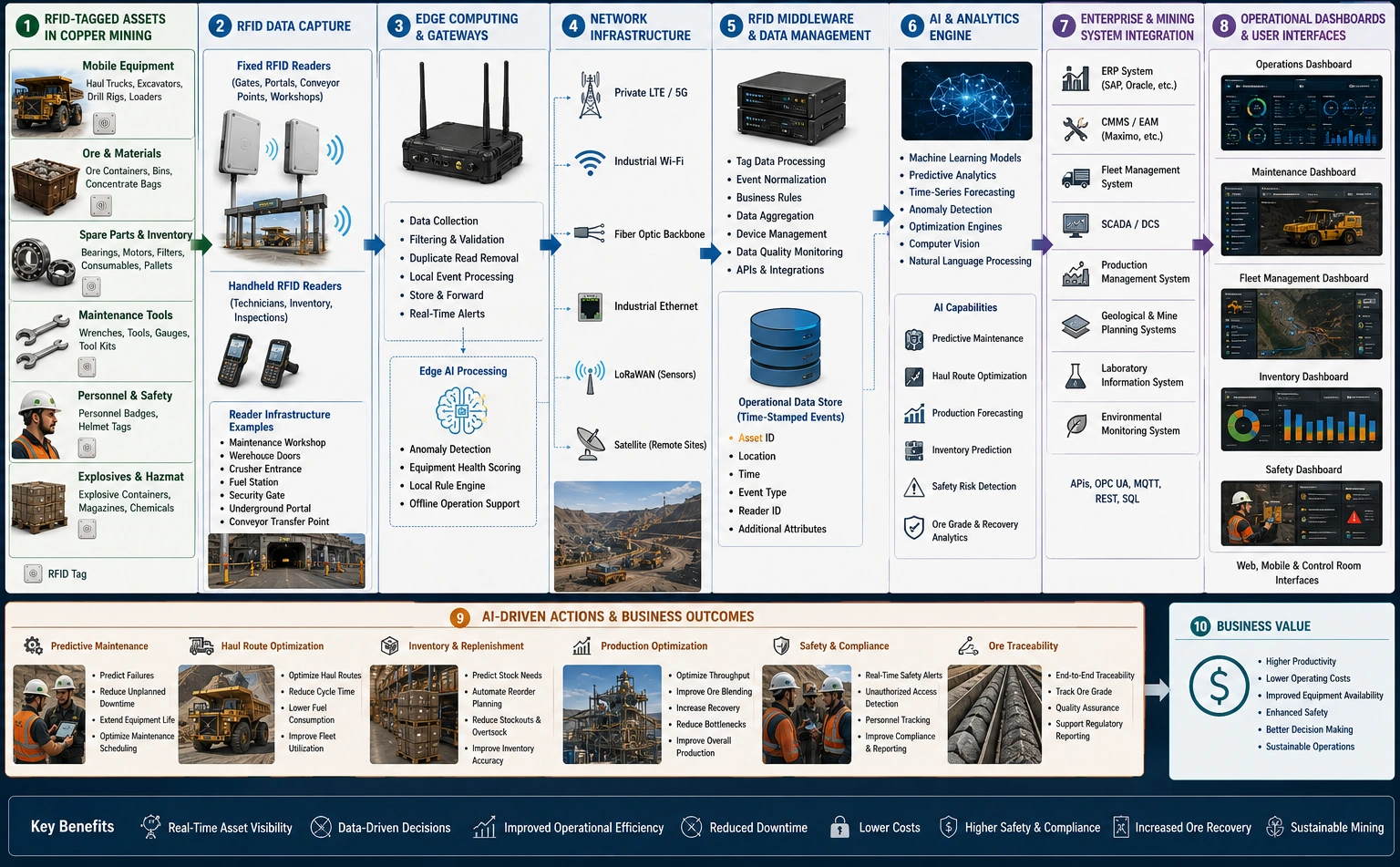
This workflow diagram illustrates the complete operational data flow in an AI-enabled RFID solution for copper mining, beginning with RFID-tagged mining assets and progressing through data capture, edge computing, industrial communication networks, AI analytics, enterprise mining software, and operational dashboards. It demonstrates how RFID-generated events are transformed into predictive maintenance, haul route optimization, inventory replenishment, production scheduling, safety monitoring, and ore traceability to support data-driven mining operations.
Communication Infrastructure and System Integration
Reliable communication infrastructure is essential because copper mines often span several square kilometers, include underground tunnels, remote processing facilities, and challenging environmental conditions.
Communication technologies commonly supporting AI-enabled RFID deployments include:
- Industrial Ethernet
- Fiber optic backbone
- Private LTE
- Private 5G
- Industrial Wi-Fi
- LoRaWAN for long-range sensor communication
- Satellite communication for remote mining sites
- Microwave links
- OPC UA
- MQTT
- REST APIs
- Modbus TCP
- IEC 61850 where applicable for electrical systems
Each communication technology serves different operational requirements.
For example:
- Fiber networks connect processing plants, concentrators, and control rooms where high bandwidth and low latency are required.
- Private LTE and private 5G provide reliable wireless coverage for moving haul trucks, maintenance vehicles, and remote field equipment.
- Industrial Wi-Fi supports warehouses, workshops, laboratories, and maintenance facilities.
- LoRaWAN complements RFID by transmitting environmental sensor data from tailings dams, water monitoring stations, and remote infrastructure where low power consumption is important.
Integration software exchanges information between RFID systems and operational applications through secure APIs and standardized industrial protocols. This interoperability allows maintenance records, inventory transactions, production data, and equipment histories to remain synchronized across existing mining software without requiring major process changes.
Mining organizations often implement phased integration strategies, beginning with high-value operational areas such as maintenance workshops or warehouses before expanding to fleet operations, mineral processing, and site-wide asset visibility. This staged approach reduces deployment risk, simplifies user adoption, and enables engineering teams to validate data quality before scaling across the entire mining operation.
GAO has supported customers by supplying industrial RFID hardware designed to integrate with existing operational software, allowing organizations to modernize identification capabilities while preserving investments in established mining information systems.
AI-Enabled RFID System Integration for Copper Mining: Industrial Networks, Enterprise Software, and Secure Data Flow
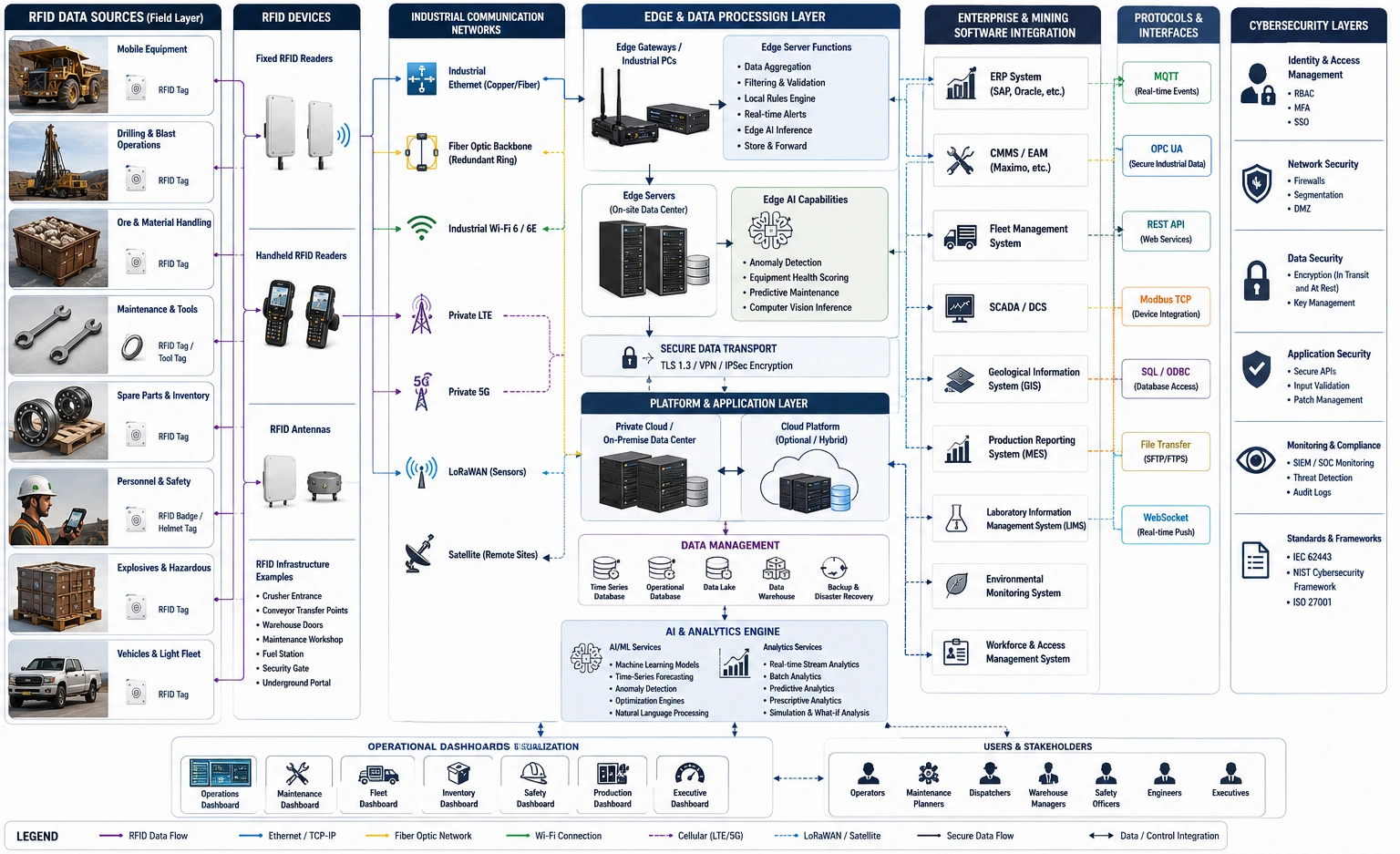
This system integration diagram illustrates how RFID readers deployed across a copper mining operation connect through industrial Ethernet, fiber optic networks, industrial Wi-Fi, private LTE, and private 5G to edge computing, cloud or privately hosted software, and enterprise mining applications. It demonstrates secure integration with ERP, CMMS, EAM, fleet management, SCADA, geological information systems, AI analytics, and operational dashboards using industrial communication protocols and layered cybersecurity controls.
RFID Infrastructure Supporting AI-Enabled Copper Mining Solutions
RFID serves as the operational identification layer that enables AI systems to associate physical mining activities with digital records. Selecting the appropriate RFID technology depends on read distance, environmental conditions, asset characteristics, and operational requirements.
Common RFID infrastructure used in copper mining includes:
UHF RFID
UHF RFID is well suited for:
- Haul truck identification
- Warehouse inventory management
- Pallet tracking
- Yard logistics
- Equipment visibility
- Vehicle checkpoints
- Container identification
Its longer read range allows automatic identification without stopping vehicles or interrupting material flow.
HF RFID
HF RFID is commonly used where controlled read distances and secure identification are important, including:
- Laboratory sample tracking
- Document management
- Maintenance records
- Tool control
- Work order processing
LF RFID
LF RFID performs reliably in environments where metal, moisture, dirt, or harsh industrial conditions may reduce the effectiveness of higher-frequency technologies. Typical applications include:
- Personnel identification
- Equipment authentication
- Livestock management at mine rehabilitation sites
- Harsh-environment asset identification
The appropriate mix of UHF, HF, and LF RFID technologies is determined during solution planning based on operational workflows, environmental constraints, and performance requirements rather than applying a single technology across the entire mining operation.
Hardware, Software, AI Models, and Supporting Infrastructure for AI-Powered Copper Mining
Successful AI-driven copper mining solutions depend on much more than RFID hardware alone. Reliable performance requires a coordinated combination of rugged industrial hardware, edge computing, AI software, secure communications, enterprise applications, and operational procedures that can withstand the demanding conditions of open-pit mines, underground operations, concentrators, and remote mining sites. Each component contributes a specific role in transforming operational data into actionable intelligence.
RFID Hardware for Copper Mining Operations
Mining environments expose equipment to abrasive dust, vibration, mud, moisture, high temperatures, electromagnetic interference, and heavy mechanical impacts. RFID hardware must therefore be selected based on environmental durability as well as operational requirements.
Typical hardware includes:
- UHF RFID fixed readers for vehicle checkpoints, warehouse entrances, conveyor transfer stations, and crusher feed points
- HF RFID readers for laboratories, maintenance workshops, and document control
- LF RFID readers for personnel identification and harsh-environment applications
- Rugged handheld RFID readers used by warehouse personnel, maintenance technicians, and field inspectors
- Industrial RFID antennas designed for long operating life in outdoor mining environments
- Passive RFID tags for inventory, spare parts, laboratory samples, and tools
- Rugged encapsulated RFID tags for haul trucks, excavators, crushers, conveyors, pumps, and mobile equipment
- High-temperature RFID tags for processing facilities
- Metal-mount RFID tags for steel mining equipment
- Explosion-resistant RFID devices where hazardous environments require certified equipment
Proper tag placement is equally important. Engineers should evaluate antenna orientation, read zones, metal interference, moving equipment speeds, and environmental exposure during site commissioning to achieve consistent read accuracy.
Edge Computing Systems
Copper mines frequently operate in locations where cloud connectivity cannot always be guaranteed. Edge computing minimizes latency while ensuring operational continuity.
Typical edge computing responsibilities include:
- RFID event filtering
- Duplicate read elimination
- Local asset databases
- AI inference close to production equipment
- Temporary data storage during network interruptions
- Initial anomaly detection
- Equipment health scoring
- Operational alert generation
By processing operational events near the production environment, edge servers reduce bandwidth requirements while allowing critical operational decisions to continue even if external communication links become temporarily unavailable.
Artificial Intelligence Models Used in Copper Mining
Different mining processes require different AI techniques. Rather than relying on a single algorithm, most production environments combine multiple AI models that solve specific operational problems.
Common AI methods include:
Machine Learning
Machine learning identifies relationships between operational variables such as:
- Equipment utilization
- Fuel consumption
- Production throughput
- Maintenance history
- Ore grade
- Weather conditions
- Shift productivity
Typical applications include:
- Production forecasting
- Maintenance prediction
- Inventory optimization
- Equipment utilization analysis
Computer Vision
Computer vision analyzes images and video captured by industrial cameras throughout the mine.
Applications include:
- Conveyor belt inspection
- Ore fragmentation analysis
- PPE compliance
- Vehicle detection
- Tailings monitoring
- Stockpile measurement
- Crack detection
- Conveyor misalignment detection
RFID complements computer vision by positively identifying equipment or material being inspected.
Time-Series Forecasting
Mining operations generate continuous sensor measurements.
Examples include:
- Motor temperatures
- Vibration signals
- Power consumption
- Pump pressures
- Flow rates
- Conveyor speeds
- Ore processing rates
Time-series forecasting predicts future operational behavior, enabling maintenance teams to intervene before failures occur.
Anomaly Detection
AI continuously compares current operating conditions against historical operating patterns.
Typical abnormalities include:
- Unexpected equipment movement
- Unauthorized warehouse access
- Conveyor stoppages
- Fuel theft
- Abnormal maintenance frequency
- Unusual inventory withdrawals
- Unexpected haul truck routes
Early detection allows operational teams to investigate issues before they escalate into production disruptions.
Optimization Algorithms
Optimization models continuously recommend improvements to mining operations.
Typical optimization objectives include:
- Haul truck dispatch
- Shift scheduling
- Crusher utilization
- Maintenance planning
- Inventory replenishment
- Energy consumption
- Processing throughput
- Ore blending
Rather than replacing human decision makers, these models provide recommendations supported by operational data.
Enterprise Software Supporting AI-Driven Copper Mining
AI-powered RFID solutions integrate with existing mining software instead of operating independently. This approach preserves historical operational data while enabling intelligent decision support.
Frequently integrated software includes:
- SAP
- Oracle ERP
- IBM Maximo
- Hexagon MinePlan
- Hexagon HxGN MineOperate
- GEOVIA Surpac
- GEOVIA MineSched
- Deswik
- Micromine
- ABB Ability
- AVEVA PI System
- AspenTech industrial software
- Rockwell FactoryTalk
- Siemens SIMATIC systems
- Microsoft Power BI
- Tableau
- ESRI ArcGIS
Information exchanged between these applications may include:
- Equipment maintenance history
- Asset master records
- Inventory transactions
- Geological block models
- Production schedules
- Shift reports
- Equipment operating hours
- Spare component consumption
- Laboratory results
- Environmental compliance records
Because many copper mining organizations already operate several enterprise applications, integration planning should begin early in the project lifecycle to ensure consistent data structures, naming conventions, and asset identifiers.
Cloud Version and Server Version Deployment Models
The appropriate deployment model depends on operational requirements, cybersecurity policies, communication infrastructure, regulatory obligations, and available IT resources.
Cloud Version
Cloud-hosted software is managed within secure cloud infrastructure and accessed through encrypted network connections.
Cloud deployment is well suited for:
- Multi-site copper mining companies
- Centralized production reporting
- Remote management
- Corporate analytics
- Fleet-wide benchmarking
- Long-term data storage
- AI model training using historical production data
Advantages include:
- Simplified software updates
- Elastic computing resources
- Centralized reporting
- Easier collaboration between geographically distributed mining sites
- Reduced infrastructure management for internal IT teams
Potential considerations include:
- Dependence on reliable external connectivity
- Corporate cybersecurity policies
- Data sovereignty requirements
- Network latency for time-sensitive operational functions
Server Version
Server Version refers to software deployed on privately managed infrastructure rather than cloud-managed environments. These servers may be installed within mine facilities, regional data centers, edge computing locations, or privately hosted enterprise environments.
Server deployments are frequently selected when:
- Continuous operation is required despite internet outages
- Low-latency operational decisions are essential
- Sensitive production information must remain within customer-managed infrastructure
- Mining organizations maintain dedicated operational technology networks
- Regulatory requirements restrict external data storage
Benefits include:
- Greater operational independence
- Reduced communication latency
- Local processing of production data
- Greater control over cybersecurity policies
- Integration with isolated operational technology networks
Many copper mining organizations ultimately implement hybrid deployments where operational decision making occurs on privately managed servers while selected production data is synchronized with cloud-hosted analytics for long-term reporting and corporate performance management.
GAO supports organizations implementing both deployment models by providing RFID hardware that integrates with privately managed infrastructure as well as cloud-hosted software environments.
Cloud-Hosted vs Privately Hosted AI-Enabled RFID Deployment Models for Copper Mining
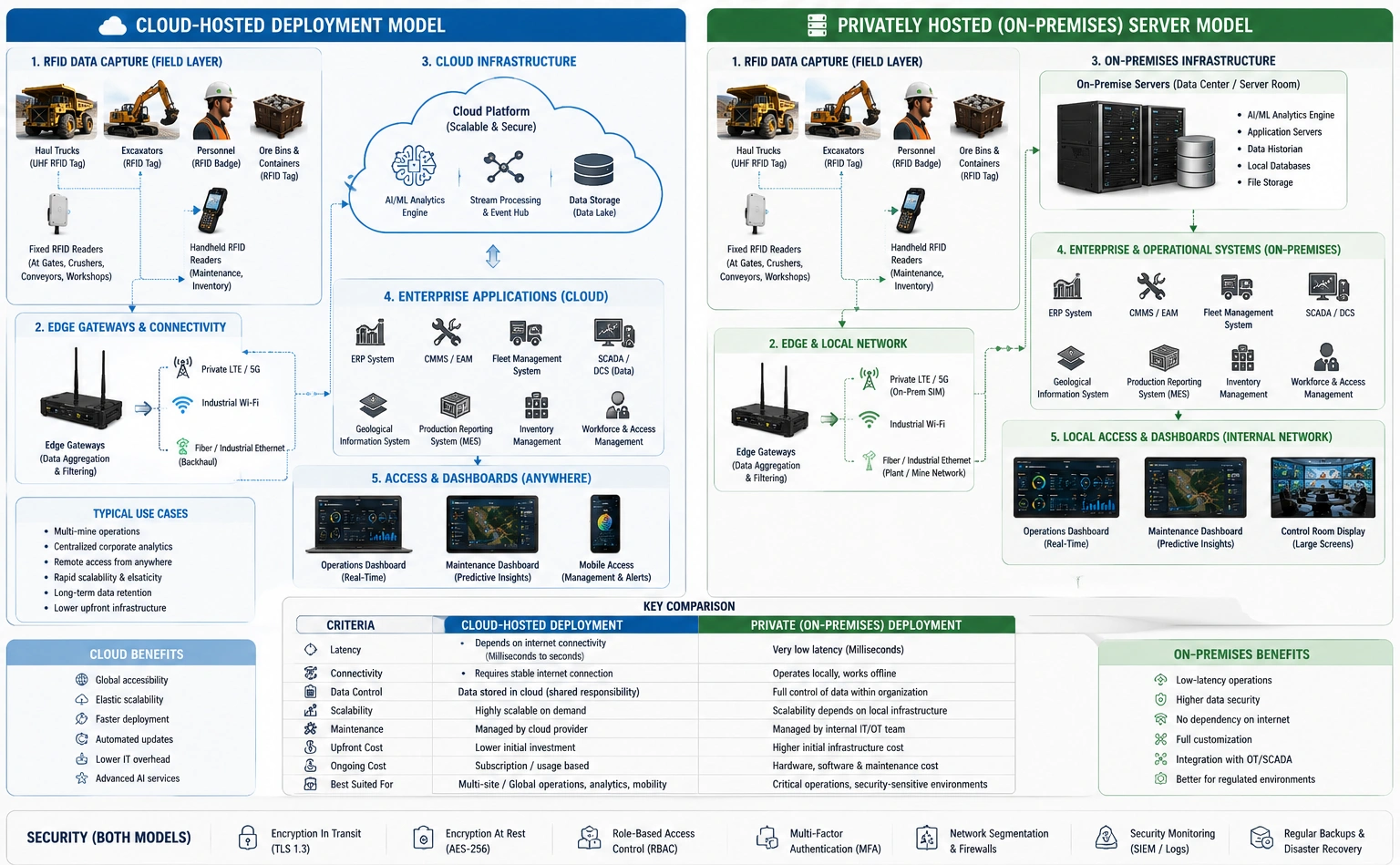
This comparison diagram illustrates two deployment approaches for AI-enabled RFID systems in copper mining, contrasting cloud-hosted and privately hosted server environments. It highlights how RFID readers, edge gateways, AI analytics, enterprise mining software, and operational dashboards are integrated while comparing latency, connectivity, scalability, data control, maintenance responsibilities, cybersecurity, and typical deployment scenarios to help organizations select the most appropriate solution.
Cybersecurity Considerations for AI-Enabled RFID Copper Mining Systems
Copper mining operations increasingly connect operational technology (OT) with information technology (IT), making cybersecurity a fundamental design consideration rather than an afterthought. Production interruptions caused by cyber incidents can affect worker safety, concentrate production, environmental compliance, and supply chain continuity.
Key cybersecurity measures include:
- Encrypt RFID communications where supported by the application and hardware.
- Use mutual authentication between RFID readers, edge devices, servers, and enterprise applications.
- Implement role-based access control for maintenance personnel, warehouse operators, contractors, and system administrators.
- Segment operational technology networks from corporate IT networks using industrial firewalls and secure gateways.
- Continuously monitor network traffic with security information and event management (SIEM) tools to detect anomalous activity.
- Maintain secure firmware and software update procedures for RFID readers, gateways, and edge servers.
- Perform regular vulnerability assessments and penetration testing of both IT and OT environments.
- Protect AI models and training data from unauthorized modification through integrity checks and version control.
- Maintain comprehensive audit logs of asset movements, user actions, and system changes to support investigations and regulatory compliance.
Cybersecurity strategies should align with recognized industrial standards and guidance, including IEC 62443 for industrial automation and control systems, the NIST Cybersecurity Framework, and ISO/IEC 27001 for information security management. Applying these practices throughout planning, deployment, and ongoing operations helps reduce cyber risk while supporting reliable AI-driven copper mining systems.
Technical Capabilities and Operational Benefits of AI-Powered RFID in Copper Mining
Combining Artificial Intelligence with RFID-enabled identification allows copper mining organizations to move beyond simple asset visibility toward intelligent operational optimization. The greatest value is achieved when RFID-generated operational events are continuously analyzed alongside production, maintenance, geological, environmental, and workforce data.
Improved Asset Visibility
Copper mining operations often manage tens of thousands of mobile and fixed assets distributed across large geographical areas. RFID enables continuous identification of equipment, tools, spare parts, laboratory samples, and production materials without relying on manual data entry.
AI further enhances asset visibility by:
- Identifying underutilized equipment
- Detecting missing or misplaced assets
- Recommending equipment redistribution between operating areas
- Predicting future asset demand
- Improving maintenance planning through accurate utilization records
This reduces unnecessary equipment purchases while increasing utilization of existing mining assets.
Enhanced Ore Traceability
Maintaining traceability from extraction through concentrate shipment is essential for production optimization, quality assurance, and regulatory reporting.
AI-supported RFID solutions improve traceability by:
- Associating ore movement with geological block models
- Recording material transfers between production stages
- Monitoring concentrate storage movements
- Supporting laboratory sample tracking
- Correlating recovery performance with extraction locations
Greater visibility enables metallurgists and production engineers to refine ore blending strategies and improve overall recovery rates.
Higher Equipment Availability
Unexpected failures of crushers, SAG mills, conveyors, pumps, flotation systems, or haul trucks can significantly reduce daily production.
AI analyzes RFID-generated maintenance records together with equipment condition data to:
- Predict probable component failures
- Recommend preventive maintenance windows
- Prioritize high-risk equipment
- Estimate spare part requirements
- Optimize technician scheduling
Improved maintenance planning reduces unplanned downtime while extending equipment service life.
Warehouse Optimization
Mining warehouses support every stage of copper production.
AI continuously evaluates RFID inventory data to:
- Predict replenishment requirements
- Identify slow-moving inventory
- Detect abnormal stock consumption
- Reduce emergency purchasing
- Improve inventory accuracy
- Support vendor performance analysis
Warehouse personnel spend less time locating components while maintenance teams experience fewer production delays caused by missing spare parts.
Workforce Safety Improvements
Personnel safety remains a primary operational objective throughout both open-pit and underground copper mining.
RFID-supported identification combined with AI enables:
- Restricted-area access management
- Emergency personnel accounting
- Contractor authorization verification
- PPE compliance support when integrated with computer vision
- Equipment authorization tracking
- Proximity monitoring between workers and heavy mobile equipment
- Analysis of recurring safety risks
These capabilities support proactive safety management rather than relying solely on incident investigations.
Sustainability and Environmental Performance
Copper mining organizations increasingly measure environmental performance alongside production targets.
AI can analyze RFID-generated operational information together with environmental monitoring systems to support:
- Fuel consumption optimization
- Reduced equipment idle time
- Improved energy efficiency
- Water usage monitoring
- Tailings facility inspections
- Hazardous material tracking
- Waste management reporting
- Carbon emission analysis
Operational improvements frequently contribute to both sustainability objectives and lower operating costs.
Key Performance Indicators Improved by AI-Enabled RFID
Successful implementations should establish measurable performance objectives before deployment. Common KPIs monitored in copper mining include:
- Overall Equipment Effectiveness (OEE)
- Equipment availability
- Haul truck utilization
- Haul cycle time
- Crusher utilization
- Mill throughput
- Ore recovery rate
- Concentrate production
- Inventory accuracy
- Spare part availability
- Mean Time Between Failures (MTBF)
- Mean Time To Repair (MTTR)
- Maintenance schedule compliance
- Fuel consumption per tonne mined
- Energy consumption per tonne processed
- Workforce productivity
- Equipment idle time
- Warehouse picking accuracy
- Laboratory sample turnaround time
- Safety incident frequency
- Near-miss reporting rate
- Emergency response readiness
- Production cost per tonne
- Carbon emissions per tonne produced
Rather than evaluating individual metrics independently, AI identifies relationships between multiple KPIs to uncover improvement opportunities that may not be visible through traditional reporting methods.
Engineering Best Practices for Deployment
Successful AI-enabled RFID implementations in copper mining require careful planning, phased execution, and continuous optimization. Practical engineering considerations include:
- Conduct comprehensive site surveys to evaluate mine layout, communication coverage, environmental conditions, and equipment movement patterns before selecting RFID technologies.
- Match UHF, HF, and LF RFID technologies to specific operational workflows instead of applying one technology universally.
- Select industrial-grade RFID hardware with appropriate ingress protection, temperature tolerance, and resistance to vibration, dust, and moisture.
- Establish consistent asset identification standards and naming conventions across maintenance, warehouse, production, and geological systems.
- Integrate RFID data with ERP, CMMS, fleet management, and production software early to avoid isolated information silos.
- Validate RFID read zones through field testing under actual operating conditions, including moving equipment and loaded haul trucks.
- Implement edge computing for latency-sensitive operational decisions while reserving cloud resources for historical analytics and AI model training where appropriate.
- Develop data governance policies covering data quality, retention, ownership, and lifecycle management.
- Apply cybersecurity controls across both IT and operational technology environments from the beginning of the project.
- Train operators, maintenance technicians, warehouse personnel, and supervisors on updated workflows to maximize user adoption.
- Measure deployment success using predefined KPIs and continuously refine AI models using operational feedback.
Organizations typically achieve greater long-term success by beginning with clearly defined pilot projects, validating operational improvements, and then expanding deployments to additional mining functions.
RFID Technology and Deployment Model Selection for AI-Enabled Copper Mining Operations
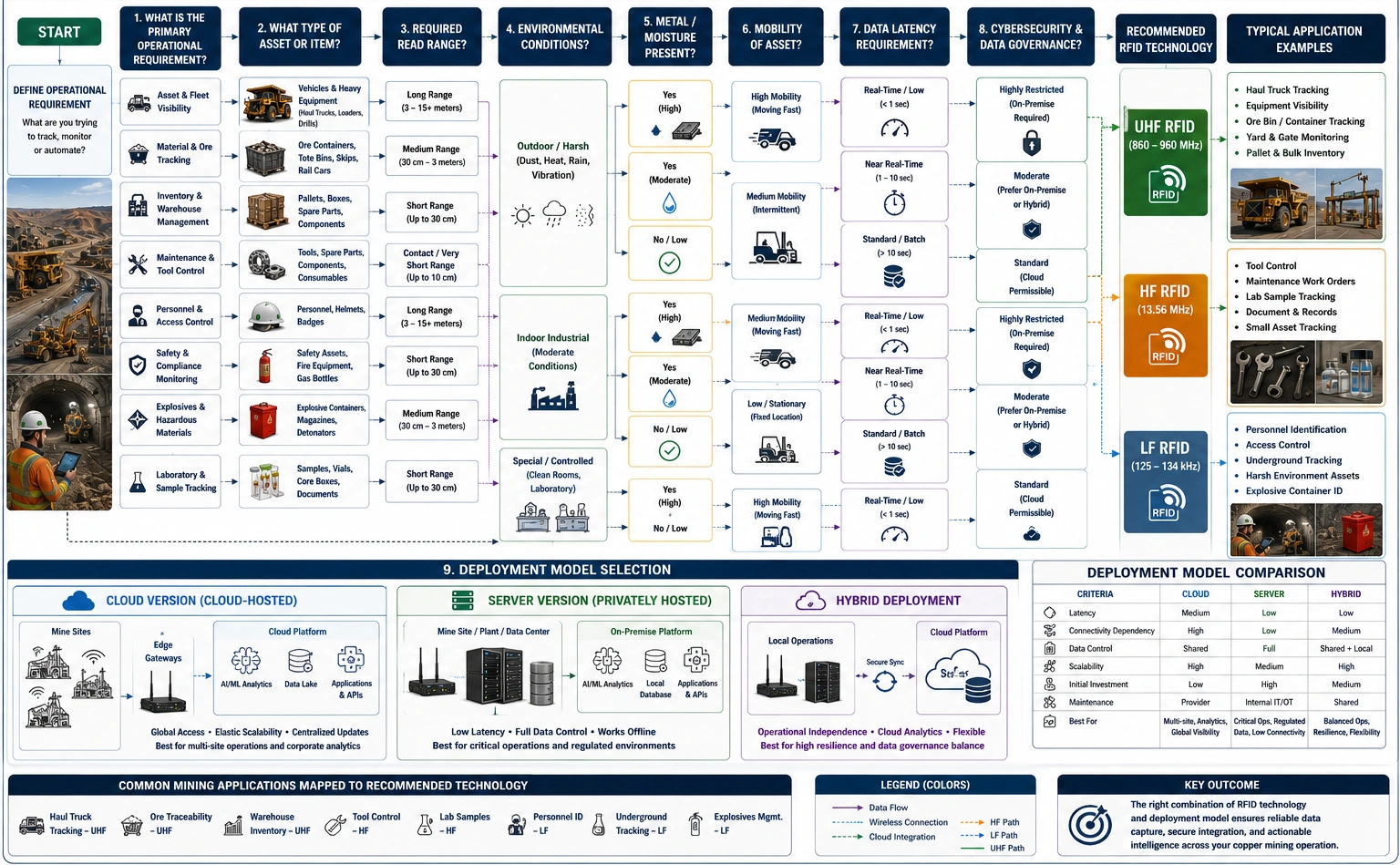
This engineering decision tree guides mining professionals through the selection of the most appropriate RFID technology and deployment model for AI-enabled copper mining applications. It evaluates operational requirements, asset characteristics, read distance, environmental conditions, mobility, latency, cybersecurity, and data governance to recommend UHF, HF, or LF RFID along with Cloud, Server, or Hybrid deployments for use cases such as haul truck tracking, ore traceability, warehouse inventory management, personnel identification, laboratory sample tracking, and maintenance tool control.
Implementation Recommendations
Organizations planning AI-enabled RFID initiatives for copper mining should adopt a structured implementation strategy that minimizes operational disruption while maximizing measurable business value.
Recommended implementation practices include:
- Prioritize operational challenges with clearly defined business objectives, such as maintenance optimization, ore traceability, fleet utilization, or warehouse accuracy.
- Build a multidisciplinary project team including mining engineers, maintenance personnel, metallurgists, warehouse managers, IT specialists, operational technology engineers, cybersecurity professionals, and production supervisors.
- Conduct a comprehensive asset inventory to identify equipment, tools, inventory, and materials requiring RFID identification.
- Evaluate communication coverage across open-pit operations, underground workings, concentrators, warehouses, and remote infrastructure.
- Pilot the solution within a single operational area before expanding across the mine.
- Validate AI recommendations against operational experience to establish confidence in decision support outputs.
- Define governance procedures for AI model retraining as mining conditions, equipment fleets, and production processes evolve.
- Continuously review KPIs and operational feedback to identify opportunities for additional optimization.
A phased deployment strategy generally reduces implementation risk while allowing engineering teams to refine workflows before large-scale adoption.
Throughout these projects, GAO supports mining organizations by supplying industrial RFID readers, antennas, tags, handheld readers, and related IoT hardware that integrate with existing mining software and operational environments. Headquartered in New York City and Toronto, Canada, GAO is recognized among the world’s leading B2B and B2G suppliers of RFID and BLE technologies. For more than three decades, GAO and its sister companies, GAO Research Inc. and GAO Tek Inc., have supported Fortune 500 companies, research institutions, universities, and government organizations across the United States and Canada through sustained investment in research and development, rigorous quality assurance, and expert technical support delivered remotely and onsite.
Advancing Intelligent Copper Mining with AI and RFID
AI-powered copper mining solutions supported by RFID enable mining organizations to improve operational visibility, equipment reliability, ore traceability, workforce safety, inventory accuracy, and production efficiency. By combining reliable asset identification with industrial AI, edge computing, connected equipment, and integrated mining software, organizations can transform operational data into timely, actionable intelligence.
Successful deployments depend on careful planning, robust communication infrastructure, appropriate RFID technology selection, secure system integration, high-quality operational data, and continuous performance optimization. When implemented using sound engineering practices, these solutions help mining organizations reduce operational costs, improve production consistency, strengthen regulatory compliance, and support safer, more sustainable mining operations.
GAO continues to help organizations modernize their mining operations by providing industrial RFID hardware, IoT solutions, and technical expertise that support reliable AI-enabled identification systems tailored to demanding copper mining environments.
Building the Future of Industrial AI and IoT with Aperture Venture Studio and GAO RFID Inc.
For more than three decades, GAO Group of Companies has invested extensively in research and development of industrial RFID, BLE, and IoT technologies. As Artificial Intelligence has become an integral part of industrial operations such as copper mining, we have expanded our work in AI, Industrial AI, Edge AI, RFID, BLE, and AIoT solutions to support increasingly intelligent mining and resource extraction applications. To further accelerate innovation in industrial AI and connected technologies, we founded Aperture Venture Studio to help build, launch, and scale advanced AI and IoT solutions addressing real-world industrial challenges.
Aperture has attracted leading AI and IoT technical experts, experienced operational executives, influential investors, and established industry organizations. Through initiatives including Aperture Ventures Summit and TekSummit, we continue to foster collaboration, share technical knowledge, and advance practical applications of AI and IoT across industrial sectors. We welcome advisors, employees, investors, and customers to join us in shaping the future of intelligent industrial operations.